tow HYUNDAI COUPE 2014 Owner's Manual
[x] Cancel search | Manufacturer: HYUNDAI, Model Year: 2014, Model line: COUPE, Model: HYUNDAI COUPE 2014Pages: 546, PDF Size: 14.38 MB
Page 368 of 546
5-92
Driving your vehicle
Smooth cornering
Avoid braking or gear changing in
corners, especially when roads are
wet. Ideally, corners should always
be taken under gentle acceleration.
Driving at night
Night driving presents more hazards
than driving in the daylight. Here are
some important tips to remember:
• Slow down and keep more dis-
tance between you and other vehi-
cles, as it may be more difficult to
see at night, especially in areas
where there may not be any street
lights.
• Adjust your mirrors to reduce the
glare from other driver's head-
lamps.
• Keep your headlamps clean and
properly aimed. Dirty or improperly
aimed headlamps will make it
much more difficult to see at night.
• Avoid staring directly at the head-
lamps of oncoming vehicles. You
could be temporarily blinded, and it
will take several seconds for your
eyes to readjust to the darkness. If you are still stuck after rock-
ing the vehicle a few times, have
the vehicle pulled out by a tow
vehicle to avoid engine over-
heating, possible damage to the
transmission, and tire damage.
See “Towing” in chapter 6.
To prevent damage to the trans-
mission, turn OFF the ESC prior
to rocking the vehicle.CAUTION
ProCarManuals.com
Page 370 of 546
5-94
Driving your vehicle
Snow or icy conditions
You need to keep sufficient distance
between your vehicle and the vehicle
in front of you.
Apply the brakes gently. Speeding,
rapid acceleration, sudden brake
applications, and sharp turns are
potentially very hazardous practices.
During deceleration, use engine
braking to the fullest extent. Sudden
brake applications on snowy or icy
roads may cause skids to occur.
To drive your vehicle in deep snow, it
may be necessary to use snow tires
or to install tire chains on your tires.
Always carry emergency equipment.
Some of the items you may want to
carry include tire chains, tow straps
or chains, a flashlight, emergency
flares, sand, a shovel, jumper cables,
a window scraper, gloves, ground
cloth, coveralls, a blanket, etc.
Snow tires
WINTER DRIVING
Standard tire Recommended snow tire
Front Rear Front Rear
Tire sizeWheel
sizeTire sizeWheel
sizeTire size
Wheel
sizeTire sizeWheel
size
225/55R17 7.0Jx17 225/55R17 7.0Jx17 225/55R17
7.0Jx17 225/55R17 7.0Jx17
245/45R18
8.0Jx18 245/45R18 8.0Jx18
245/45R18 8.0Jx18 245/45R18 8.0Jx18 245/45R18
8.0Jx18 245/45R18 8.0Jx18
245/40R19
8.5Jx19245/40R19
or
275/35R198.5Jx19
or
9.0Jx19
245/40R19 8.5Jx19 275/35R19 9.0Jx19 245/40R19
8.5Jx19245/40R19
or
275/35R19 8.5Jx19
or
9.0Jx19
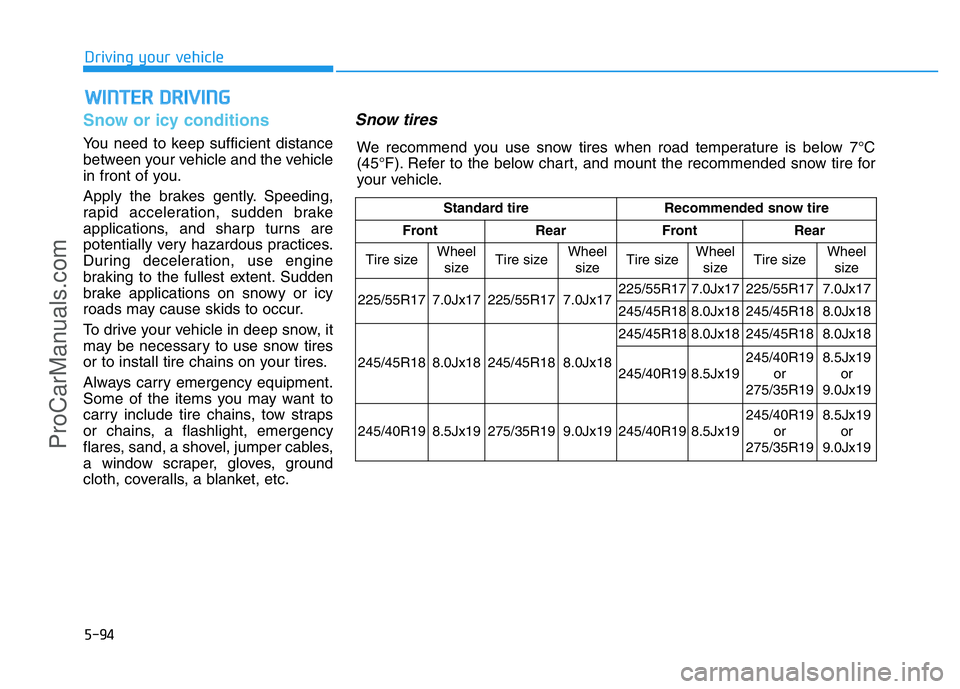
We recommend you use snow tires when road temperature is below 7°C
(45°F). Refer to the below chart, and mount the recommended snow tire for
your vehicle.
ProCarManuals.com
Page 374 of 546
5-98
Don't let your parking brake
freeze
Under some conditions your parking
brake can freeze in the engaged
position. This is most likely to hap-
pen when there is an accumulation
of snow or ice around or near the
rear brakes or if the brakes are wet.
If there is a risk the parking brake
may freeze, apply it only temporarily
while you put the shift lever in P and
block the rear wheels so the vehicle
cannot roll. Then release the parking
brake.
Don't let ice and snow accumu-
late underneath
Under some conditions, snow and
ice can build up under the fenders
and interfere with the steering. When
driving in severe winter conditions
where this may happen, you should
periodically check underneath the
vehicle to be sure the movement of
the front wheels and the steering
components is not obstructed.
Carry emergency equipment
Depending on the severity of the
weather, you should carry appropri-
ate emergency equipment. Some of
the items you may want to carry
include tire chains, tow straps or
chains, flashlight, emergency flares,
sand, shovel, jumper cables, window
scraper, gloves, ground cloth, cover-
alls, blanket, etc.
Don't place foreign objects or
materials in the engine com-
partment
Placement of foreign objects or mate-
rials which prevent cooling of the
engine, in the engine compartment,
may cause a failure or combustion.
The manufacturer is not responsible
for the damage caused by such
placement.
Driving your vehicle
ProCarManuals.com
Page 376 of 546
5-100
Driving your vehicle
TRAILER TOWING
We do not recommend using this vehicle for trailer towing.
ProCarManuals.com
Page 394 of 546

5-118
Driving your vehicle
Ośnieżenie lub oblodzenie
Potrzebujesz utrzymywać dostateczną
odległość między Twoim pojazdem, a
pojazdem poprzedzającym.
Należy hamować łagodnie. Bardzo
niebezpiecznymi potencjalnie
niebezpiecznymi nawykami jest nagłe
zwiększanie obrotów silnika, nagłe
przyspieszanie, gwałtowne
hamowanie i ostre skręty.
Podczas przyspieszania należy
korzystać w całym zakresie z
hamowania silnikiem. Nagłe
hamowanie na ośnieżonych lub
oblodzonych drogach może
spowodować wystąpienie poślizgów.
Aby prowadzić pojazd w głębokim
śniegu, może być niezbędne
korzystanie z opon zimowych lub
zainstalowanie na kołach łańcuchów
przeciwpoślizgowych.
Należy zawsze mieć dodatkowe
wyposażenie awaryjne.Niektóre elementy, które możemy
chcieć przewozić obejmują: łańcuchy
przeciwpoślizgowe, taśmy lub
łańcuchy holownicze, lampę błyskową,
rakiety sygnalizacji awaryjnej, piasek,
łopatę, przewody rozruchowe, skrobak
zimowy, rękawice, płótno ścierne,
kombinezon, koc itp.
Opony zimowe
Opony zimowe zaleca się stosować,
kiedy temperatura przy powierzchni
drogi osiągnie 7°C (45°F). Prosimy
zapoznać się z tabelką zamieszczoną
poniżej i zamontować w swoim
pojeździe zalecane opony zimowe.
JAZDA W WARUNKACH ZIMOWYCH (POLISH)
ProCarManuals.com
Page 396 of 546
5-120
Driving your vehicle
Stosowanie AutoSock
(fabrycznych łańcuchów
przeciwpoślizgowych) może
mieć negatywny wpływ na
prowadzenie pojazdu:
•Jedź z prędkością niższą od 30
km/godz. (20 mil/godz.) albo z
prędkością minimalną zalecaną
przez producenta, zależnie od
tego, która wartość jest niższa.
•Jedź ostrożnie i unikaj
wybojów, dziur, ostrych
skrętów i innych zagrożeń
drogowych, które mogą
spowodować podskakiwanie
samochodu.
•Unikaj ostrych skrętów lub
hamowania z zablokowanymi
kołami.
OSTRZEŻENIE Łańcuchy przeciwpoślizgowe
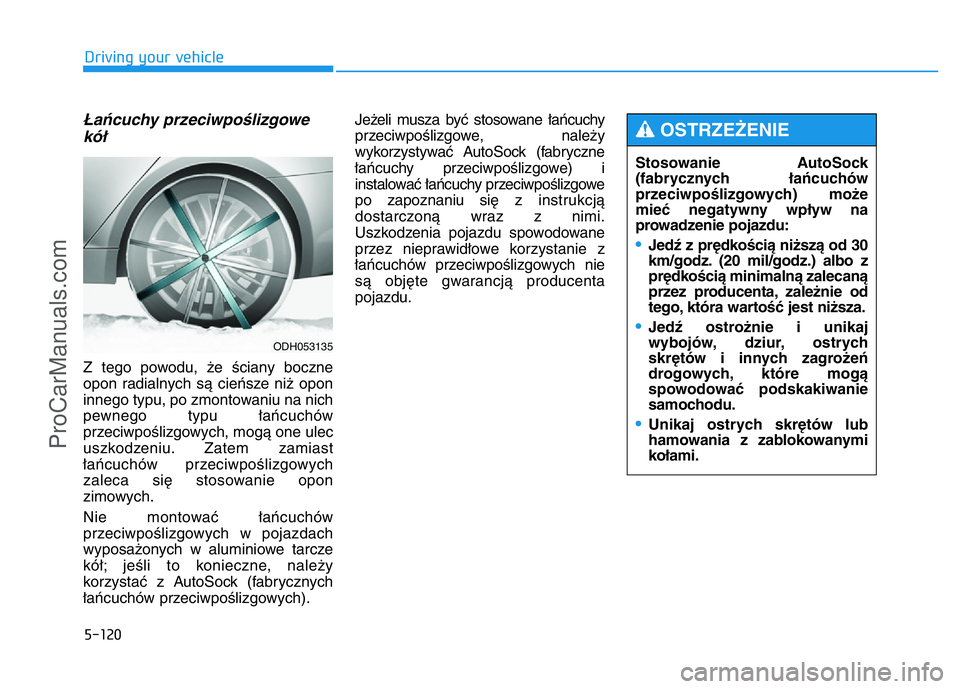
kół
Z tego powodu, że ściany boczne
opon radialnych są cieńsze niż opon
innego typu, po zmontowaniu na nich
pewnego typu łańcuchów
przeciwpoślizgowych, mogą one ulec
uszkodzeniu. Zatem zamiast
łańcuchów przeciwpoślizgowych
zaleca się stosowanie opon
zimowych.
Nie montować łańcuchów
przeciwpoślizgowych w pojazdach
wyposażonych w aluminiowe tarcze
kół; jeśli to konieczne, należy
korzystać z AutoSock (fabrycznych
łańcuchów przeciwpoślizgowych).Jeżeli musza być stosowane łańcuchy
przeciwpoślizgowe, należy
wykorzystywać AutoSock (fabryczne
łańcuchy przeciwpoślizgowe) i
instalować łańcuchy przeciwpoślizgowe
po zapoznaniu się z instrukcją
dostarczoną wraz z nimi.
Uszkodzenia pojazdu spowodowane
przez nieprawidłowe korzystanie z
łańcuchów przeciwpoślizgowych nie
są objęte gwarancją producenta
pojazdu.
ODH053135
ProCarManuals.com
Page 397 of 546
5-121
Driving your vehicle
5
✽UWAGA
• Zainstaluj AutoSock (fabryczne
іaсcuchy przeciwpoњlizgowe) na
koіach tylnych pojazdуw z
napкdem 2WD lub na wszystkich
czterech koіach w pojazdach z
napкdem AWD. Naleїy zauwaїyж,
їe zainstalowanie AutoSock
(fabrycznych іaсcuchуw
przeciwpoњlizgowych) na koіach
powoduje zwiкkszenie siіy
napкdowej, lecz nie zapobiega
poњlizgom bocznym.
• Nie naleїy instalowaж opon
kolcowych bez wczeњniejszego
sprawdzenia przepisуw
paсstwowych i miejskich, pod
k№tem wystкpowania moїliwych
ograniczeс ich stosowania.Zakіadanie іaсcuchуw
przeciwpoњlizgowychPodczas instalowania AutoSock
(fabrycznych łańcuchów
przeciwpoślizgowych), postępuj
zgodnie z instrukcjami producenta i
montuj je możliwie ciasno. Z
zainstalowanymi łańcuchami
przeciwpoślizgowymi jedź wolno z
prędkością niższą od 30 km/godz. (20
mil/godz.). Jeśli usłyszysz, że łańcuchy
przeciwpoślizgowe stykają się z
nadwoziem lub podwoziem, zatrzymaj
pojazd i je dociągnij. Jeśli nadal stykają
się z nadwoziem, zwolnij do chwili, aż
hałas zniknie.
Zdejmij AutoSock (fabryczne łańcuchy
przeciwpoślizgowe) wkrótce po tym,
jak gdy jazda zacznie się po
odśnieżonych drogach.
Kiedy instalujesz AutoSock (fabryczne
łańcuchy przeciwpoślizgowe), zaparkuj
pojazd na poziomym gruncie z dala od
ruchu drogowego. Włącz światła
awaryjne i ustaw trójkąt odblaskowy za
pojazdem (jeśli jest dostępny).Przed zamontowaniem łańcuchów
przeciwpoślizgowych zawsze ustawiaj
dźwignię zmiany biegów w pozycji P
(Postój), zaciągnij hamulec postojowy i
zgaś silnik.
Kiedy korzystasz z AutoSock
(fabrycznych łańcuchów
przeciwpoślizgowych):
•Łańcuchy przeciwpoślizgowe
o niewłaściwym rozmiarze albo
nieprawidłowo zainstalowane
mogą uszkodzić wykładziny
hamulcowe pojazdu,
zawieszenie i tarcze kół.
•Jeśli usłyszysz, że łańcuchy
przeciwpoślizgowe stykają się
z nadwoziem, zatrzymaj pojazd
i je dociągnij, aby zapobiec
przed ich kontaktem.
•Aby zapobiec uszkodzeniu
nadwozia, należy ponownie
dociągnąć łańcuchy po
przejechaniu około 0,5~1,0 km
(0,3~0,6 mili).
OSTROŻNIE
ProCarManuals.com
Page 404 of 546
What to do in an emergency
Hazard warning flasher ........................................6-2
In case of an emergency while driving ..............6-3
If the engine stalls while driving ...................................6-3
If the engine stalls at a crossroad or crossing .........6-3
If you have a flat tire while driving..............................6-3
If the engine will not start ...................................6-4
If the engine doesn't turn over or turns over
slowly....................................................................................6-4
If the engine turns over normally but doesn't
start.......................................................................................6-4
Jump starting ..........................................................6-5
If the engine overheats ........................................6-9
Tire Pressure Monitoring System (TPMS).......6-11
Check tire pressure ........................................................6-11
Tire Pressure Monitoring System ...............................6-12
Low tire pressure telltale ..............................................6-13
TPMS (Tire Pressure Monitoring System)
malfunction indicator .....................................................6-14
Changing a tire with TPMS...........................................6-15
If you have a flat tire..........................................6-18
Jack and tools ..................................................................6-18
Changing tires ..................................................................6-19
Jack label ...........................................................................6-25
EC Declaration of conformity for Jack......................6-26
Towing ...................................................................6-27
Towing service .................................................................6-27
Removable towing hook ................................................6-29
Emergency towing ..........................................................6-29
Emergency commodity ........................................6-32
Fire extinguisher .............................................................6-32
First aid kit ......................................................................6-32
Triangle reflector ............................................................6-32
Tire pressure gauge .......................................................6-33
6
ProCarManuals.com
Page 408 of 546
6-5
What to do in an emergency
Jump starting can be dangerous if
done incorrectly. Follow the jump
starting procedure in this section to
avoid serious injury or damage to
your vehicle. If in doubt about how to
properly jump start your vehicle, we
strongly recommend that you have a
service technician or towing service
do it for you.
JUMP STARTING
6
To prevent SERIOUS INJURY or
DEATH to you or bystanders,
always follow these precautions
when working near or handling
the battery:
Always read and follow
instructions carefully
when handling a battery.
Wear eye protection
designed to protect the
eyes from acid splashes.
Keep all flames, sparks,
or smoking materials
away from the battery.
Hydrogen is always
present in battery cells,
is highly combustible,
and may explode if ignit-
ed.
Keep batteries out of
reach of children.
(Continued)
WARNING (Continued)
Batteries contain sulfu-
ric acid which is highly
corrosive. Do not allow
acid to contact your
eyes, skin or clothing.
If acid gets into your eyes, flush
your eyes with clean water for at
least 15 minutes and get imme-
diate medical attention. If acid
gets on your skin, thoroughly
wash the area. If you feel pain or
a burning sensation, get med-
ical attention immediately.
•When lifting a plastic-cased
battery, excessive pressure
on the case may cause battery
acid to leak. Lift with a battery
carrier or with your hands on
opposite corners.
•Do not attempt to jump start
your vehicle if your battery is
frozen.
(Continued)
ProCarManuals.com
Page 411 of 546
6-8
Disconnect the jumper cables in the
exact reverse order you connected
them:
1.Disconnect the jumper cable from
the black, negative (-) chassis
ground of your vehicle (4).
2.Disconnect the other end of the
jumper cable from the black, nega-
tive (-) battery/chassis ground of
the assisting vehicle (3).
3.Disconnect the second jumper
cable from the red, positive (+) bat-
tery/jumper terminal of the assist-
ing vehicle (2).
4.Disconnect the other end of the
jumper cable from the red, positive
(+) jumper terminal of your vehicle
(1).Push-starting
Vehicles equipped with automatic
transmission cannot be push-started.
Follow the directions in this chapter
for jump-starting.
What to do in an emergency
Never tow a vehicle to start it
because the sudden surge for-
ward when the engine starts
could cause a collision with the
tow vehicle.
WARNING
ProCarManuals.com