traction control HYUNDAI COUPE 2014 Owners Manual
[x] Cancel search | Manufacturer: HYUNDAI, Model Year: 2014, Model line: COUPE, Model: HYUNDAI COUPE 2014Pages: 546, PDF Size: 14.38 MB
Page 19 of 546
Safety system of your vehicle
2
Important safety precautions...............................2-2
Always wear your seat belt ..........................................2-2
Restrain all children .........................................................2-2
Air bag hazards ................................................................2-2
Driver distraction .............................................................2-2
Control your speed ..........................................................2-3
Keep your vehicle in safe condition ............................2-3
Seats ........................................................................2-4
Safety precautions ..........................................................2-5
Front seats ..........................................................................2-6
Rear seats .........................................................................2-11
Headrest ...........................................................................2-16
Seat warmers and coolers ............................................2-20
Seat belts ..............................................................2-24
Seat belt safety precautions ......................................2-24
Seat belt warning light .................................................2-25
Seat belt restraint system ...........................................2-27
Pre-Safe Seat belt (PSB) ..............................................2-32
Additional seat belt safety precautions ...................2-33
Care of seat belts ..........................................................2-36
Child restraint system (CRS) ..............................2-37
Children always in the rear .........................................2-37
Selecting a Child Restraint System (CRS) ................2-38
Installing a Child Restraint System (CRS)..................2-40
Air bag
- supplemental restraint system.....................2-50
Where are the air bags? ..............................................2-52
How does the air bags system operate? .................2-55
What to expect after an air bag inflates ................2-59
Passenger's front air bag ON/OFF switch ..............2-60
Do not install a child restraint on
the front passenger seat ..............................................2-62
Why didn't my air bag go off in a collision? ...........2-63
SRS care ...........................................................................2-68
Additional safety precautions .....................................2-69
Air bag warning labels ...................................................2-70
Active hood lift system .......................................2-71
Active hood lift system activation situation .............2-71
Active hood lift system non-activation situation ...2-72
Active hood lift system malfunction ..........................2-73
ProCarManuals.com
Page 50 of 546
2-32
Safety system of your vehicle
Pre-Safe Seat belt (PSB)
(if equipped)
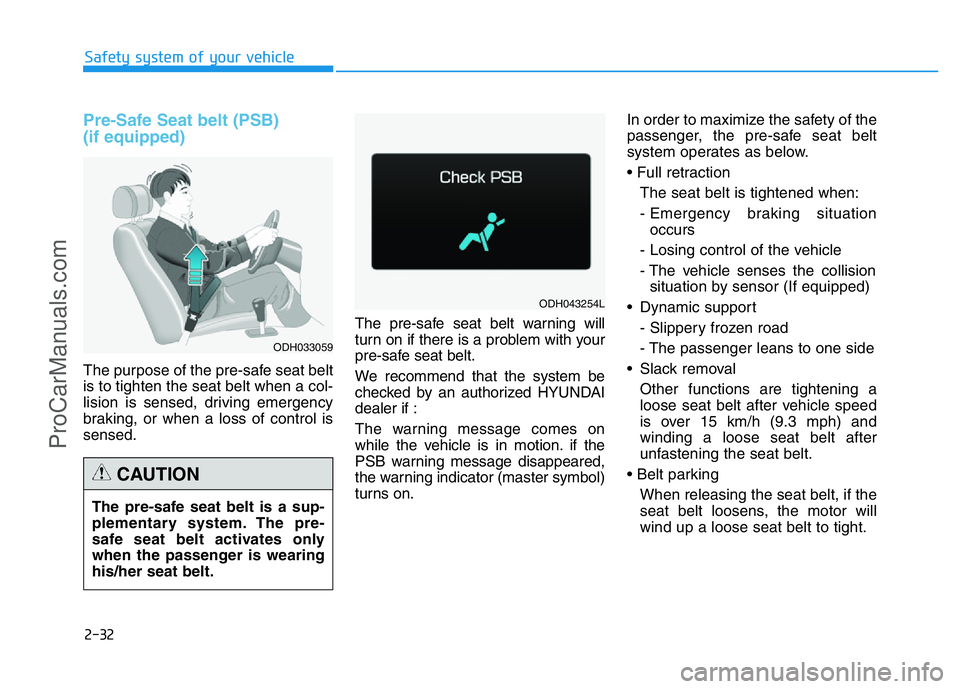
The purpose of the pre-safe seat belt
is to tighten the seat belt when a col-
lision is sensed, driving emergency
braking, or when a loss of control is
sensed.The pre-safe seat belt warning will
turn on if there is a problem with your
pre-safe seat belt.
We recommend that the system be
checked by an authorized HYUNDAI
dealer if :
The warning message comes on
while the vehicle is in motion. if the
PSB warning message disappeared,
the warning indicator (master symbol)
turns on.In order to maximize the safety of the
passenger, the pre-safe seat belt
system operates as below.
• Full retraction
The seat belt is tightened when:
- Emergency braking situation
occurs
- Losing control of the vehicle
- The vehicle senses the collision
situation by sensor (If equipped)
• Dynamic support
- Slippery frozen road
- The passenger leans to one side
• Slack removal
Other functions are tightening a
loose seat belt after vehicle speed
is over 15 km/h (9.3 mph) and
winding a loose seat belt after
unfastening the seat belt.
• Belt parking
When releasing the seat belt, if the
seat belt loosens, the motor will
wind up a loose seat belt to tight.
ODH033059
ODH043254L
The pre-safe seat belt is a sup-
plementary system. The pre-
safe seat belt activates only
when the passenger is wearing
his/her seat belt.
CAUTION
ProCarManuals.com
Page 154 of 546
3-63
Convenient features of your vehicle
3
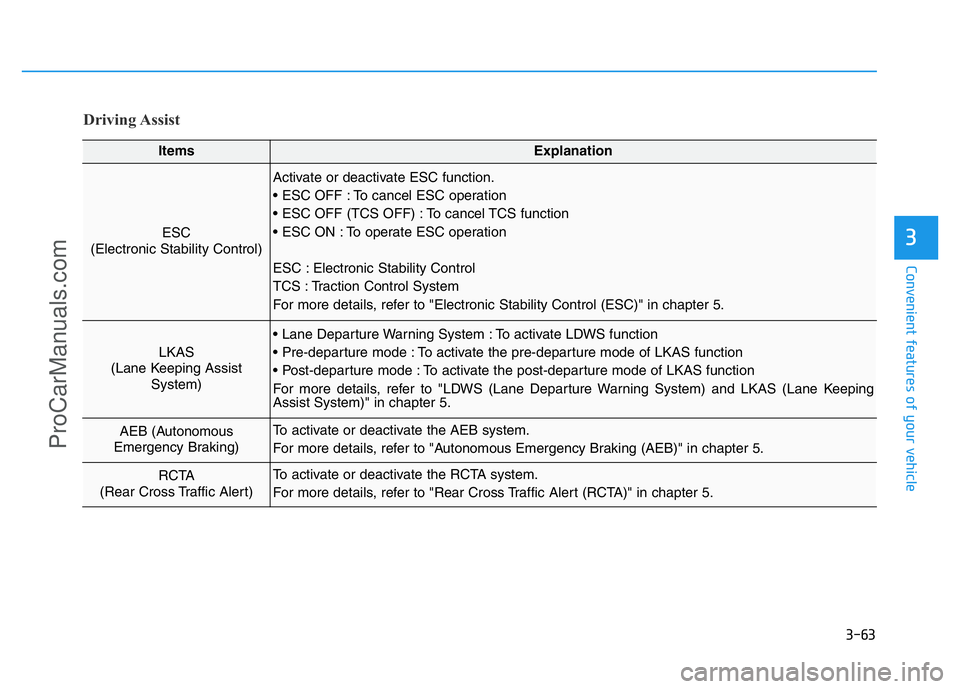
Driving Assist
ItemsExplanation
ESC
(Electronic Stability Control)
Activate or deactivate ESC function.
• ESC OFF : To cancel ESC operation
• ESC OFF (TCS OFF) : To cancel TCS function
• ESC ON : To operate ESC operation
ESC : Electronic Stability Control
TCS : Traction Control System
For more details, refer to "Electronic Stability Control (ESC)" in chapter 5.
LKAS
(Lane Keeping Assist
System)
• Lane Departure Warning System : To activate LDWS function
• Pre-departure mode : To activate the pre-departure mode of LKAS function
• Post-departure mode : To activate the post-departure mode of LKAS function
For more details, refer to "LDWS (Lane Departure Warning System) and LKAS (Lane Keeping
Assist System)" in chapter 5.
AEB (Autonomous
Emergency Braking)To activate or deactivate the AEB system.
For more details, refer to "Autonomous Emergency Braking (AEB)" in chapter 5.
RCTA
(Rear Cross Traffic Alert)To activate or deactivate the RCTA system.
For more details, refer to "Rear Cross Traffic Alert (RCTA)" in chapter 5.
ProCarManuals.com
Page 226 of 546
3-135
Convenient features of your vehicle
3
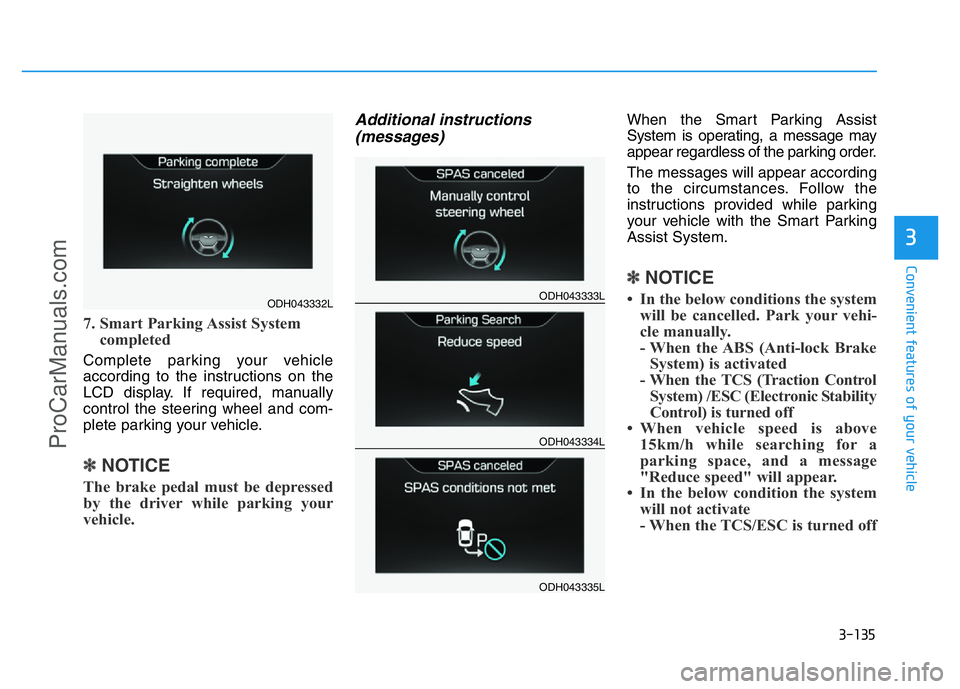
7. Smart Parking Assist System
completed
Complete parking your vehicle
according to the instructions on the
LCD display. If required, manually
control the steering wheel and com-
plete parking your vehicle.
✽NOTICE
The brake pedal must be depressed
by the driver while parking your
vehicle.
Additional instructions
(messages)When the Smart Parking Assist
System is operating, a message may
appear regardless of the parking order.
The messages will appear according
to the circumstances. Follow the
instructions provided while parking
your vehicle with the Smart Parking
Assist System.
✽NOTICE
• In the below conditions the system
will be cancelled. Park your vehi-
cle manually.
- When the ABS (Anti-lock Brake
System) is activated
- When the TCS (Traction Control
System) /ESC (Electronic Stability
Control) is turned off
• When vehicle speed is above
15km/h while searching for a
parking space, and a message
"Reduce speed" will appear.
• In the below condition the system
will not activate
- When the TCS/ESC is turned offODH043332LODH043333L
ODH043334L
ODH043335L
ProCarManuals.com
Page 232 of 546
3-141
Convenient features of your vehicle
3
✽NOTICE
• In the below conditions the system
will be cancelled. Park your vehi-
cle manually.
- When the ABS (Anti-lock Brake
System) is activated
- When the TCS (Traction Control
System) /ESC (Electronic Stability
Control) is turned off
• In the below condition the system
will not activate
- When the TCS/ESC is turned off
System malfunction
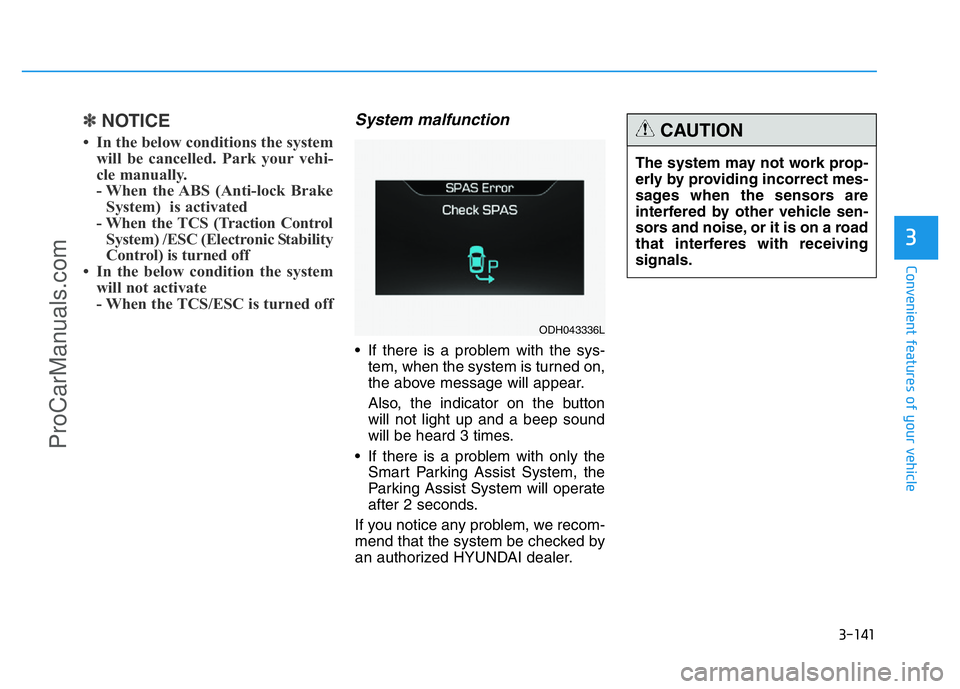
• If there is a problem with the sys-
tem, when the system is turned on,
the above message will appear.
Also, the indicator on the button
will not light up and a beep sound
will be heard 3 times.
• If there is a problem with only the
Smart Parking Assist System, the
Parking Assist System will operate
after 2 seconds.
If you notice any problem, we recom-
mend that the system be checked by
an authorized HYUNDAI dealer.The system may not work prop-
erly by providing incorrect mes-
sages when the sensors are
interfered by other vehicle sen-
sors and noise, or it is on a road
that interferes with receiving
signals.
CAUTION
ODH043336L
ProCarManuals.com
Page 293 of 546
5-17
Driving your vehicle
5
Parking
Always come to a complete stop and
continue to depress the brake pedal.
Move the shift lever into the P (Park)
position, apply the parking brake,
and place the Engine Start/Stop but-
ton in the OFF position. Take the Key
with you when exiting the vehicle.
Good driving practices
• Never move the shift lever from P
(Park) or N (Neutral) to any other
position with the accelerator pedal
depressed.
• Never move the shift lever into P
(Park) when the vehicle is in motion.
Be sure the vehicle is completely
stopped before you attempt to shift
into R (Reverse) or D (Drive).
• Do not move the shift lever to N
(Neutral) when driving. Doing so
may result in an accident because
of a loss of engine braking and the
transmission could be damaged.
• Do not drive with your foot resting
on the brake pedal. Even light, but
consistent pedal pressure can
result in the brakes overheating,
brake wear and possibly even brake
failure.
• Depressing both accelerator and
brake pedals at the same time can
trigger logic for engine power reduc-
tion to assure vehicle deceleration.
Vehicle acceleration will resume
after the brake pedal is released.• When driving in Sports Mode, slow
down before shifting to a lower
gear. Otherwise, the lower gear
may not be engaged if the engine
rpms are outside of the allowable
range.
• Always apply the parking brake
when leaving the vehicle. Do not
depend on placing the transmis-
sion in P (Park) to keep the vehicle
from moving.
• Exercise extreme caution when
driving on a slippery surface. Be
especially careful when braking,
accelerating or shifting gears. On a
slippery surface, an abrupt change
in vehicle speed can cause the
drive wheels to lose traction and
may cause loss of vehicle control
resulting in an accident.
• Optimum vehicle performance and
economy is obtained by smoothly
depressing and releasing the
accelerator. When you stay in the vehicle
with the engine running, be
careful not to depress the accel-
erator pedal for a long period of
time. The engine or exhaust
system may overheat and start
a fire.
The exhaust gas and the
exhaust system are very hot.
Keep away from the exhaust
system components.
Do not stop or park over flam-
mable materials, such as dry
grass, paper or leaves. They
may ignite and cause a fire.
WARNING
ProCarManuals.com
Page 295 of 546
5-19
Driving your vehicle
5
Using All Wheel Drive (AWD)
The All Wheel Drive (AWD) System
delivers engine power to front and
rear wheels for maximum traction.
AWD is useful when extra traction is
required, such as when driving slip-
pery, muddy, wet, or snow-covered
roads.
If the system determines there is a
need for four wheel drive, the
engine's driving power is distributed
to all four wheels automatically.
✽NOTICE
• Do not drive in water if the level is
higher than the bottom of the vehi-
cle.
• Check your brake condition once
you are out of mud or water.
Depress the brake pedal several
times as you move slowly until you
feel normal braking return.
• Shorten your scheduled mainte-
nance interval if you drive in off-
road conditions such as sand, mud
or water (see “Maintenance Under
Severe Usage Conditions” in chap-
ter 7).
• Make sure that AWD vehicle is
towed by a flatbed tow truck.
ALL WHEEL DRIVE (AWD) (IF EQUIPPED)
To reduce the risk of SERIOUS
INJURY or DEATH:
•Do not drive in conditions that
exceed the vehicles intended
design such as challenging
off-road conditions.
•Avoid high speeds when cor-
nering or turning.
•Do not make quick steering
wheel movements, such as
sharp lane changes or fast,
sharp turns.
•The risk of a rollover is great-
ly increased if you lose con-
trol of your vehicle at highway
speeds.
•Loss of control often occurs if
two or more wheels drop off
the roadway and the driver
over steers to reenter the
roadway.
•In the event your vehicle
leaves the roadway, do not
steer sharply. Instead, slow
down before pulling back into
the travel lanes.
WARNING
If the AWD warning light ( )
stays on the instrument cluster,
your vehicle may have a mal-
function with the AWD system.
When the AWD warning light
( ) illuminates we recom-
mend that the vehicle be
checked by an authorized
HYUNDAI dealer as soon as
possible.
WARNING
ProCarManuals.com
Page 314 of 546
5-38
Driving your vehicle
When operating
When the ESC is in opera-
tion, the ESC indicator light
blinks:
• When you apply your brakes under
conditions which may lock the
wheels, you may hear sounds from
the brakes, or feel a corresponding
sensation in the brake pedal. This
is normal and it means your ESC is
active.
• When the ESC activates, the
engine may not respond to the
accelerator as it does under rou-
tine conditions.
• If the Cruise Control was in use
when the ESC activates, the
Cruise Control automatically disen-
gages. The Cruise Control can be
reengaged when the road condi-
tions allow. See “Cruise Control
System” later in this chapter. (if
equipped)• When moving out of the mud or
driving on a slippery road, the
engine rpm (revolutions per
minute) may not increase even if
you press the accelerator pedal
deeply. This is to maintain the sta-
bility and traction of the vehicle and
does not indicate a problem.
ESC OFF condition
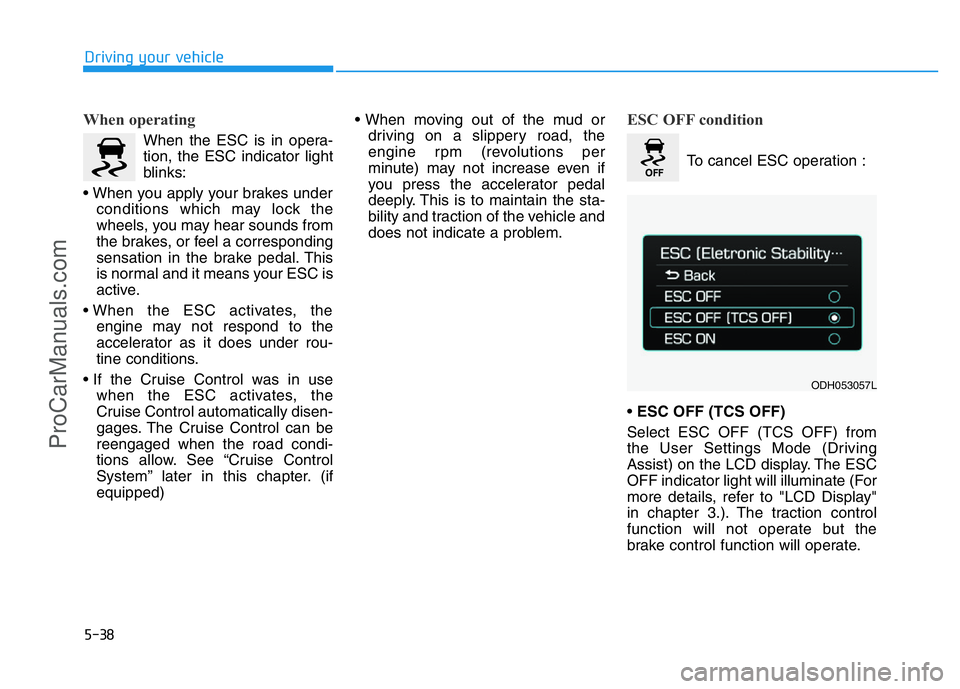
To cancel ESC operation :
• ESC OFF (TCS OFF)
Select ESC OFF (TCS OFF) from
the User Settings Mode (Driving
Assist) on the LCD display. The ESC
OFF indicator light will illuminate (For
more details, refer to "LCD Display"
in chapter 3.). The traction control
function will not operate but the
brake control function will operate.
ODH053057L
ProCarManuals.com
Page 437 of 546
7
Maintenance
7
Maintenance
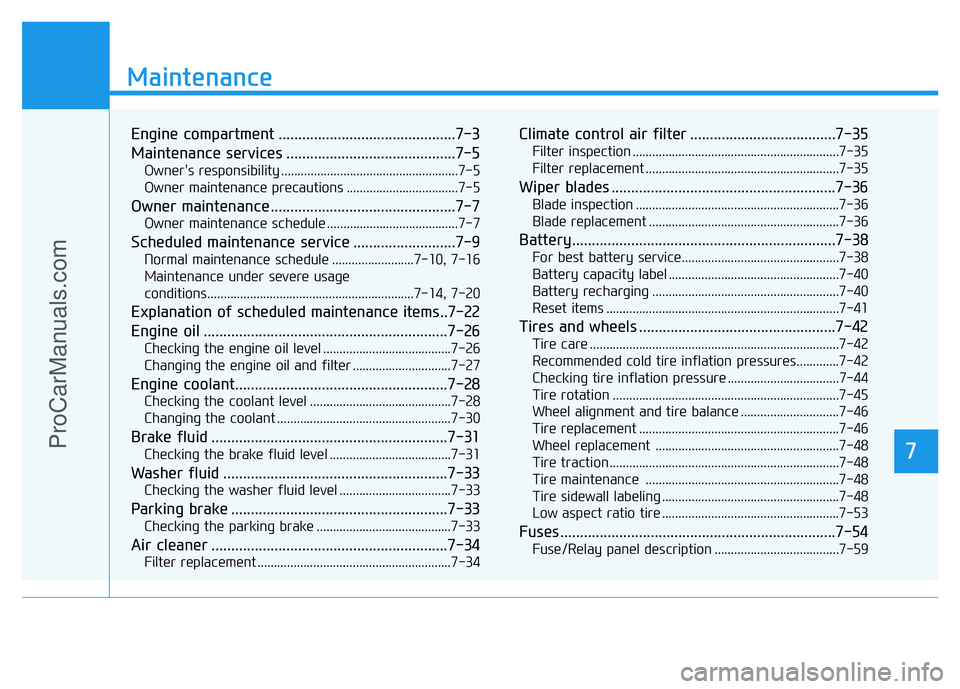
Engine compartment .............................................7-3
Maintenance services ...........................................7-5
Owner's responsibility ......................................................7-5
Owner maintenance precautions ..................................7-5
Owner maintenance ...............................................7-7
Owner maintenance schedule ........................................7-7
Scheduled maintenance service ..........................7-9
Normal maintenance schedule .........................7-10, 7-16
Maintenance under severe usage
conditions...............................................................7-14, 7-20
Explanation of scheduled maintenance items..7-22
Engine oil ..............................................................7-26
Checking the engine oil level .......................................7-26
Changing the engine oil and filter ..............................7-27
Engine coolant......................................................7-28
Checking the coolant level ...........................................7-28
Changing the coolant .....................................................7-30
Brake fluid ............................................................7-31
Checking the brake fluid level .....................................7-31
Washer fluid .........................................................7-33
Checking the washer fluid level ..................................7-33
Parking brake .......................................................7-33
Checking the parking brake .........................................7-33
Air cleaner ............................................................7-34
Filter replacement ...........................................................7-34
Climate control air filter .....................................7-35
Filter inspection ...............................................................7-35
Filter replacement ...........................................................7-35
Wiper blades .........................................................7-36
Blade inspection ..............................................................7-36
Blade replacement ..........................................................7-36
Battery...................................................................7-38
For best battery service................................................7-38
Battery capacity label ....................................................7-40
Battery recharging .........................................................7-40
Reset items .......................................................................7-41
Tires and wheels ..................................................7-42
Tire care ............................................................................7-42
Recommended cold tire inflation pressures.............7-42
Checking tire inflation pressure ..................................7-44
Tire rotation .....................................................................7-45
Wheel alignment and tire balance ..............................7-46
Tire replacement .............................................................7-46
Wheel replacement ........................................................7-48
Tire traction ......................................................................7-48
Tire maintenance ...........................................................7-48
Tire sidewall labeling ......................................................7-48
Low aspect ratio tire ......................................................7-53
Fuses ......................................................................7-54
Fuse/Relay panel description ......................................7-59
7
ProCarManuals.com
Page 484 of 546
7-48
Maintenance
Wheel replacement
When replacing the metal wheels for
any reason, make sure the new
wheels are equivalent to the original
factory units in diameter, rim width
and offset.
Tire traction
Tire traction can be reduced if you
drive on worn tires, tires that are
improperly inflated or on slippery
road surfaces. Tires should be
replaced when tread wear indicators
appear. To reduce the possibility of
losing control, slow down whenever
there is rain, snow or ice on the road.
Tire maintenance
In addition to proper inflation, correct
wheel alignment helps to decrease
tire wear. If you find a tire is worn
unevenly, have your dealer check the
wheel alignment.
When you have new tires installed,
make sure they are balanced. This
will increase vehicle ride comfort and
tire life. Additionally, a tire should
always be rebalanced if it is removed
from the wheel.
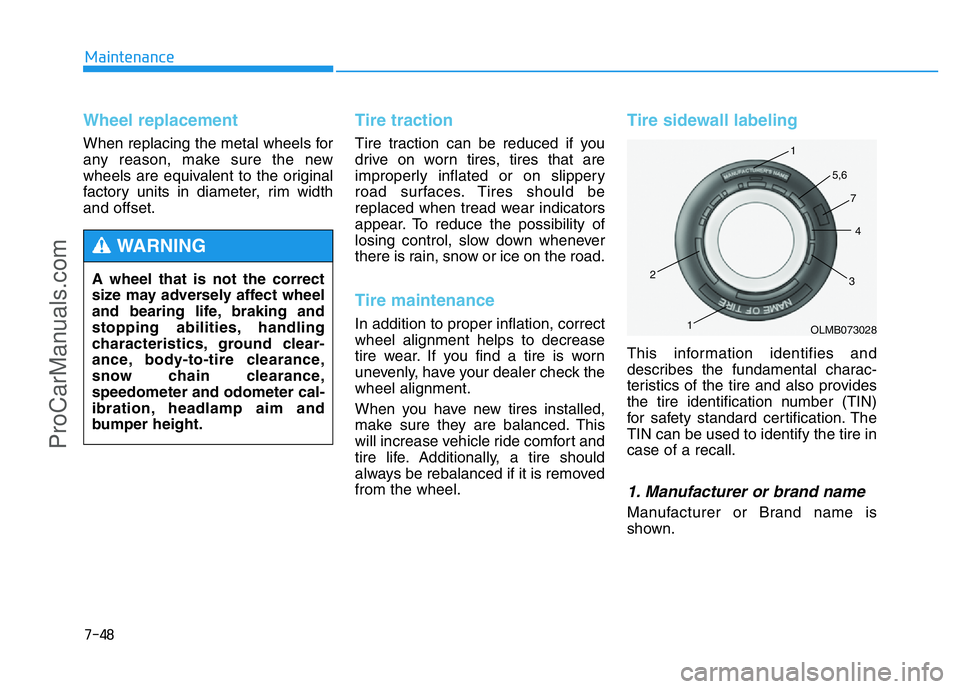
Tire sidewall labeling
This information identifies and
describes the fundamental charac-
teristics of the tire and also provides
the tire identification number (TIN)
for safety standard certification. The
TIN can be used to identify the tire in
case of a recall.
1. Manufacturer or brand name
Manufacturer or Brand name is
shown.
OLMB073028 1
1 2
34 5,6
7
A wheel that is not the correct
size may adversely affect wheel
and bearing life, braking and
stopping abilities, handling
characteristics, ground clear-
ance, body-to-tire clearance,
snow chain clearance,
speedometer and odometer cal-
ibration, headlamp aim and
bumper height.
WARNING
ProCarManuals.com