engine oil HYUNDAI COUPE 2016 Owner's Guide
[x] Cancel search | Manufacturer: HYUNDAI, Model Year: 2016, Model line: COUPE, Model: HYUNDAI COUPE 2016Pages: 475, PDF Size: 14.78 MB
Page 397 of 475
Maintenance
28
7
BRAKE AND CLUTCH (IF EQUIPPED) FLUID
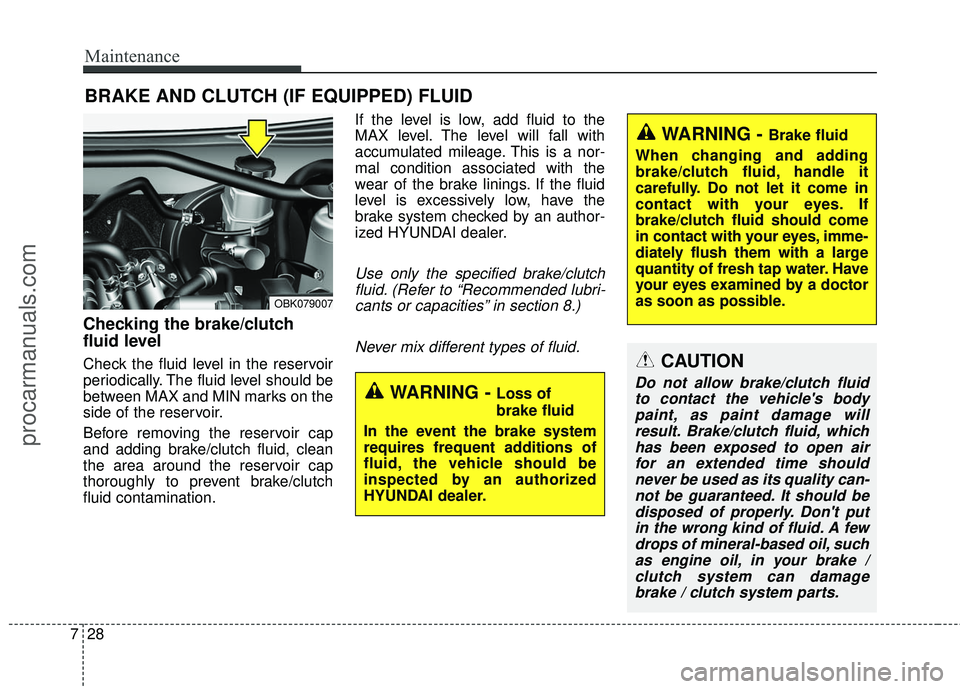
Checking the brake/clutch
fluid level
Check the fluid level in the reservoir
periodically. The fluid level should be
between MAX and MIN marks on the
side of the reservoir.
Before removing the reservoir cap
and adding brake/clutch fluid, clean
the area around the reservoir cap
thoroughly to prevent brake/clutch
fluid contamination. If the level is low, add fluid to the
MAX level. The level will fall with
accumulated mileage. This is a nor-
mal condition associated with the
wear of the brake linings. If the fluid
level is excessively low, have the
brake system checked by an author-
ized HYUNDAI dealer.
Use only the specified brake/clutch
fluid. (Refer to “Recommended lubri-cants or capacities” in section 8.)
Never mix different types of fluid.
WARNING - Brake fluid
When changing and adding
brake/clutch fluid, handle it
carefully. Do not let it come in
contact with your eyes. If
brake/clutch fluid should come
in contact with your eyes, imme-
diately flush them with a large
quantity of fresh tap water. Have
your eyes examined by a doctor
as soon as possible.
WARNING - Loss of
brake fluid
In the event the brake system
requires frequent additions of
fluid, the vehicle should be
inspected by an authorized
HYUNDAI dealer.
OBK079007
CAUTION
Do not allow brake/clutch fluid to contact the vehicle's bodypaint, as paint damage willresult. Brake/clutch fluid, whichhas been exposed to open airfor an extended time shouldnever be used as its quality can-not be guaranteed. It should bedisposed of properly. Don't putin the wrong kind of fluid. A fewdrops of mineral-based oil, suchas engine oil, in your brake /clutch system can damagebrake / clutch system parts.
procarmanuals.com
Page 398 of 475
729
Maintenance
POWER STEERING FLUID
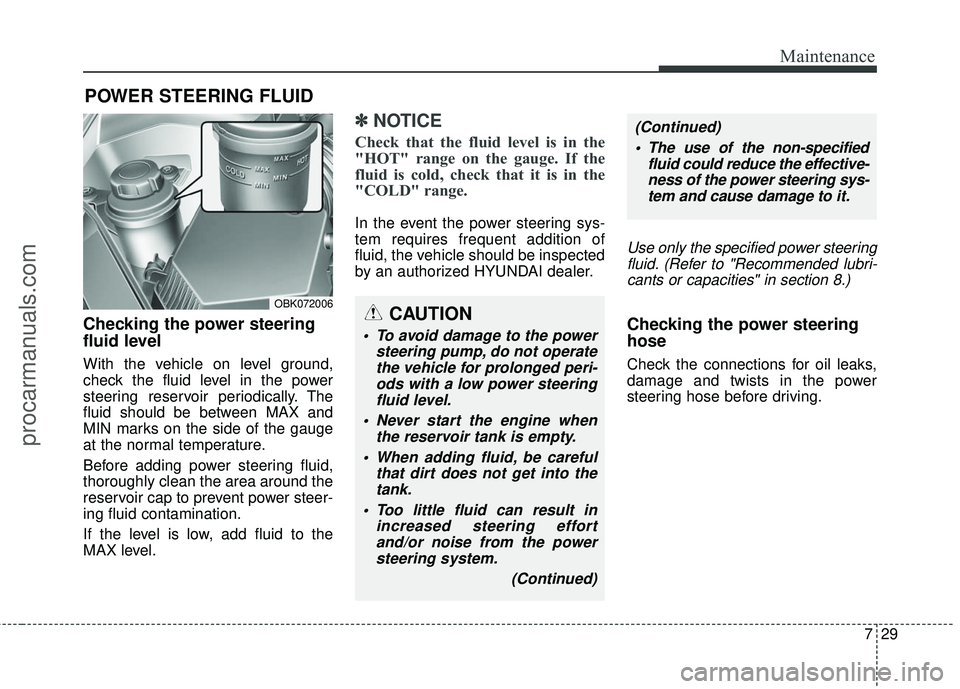
Checking the power steering
fluid level
With the vehicle on level ground,
check the fluid level in the power
steering reservoir periodically. The
fluid should be between MAX and
MIN marks on the side of the gauge
at the normal temperature.
Before adding power steering fluid,
thoroughly clean the area around the
reservoir cap to prevent power steer-
ing fluid contamination.
If the level is low, add fluid to the
MAX level.
✽ ✽NOTICE
Check that the fluid level is in the
"HOT" range on the gauge. If the
fluid is cold, check that it is in the
"COLD" range.
In the event the power steering sys-
tem requires frequent addition of
fluid, the vehicle should be inspected
by an authorized HYUNDAI dealer.
Use only the specified power steering
fluid. (Refer to "Recommended lubri-cants or capacities" in section 8.)
Checking the power steering
hose
Check the connections for oil leaks,
damage and twists in the power
steering hose before driving.
CAUTION
To avoid damage to the power steering pump, do not operatethe vehicle for prolonged peri-ods with a low power steeringfluid level.
Never start the engine when the reservoir tank is empty.
When adding fluid, be careful that dirt does not get into thetank.
Too little fluid can result in increased steering effortand/or noise from the powersteering system.
(Continued)
(Continued) The use of the non-specified fluid could reduce the effective-ness of the power steering sys-tem and cause damage to it.
OBK072006
procarmanuals.com
Page 409 of 475
Maintenance
40
7
Reset items
Items should be reset after the bat-
tery has been discharged or the bat-
tery has been disconnected.
Sunroof (See section 4)
Trip computer (See section 4)
Climate control system
(See section 4)
Clock (See section 4)
Audio (See section 4)
Auto up/down window (See section 4)WARNING
Before performing mainte-nance or recharging the bat-
tery, turn off all accessories
and stop the engine.
The negative battery cable must be removed first and
installed last when the battery
is disconnected.
Operation related to the bat- tery should be done in an
authorized HYUNDAI dealer.
CAUTION
Keep the battery away from water or any liquid.
Use genuine HYUNDAI batter- ies, available at HYUNDAIdealers, when you replace thebattery.
(Continued)
Watch the battery during charg- ing, and stop or reduce the
charging rate if the battery cells
begin gassing (boiling) violent-
ly or if the temperature of the
electrolyte of any cell exceeds
120°F (49°C).
Wear eye protection when checking the battery during
charging.
Disconnect the battery charger in the following order.
1. Turn off the battery charger main switch.
2. Unhook the negative clamp from the negative battery ter-
minal.
3. Unhook the positive clamp from the positive battery ter-
minal.
procarmanuals.com
Page 424 of 475
755
Maintenance
FUSES
A vehicle’s electrical system is pro-
tected from electrical overload dam-
age by fuses.This vehicle has 3 fuse panels, one
located in the driver’s side panel bol-
ster, the others in the engine com-
partment.
If any of your vehicle’s lights, acces-
sories, or controls do not work, check
the appropriate circuit fuse. If a fuse
has blown, the element inside the
fuse will be melted.
If the electrical system does not
work, first check the driver’s side
fuse panel.
Always replace a blown fuse with
one of the same rating.
If the replacement fuse blows, this
indicates an electrical problem. Avoid
using the system involved and imme-
diately consult an authorized
HYUNDAI dealer.
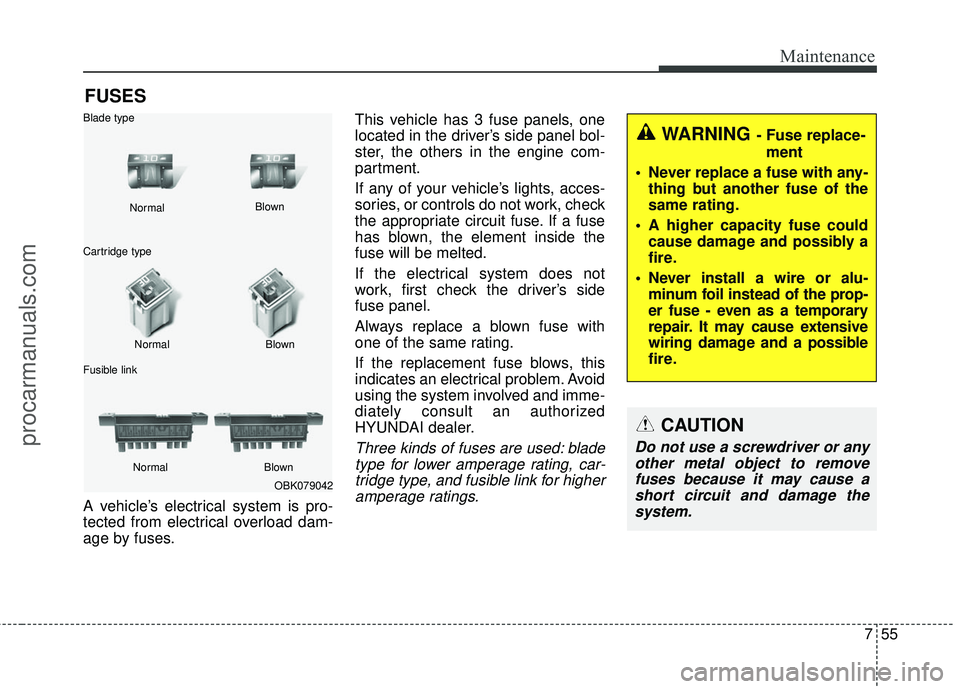
Three kinds of fuses are used: blade
type for lower amperage rating, car-tridge type, and fusible link for higheramperage ratings.
OBK079042
Normal
Normal
Blade type
Cartridge type
Fusible link Blown
Blown
Normal Blown
WARNING - Fuse replace-
ment
Never replace a fuse with any- thing but another fuse of the
same rating.
A higher capacity fuse could cause damage and possibly a
fire.
Never install a wire or alu- minum foil instead of the prop-
er fuse - even as a temporary
repair. It may cause extensive
wiring damage and a possible
fire.
CAUTION
Do not use a screwdriver or anyother metal object to removefuses because it may cause ashort circuit and damage thesystem.
procarmanuals.com
Page 434 of 475
765
Maintenance
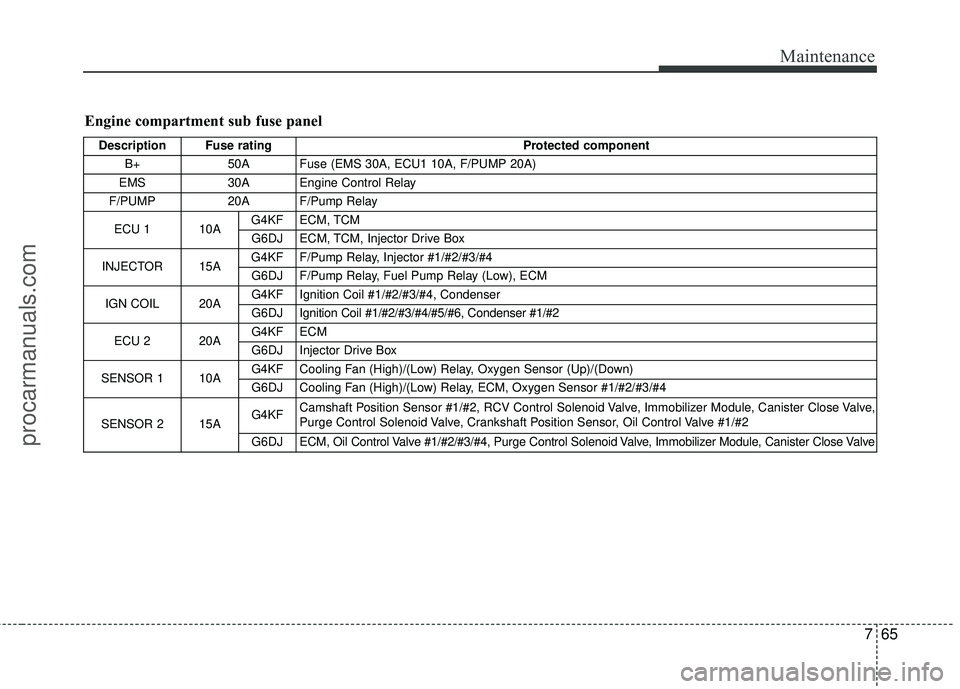
Engine compartment sub fuse panel
Description Fuse ratingProtected component
B+ 50A Fuse (EMS 30A, ECU1 10A, F/PUMP 20A)
EMS 30A Engine Control Relay
F/PUMP 20A F/Pump Relay
ECU 1 10A G4KF ECM, TCM
G6DJ ECM, TCM, Injector Drive Box
INJECTOR 15A G4KF F/Pump Relay, Injector #1/#2/#3/#4
G6DJ F/Pump Relay, Fuel Pump Relay (Low), ECM
IGN COIL20AG4KFIgnition Coil #1/#2/#3/#4, Condenser
G6DJIgnition Coil #1/#2/#3/#4/#5/#6, Condenser #1/#2
ECU 2 20A G4KF ECM
G6DJInjector Drive Box
SENSOR 1 10A G4KF Cooling Fan (High)/(Low) Relay, Oxygen Sensor (Up)/(Down)
G6DJ Cooling Fan (High)/(Low) Relay, ECM, Oxygen Sensor #1/#2/#3/#4
SENSOR 2 15A G4KF
Camshaft Position Sensor #1/#2, RCV Control Solenoid Valve, Immobilizer Module, Canister Close Valve,
Purge Control Solenoid Valve, Crankshaft Position Sensor, Oil Control Valve #1/#2
G6DJ ECM, Oil Control Valve #1/#2/#3/#4, Purge Control Solenoid Valve, Immobilizer Module, Canister Close Valve
procarmanuals.com
Page 446 of 475
777
Maintenance
Waxing
A good coat of wax is a barrier
between your paint and contaminate.
Keeping a good coat of wax on your
vehicle will help protect it.
Wax the vehicle when water will no
longer bead on the paint.
Always wash and dry the vehicle
before waxing. Use a good quality
liquid or paste wax, and follow the
manufacturer’s instructions. Wax all
metal trim to protect it and to main-
tain its luster.
Removing oil, tar, and similar materi-
als with a spot remover will usually
strip the wax from the finish. Be sure to
re-wax these areas even if the rest of
the vehicle does not yet need waxing.CAUTION
Wiping dust or dirt off thebody with a dry cloth willscratch the finish.
Do not use steel wool, abra- sive cleaners, or strong deter-gents containing highly alka-line or caustic agents onchrome-plated or anodizedaluminum parts. This mayresult in damage to the protec-tive coating and cause discol-oration or paint deterioration.
CAUTION
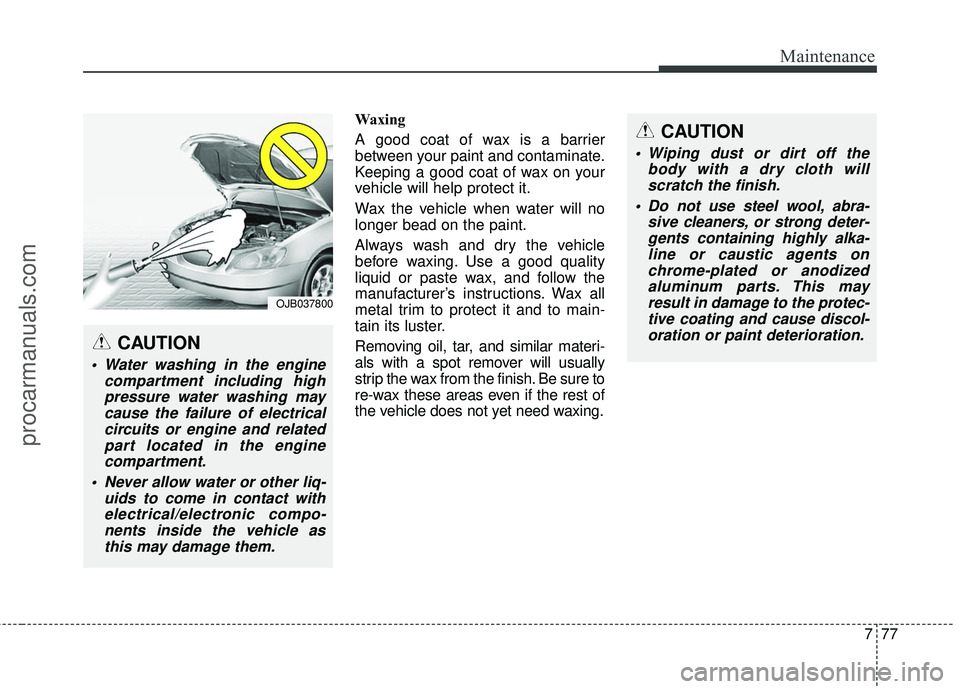
Water washing in the engine compartment including highpressure water washing maycause the failure of electricalcircuits or engine and relatedpart located in the enginecompartment.
Never allow water or other liq- uids to come in contact withelectrical/electronic compo-nents inside the vehicle asthis may damage them.
OJB037800
procarmanuals.com
Page 459 of 475
Specifications, Consumer information, Reporting safety defects
48
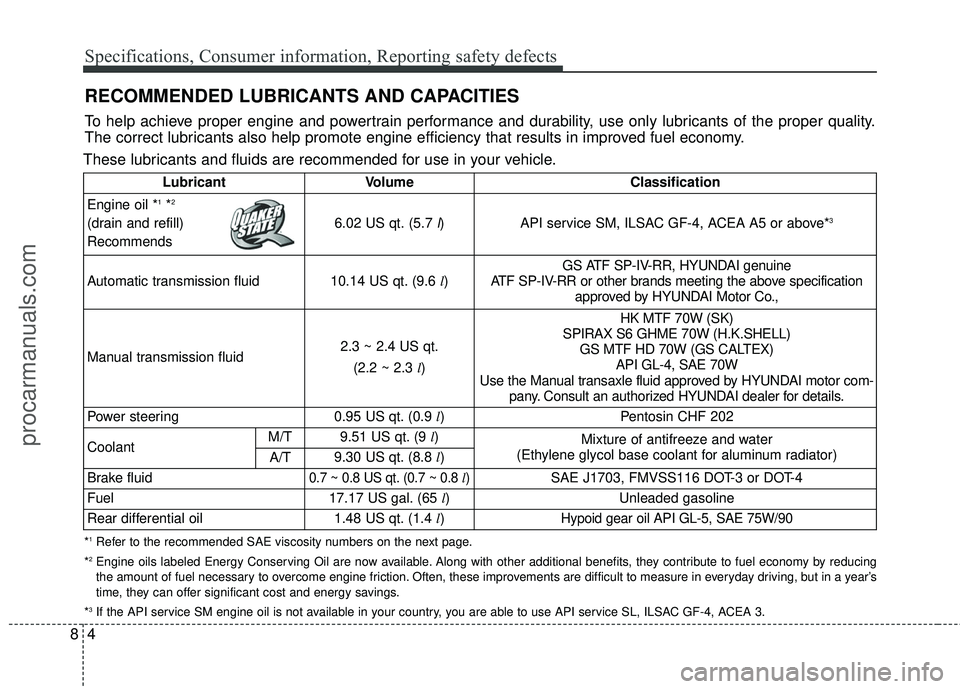
RECOMMENDED LUBRICANTS AND CAPACITIES
These lubricants and fluids are recommended for use in your vehicle.
*1Refer to the recommended SAE viscosity numbers on the next page.
*2Engine oils labeled Energy Conserving Oil are now available. Along with other additional benefits, they contribute to fuel econo my by reducing
the amount of fuel necessary to overcome engine friction. Often, these improvements are difficult to measure in everyday driving, but in a year’s
time, they can offer significant cost and energy savings.
*
3If the API service SM engine oil is not available in your country, you are able to use API service SL, ILSAC GF-4, ACEA 3.
To help achieve proper engine and powertrain performance and durability, use only lubricants of the proper quality.
The correct lubricants also help promote engine efficiency that results in improved fuel economy.
LubricantVolumeClassification
Engine oil *1*2
(drain and refill)
Recommends6.02 US qt. (5.7 l)API service SM, ILSAC GF-4, ACEA A5 or above*3
Automatic transmission fluid10.14 US qt. (9.6 l)
GS ATF SP-IV-RR, HYUNDAI genuine
ATF SP-IV-RR or other brands meeting the above specification approved by HYUNDAI Motor Co.,
Manual transmission fluid2.3 ~ 2.4 US qt.
(2.2 ~ 2.3 l)
HK MTF 70W (SK)
SPIRAX S6 GHME 70W (H.K.SHELL) GS MTF HD 70W (GS CALTEX) API GL-4, SAE 70W
Use the Manual transaxle fluid approved by HYUNDAI motor com- pany. Consult an authorized HYUNDAI dealer for details.
Power steering0.95 US qt. (0.9 l)Pentosin CHF 202
CoolantM/T9.51 US qt. (9 l) Mixture of antifreeze and water
(Ethylene glycol base coolant for aluminum radiator)
A/T9.30 US qt. (8.8 l)
Brake fluid0.7 ~ 0.8 US qt. (0.7 ~ 0.8 l )SAE J1703, FMVSS116 DOT-3 or DOT-4
Fuel17.17 US gal. (65 l)Unleaded gasoline
Rear differential oil1.48 US qt. (1.4 l)Hypoid gear oil API GL-5, SAE 75W/90
procarmanuals.com
Page 460 of 475
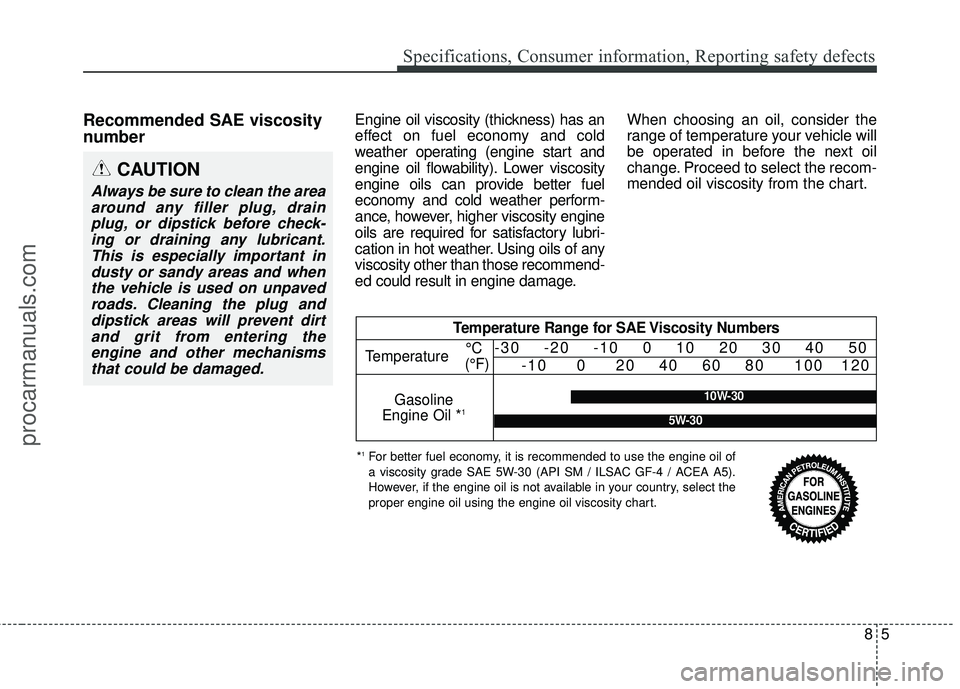
Recommended SAE viscosity
number Engine oil viscosity (thickness) has an
effect on fuel economy and cold
weather operating (engine start and
engine oil flowability). Lower viscosity
engine oils can provide better fuel
economy and cold weather perform-
ance, however, higher viscosity engine
oils are required for satisfactory lubri-
cation in hot weather. Using oils of any
viscosity other than those recommend-
ed could result in engine damage.When choosing an oil, consider the
range of temperature your vehicle will
be operated in before the next oil
change. Proceed to select the recom-
mended oil viscosity from the chart.
CAUTION
Always be sure to clean the area
around any filler plug, drainplug, or dipstick before check-ing or draining any lubricant.This is especially important industy or sandy areas and whenthe vehicle is used on unpavedroads. Cleaning the plug anddipstick areas will prevent dirtand grit from entering theengine and other mechanismsthat could be damaged.
85
Specifications, Consumer information, Reporting safety defects
Temperature Range for SAE Viscosity Numbers
Temperature
Gasoline
Engine Oil *
1
°C
(°F)-30 -20 -10 0 10 20 30 40 50
-10 0 20 40 60 80 100 120
10W-30
5W-30
*1For better fuel economy, it is recommended to use the engine oil of
a viscosity grade SAE 5W-30 (API SM / ILSAC GF-4 / ACEA A5).
However, if the engine oil is not available in your country, select the
proper engine oil using the engine oil viscosity chart.
procarmanuals.com
Page 468 of 475
··················\
··········4-117
Defroster (Front window) Front windshield deicer ··················\
······")
Index
4I
Defogging logic (Windshield)··················\
··········4-117
Defroster (Front window) Front windshield deicer ··················\
···············4-91
Defroster (Rear window) ··················\
················ ·4-91
Defrosting (Windshield) ··················\
·················4-114
Digital clock ··················\
··················\
··········· ·4-124
Dimensions ··················\
··················\
·················8-2
Display illumination, see instrument panel illumination · · ·4-46
Displays, see instrument cluster ··················\
·········4-45
Door locks ··················\
··················\
··············· ·4-16
Central door lock switch ··················\
··············4-18
Speed sensing door lock system ··················\
·····4-19
Drinks holders, see cup holders ··················\
········4-122
Driver's 3-point seat belt ··················\
················· ·3-18
Driver's and passenger's front air bag ··················\
···3-48
Driving at night ··················\
··················\
········· ·5-44
Driving in flooded areas ··················\
················· ·5-46
Driving in the rain ··················\
··················\
······ ·5-45
Driving off-road ··················\
··················\
········· ·5-46
DRL ··················\
··················\
··················\
···· ·4-83
Economical operation ··················\
··················\
·· ·5-41
Electric chromic mirror (ECM) ··················\
··········4-35
Electronic stability program (ESC) ··················\
·····5-31
Emergency fuel filler lid release ··················\
·········4-29 Emergency starting
Jump starting ··················\
··················\
·········· ·6-4
Push starting ··················\
··················\
··········· ·6-5
Emergency while driving ··················\
················· ·6-2
Emission control system ··················\
················· ·7-83
Crankcase emission control system ··················\
··7-83
Evaporative emission control System ·················7-83
Exhaust emission control system ··················\
····7-84
Engine compartment ··················\
················· ·2-6, 7-3
Engine compartment fuse label ··················\
··········7-60
Engine compartment panel fuse ··················\
·········7-57
Engine coolant ··················\
··················\
·········· ·7-25
Engine coolcant temperature gauge ··················\
·····4-47
Engine number ··················\
··················\
··········· ·8-7
Engine oil ··················\
··················\
·················7-23
Engine overheats ··················\
··················\
········· ·6-6
Engine Specification ··················\
··················\
····· ·8-2
Engine start/stop button ··················\
··················\
· ·5-8
Engine will not start ··················\
··················\
····· ·6-3
Escort function ··················\
··················\
·········· ·4-83
Evaporative emission control system ··················\
···7-83
Exhaust emission control system ··················\
········7-84
Explanation of scheduled maintenance items ···········7-20
Exterior care ··················\
··················\
··············7-76
Exterior overview (front) ··················\
················· ·2-2
Exterior overview (rear) ··················\
··················\
· ·2-3
E
procarmanuals.com
Page 472 of 475

Index
8I
Mirrors··················\
··················\
··················\
· ·4-35
Day/night rearview mirror ··················\
············4-35
"Electric chromic mirror (ECM) with HomeLink system and compass" ··················\
··4-35
Folding the outside rearviwe mirror ··················\
·4-44
Inside rearview mirror ··················\
················ ·4-35
Outside rearview mirror ··················\
···············4-43
Remote control ··················\
··················\
······ ·4-44
Multi fuse ··················\
··················\
·················7-58
Multi gauge ··················\
··················\
·············· ·4-71
Occupant classification system ··················\
··········3-43
Odometer ··················\
··················\
·················4-49
Oil (Engine) ··················\
··················\
··············7-23
Outside rearview mirror ··················\
················· ·4-43
Outside rearview mirror remote control ··················4-44
Outside thermometer ··················\
··················\
· ·4-125
Overheats ··················\
··················\
··················\
·6-6
Owner maintenance ··················\
··················\
·······7-6
Parking assist system ··················\
··················\
··· ·4-77
Parking brake ··················\
··················\
············ ·5-27
Parking brake ··················\
··················\
············ ·7-31Passerger's seat for Child restraint system
···············3-38
Power brakes ··················\
··················\
············ ·5-25
Power outlet ··················\
··················\
············ ·4-124
Power steering ··················\
··················\
·········· ·4-33
Power steering fluid ··················\
··················\
···· ·7-29
Pre-tensioner seat belt ··················\
··················\
·· ·3-20
Push starting ··················\
··················\
·············· ·6-5
Rear parking assist system ··················\
···············4-74
Rear seat ··················\
··················\
················· ·3-13
Rear seat entry ··················\
··················\
·········· ·3-12
Recommended cold tire inflation pressures ··············7-41
Recommended lubricants and capacities ··················8-4
Recommended SAE viscosity number ··················8-5
Refrigerant label ··················\
··················\
·········· ·8-7
Remote control (Mirror) ··················\
················· ·4-44
Remote key battery replacement ··················\
········4-13
Remote keyless entry ··················\
··················\
····
4-11
Remote key battery replacement ··················\
·····4-13
Removable towing hook ··················\
················· ·6-22
Replacement light bulb ··················\
··················\
·7-67
Reportin safety defects ··················\
··················\
·· ·8-9
Road warning ··················\
··················\
··············6-2
Rocking the vehicle ··················\
··················\
···· ·5-43
O
P
R
procarmanuals.com