Check Hyundai Creta 2018 Owners Manual
[x] Cancel search | Manufacturer: HYUNDAI, Model Year: 2018, Model line: Creta, Model: Hyundai Creta 2018Pages: 472, PDF Size: 11.87 MB
Page 412 of 472
7-55
7
Maintenance
Wheel alignment and tire bal-
ance
The wheels on your vehicle were
aligned and balanced carefully at the
factory to give you the longest tire life
and best overall performance.
In most cases, you will not need to
have your wheels aligned again.
However, if you notice unusual tire
wear or your vehicle pulling one way
or the other, the alignment may need
to be reset.
If you notice your vehicle vibrating
when driving on a smooth road, your
wheels may need to be rebalanced.
Improper wheel weights can dam-
age your vehicle's aluminum
wheels. Use only approved wheel
weights.
Tire replacement
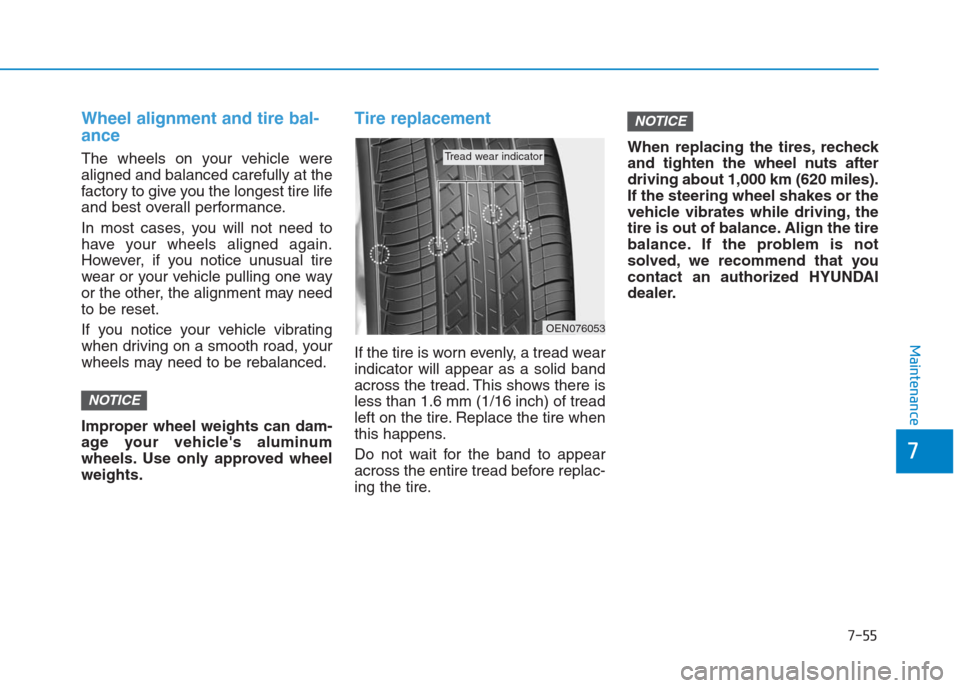
If the tire is worn evenly, a tread wear
indicator will appear as a solid band
across the tread. This shows there is
less than 1.6 mm (1/16 inch) of tread
left on the tire. Replace the tire when
this happens.
Do not wait for the band to appear
across the entire tread before replac-
ing the tire.When replacing the tires, recheck
and tighten the wheel nuts after
driving about 1,000 km (620 miles).
If the steering wheel shakes or the
vehicle vibrates while driving, the
tire is out of balance. Align the tire
balance. If the problem is not
solved, we recommend that you
contact an authorized HYUNDAI
dealer.
NOTICE
NOTICE
OEN076053
Tread wear indicator
Page 414 of 472
7-57
7
Maintenance
Tire traction
Tire traction can be reduced if you
drive on worn tires, tires that are
improperly inflated or on slippery
road surfaces. Tires should be
replaced when tread wear indicators
appear. Slow down whenever there
is rain, snow or ice on the road, to
reduce the possibility of losing con-
trol of the vehicle.
Tire maintenance
In addition to proper inflation, correct
wheel alignment helps decrease tire
wear. If you find a tire worn unevenly,
have your dealer check the wheel
alignment.
When you have new tires installed,
make sure they are balanced. This
will increase vehicle ride comfort and
tire life. Additionally, a tire should
always be rebalanced if it is removed
from the wheel.
Tire sidewall labeling
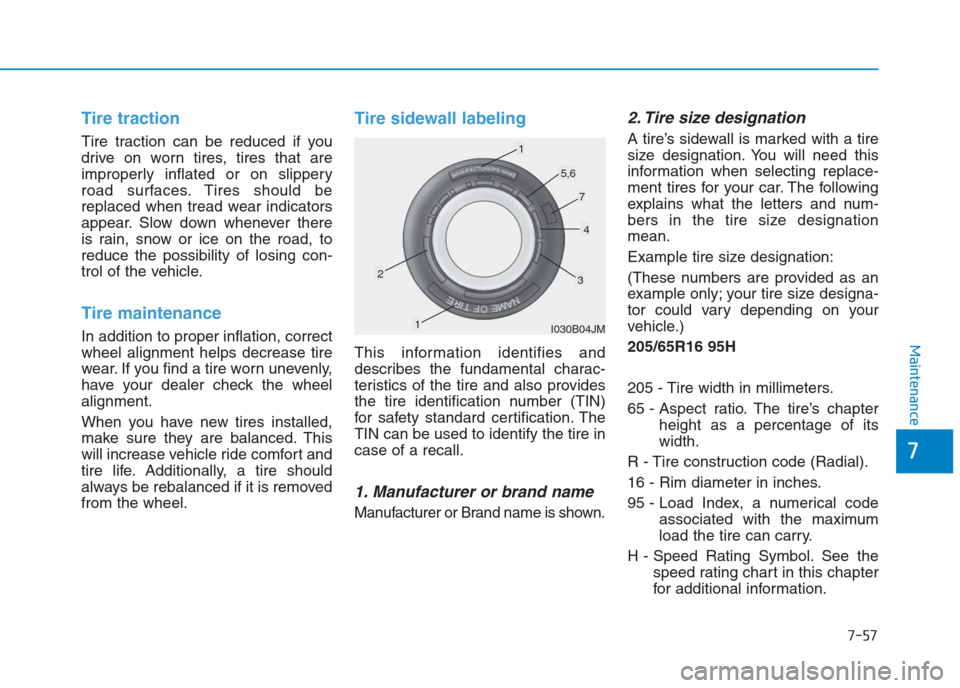
This information identifies and
describes the fundamental charac-
teristics of the tire and also provides
the tire identification number (TIN)
for safety standard certification. The
TIN can be used to identify the tire in
case of a recall.
1. Manufacturer or brand name
Manufacturer or Brand name is shown.
2. Tire size designation
A tire’s sidewall is marked with a tire
size designation. You will need this
information when selecting replace-
ment tires for your car. The following
explains what the letters and num-
bers in the tire size designation
mean.
Example tire size designation:
(These numbers are provided as an
example only; your tire size designa-
tor could vary depending on your
vehicle.)
205/65R16 95H
205 - Tire width in millimeters.
65 - Aspect ratio. The tire’s chapter
height as a percentage of its
width.
R - Tire construction code (Radial).
16 - Rim diameter in inches.
95 - Load Index, a numerical code
associated with the maximum
load the tire can carry.
H - Speed Rating Symbol. See the
speed rating chart in this chapter
for additional information.
I030B04JM
1
1
23
4
5,6
7
Page 415 of 472
7-58
Maintenance
Wheel size designation
Wheels are also marked with impor-
tant information that you need if you
ever have to replace one. The follow-
ing explains what the letters and
numbers in the wheel size designa-
tion mean.
Example wheel size designation:
6.0JX16
6.0 - Rim width in inches.
J - Rim contour designation.
16 - Rim diameter in inches.
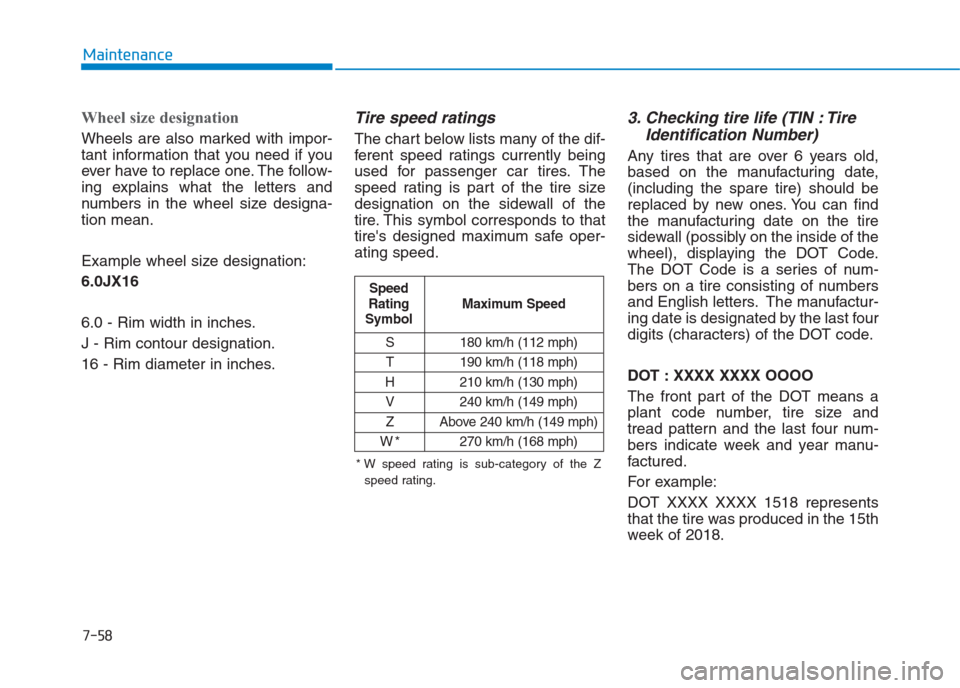
Tire speed ratings
The chart below lists many of the dif-
ferent speed ratings currently being
used for passenger car tires. The
speed rating is part of the tire size
designation on the sidewall of the
tire. This symbol corresponds to that
tire's designed maximum safe oper-
ating speed.
3. Checking tire life (TIN : Tire
Identification Number)
Any tires that are over 6 years old,
based on the manufacturing date,
(including the spare tire) should be
replaced by new ones. You can find
the manufacturing date on the tire
sidewall (possibly on the inside of the
wheel), displaying the DOT Code.
The DOT Code is a series of num-
bers on a tire consisting of numbers
and English letters. The manufactur-
ing date is designated by the last four
digits (characters) of the DOT code.
DOT : XXXX XXXX OOOO
The front part of the DOT means a
plant code number, tire size and
tread pattern and the last four num-
bers indicate week and year manu-
factured.
For example:
DOT XXXX XXXX 1518 represents
that the tire was produced in the 15th
week of 2018.
S 180 km/h (112 mph)
T 190 km/h (118 mph)
H 210 km/h (130 mph)
V 240 km/h (149 mph)
Z Above 240 km/h (149 mph)
W*270 km/h (168 mph)
Maximum Speed Speed
Rating
Symbol
* W speed rating is sub-category of the Z
speed rating.
Page 419 of 472
7-62
Maintenance
It is difficult to recognize tire
damage only with eyes.
However, we recommend you to
have the tire checked or
replaced upon detecting even
the slightest tire damage. The
tire damage may leak air from
the tire.
Tire damage, caused by driving
on a rough road, pothole, man-
hole or curb stone, or off the
road, is not covered by the man-
ufacturer’s warranty.
For further information about
the tire, refer to the label on the
tire sidewall.
NOTICE
Page 420 of 472
7-63
7
Maintenance
F FU
US
SE
ES
S
A vehicle’s electrical system is pro-
tected from electrical overload dam-
age by fuses.
This vehicle has 2 fuse panels, one
located in the driver’s side panel bol-
ster, the other in the engine compart-
ment near the battery.
If any of your vehicle’s lights, acces-
sories, or controls do not work, check
the appropriate circuit fuse. If a fuse
has blown, the element inside the
fuse will be melted.
If the electrical system does not
work, first check the driver’s side
fuse panel.
Before replacing a blown fuse, dis-
connect the negative battery cable.
Always replace a blown fuse with
one of the same rating.
If the replacement fuse blows, this
indicates an electrical problem. Avoid
using the system involved and imme-
diately consult an authorized
HYUNDAI dealer.
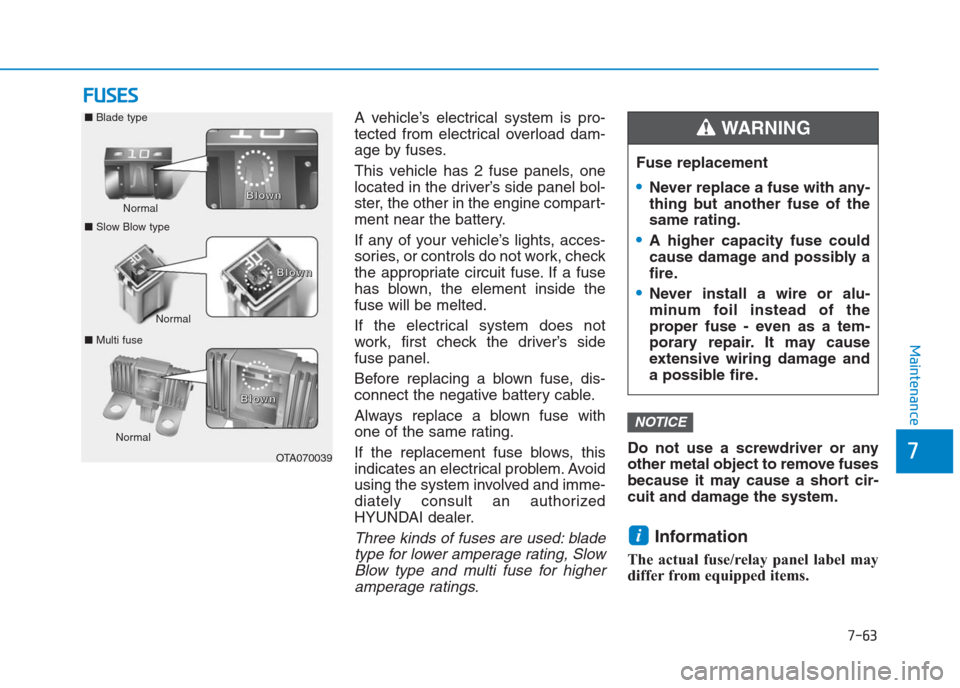
Three kinds of fuses are used: blade
type for lower amperage rating, Slow
Blow type and multi fuse for higher
amperage ratings.
Do not use a screwdriver or any
other metal object to remove fuses
because it may cause a short cir-
cuit and damage the system.
Information
The actual fuse/relay panel label may
differ from equipped items.
i
NOTICE
OTA070039 Normal Normal
■Slow Blow type
■Multi fuseB B B B
l l l l
o o o o
w w w w
n n n n
Normal ■Blade type
B B B B
l l l l
o o o o
w w w w
n n n n
B B B B
l l l l
o o o o
w w w w
n n n n
Fuse replacement
Never replace a fuse with any-
thing but another fuse of the
same rating.
A higher capacity fuse could
cause damage and possibly a
fire.
Never install a wire or alu-
minum foil instead of the
proper fuse - even as a tem-
porary repair. It may cause
extensive wiring damage and
a possible fire.
WARNING
Page 421 of 472
7-64
Maintenance
When replacing a blown fuse or
relay with a new one, make sure
the new fuse or relay fits tightly
into the clips. The incomplete
fastening fuse or relay may
cause the vehicle wiring and
electric systems damage and a
possible fire.
Do not remove fuses, relays and
terminals fastened with bolts or
nuts. The fuses, relays and ter-
minals may be fastened incom-
pletely, and it may cause a pos-
sible fire. If fuses, relays and ter-
minals fastened with bolts or
nuts are blown, consult with an
authorized HYUNDAI dealer.
Do not input any other objects
except fuses or relays into
fuse/relay terminals such as a
driver or wiring. It may cause
contact failure and system mal-
function.
(Continued)(Continued)
Check the blown fuse with the
fuse information on the fuse box
cover.
Replace the blown fuse on the
same place after turning off the
ignition switch and all electric
switches and disconnecting the
negative battery cable.
Instrument panel fuse replace-
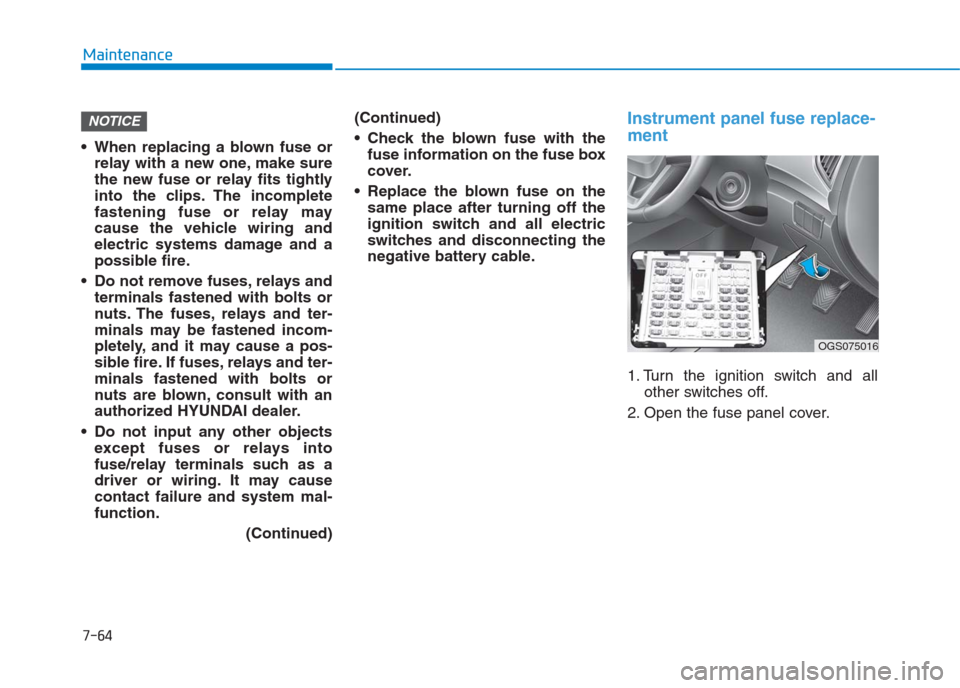
ment
1. Turn the ignition switch and all
other switches off.
2. Open the fuse panel cover.
NOTICE
OGS075016
Page 422 of 472
7-65
7
Maintenance
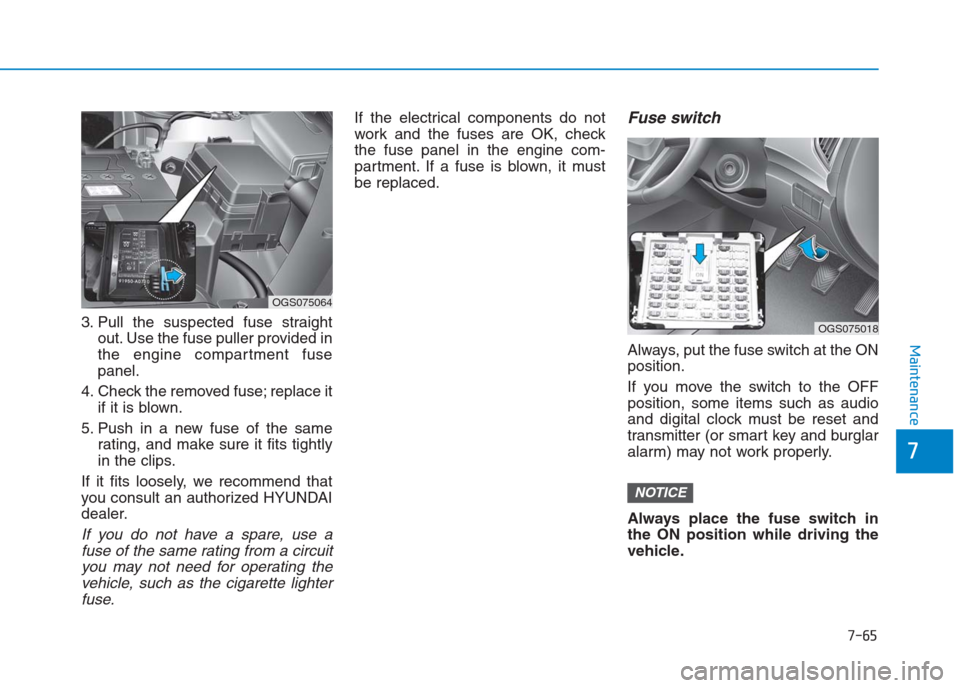
3. Pull the suspected fuse straight
out. Use the fuse puller provided in
the engine compartment fuse
panel.
4. Check the removed fuse; replace it
if it is blown.
5. Push in a new fuse of the same
rating, and make sure it fits tightly
in the clips.
If it fits loosely, we recommend that
you consult an authorized HYUNDAI
dealer.
If you do not have a spare, use a
fuse of the same rating from a circuit
you may not need for operating the
vehicle, such as the cigarette lighter
fuse.
If the electrical components do not
work and the fuses are OK, check
the fuse panel in the engine com-
partment. If a fuse is blown, it must
be replaced.Fuse switch
Always, put the fuse switch at the ON
position.
If you move the switch to the OFF
position, some items such as audio
and digital clock must be reset and
transmitter (or smart key and burglar
alarm) may not work properly.
Always place the fuse switch in
the ON position while driving the
vehicle.
NOTICE
OGS075064
OGS075018
Page 423 of 472
7-66
Maintenance
Information
If the fuse switch is OFF, the above
message will appear on instrument
cluster display.
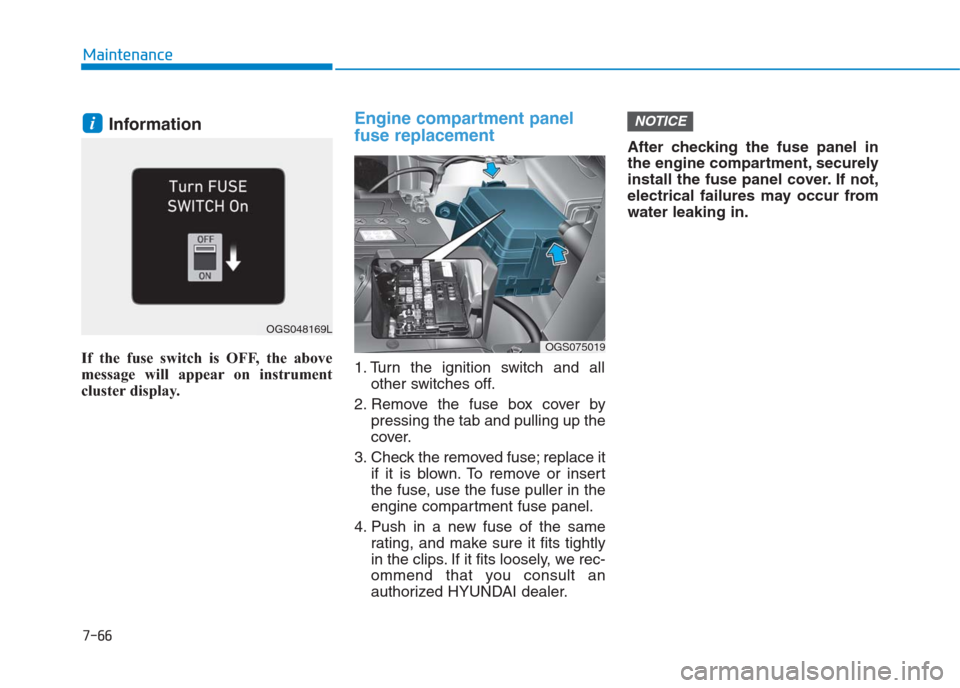
Engine compartment panel
fuse replacement
1. Turn the ignition switch and all
other switches off.
2. Remove the fuse box cover by
pressing the tab and pulling up the
cover.
3. Check the removed fuse; replace it
if it is blown. To remove or insert
the fuse, use the fuse puller in the
engine compartment fuse panel.
4. Push in a new fuse of the same
rating, and make sure it fits tightly
in the clips. If it fits loosely, we rec-
ommend that you consult an
authorized HYUNDAI dealer.After checking the fuse panel in
the engine compartment, securely
install the fuse panel cover. If not,
electrical failures may occur from
water leaking in.
NOTICEi
OGS075019
OGS048169L
Page 434 of 472
7-77
7
Maintenance
L LI
IG
GH
HT
T
B
BU
UL
LB
BS
S
Consult an authorized HYUNDAI
dealer to replace most vehicle light
bulbs. It is difficult to replace vehicle
light bulbs because other parts of the
vehicle must be removed before you
can get to the bulb. This is especially
true for removing the headlight
assembly to get to the bulb(s).
Removing/installing the headlight
assembly can result in damage to
the vehicle.Information
After heavy driving, rain or washing
headlight and taillight lenses could
appear frosty. This condition is caused
by the temperature difference between
the lamp inside and outside.
This is similar to the condensation on
your windows inside your vehicle dur-
ing the rain and doesn’t indicate a
problem with your vehicle. If the
water leaks into the lamp bulb circuit-
ry, we recommend that the system be
checked by an authorized HYUNDAI
dealer.
Be sure to replace the burned-out
bulb with one of the same wattage
rating. Otherwise, it may cause
damage to the fuse or electric
wiring system.
NOTICE
i
Prior to replacing a light,
depress the foot brake, move
the shift lever into the P (Park,
for automatic transaxle vehicle)
or neutral (for manual transaxle
vehicle), apply the parking
brake, place the ignition switch
in the LOCK/OFF position, and
take the key with you when leav-
ing the vehicle to avoid sudden
movement of the vehicle and to
prevent possible electric shock.
Be aware the bulbs may be hot
and may burn your fingers.
WARNING
Page 440 of 472
7-83
7
Maintenance
Parking (Position light)
If the light does not operate, we rec-
ommend that the vehicle be checked
by an authorized HYUNDAI dealer.
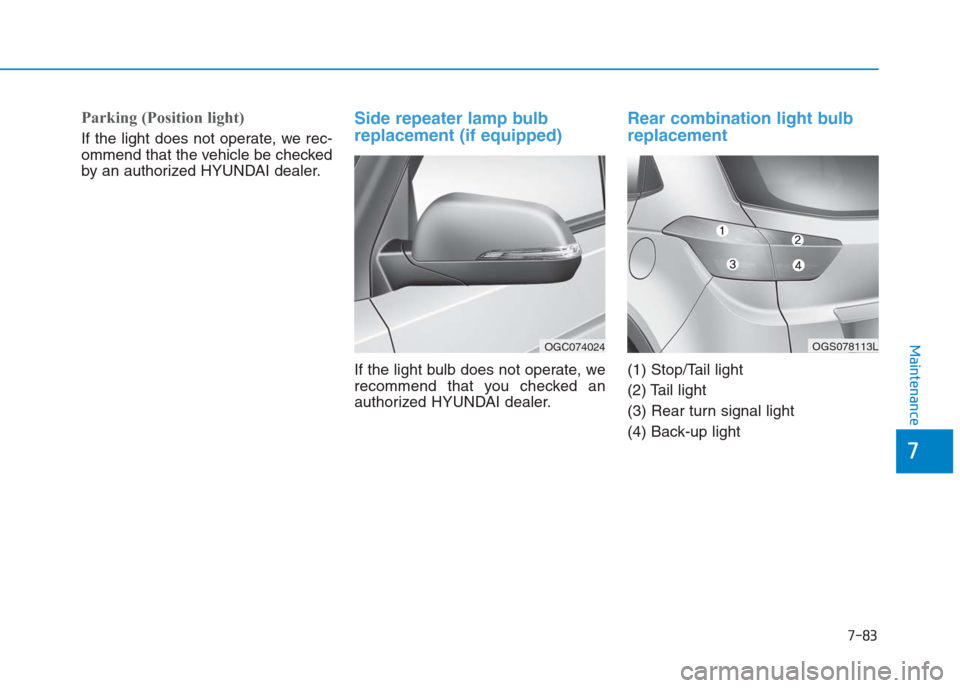
Side repeater lamp bulb
replacement (if equipped)
If the light bulb does not operate, we
recommend that you checked an
authorized HYUNDAI dealer.
Rear combination light bulb
replacement
(1) Stop/Tail light
(2) Tail light
(3) Rear turn signal light
(4) Back-up light
OGC074024OGS078113L