Oil Hyundai Creta 2018 User Guide
[x] Cancel search | Manufacturer: HYUNDAI, Model Year: 2018, Model line: Creta, Model: Hyundai Creta 2018Pages: 472, PDF Size: 11.87 MB
Page 251 of 472
4-37
Multimedia System
4
Operating the device while driv-
ing could lead to accidents due
to a lack of attention to external
surroundings. First park the
vehicle before operating the
device.
Adjust the volume to levels that
allow the driver to hear sounds
from outside of the vehicle.
Driving in a state where external
sounds cannot be heard may
lead to accidents.
Pay attention to the volume set-
ting when turning the device on.
A sudden output of extreme vol-
ume upon turning the device on
could lead to hearing impair-
ment. (Adjust the volume to a
suitable level before turning off
the device.)
Turn on the car engine before
using this device. Do not oper-
ate the audio system for long
periods of time only with the
ignition turned on as such oper-
ations may lead to battery dis-
charge.
(Continued)(Continued)
Do not subject the device to
severe shock or impact. Direct
pressure onto the front side of
the monitor may cause damage
to the LCD.
When cleaning the device, make
sure to turn off the device and
use a dry and smooth cloth.
Never use tough materials,
chemical cloths, or solvents
(alcohol, benzene, thinners,
etc.). As such materials may
damage the device panel or
cause color/quality deterioration
Do not place beverages close to
the audio system. Spilling bever-
ages may lead to system mal-
function.
In this case of product malfunc-
tion, please contact your place of
purchase or After Service center.
Placing the audio system within
an electromagnetic environment
may result in noise interference.
Prevent caustic solutions such
as perfume and cosmetic oil
from contacting the dashboard
because they may cause dam-
age or discoloration.
NOTICE
Driving while distracted can
result in a loss of vehicle con-
trol that may lead to an acci-
dent, severe personal injury,
and death. The driver’s primary
responsibility is in the safe and
legal operation of a vehicle, and
use of any handheld devices,
other equipment, or vehicle sys-
tems which take the driver’s
eyes, attention and focus away
from the safe operation of a
vehicle or which are not permis-
sible by law should never be
used during operation of the
vehicle.
WARNING
Page 277 of 472
5-2
Driving your vehicle
Carbon monoxide (CO) gas is toxic. Breathing CO can cause unconsciousness and death.
Engine exhaust contains carbon monoxide which cannot be seen or smelled.
Do not inhale engine exhaust.
If at any time you smell engine exhaust inside the vehicle, open the windows immediately. Exposure to CO can cause
unconsciousness and death by asphyxiation.
Be sure the exhaust system does not leak.
The exhaust system should be checked whenever the vehicle is raised to change the oil or for any other purpose. If
you hear a change in the sound of the exhaust or if you drive over something that strikes the underneath side of the
vehicle, we recommend that the exhaust system be checked as soon as possible by an authorized HYUNDAI dealer.
Do not run the engine in an enclosed area.
Letting the engine idle in your garage, even with the garage door open, is a hazardous practice. Run the engine only
long enough to start the engine and to move the vehicle out of the garage.
Avoid idling the engine for prolonged periods with people inside the vehicle.
If it is necessary to idle the engine for a prolonged period with people inside the vehicle , be sure to do so only in an
open area with the air intake set at "Fresh" and fan control set to high so fresh air is drawn into the interior.
Keep the air intakes clear.
To assure proper operation of the ventilation system, keep the ventilation air intakes located in front of the windshield
clear of snow, ice, leaves, or other obstructions.
If you must drive with the tailgate open:
Close all windows.
Open instrument panel air vents.
Set the air intake control at "Fresh", the air flow control at "Floor" or "Face", and the fan control set to high.
WARNING
Page 326 of 472
5-51
Driving your vehicle
5
Highway driving
Tires
Adjust the tire inflation, as specified.
Under-inflation may overheat or
damage the tires.
Do not install worn-out or damaged
tires, which may reduce traction or
fail the braking operation.
Information
Never over-inflate your tires above the
maximum inflation pressure, as speci-
fied on your tires.
Fuel, engine coolant and engine
oil
Driving at higher speeds on the high-
way consumes more fuel and is less
efficient than driving at a slower,
more moderate speed. Maintain a
moderate speed in order to conserve
fuel when driving on the highway.
Be sure to check both the engine
coolant level and the engine oil
before driving.
Drive belt
A loose or damaged drive belt may
overheat the engine.
i
Page 329 of 472
When using tire chains:
Wrong size chains or improperly
installed chains can damage
your vehicle's brake lines, sus-
pension, body and wheels.
Use SAE “S” class or wire
chains.
If you hear noise caused by
chains contacting the body,
retighten the chain to prevent
contact with the vehicle body.
To prevent body damage,
retighten the chains after driving
0.5~1.0 km (0.3~0.6 miles).
Do not use tire chains on vehi-
cles equipped with aluminum
wheels. If unavoidable, use a
wire type chain.
Use wire chains less than 15 mm
(0.59 in) wide to prevent damage
to the chain’s connection.
Winter precautions
Use high quality ethylene glycol
coolant
Your vehicle is delivered with high
quality ethylene glycol coolant in the
cooling system. It is the only type of
coolant that should be used because
it helps prevent corrosion in the cool-
ing system, lubricates the water
pump and prevents freezing. Be sure
to replace or replenish your coolant
in accordance with the maintenance
schedule in chapter 7. Before winter,
have your coolant tested to assure
that its freezing point is sufficient for
the temperatures anticipated during
the winter.
Check battery and cables
Winter puts additional burdens on
the battery system. Visually inspect
the battery and cables as described
in chapter 7. The level of charge in
your battery can be checked by an
authorized HYUNDAI dealer or a
service station.
Change to "winter weight" oil if
necessary
In some climates it is recommended
that a lower viscosity "winter weight"
oil be used during cold weather. See
chapter 8 for recommendations. If
you aren't sure what weight oil you
should use, we recommend that you
consult with an authorized HYUNDAI
dealer.
Check spark plugs and ignition
system
Inspect your spark plugs as
described in chapter 7 and replace
them if necessary. Also check all
ignition wiring and components to be
sure they are not cracked, worn or
damaged in any way.
NOTICE
Driving your vehicle
5-54
Page 358 of 472
7
Maintenance
7
Maintenance
Engine compartment .............................................7-3
Maintenance services ...........................................7-5
Owner's responsibility ......................................................7-5
Owner maintenance precautions ................................7-5
Owner maintenance ...............................................7-8
Owner maintenance schedule ......................................7-8
Scheduled maintenance service ........................7-10
Explanation of scheduled maintenance items..7-28
Engine oil ..............................................................7-32
Checking the engine oil level ....................................7-32
Changing the engine oil and filter ..............................7-33
Engine coolant......................................................7-34
Checking the coolant level ...........................................7-34
Recommended engine coolant.....................................7-36
Changing the coolant .....................................................7-36
Brake/clutch fluid ................................................7-37
Checking the brake/clutch fluid level ........................7-37
Washer fluid .........................................................7-39
Checking the washer fluid level ..................................7-39
Parking brake .......................................................7-39
Checking the parking brake .........................................7-39
Fuel filter (For Diesel) ........................................7-40
Draining water from fuel filter ....................................7-40
Extracting air from the fuel filter ..............................7-40
Air cleaner ............................................................7-41
Filter replacement ........................................................7-41
Climate control air filter .....................................7-42
Filter inspection ...............................................................7-42
Filter replacement ...........................................................7-42
Wiper blades .........................................................7-44
Blade inspection ..............................................................7-44
Blade replacement ..........................................................7-44
Battery...................................................................7-47
For best battery service................................................7-47
Battery capacity label ....................................................7-49
Battery recharging .........................................................7-49
Reset items .......................................................................7-50
Tires and wheels ..................................................7-51
Tire care ............................................................................7-51
Recommended cold tire inflation pressures.............7-51
Checking tire inflation pressure ..................................7-53
Tire rotation .....................................................................7-54
Wheel alignment and tire balance ..............................7-55
Tire replacement .............................................................7-55
Wheel replacement ........................................................7-56
Tire traction ......................................................................7-57
Tire maintenance ...........................................................7-57
Tire sidewall labeling ......................................................7-57
Low aspect ratio tire ......................................................7-61
7
Page 360 of 472
7-3
7
Maintenance
E EN
NG
GI
IN
NE
E
C
CO
OM
MP
PA
AR
RT
TM
ME
EN
NT
T
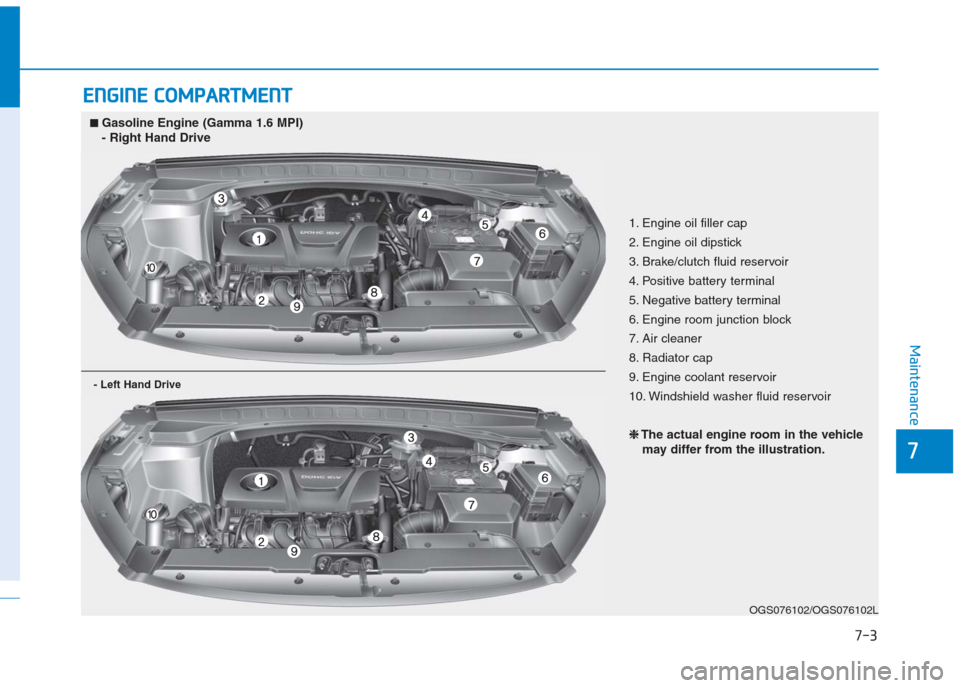
OGS076102/OGS076102L
1. Engine oil filler cap
2. Engine oil dipstick
3. Brake/clutch fluid reservoir
4. Positive battery terminal
5. Negative battery terminal
6. Engine room junction block
7. Air cleaner
8. Radiator cap
9. Engine coolant reservoir
10. Windshield washer fluid reservoir
❈ ❈
The actual engine room in the vehicle
may differ from the illustration.
■ ■Gasoline Engine (Gamma 1.6 MPI)
- Right Hand Drive
- Left Hand Drive
Page 361 of 472
7-4
Maintenance
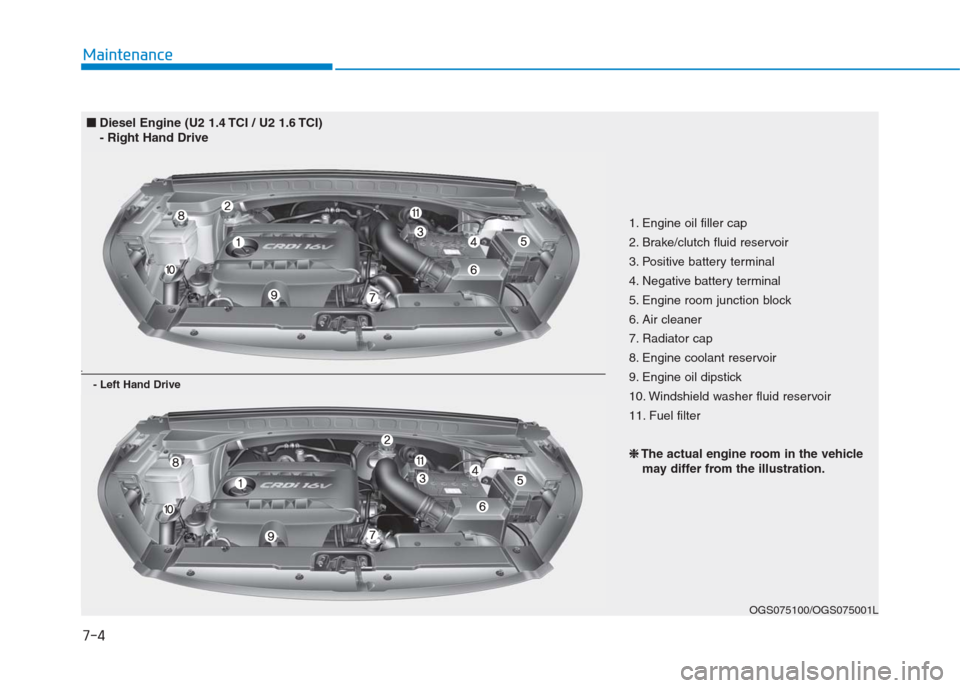
OGS075100/OGS075001L
1. Engine oil filler cap
2. Brake/clutch fluid reservoir
3. Positive battery terminal
4. Negative battery terminal
5. Engine room junction block
6. Air cleaner
7. Radiator cap
8. Engine coolant reservoir
9. Engine oil dipstick
10. Windshield washer fluid reservoir
11. Fuel filter
❈ ❈
The actual engine room in the vehicle
may differ from the illustration. ■ ■
Diesel Engine (U2 1.4 TCI / U2 1.6 TCI)
- Right Hand Drive
- Left Hand Drive
Page 363 of 472
7-6
Maintenance
• Do not put heavy objects or
apply excessive force on top of
the engine cover (if equipped) or
fuel related parts.
When you inspect the fuel sys-
tem (fuel lines and fuel injection
devices), we recommend that
you contact an authorized
HYUNDAI dealer.
Do not drive long time with
the engine cover (if equipped)
removed.
When checking the engine
room, do not go near fire. Fuel,
washer fluid, etc. are flammable
oils that may cause fire.
Before touching the battery,
ignition cables and electrical
wiring, you should disconnect
the battery "-" terminal. You may
get an electric shock from the
electric current.
(Continued)
NOTICE
Maintenance work
Performing maintenance work
on a vehicle can be danger-
ous. You can be seriously
injured while performing some
maintenance procedures. If
you lack sufficient knowledge
and experience or the proper
tools and equipment to do the
work, we recommend that the
system be serviced by an
authorized HYUNDAI dealer.
Working under the hood with
the engine running is danger-
ous. It becomes even more
dangerous when you wear
jewelry or loose clothing.
These can become entangled
in moving parts and result in
injury.
(Continued)
WARNING (Continued)
Therefore, if you must run the
engine while working under the
hood, make certain that you
remove all jewelry (especially
rings, bracelets, watches, and
necklaces) and all neckties,
scarves, and similar loose
clothing before getting near the
engine or cooling fans.
Do not leave gloves, rags or any
other combustible material in
the engine compartment. Doing
so may cause a heat-induced
fire.
WARNING
Page 365 of 472
7-8
Maintenance
O OW
WN
NE
ER
R
M
MA
AI
IN
NT
TE
EN
NA
AN
NC
CE
E
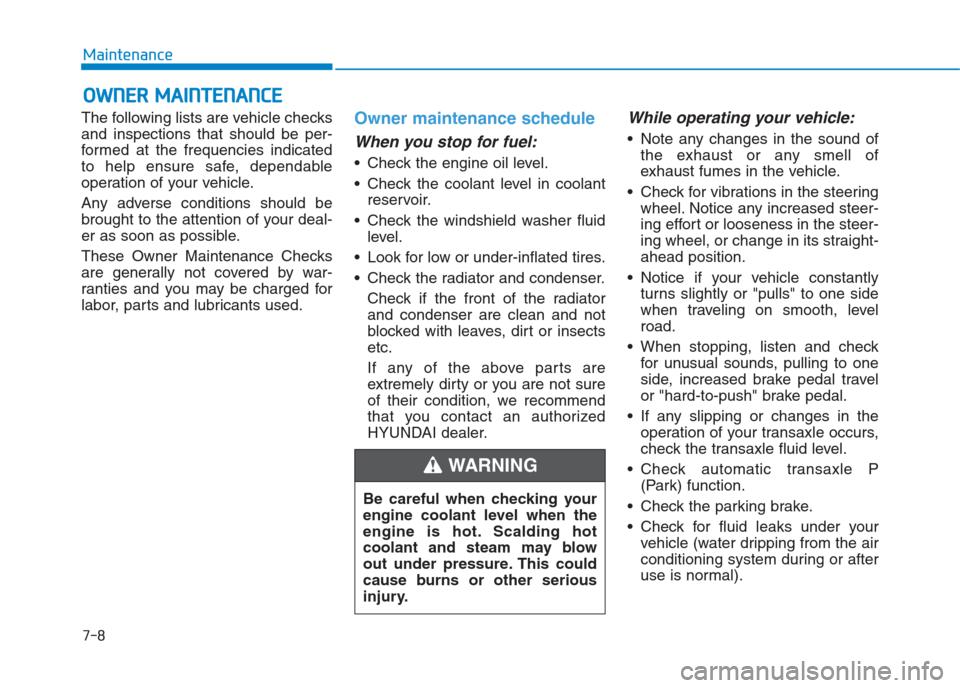
The following lists are vehicle checks
and inspections that should be per-
formed at the frequencies indicated
to help ensure safe, dependable
operation of your vehicle.
Any adverse conditions should be
brought to the attention of your deal-
er as soon as possible.
These Owner Maintenance Checks
are generally not covered by war-
ranties and you may be charged for
labor, parts and lubricants used.Owner maintenance schedule
When you stop for fuel:
• Check the engine oil level.
Check the coolant level in coolant
reservoir.
Check the windshield washer fluid
level.
Look for low or under-inflated tires.
Check the radiator and condenser.
Check if the front of the radiator
and condenser are clean and not
blocked with leaves, dirt or insects
etc.
If any of the above parts are
extremely dirty or you are not sure
of their condition, we recommend
that you contact an authorized
HYUNDAI dealer.
While operating your vehicle:
Note any changes in the sound of
the exhaust or any smell of
exhaust fumes in the vehicle.
Check for vibrations in the steering
wheel. Notice any increased steer-
ing effort or looseness in the steer-
ing wheel, or change in its straight-
ahead position.
Notice if your vehicle constantly
turns slightly or "pulls" to one side
when traveling on smooth, level
road.
When stopping, listen and check
for unusual sounds, pulling to one
side, increased brake pedal travel
or "hard-to-push" brake pedal.
If any slipping or changes in the
operation of your transaxle occurs,
check the transaxle fluid level.
Check automatic transaxle P
(Park) function.
Check the parking brake.
Check for fluid leaks under your
vehicle (water dripping from the air
conditioning system during or after
use is normal). Be careful when checking your
engine coolant level when the
engine is hot. Scalding hot
coolant and steam may blow
out under pressure. This could
cause burns or other serious
injury.
WARNING
Page 368 of 472
7-11
7
Maintenance
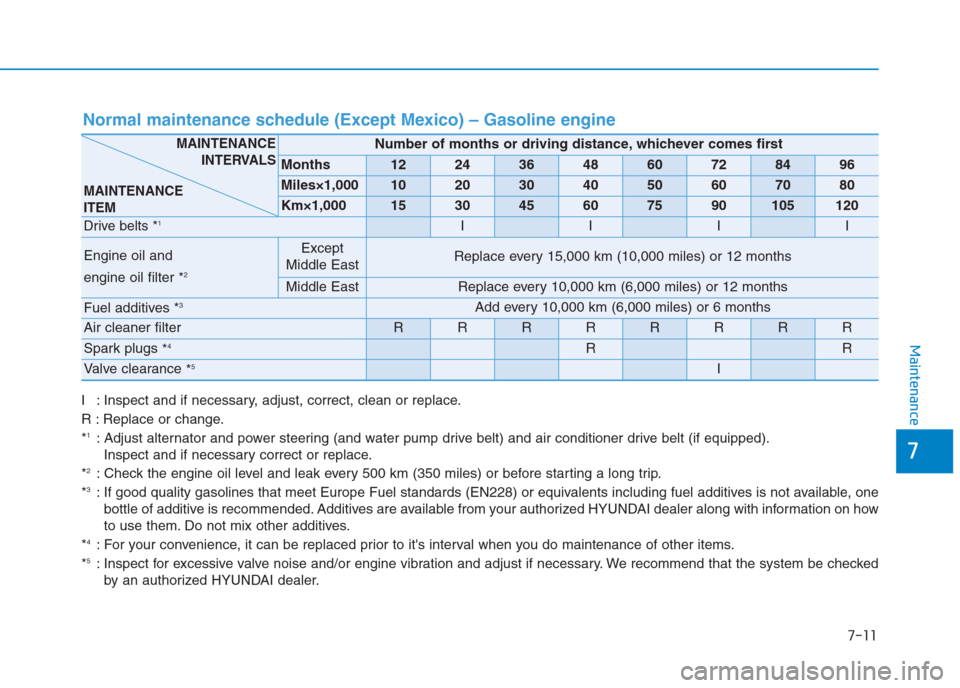
I : Inspect and if necessary, adjust, correct, clean or replace.
R : Replace or change.
*
1: Adjust alternator and power steering (and water pump drive belt) and air conditioner drive belt (if equipped).
Inspect and if necessary correct or replace.
*
2: Check the engine oil level and leak every 500 km (350 miles) or before starting a long trip.
*3: If good quality gasolines that meet Europe Fuel standards (EN228) or equivalents including fuel additives is not available, one
bottle of additive is recommended. Additives are available from your authorized HYUNDAI dealer along with information on how
to use them. Do not mix other additives.
*
4: For your convenience, it can be replaced prior to it's interval when you do maintenance of other items.
*5: Inspect for excessive valve noise and/or engine vibration and adjust if necessary. We recommend that the system be checked
by an authorized HYUNDAI dealer.
Normal maintenance schedule (Except Mexico) – Gasoline engine
Number of months or driving distance, whichever comes first
Months1224364860728496
Miles×1,0001020304050607080
Km×1,000153045607590105120
Drive belts *1IIII
Engine oil and
engine oil filter *
2
Except
Middle EastReplace every 15,000 km (10,000 miles) or 12 months
Middle EastReplace every 10,000 km (6,000 miles) or 12 months
Fuel additives *3Add every 10,000 km (6,000 miles) or 6 months
Air cleaner filterRRRRRRRR
Spark plugs
*4RR
Valve clearance
*5I
MAINTENANCE
INTERVALS
MAINTENANCE
ITEM