lock Hyundai Creta 2018 User Guide
[x] Cancel search | Manufacturer: HYUNDAI, Model Year: 2018, Model line: Creta, Model: Hyundai Creta 2018Pages: 472, PDF Size: 11.87 MB
Page 35 of 472
2-15
Safety system of your vehicle
2
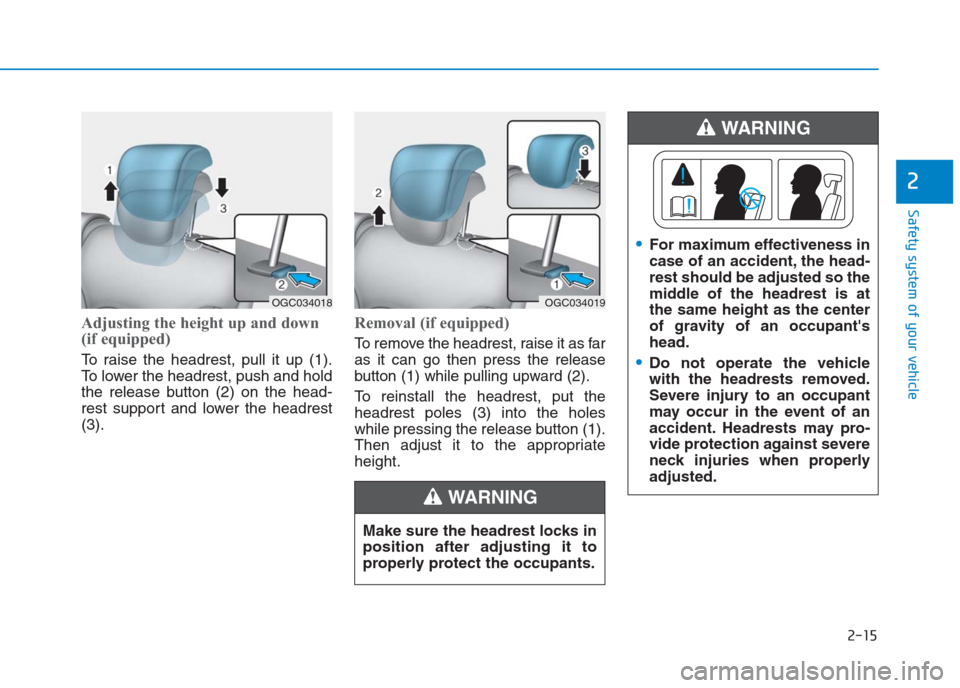
Adjusting the height up and down
(if equipped)
To raise the headrest, pull it up (1).
To lower the headrest, push and hold
the release button (2) on the head-
rest support and lower the headrest
(3).
Removal (if equipped)
To remove the headrest, raise it as far
as it can go then press the release
button (1) while pulling upward (2).
To reinstall the headrest, put the
headrest poles (3) into the holes
while pressing the release button (1).
Then adjust it to the appropriate
height.
Make sure the headrest locks in
position after adjusting it to
properly protect the occupants.
WARNING
OGC034018OGC034019
For maximum effectiveness in
case of an accident, the head-
rest should be adjusted so the
middle of the headrest is at
the same height as the center
of gravity of an occupant's
head.
Do not operate the vehicle
with the headrests removed.
Severe injury to an occupant
may occur in the event of an
accident. Headrests may pro-
vide protection against severe
neck injuries when properly
adjusted.
WARNING
Page 36 of 472
2-16
Safety system of your vehicle
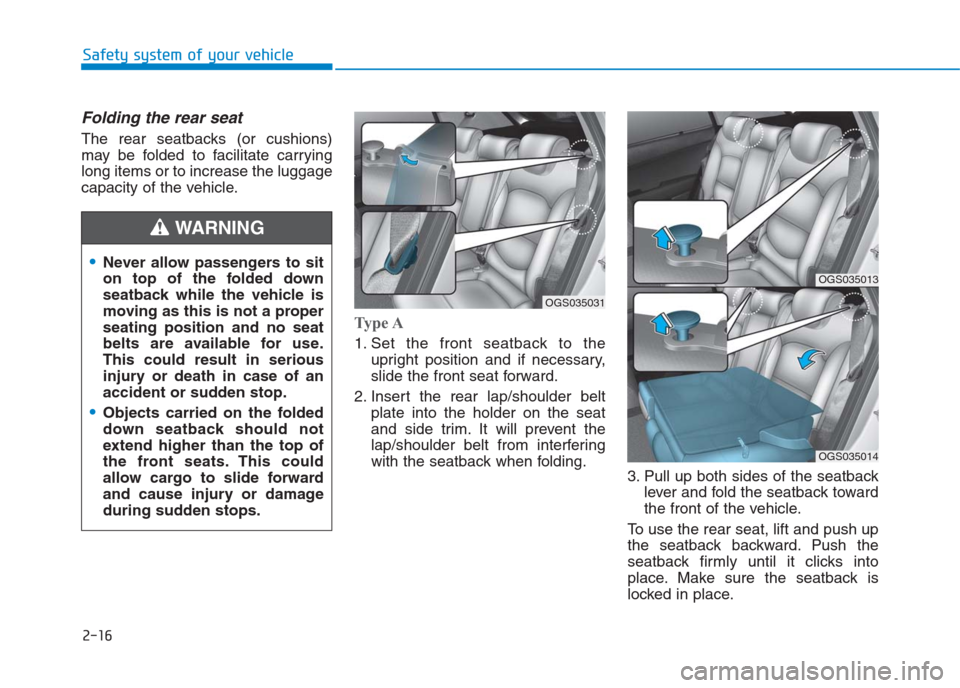
Folding the rear seat
The rear seatbacks (or cushions)
may be folded to facilitate carrying
long items or to increase the luggage
capacity of the vehicle.
Type A
1. Set the front seatback to the
upright position and if necessary,
slide the front seat forward.
2. Insert the rear lap/shoulder belt
plate into the holder on the seat
and side trim. It will prevent the
lap/shoulder belt from interfering
with the seatback when folding.
3. Pull up both sides of the seatback
lever and fold the seatback toward
the front of the vehicle.
To use the rear seat, lift and push up
the seatback backward. Push the
seatback firmly until it clicks into
place. Make sure the seatback is
locked in place.
OGS035031
OGS035013
OGS035014
Never allow passengers to sit
on top of the folded down
seatback while the vehicle is
moving as this is not a proper
seating position and no seat
belts are available for use.
This could result in serious
injury or death in case of an
accident or sudden stop.
Objects carried on the folded
down seatback should not
extend higher than the top of
the front seats. This could
allow cargo to slide forward
and cause injury or damage
during sudden stops.
WARNING
Page 37 of 472

2-17
Safety system of your vehicle
2
When returning the rear seatbacks to
the upright position, remember to
return the rear shoulder belts to their
proper position.
Type B
1. Insert the rear seat belt webbing in
the guide to prevent the seat belt
from being damaged.
2. Set the front seatback to the
upright position and if necessary,
slide the front seat forward.
3. Lower the rear headrests to the
lowest position.4. Pull up the seatback lever, then
fold the seat toward the front of the
vehicle.5. To use the rear seat, lift and push
up the seatback backward. Push
the seatback firmly until it clicks
into place. Make sure the seatback
is locked in place.
When returning the rear seatbacks to
the upright position, remember to
return the rear shoulder belts to their
proper position.
OGC034006
OGS035037OGC034009
Page 38 of 472
2-18
Safety system of your vehicle
When returning the rear seat-
backs to the upright position,
remember to return the rear
shoulder belts to their proper
position.
Routing the seat belt webbing
through the rear seat belt guides
will help keep the seat belts from
being trapped behind or under
the seats.
NOTICE
Cargo
Cargo should always be secured
to prevent it from being thrown
about the vehicle in a collision
and causing injury to the vehicle
occupants. Do not place objects
in the rear seats, since they can-
not be properly secured and may
hit the front seat occupants in a
collision.
WARNING
When you return the rear seat-
back to its upright position after
being folded down:
Be careful not to damage the
seat belt webbing or buckle. Do
not allow the seat belt webbing
or buckle to get caught or
pinched in the rear seat. Ensure
that the seatback is completely
locked into its upright position
by pushing on the top of the
seatback. Otherwise, in an acci-
dent or sudden stop, the seat
could fold down and allow
cargo to enter the passenger
compartment, which could
result in serious injury or death.
WARNING
Cargo loading
Make sure the engine is off, the
manual transaxle is in R
(Reverse) or 1st, and the parking
brake is securely applied when-
ever loading or unloading cargo.
Failure to take these steps may
allow the vehicle to move if the
shift lever is inadvertently moved
to another position.
WARNING
Page 41 of 472
2-21
Safety system of your vehicle
2
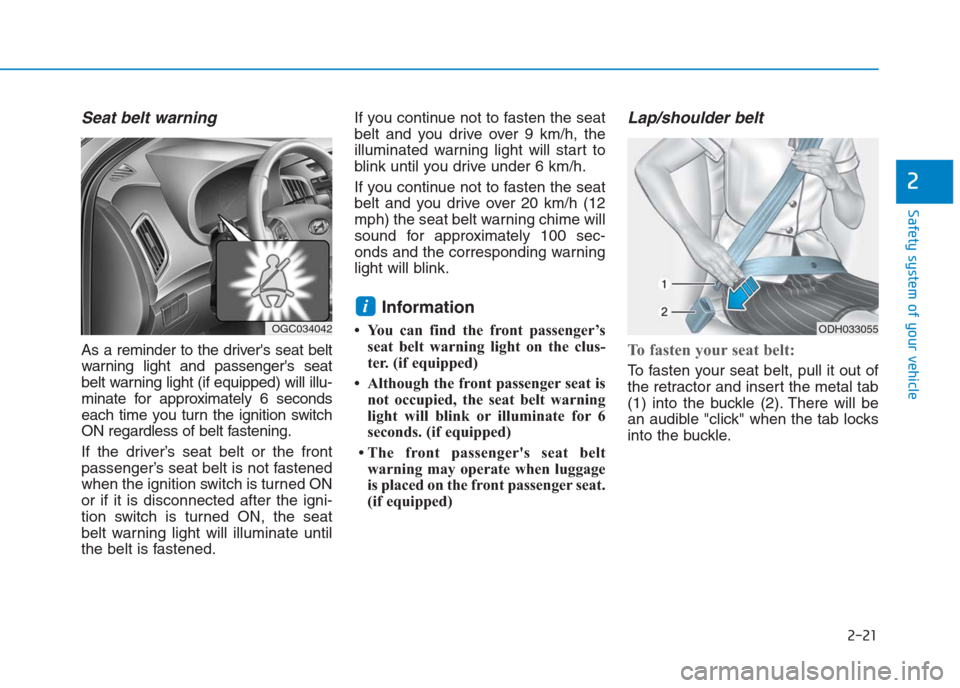
Seat belt warning
As a reminder to the driver's seat belt
warning light and passenger's seat
belt warning light (if equipped) will illu-
minate for approximately 6 seconds
each time you turn the ignition switch
ON regardless of belt fastening.
If the driver’s seat belt or the front
passenger’s seat belt is not fastened
when the ignition switch is turned ON
or if it is disconnected after the igni-
tion switch is turned ON, the seat
belt warning light will illuminate until
the belt is fastened.If you continue not to fasten the seat
belt and you drive over 9 km/h, the
illuminated warning light will start to
blink until you drive under 6 km/h.
If you continue not to fasten the seat
belt and you drive over 20 km/h (12
mph) the seat belt warning chime will
sound for approximately 100 sec-
onds and the corresponding warning
light will blink.
Information
• You can find the front passenger’s
seat belt warning light on the clus-
ter. (if equipped)
• Although the front passenger seat is
not occupied, the seat belt warning
light will blink or illuminate for 6
seconds. (if equipped)
• The front passenger's seat belt
warning may operate when luggage
is placed on the front passenger seat.
(if equipped)
Lap/shoulder belt
To fasten your seat belt:
To fasten your seat belt, pull it out of
the retractor and insert the metal tab
(1) into the buckle (2). There will be
an audible "click" when the tab locks
into the buckle.
i
OGC034042ODH033055
Page 42 of 472
2-22
Safety system of your vehicle
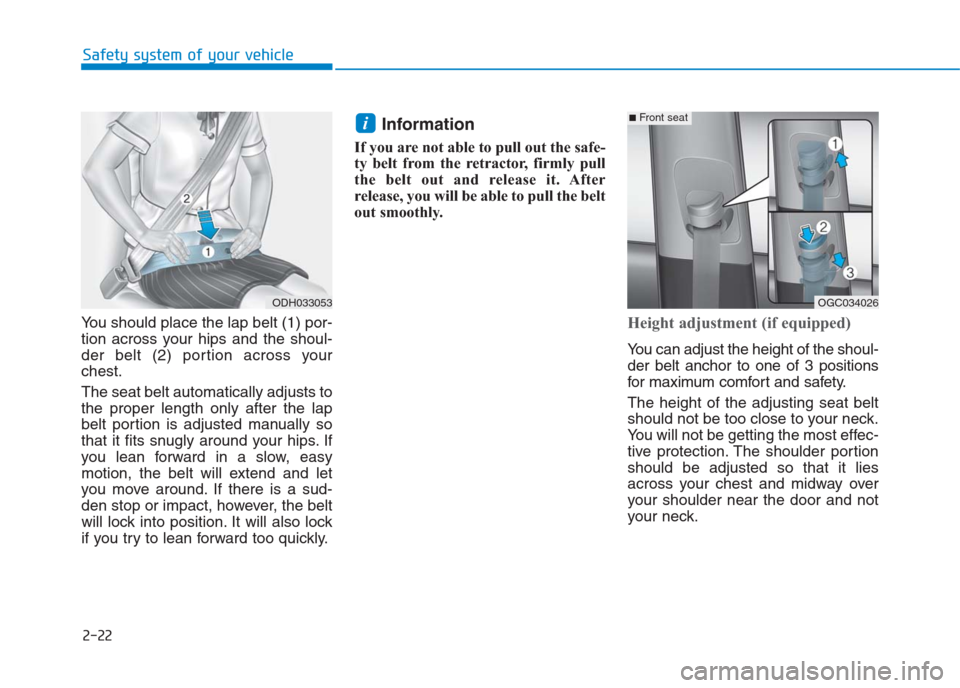
You should place the lap belt (1) por-
tion across your hips and the shoul-
der belt (2) portion across your
chest.
The seat belt automatically adjusts to
the proper length only after the lap
belt portion is adjusted manually so
that it fits snugly around your hips. If
you lean forward in a slow, easy
motion, the belt will extend and let
you move around. If there is a sud-
den stop or impact, however, the belt
will lock into position. It will also lock
if you try to lean forward too quickly.
Information
If you are not able to pull out the safe-
ty belt from the retractor, firmly pull
the belt out and release it. After
release, you will be able to pull the belt
out smoothly.
Height adjustment (if equipped)
You can adjust the height of the shoul-
der belt anchor to one of 3 positions
for maximum comfort and safety.
The height of the adjusting seat belt
should not be too close to your neck.
You will not be getting the most effec-
tive protection. The shoulder portion
should be adjusted so that it lies
across your chest and midway over
your shoulder near the door and not
your neck.
i
OGC034026
■Front seat
ODH033053
Page 43 of 472
2-23
Safety system of your vehicle
2
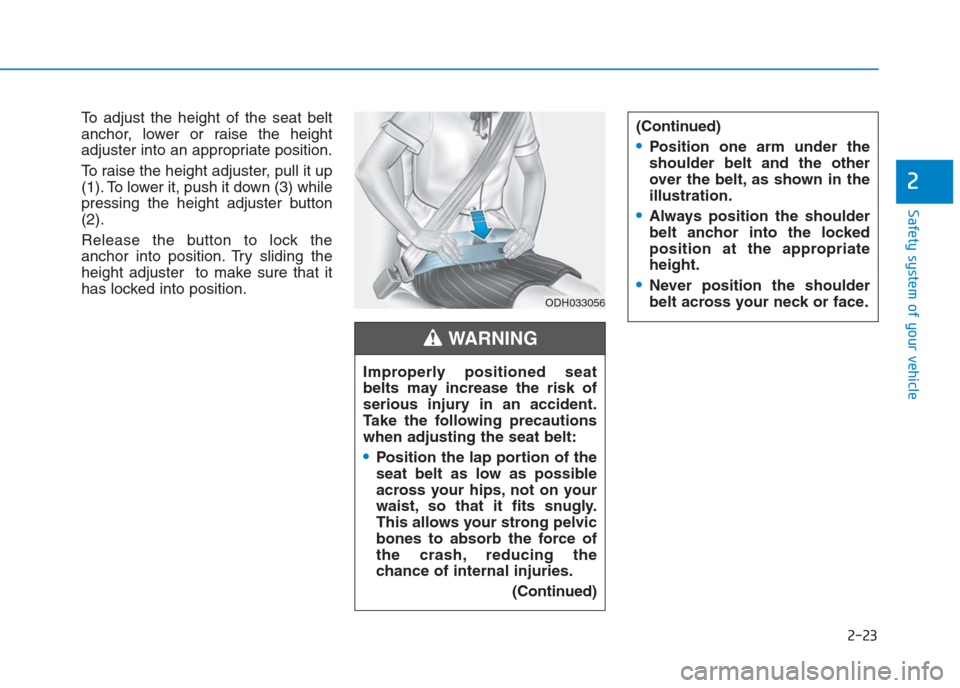
To adjust the height of the seat belt
anchor, lower or raise the height
adjuster into an appropriate position.
To raise the height adjuster, pull it up
(1). To lower it, push it down (3) while
pressing the height adjuster button
(2).
Release the button to lock the
anchor into position. Try sliding the
height adjuster to make sure that it
has locked into position.
ODH033056
Improperly positioned seat
belts may increase the risk of
serious injury in an accident.
Take the following precautions
when adjusting the seat belt:
Position the lap portion of the
seat belt as low as possible
across your hips, not on your
waist, so that it fits snugly.
This allows your strong pelvic
bones to absorb the force of
the crash, reducing the
chance of internal injuries.
(Continued)
WARNING
(Continued)
Position one arm under the
shoulder belt and the other
over the belt, as shown in the
illustration.
Always position the shoulder
belt anchor into the locked
position at the appropriate
height.
Never position the shoulder
belt across your neck or face.
Page 44 of 472
2-24
Safety system of your vehicle
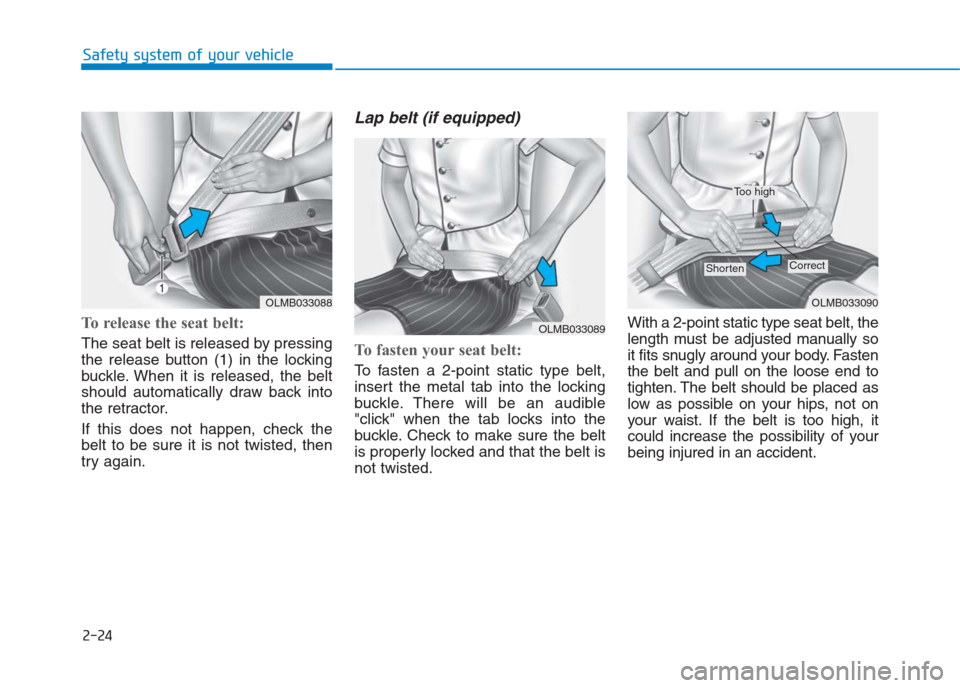
To release the seat belt:
The seat belt is released by pressing
the release button (1) in the locking
buckle. When it is released, the belt
should automatically draw back into
the retractor.
If this does not happen, check the
belt to be sure it is not twisted, then
try again.
Lap belt (if equipped)
To fasten your seat belt:
To fasten a 2-point static type belt,
insert the metal tab into the locking
buckle. There will be an audible
"click" when the tab locks into the
buckle. Check to make sure the belt
is properly locked and that the belt is
not twisted.With a 2-point static type seat belt, the
length must be adjusted manually so
it fits snugly around your body. Fasten
the belt and pull on the loose end to
tighten. The belt should be placed as
low as possible on your hips, not on
your waist. If the belt is too high, it
could increase the possibility of your
being injured in an accident.
OLMB033089
OLMB033090
Too high
ShortenCorrect
OLMB033088
Page 45 of 472
2-25
Safety system of your vehicle
2
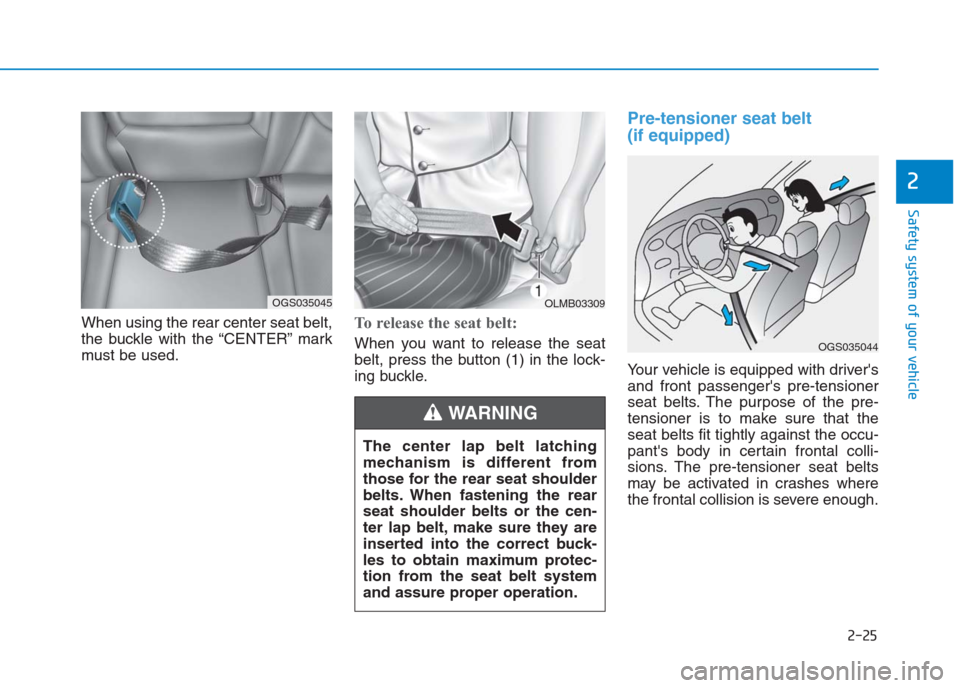
When using the rear center seat belt,
the buckle with the “CENTER” mark
must be used.To release the seat belt:
When you want to release the seat
belt, press the button (1) in the lock-
ing buckle.
Pre-tensioner seat belt
(if equipped)
Your vehicle is equipped with driver's
and front passenger's pre-tensioner
seat belts. The purpose of the pre-
tensioner is to make sure that the
seat belts fit tightly against the occu-
pant's body in certain frontal colli-
sions. The pre-tensioner seat belts
may be activated in crashes where
the frontal collision is severe enough.
OGS035044
The center lap belt latching
mechanism is different from
those for the rear seat shoulder
belts. When fastening the rear
seat shoulder belts or the cen-
ter lap belt, make sure they are
inserted into the correct buck-
les to obtain maximum protec-
tion from the seat belt system
and assure proper operation.
WARNING
OLMB03309OGS035045
Page 46 of 472
2-26
Safety system of your vehicle
When the vehicle stops suddenly, or
if the occupant tries to lean forward
too quickly, the seat belt retractor will
lock into position. In certain frontal
collisions, the pre-tensioner will acti-
vate and pull the seat belt into tighter
contact against the occupant's body.
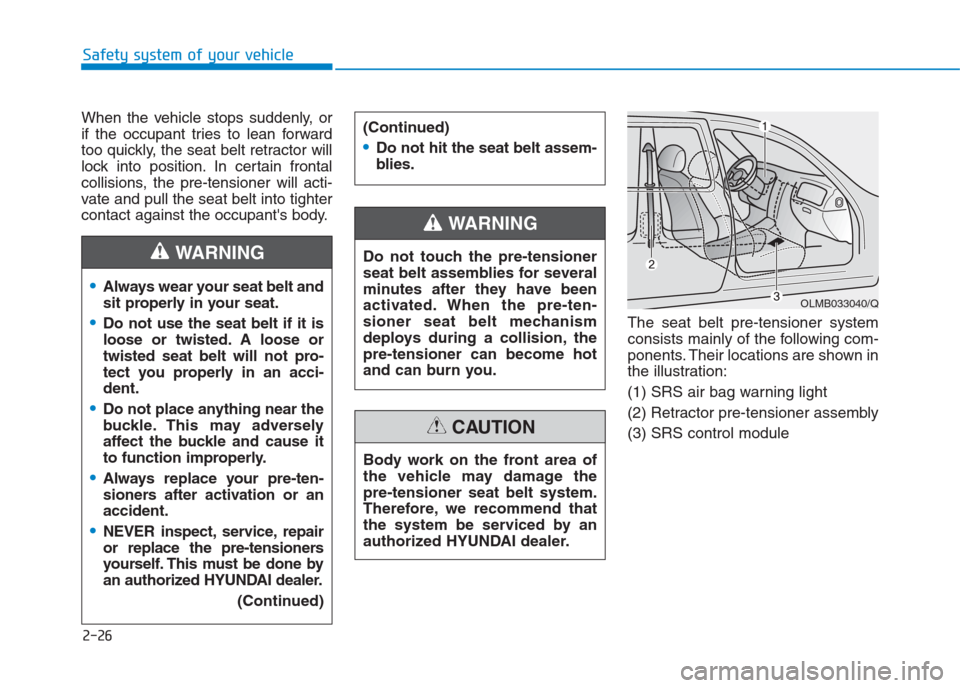
The seat belt pre-tensioner system
consists mainly of the following com-
ponents. Their locations are shown in
the illustration:
(1) SRS air bag warning light
(2) Retractor pre-tensioner assembly
(3) SRS control module (Continued)
Do not hit the seat belt assem-
blies.
Do not touch the pre-tensioner
seat belt assemblies for several
minutes after they have been
activated. When the pre-ten-
sioner seat belt mechanism
deploys during a collision, the
pre-tensioner can become hot
and can burn you.
WARNING
Body work on the front area of
the vehicle may damage the
pre-tensioner seat belt system.
Therefore, we recommend that
the system be serviced by an
authorized HYUNDAI dealer.
CAUTION
OLMB033040/Q
Always wear your seat belt and
sit properly in your seat.
Do not use the seat belt if it is
loose or twisted. A loose or
twisted seat belt will not pro-
tect you properly in an acci-
dent.
Do not place anything near the
buckle. This may adversely
affect the buckle and cause it
to function improperly.
Always replace your pre-ten-
sioners after activation or an
accident.
NEVER inspect, service, repair
or replace the pre-tensioners
yourself. This must be done by
an authorized HYUNDAI dealer.
(Continued)
WARNING