engine oil Hyundai Creta 2018 Owner's Guide
[x] Cancel search | Manufacturer: HYUNDAI, Model Year: 2018, Model line: Creta, Model: Hyundai Creta 2018Pages: 472, PDF Size: 11.87 MB
Page 389 of 472
7-32
Maintenance
E EN
NG
GI
IN
NE
E
O
OI
IL
L
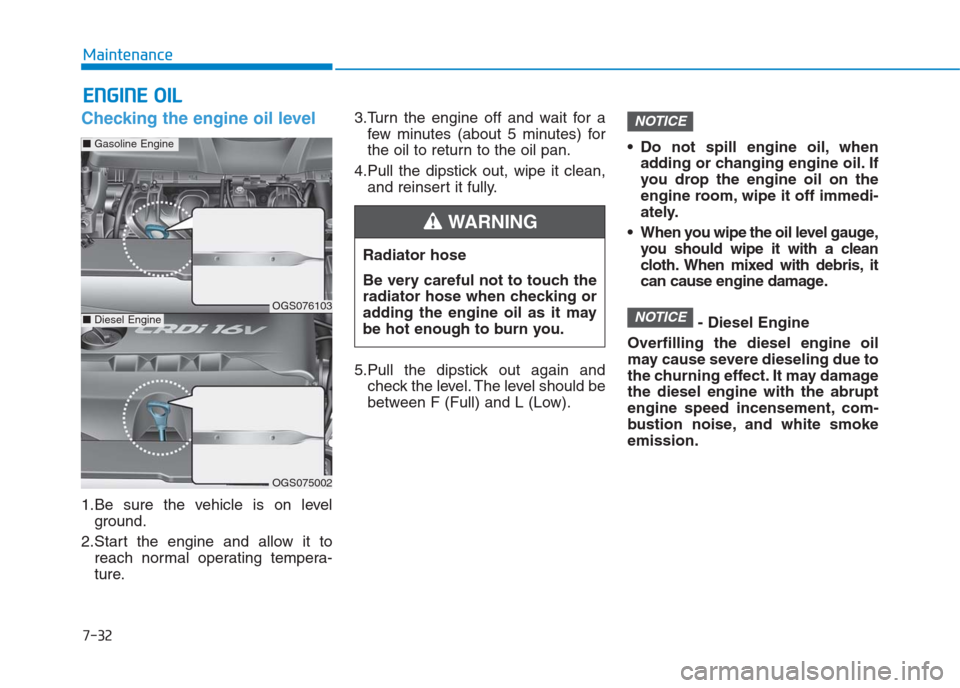
Checking the engine oil level
1.Be sure the vehicle is on level
ground.
2.Start the engine and allow it to
reach normal operating tempera-
ture.3.Turn the engine off and wait for a
few minutes (about 5 minutes) for
the oil to return to the oil pan.
4.Pull the dipstick out, wipe it clean,
and reinsert it fully.
5.Pull the dipstick out again and
check the level. The level should be
between F (Full) and L (Low). Do not spill engine oil, when
adding or changing engine oil. If
you drop the engine oil on the
engine room, wipe it off immedi-
ately.
When you wipe the oil level gauge,
you should wipe it with a clean
cloth. When mixed with debris, it
can cause engine damage.
- Diesel Engine
Overfilling the diesel engine oil
may cause severe dieseling due to
the churning effect. It may damage
the diesel engine with the abrupt
engine speed incensement, com-
bustion noise, and white smoke
emission.
NOTICE
NOTICE
Radiator hose
Be very careful not to touch the
radiator hose when checking or
adding the engine oil as it may
be hot enough to burn you.
WARNING
OGS076103
OGS075002
■Gasoline Engine
■Diesel Engine
Page 390 of 472
7-33
7
Maintenance
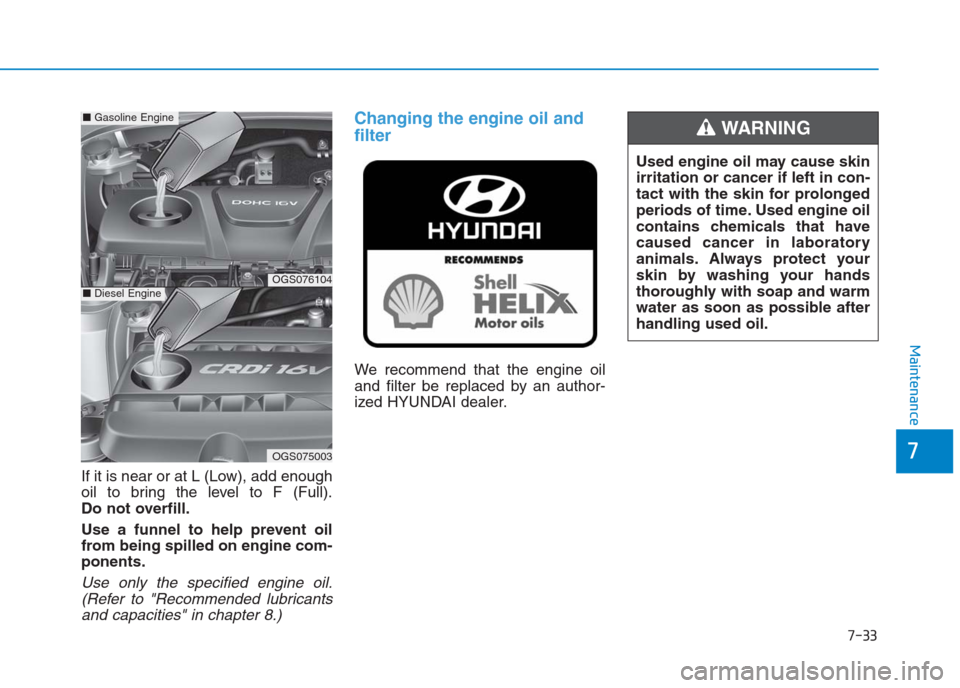
If it is near or at L (Low), add enough
oil to bring the level to F (Full).
Do not overfill.
Use a funnel to help prevent oil
from being spilled on engine com-
ponents.
Use only the specified engine oil.
(Refer to "Recommended lubricants
and capacities" in chapter 8.)
Changing the engine oil and
filter
We recommend that the engine oil
and filter be replaced by an author-
ized HYUNDAI dealer.
Used engine oil may cause skin
irritation or cancer if left in con-
tact with the skin for prolonged
periods of time. Used engine oil
contains chemicals that have
caused cancer in laboratory
animals. Always protect your
skin by washing your hands
thoroughly with soap and warm
water as soon as possible after
handling used oil.
WARNING
OGS076104
OGS075003
■Gasoline Engine
■Diesel Engine
Page 395 of 472
7-38
Maintenance
Do not allow brake/clutch fluid to
contact the vehicle's body paint,
as paint damage will result.
Brake/clutch fluid, which has been
exposed to open air for an extend-
ed time should never be used as
its quality cannot be guaranteed. It
should be properly disposed.
Don't put in the wrong kind of
fluid. A few drops of mineral-
based oil, such as engine oil, in
your brake/clutch system can dam-
age brake/clutch system parts.
NOTICE
Brake/clutch fluid
When changing and adding
brake/clutch fluid, handle it
carefully. Do not let it come in
contact with your eyes. If
brake/clutch fluid come in con-
tact with your eyes, immediately
flush them with a large quantity
of fresh tap water. Have your
eyes examined by a doctor as
soon as possible.
WARNING
Page 407 of 472
7-50
Maintenance
Reset items
Items should be reset after the bat-
tery has been discharged or the bat-
tery has been disconnected.
Auto up/down window
(See chapter 3)
Climate control system
(See chapter 3)
Audio (See chapter 3)
Clock (See chapter3)
Trip computer (See chapter 3) When recharging the battery,
observe the following precau-
tions:
Before performing maintenance
or recharging the battery, turn
off all accessories and stop the
engine.
Do not allow cigarettes, sparks,
or flame near the battery.
Wear eye protection when
checking the battery during
charging.
The battery must be removed
from the vehicle and placed in
an area with good ventilation.
Watch the battery during
charging, and stop or reduce
the charging rate if the battery
cells begin gassing (boiling)
violently or if the temperature
of the electrolyte of any cell
exceeds 49°C (120°F).
(Continued)
WARNING (Continued)
The negative battery cable
must be removed first and
installed last when the battery
is disconnected.
Disconnect the battery charger
in the following order.
1. Turn off the battery charger
main switch.
2. Unhook the negative clamp
from the negative battery
terminal.
3. Unhook the positive clamp
from the positive battery
terminal.
Page 420 of 472
7-63
7
Maintenance
F FU
US
SE
ES
S
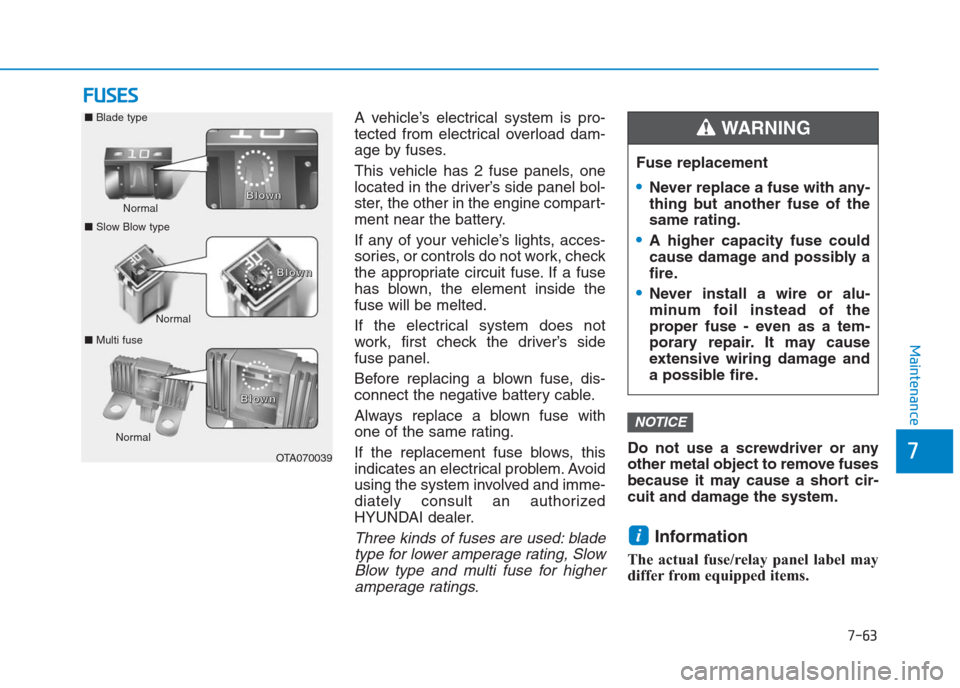
A vehicle’s electrical system is pro-
tected from electrical overload dam-
age by fuses.
This vehicle has 2 fuse panels, one
located in the driver’s side panel bol-
ster, the other in the engine compart-
ment near the battery.
If any of your vehicle’s lights, acces-
sories, or controls do not work, check
the appropriate circuit fuse. If a fuse
has blown, the element inside the
fuse will be melted.
If the electrical system does not
work, first check the driver’s side
fuse panel.
Before replacing a blown fuse, dis-
connect the negative battery cable.
Always replace a blown fuse with
one of the same rating.
If the replacement fuse blows, this
indicates an electrical problem. Avoid
using the system involved and imme-
diately consult an authorized
HYUNDAI dealer.
Three kinds of fuses are used: blade
type for lower amperage rating, Slow
Blow type and multi fuse for higher
amperage ratings.
Do not use a screwdriver or any
other metal object to remove fuses
because it may cause a short cir-
cuit and damage the system.
Information
The actual fuse/relay panel label may
differ from equipped items.
i
NOTICE
OTA070039 Normal Normal
■Slow Blow type
■Multi fuseB B B B
l l l l
o o o o
w w w w
n n n n
Normal ■Blade type
B B B B
l l l l
o o o o
w w w w
n n n n
B B B B
l l l l
o o o o
w w w w
n n n n
Fuse replacement
Never replace a fuse with any-
thing but another fuse of the
same rating.
A higher capacity fuse could
cause damage and possibly a
fire.
Never install a wire or alu-
minum foil instead of the
proper fuse - even as a tem-
porary repair. It may cause
extensive wiring damage and
a possible fire.
WARNING
Page 446 of 472
7-89
7
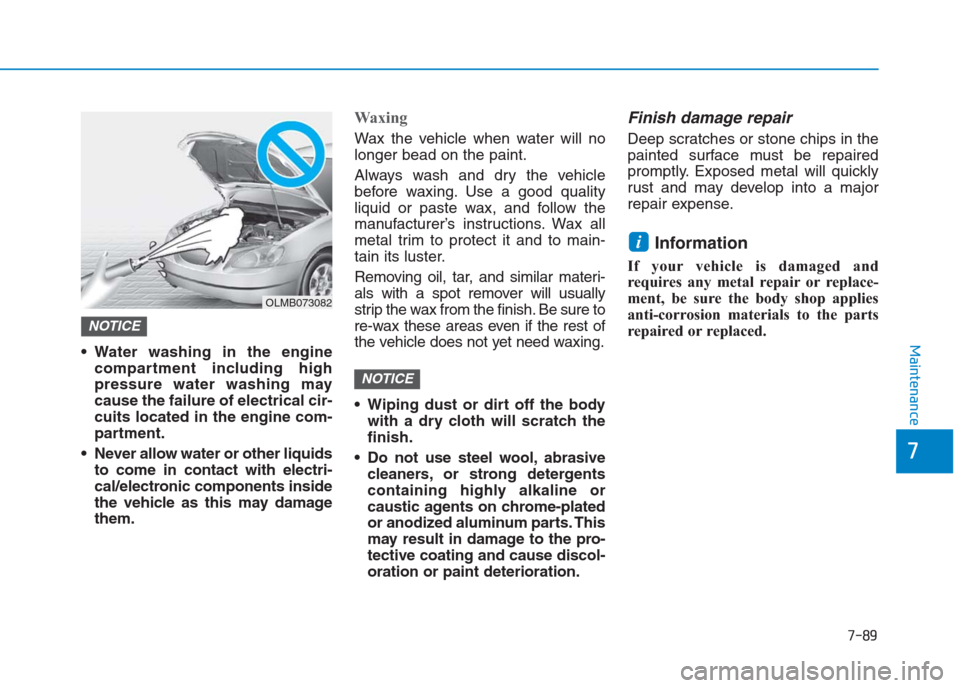
Maintenance Water washing in the engine
compartment including high
pressure water washing may
cause the failure of electrical cir-
cuits located in the engine com-
partment.
Never allow water or other liquids
to come in contact with electri-
cal/electronic components inside
the vehicle as this may damage
them.
Waxing
Wax the vehicle when water will no
longer bead on the paint.
Always wash and dry the vehicle
before waxing. Use a good quality
liquid or paste wax, and follow the
manufacturer’s instructions. Wax all
metal trim to protect it and to main-
tain its luster.
Removing oil, tar, and similar materi-
als with a spot remover will usually
strip the wax from the finish. Be sure to
re-wax these areas even if the rest of
the vehicle does not yet need waxing.
Wiping dust or dirt off the body
with a dry cloth will scratch the
finish.
Do not use steel wool, abrasive
cleaners, or strong detergents
containing highly alkaline or
caustic agents on chrome-plated
or anodized aluminum parts. This
may result in damage to the pro-
tective coating and cause discol-
oration or paint deterioration.
Finish damage repair
Deep scratches or stone chips in the
painted surface must be repaired
promptly. Exposed metal will quickly
rust and may develop into a major
repair expense.
Information
If your vehicle is damaged and
requires any metal repair or replace-
ment, be sure the body shop applies
anti-corrosion materials to the parts
repaired or replaced.
i
NOTICE
NOTICE
OLMB073082
Page 459 of 472
8-5
8
Specifications & Consumer information
R RE
EC
CO
OM
MM
ME
EN
ND
DE
ED
D
L
LU
UB
BR
RI
IC
CA
AN
NT
TS
S
A
AN
ND
D
C
CA
AP
PA
AC
CI
IT
TI
IE
ES
S
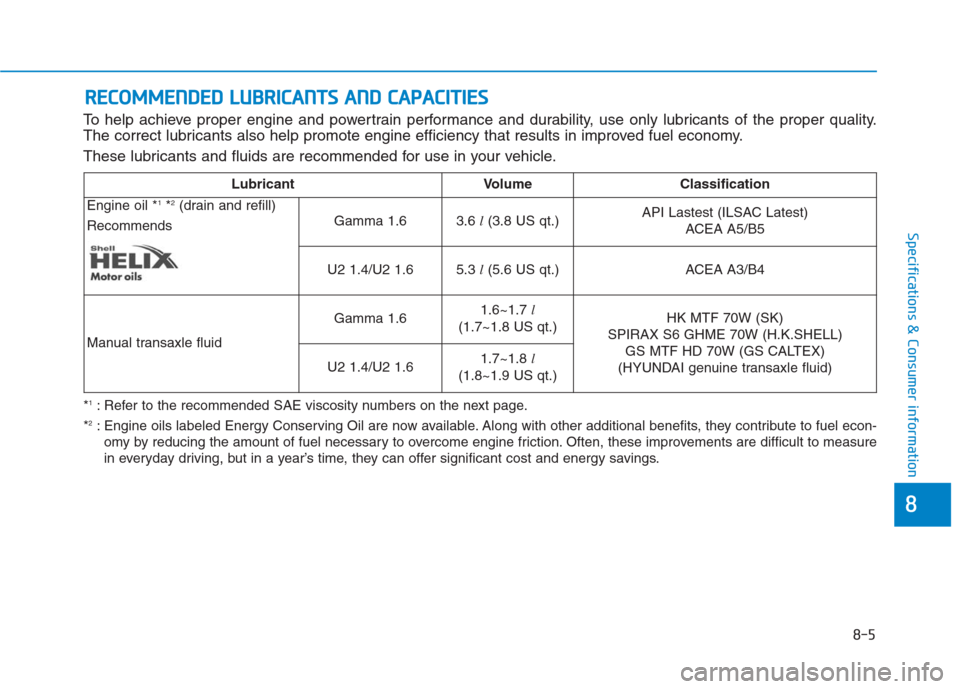
To help achieve proper engine and powertrain performance and durability, use only lubricants of the proper quality.
The correct lubricants also help promote engine efficiency that results in improved fuel economy.
These lubricants and fluids are recommended for use in your vehicle.
Lubricant Volume Classification
Engine oil *
1*2(drain and refill)
RecommendsGamma 1.63.6 l(3.8 US qt.)API Lastest (ILSAC Latest)
ACEA A5/B5
U2 1.4/U2 1.65.3 l(5.6 US qt.)ACEA A3/B4
Manual transaxle fluidGamma 1.61.6~1.7 l
(1.7~1.8 US qt.)HK MTF 70W (SK)
SPIRAX S6 GHME 70W (H.K.SHELL)
GS MTF HD 70W (GS CALTEX)
(HYUNDAI genuine transaxle fluid) U2 1.4/U2 1.61.7~1.8 l
(1.8~1.9 US qt.)
*1: Refer to the recommended SAE viscosity numbers on the next page.
*
2: Engine oils labeled Energy Conserving Oil are now available. Along with other additional benefits, they contribute to fuel econ-
omy by reducing the amount of fuel necessary to overcome engine friction. Often, these improvements are difficult to measure
in everyday driving, but in a year’s time, they can offer significant cost and energy savings.
Page 461 of 472
8-7
8
Specifications & Consumer information
Recommended SAE viscosity
number
Engine oil viscosity (thickness) has
an effect on fuel economy and cold
weather operating (engine start and
engine oil flowability). Lower viscosi-
ty engine oils can provide better fuel
economy and cold weather perform-
ance, however, higher viscosity
engine oils are required for satisfac-
tory lubrication in hot weather. Using
oils of any viscosity other than those
recommended could result in engine
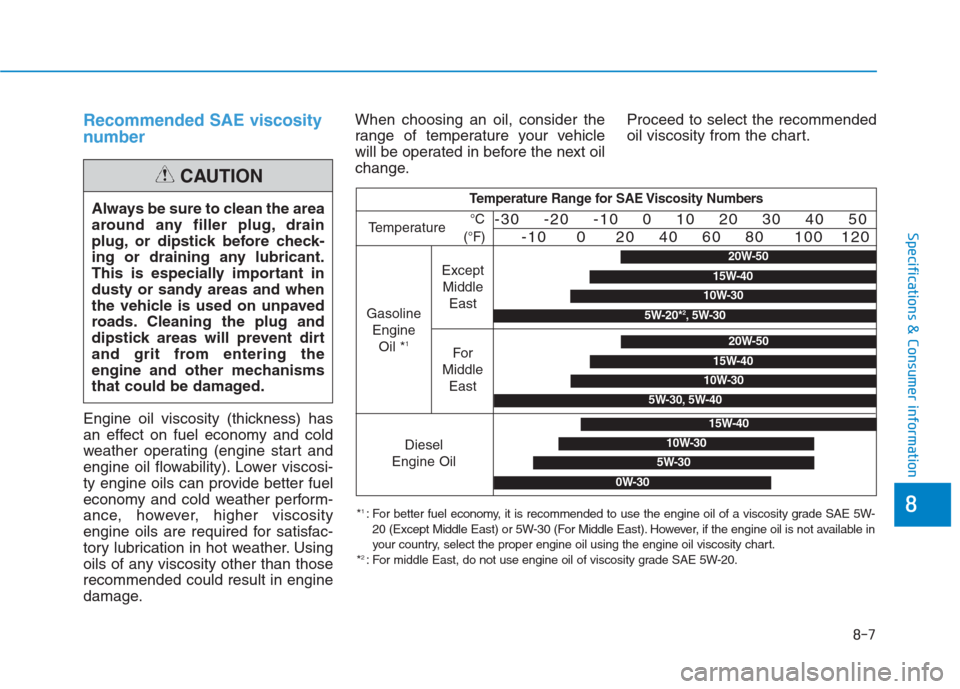
damage.When choosing an oil, consider the
range of temperature your vehicle
will be operated in before the next oil
change.Proceed to select the recommended
oil viscosity from the chart.
Always be sure to clean the area
around any filler plug, drain
plug, or dipstick before check-
ing or draining any lubricant.
This is especially important in
dusty or sandy areas and when
the vehicle is used on unpaved
roads. Cleaning the plug and
dipstick areas will prevent dirt
and grit from entering the
engine and other mechanisms
that could be damaged.
CAUTION
Temperature Range for SAE Viscosity Numbers
Temperature°C
(°F)-30 -20 -10 0 10 20 30 40 50
-10 0 20 40 60 80 100 120
Diesel
Engine Oil
5W-30
15W-40
10W-30
0W-30
*1 : For better fuel economy, it is recommended to use the engine oil of a viscosity grade SAE 5W-
20 (Except Middle East) or 5W-30 (For Middle East). However, if the engine oil is not available in
your country, select the proper engine oil using the engine oil viscosity chart.
*
2 : For middle East, do not use engine oil of viscosity grade SAE 5W-20.
Gasoline
Engine
Oil *
1
20W-50
10W-30
15W-40
5W-20*2, 5W-30
20W-50
10W-30
15W-40
5W-30, 5W-40
Except
Middle
East
For
Middle
East
Page 468 of 472
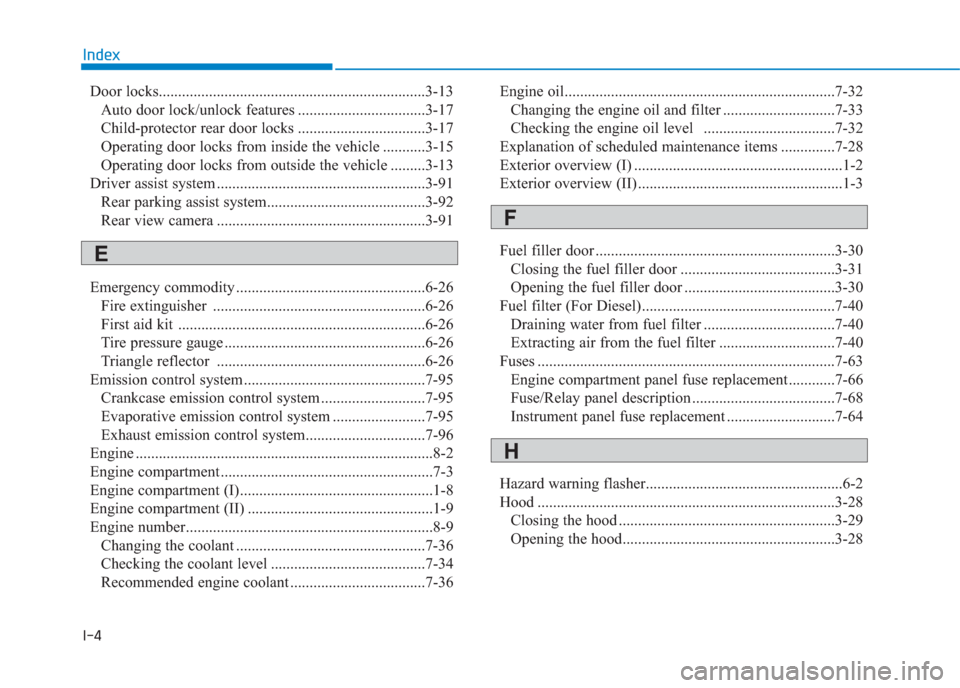
I-4
Door locks.....................................................................3-13
Auto door lock/unlock features .................................3-17
Child-protector rear door locks .................................3-17
Operating door locks from inside the vehicle ...........3-15
Operating door locks from outside the vehicle .........3-13
Driver assist system ......................................................3-91
Rear parking assist system.........................................3-92
Rear view camera ......................................................3-91
Emergency commodity .................................................6-26
Fire extinguisher .......................................................6-26
First aid kit ................................................................6-26
Tire pressure gauge ....................................................6-26
Triangle reflector ......................................................6-26
Emission control system ...............................................7-95
Crankcase emission control system ...........................7-95
Evaporative emission control system ........................7-95
Exhaust emission control system...............................7-96
Engine .............................................................................8-2
Engine compartment .......................................................7-3
Engine compartment (I)..................................................1-8
Engine compartment (II) ................................................1-9
Engine number................................................................8-9
Changing the coolant .................................................7-36
Checking the coolant level ........................................7-34
Recommended engine coolant ...................................7-36Engine oil......................................................................7-32
Changing the engine oil and filter .............................7-33
Checking the engine oil level ..................................7-32
Explanation of scheduled maintenance items ..............7-28
Exterior overview (I) ......................................................1-2
Exterior overview (II) .....................................................1-3
Fuel filler door ..............................................................3-30
Closing the fuel filler door ........................................3-31
Opening the fuel filler door .......................................3-30
Fuel filter (For Diesel)..................................................7-40
Draining water from fuel filter ..................................7-40
Extracting air from the fuel filter ..............................7-40
Fuses .............................................................................7-63
Engine compartment panel fuse replacement ............7-66
Fuse/Relay panel description .....................................7-68
Instrument panel fuse replacement ............................7-64
Hazard warning flasher...................................................6-2
Hood .............................................................................3-28
Closing the hood ........................................................3-29
Opening the hood.......................................................3-28
Index
E
F
H