Air bag Hyundai Creta 2018 Owner's Manual
[x] Cancel search | Manufacturer: HYUNDAI, Model Year: 2018, Model line: Creta, Model: Hyundai Creta 2018Pages: 472, PDF Size: 11.87 MB
Page 17 of 472
1-6
Your vehicle at a glance
I IN
NS
ST
TR
RU
UM
ME
EN
NT
T
P
PA
AN
NE
EL
L
O
OV
VE
ER
RV
VI
IE
EW
W
(
(I
I)
)
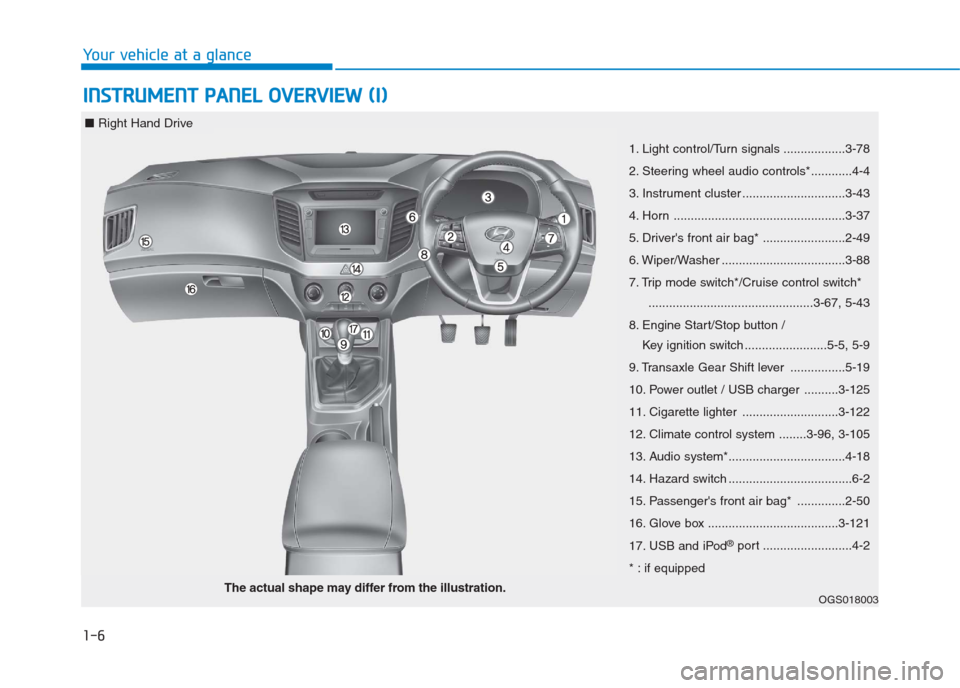
1. Light control/Turn signals ..................3-78
2. Steering wheel audio controls*............4-4
3. Instrument cluster ..............................3-43
4. Horn ..................................................3-37
5. Driver's front air bag* ........................2-49
6. Wiper/Washer ....................................3-88
7. Trip mode switch*/Cruise control switch*
................................................3-67, 5-43
8. Engine Start/Stop button /
Key ignition switch ........................5-5, 5-9
9. Transaxle Gear Shift lever ................5-19
10. Power outlet / USB charger ..........3-125
11. Cigarette lighter ............................3-122
12. Climate control system ........3-96, 3-105
13. Audio system*..................................4-18
14. Hazard switch ....................................6-2
15. Passenger's front air bag* ..............2-50
16. Glove box ......................................3-121
17. USB and iPod
®port ..........................4-2
* : if equipped
OGS018003The actual shape may differ from the illustration.
■Right Hand Drive
Page 18 of 472
1-7
Your vehicle at a glance
I IN
NS
ST
TR
RU
UM
ME
EN
NT
T
P
PA
AN
NE
EL
L
O
OV
VE
ER
RV
VI
IE
EW
W
(
(I
II
I)
)
1
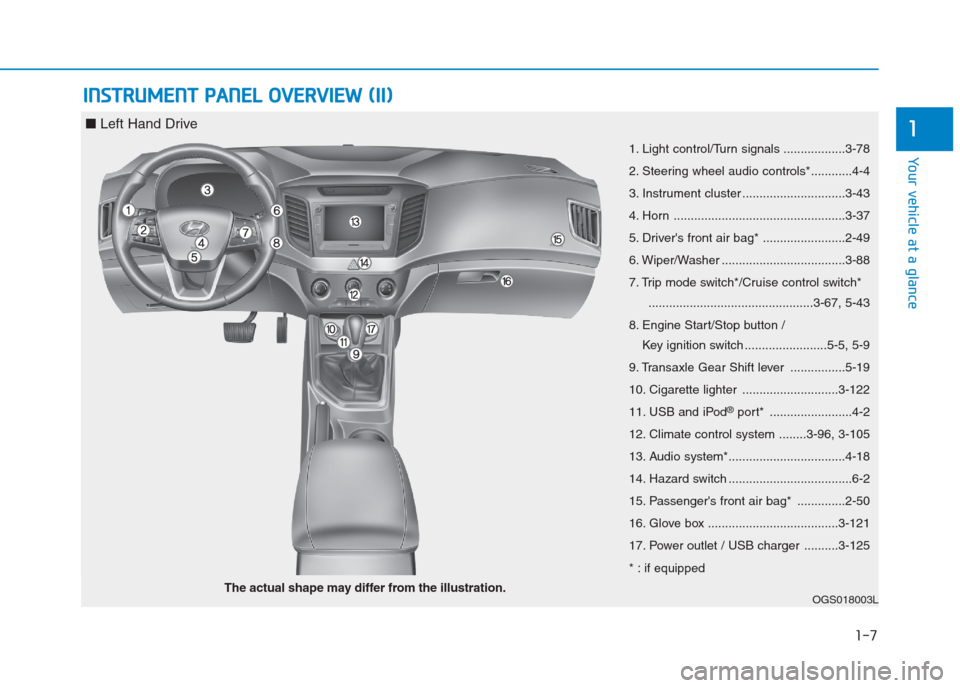
1. Light control/Turn signals ..................3-78
2. Steering wheel audio controls*............4-4
3. Instrument cluster ..............................3-43
4. Horn ..................................................3-37
5. Driver's front air bag* ........................2-49
6. Wiper/Washer ....................................3-88
7. Trip mode switch*/Cruise control switch*
................................................3-67, 5-43
8. Engine Start/Stop button /
Key ignition switch ........................5-5, 5-9
9. Transaxle Gear Shift lever ................5-19
10. Cigarette lighter ............................3-122
11. USB and iPod
®port* ........................4-2
12. Climate control system ........3-96, 3-105
13. Audio system*..................................4-18
14. Hazard switch ....................................6-2
15. Passenger's front air bag* ..............2-50
16. Glove box ......................................3-121
17. Power outlet / USB charger ..........3-125
* : if equipped
OGS018003LThe actual shape may differ from the illustration.
■Left Hand Drive
Page 21 of 472
Safety system of your vehicle
2
Safety system of your vehicle
2
Seats .......................................................................2-2
Front seats .......................................................................2-7
Rear seats ........................................................................2-14
Seat belts ..............................................................2-19
Pre-tensioner seat belt ................................................2-25
Additional seat belt safety precautions ...................2-27
Care of seat belts ...........................................................2-30
Child restraint system .........................................2-31
Children always in the rear .........................................2-31
Installing a Child Restraint System (CRS)..................2-33
Air bag-supplemental restraint system(SRS) ..2-43
How does the air bag system operate .....................2-45
Do not install a child restraint on the
front passenger's seat...................................................2-47
Air bag warning and indicator .....................................2-48
SRS components and functions ..................................2-48
Driver's and passenger's front air bag ....................2-52
Side impact air bag ........................................................2-55
Curtain air bag ................................................................2-56
SRS Care ............................................................................2-63
Air bag warning label ....................................................2-65
Page 24 of 472
2-4
Safety system of your vehicle
Loose objects
Loose objects in the driver’s
foot area could interfere with
the operation of the foot pedals,
possibly causing an accident.
Do not place anything under the
front seats.
WARNING
Uprighting seat
When you return the seatback
to its upright position, hold the
seatback and return it slowly
and be sure there are no other
occupants around the seat. If
the seatback is returned with-
out being held and controlled,
the back of the seat could move
forward or backward resulting
in accidental injury to a person
struck by the seatback.
WARNING
Driver responsibility for passen-
gers
Riding in a vehicle with seatback
reclined could lead to serious or
fatal injury in an accident. If a
seat is reclined during an acci-
dent, the occupant’s hips may
slide under the lap portion of the
seat belt applying great force to
the unprotected abdomen. The
protection of your restraint sys-
tem (seat belt and air bags) is
greatly reduced by reclining your
seat. Serious or fatal internal
injuries could result. The driver
must advise the passenger to
keep the seatback in an upright
position whenever the vehicle is
in motion.
WARNING
Do not use a sitting cushion
that reduces friction between
the seat and passenger. The
passenger's hips may slide
under the lap portion of the seat
belt during an accident or a
sudden stop. Serious or fatal
internal injuries could result
because the seat belt can't
operate normally.
WARNING
Page 25 of 472
2-5
Safety system of your vehicle
2
Driver’s seat
Never attempt to adjust seat
while the vehicle is moving.
This could result in loss of
control, and an accident caus-
ing death, serious injury, or
property damage.
Do not allow anything to inter-
fere with the normal position
of the seatback. Storing items
against a seatback or in any
other way interfering with
proper locking of a seatback
could result in serious or fatal
injury in a sudden stop or col-
lision.
Always drive and ride with
your seatback upright and the
lap portion of the seat belt
snug and low across the hips.
This is the best position to pro-
tect you in case of an accident.
(Continued)
WARNING (Continued)
In order to avoid unnecessary
and perhaps severe air bag
injuries, always sit as far back
as possible from the steering
wheel while maintaining com-
fortable control of the vehicle.Rear seatbacks
The rear seatback must be
securely latched. If not, passen-
gers and objects could be
thrown forward resulting in seri-
ous injury or death in the event
of a sudden stop or collision.
Luggage and other cargo
should be laid flat in the cargo
area. If objects are large, heavy,
or must be piled, they must be
secured. Under no circum-
stances should cargo be piled
higher than the seatbacks.
Failure to follow these warnings
could result in serious injury or
death in the event of a sudden
stop, collision or rollover.
No passenger should ride in the
cargo area or sit or lie on folded
seatbacks while the vehicle is
moving. All passengers must be
properly seated in seats and
restrained properly while riding.
(Continued)
WARNING
Page 46 of 472
2-26
Safety system of your vehicle
When the vehicle stops suddenly, or
if the occupant tries to lean forward
too quickly, the seat belt retractor will
lock into position. In certain frontal
collisions, the pre-tensioner will acti-
vate and pull the seat belt into tighter
contact against the occupant's body.
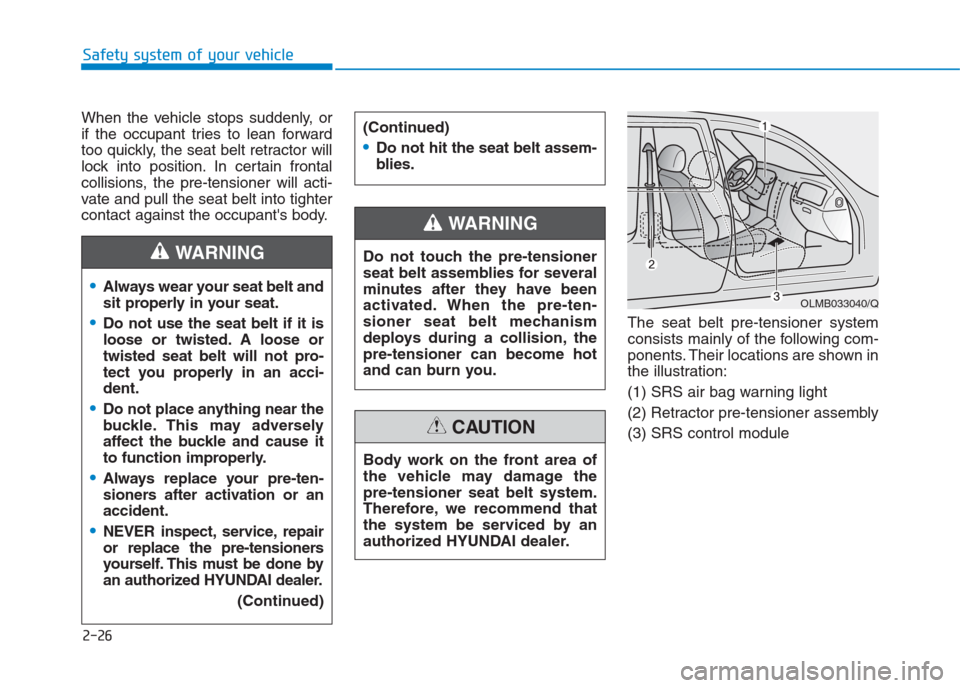
The seat belt pre-tensioner system
consists mainly of the following com-
ponents. Their locations are shown in
the illustration:
(1) SRS air bag warning light
(2) Retractor pre-tensioner assembly
(3) SRS control module (Continued)
Do not hit the seat belt assem-
blies.
Do not touch the pre-tensioner
seat belt assemblies for several
minutes after they have been
activated. When the pre-ten-
sioner seat belt mechanism
deploys during a collision, the
pre-tensioner can become hot
and can burn you.
WARNING
Body work on the front area of
the vehicle may damage the
pre-tensioner seat belt system.
Therefore, we recommend that
the system be serviced by an
authorized HYUNDAI dealer.
CAUTION
OLMB033040/Q
Always wear your seat belt and
sit properly in your seat.
Do not use the seat belt if it is
loose or twisted. A loose or
twisted seat belt will not pro-
tect you properly in an acci-
dent.
Do not place anything near the
buckle. This may adversely
affect the buckle and cause it
to function improperly.
Always replace your pre-ten-
sioners after activation or an
accident.
NEVER inspect, service, repair
or replace the pre-tensioners
yourself. This must be done by
an authorized HYUNDAI dealer.
(Continued)
WARNING
Page 47 of 472
2-27
Safety system of your vehicle
2
The sensor that activates the SRS
air bag is connected with the
pre–tensioner seat belts. The SRS
air bag warning light on the instru-
ment panel will illuminate for
approximately 6 seconds after the
ignition switch is placed to the ON
position, and then it should turn off.
If the pre-tensioner is not working
properly, the warning light will illu-
minate even if the SRS air bag is
not malfunctioning. If the warning
light does not illuminate, stays illu-
minated or illuminates when the
vehicle is being driven, we recom-
mend the pre-tensioner seat belts
and/or SRS air bags be inspected
by an authorized HYUNDAI dealer
as soon as possible.
Information
• Both the driver's and front passen-
ger's pre-tensioner seat belts may be
activated in certain frontal or side
collisions.
• The pre-tensioners will be activated
even if the seat belts are not worn at
the time of the collision.
• When the pre-tensioner seat belts
are activated, a loud noise may be
heard and fine dust, which may
appear to be smoke, may be visible
in the passenger compartment.
These are normal operating condi-
tions and are not hazardous.
• Although it is non-toxic, the fine
dust may cause skin irritation and
should not be breathed for pro-
longed periods. Wash all exposed
skin areas thoroughly after an acci-
dent in which the pre-tensioner seat
belts were activated.
Additional seat belt safety pre-
cautions
Seat belt use during pregnancy
The seat belt should always be used
during pregnancy. The best way to
protect your unborn child is to protect
yourself by always wearing the seat
belt.
Pregnant women should always wear
a lap-shoulder seat belt. Place the
shoulder belt across your chest, rout-
ed between your breasts and away
from your neck. Place the lap belt
below your belly so that it fits SNUGLY
across your hips and pelvic bone,
under the rounded part of the belly.
iNOTICE
To reduce the risk of serious
injury or death to an unborn
child during an accident, preg-
nant women should NEVER
place the lap portion of the seat
belt above or over the area of
the abdomen where the unborn
child is located.
WARNING
Page 49 of 472
2-29
Safety system of your vehicle
2
Seat belt use and injured people
A seat belt should be used when an
injured person is being transported.
Consult a physician for specific rec-
ommendations.
One person per belt
Two people (including children) should
never attempt to use a single seat belt.
This could increase the severity of
injuries in case of an accident.
Do not lie down
Sitting in a reclined position when
the vehicle is in motion can be dan-
gerous. Even when buckled up, the
protections of your restraint system
(seat belts and/or air bags) is greatly
reduced by reclining your seatback.
Seat belts must be snug against your
hips and chest to work properly. During
an accident, you could be thrown into
the seat belt, causing neck or other
injuries.
The more the seatback is reclined,
the greater chance the passenger’s
hips will slide under the lap belt or
the passenger’s neck will strike the
shoulder belt.
NEVER ride with a reclined
seatback when the vehicle is
moving.
Riding with a reclined seatback
increases your chance of seri-
ous or fatal injuries in the event
of a collision or sudden stop.
Driver and passengers should
always sit well back in their
seats, properly belted, and with
the seatbacks upright.
WARNING
Always make sure larger chil-
dren’s seat belts are worn and
properly adjusted.
NEVER allow the shoulder
belt to contact the child’s
neck or face.
Do not allow more than one
child to use a single seat belt.
WARNING
Page 51 of 472
2-31
Safety system of your vehicle
2
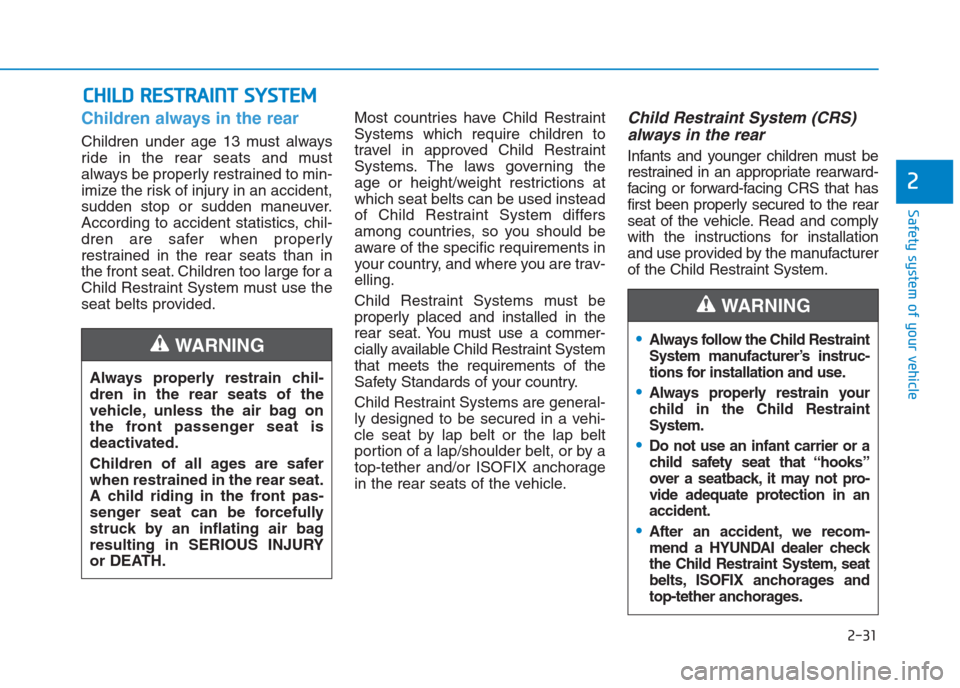
Children always in the rear
Children under age 13 must always
ride in the rear seats and must
always be properly restrained to min-
imize the risk of injury in an accident,
sudden stop or sudden maneuver.
According to accident statistics, chil-
dren are safer when properly
restrained in the rear seats than in
the front seat. Children too large for a
Child Restraint System must use the
seat belts provided.Most countries have Child Restraint
Systems which require children to
travel in approved Child Restraint
Systems. The laws governing the
age or height/weight restrictions at
which seat belts can be used instead
of Child Restraint System differs
among countries, so you should be
aware of the specific requirements in
your country, and where you are trav-
elling.
Child Restraint Systems must be
properly placed and installed in the
rear seat. You must use a commer-
cially available Child Restraint System
that meets the requirements of the
Safety Standards of your country.
Child Restraint Systems are general-
ly designed to be secured in a vehi-
cle seat by lap belt or the lap belt
portion of a lap/shoulder belt, or by a
top-tether and/or ISOFIX anchorage
in the rear seats of the vehicle.
Child Restraint System (CRS)
always in the rear
Infants and younger children must be
restrained in an appropriate rearward-
facing or forward-facing CRS that has
first been properly secured to the rear
seat of the vehicle. Read and comply
with the instructions for installation
and use provided by the manufacturer
of the Child Restraint System.
C CH
HI
IL
LD
D
R
RE
ES
ST
TR
RA
AI
IN
NT
T
S
SY
YS
ST
TE
EM
M
Always follow the Child Restraint
System manufacturer’s instruc-
tions for installation and use.
Always properly restrain your
child in the Child Restraint
System.
Do not use an infant carrier or a
child safety seat that “hooks”
over a seatback, it may not pro-
vide adequate protection in an
accident.
After an accident, we recom-
mend a HYUNDAI dealer check
the Child Restraint System, seat
belts, ISOFIX anchorages and
top-tether anchorages.
WARNING
Always properly restrain chil-
dren in the rear seats of the
vehicle, unless the air bag on
the front passenger seat is
deactivated.
Children of all ages are safer
when restrained in the rear seat.
A child riding in the front pas-
senger seat can be forcefully
struck by an inflating air bag
resulting in SERIOUS INJURY
or DEATH.
WARNING
Page 52 of 472
2-32
Safety system of your vehicle
To reduce the chance of serious
or fatal injuries:
Children of all ages are safer
when restrained in the rear
seat. A child riding in the front
passenger seat can be force-
fully struck by an inflating air
bag resulting in serious or
fatal injuries.
Always follow the instructions
for installation and use of the
child restraint maker.
Always make sure the child
seat is secured properly in the
car and your child is securely
restrained in the child seat.
Never hold a child in your arms
or lap when riding in a vehicle.
The violent forces created dur-
ing a crash will tear the child
from your arms and throw the
child against the car’s interior.
(Continued)
WARNING (Continued)
Never put a seat belt over your-
self and a child. During a crash,
the belt could press deep into
the child causing serious inter-
nal injuries.
Never leave children unattend-
ed in a vehicle – not even for a
short time. The car can heat up
very quickly, resulting in seri-
ous injuries to children inside.
Even very young children may
inadvertently cause the vehicle
to move, entangle themselves
in the windows, or lock them-
selves or others inside the vehi-
cle.
Never allow two children, or any
two persons, to use the same
seat belt.
Children often squirm and
reposition themselves improp-
erly. Never let a child ride with
the shoulder belt under their
arm or behind their back.
Always properly position and
secure children in rear seat.
(Continued)
(Continued)
Never allow a child to stand-up
or kneel on the seat or floor-
board of a moving vehicle.
During a collision or sudden
stop, the child can be violently
thrown against the vehicles
interior, resulting in serious
injury.
Never use an infant carrier or a
child safety seat that "hooks"
over a seatback, it may not pro-
vide adequate security in an
accident.
Seat belts can become very
hot, especially when the car is
parked in direct sunlight.
Always check seat belt buck-
les before fastening them over
a child.
After an accident, we recom-
mend that the system be
checked by an authorized
HYUNDAI dealer.
If there is not enough space to
place the child restraint sys-
tem because of the driver's
seat, install the child restraint
system in the rear right seat.