Body Hyundai Creta 2018 Owner's Manual
[x] Cancel search | Manufacturer: HYUNDAI, Model Year: 2018, Model line: Creta, Model: Hyundai Creta 2018Pages: 472, PDF Size: 11.87 MB
Page 31 of 472
2-11
Safety system of your vehicle
2
To prevent damage, NEVER hit or
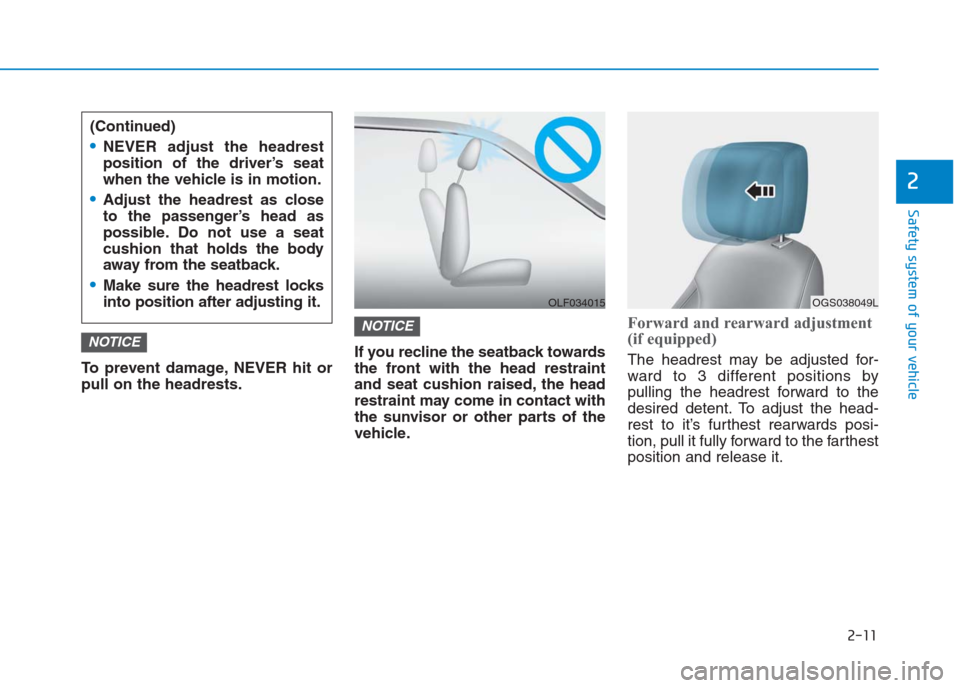
pull on the headrests.If you recline the seatback towards
the front with the head restraint
and seat cushion raised, the head
restraint may come in contact with
the sunvisor or other parts of the
vehicle.
Forward and rearward adjustment
(if equipped)
The headrest may be adjusted for-
ward to 3 different positions by
pulling the headrest forward to the
desired detent. To adjust the head-
rest to it’s furthest rearwards posi-
tion, pull it fully forward to the farthest
position and release it.
NOTICE
NOTICE
(Continued)
NEVER adjust the headrest
position of the driver’s seat
when the vehicle is in motion.
Adjust the headrest as close
to the passenger’s head as
possible. Do not use a seat
cushion that holds the body
away from the seatback.
Make sure the headrest locks
into position after adjusting it.
OLF034015OGS038049L
Page 34 of 472
2-14
Safety system of your vehicle
Rear seats
Headrest
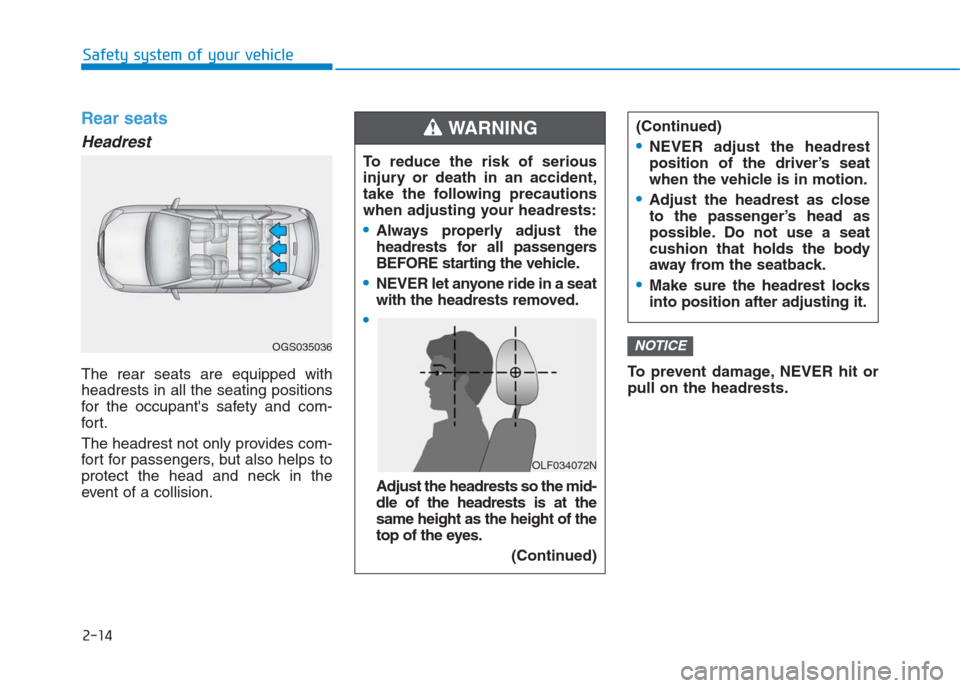
The rear seats are equipped with
headrests in all the seating positions
for the occupant's safety and com-
for t.
The headrest not only provides com-
fort for passengers, but also helps to
protect the head and neck in the
event of a collision.To prevent damage, NEVER hit or
pull on the headrests.
NOTICE
(Continued)
NEVER adjust the headrest
position of the driver’s seat
when the vehicle is in motion.
Adjust the headrest as close
to the passenger’s head as
possible. Do not use a seat
cushion that holds the body
away from the seatback.
Make sure the headrest locks
into position after adjusting it.
To reduce the risk of serious
injury or death in an accident,
take the following precautions
when adjusting your headrests:
Always properly adjust the
headrests for all passengers
BEFORE starting the vehicle.
NEVER let anyone ride in a seat
with the headrests removed.
Adjust the headrests so the mid-
dle of the headrests is at the
same height as the height of the
top of the eyes.
(Continued)
WARNING
OLF034072N
OGS035036
Page 39 of 472
2-19
Safety system of your vehicle
2
S SE
EA
AT
T
B
BE
EL
LT
TS
S
For maximum restraint sys-
tem protection, the seat belts
must always be used whenev-
er the car is moving.
Seat belts are most effective
when seatbacks are in the
upright position.
Children age 12 and under
must always be properly
restrained in the rear seat.
Never allow children to ride in
the front passenger seat. If a
child over 12 must be seated
in the front seat, he/she must
be properly belted and the
seat should be moved as far
back as possible.
(Continued)
WARNING (Continued)
Never wear the shoulder belt
under your arm or behind
your back. An improperly
positioned shoulder belt can
cause serious injuries in a
crash. The shoulder belt
should be positioned midway
over your shoulder across
your collarbone.
Never wear a seat belt over
fragile objects. If there is a
sudden stop or impact, the
seat belt can damage it.
Avoid wearing twisted seat
belts. A twisted belt can't do
its job as well. In a collision, it
could even cut into you. Be
sure the belt webbing is
straight and not twisted.
Be careful not to damage the
belt webbing or hardware. If
the belt webbing or hardware
is damaged, replace it.
Seat belts are designed to bear
upon the bony structure of the
body, and should be worn low
across the front of the pelvis or
the pelvis, chest and shoulders,
as applicable; wearing the lap
section of the belt across the
abdominal area must be avoided.
Seat belts should be adjusted as
firmly as possible, consistent
with comfort, to provide the pro-
tection for which they have been
designed.
A slack belt will greatly reduce
the protection afforded to the
wearer.
Care should be taken to avoid
contamination of the webbing
with polishes, oils and chemicals,
and particularly battery acid.
Cleaning may safely be carried
out using mild soap and water.
The belt should be replaced if
webbing becomes frayed, con-
taminated or damaged.
(Continued)
WARNING
Page 44 of 472
2-24
Safety system of your vehicle
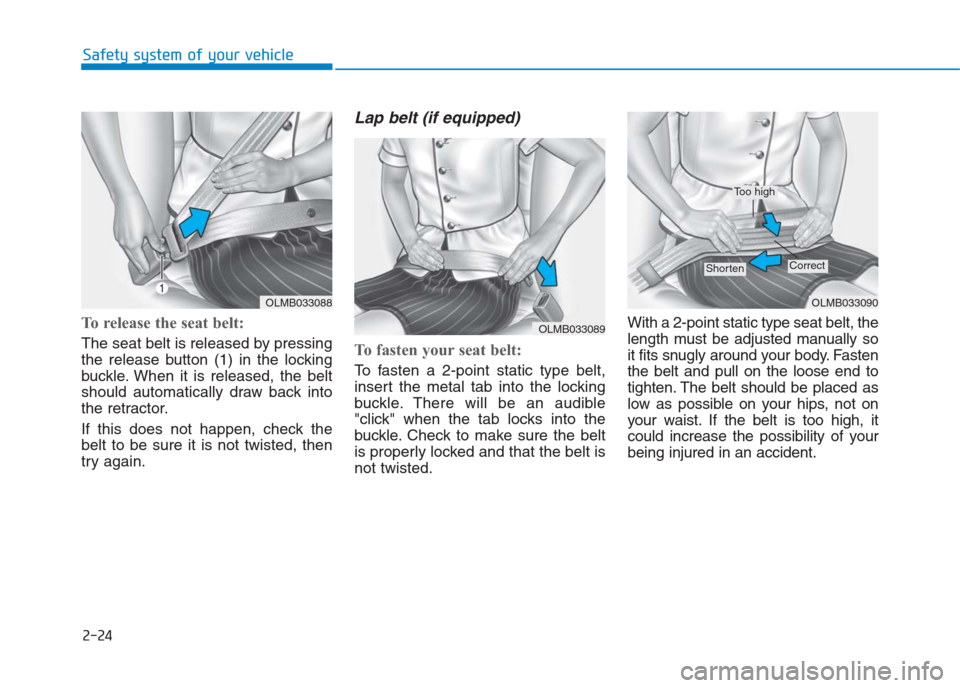
To release the seat belt:
The seat belt is released by pressing
the release button (1) in the locking
buckle. When it is released, the belt
should automatically draw back into
the retractor.
If this does not happen, check the
belt to be sure it is not twisted, then
try again.
Lap belt (if equipped)
To fasten your seat belt:
To fasten a 2-point static type belt,
insert the metal tab into the locking
buckle. There will be an audible
"click" when the tab locks into the
buckle. Check to make sure the belt
is properly locked and that the belt is
not twisted.With a 2-point static type seat belt, the
length must be adjusted manually so
it fits snugly around your body. Fasten
the belt and pull on the loose end to
tighten. The belt should be placed as
low as possible on your hips, not on
your waist. If the belt is too high, it
could increase the possibility of your
being injured in an accident.
OLMB033089
OLMB033090
Too high
ShortenCorrect
OLMB033088
Page 45 of 472
2-25
Safety system of your vehicle
2
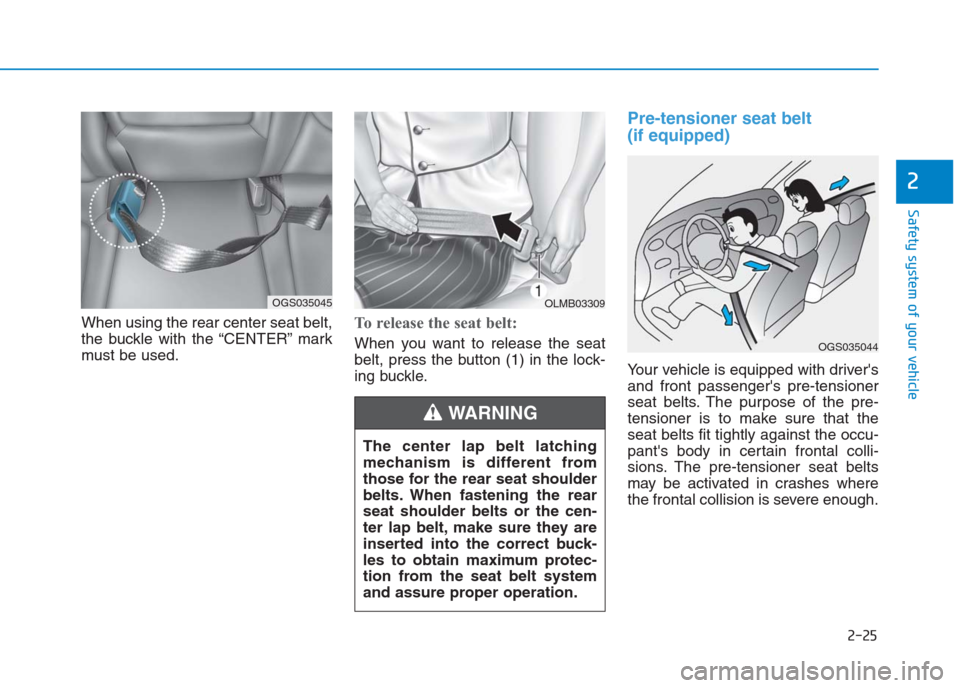
When using the rear center seat belt,
the buckle with the “CENTER” mark
must be used.To release the seat belt:
When you want to release the seat
belt, press the button (1) in the lock-
ing buckle.
Pre-tensioner seat belt
(if equipped)
Your vehicle is equipped with driver's
and front passenger's pre-tensioner
seat belts. The purpose of the pre-
tensioner is to make sure that the
seat belts fit tightly against the occu-
pant's body in certain frontal colli-
sions. The pre-tensioner seat belts
may be activated in crashes where
the frontal collision is severe enough.
OGS035044
The center lap belt latching
mechanism is different from
those for the rear seat shoulder
belts. When fastening the rear
seat shoulder belts or the cen-
ter lap belt, make sure they are
inserted into the correct buck-
les to obtain maximum protec-
tion from the seat belt system
and assure proper operation.
WARNING
OLMB03309OGS035045
Page 46 of 472
2-26
Safety system of your vehicle
When the vehicle stops suddenly, or
if the occupant tries to lean forward
too quickly, the seat belt retractor will
lock into position. In certain frontal
collisions, the pre-tensioner will acti-
vate and pull the seat belt into tighter
contact against the occupant's body.
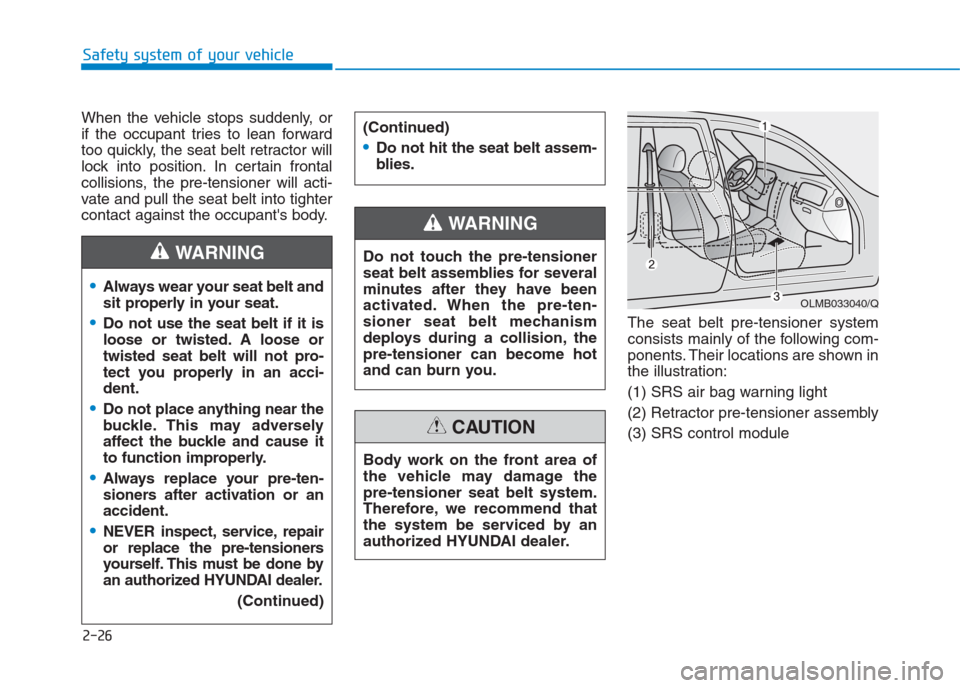
The seat belt pre-tensioner system
consists mainly of the following com-
ponents. Their locations are shown in
the illustration:
(1) SRS air bag warning light
(2) Retractor pre-tensioner assembly
(3) SRS control module (Continued)
Do not hit the seat belt assem-
blies.
Do not touch the pre-tensioner
seat belt assemblies for several
minutes after they have been
activated. When the pre-ten-
sioner seat belt mechanism
deploys during a collision, the
pre-tensioner can become hot
and can burn you.
WARNING
Body work on the front area of
the vehicle may damage the
pre-tensioner seat belt system.
Therefore, we recommend that
the system be serviced by an
authorized HYUNDAI dealer.
CAUTION
OLMB033040/Q
Always wear your seat belt and
sit properly in your seat.
Do not use the seat belt if it is
loose or twisted. A loose or
twisted seat belt will not pro-
tect you properly in an acci-
dent.
Do not place anything near the
buckle. This may adversely
affect the buckle and cause it
to function improperly.
Always replace your pre-ten-
sioners after activation or an
accident.
NEVER inspect, service, repair
or replace the pre-tensioners
yourself. This must be done by
an authorized HYUNDAI dealer.
(Continued)
WARNING
Page 79 of 472
2-59
Safety system of your vehicle
2
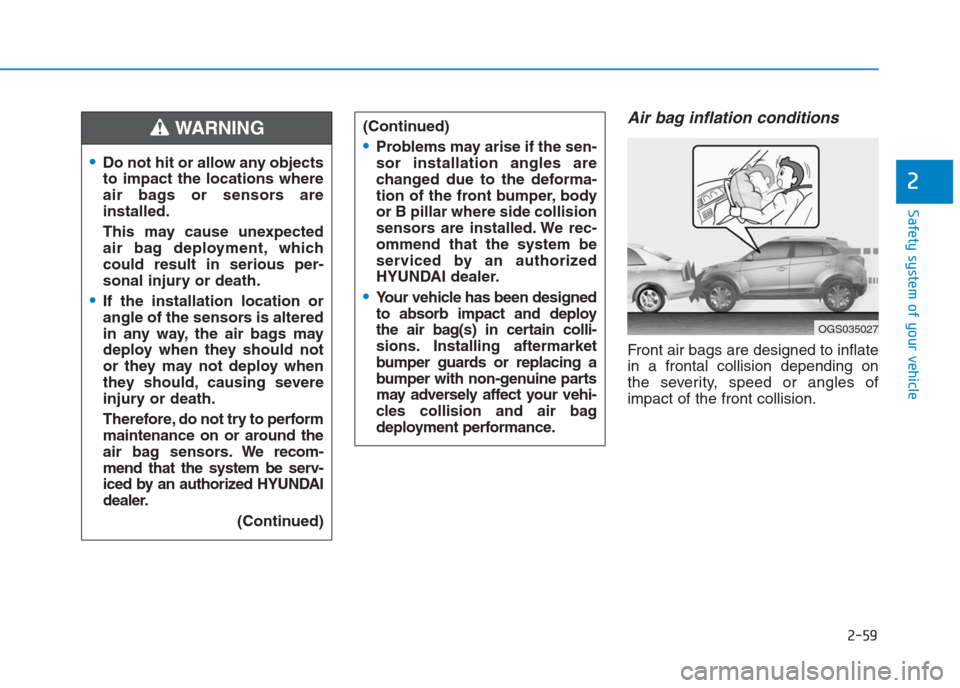
Air bag inflation conditions
Front air bags are designed to inflate
in a frontal collision depending on
the severity, speed or angles of
impact of the front collision.
Do not hit or allow any objects
to impact the locations where
air bags or sensors are
installed.
This may cause unexpected
air bag deployment, which
could result in serious per-
sonal injury or death.
If the installation location or
angle of the sensors is altered
in any way, the air bags may
deploy when they should not
or they may not deploy when
they should, causing severe
injury or death.
Therefore, do not try to perform
maintenance on or around the
air bag sensors. We recom-
mend that the system be serv-
iced by an authorized HYUNDAI
dealer.
(Continued)
WARNING (Continued)
Problems may arise if the sen-
sor installation angles are
changed due to the deforma-
tion of the front bumper, body
or B pillar where side collision
sensors are installed. We rec-
ommend that the system be
serviced by an authorized
HYUNDAI dealer.
Your vehicle has been designed
to absorb impact and deploy
the air bag(s) in certain colli-
sions. Installing aftermarket
bumper guards or replacing a
bumper with non-genuine parts
may adversely affect your vehi-
cles collision and air bag
deployment performance.
OGS035027
Page 83 of 472
2-63
Safety system of your vehicle
2
SRS Care
The SRS is virtually maintenance-
free and so there are no parts you
can safely service by yourself. If the
SRS air bag warning light does not
illuminate, or continuously remains
on, we recommend that the system
be inspected by an authorized
HYUNDAI dealer.
We recommend that the any work on
the SRS system, such as removing,
installing, repairing, or any work on
the steering wheel, the front passen-
ger's panel, front seats and roof rails
be performed by an authorized
HYUNDAI dealer. Improper handling
of the SRS system may result in seri-
ous personal injury.(Continued)If the air bags inflate, we rec-
ommend that the system be
replaced by an authorized
HYUNDAI dealer.
Do not tamper with or discon-
nect SRS wiring, or other
components of the SRS sys-
tem. Doing so could result in
injury, due to accidental infla-
tion of the air bags or by ren-
dering the SRS inoperative.
If components of the air bag
system must be discarded, or if
the vehicle must be scrapped,
certain safety precautions
must be observed. An author-
ized HYUNDAI dealer knows
these precautions and can
give you the necessary infor-
mation. Failure to follow these
precautions and procedures
could increase the risk of per-
sonal injury.
If your car was flooded and
has soaked carpeting or water
on the flooring, you shouldn't
try to start the engine; we rec-
ommend that you contact an
authorized HYUNDAI dealer.
Modification to SRS compo-
nents or wiring, including the
addition of any kind of badges
to the pad covers or modifica-
tions to the body structure,
can adversely affect SRS per-
formance and lead to possible
injury.
For cleaning the air bag pad
covers, use only a soft, dry
cloth or one which has been
moistened with plain water.
Solvents or cleaners could
adversely affect the air bag
covers and proper deploy-
ment of the system.
No objects should be placed
over or near the air bag mod-
ules on the steering wheel,
instrument panel, and the
front passenger's panel above
the glove box, because any
such object could cause harm
if the vehicle is in a crash
severe enough to cause the
air bags to inflate.
(Continued)
WARNING
Page 107 of 472

3-22
Convenient features of your vehicle
Information
The automatic reverse feature is only
active when the “auto up” feature is
used by fully pulling up the switch to
the second detent.
Power window lock switch
The driver can disable the power
window switches on the rear passen-
gers' doors by pressing the power
window lock switch to the lock posi-
tion (pressed).When the power window lock switch
is pressed:
The driver's master control can
operate the front passenger's power
window but cannot operate the rear
passengers' power windows.
The front passenger's control can
operate the front passenger's
power window.
The rear passenger's control can-
not operate the rear passengers'
power window.
To prevent possible damage to
the power window system, do
not open or close two windows
or more at the same time. This
will also ensure the longevity of
the fuse.
Never try to operate the main
switch on the driver's door and
the individual door window
switch in opposite directions at
the same time. If this is done, the
window will stop and cannot be
opened or closed.NOTICE
i
Make sure heads, other body
parts or other objects are safely
out of the way before closing
the windows to avoid injuries or
vehicle damage. Objects less
than 4 mm (0.16 in.) in diameter
caught between the window
glass and the upper window
channel may not be detected by
the automatic reverse window
and the window will not stop
and reverse direction.
WARNING
OGS045011L
Page 108 of 472
3-23
Convenient features of your vehicle
3
Windows
NEVER leave the keys in your
vehicle with unsupervised
children, when the engine is
running.
NEVER leave any child unat-
tended in the vehicle. Even
very young children may inad-
vertently cause the vehicle to
move, entangle themselves in
the windows, or otherwise
injure themselves or others.
Always double check to make
sure all arms, hands, head
and other obstructions are
safely out of the way before
closing a window.
(Continued)
WARNING (Continued)
Do not allow children to play
with the power windows. Keep
the driver’s door power window
lock switch in the LOCK posi-
tion (pressed). Serious injury
can result from unintentional
window operation by the child.
Do not extend your head,
arms or body outside the win-
dows while driving.