fuel Hyundai Creta 2019 User Guide
[x] Cancel search | Manufacturer: HYUNDAI, Model Year: 2019, Model line: Creta, Model: Hyundai Creta 2019Pages: 472, PDF Size: 13.39 MB
Page 86 of 472
Convenient features of your vehicle
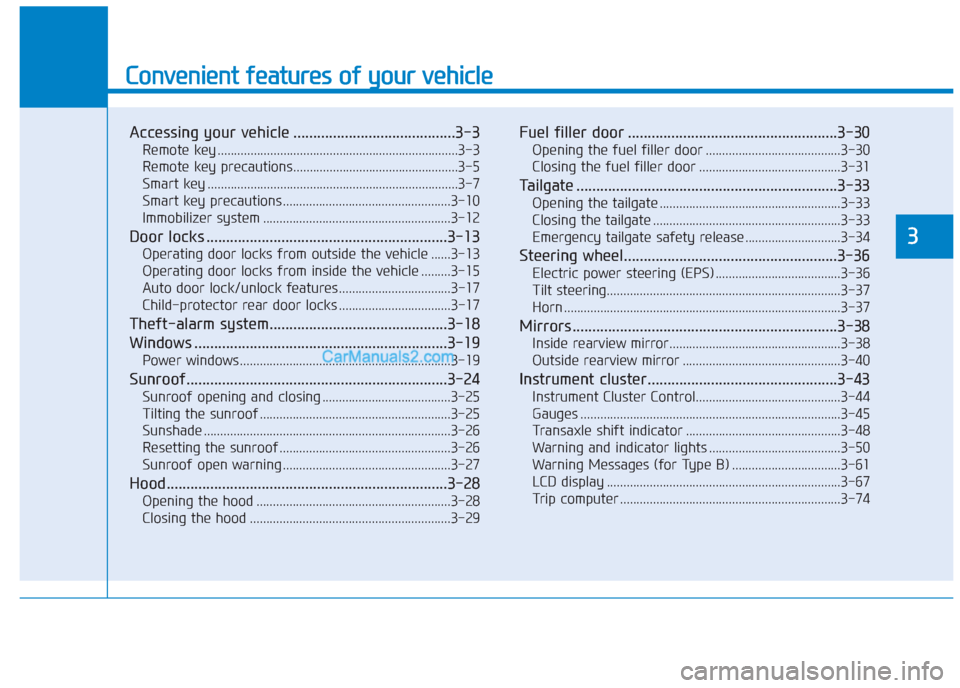
Accessing your vehicle .........................................3-3
Remote key .........................................................................3-3
Remote key precautions..................................................3-5
Smart key ............................................................................3-7
Smart key precautions...................................................3-10
Immobilizer system .........................................................3-12
Door locks .............................................................3-13
Operating door locks from outside the vehicle ......3-13
Operating door locks from inside the vehicle .........3-15
Auto door lock/unlock features..................................3-17
Child-protector rear door locks ..................................3-17
Theft-alarm system.............................................3-18
Windows ................................................................3-19
Power windows ................................................................3-19
Sunroof..................................................................3-24
Sunroof opening and closing .......................................3-25
Tilting the sunroof ..........................................................3-25
Sunshade ...........................................................................3-26
Resetting the sunroof ....................................................3-26
Sunroof open warning ...................................................3-27
Hood.......................................................................3-28
Opening the hood ...........................................................3-28
Closing the hood .............................................................3-29
Fuel filler door .....................................................3-30
Opening the fuel filler door .........................................3-30
Closing the fuel filler door ...........................................3-31
Tailgate ..................................................................3-33
Opening the tailgate .......................................................3-33
Closing the tailgate .........................................................3-33
Emergency tailgate safety release .............................3-34
Steering wheel......................................................3-36
Electric power steering (EPS) ......................................3-36
Tilt steering.......................................................................3-37
Horn ....................................................................................3-37
Mirrors ...................................................................3-38
Inside rearview mirror....................................................3-38
Outside rearview mirror ................................................3-40
Instrument cluster................................................3-43
Instrument Cluster Control............................................3-44
Gauges ...............................................................................3-45
Transaxle shift indicator ...............................................3-48
Warning and indicator lights ........................................3-50
Warning Messages (for Type B) .................................3-61
LCD display .......................................................................3-67
Trip computer ...................................................................3-74
3
Page 97 of 472
3-12
Convenient features of your vehicle
Immobilizer system
(if equipped)
The immobilizer system protects your
vehicle from theft. If an improperly
coded key (or other device) is used,
the engine’s fuel system is disabled.
When the ignition switch is placed in
the ON position, the immobilizer sys-
tem indicator should come on briefly,
then go off. If the indicator starts to
blink, the system does not recognize
the coding of the key.
Place the ignition switch to the
LOCK/OFF position, then place the
ignition switch to the ON position
again.
The system may not recognize your
key’s coding if another immobilizer
key or other metal object (i.e., key
chain) is near the key. The engine
may not start because the metal may
interrupt the transponder signal from
transmitting normally.
If the system repeatedly does not
recognize the coding of the key, it is
recommended that you contact your
HYUNDAI dealer.Do not attempt to alter this system or
add other devices to it. Electrical
problems could result that may make
your vehicle inoperable.
The transponder in your key is an
important part of the immobilizer
system. It is designed to give
years of trouble-free service, how-
ever you should avoid exposure to
moisture, static electricity and
rough handling. Immobilizer sys-
tem malfunction could occur.
NOTICE
In order to prevent theft of your
vehicle, do not leave spare keys
anywhere in your vehicle. Your
immobilizer password is a cus-
tomer unique password and
should be kept confidential.
WARNING
Page 115 of 472
3-30
Convenient features of your vehicle
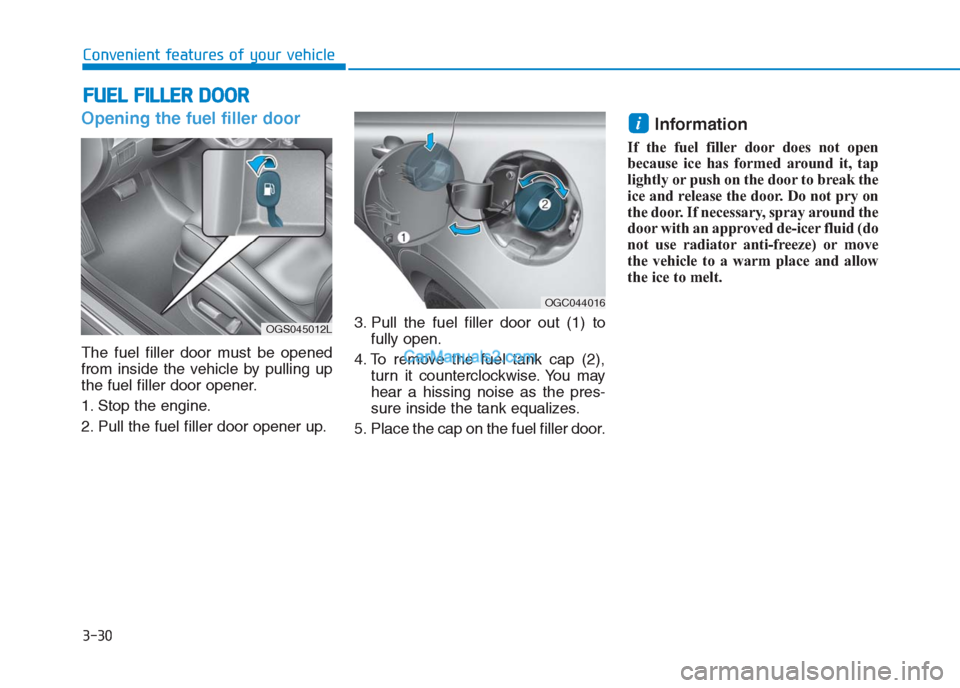
Opening the fuel filler door
The fuel filler door must be opened
from inside the vehicle by pulling up
the fuel filler door opener.
1. Stop the engine.
2. Pull the fuel filler door opener up.3. Pull the fuel filler door out (1) to
fully open.
4. To remove the fuel tank cap (2),
turn it counterclockwise. You may
hear a hissing noise as the pres-
sure inside the tank equalizes.
5. Place the cap on the fuel filler door.
Information
If the fuel filler door does not open
because ice has formed around it, tap
lightly or push on the door to break the
ice and release the door. Do not pry on
the door. If necessary, spray around the
door with an approved de-icer fluid (do
not use radiator anti-freeze) or move
the vehicle to a warm place and allow
the ice to melt.
i
F FU
UE
EL
L
F
FI
IL
LL
LE
ER
R
D
DO
OO
OR
R
OGS045012L
OGC044016
Page 116 of 472
3-31
Convenient features of your vehicle
3
Closing the fuel filler door
1. To install the fuel tank cap (2), turn
it clockwise until it “clicks” once.
This indicates that the cap is
securely tightened.
2. Close the fuel filler door (1) and
push it lightly and make sure that it
is securely closed.
Gasoline is highly flammable
and explosive. Failure to follow
these guidelines may result in
SERIOUS INJURY or DEATH:
Read and follow all warnings
posted at the gas station.
Before refueling, note the
location of the Emergency
Gasoline Shut-Off, if available,
at the gas station.
(Continued)
(Continued)
Before touching the fuel noz-
zle, you should eliminate the
potential build-up of static
electricity by touching a metal
part of the vehicle, a safe dis-
tance away from the fuel filler
neck, nozzle, or other gas
source, with your bare hand.
Do not use cellular phones
while refueling. Electric cur-
rent and/or electronic interfer-
ence from cellular phones can
potentially ignite fuel vapors
and cause a fire.
Do not get back into a vehicle
once you have begun refuel-
ing. You can generate a build-
up of static electricity by
touching, rubbing or sliding
against any item or fabric
capable of producing static
electricity. Static electricity
discharge can ignite fuel
vapors causing a fire.
(Continued)
(Continued)
If you must re-enter the vehi-
cle, you should once again
eliminate potentially danger-
ous static electricity dis-
charge by touching a metal
part of the vehicle, away from
the fuel filler neck, nozzle or
other gasoline source, with
your bare hand.
When using an approved
portable fuel container, be
sure to place the container on
the ground prior to refueling.
Static electricity discharge
from the container can ignite
fuel vapors causing a fire.
Once refueling has begun,
contact between your bare
hand and the vehicle should
be maintained until the filling
is complete.
Use only approved portable
plastic fuel containers designed
to carry and store gasoline.
(Continued)
WARNING
Page 117 of 472
3-32
Convenient features of your vehicle
Information
• Make sure to refuel your vehicle
according to the "Fuel Requirements"
suggested in the introduction chapter.
• Do not spill fuel on the exterior sur-
faces of the vehicle. Any type of fuel
spilled on painted surfaces may
damage the paint.
If the fuel filler cap requires
replacement, use only a genuine
HYUNDAI cap or the equivalent
specified for your vehicle. An
incorrect fuel filler cap can result
in a serious malfunction of the
fuel system or emission control
system.
NOTICE
i(Continued)
When refueling, always move
the shift lever to the P (Park)
position (for automatic
transaxle) or first gear or R
(Reverse, for manual
transaxle), set the parking
brake, and place the ignition
switch to the LOCK/OFF posi-
tion. Sparks produced by
electrical components related
to the engine can ignite fuel
vapors causing a fire.
Do not use matches or a
lighter and do not smoke or
leave a lit cigarette in your
vehicle while at a gas station,
especially during refueling.
Do not over-fill or top-off your
vehicle tank, which can cause
gasoline spillage.
(Continued)
(Continued)
If a fire breaks out during refu-
eling, leave the vicinity of the
vehicle, and immediately con-
tact the manager of the gas
station and then contact the
local fire department. Follow
any safety instructions they
provide.
If pressurized fuel sprays out,
it can cover your clothes or
skin and thus subject you to
the risk of fire and burns.
Always remove the fuel cap
carefully and slowly. If the cap
is venting fuel or if you hear a
hissing sound, wait until the
condition stops before com-
pletely removing the cap.
Always check that the fuel cap
is installed securely to pre-
vent fuel spillage in the event
of an accident.
Page 128 of 472
3-43
Convenient features of your vehicle
3
I IN
NS
ST
TR
RU
UM
ME
EN
NT
T
C
CL
LU
US
ST
TE
ER
R
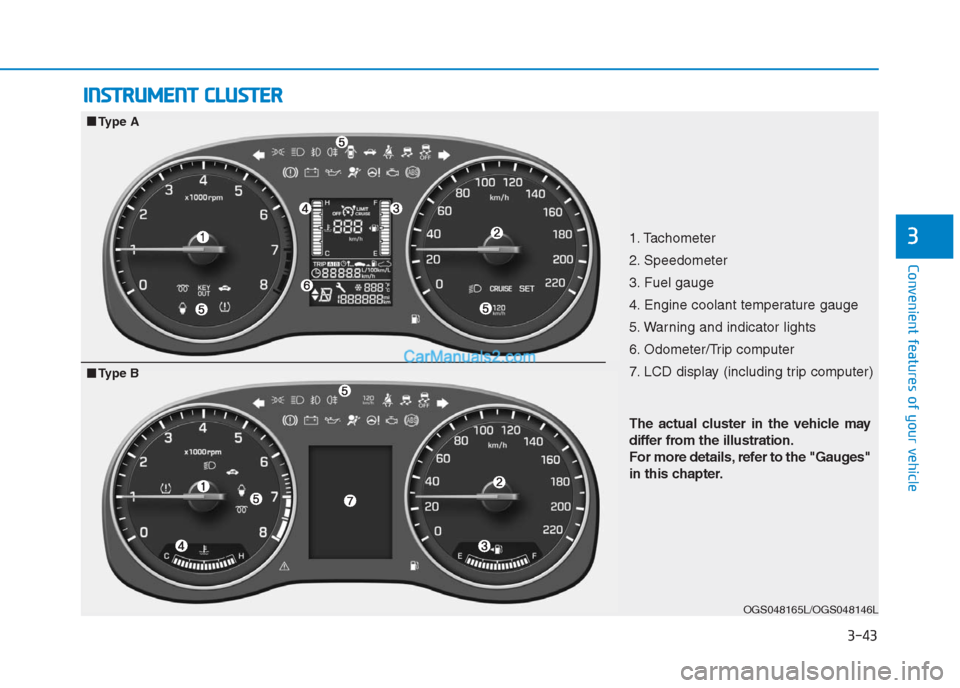
1. Tachometer
2. Speedometer
3. Fuel gauge
4. Engine coolant temperature gauge
5. Warning and indicator lights
6. Odometer/Trip computer
7. LCD display (including trip computer)
OGS048165L/OGS048146L
■ ■
Type A
The actual cluster in the vehicle may
differ from the illustration.
For more details, refer to the "Gauges"
in this chapter.
■ ■
Type B
Page 132 of 472
3-47
Convenient features of your vehicle
3
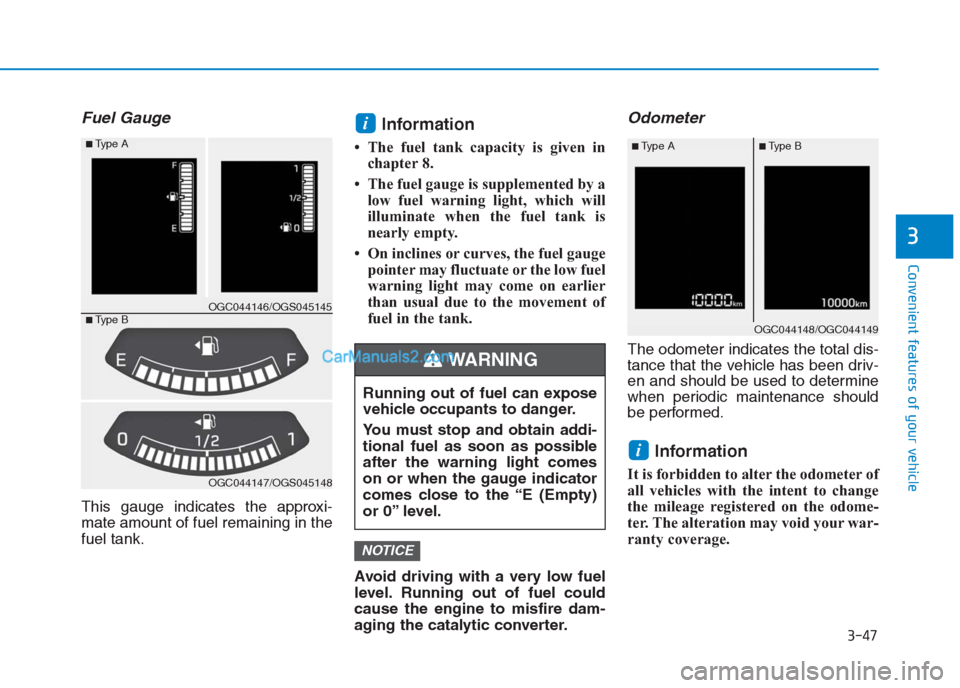
Fuel Gauge
This gauge indicates the approxi-
mate amount of fuel remaining in the
fuel tank.
Information
• The fuel tank capacity is given in
chapter 8.
• The fuel gauge is supplemented by a
low fuel warning light, which will
illuminate when the fuel tank is
nearly empty.
• On inclines or curves, the fuel gauge
pointer may fluctuate or the low fuel
warning light may come on earlier
than usual due to the movement of
fuel in the tank.
Avoid driving with a very low fuel
level. Running out of fuel could
cause the engine to misfire dam-
aging the catalytic converter.
Odometer
The odometer indicates the total dis-
tance that the vehicle has been driv-
en and should be used to determine
when periodic maintenance should
be performed.
Information
It is forbidden to alter the odometer of
all vehicles with the intent to change
the mileage registered on the odome-
ter. The alteration may void your war-
ranty coverage.
i
NOTICE
i
Running out of fuel can expose
vehicle occupants to danger.
You must stop and obtain addi-
tional fuel as soon as possible
after the warning light comes
on or when the gauge indicator
comes close to the “E (Empty)
or 0” level.
WARNING
OGC044147/OGS045148
■Type A
■Type BOGC044146/OGS045145
OGC044148/OGC044149
■Type B■Type A
Page 133 of 472
3-48
Convenient features of your vehicle
Outside Temperature Gauge
(if equipped)
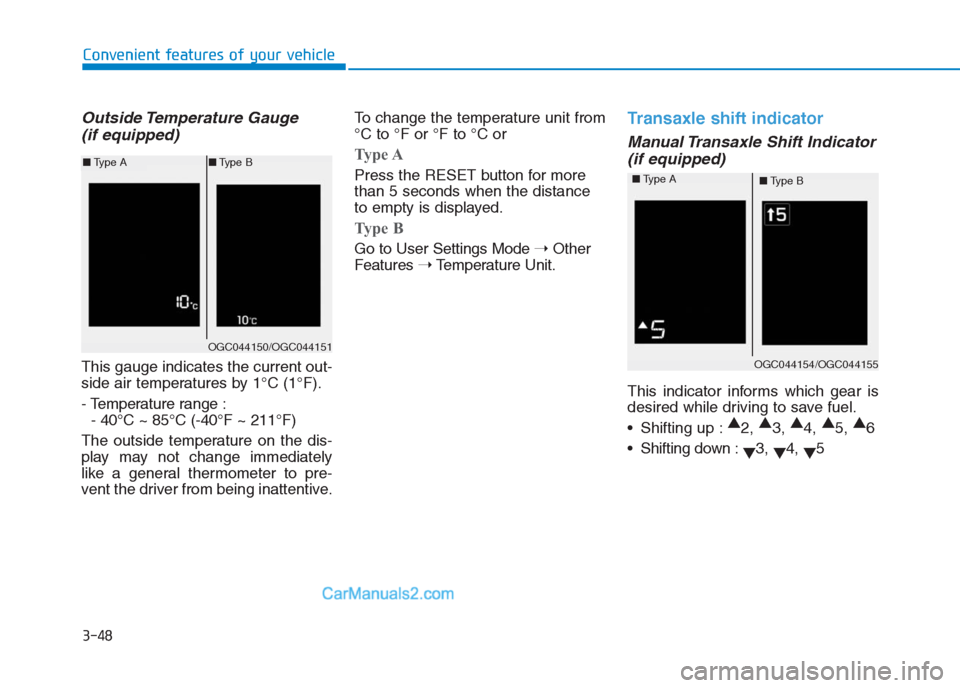
This gauge indicates the current out-
side air temperatures by 1°C (1°F).
- Temperature range :
- 40°C ~ 85°C (-40°F ~ 211°F)
The outside temperature on the dis-
play may not change immediately
like a general thermometer to pre-
vent the driver from being inattentive.To change the temperature unit from
°C to °F or °F to °C or
Type A
Press the RESET button for more
than 5 seconds when the distance
to empty is displayed.
Type B
Go to User Settings Mode ➝Other
Features ➝Temperature Unit.
Transaxle shift indicator
Manual Transaxle Shift Indicator
(if equipped)
This indicator informs which gear is
desired while driving to save fuel.
Shifting up :▲
2, ▲
3, ▲
4, ▲
5, ▲
6
Shifting down :
▼3,
▼4,
▼5
OGC044150/OGC044151
■Type A■Type B
OGC044154/OGC044155 ■Type A
■Type B
Page 137 of 472
3-52
Convenient features of your vehicle
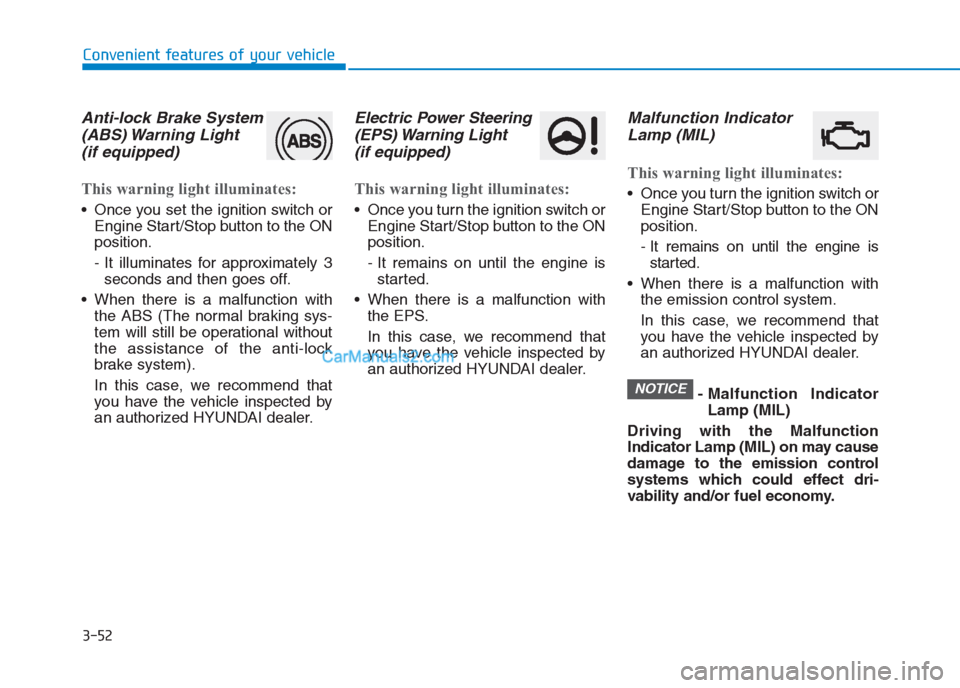
Anti-lock Brake System
(ABS) Warning Light
(if equipped)
This warning light illuminates:
Once you set the ignition switch or
Engine Start/Stop button to the ON
position.
- It illuminates for approximately 3
seconds and then goes off.
When there is a malfunction with
the ABS (The normal braking sys-
tem will still be operational without
the assistance of the anti-lock
brake system).
In this case, we recommend that
you have the vehicle inspected by
an authorized HYUNDAI dealer.
Electric Power Steering
(EPS) Warning Light
(if equipped)
This warning light illuminates:
Once you turn the ignition switch or
Engine Start/Stop button to the ON
position.
- It remains on until the engine is
started.
When there is a malfunction with
the EPS.
In this case, we recommend that
you have the vehicle inspected by
an authorized HYUNDAI dealer.
Malfunction Indicator
Lamp (MIL)
This warning light illuminates:
Once you turn the ignition switch or
Engine Start/Stop button to the ON
position.
- It remains on until the engine is
started.
When there is a malfunction with
the emission control system.
In this case, we recommend that
you have the vehicle inspected by
an authorized HYUNDAI dealer.
- Malfunction Indicator
Lamp (MIL)
Driving with the Malfunction
Indicator Lamp (MIL) on may cause
damage to the emission control
systems which could effect dri-
vability and/or fuel economy.
NOTICE
Page 138 of 472
3-53
Convenient features of your vehicle
3
- Gasoline Engine
If the Malfunction Indicator Lamp
(MIL) illuminates, potential catalyt-
ic converter damage is possible
which could result in loss of
engine power.
In this case, we recommend that
you have the vehicle inspected by
an authorized HYUNDAI dealer as
soon as possible.
- Diesel Engine with DPF
(if equipped)
When the Malfunction Indicator
Lamp (MIL) blinks, it may stop
blinking after driving the vehicle:
- at more than 60km/h (37 mph), or
- at more than 2nd gear with 1500 ~
2000 engine rpm for a certain time
(for about 25 minutes).
If the Malfunction Indicator Lamp
(MIL) continues to blink in spite of
the procedure, we recommend
that you have the DPF system
checked by an authorized
HYUNDAI dealer.
(Continued)(Continued)
If you continue to drive with the
Malfunction Indicator Lamp (MIL)
blinking for a long time, the DPF
system can be damaged and fuel
consumption can worsen.
- Diesel Engine
If the Malfunction Indicator Lamp
(MIL) blinks, some error related to
the injection quantity adjustment
occurs which could result in loss
of engine power, combustion
noise and poor emission.
In this case, we recommend that
you have the engine control sys-
tem inspected by an authorized
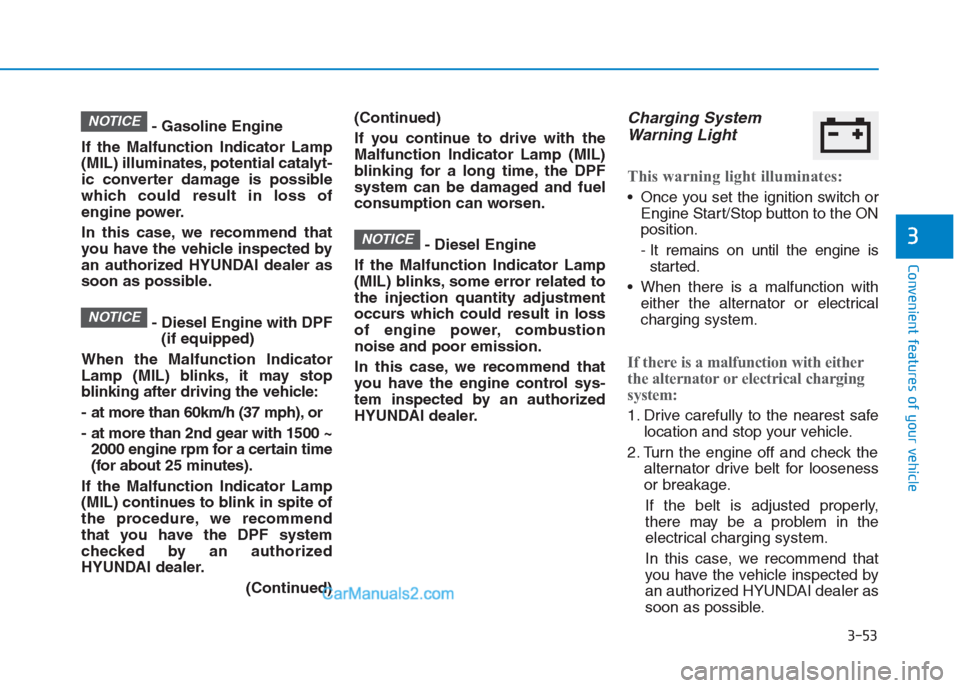
HYUNDAI dealer.Charging System
Warning Light
This warning light illuminates:
Once you set the ignition switch or
Engine Start/Stop button to the ON
position.
- It remains on until the engine is
started.
When there is a malfunction with
either the alternator or electrical
charging system.
If there is a malfunction with either
the alternator or electrical charging
system:
1. Drive carefully to the nearest safe
location and stop your vehicle.
2. Turn the engine off and check the
alternator drive belt for looseness
or breakage.
If the belt is adjusted properly,
there may be a problem in the
electrical charging system.
In this case, we recommend that
you have the vehicle inspected by
an authorized HYUNDAI dealer as
soon as possible.
NOTICE
NOTICE
NOTICE