fuel filter Hyundai Creta 2019 User Guide
[x] Cancel search | Manufacturer: HYUNDAI, Model Year: 2019, Model line: Creta, Model: Hyundai Creta 2019Pages: 472, PDF Size: 13.39 MB
Page 386 of 472
7-29
7
Maintenance
Vapor hose and fuel filler cap
The vapor hose and fuel filler cap
should be inspected at those inter-
vals specified in the maintenance
schedule. Make sure that a new
vapor hose or fuel filler cap is cor-
rectly replaced.
Vacuum crankcase ventilation
hoses (if equipped)
Inspect the surface of hoses for evi-
dence of heat and/or mechanical
damage. Hard and brittle rubber,
cracking, tears, cuts, abrasions, and
excessive swelling indicate deterio-
ration. Particular attention should be
paid to examine those hose surfaces
nearest to high heat sources, such
as the exhaust manifold.
Inspect the hose routing to assure
that the hoses do not come in con-
tact with any heat source, sharp
edges or moving component which
might cause heat damage or
mechanical wear. Inspect all hose
connections, such as clamps and
couplings, to make sure they are
secure, and that no leaks are pres-
ent. Hoses should be replaced
immediately if there is any evidence
of deterioration or damage.
Air cleaner filter
We recommend that the air cleaner
filter be replaced by an authorized
HYUNDAI dealer.
Spark plugs
(For gasoline engine)
Make sure to install new spark plugs
of the correct heat range.
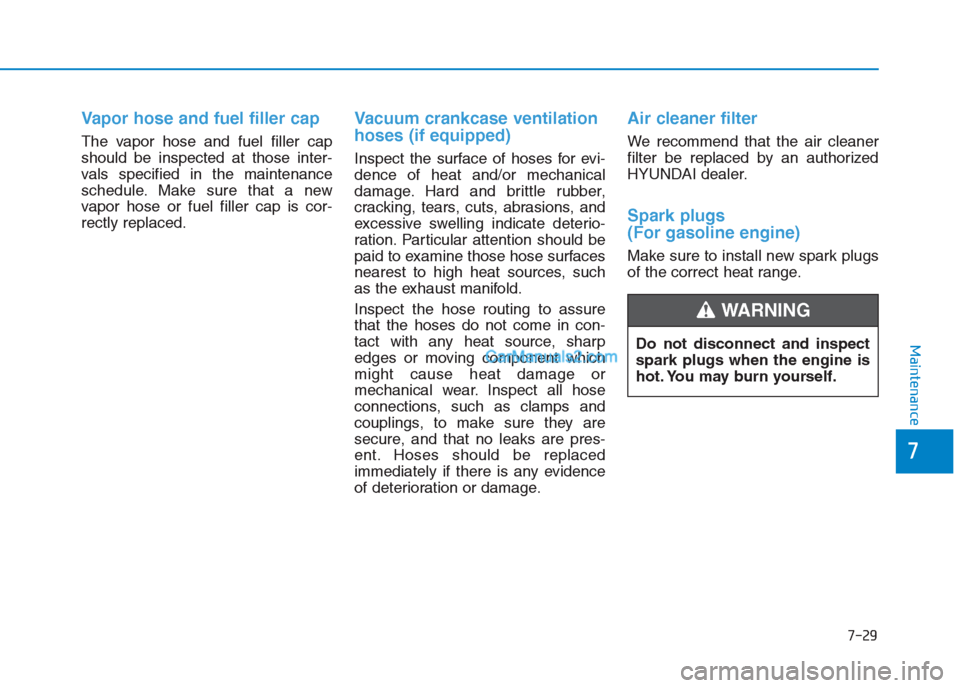
Do not disconnect and inspect
spark plugs when the engine is
hot. You may burn yourself.
WARNING
Page 397 of 472
7-40
Maintenance
F FU
UE
EL
L
F
FI
IL
LT
TE
ER
R
(
(F
FO
OR
R
D
DI
IE
ES
SE
EL
L)
)
Draining water from fuel filter
The fuel filter for diesel engine plays
an important role of separating water
from fuel and accumulating the water
in its bottom.
If water accumulates in the fuel filter,
the warning light comes on when the
ignition switch is in the ON position.
If this warning light turned
on, we recommend that the
system be serviced by an
authorized HYUNDAI dealer.
If the water accumulated in the
fuel filter is not drained at proper
times, damages to the major parts
such as the fuel system can be
caused by water permeation in the
fuel filter.
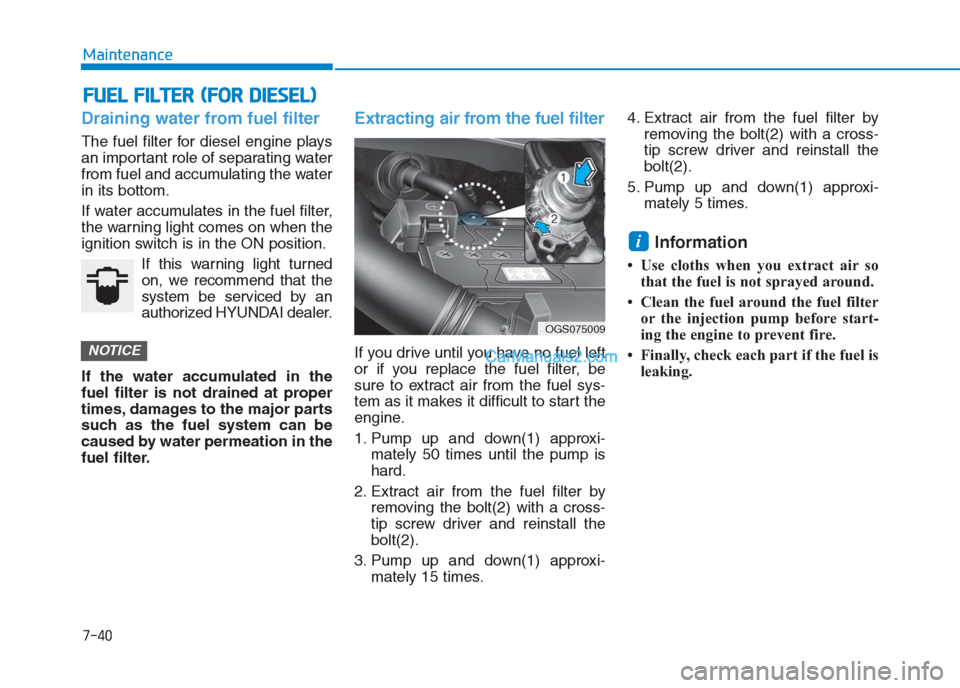
Extracting air from the fuel filter
If you drive until you have no fuel left
or if you replace the fuel filter, be
sure to extract air from the fuel sys-
tem as it makes it difficult to start the
engine.
1. Pump up and down(1) approxi-
mately 50 times until the pump is
hard.
2. Extract air from the fuel filter by
removing the bolt(2) with a cross-
tip screw driver and reinstall the
bolt(2).
3. Pump up and down(1) approxi-
mately 15 times.4. Extract air from the fuel filter by
removing the bolt(2) with a cross-
tip screw driver and reinstall the
bolt(2).
5. Pump up and down(1) approxi-
mately 5 times.
Information
• Use cloths when you extract air so
that the fuel is not sprayed around.
• Clean the fuel around the fuel filter
or the injection pump before start-
ing the engine to prevent fire.
• Finally, check each part if the fuel is
leaking.
i
NOTICE
OGS075009
Page 452 of 472
7-95
7
Maintenance
E EM
MI
IS
SS
SI
IO
ON
N
C
CO
ON
NT
TR
RO
OL
L
S
SY
YS
ST
TE
EM
M
The emission control system of your
vehicle is covered by a written limited
warranty. Please see the warranty
information contained in the Service
Passport in your vehicle.
Your vehicle is equipped with an
emission control system to meet all
emission regulations.
There are three emission control
systems which are as follows.
(1) Crankcase emission control sys-
tem
(2) Evaporative emission control sys-
tem
(3) Exhaust emission control system
In order to assure the proper function
of the emission control systems, it is
recommended that you have your
car inspected and maintained by an
authorized HYUNDAI dealer in
accordance with the maintenance
schedule in this manual.1. Crankcase emission control
system
The positive crankcase ventilation
system is employed to prevent air
pollution caused by blow-by gases
being emitted from the crankcase.
This system supplies fresh filtered air
to the crankcase through the air
intake hose. Inside the crankcase,
the fresh air mixes with blow-by
gases, which then pass through the
PCV valve into the induction system.
2. Evaporative emission con-
trol system
The Evaporative Emission Control
System is designed to prevent fuel
vapors from escaping into the atmos-
phere.
Canister
Fuel vapors generated inside the fuel
tank are absorbed and stored in the
onboard canister. When the engine is
running, the fuel vapors absorbed in
the canister are drawn into the surge
tank through the purge control sole-
noid valve.
Purge Control Solenoid Valve
(PCSV)
The purge control solenoid valve is
controlled by the Engine Control
Module (ECM); when the engine
coolant temperature is low during
idling, the PCSV closes so that evap-
orated fuel is not taken into the
engine. After the engine warms up
during ordinary driving, the PCSV
opens to introduce evaporated fuel to
the engine.
Page 468 of 472
I-4
Door locks.....................................................................3-13
Auto door lock/unlock features .................................3-17
Child-protector rear door locks .................................3-17
Operating door locks from inside the vehicle ...........3-15
Operating door locks from outside the vehicle .........3-13
Driver assist system ......................................................3-91
Rear parking assist system.........................................3-92
Rear view camera ......................................................3-91
Emergency commodity .................................................6-26
Fire extinguisher .......................................................6-26
First aid kit ................................................................6-26
Tire pressure gauge ....................................................6-26
Triangle reflector ......................................................6-26
Emission control system ...............................................7-95
Crankcase emission control system ...........................7-95
Evaporative emission control system ........................7-95
Exhaust emission control system...............................7-96
Engine .............................................................................8-2
Engine compartment .......................................................7-3
Engine compartment (I)..................................................1-8
Engine compartment (II) ................................................1-9
Engine number................................................................8-9
Changing the coolant .................................................7-36
Checking the coolant level ........................................7-34
Recommended engine coolant ...................................7-36Engine oil......................................................................7-32
Changing the engine oil and filter .............................7-33
Checking the engine oil level ..................................7-32
Explanation of scheduled maintenance items ..............7-28
Exterior overview (I) ......................................................1-2
Exterior overview (II) .....................................................1-3
Fuel filler door ..............................................................3-30
Closing the fuel filler door ........................................3-31
Opening the fuel filler door .......................................3-30
Fuel filter (For Diesel)..................................................7-40
Draining water from fuel filter ..................................7-40
Extracting air from the fuel filter ..............................7-40
Fuses .............................................................................7-63
Engine compartment panel fuse replacement ............7-66
Fuse/Relay panel description .....................................7-68
Instrument panel fuse replacement ............................7-64
Hazard warning flasher...................................................6-2
Hood .............................................................................3-28
Closing the hood ........................................................3-29
Opening the hood.......................................................3-28
Index
E
F
H