maintenance schedule Hyundai Creta 2019 Owner's Guide
[x] Cancel search | Manufacturer: HYUNDAI, Model Year: 2019, Model line: Creta, Model: Hyundai Creta 2019Pages: 472, PDF Size: 13.39 MB
Page 386 of 472
7-29
7
Maintenance
Vapor hose and fuel filler cap
The vapor hose and fuel filler cap
should be inspected at those inter-
vals specified in the maintenance
schedule. Make sure that a new
vapor hose or fuel filler cap is cor-
rectly replaced.
Vacuum crankcase ventilation
hoses (if equipped)
Inspect the surface of hoses for evi-
dence of heat and/or mechanical
damage. Hard and brittle rubber,
cracking, tears, cuts, abrasions, and
excessive swelling indicate deterio-
ration. Particular attention should be
paid to examine those hose surfaces
nearest to high heat sources, such
as the exhaust manifold.
Inspect the hose routing to assure
that the hoses do not come in con-
tact with any heat source, sharp
edges or moving component which
might cause heat damage or
mechanical wear. Inspect all hose
connections, such as clamps and
couplings, to make sure they are
secure, and that no leaks are pres-
ent. Hoses should be replaced
immediately if there is any evidence
of deterioration or damage.
Air cleaner filter
We recommend that the air cleaner
filter be replaced by an authorized
HYUNDAI dealer.
Spark plugs
(For gasoline engine)
Make sure to install new spark plugs
of the correct heat range.
Do not disconnect and inspect
spark plugs when the engine is
hot. You may burn yourself.
WARNING
Page 387 of 472
7-30
Maintenance
Valve clearance
(For gasoline engine)
Inspect excessive valve noise and/or
engine vibration and adjust if neces-
sary.
We recommend that the system be
serviced by an authorized HYUNDAI
dealer.
Cooling system
Check cooling system components,
such as radiator, coolant reservoir,
hoses and connections for leakage
and damage. Replace any damaged
parts.
Engine coolant
The coolant should be changed at
the intervals specified in the mainte-
nance schedule.
Manual transaxle fluid
(if equipped)
Inspect the manual transaxle fluid
according to the maintenance sched-
ule.
Automatic transaxle fluid
(if equipped)
Automatic transaxle fluid should not
be checked under normal usage
conditions.
We recommend that the automatic
transaxle fluid changed by an author-
ized HYUNDAI dealer according to
the maintenance schedule.
Information
Automatic transaxle fluid color is
basically red.
As the vehicle is driven, the automatic
transaxle fluid will begin to look darker.
It is normal condition and you should
not judge the need to replace the fluid
based upon the changed color.The use of a non-specified fluid
could result in transaxle malfunc-
tion and failure.
Use only specified automatic
transaxle fluid. (Refer to
"Recommended lubricants and
capacities" in chapter 8.)
NOTICE
i
Page 398 of 472
7-41
7
Maintenance
A AI
IR
R
C
CL
LE
EA
AN
NE
ER
R
Filter replacement
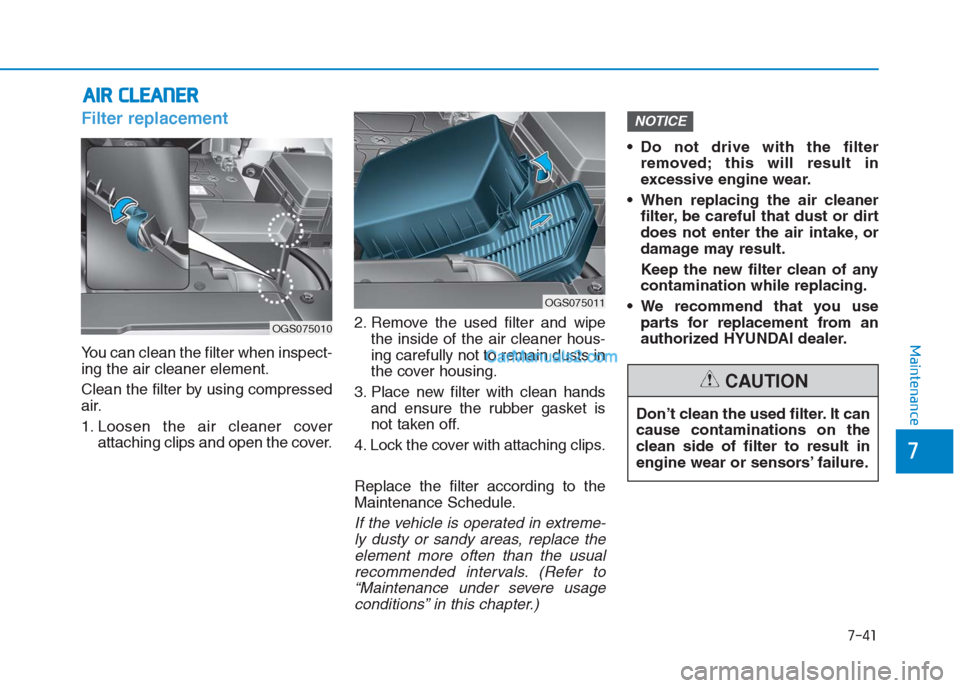
You can clean the filter when inspect-
ing the air cleaner element.
Clean the filter by using compressed
air.
1. Loosen the air cleaner cover
attaching clips and open the cover.2. Remove the used filter and wipe
the inside of the air cleaner hous-
ing carefully not to remain dusts in
the cover housing.
3. Place new filter with clean hands
and ensure the rubber gasket is
not taken off.
4. Lock the cover with attaching clips.
Replace the filter according to the
Maintenance Schedule.
If the vehicle is operated in extreme-
ly dusty or sandy areas, replace the
element more often than the usual
recommended intervals. (Refer to
“Maintenance under severe usage
conditions” in this chapter.)
Do not drive with the filter
removed; this will result in
excessive engine wear.
When replacing the air cleaner
filter, be careful that dust or dirt
does not enter the air intake, or
damage may result.
Keep the new filter clean of any
contamination while replacing.
We recommend that you use
parts for replacement from an
authorized HYUNDAI dealer.
NOTICE
OGS075010
OGS075011
Don’t clean the used filter. It can
cause contaminations on the
clean side of filter to result in
engine wear or sensors’ failure.
CAUTION
Page 399 of 472
7-42
Maintenance
C CL
LI
IM
MA
AT
TE
E
C
CO
ON
NT
TR
RO
OL
L
A
AI
IR
R
F
FI
IL
LT
TE
ER
R
(
(I
IF
F
E
EQ
QU
UI
IP
PP
PE
ED
D)
)
Filter inspection
If the vehicle is operated in the
severely air-polluted cities or on
dusty rough roads for a long period,
it should be inspected more fre-
quently and replaced earlier. When
you, the owner, replace the climate
control air filter, replace it performing
the following procedure, and be care-
ful to avoid damaging other compo-
nents.
Replace the filter according to the
maintenance Schedule.
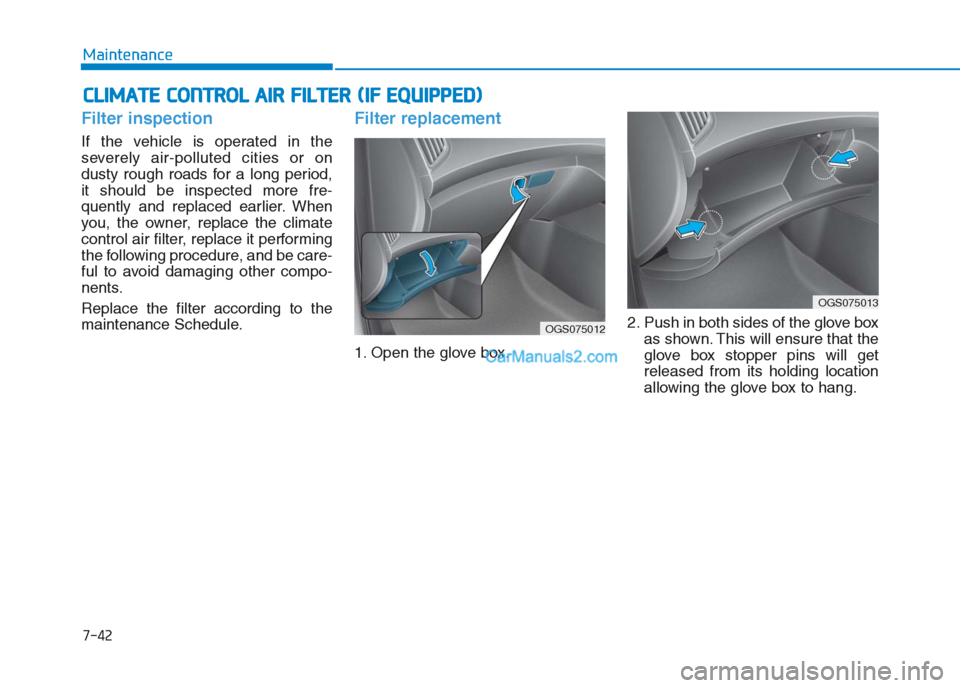
Filter replacement
1. Open the glove box.2. Push in both sides of the glove box
as shown. This will ensure that the
glove box stopper pins will get
released from its holding location
allowing the glove box to hang.
OGS075013
OGS075012
Page 452 of 472
7-95
7
Maintenance
E EM
MI
IS
SS
SI
IO
ON
N
C
CO
ON
NT
TR
RO
OL
L
S
SY
YS
ST
TE
EM
M
The emission control system of your
vehicle is covered by a written limited
warranty. Please see the warranty
information contained in the Service
Passport in your vehicle.
Your vehicle is equipped with an
emission control system to meet all
emission regulations.
There are three emission control
systems which are as follows.
(1) Crankcase emission control sys-
tem
(2) Evaporative emission control sys-
tem
(3) Exhaust emission control system
In order to assure the proper function
of the emission control systems, it is
recommended that you have your
car inspected and maintained by an
authorized HYUNDAI dealer in
accordance with the maintenance
schedule in this manual.1. Crankcase emission control
system
The positive crankcase ventilation
system is employed to prevent air
pollution caused by blow-by gases
being emitted from the crankcase.
This system supplies fresh filtered air
to the crankcase through the air
intake hose. Inside the crankcase,
the fresh air mixes with blow-by
gases, which then pass through the
PCV valve into the induction system.
2. Evaporative emission con-
trol system
The Evaporative Emission Control
System is designed to prevent fuel
vapors from escaping into the atmos-
phere.
Canister
Fuel vapors generated inside the fuel
tank are absorbed and stored in the
onboard canister. When the engine is
running, the fuel vapors absorbed in
the canister are drawn into the surge
tank through the purge control sole-
noid valve.
Purge Control Solenoid Valve
(PCSV)
The purge control solenoid valve is
controlled by the Engine Control
Module (ECM); when the engine
coolant temperature is low during
idling, the PCSV closes so that evap-
orated fuel is not taken into the
engine. After the engine warms up
during ordinary driving, the PCSV
opens to introduce evaporated fuel to
the engine.
Page 468 of 472
I-4
Door locks.....................................................................3-13
Auto door lock/unlock features .................................3-17
Child-protector rear door locks .................................3-17
Operating door locks from inside the vehicle ...........3-15
Operating door locks from outside the vehicle .........3-13
Driver assist system ......................................................3-91
Rear parking assist system.........................................3-92
Rear view camera ......................................................3-91
Emergency commodity .................................................6-26
Fire extinguisher .......................................................6-26
First aid kit ................................................................6-26
Tire pressure gauge ....................................................6-26
Triangle reflector ......................................................6-26
Emission control system ...............................................7-95
Crankcase emission control system ...........................7-95
Evaporative emission control system ........................7-95
Exhaust emission control system...............................7-96
Engine .............................................................................8-2
Engine compartment .......................................................7-3
Engine compartment (I)..................................................1-8
Engine compartment (II) ................................................1-9
Engine number................................................................8-9
Changing the coolant .................................................7-36
Checking the coolant level ........................................7-34
Recommended engine coolant ...................................7-36Engine oil......................................................................7-32
Changing the engine oil and filter .............................7-33
Checking the engine oil level ..................................7-32
Explanation of scheduled maintenance items ..............7-28
Exterior overview (I) ......................................................1-2
Exterior overview (II) .....................................................1-3
Fuel filler door ..............................................................3-30
Closing the fuel filler door ........................................3-31
Opening the fuel filler door .......................................3-30
Fuel filter (For Diesel)..................................................7-40
Draining water from fuel filter ..................................7-40
Extracting air from the fuel filter ..............................7-40
Fuses .............................................................................7-63
Engine compartment panel fuse replacement ............7-66
Fuse/Relay panel description .....................................7-68
Instrument panel fuse replacement ............................7-64
Hazard warning flasher...................................................6-2
Hood .............................................................................3-28
Closing the hood ........................................................3-29
Opening the hood.......................................................3-28
Index
E
F
H
Page 470 of 472

I-6
Light........................................................................\
......3-78Exterior lights ............................................................3-78
Interior lights .............................................................3-85
Light bulbs ....................................................................7-77\
Headlight, position light, turn signal light, and front fog light bulb replacement .......................7-78
High mounted stop light ............................................7-85
Interior light bulb replacement ..................................7-86
License plate light bulb replacement ........................7-86
Rear combination light bulb replacement..................7-83
Side repeater light bulb replacement .........................7-83
Maintenance services......................................................7-5 Owner maintenance precautions ................................7-5
Owner's responsibility .................................................7-5
Manual transaxle...........................................................5-19 Good driving practices...............................................5-21
Manual transaxle operation .......................................5-19
Mirrors ........................................................................\
..3-38 Inside rearview mirror ...............................................3-38
Outside rearview mirror.............................................3-40 Multimedia system .........................................................4-2
Antenna ........................................................................\
4-2
Bluetooth®Wireless Technology Hands-Free .............4-4
How vehicle audio works ............................................4-5
Steering wheel audio control .......................................4-3
USB and iPod
®port.....................................................4-2
Owner maintenance ........................................................7-8 Owner maintenance schedule .....................................7-8
Parking brake ................................................................7-39 Checking the parking brake .......................................7-39
Recommended lubricants and capacities........................8-5 Recommended sae viscosity number...........................8-7
Index
L
O
P
M
R
Page 471 of 472
I-7
Scheduled maintenance service ....................................7-10
Seat belts .......................................................................2-19
Additional seat belt safety precautions .....................2-27
Care of seat belts .......................................................2-30
Pre-tensioner seat belt ...............................................2-25
Seats ...............................................................................2-2
Front seats ..................................................................2-7
Rear seats ..................................................................2-14
Special driving conditions ............................................5-48
Driving at night..........................................................5-49
Driving in flooded areas ............................................5-50
Driving in the rain .....................................................5-50
Hazardous driving conditions ....................................5-48
Highway driving ........................................................5-51
Rocking the vehicle ...................................................5-48
Smooth cornering.......................................................5-49
Steering wheel ..............................................................3-36
Electric power steering (EPS) ...................................3-36
Horn ...........................................................................3-37
Tilt steering ................................................................3-37Storage compartment ..................................................3-120
Center console storage .............................................3-120
Glove box.................................................................3-121
Sunglass holder ........................................................3-121
Sunroof .........................................................................3-24
Resetting the sunroof .................................................3-26
Sunroof open warning ...............................................3-27
Sunroof opening and closing .....................................3-25
Sunshade ....................................................................3-26
Tilting the sunroof .....................................................3-25
Tailgate .........................................................................3-33
Closing the tailgate ....................................................3-33
Emergency tailgate safety release..............................3-34
Opening the tailgate ...................................................3-33
Theft-alarm system .......................................................3-18
Tire Pressure Monitoring System (TPMS)...................6-10
Changing a tire with TPMS .......................................6-13
Low tire pressure telltale ...........................................6-11
TPMS (Tire Pressure Monitoring System)
malfunction indicator...............................................6-12
I
Index
S
T