Start Hyundai Creta 2019 Manual Online
[x] Cancel search | Manufacturer: HYUNDAI, Model Year: 2019, Model line: Creta, Model: Hyundai Creta 2019Pages: 472, PDF Size: 13.39 MB
Page 338 of 472
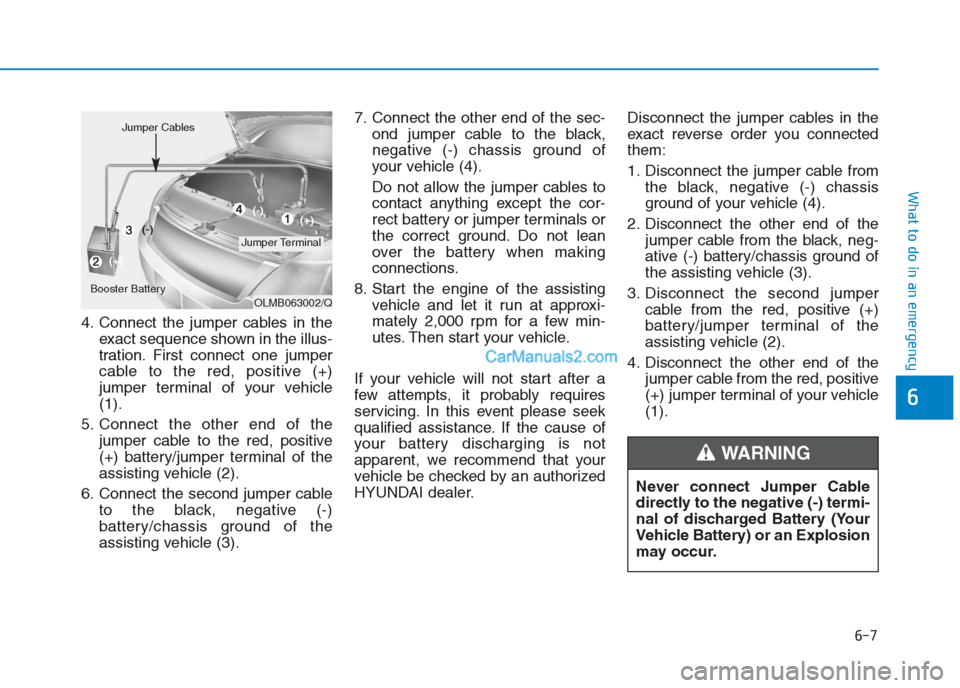
4. Connect the jumper cables in the
exact sequence shown in the illus-
tration. First connect one jumper
cable to the red, positive (+)
jumper terminal of your vehicle
(1).
5. Connect the other end of the
jumper cable to the red, positive
(+) battery/jumper terminal of the
assisting vehicle (2).
6. Connect the second jumper cable
to the black, negative (-)
battery/chassis ground of the
assisting vehicle (3).7. Connect the other end of the sec-
ond jumper cable to the black,
negative (-) chassis ground of
your vehicle (4).
Do not allow the jumper cables to
contact anything except the cor-
rect battery or jumper terminals or
the correct ground. Do not lean
over the battery when making
connections.
8. Start the engine of the assisting
vehicle and let it run at approxi-
mately 2,000 rpm for a few min-
utes. Then start your vehicle.
If your vehicle will not start after a
few attempts, it probably requires
servicing. In this event please seek
qualified assistance. If the cause of
your battery discharging is not
apparent, we recommend that your
vehicle be checked by an authorized
HYUNDAI dealer.Disconnect the jumper cables in the
exact reverse order you connected
them:
1. Disconnect the jumper cable from
the black, negative (-) chassis
ground of your vehicle (4).
2. Disconnect the other end of the
jumper cable from the black, neg-
ative (-) battery/chassis ground of
the assisting vehicle (3).
3. Disconnect the second jumper
cable from the red, positive (+)
battery/jumper terminal of the
assisting vehicle (2).
4. Disconnect the other end of the
jumper cable from the red, positive
(+) jumper terminal of your vehicle
(1).
6-7
What to do in an emergency
6
OLMB063002/Q
Jumper Terminal Jumper Cables
Booster Battery(-)
(+)(+) (-)
Never connect Jumper Cable
directly to the negative (-) termi-
nal of discharged Battery (Your
Vehicle Battery) or an Explosion
may occur.
WARNING
Page 341 of 472
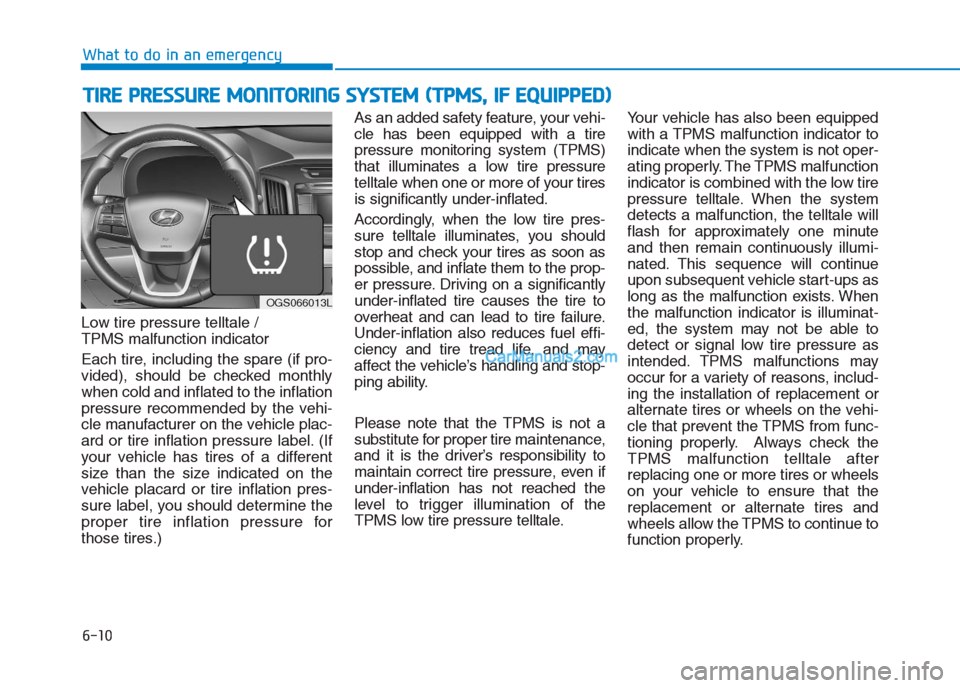
Low tire pressure telltale /
TPMS malfunction indicator
Each tire, including the spare (if pro-
vided), should be checked monthly
when cold and inflated to the inflation
pressure recommended by the vehi-
cle manufacturer on the vehicle plac-
ard or tire inflation pressure label. (If
your vehicle has tires of a different
size than the size indicated on the
vehicle placard or tire inflation pres-
sure label, you should determine the
proper tire inflation pressure for
those tires.)As an added safety feature, your vehi-
cle has been equipped with a tire
pressure monitoring system (TPMS)
that illuminates a low tire pressure
telltale when one or more of your tires
is significantly under-inflated.
Accordingly, when the low tire pres-
sure telltale illuminates, you should
stop and check your tires as soon as
possible, and inflate them to the prop-
er pressure. Driving on a significantly
under-inflated tire causes the tire to
overheat and can lead to tire failure.
Under-inflation also reduces fuel effi-
ciency and tire tread life, and may
affect the vehicle’s handling and stop-
ping ability.
Please note that the TPMS is not a
substitute for proper tire maintenance,
and it is the driver’s responsibility to
maintain correct tire pressure, even if
under-inflation has not reached the
level to trigger illumination of the
TPMS low tire pressure telltale.Your vehicle has also been equipped
with a TPMS malfunction indicator to
indicate when the system is not oper-
ating properly. The TPMS malfunction
indicator is combined with the low tire
pressure telltale. When the system
detects a malfunction, the telltale will
flash for approximately one minute
and then remain continuously illumi-
nated. This sequence will continue
upon subsequent vehicle start-ups as
long as the malfunction exists. When
the malfunction indicator is illuminat-
ed, the system may not be able to
detect or signal low tire pressure as
intended. TPMS malfunctions may
occur for a variety of reasons, includ-
ing the installation of replacement or
alternate tires or wheels on the vehi-
cle that prevent the TPMS from func-
tioning properly. Always check the
TPMS malfunction telltale after
replacing one or more tires or wheels
on your vehicle to ensure that the
replacement or alternate tires and
wheels allow the TPMS to continue to
function properly.
T TI
IR
RE
E
P
PR
RE
ES
SS
SU
UR
RE
E
M
MO
ON
NI
IT
TO
OR
RI
IN
NG
G
S
SY
YS
ST
TE
EM
M
(
(T
TP
PM
MS
S,
,
I
IF
F
E
EQ
QU
UI
IP
PP
PE
ED
D)
)
6-10
What to do in an emergency
OGS066013L
Page 342 of 472
Information
If the TPMS indicator does not illumi-
nate for 3 seconds when the ignition
switch is turned to the ON position or
engine is running, or if it comes on
after blinking for approximately one
minute, we recommend that you con-
tact an authorized HYUNDAI dealer.
Low tire pressure
telltale
When the tire pressure monitoring
system warning indicator is illuminat-
ed, one or more of your tires is sig-
nificantly under-inflated.
If the telltale illuminates, immediately
reduce your speed, avoid hard cor-
nering and anticipate increased stop-
ping distances. You should stop and
check your tires as soon as possible.
Inflate the tires to the proper pres-
sure as indicated on the vehicle’s
placard or tire inflation pressure label
located on the driver’s side center pil-
lar outer panel. If you cannot reach a
service station or if the tire cannot
hold the newly added air, replace the
low pressure tire with the spare tire.
Then the Low Tire Pressure telltale
may flash for approximately one
minute and then remain continuously
illuminated after restarting and about
20 minutes of continuous driving
before you have the low pressure tire
repaired and replaced on the vehicle.
i
6-11
What to do in an emergency
6
In winter or cold weather, the
low tire pressure telltale may be
illuminated if the tire pressure
was adjusted to the recom-
mended tire inflation pressure
in warm weather. It does not
mean your TPMS is malfunc-
tioning because the decreased
temperature leads to a propor-
tional lowering of tire pressure.
When you drive your vehicle
from a warm area to a cold area
or from a cold area to a warm
area, or the outside temperature
is greatly higher or lower, you
should check the tire inflation
pressure and adjust the tires to
the recommended tire inflation
pressure.
CAUTION
Page 343 of 472
TPMS (Tire Pressure
Monitoring System)
malfunction indicator
The TPMS malfunction indicator will
illuminate after it blinks for approxi-
mately one minute when there is a
problem with the Tire Pressure
Monitoring System. If the system is
able to correctly detect an under infla-
tion warning at the same time as sys-
tem failure then it will illuminate the
TPMS malfunction indicator.
We recommend that the system be
checked by an authorized HYUNDAI
dealer.
6-12
What to do in an emergency
Low pressure damage
Significantly low tire pressure
makes the vehicle unstable and
can contribute to loss of vehicle
control and increased braking
distances.
Continued driving on low pres-
sure tires can cause the tires to
overheat and fail.
WARNING
The TPMS malfunction indica-
tor may be illuminated if the
vehicle is moving around
electric power supply cables
or radios transmitter such as
at police stations, government
and public offices, broadcast-
ing stations, military installa-
tions, airports, or transmitting
towers, etc. This can interfere
with normal operation of the
Tire Pressure Monitoring
System (TPMS).
The TPMS malfunction indica-
tor may illuminate if snow
chains or some separately
purchased devices such as
notebook computers, mobile
charger, remote starter, navi-
gation etc. are used in the
vehicle. This can interfere with
normal operation of the Tire
Pressure Monitoring System
(TPMS).
CAUTION
Page 348 of 472
6-17
What to do in an emergency
6
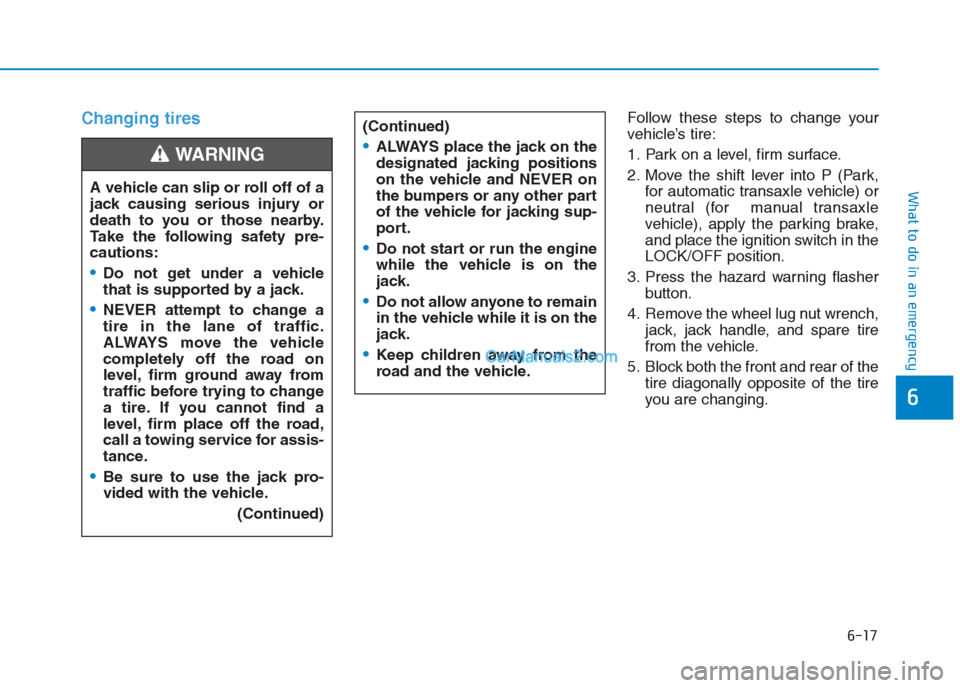
Changing tires Follow these steps to change your
vehicle’s tire:
1. Park on a level, firm surface.
2. Move the shift lever into P (Park,
for automatic transaxle vehicle) or
neutral (for manual transaxle
vehicle), apply the parking brake,
and place the ignition switch in the
LOCK/OFF position.
3. Press the hazard warning flasher
button.
4. Remove the wheel lug nut wrench,
jack, jack handle, and spare tire
from the vehicle.
5. Block both the front and rear of the
tire diagonally opposite of the tire
you are changing. A vehicle can slip or roll off of a
jack causing serious injury or
death to you or those nearby.
Take the following safety pre-
cautions:
Do not get under a vehicle
that is supported by a jack.
NEVER attempt to change a
tire in the lane of traffic.
ALWAYS move the vehicle
completely off the road on
level, firm ground away from
traffic before trying to change
a tire. If you cannot find a
level, firm place off the road,
call a towing service for assis-
tance.
Be sure to use the jack pro-
vided with the vehicle.
(Continued)
(Continued)
ALWAYS place the jack on the
designated jacking positions
on the vehicle and NEVER on
the bumpers or any other part
of the vehicle for jacking sup-
port.
Do not start or run the engine
while the vehicle is on the
jack.
Do not allow anyone to remain
in the vehicle while it is on the
jack.
Keep children away from the
road and the vehicle.
WARNING
Page 368 of 472
7-11
7
Maintenance
I : Inspect and if necessary, adjust, correct, clean or replace.
R : Replace or change.
*
1: Adjust alternator and power steering (and water pump drive belt) and air conditioner drive belt (if equipped).
Inspect and if necessary correct or replace.
*
2: Check the engine oil level and leak every 500 km (350 miles) or before starting a long trip.
*3: If good quality gasolines that meet Europe Fuel standards (EN228) or equivalents including fuel additives is not available, one
bottle of additive is recommended. Additives are available from your authorized HYUNDAI dealer along with information on how
to use them. Do not mix other additives.
*
4: For your convenience, it can be replaced prior to it's interval when you do maintenance of other items.
*5: Inspect for excessive valve noise and/or engine vibration and adjust if necessary. We recommend that the system be checked
by an authorized HYUNDAI dealer.
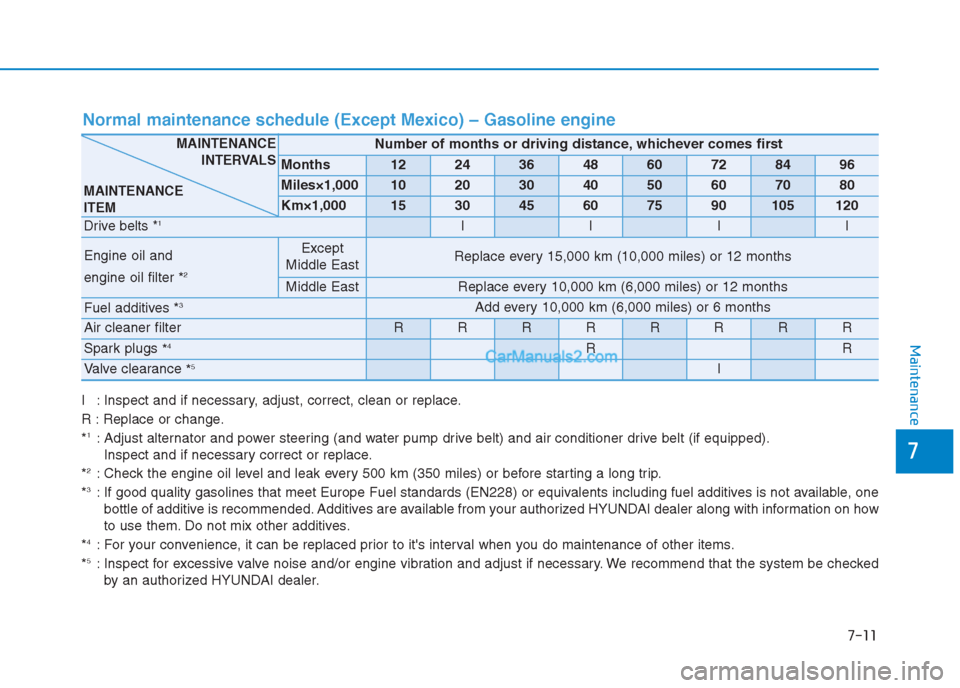
Normal maintenance schedule (Except Mexico) – Gasoline engine
Number of months or driving distance, whichever comes first
Months1224364860728496
Miles×1,0001020304050607080
Km×1,000153045607590105120
Drive belts *1IIII
Engine oil and
engine oil filter *
2
Except
Middle EastReplace every 15,000 km (10,000 miles) or 12 months
Middle EastReplace every 10,000 km (6,000 miles) or 12 months
Fuel additives *3Add every 10,000 km (6,000 miles) or 6 months
Air cleaner filterRRRRRRRR
Spark plugs
*4RR
Valve clearance
*5I
MAINTENANCE
INTERVALS
MAINTENANCE
ITEM
Page 369 of 472
7-12
Maintenance
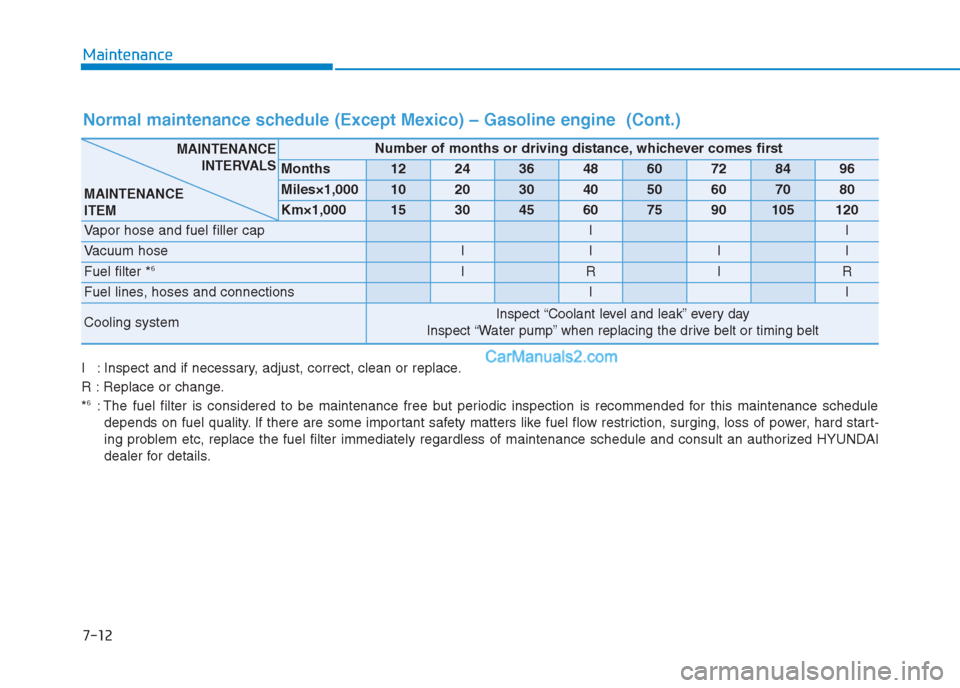
Normal maintenance schedule (Except Mexico) – Gasoline engine (Cont.)
I : Inspect and if necessary, adjust, correct, clean or replace.
R : Replace or change.
*
6: The fuel filter is considered to be maintenance free but periodic inspection is recommended for this maintenance schedule
depends on fuel quality. If there are some important safety matters like fuel flow restriction, surging, loss of power, hard start-
ing problem etc, replace the fuel filter immediately regardless of maintenance schedule and consult an authorized HYUNDAI
dealer for details.
Number of months or driving distance, whichever comes first
Months1224364860728496
Miles×1,0001020304050607080
Km×1,000153045607590105120
Vapor hose and fuel filler capII
Vacuum hoseIIII
Fuel filter *6IRIR
Fuel lines, hoses and connectionsII
Cooling systemInspect “Coolant level and leak” every day
Inspect “Water pump” when replacing the drive belt or timing belt
MAINTENANCE
INTERVALS
MAINTENANCE
ITEM
Page 374 of 472
7-17
7
Maintenance
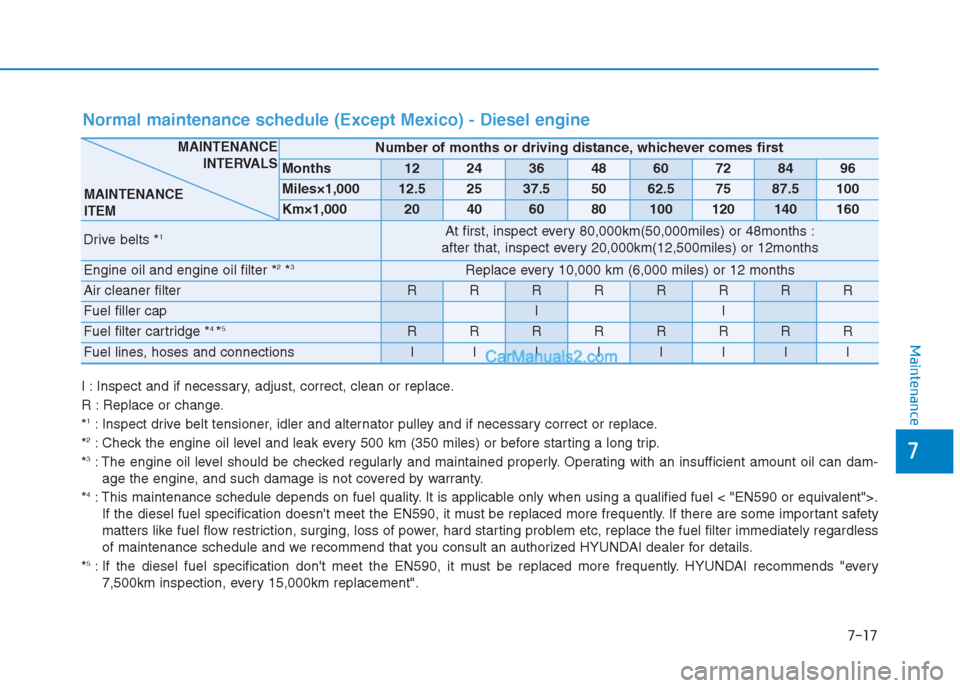
Normal maintenance schedule (Except Mexico) - Diesel engine
I : Inspect and if necessary, adjust, correct, clean or replace.
R : Replace or change.
*
1: Inspect drive belt tensioner, idler and alternator pulley and if necessary correct or replace.
*2: Check the engine oil level and leak every 500 km (350 miles) or before starting a long trip.
*3: The engine oil level should be checked regularly and maintained properly. Operating with an insufficient amount oil can dam-
age the engine, and such damage is not covered by warranty.
*
4: This maintenance schedule depends on fuel quality. It is applicable only when using a qualified fuel < "EN590 or equivalent">.
If the diesel fuel specification doesn't meet the EN590, it must be replaced more frequently. If there are some important safety
matters like fuel flow restriction, surging, loss of power, hard starting problem etc, replace the fuel filter immediately regardless
of maintenance schedule and we recommend that you consult an authorized HYUNDAI dealer for details.
*
5: If the diesel fuel specification don't meet the EN590, it must be replaced more frequently. HYUNDAI recommends "every
7,500km inspection, every 15,000km replacement".
Number of months or driving distance, whichever comes first
Months1224364860728496
Miles×1,00012.52537.55062.57587.5100
Km×1,00020406080100120140160
Drive belts *1At first, inspect every 80,000km(50,000miles) or 48months :
after that, inspect every 20,000km(12,500miles) or 12months
Engine oil and engine oil filter *2*3Replace every 10,000 km (6,000 miles) or 12 months
Air cleaner filter RRRRRRRR
Fuel filler capII
Fuel filter cartridge *4 *5RRRRRRRR
Fuel lines, hoses and connectionsIIIIIIII
MAINTENANCE
INTERVALS
MAINTENANCE
ITEM
Page 379 of 472
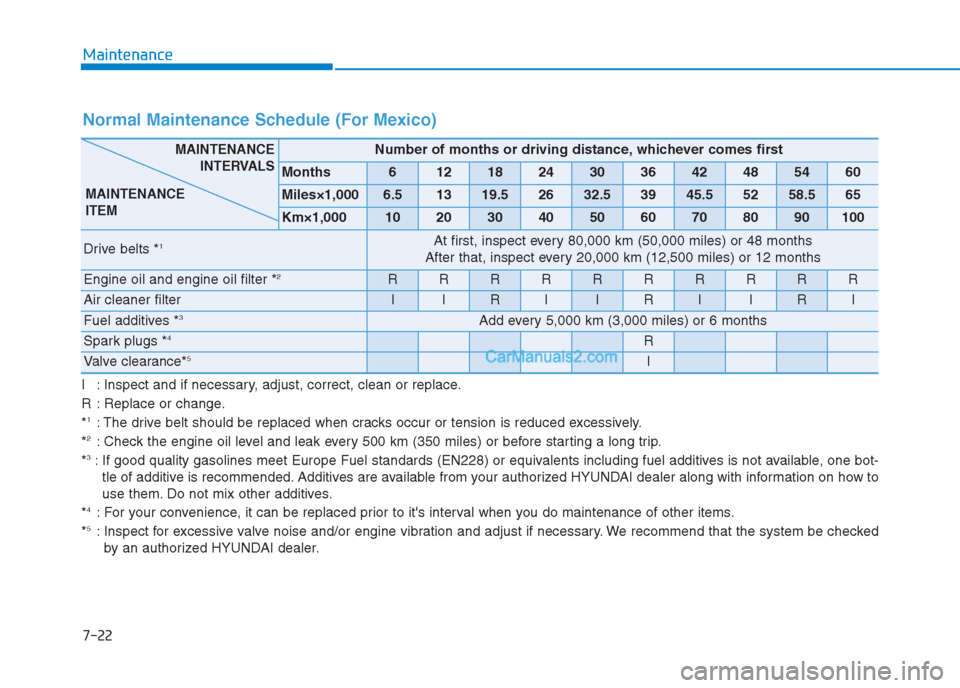
7-22
Maintenance
I : Inspect and if necessary, adjust, correct, clean or replace.
R : Replace or change.
*
1: The drive belt should be replaced when cracks occur or tension is reduced excessively.
*2: Check the engine oil level and leak every 500 km (350 miles) or before starting a long trip.
*3: If good quality gasolines meet Europe Fuel standards (EN228) or equivalents including fuel additives is not available, one bot-
tle of additive is recommended. Additives are available from your authorized HYUNDAI dealer along with information on how to
use them. Do not mix other additives.
*
4: For your convenience, it can be replaced prior to it's interval when you do maintenance of other items.
*5: Inspect for excessive valve noise and/or engine vibration and adjust if necessary. We recommend that the system be checked
by an authorized HYUNDAI dealer.
Normal Maintenance Schedule (For Mexico)
Number of months or driving distance, whichever comes first
Months6121824303642485460
Miles×1,0006.51319.52632.53945.55258.565
Km×1,000102030405060708090100
Drive belts *1At first, inspect every 80,000 km (50,000 miles) or 48 months
After that, inspect every 20,000 km (12,500 miles) or 12 months
Engine oil and engine oil filter *2RRRRRRRRRR
Air cleaner filterIIRIIRIIRI
Fuel additives *3Add every 5,000 km (3,000 miles) or 6 months
Spark plugs *4R
Valve clearance*5I
MAINTENANCE
INTERVALS
MAINTENANCE
ITEM
Page 385 of 472
7-28
Maintenance
E EX
XP
PL
LA
AN
NA
AT
TI
IO
ON
N
O
OF
F
S
SC
CH
HE
ED
DU
UL
LE
ED
D
M
MA
AI
IN
NT
TE
EN
NA
AN
NC
CE
E
I
IT
TE
EM
MS
S
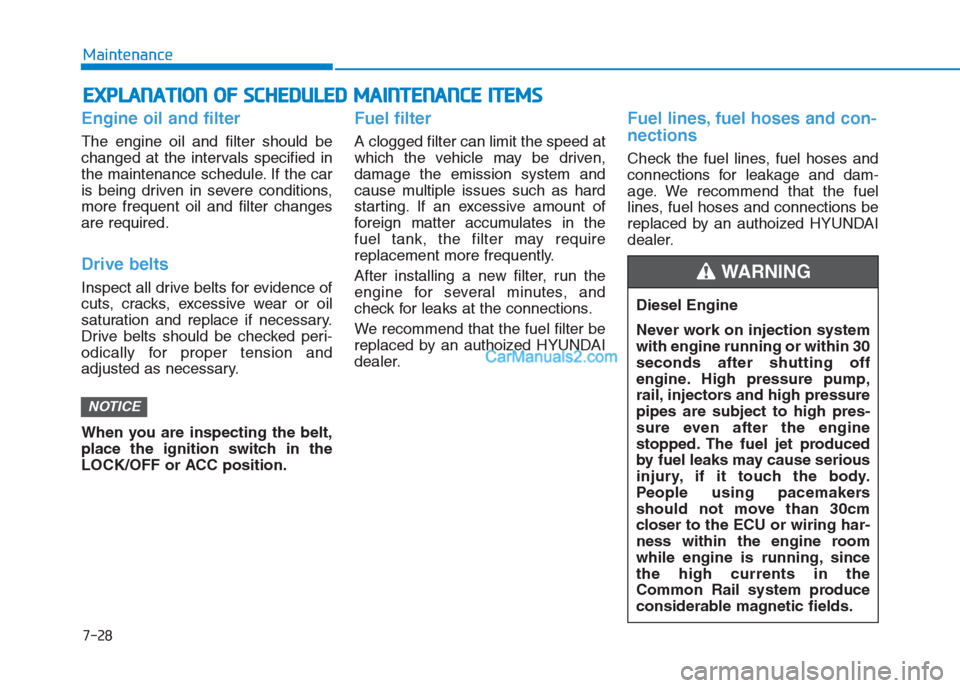
Engine oil and filter
The engine oil and filter should be
changed at the intervals specified in
the maintenance schedule. If the car
is being driven in severe conditions,
more frequent oil and filter changes
are required.
Drive belts
Inspect all drive belts for evidence of
cuts, cracks, excessive wear or oil
saturation and replace if necessary.
Drive belts should be checked peri-
odically for proper tension and
adjusted as necessary.
When you are inspecting the belt,
place the ignition switch in the
LOCK/OFF or ACC position.
Fuel filter
A clogged filter can limit the speed at
which the vehicle may be driven,
damage the emission system and
cause multiple issues such as hard
starting. If an excessive amount of
foreign matter accumulates in the
fuel tank, the filter may require
replacement more frequently.
After installing a new filter, run the
engine for several minutes, and
check for leaks at the connections.
We recommend that the fuel filter be
replaced by an authoized HYUNDAI
dealer.
Fuel lines, fuel hoses and con-
nections
Check the fuel lines, fuel hoses and
connections for leakage and dam-
age. We recommend that the fuel
lines, fuel hoses and connections be
replaced by an authoized HYUNDAI
dealer.
NOTICE
Diesel Engine
Never work on injection system
with engine running or within 30
seconds after shutting off
engine. High pressure pump,
rail, injectors and high pressure
pipes are subject to high pres-
sure even after the engine
stopped. The fuel jet produced
by fuel leaks may cause serious
injury, if it touch the body.
People using pacemakers
should not move than 30cm
closer to the ECU or wiring har-
ness within the engine room
while engine is running, since
the high currents in the
Common Rail system produce
considerable magnetic fields.
WARNING