fluid Hyundai Elantra 2007 Owner's Guide
[x] Cancel search | Manufacturer: HYUNDAI, Model Year: 2007, Model line: Elantra, Model: Hyundai Elantra 2007Pages: 339, PDF Size: 11.19 MB
Page 274 of 339
719
Maintenance
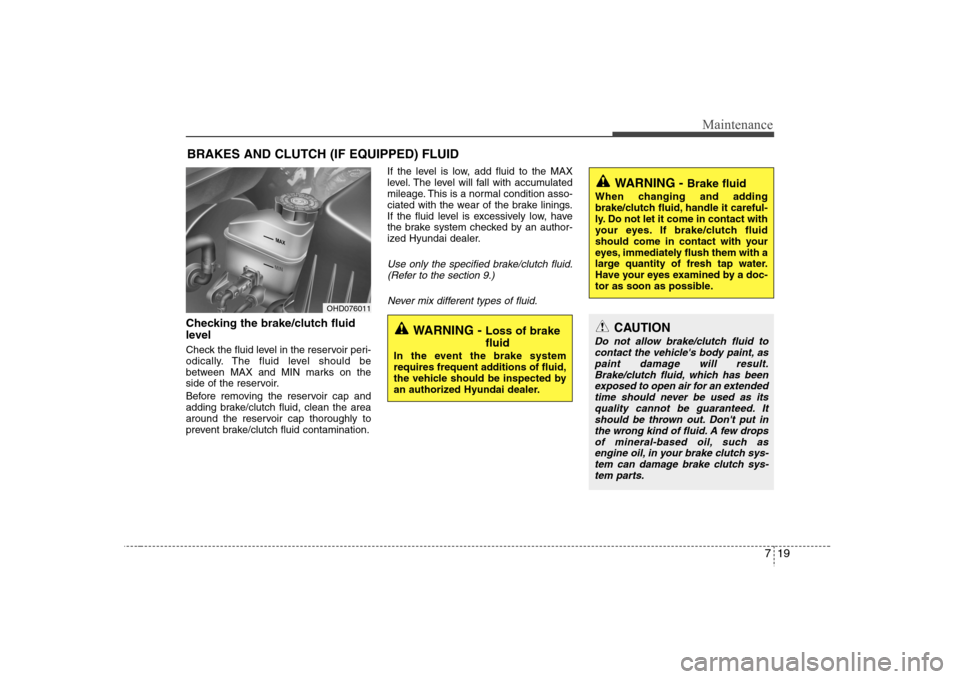
BRAKES AND CLUTCH (IF EQUIPPED) FLUIDChecking the brake/clutch fluid
level Check the fluid level in the reservoir peri-
odically. The fluid level should be
between MAX and MIN marks on the
side of the reservoir.
Before removing the reservoir cap and
adding brake/clutch fluid, clean the area
around the reservoir cap thoroughly to
prevent brake/clutch fluid contamination.If the level is low, add fluid to the MAX
level. The level will fall with accumulated
mileage. This is a normal condition asso-
ciated with the wear of the brake linings.
If the fluid level is excessively low, have
the brake system checked by an author-
ized Hyundai dealer.
Use only the specified brake/clutch fluid.
(Refer to the section 9.)
Never mix different types of fluid.
WARNING -
Brake fluid
When changing and adding
brake/clutch fluid, handle it careful-
ly. Do not let it come in contact with
your eyes. If brake/clutch fluid
should come in contact with your
eyes, immediately flush them with a
large quantity of fresh tap water.
Have your eyes examined by a doc-
tor as soon as possible.
WARNING -
Loss of brake
fluid
In the event the brake system
requires frequent additions of fluid,
the vehicle should be inspected by
an authorized Hyundai dealer.
OHD076011
CAUTION
Do not allow brake/clutch fluid to
contact the vehicle's body paint, as
paint damage will result.
Brake/clutch fluid, which has been
exposed to open air for an extended
time should never be used as its
quality cannot be guaranteed. It
should be thrown out. Don't put in
the wrong kind of fluid. A few drops
of mineral-based oil, such as
engine oil, in your brake clutch sys-
tem can damage brake clutch sys-
tem parts.
Page 275 of 339
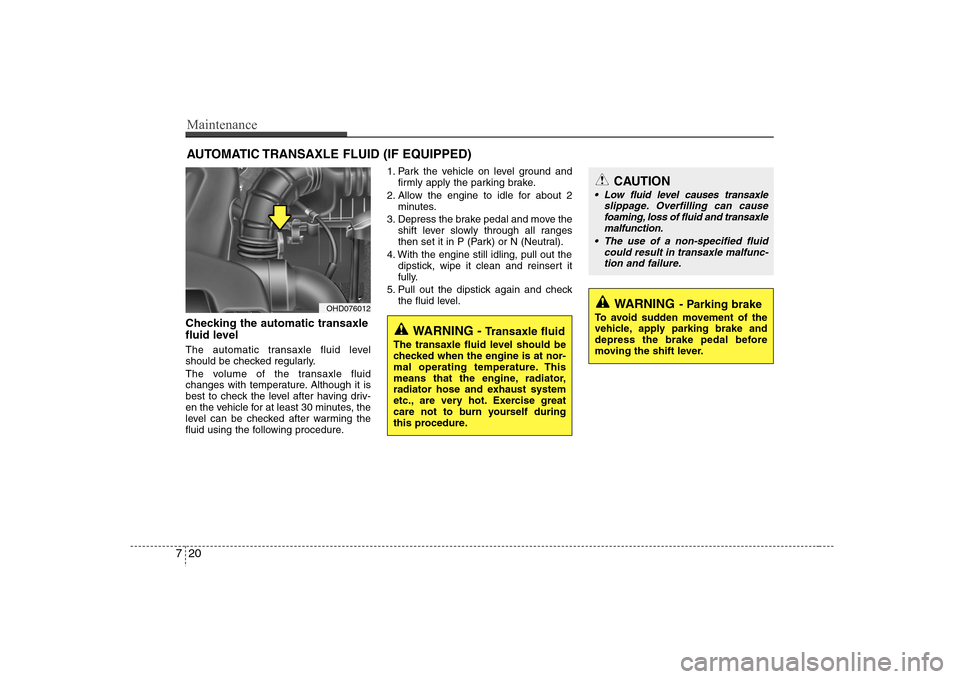
Maintenance20 7AUTOMATIC TRANSAXLE FLUID (IF EQUIPPED)Checking the automatic transaxle
fluid level The automatic transaxle fluid level
should be checked regularly.
The volume of the transaxle fluid
changes with temperature. Although it is
best to check the level after having driv-
en the vehicle for at least 30 minutes, the
level can be checked after warming the
fluid using the following procedure.1. Park the vehicle on level ground and
firmly apply the parking brake.
2. Allow the engine to idle for about 2
minutes.
3. Depress the brake pedal and move the
shift lever slowly through all ranges
then set it in P (Park) or N (Neutral).
4. With the engine still idling, pull out the
dipstick, wipe it clean and reinsert it
fully.
5. Pull out the dipstick again and check
the fluid level.
WARNING -
Transaxle fluid
The transaxle fluid level should be
checked when the engine is at nor-
mal operating temperature. This
means that the engine, radiator,
radiator hose and exhaust system
etc., are very hot. Exercise great
care not to burn yourself during
this procedure.
WARNING
- Parking brake
To avoid sudden movement of the
vehicle, apply parking brake and
depress the brake pedal before
moving the shift lever.
CAUTION
Low fluid level causes transaxle
slippage. Overfilling can cause
foaming, loss of fluid and transaxle
malfunction.
The use of a non-specified fluid
could result in transaxle malfunc-
tion and failure.
OHD076012
Page 276 of 339
721
Maintenance
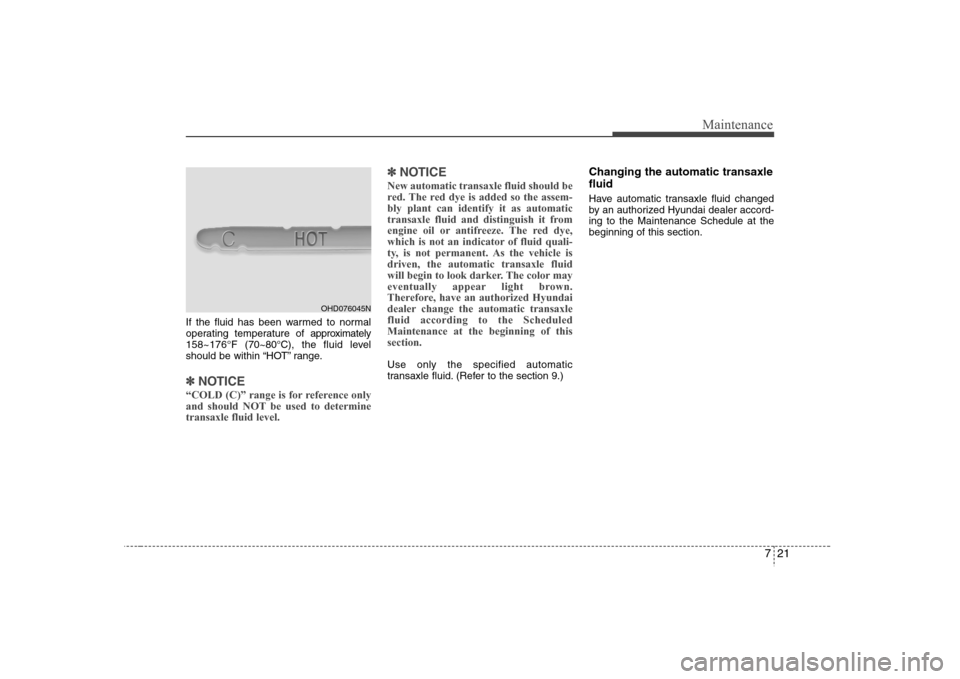
If the fluid has been warmed to normal
operating temperature of approximately
158~176°F (70~80°C), the fluid level
should be within “HOT” range.✽ ✽
NOTICE“COLD (C)” range is for reference only
and should NOT be used to determine
transaxle fluid level.
✽ ✽
NOTICENew automatic transaxle fluid should be
red. The red dye is added so the assem-
bly plant can identify it as automatic
transaxle fluid and distinguish it from
engine oil or antifreeze. The red dye,
which is not an indicator of fluid quali-
ty, is not permanent. As the vehicle is
driven, the automatic transaxle fluid
will begin to look darker. The color may
eventually appear light brown.
Therefore, have an authorized Hyundai
dealer change the automatic transaxle
fluid according to the Scheduled
Maintenance at the beginning of this
section.Use only the specified automatic
transaxle fluid. (Refer to the section 9.)
Changing the automatic transaxle
fluidHave automatic transaxle fluid changed
by an authorized Hyundai dealer accord-
ing to the Maintenance Schedule at the
beginning of this section.
OHD076045N
Page 277 of 339
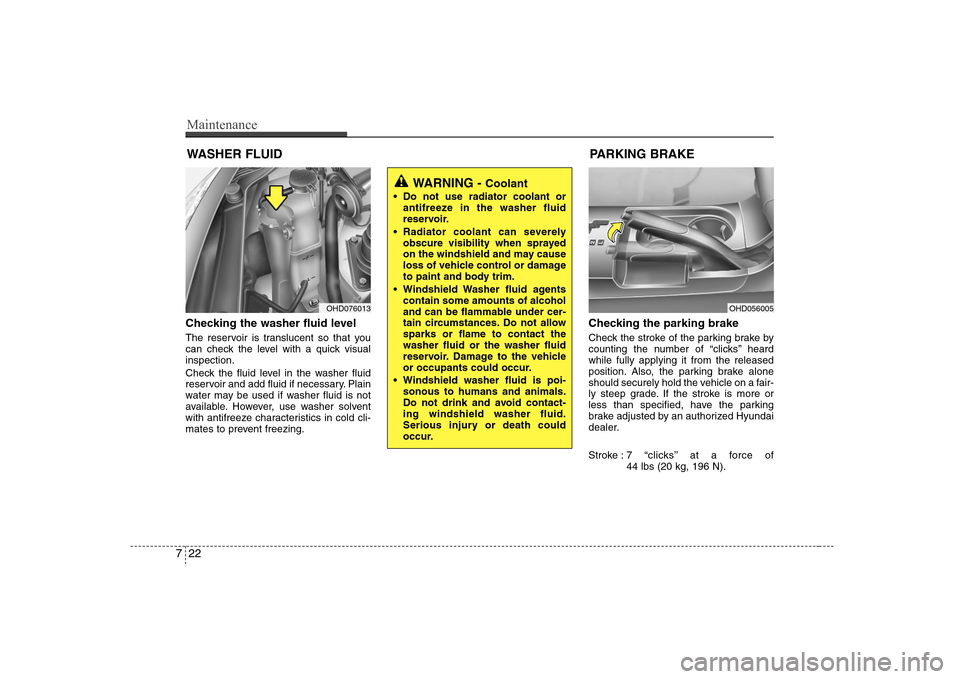
Maintenance22 7WASHER FLUIDChecking the washer fluid level The reservoir is translucent so that you
can check the level with a quick visual
inspection.
Check the fluid level in the washer fluid
reservoir and add fluid if necessary. Plain
water may be used if washer fluid is not
available. However, use washer solvent
with antifreeze characteristics in cold cli-
mates to prevent freezing.
Checking the parking brake Check the stroke of the parking brake by
counting the number of “clicks’’ heard
while fully applying it from the released
position. Also, the parking brake alone
should securely hold the vehicle on a fair-
ly steep grade. If the stroke is more or
less than specified, have the parking
brake adjusted by an authorized Hyundai
dealer.
Stroke : 7 “clicks’’ at a force of
44 lbs (20 kg, 196 N).
WARNING -
Coolant
Do not use radiator coolant or
antifreeze in the washer fluid
reservoir.
Radiator coolant can severely
obscure visibility when sprayed
on the windshield and may cause
loss of vehicle control or damage
to paint and body trim.
Windshield Washer fluid agents
contain some amounts of alcohol
and can be flammable under cer-
tain circumstances. Do not allow
sparks or flame to contact the
washer fluid or the washer fluid
reservoir. Damage to the vehicle
or occupants could occur.
Windshield washer fluid is poi-
sonous to humans and animals.
Do not drink and avoid contact-
ing windshield washer fluid.
Serious injury or death could
occur.
OHD076013
OHD056005
PARKING BRAKE
Page 321 of 339
Maintenance66 73. Exhaust emission control
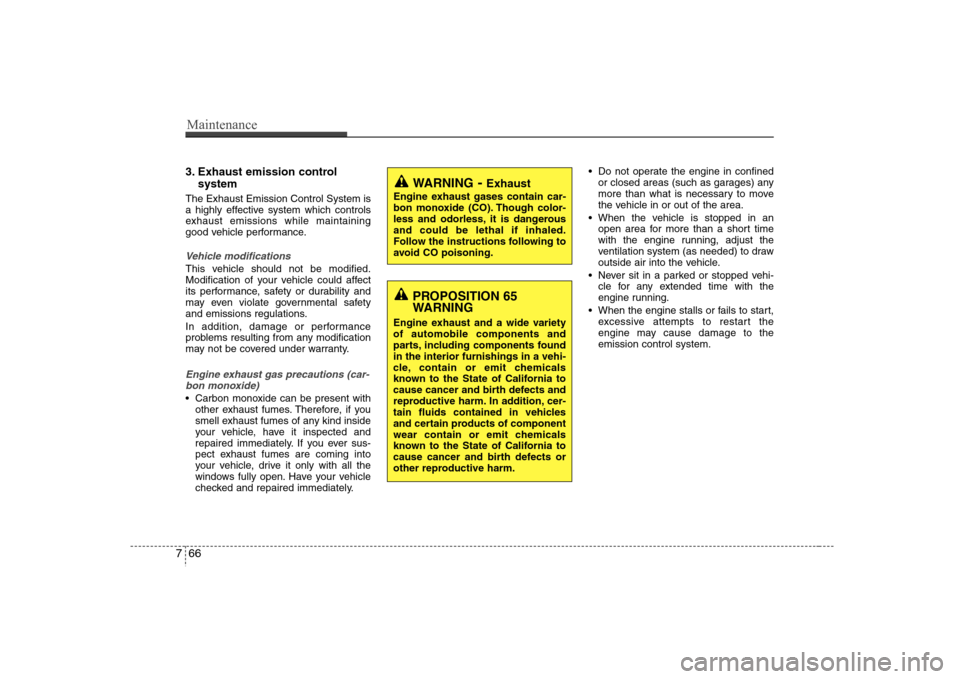
systemThe Exhaust Emission Control System is
a highly effective system which controls
exhaust emissions while maintaining
good vehicle performance.Vehicle modifications This vehicle should not be modified.
Modification of your vehicle could affect
its performance, safety or durability and
may even violate governmental safety
and emissions regulations.
In addition, damage or performance
problems resulting from any modification
may not be covered under warranty.Engine exhaust gas precautions (car-
bon monoxide) Carbon monoxide can be present with
other exhaust fumes. Therefore, if you
smell exhaust fumes of any kind inside
your vehicle, have it inspected and
repaired immediately. If you ever sus-
pect exhaust fumes are coming into
your vehicle, drive it only with all the
windows fully open. Have your vehicle
checked and repaired immediately. Do not operate the engine in confined
or closed areas (such as garages) any
more than what is necessary to move
the vehicle in or out of the area.
When the vehicle is stopped in an
open area for more than a short time
with the engine running, adjust the
ventilation system (as needed) to draw
outside air into the vehicle.
Never sit in a parked or stopped vehi-
cle for any extended time with the
engine running.
When the engine stalls or fails to start,
excessive attempts to restart the
engine may cause damage to the
emission control system.
WARNING
- Exhaust
Engine exhaust gases contain car-
bon monoxide (CO). Though color-
less and odorless, it is dangerous
and could be lethal if inhaled.
Follow the instructions following to
avoid CO poisoning.
PROPOSITION 65
WARNING
Engine exhaust and a wide variety
of automobile components and
parts, including components found
in the interior furnishings in a vehi-
cle, contain or emit chemicals
known to the State of California to
cause cancer and birth defects and
reproductive harm. In addition, cer-
tain fluids contained in vehicles
and certain products of component
wear contain or emit chemicals
known to the State of California to
cause cancer and birth defects or
other reproductive harm.
Page 331 of 339
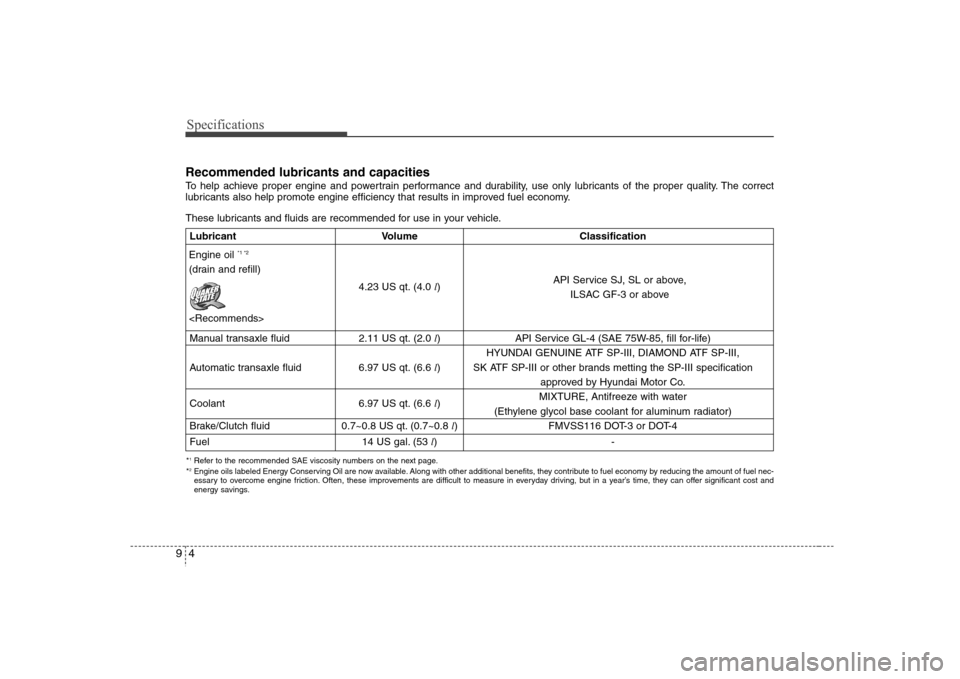
Specifications4 9Recommended lubricants and capacities To help achieve proper engine and powertrain performance and durability, use only lubricants of the proper quality. The correct
lubricants also help promote engine efficiency that results in improved fuel economy.These lubricants and fluids are recommended for use in your vehicle.*1Refer to the recommended SAE viscosity numbers on the next page.
*2Engine oils labeled Energy Conserving Oil are now available. Along with other additional benefits, they contribute to fuel economy by reducing the amount of fuel nec-
essary to overcome engine friction. Often, these improvements are difficult to measure in everyday driving, but in a year’s time, they can offer significant cost and
energy savings.Lubricant Volume Classification
4.23 US qt. (4.0 l)
Manual transaxle fluid 2.11 US qt. (2.0 l) API Service GL-4 (SAE 75W-85, fill for-life)
HYUNDAI GENUINE ATF SP-III, DIAMOND ATF SP-III,
Automatic transaxle fluid 6.97 US qt. (6.6 l) SK ATF SP-III or other brands metting the SP-III specification
approved by Hyundai Motor Co.
Coolant 6.97 US qt. (6.6 l)MIXTURE, Antifreeze with water
(Ethylene glycol base coolant for aluminum radiator)
Brake/Clutch fluid 0.7~0.8 US qt. (0.7~0.8 l) FMVSS116 DOT-3 or DOT-4
Fuel 14 US gal. (53 l)-Engine oil
*1 *2
(drain and refill)
ILSAC GF-3 or above
Page 334 of 339
Index2I
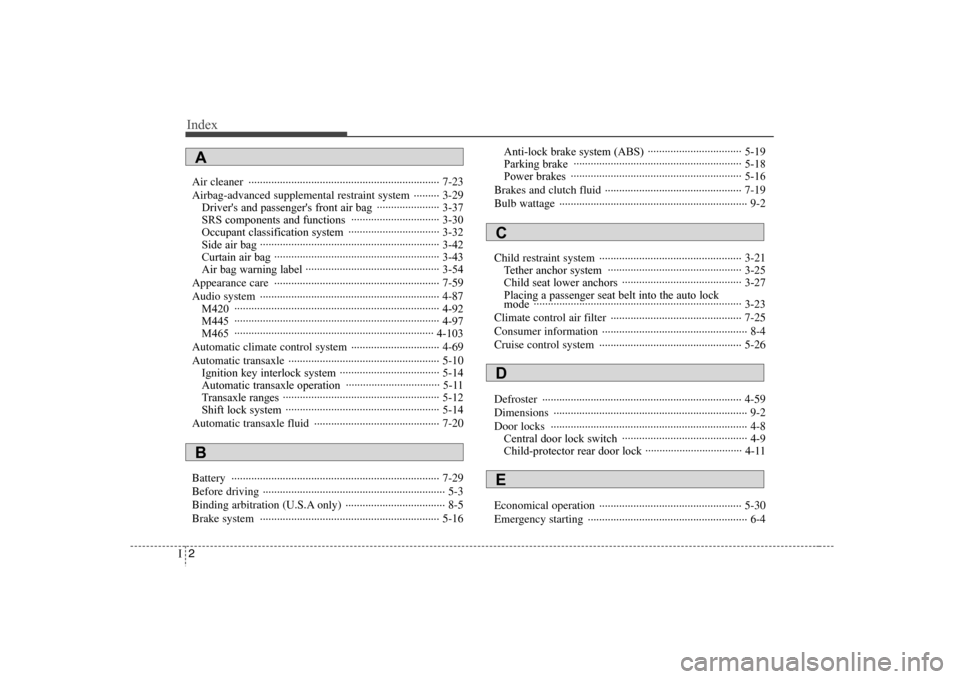
Air cleaner ··································································· 7-23
Airbag-advanced supplemental restraint system ········· 3-29
Driver's and passenger's front air bag ······················ 3-37
SRS components and functions ······························· 3-30
Occupant classification system ································ 3-32
Side air bag ······························································· 3-42
Curtain air bag ·························································· 3-43
Air bag warning label ··············································· 3-54
Appearance care ·························································· 7-59
Audio system ······························································· 4-87
M420 ········································································ 4-92
M445 ········································································ 4-97
M465 ······································································ 4-103
Automatic climate control system ······························· 4-69
Automatic transaxle ····················································· 5-10
Ignition key interlock system ··································· 5-14
Automatic transaxle operation ································· 5-11
Transaxle ranges ······················································· 5-12
Shift lock system ······················································ 5-14
Automatic transaxle fluid ············································ 7-20
Battery ········································································· 7-29
Before driving ································································ 5-3
Binding arbitration (U.S.A only) ··································· 8-5
Brake system ······························································· 5-16Anti-lock brake system (ABS) ································· 5-19
Parking brake ··························································· 5-18
Power brakes ···························································· 5-16
Brakes and clutch fluid ················································ 7-19
Bulb wattage ·································································· 9-2
Child restraint system ·················································· 3-21
Tether anchor system ··············································· 3-25
Child seat lower anchors ·········································· 3-27
Placing a passenger seat belt into the auto lock
mode ········································································· 3-23
Climate control air filter ·············································· 7-25
Consumer information ··················································· 8-4
Cruise control system ·················································· 5-26
Defroster ······································································ 4-59
Dimensions ···································································· 9-2
Door locks ····································································· 4-8
Central door lock switch ············································ 4-9
Child-protector rear door lock ·································· 4-11
Economical operation ·················································· 5-30
Emergency starting ························································ 6-4AB
CDE
Page 337 of 339
I5
Index
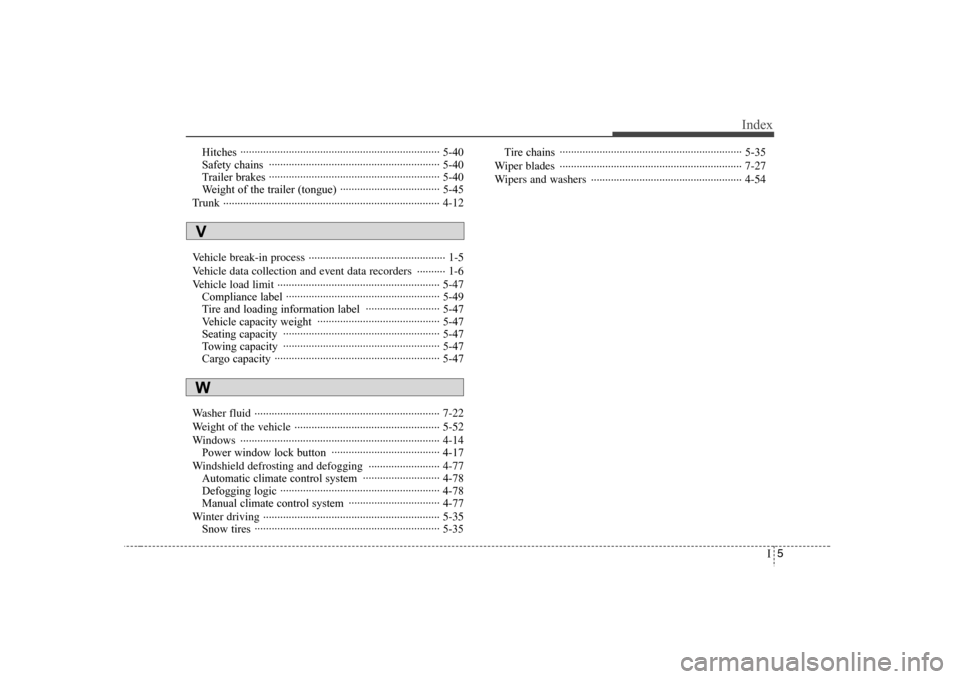
Hitches ······································································ 5-40
Safety chains ···························································· 5-40
Trailer brakes ···························································· 5-40
Weight of the trailer (tongue) ··································· 5-45
Trunk ············································································ 4-12
Vehicle break-in process ················································ 1-5
Vehicle data collection and event data recorders ·········· 1-6
Vehicle load limit ························································· 5-47
Compliance label ······················································ 5-49
Tire and loading information label ·························· 5-47
Vehicle capacity weight ··········································· 5-47
Seating capacity ······················································· 5-47
Towing capacity ······················································· 5-47
Cargo capacity ·························································· 5-47
Washer fluid ································································· 7-22
Weight of the vehicle ··················································· 5-52
Windows ······································································ 4-14
Power window lock button ······································ 4-17
Windshield defrosting and defogging ························· 4-77
Automatic climate control system ··························· 4-78
Defogging logic ························································ 4-78
Manual climate control system ································ 4-77
Winter driving ······························································ 5-35
Snow tires ································································· 5-35Tire chains ································································ 5-35
Wiper blades ································································ 7-27
Wipers and washers ····················································· 4-54VW