height Hyundai Elantra 2007 Owner's Manual
[x] Cancel search | Manufacturer: HYUNDAI, Model Year: 2007, Model line: Elantra, Model: Hyundai Elantra 2007Pages: 339, PDF Size: 11.19 MB
Page 21 of 339
Safety system of your vehicle2 3
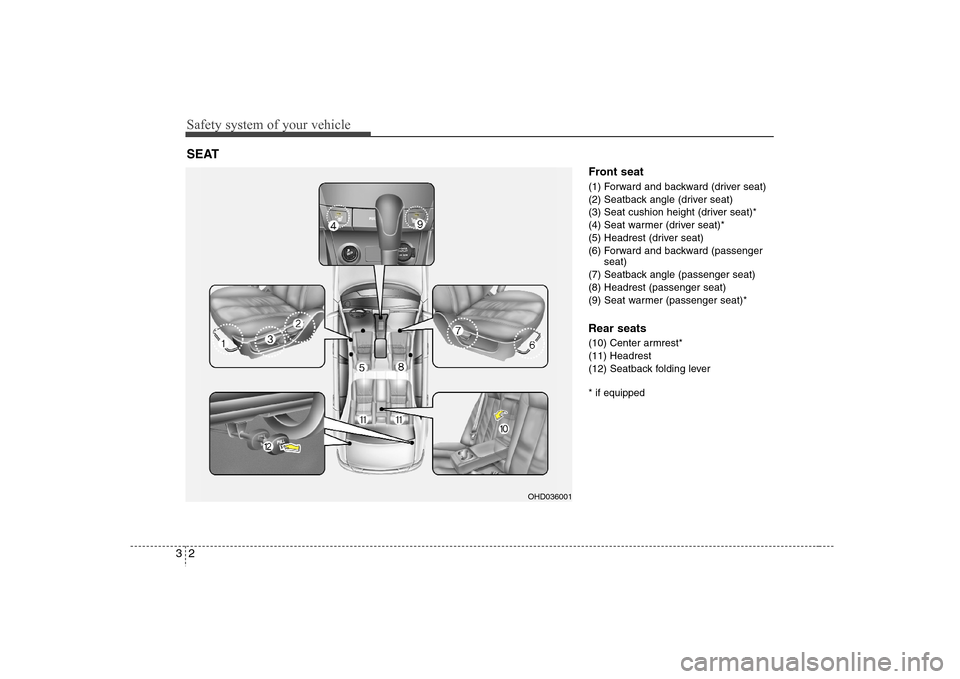
Front seat(1) Forward and backward (driver seat)
(2) Seatback angle (driver seat)
(3) Seat cushion height (driver seat)*
(4) Seat warmer (driver seat)*
(5) Headrest (driver seat)
(6) Forward and backward (passenger
seat)
(7) Seatback angle (passenger seat)
(8) Headrest (passenger seat)
(9) Seat warmer (passenger seat)*Rear seats(10) Center armrest*
(11) Headrest
(12) Seatback folding lever* if equipped
SEAT
OHD036001
Page 23 of 339
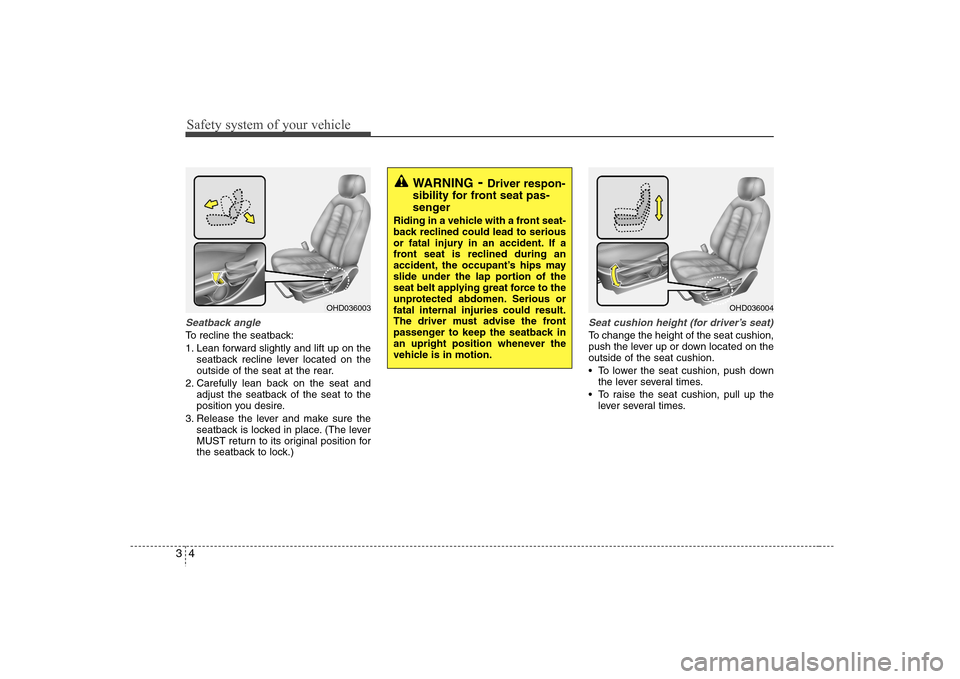
Safety system of your vehicle4 3Seatback angleTo recline the seatback:
1. Lean forward slightly and lift up on the
seatback recline lever located on the
outside of the seat at the rear.
2. Carefully lean back on the seat and
adjust the seatback of the seat to the
position you desire.
3. Release the lever and make sure the
seatback is locked in place. (The lever
MUST return to its original position for
the seatback to lock.)
Seat cushion height (for driver’s seat)To change the height of the seat cushion,
push the lever up or down located on the
outside of the seat cushion.
• To lower the seat cushion, push down
the lever several times.
To raise the seat cushion, pull up the
lever several times.
OHD036003
WARNING
- Driver respon-
sibility for front seat pas-
senger
Riding in a vehicle with a front seat-
back reclined could lead to serious
or fatal injury in an accident. If a
front seat is reclined during an
accident, the occupant’s hips may
slide under the lap portion of the
seat belt applying great force to the
unprotected abdomen. Serious or
fatal internal injuries could result.
The driver must advise the front
passenger to keep the seatback in
an upright position whenever the
vehicle is in motion.
OHD036004
Page 24 of 339
35
Safety system of your vehicle
Headrest
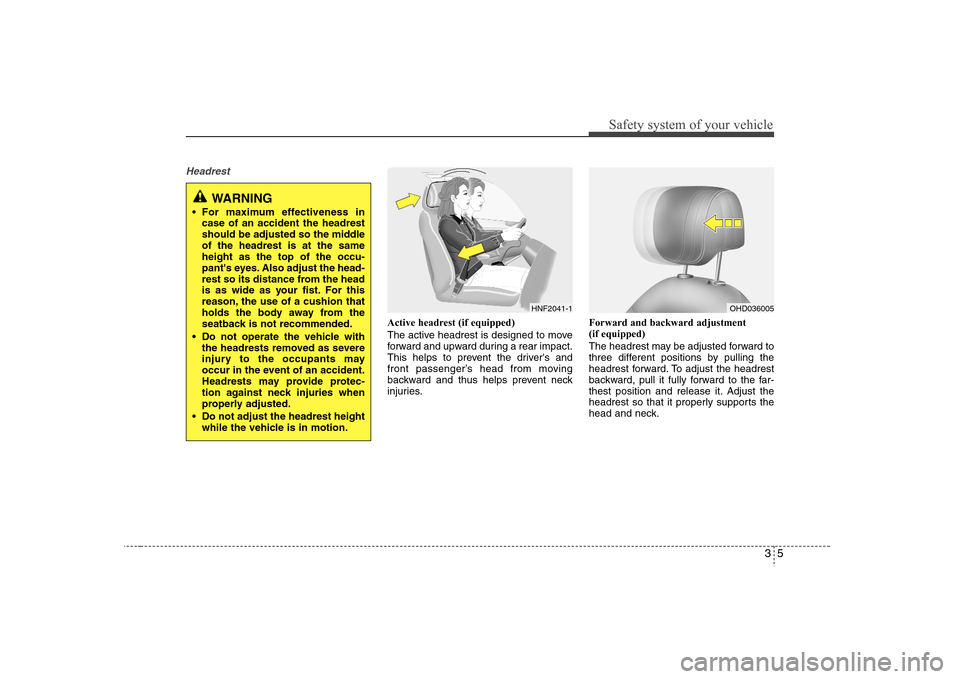
Active headrest (if equipped)
The active headrest is designed to move
forward and upward during a rear impact.
This helps to prevent the driver's and
front passenger’s head from moving
backward and thus helps prevent neck
injuries.Forward and backward adjustment
(if equipped)
The headrest may be adjusted forward to
three different positions by pulling the
headrest forward. To adjust the headrest
backward, pull it fully forward to the far-
thest position and release it. Adjust the
headrest so that it properly supports the
head and neck.
OHD036005
HNF2041-1
WARNING
For maximum effectiveness in
case of an accident the headrest
should be adjusted so the middle
of the headrest is at the same
height as the top of the occu-
pant's eyes. Also adjust the head-
rest so its distance from the head
is as wide as your fist. For this
reason, the use of a cushion that
holds the body away from the
seatback is not recommended.
Do not operate the vehicle with
the headrests removed as severe
injury to the occupants may
occur in the event of an accident.
Headrests may provide protec-
tion against neck injuries when
properly adjusted.
Do not adjust the headrest height
while the vehicle is in motion.
Page 25 of 339
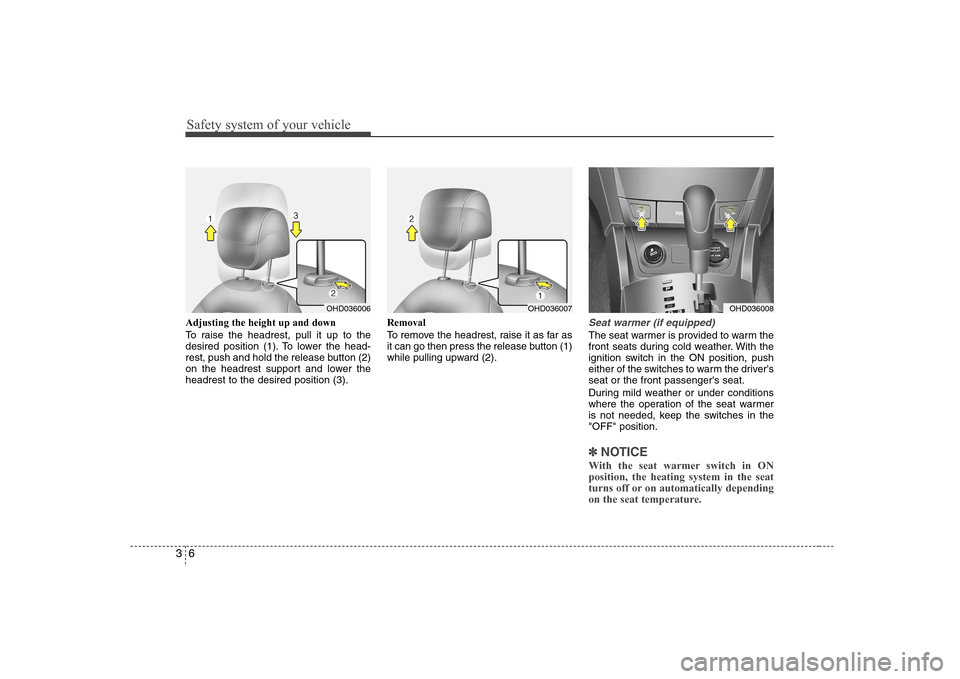
Safety system of your vehicle6 3Adjusting the height up and down
To raise the headrest, pull it up to the
desired position (1). To lower the head-
rest, push and hold the release button (2)
on the headrest support and lower the
headrest to the desired position (3).Removal
To remove the headrest, raise it as far as
it can go then press the release button (1)
while pulling upward (2).
Seat warmer (if equipped)The seat warmer is provided to warm the
front seats during cold weather. With the
ignition switch in the ON position, push
either of the switches to warm the driver's
seat or the front passenger's seat.
During mild weather or under conditions
where the operation of the seat warmer
is not needed, keep the switches in the
"OFF" position.✽ ✽
NOTICEWith the seat warmer switch in ON
position, the heating system in the seat
turns off or on automatically depending
on the seat temperature.
OHD036007
OHD036006
OHD036008
Page 27 of 339
Safety system of your vehicle8 3
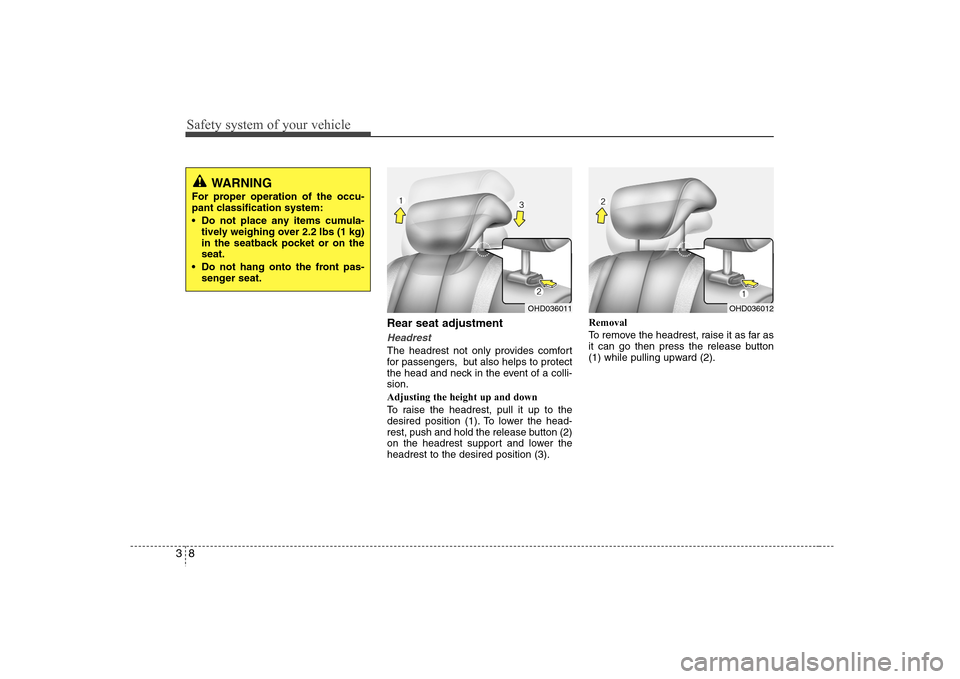
Rear seat adjustmentHeadrestThe headrest not only provides comfort
for passengers, but also helps to protect
the head and neck in the event of a colli-
sion.
Adjusting the height up and down
To raise the headrest, pull it up to the
desired position (1). To lower the head-
rest, push and hold the release button (2)
on the headrest support and lower the
headrest to the desired position (3).Removal
To remove the headrest, raise it as far as
it can go then press the release button
(1) while pulling upward (2).
OHD036011
OHD036012
WARNING
For proper operation of the occu-
pant classification system:
Do not place any items cumula-
tively weighing over 2.2 lbs (1 kg)
in the seatback pocket or on the
seat.
Do not hang onto the front pas-
senger seat.
Page 28 of 339
39
Safety system of your vehicle
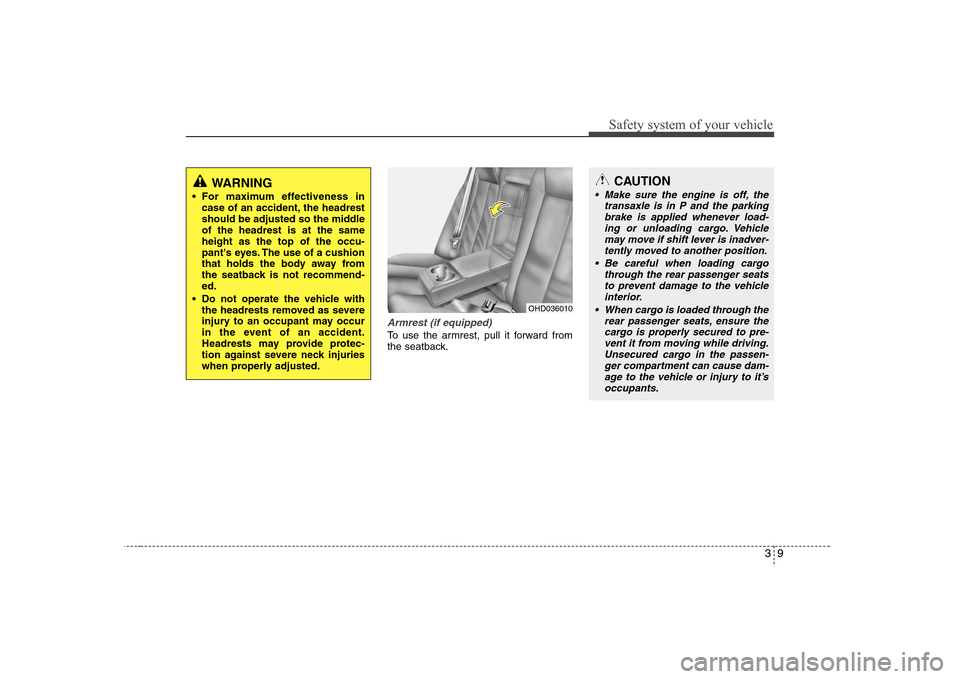
Armrest (if equipped)To use the armrest, pull it forward from
the seatback.
WARNING
For maximum effectiveness in
case of an accident, the headrest
should be adjusted so the middle
of the headrest is at the same
height as the top of the occu-
pant's eyes. The use of a cushion
that holds the body away from
the seatback is not recommend-
ed.
Do not operate the vehicle with
the headrests removed as severe
injury to an occupant may occur
in the event of an accident.
Headrests may provide protec-
tion against severe neck injuries
when properly adjusted.
OHD036010
CAUTION
Make sure the engine is off, the
transaxle is in P and the parking
brake is applied whenever load-
ing or unloading cargo. Vehicle
may move if shift lever is inadver-
tently moved to another position.
Be careful when loading cargo
through the rear passenger seats
to prevent damage to the vehicle
interior.
When cargo is loaded through the
rear passenger seats, ensure the
cargo is properly secured to pre-
vent it from moving while driving.
Unsecured cargo in the passen-
ger compartment can cause dam-
age to the vehicle or injury to it’s
occupants.
Page 32 of 339
313
Safety system of your vehicle
Seat belt warning chimeIf the driver's seat belt is not fastened
when the ignition key is turned ON, the
seat belt warning chime sounds for
approximately 6 seconds. And if the vehi-
cle speed exceeds 10km/h with the seat
belt unfastened, the seat belt warning
chime sounds with the pattern of 6 sec-
onds on and 24 seconds off for 11
times.The seat belt warning chime will
stop if the seat belt is fastened or the
vehicle speed is reduced to below 5km/h.
Seat belt - Driver’s 3-point system
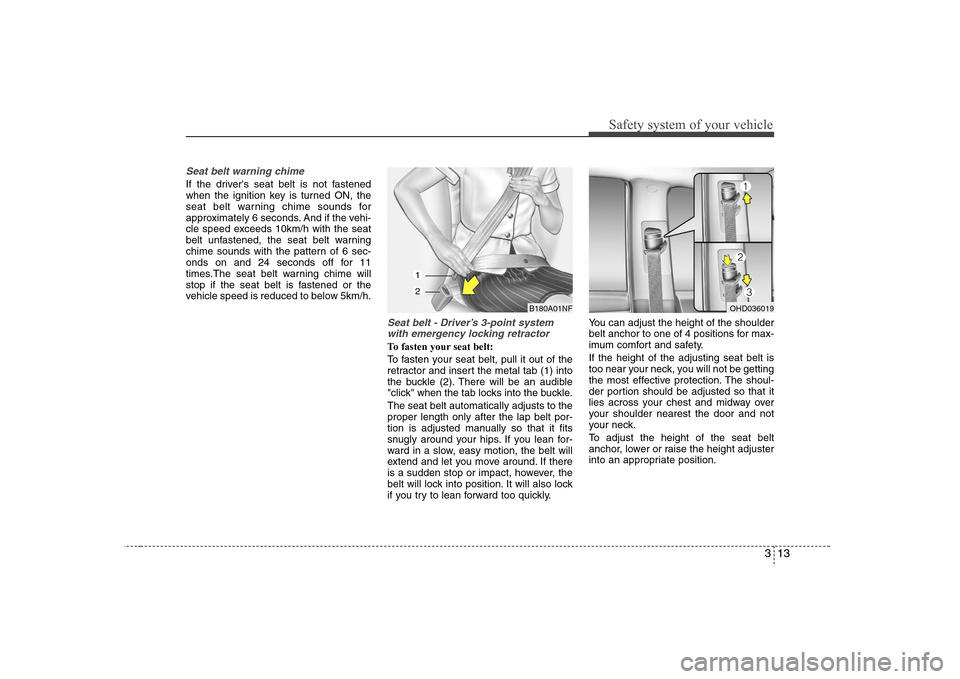
with emergency locking retractorTo fasten your seat belt:
To fasten your seat belt, pull it out of the
retractor and insert the metal tab (1) into
the buckle (2). There will be an audible
"click" when the tab locks into the buckle.
The seat belt automatically adjusts to the
proper length only after the lap belt por-
tion is adjusted manually so that it fits
snugly around your hips. If you lean for-
ward in a slow, easy motion, the belt will
extend and let you move around. If there
is a sudden stop or impact, however, the
belt will lock into position. It will also lock
if you try to lean forward too quickly.You can adjust the height of the shoulder
belt anchor to one of 4 positions for max-
imum comfort and safety.
If the height of the adjusting seat belt is
too near your neck, you will not be getting
the most effective protection. The shoul-
der portion should be adjusted so that it
lies across your chest and midway over
your shoulder nearest the door and not
your neck.
To adjust the height of the seat belt
anchor, lower or raise the height adjuster
into an appropriate position.
OHD036019
B180A01NF
12
Page 33 of 339
Safety system of your vehicle14 3To raise the height adjuster, pull it up (1).
To lower it, push it down (3) while press-
ing the height adjuster button (2).
Release the button to lock the anchor
into position. Try sliding the height
adjuster to make sure that it has locked
into position.
Seat belts - Front passenger and rear
seat 3-point system with combination
locking retractorTo fasten your seat belt
Combination retractor type seat belts are
installed in the rear seat positions to help
accommodate the installation of child
restraint systems. Although a combina-
tion retractor is also installed in the front
passenger seat position, we strongly rec-
ommend that children always be seated
in the rear seat. NEVER place any infant
restraint system in the front seat of the
vehicle.
This type of seat belt combines the fea-
tures of both an emergency locking
retractor seat belt and an automatic lock-
ing retractor seat belt. To fasten your seat
belt, pull it out of the retractor and insert
the metal tab into the buckle. There will
be an audible "click" when the tab locks
into the buckle. When not securing a
child restraint, the seat belt operates in
the same way as the driver's seat belt
(Emergency Locking Retractor Type). It
automatically adjusts to the proper length
only after the lap belt portion of the seat
belt is adjusted manually so that it fits
snugly around your hips.
WARNING
Verify the shoulder belt anchor is
locked into position at the appro-
priate height. Never position the
shoulder belt across your neck or
face. Improperly positioned seat
belts can cause serious injuries
in an accident.
Failure to replace seat belts after
an accident could leave you with
damaged seat belts that will not
provide protection in the event of
another collision leading to per-
sonal injury or death. Replace
your seat belts after being in an
accident as soon as possible.
B200A01NF
WARNING
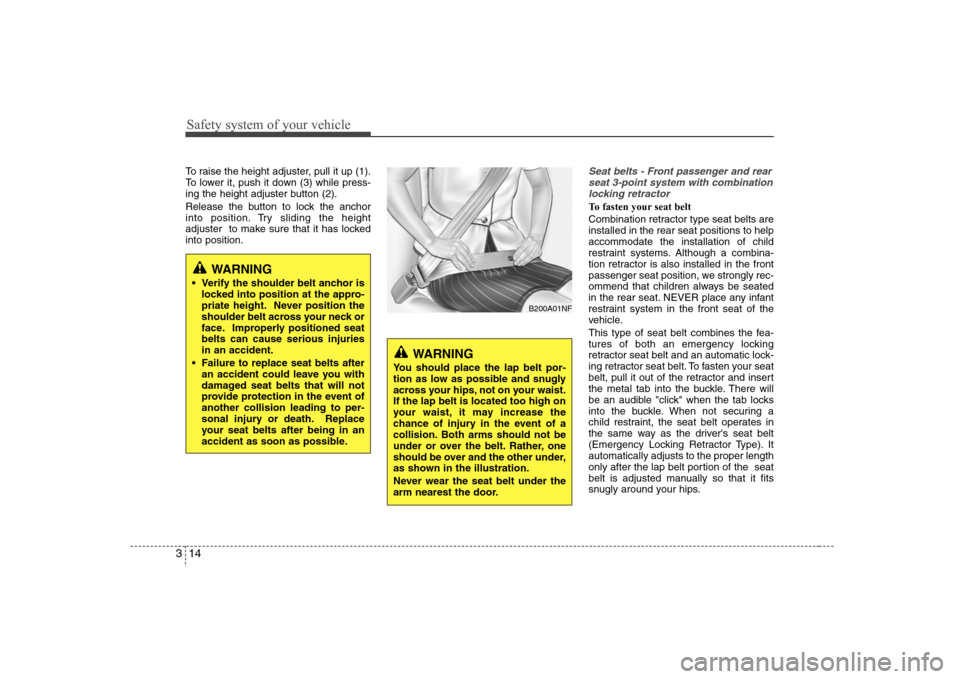
You should place the lap belt por-
tion as low as possible and snugly
across your hips, not on your waist.
If the lap belt is located too high on
your waist, it may increase the
chance of injury in the event of a
collision. Both arms should not be
under or over the belt. Rather, one
should be over and the other under,
as shown in the illustration.
Never wear the seat belt under the
arm nearest the door.
Page 37 of 339
Safety system of your vehicle18 3
Seat belt precautions
Infant or small childAll 50 states have child restraint laws. You
should be aware of the specific require-
ments in your state. Child and/or infant
seats must be properly placed and
installed in the rear seat. For more infor-
mation about the use of these restraints,
refer to “Child restraint system” in this
section.
WARNING
All occupants of the vehicle must
wear their seat belts at all times.
Seat belts and child restraints
reduce the risk of serious or fatal
injuries for all occupants in the
event of a collision or sudden stop.
Without a seat belt, occupants
could be shifted too close to a
deploying air bag, strike the interior
structure or be thrown from the
vehicle. Properly worn seat belts
greatly reduce these hazards.
Even with advanced air bags,
unbelted occupants can be severe-
ly injured by a deploying air bag.
Always follow the precautions
about seat belts, air bags and occu-
pant seat contained in this manual.
(Continued)
Improper handling of the pre-ten-
sioner seat belt assemblies, and
failure to heed the warnings not
to strike, modify, inspect, replace,
service or repair the pre-tension-
er seat belt assemblies may lead
to improper operation or inadver-
tent activation and serious injury.
Always wear the seat belts when
driving or riding in a motor vehi-
cle.
WARNING
Every person in your vehicle needs
to be properly restrained at all
times, including infants and chil-
dren. Never hold a child in your
arms or lap when riding in a vehi-
cle. The violent forces created dur-
ing a crash will tear the child from
your arms and throw the child
against the interior. Always use a
child restraint appropriate for your
child's height and weight.
Page 38 of 339
319
Safety system of your vehicle
✽ ✽
NOTICESmall children are best protected from
injury in an accident when properly
restrained in the rear seat by a child
restraint system that meets the require-
ments of the the Federal Motor Vehicle
Safety Standards. Before buying any
child restraint system, make sure that it
has a label certifying that it meets
Federal Motor Vehicle Safety Standard
213. The restraint must be appropriate
for your child's height and weight.
Check the label on the child restraint for
this information. Refer to “Child
restraint system” in this section.
Larger childrenChildren who are too large for child
restraint systems should always occupy
the rear seat and use the available
lap/shoulder belts. The lap portion should
be fastened snug on the hips and as low
as possible. Check belt fit periodically. A
child's squirming could put the belt out of
position. Children are afforded the most
safety in the event of an accident when
they are restrained by a proper restraint
system in the rear seat. If a larger child
(over age 13) must be seated in the front
seat, the child should be securely
restrained by the available lap/shoulder
belt and the seat should be placed in the
rearmost position. Children under the
age of 13 should be restrained securely
in the rear seat. NEVER place a child
under the age of 13 in the front seat.
NEVER place a rear facing child seat in
the front seat of a vehicle.If the shoulder belt portion slightly touch-
es the child’s neck or face, try placing the
child closer to the center of the vehicle. If
the shoulder belt still touches their face
or neck they need to be returned to a
child restraint system. In addition, after-
market devices are available from inde-
pendent manufacturers which help pull
the shoulder belt down and away from
the child’s face or neck.
WARNING
- Shoulder belts
on small children
Never allow a shoulder belt to be
in contact with a child’s neck or
face while the vehicle is in
motion.
If seat belts are not properly worn
and adjusted on children, there is
a risk of death or serious injury.