lock Hyundai Elantra 2007 Owner's Manual
[x] Cancel search | Manufacturer: HYUNDAI, Model Year: 2007, Model line: Elantra, Model: Hyundai Elantra 2007Pages: 339, PDF Size: 11.19 MB
Page 13 of 339
Introduction4 1Use of MTBEWe recommend that fuels containing
MTBE (Methyl Tertiary Butyl Ether) over
15.0% vol. (Oxygen Content 2.7%
weight) should not be used in your vehi-
cle.
Fuel containing MTBE over 15.0% vol.
(Oxygen Content 2.7% weight) may
reduce vehicle performance and produce
vapor lock or hard starting.
Do not use methanolFuels containing methanol (wood alco-
hol) should not be used in your vehicle.
This type of fuel can reduce vehicle per-
formance and damage components of
the fuel system.
Gasolines for cleaner airTo help contribute to cleaner air, we rec-
ommend that you use gasolines treated
with detergent additives, which help pre-
vent deposit formation in the engine.
These gasolines will help the engine run
cleaner and enhance performance of the
Emission Control System.Operation in foreign countriesIf you are going to drive your vehicle in
another country, be sure to:
Observe all regulations regarding reg-
istration and insurance.
Determine that acceptable fuel is avail-
able.
CAUTION
Your New Vehicle Limited Warranty
may not cover damage to the fuel
system and performance problems
that are caused by the use of
methanol or fuels containing
methanol.
CAUTION
Your New Vehicle Limited Warranty
may not cover damage to the fuel
system and any performance prob-
lems that are caused by the use of
fuels containing methanol or fuels
containing MTBE (Methyl Tertiary
Butyl Ether) over 15.0% vol.
(Oxygen Content 2.7% weight.)
Page 15 of 339
Introduction6 1Your Hyundai vehicle is equipped with
many high technology, electronically
controlled systems that help to
ensure your vehicle operates properly
and provides the performance that
you expect. These systems utilize
computers to monitor the operation of
various systems and components and
help to control their operation. These
computerized system operations are
wide-ranging and involve components
to reduce emissions, to continuously
evaluate the readiness of the airbag
and seat belt pretensioner systems, to
determine when the airbag and seat
belt pre-tensioner systems should be
deployed and then to activate the
deployment, and if equipped, to oper-
ate anti-lock braking, traction control
and electrical stability control to
assist the driver to control the vehicle
in difficult driving situations. These
systems electronically store informa-
tion that is useful to service techni-
cians when they need to diagnose and
repair these systems.Additional information is stored only
when a crash occurs that results in
the deployment of the airbags or seat
belt pre-tensioners. This type of data
storage is done by devices called
event data recorders(EDR).
After a crash event, the airbag and
seat belt pre-tensioner computer sys-
tem, known as the Supplemental
Restraint System Control Module
(SRSCM) or Airbag Control Unit
(ACU), may record some information
about the condition of the vehicle and
how it was being operated. This infor-
mation consists of data related to seat
belt usage and if there was diagnostic
information in the airbag or seat belt
systems at the time that a crash
occurred, and if the ACU sensed that a
crash of sufficient severity occurred
to require seat belt pre-tensioner or
airbag deployment.To retrieve this information, special
equipment is needed and access to
the vehicle or the device that stores
the data is required. Hyundai will not
access information about a crash
event or share it with others except:
in response to an official request of
police or similar government office,
or
with the consent of the vehicle
owner or, if the vehicle is leased,
with the consent of the lessee, or
as part of Hyundai’s defense of liti-
gation, or
as required by law.VEHICLE DATA COLLECTION AND EVENT DATA RECORDERS
Page 18 of 339
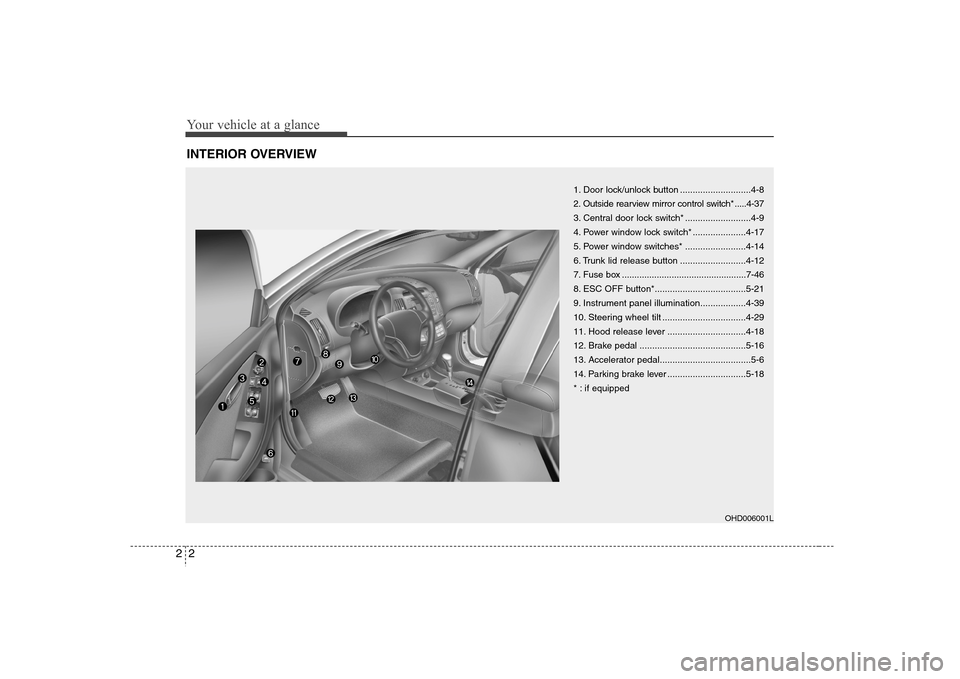
Your vehicle at a glance2 2INTERIOR OVERVIEW
1. Door lock/unlock button ............................4-8
2. Outside rearview mirror control switch* .....4-37
3. Central door lock switch* ..........................4-9
4. Power window lock switch* .....................4-17
5. Power window switches* ........................4-14
6. Trunk lid release button ..........................4-12
7. Fuse box ..................................................7-46
8. ESC OFF button*....................................5-21
9. Instrument panel illumination..................4-39
10. Steering wheel tilt .................................4-29
11. Hood release lever ...............................4-18
12. Brake pedal ..........................................5-16
13. Accelerator pedal....................................5-6
14. Parking brake lever ...............................5-18
* : if equipped
OHD006001L
Page 19 of 339
23
Your vehicle at a glance
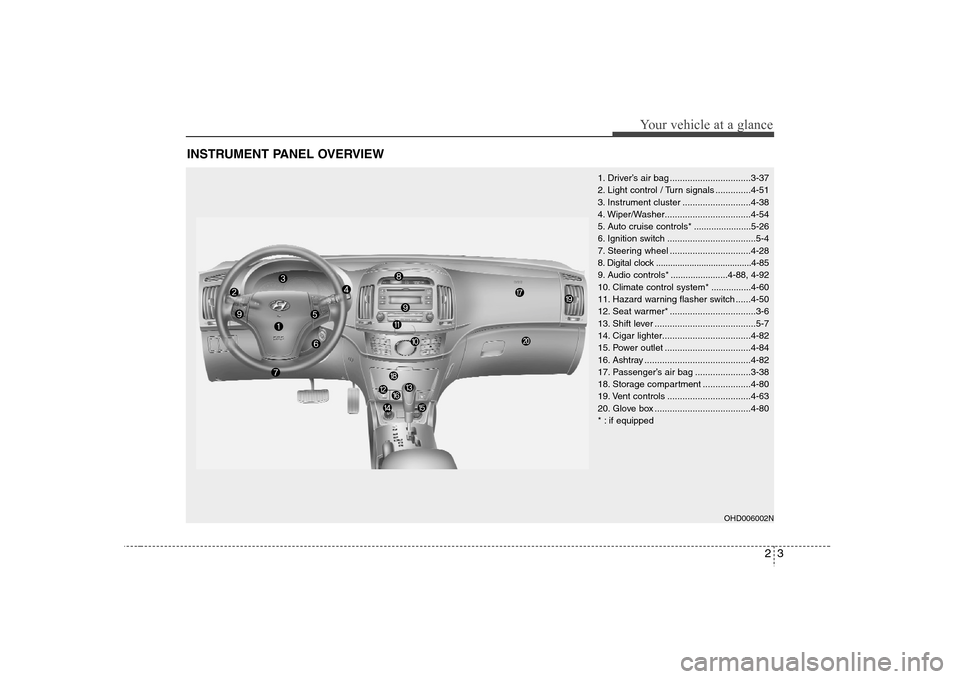
INSTRUMENT PANEL OVERVIEW
1. Driver’s air bag ................................3-37
2. Light control / Turn signals ..............4-51
3. Instrument cluster ...........................4-38
4. Wiper/Washer..................................4-54
5. Auto cruise controls* .......................5-26
6. Ignition switch ...................................5-4
7. Steering wheel ................................4-28
8. Digital clock ........................................4-85
9. Audio controls* .......................4-88, 4-92
10. Climate control system*................4-60
11. Hazard warning flasher switch ......4-50
12. Seat warmer* ..................................3-6
13. Shift lever ........................................5-7
14. Cigar lighter...................................4-82
15. Power outlet ..................................4-84
16. Ashtray ..........................................4-82
17. Passenger’s air bag ......................3-38
18. Storage compartment ...................4-80
19. Vent controls .................................4-63
20. Glove box ......................................4-80
* : if equipped
OHD006002N
Page 22 of 339
33
Safety system of your vehicle
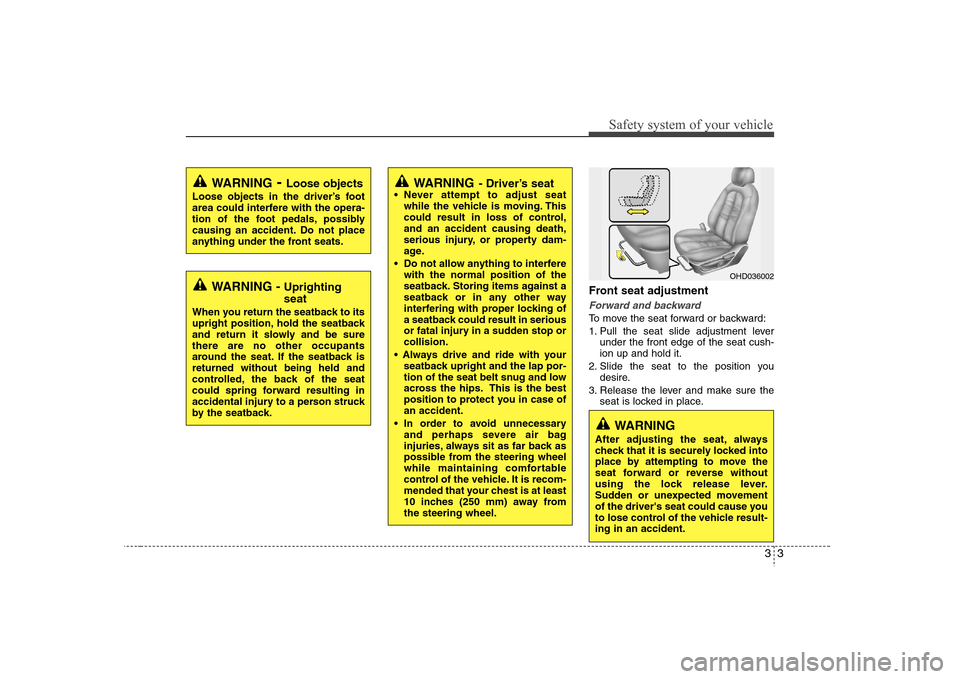
Front seat adjustmentForward and backwardTo move the seat forward or backward:
1. Pull the seat slide adjustment lever
under the front edge of the seat cush-
ion up and hold it.
2. Slide the seat to the position you
desire.
3. Release the lever and make sure the
seat is locked in place.
WARNING
- Driver’s seat
Never attempt to adjust seat
while the vehicle is moving. This
could result in loss of control,
and an accident causing death,
serious injury, or property dam-
age.
Do not allow anything to interfere
with the normal position of the
seatback. Storing items against a
seatback or in any other way
interfering with proper locking of
a seatback could result in serious
or fatal injury in a sudden stop or
collision.
seatback upright and the lap por-
tion of the seat belt snug and low
across the hips. This is the best
position to protect you in case of
an accident.
In order to avoid unnecessary
and perhaps severe air bag
injuries, always sit as far back as
possible from the steering wheel
while maintaining comfortable
control of the vehicle. It is recom-
mended that your chest is at least
10 inches (250 mm) away from
the steering wheel.
WARNING -
Uprighting
seat
When you return the seatback to its
upright position, hold the seatback
and return it slowly and be sure
there are no other occupants
around the seat. If the seatback is
returned without being held and
controlled, the back of the seat
could spring forward resulting in
accidental injury to a person struck
by the seatback.
OHD036002
WARNING
- Loose objects
Loose objects in the driver’s foot
area could interfere with the opera-
tion of the foot pedals, possibly
causing an accident. Do not place
anything under the front seats.
WARNING
After adjusting the seat, always
check that it is securely locked into
place by attempting to move the
seat forward or reverse without
using the lock release lever.
Sudden or unexpected movement
of the driver's seat could cause you
to lose control of the vehicle result-
ing in an accident.
Page 23 of 339
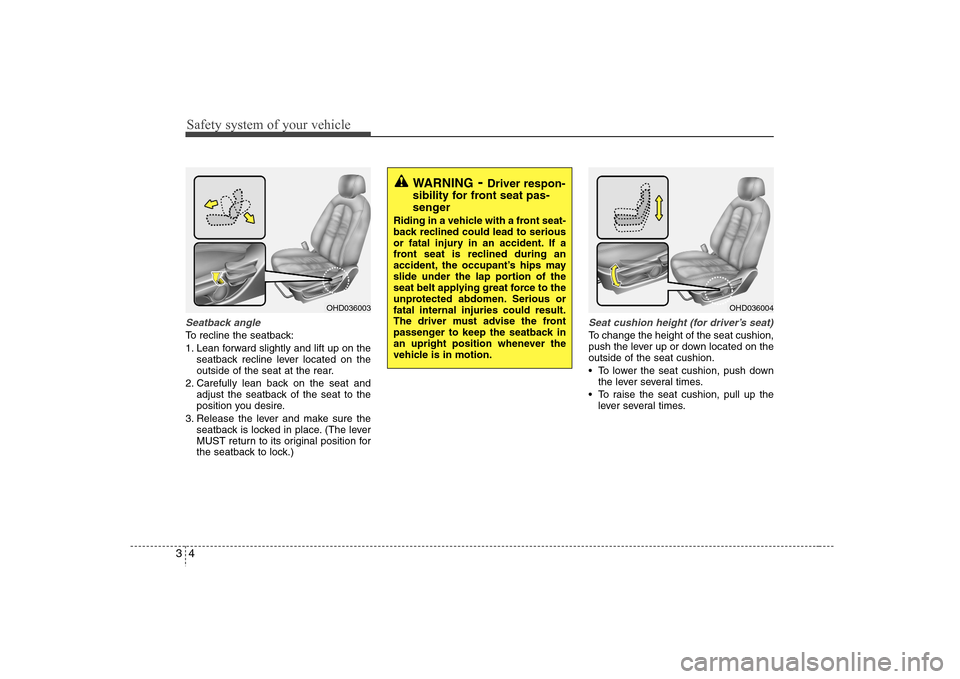
Safety system of your vehicle4 3Seatback angleTo recline the seatback:
1. Lean forward slightly and lift up on the
seatback recline lever located on the
outside of the seat at the rear.
2. Carefully lean back on the seat and
adjust the seatback of the seat to the
position you desire.
3. Release the lever and make sure the
seatback is locked in place. (The lever
MUST return to its original position for
the seatback to lock.)
Seat cushion height (for driver’s seat)To change the height of the seat cushion,
push the lever up or down located on the
outside of the seat cushion.
• To lower the seat cushion, push down
the lever several times.
To raise the seat cushion, pull up the
lever several times.
OHD036003
WARNING
- Driver respon-
sibility for front seat pas-
senger
Riding in a vehicle with a front seat-
back reclined could lead to serious
or fatal injury in an accident. If a
front seat is reclined during an
accident, the occupant’s hips may
slide under the lap portion of the
seat belt applying great force to the
unprotected abdomen. Serious or
fatal internal injuries could result.
The driver must advise the front
passenger to keep the seatback in
an upright position whenever the
vehicle is in motion.
OHD036004
Page 29 of 339
Safety system of your vehicle10 3Folding the rear seatThe rear seatbacks may be folded to
facilitate carrying long items or to
increase the luggage capacity of the
vehicle.
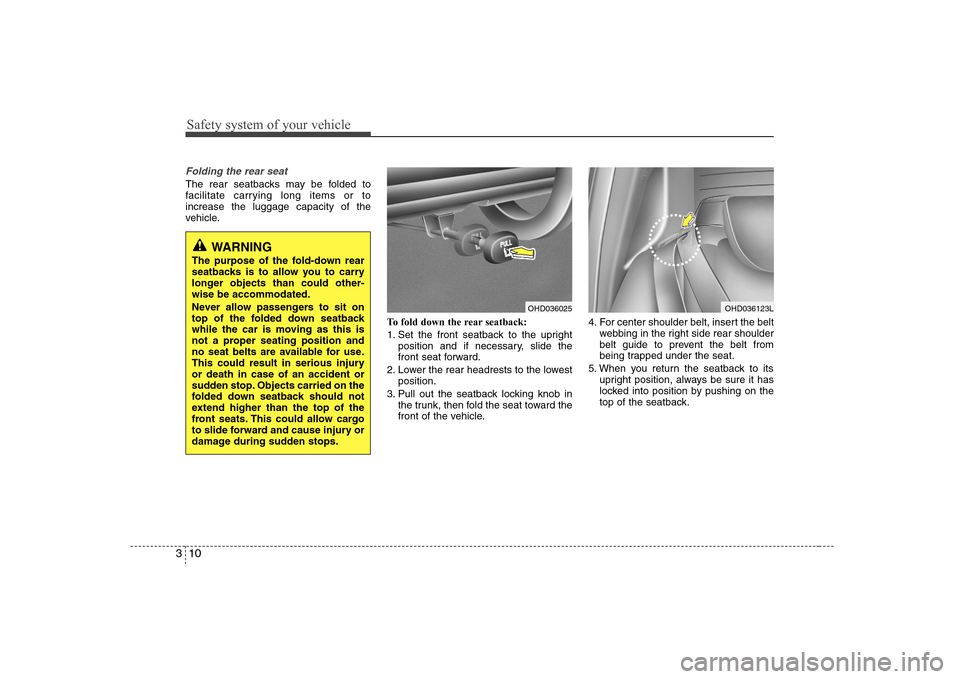
To fold down the rear seatback:
1. Set the front seatback to the upright
position and if necessary, slide the
front seat forward.
2. Lower the rear headrests to the lowest
position.
3. Pull out the seatback locking knob in
the trunk, then fold the seat toward the
front of the vehicle.4. For center shoulder belt, insert the belt
webbing in the right side rear shoulder
belt guide to prevent the belt from
being trapped under the seat.
5. When you return the seatback to its
upright position, always be sure it has
locked into position by pushing on the
top of the seatback.
WARNING
The purpose of the fold-down rear
seatbacks is to allow you to carry
longer objects than could other-
wise be accommodated.
Never allow passengers to sit on
top of the folded down seatback
while the car is moving as this is
not a proper seating position and
no seat belts are available for use.
This could result in serious injury
or death in case of an accident or
sudden stop. Objects carried on the
folded down seatback should not
extend higher than the top of the
front seats. This could allow cargo
to slide forward and cause injury or
damage during sudden stops.
OHD036025
OHD036123L
Page 30 of 339
311
Safety system of your vehicle
WARNING
When you return the rear seatback
to its upright position after being
folded down:
Be careful not to damage the seat
belt webbing or buckle. Do not
allow the seat belt webbing or
buckle to get caught or pinched in
the rear seat. Ensure that the seat-
back is completely locked into its
upright position by pushing on the
top of the seaback. Otherwise, in an
accident or sudden stop, the seat
could fold down and allow cargo to
enter the passenger compartment,
which could result in serious injury
or death.
OHD036124L
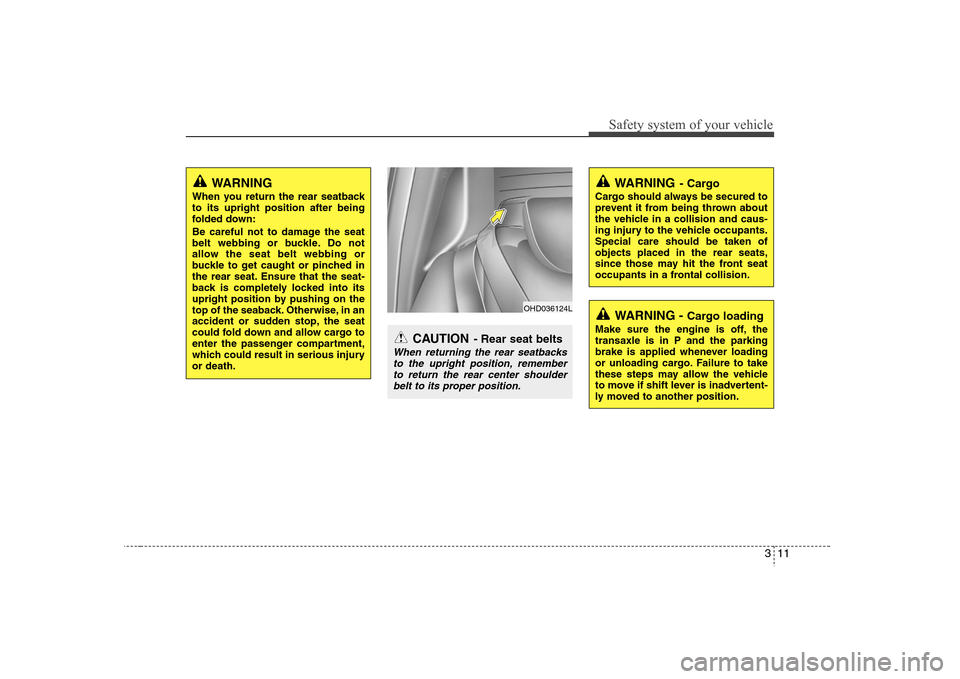
CAUTION
- Rear seat belts
When returning the rear seatbacks
to the upright position, remember
to return the rear center shoulder
belt to its proper position.
WARNING
- Cargo
Cargo should always be secured to
prevent it from being thrown about
the vehicle in a collision and caus-
ing injury to the vehicle occupants.
Special care should be taken of
objects placed in the rear seats,
since those may hit the front seat
occupants in a frontal collision.
WARNING -
Cargo loading
Make sure the engine is off, the
transaxle is in P and the parking
brake is applied whenever loading
or unloading cargo. Failure to take
these steps may allow the vehicle
to move if shift lever is inadvertent-
ly moved to another position.
Page 32 of 339
313
Safety system of your vehicle
Seat belt warning chimeIf the driver's seat belt is not fastened
when the ignition key is turned ON, the
seat belt warning chime sounds for
approximately 6 seconds. And if the vehi-
cle speed exceeds 10km/h with the seat
belt unfastened, the seat belt warning
chime sounds with the pattern of 6 sec-
onds on and 24 seconds off for 11
times.The seat belt warning chime will
stop if the seat belt is fastened or the
vehicle speed is reduced to below 5km/h.
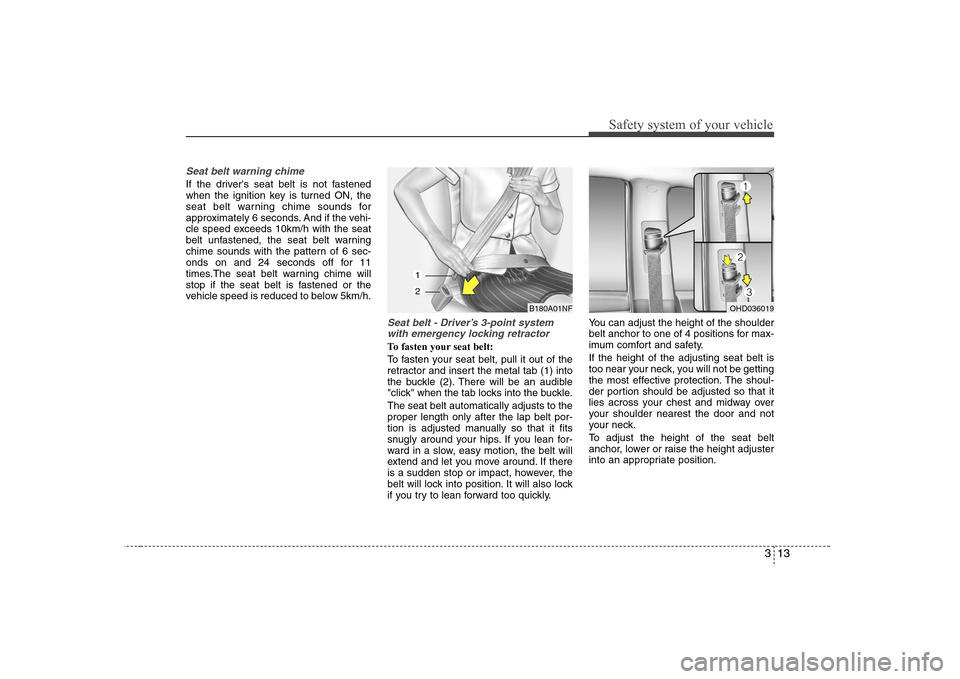
Seat belt - Driver’s 3-point system
with emergency locking retractorTo fasten your seat belt:
To fasten your seat belt, pull it out of the
retractor and insert the metal tab (1) into
the buckle (2). There will be an audible
"click" when the tab locks into the buckle.
The seat belt automatically adjusts to the
proper length only after the lap belt por-
tion is adjusted manually so that it fits
snugly around your hips. If you lean for-
ward in a slow, easy motion, the belt will
extend and let you move around. If there
is a sudden stop or impact, however, the
belt will lock into position. It will also lock
if you try to lean forward too quickly.You can adjust the height of the shoulder
belt anchor to one of 4 positions for max-
imum comfort and safety.
If the height of the adjusting seat belt is
too near your neck, you will not be getting
the most effective protection. The shoul-
der portion should be adjusted so that it
lies across your chest and midway over
your shoulder nearest the door and not
your neck.
To adjust the height of the seat belt
anchor, lower or raise the height adjuster
into an appropriate position.
OHD036019
B180A01NF
12
Page 33 of 339
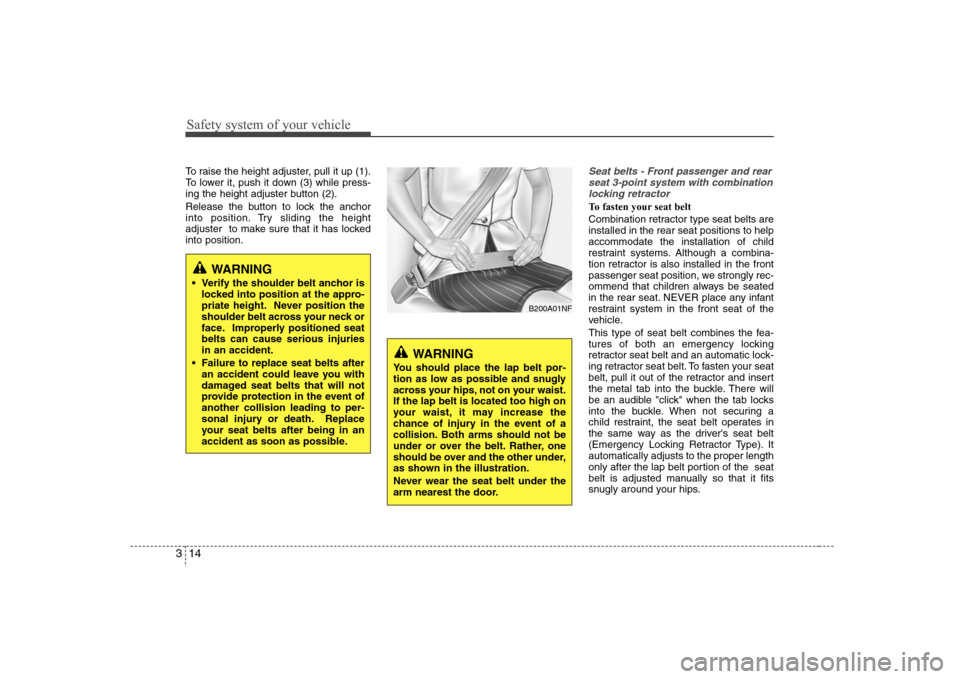
Safety system of your vehicle14 3To raise the height adjuster, pull it up (1).
To lower it, push it down (3) while press-
ing the height adjuster button (2).
Release the button to lock the anchor
into position. Try sliding the height
adjuster to make sure that it has locked
into position.
Seat belts - Front passenger and rear
seat 3-point system with combination
locking retractorTo fasten your seat belt
Combination retractor type seat belts are
installed in the rear seat positions to help
accommodate the installation of child
restraint systems. Although a combina-
tion retractor is also installed in the front
passenger seat position, we strongly rec-
ommend that children always be seated
in the rear seat. NEVER place any infant
restraint system in the front seat of the
vehicle.
This type of seat belt combines the fea-
tures of both an emergency locking
retractor seat belt and an automatic lock-
ing retractor seat belt. To fasten your seat
belt, pull it out of the retractor and insert
the metal tab into the buckle. There will
be an audible "click" when the tab locks
into the buckle. When not securing a
child restraint, the seat belt operates in
the same way as the driver's seat belt
(Emergency Locking Retractor Type). It
automatically adjusts to the proper length
only after the lap belt portion of the seat
belt is adjusted manually so that it fits
snugly around your hips.
WARNING
Verify the shoulder belt anchor is
locked into position at the appro-
priate height. Never position the
shoulder belt across your neck or
face. Improperly positioned seat
belts can cause serious injuries
in an accident.
Failure to replace seat belts after
an accident could leave you with
damaged seat belts that will not
provide protection in the event of
another collision leading to per-
sonal injury or death. Replace
your seat belts after being in an
accident as soon as possible.
B200A01NF
WARNING
You should place the lap belt por-
tion as low as possible and snugly
across your hips, not on your waist.
If the lap belt is located too high on
your waist, it may increase the
chance of injury in the event of a
collision. Both arms should not be
under or over the belt. Rather, one
should be over and the other under,
as shown in the illustration.
Never wear the seat belt under the
arm nearest the door.