tension Hyundai Elantra 2007 Owner's Manual
[x] Cancel search | Manufacturer: HYUNDAI, Model Year: 2007, Model line: Elantra, Model: Hyundai Elantra 2007Pages: 339, PDF Size: 11.19 MB
Page 15 of 339
Introduction6 1Your Hyundai vehicle is equipped with
many high technology, electronically
controlled systems that help to
ensure your vehicle operates properly
and provides the performance that
you expect. These systems utilize
computers to monitor the operation of
various systems and components and
help to control their operation. These
computerized system operations are
wide-ranging and involve components
to reduce emissions, to continuously
evaluate the readiness of the airbag
and seat belt pretensioner systems, to
determine when the airbag and seat
belt pre-tensioner systems should be
deployed and then to activate the
deployment, and if equipped, to oper-
ate anti-lock braking, traction control
and electrical stability control to
assist the driver to control the vehicle
in difficult driving situations. These
systems electronically store informa-
tion that is useful to service techni-
cians when they need to diagnose and
repair these systems.Additional information is stored only
when a crash occurs that results in
the deployment of the airbags or seat
belt pre-tensioners. This type of data
storage is done by devices called
event data recorders(EDR).
After a crash event, the airbag and
seat belt pre-tensioner computer sys-
tem, known as the Supplemental
Restraint System Control Module
(SRSCM) or Airbag Control Unit
(ACU), may record some information
about the condition of the vehicle and
how it was being operated. This infor-
mation consists of data related to seat
belt usage and if there was diagnostic
information in the airbag or seat belt
systems at the time that a crash
occurred, and if the ACU sensed that a
crash of sufficient severity occurred
to require seat belt pre-tensioner or
airbag deployment.To retrieve this information, special
equipment is needed and access to
the vehicle or the device that stores
the data is required. Hyundai will not
access information about a crash
event or share it with others except:
in response to an official request of
police or similar government office,
or
with the consent of the vehicle
owner or, if the vehicle is leased,
with the consent of the lessee, or
as part of Hyundai’s defense of liti-
gation, or
as required by law.VEHICLE DATA COLLECTION AND EVENT DATA RECORDERS
Page 34 of 339
315
Safety system of your vehicle
When the seat belt is fully extended from
the retractor to allow the installation of a
child restraint system, the seat belt oper-
ation changes to allow the belt to retract,
but not to extend (Automatic Locking
Retractor Type). Refer to “Using a child
restraint system” in this section.✽ ✽
NOTICEAlthough the combination retractor
provides the same level of protection for
seated passengers in either emergency
or automatic locking modes, it is recom-
mended that seated passengers use the
emergency locking feature for improved
convenience. The automatic locking
function is intended to facilitate child
restraint installation. To convert from
the automatic locking feature to the
emergency locking operation mode,
allow the unbuckled seat belt to fully
retract.
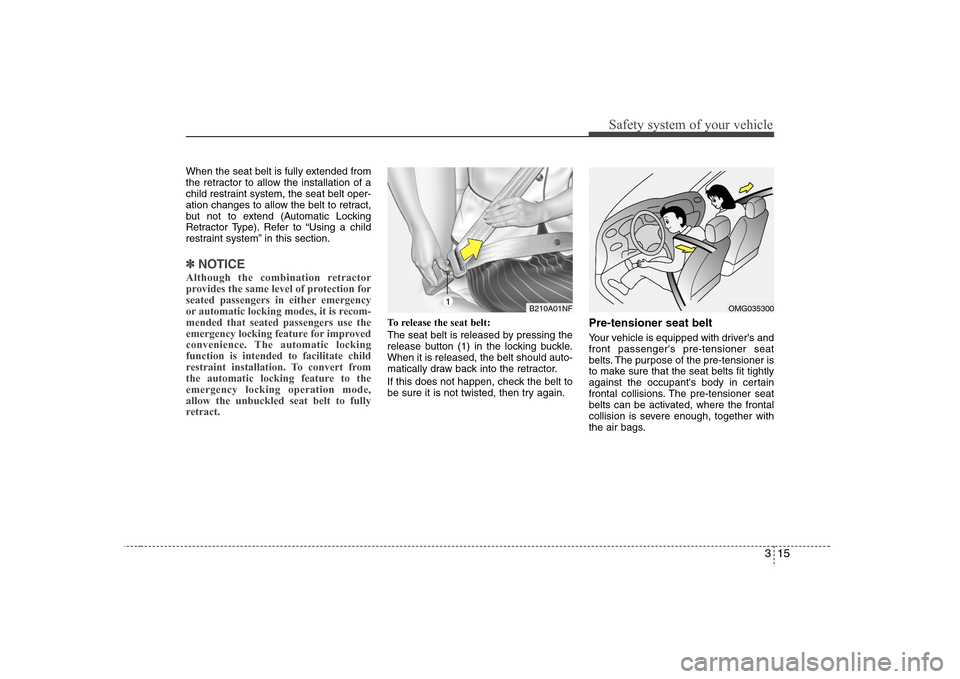
To release the seat belt:
The seat belt is released by pressing the
release button (1) in the locking buckle.
When it is released, the belt should auto-
matically draw back into the retractor.
If this does not happen, check the belt to
be sure it is not twisted, then try again.
Pre-tensioner seat belt Your vehicle is equipped with driver's and
front passenger's pre-tensioner seat
belts. The purpose of the pre-tensioner is
to make sure that the seat belts fit tightly
against the occupant's body in certain
frontal collisions. The pre-tensioner seat
belts can be activated, where the frontal
collision is severe enough, together with
the air bags.
B210A01NF
1
OMG035300
Page 35 of 339
Safety system of your vehicle16 3When the vehicle stops suddenly, or if
the occupant tries to lean forward too
quickly, the seat belt retractor will lock
into position. In certain frontal collisions,
the pre-tensioner will activate and pull
the seat belt into tighter contact against
the occupant's body.
If the system senses excessive seat belt
tension on the driver or passenger's seat
belt when the pre-tensioner activates, the
load limiter inside the pre-tensioner will
release some of the pressure on the
affected seat belt.
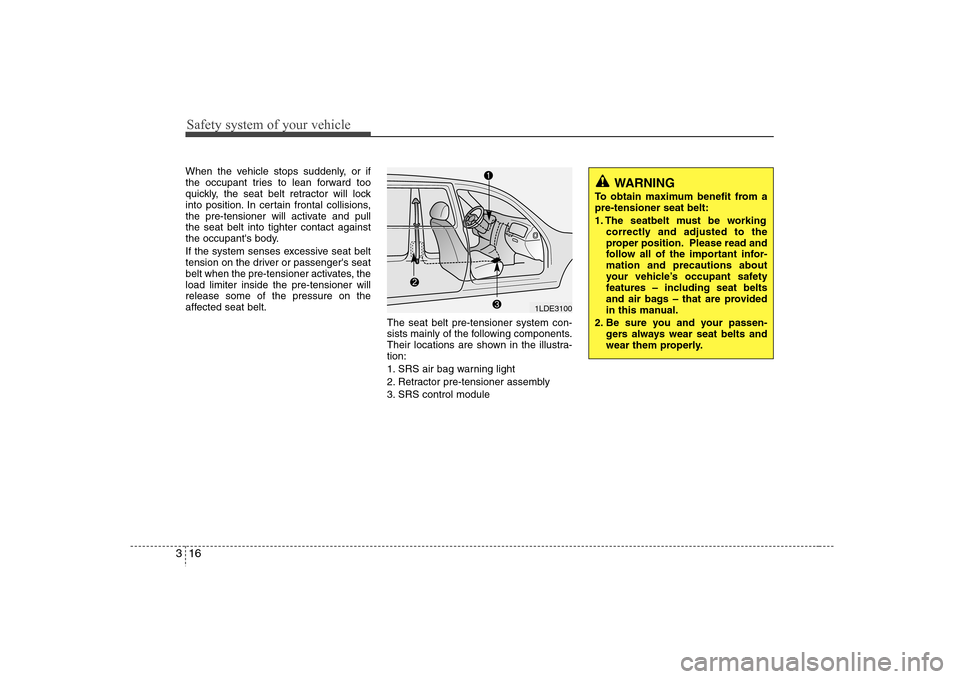
The seat belt pre-tensioner system con-
sists mainly of the following components.
Their locations are shown in the illustra-
tion:
1. SRS air bag warning light
2. Retractor pre-tensioner assembly
3. SRS control module
1LDE3100
WARNING
To obtain maximum benefit from a
pre-tensioner seat belt:
1. The seatbelt must be working
correctly and adjusted to the
proper position. Please read and
follow all of the important infor-
mation and precautions about
your vehicle’s occupant safety
features – including seat belts
and air bags – that are provided
in this manual.
2. Be sure you and your passen-
gers always wear seat belts and
wear them properly.
Page 36 of 339
317
Safety system of your vehicle
✽ ✽
NOTICE• Both the driver's and front passen-
ger's pre-tensioner seat belts will be
activated in certain frontal collisions.
The pre-tensioner seat belts can be
activated where the frontal collision is
severe enough, together with the air
bags.
The pre-tensioners will not be activat-
ed if the seat belts are not being worn
at the time of the collision.
• When the pre-tensioner seat belts are
activated, a loud noise may be heard
and fine dust, which may appear to be
smoke, may be visible in the passenger
compartment. These are normal oper-
ating conditions and are not haz-
ardous.
• Although it is harmless, the fine dust
may cause skin irritation and should
not be breathed for prolonged peri-
ods. Wash all exposed skin areas thor-
oughly after an accident in which the
pre-tensioner seat belts were activat-
ed.
CAUTION
Because the sensor that activates
the SRS air bag is connected with
the pre-tensioner seat belt, the
SRS air bag warning light on
the instrument panel will illumi-
nate for approximately 6 seconds
after the ignition key has been
turned to the "ON" position, and
then it should turn off.
If the pre-tensioner seat belt is not
working properly, this warning
light will illuminate even if there is
no malfunction of the SRS air bag.
If the SRS air bag warning light
does not illuminate when the igni-
tion key is turned to "ON", or if it
remains illuminated after illumi-
nating for approximately 6 sec-
onds, or if it illuminates while the
vehicle is being driven, please
have an authorized Hyundai deal-
er inspect the pre-tensioner seat
belt or SRS air bag system as
soon as possible.
AIR
BAG
WARNING
Pre-tensioners are designed to
operate only one time. After acti-
vation, pre-tensioner seat belts
must be replaced. All seat belts,
of any type, should always be
replaced after they have been
worn during a collision.
The pre-tensioner seat belt
assembly mechanisms become
hot during activation. Do not
touch the pre-tensioner seat belt
assemblies for several minutes
after they have been activated.
Do not attempt to inspect or
replace the pre-tensioner seat
belts yourself. This must be done
by an authorized Hyundai dealer.
Do not strike the pre-tensioner
seat belt assemblies.
Do not attempt to service or
repair the pre-tensioner seat belt
system in any manner.
(Continued)
Page 37 of 339
Safety system of your vehicle18 3
Seat belt precautions
Infant or small childAll 50 states have child restraint laws. You
should be aware of the specific require-
ments in your state. Child and/or infant
seats must be properly placed and
installed in the rear seat. For more infor-
mation about the use of these restraints,
refer to “Child restraint system” in this
section.
WARNING
All occupants of the vehicle must
wear their seat belts at all times.
Seat belts and child restraints
reduce the risk of serious or fatal
injuries for all occupants in the
event of a collision or sudden stop.
Without a seat belt, occupants
could be shifted too close to a
deploying air bag, strike the interior
structure or be thrown from the
vehicle. Properly worn seat belts
greatly reduce these hazards.
Even with advanced air bags,
unbelted occupants can be severe-
ly injured by a deploying air bag.
Always follow the precautions
about seat belts, air bags and occu-
pant seat contained in this manual.
(Continued)
Improper handling of the pre-ten-
sioner seat belt assemblies, and
failure to heed the warnings not
to strike, modify, inspect, replace,
service or repair the pre-tension-
er seat belt assemblies may lead
to improper operation or inadver-
tent activation and serious injury.
Always wear the seat belts when
driving or riding in a motor vehi-
cle.
WARNING
Every person in your vehicle needs
to be properly restrained at all
times, including infants and chil-
dren. Never hold a child in your
arms or lap when riding in a vehi-
cle. The violent forces created dur-
ing a crash will tear the child from
your arms and throw the child
against the interior. Always use a
child restraint appropriate for your
child's height and weight.
Page 49 of 339
Safety system of your vehicle30 3SRS components and functionsThe SRS consists of the following com-
ponents:
1. Front Impact Sensors
2. “PASSENGER AIR BAG OFF”
Indicator (Front passenger’s seat only)
3. SRS "AIR BAG" warning light
4. Passenger's Air bag Module
5. Driver's Air Bag Module
6. SRS Control Module (SRSCM)
7. Occupant Classification System
(Front passenger's seat only)
8. Driver's Seat Track Position Sensor
9. Driver's and Front Passenger's Seat
Belt Buckle Sensors
10. Side Impact Sensors*
11. Retractor Pre-tensioner Assemblies
12. Side Air Bag Modules*
13. Curtain Air bag Modules*
* : If equippedThe SRSCM continually monitors all
SRS components while the ignition
switch is ON to determine if a crash
impact is severe enough to require air
bag deployment or pre-tensioner seat
belt deployment.
The SRS AIR BAG warning light on the
instrument panel will illuminate for about
6 seconds after the ignition switch is
turned to the ON position, after which the
AIR BAG warning light should go out.
If any of the following conditions occurs,
this indicates a malfunetion of the SRS.
Have an authorized Hyundai dealer
inspect the air bag system as soon as
possible.
The light does not turn on briefly when
you turn the ignition ON.
The light stays on after illuminating for
approximately 6 seconds.
The light comes on while the vehicle is
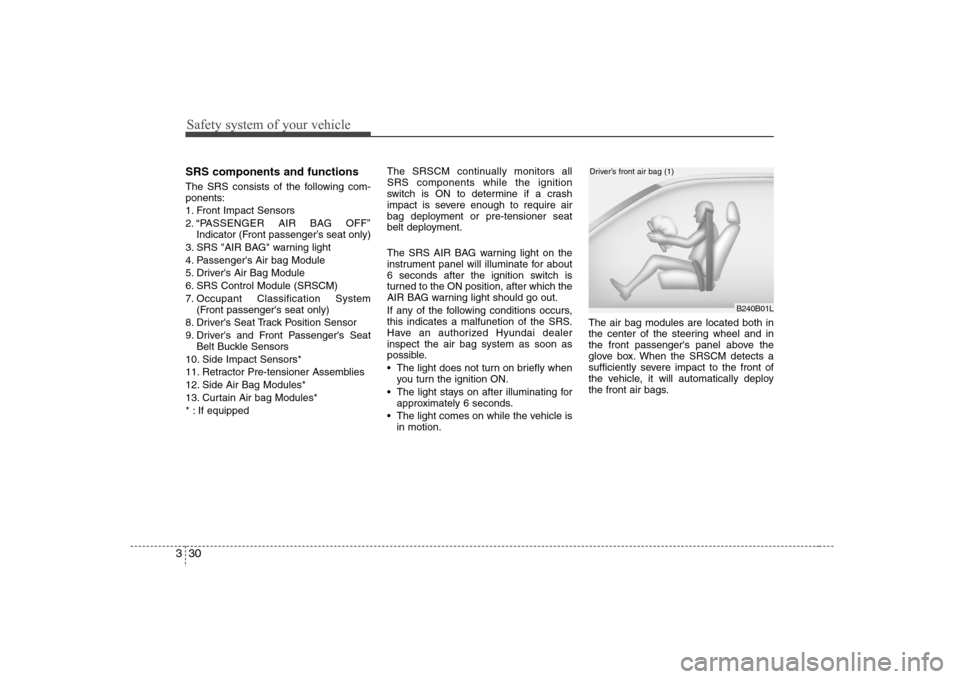
in motion.The air bag modules are located both in
the center of the steering wheel and in
the front passenger's panel above the
glove box. When the SRSCM detects a
sufficiently severe impact to the front of
the vehicle, it will automatically deploy
the front air bags.
B240B01L
Driver’s front air bag (1)
Page 58 of 339
339
Safety system of your vehicle
✽ ✽
NOTICE• Be sure to read information about the
SRS on the labels provided on the sun
visor and in the glove box.
• Advanced air bags are combined with
pre-tensioner seat belts to help pro-
vide enhanced occupant protection in
frontal crashes. Front air bags are not
intended to deploy in collisions in
which sufficient protection can be
provided by the pre-tensioner seat
belt.
• If you are considering modification of
your vehicle due to a disability, please
contact the Hyundai Customer
Assistance Center at 1-800-633-5151.
WARNING
Always use seat belts and child
restraints – every trip, every time,
everyone! Air bags inflate with
considerable force and in the blink
of an eye. Seat belts help keep
occupants in proper position to
obtain maximum benefit from the
air bag. Even with advanced air
bags, improperly and unbelted
occupants can be severely injured
when the air bag inflates. Always
follow the precautions about seat
belts, air bags and occupant safety
contained in this manual.
To reduce the chance of serious or
fatal injuries and receive the maxi-
mum safety benefit from your
restraint system:
Never place a child in any child or
booster seat in the front seat.
ABC – Always Buckle Children in
the back seat. It is the safest
place for children of any age to
ride.
Front and side air bags can injure
occupants improperly positioned
in the front seats.
(Continued)
WARNING
Modification to the seat structure
can adversely affect the seat
track position sensor and cause
the air bag to deploy at a different
level than should be provided.
Do not place any objects under-
neath the front seats as they
could damage the seat track posi-
tion sensor or interfere with the
occupant classification system.
Do not place any objects that may
cause magnetic fields near the
front seat. These may cause a
malfunction of the seat track
position sensor.
Page 156 of 339
483
Features of your vehicle
Cup holder
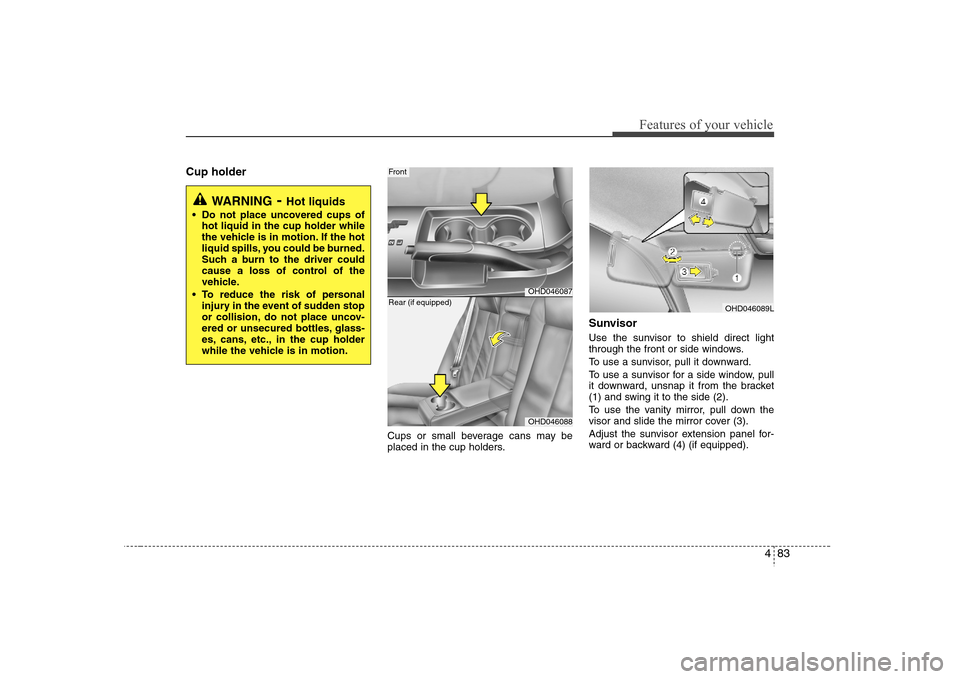
Cups or small beverage cans may be
placed in the cup holders.
SunvisorUse the sunvisor to shield direct light
through the front or side windows.
To use a sunvisor, pull it downward.
To use a sunvisor for a side window, pull
it downward, unsnap it from the bracket
(1) and swing it to the side (2).
To use the vanity mirror, pull down the
visor and slide the mirror cover (3).
Adjust the sunvisor extension panel for-
ward or backward (4) (if equipped).
WARNING
- Hot liquids
Do not place uncovered cups of
hot liquid in the cup holder while
the vehicle is in motion. If the hot
liquid spills, you could be burned.
Such a burn to the driver could
cause a loss of control of the
vehicle.
To reduce the risk of personal
injury in the event of sudden stop
or collision, do not place uncov-
ered or unsecured bottles, glass-
es, cans, etc., in the cup holder
while the vehicle is in motion.
OHD046087
Front
OHD046088
Rear (if equipped)
OHD046089L
Page 190 of 339
55
Driving your vehicle
ACC (Accessory)The steering wheel is unlocked and elec-
trical accessories are operative.✽ ✽
NOTICEIf difficulty is experienced in turning the
ignition key to the ACC position, turn
the steering wheel right and left to
release the tension and then turn the
key.ONThe warning lights can be checked
before the engine is started. This is the
normal running position after the engine
is started.Do not leave the ignition switch ON if the
engine is not running to prevent battery
discharge.
STARTTurn the ignition key to the START posi-
tion to start the engine. The engine will
crank until you release the key; then it
returns to the ON position. The brake
warning lamp can be checked in this
position.
Starting the gasoline engine 1. Make sure the parking brake is
applied.
2.Manual Transaxle- Depress the
clutch pedal fully and shift the
transaxle into Neutral. Keep the clutch
pedal and brake pedal depressed
while turning the ignition switch to the
start position.
Automatic Transaxle- Place the
transaxle shift lever in P (Park).
Depress the brake pedal fully.
You can also start the engine when
the shift lever is in the N (Neutral)
position.
WARNING -
Ignition key
Never turn the ignition switch to
LOCK or ACC while the vehicle is
moving. This would result in loss
of directional control and braking
function, which could cause an
accident.
The anti-theft steering column lock
is not a substitute for the parking
brake. Before leaving the driver’s
seat, always make sure the shift
lever is engaged in P (Park) for the
automatic transaxle and set the
parking brake fully and shut the
engine off. Unexpected and sud-
den vehicle movement may occur
if these precautions are not taken.
Never reach for the ignition switch,
or any other controls through the
steering wheel while the vehicle is
in motion. The presence of your
hand or arm in this area could
cause a loss of vehicle control, an
accident and serious bodily injury
or death.
Do not place any movable objects
around the driver’s seat as they
may move while driving, interfere
with the driver and lead to an acci-
dent.
WARNING
Always wear appropriate shoes
when operating your vehicle.
Unsuitable shoes (high heels, ski
boots,etc.) may interfere with your
ability to use the brake and acceler-
ator pedal, and the clutch (if
equipped).STARTING THE ENGINE
Page 248 of 339
611
What to do in an emergency
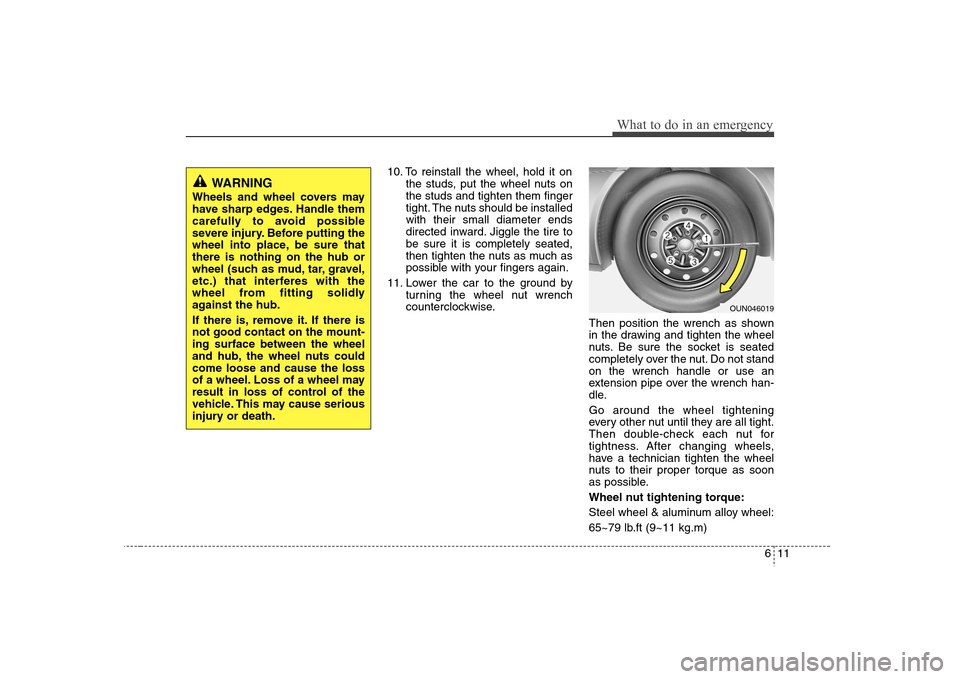
10. To reinstall the wheel, hold it on
the studs, put the wheel nuts on
the studs and tighten them finger
tight. The nuts should be installed
with their small diameter ends
directed inward. Jiggle the tire to
be sure it is completely seated,
then tighten the nuts as much as
possible with your fingers again.
11. Lower the car to the ground by
turning the wheel nut wrench
counterclockwise.
Then position the wrench as shown
in the drawing and tighten the wheel
nuts. Be sure the socket is seated
completely over the nut. Do not stand
on the wrench handle or use an
extension pipe over the wrench han-
dle.
Go around the wheel tightening
every other nut until they are all tight.
Then double-check each nut for
tightness. After changing wheels,
have a technician tighten the wheel
nuts to their proper torque as soon
as possible.
Wheel nut tightening torque:
Steel wheel & aluminum alloy wheel:
65~79 lb.ft (9~11 kg.m)
OUN046019
WARNING
Wheels and wheel covers may
have sharp edges. Handle them
carefully to avoid possible
severe injury. Before putting the
wheel into place, be sure that
there is nothing on the hub or
wheel (such as mud, tar, gravel,
etc.) that interferes with the
wheel from fitting solidly
against the hub.
If there is, remove it. If there is
not good contact on the mount-
ing surface between the wheel
and hub, the wheel nuts could
come loose and cause the loss
of a wheel. Loss of a wheel may
result in loss of control of the
vehicle. This may cause serious
injury or death.