starting engine Hyundai Elantra 2008 User Guide
[x] Cancel search | Manufacturer: HYUNDAI, Model Year: 2008, Model line: Elantra, Model: Hyundai Elantra 2008Pages: 360, PDF Size: 12.2 MB
Page 256 of 360
63
What to do in an emergency
If engine stalls while driving1. Reduce your speed gradually, keeping
a straight line. Move cautiously off the
road to a safe place.
2. Turn on your emergency flashers.
3. Try to start the engine again. If your
vehicle will not start, contact an
authorized Hyundai dealer or seek
other qualified assistance.
If engine doesn't turn over or
turns over slowly1. If your car has an automatic transaxle,
be sure the gear selector lever is in N
(Neutral) or P (Park) and the emer-
gency brake is set.
2. Check the battery connections to be
sure they are clean and tight.
3. Turn on the interior light. If the light
dims or goes out when you operate the
starter, the battery is discharged.
4. Check the starter connections to be
sure they are securely tightened.
5. Do not push or pull the vehicle to start
it. See instructions for "Jump starting".
If engine turns over normally but
does not start1. Check fuel level.
2. With the ignition switch in the OFF
position, check all connectors at igni-
tion, coil and spark plugs. Reconnect
any that may be disconnected or
loose.
3. Check the fuel line in the engine com-
partment.
4. If the engine still does not start, call an
authorized Hyundai dealer or seek
other qualified assistance.
IF THE ENGINE WILL NOT START
WARNING
If the engine will not start, do not
push or pull the car to start it. This
could result in a collision or cause
other damage. In addition, push or
pull starting may cause the catalyt-
ic converter to be overloaded and
create a fire hazard.
Page 257 of 360
What to do in an emergency4 6EMERGENCY STARTINGJump starting Jump starting can be dangerous if done
incorrectly. Therefore, to avoid harm to
yourself or damage to your vehicle or
battery, follow the jump starting proce-
dures. If in doubt, we strongly recom-
mend that you have a competent techni-
cian or towing service jump start your
vehicle.
Jump starting procedure 1. Make sure the booster battery is 12-
volt and that its negative terminal is
grounded.
2. If the booster battery is in another
vehicle, do not allow the vehicles to
touch.
3. Turn off all unnecessary electrical
loads.
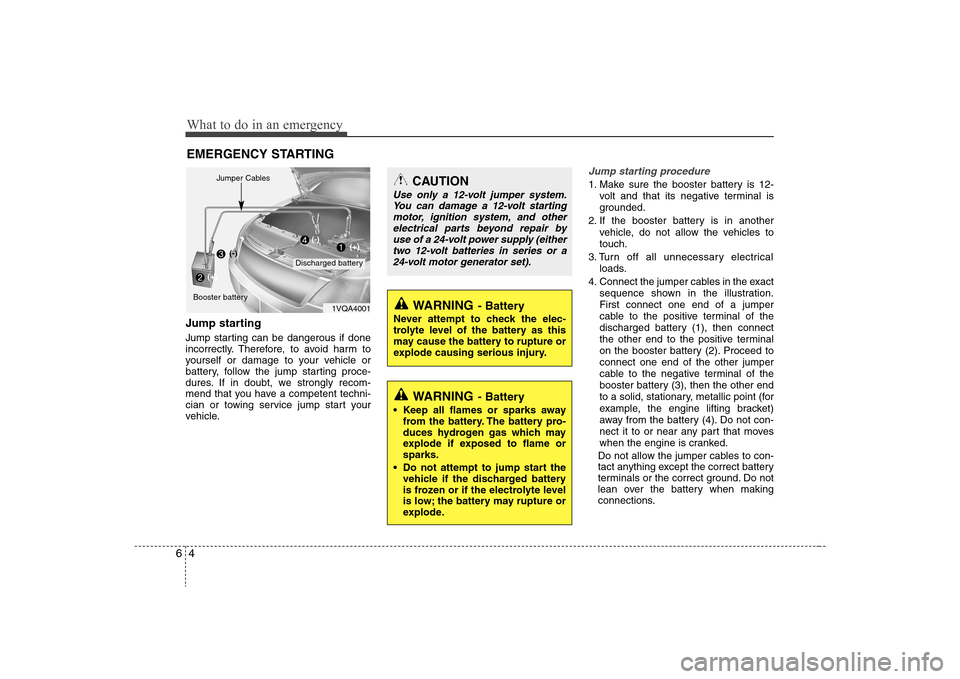
4. Connect the jumper cables in the exact
sequence shown in the illustration.
First connect one end of a jumper
cable to the positive terminal of the
discharged battery (1), then connect
the other end to the positive terminal
on the booster battery (2). Proceed to
connect one end of the other jumper
cable to the negative terminal of the
booster battery (3), then the other end
to a solid, stationary, metallic point (for
example, the engine lifting bracket)
away from the battery (4). Do not con-
nect it to or near any part that moves
when the engine is cranked.
Do not allow the jumper cables to con-
tact anything except the correct battery
terminals or the correct ground. Do not
lean over the battery when making
connections.
CAUTION
Use only a 12-volt jumper system.
You can damage a 12-volt starting
motor, ignition system, and other
electrical parts beyond repair by
use of a 24-volt power supply (either
two 12-volt batteries in series or a
24-volt motor generator set).
WARNING
- Battery
• Keep all flames or sparks away
from the battery. The battery pro-
duces hydrogen gas which may
explode if exposed to flame or
sparks.
Do not attempt to jump start the
vehicle if the discharged battery
is frozen or if the electrolyte level
is low; the battery may rupture or
explode.
WARNING
- Battery
Never attempt to check the elec-
trolyte level of the battery as this
may cause the battery to rupture or
explode causing serious injury.
1VQA4001
Discharged battery Jumper Cables
Booster battery
(-)
(+)
(+)
(-)
Page 258 of 360
65
What to do in an emergency
5. Start the engine of the vehicle with the
booster battery and let it run at 2,000
rpm, then start the engine of the vehi-
cle with the discharged battery.If the cause of your battery discharging is
not apparent, you should have your vehi-
cle checked by an authorized Hyundai
dealer.Push-starting Vehicles equipped with automatic
transaxle cannot be push-started.
Follow the directions in this section for
jump-starting.If your temperature gauge indicates over-
heating, you experience a loss of power,
or hear loud pinging or knocking, the
engine is probably too hot. If this hap-
pens, you should:
1. Pull off the road and stop as soon as it
is safe to do so.
2. Place the gear selector lever in P
(automatic transaxle) or neutral (man-
ual transaxle) and set the parking
brake. If the air conditioning is on, turn
it off.
3. If engine coolant is running out under
the car or steam is coming out from
the hood, stop the engine. Do not open
the hood until the coolant has stopped
running or the steaming has stopped.
If there is no visible loss of engine
coolant and no steam, leave the
engine running and check to be sure
the engine cooling fan is operating. If
the fan is not running, turn the engine
off.
4. Check to see if the water pump drive
belt is missing. If it is not missing,
check to see that it is tight. If the drive
belt seems to be satisfactory, check for
coolant leaking from the radiator,
hoses or under the car. (If the air con-
ditioning had been in use, it is normal
for cold water to be draining from it
when you stop).5. If the water pump drive belt is broken
or engine coolant is leaking out, stop
the engine immediately and call the
nearest authorized Hyundai dealer for
assistance.
CAUTION
Never tow a vehicle to start it
because the sudden surge forward
when the engine starts could cause
a collision with the tow vehicle.
CAUTION
- Battery cables
Do not connect the jumper cable
from the negative terminal of the
booster battery to the negative ter-
minal of the discharged battery.
This can cause the discharged bat-
tery to overheat and crack, releas-
ing battery acid.
IF THE ENGINE OVERHEATS
WARNING
While the engine is running, keep
hair, hands and clothing away from
moving parts such as the fan and
drive belts to prevent injury.
WARNING
Do not remove the radiator cap
when the engine is hot. This can
allow coolant to be blown out of the
opening and cause serious burns.
Page 288 of 360
Maintenance12 7EXPLANATION OF SCHEDULED MAINTENANCE ITEMSEngine oil and filterThe engine oil and filter should be
changed at the intervals specified in the
maintenance schedule. If the car is being
driven in severe conditions, more fre-
quent oil and filter changes are required.Drive beltsInspect all drive belts for evidence of
cuts, cracks, excessive wear or oil satu-
ration and replace if necessary. Drive
belts should be checked periodically for
proper tension and adjusted as neces-
sary.
Fuel filterA clogged filter can limit the speed at
which the vehicle may be driven, damage
the emission system and cause multiple
issues such as hard starting. If an exces-
sive amount of foreign matter accumu-
lates in the fuel tank, the filter may
require replacement more frequently.
After installing a new filter, run the engine
for several minutes, and check for leaks
at the connections. Fuel filters should be
installed by trained technicians.
Fuel lines, fuel hoses and con-
nectionsCheck the fuel lines, fuel hoses and con-
nections for leakage and damage. Have
a trained technician replace any dam-
aged or leaking parts immediately.
Page 356 of 360
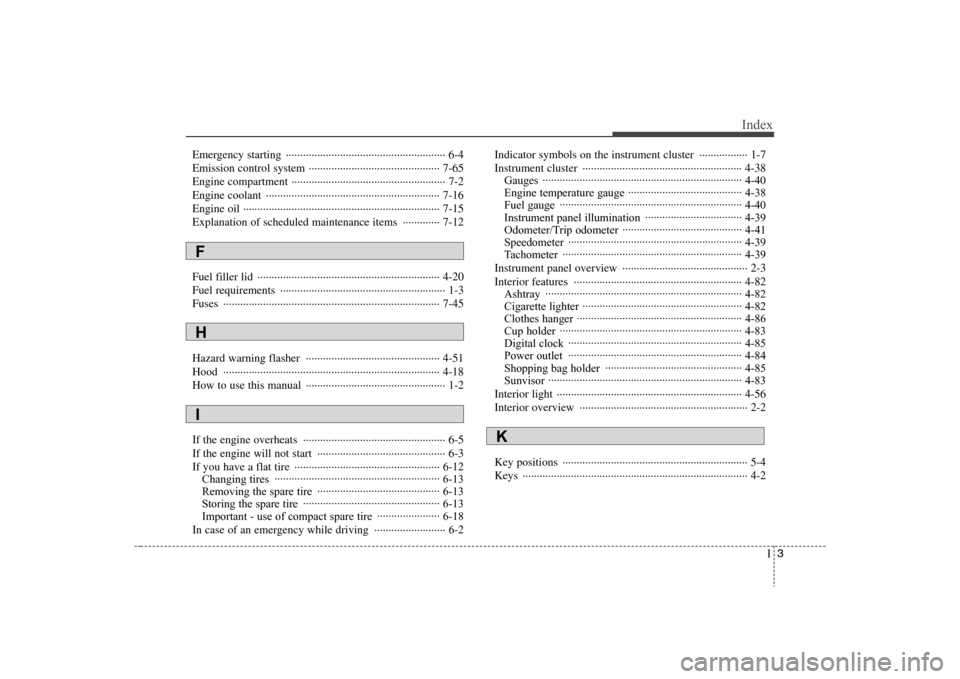
I3
Index
Emergency starting ························································ 6-4
Emission control system ·············································· 7-65
Engine compartment ······················································ 7-2
Engine coolant ····························································· 7-16
Engine oil ····································································· 7-15
Explanation of scheduled maintenance items ············· 7-12
Fuel filler lid ································································ 4-20
Fuel requirements ·························································· 1-3
Fuses ············································································ 7-45
Hazard warning flasher ··············································· 4-51
Hood ············································································ 4-18
How to use this manual ················································· 1-2
If the engine overheats ·················································· 6-5
If the engine will not start ············································· 6-3
If you have a flat tire ··················································· 6-12
Changing tires ·························································· 6-13
Removing the spare tire ··········································· 6-13
Storing the spare tire ················································ 6-13
Important - use of compact spare tire ······················ 6-18
In case of an emergency while driving ························· 6-2Indicator symbols on the instrument cluster ················· 1-7
Instrument cluster ························································ 4-38
Gauges ······································································ 4-40
Engine temperature gauge ········································ 4-38
Fuel gauge ································································ 4-40
Instrument panel illumination ·································· 4-39
Odometer/Trip odometer ·········································· 4-41
Speedometer ····························································· 4-39
Tachometer ······························································· 4-39
Instrument panel overview ············································ 2-3
Interior features ··························································· 4-82
Ashtray ····································································· 4-82
Cigarette lighter ························································ 4-82
Clothes hanger ·························································· 4-86
Cup holder ································································ 4-83
Digital clock ····························································· 4-85
Power outlet ····························································· 4-84
Shopping bag holder ················································ 4-85
Sunvisor ···································································· 4-83
Interior light ································································· 4-56
Interior overview ··························································· 2-2
Key positions ································································· 5-4
Keys ··············································································· 4-2FHI
K
Page 357 of 360
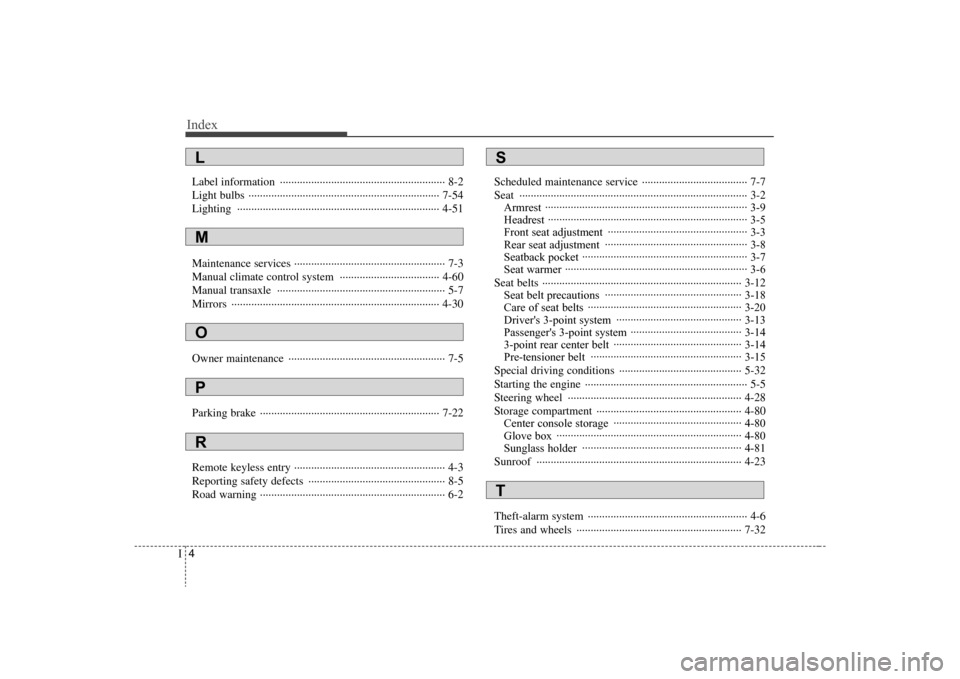
Index4I
Label information ·························································· 8-2
Light bulbs ··································································· 7-54
Lighting ······································································· 4-51
Maintenance services ····················································· 7-3
Manual climate control system ··································· 4-60
Manual transaxle ··························································· 5-7
Mirrors ········································································· 4-30
Owner maintenance ······················································· 7-5
Parking brake ······························································· 7-22
Remote keyless entry ····················································· 4-3
Reporting safety defects ················································ 8-5
Road warning ································································· 6-2Scheduled maintenance service ····································· 7-7
Seat ················································································ 3-2
Armrest ······································································· 3-9
Headrest ······································································ 3-5
Front seat adjustment ················································· 3-3
Rear seat adjustment ·················································· 3-8
Seatback pocket ·························································· 3-7
Seat warmer ································································ 3-6
Seat belts ······································································ 3-12
Seat belt precautions ················································ 3-18
Care of seat belts ······················································ 3-20
Driver's 3-point system ············································ 3-13
Passenger's 3-point system ······································· 3-14
3-point rear center belt ············································· 3-14
Pre-tensioner belt ····················································· 3-15
Special driving conditions ··········································· 5-32
Starting the engine ························································· 5-5
Steering wheel ····························································· 4-28
Storage compartment ··················································· 4-80
Center console storage ············································· 4-80
Glove box ································································· 4-80
Sunglass holder ························································ 4-81
Sunroof ········································································ 4-23
Theft-alarm system ························································ 4-6
Tires and wheels ·························································· 7-32M
S
OPR
T
L