Tire Hyundai Elantra 2008 Owner's Guide
[x] Cancel search | Manufacturer: HYUNDAI, Model Year: 2008, Model line: Elantra, Model: Hyundai Elantra 2008Pages: 360, PDF Size: 12.2 MB
Page 254 of 360
6
Road warning / 6-2
In case of an emergency while driving / 6-2
If the engine will not start / 6-3
Emergency starting / 6-4
If the engine overheats / 6-5
Tires pressure monitoring system (TPMS) / 6-7
If you have a flat tire / 6-12
Towing / 6-20
What to do in an emergency
Page 255 of 360
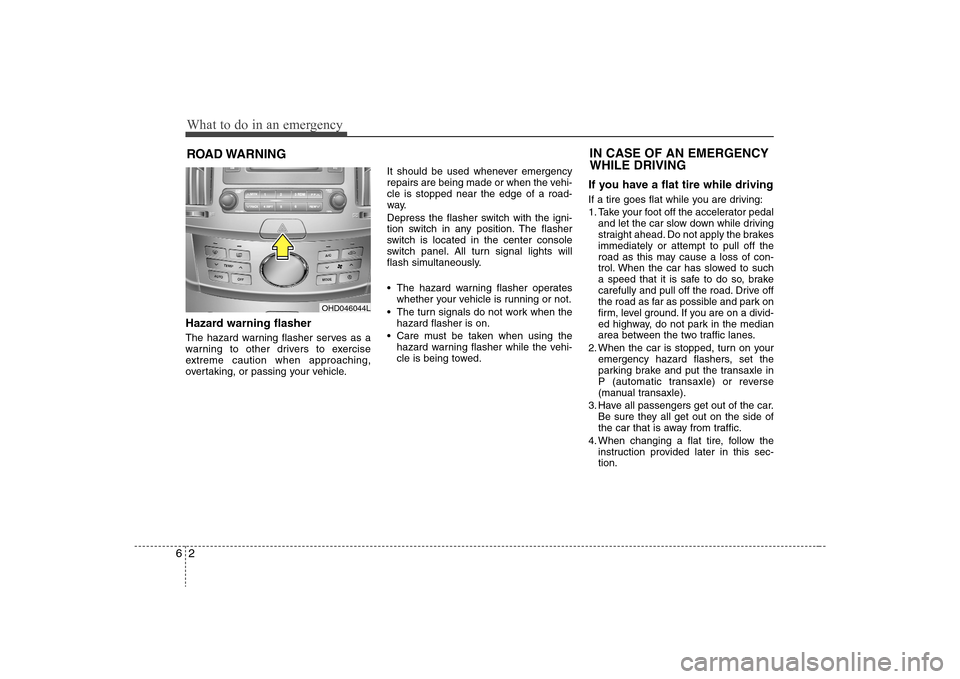
What to do in an emergency2 6ROAD WARNING Hazard warning flasher The hazard warning flasher serves as a
warning to other drivers to exercise
extreme caution when approaching,
overtaking, or passing your vehicle.It should be used whenever emergency
repairs are being made or when the vehi-
cle is stopped near the edge of a road-
way.
Depress the flasher switch with the igni-
tion switch in any position. The flasher
switch is located in the center console
switch panel. All turn signal lights will
flash simultaneously.
• The hazard warning flasher operates
whether your vehicle is running or not.
The turn signals do not work when the
hazard flasher is on.
Care must be taken when using the
hazard warning flasher while the vehi-
cle is being towed.
If you have a flat tire while drivingIf a tire goes flat while you are driving:
1. Take your foot off the accelerator pedal
and let the car slow down while driving
straight ahead. Do not apply the brakes
immediately or attempt to pull off the
road as this may cause a loss of con-
trol. When the car has slowed to such
a speed that it is safe to do so, brake
carefully and pull off the road. Drive off
the road as far as possible and park on
firm, level ground. If you are on a divid-
ed highway, do not park in the median
area between the two traffic lanes.
2. When the car is stopped, turn on your
emergency hazard flashers, set the
parking brake and put the transaxle in
P (automatic transaxle) or reverse
(manual transaxle).
3. Have all passengers get out of the car.
Be sure they all get out on the side of
the car that is away from traffic.
4. When changing a flat tire, follow the
instruction provided later in this sec-
tion.IN CASE OF AN EMERGENCY
WHILE DRIVING
OHD046044L
Page 260 of 360
67
What to do in an emergency
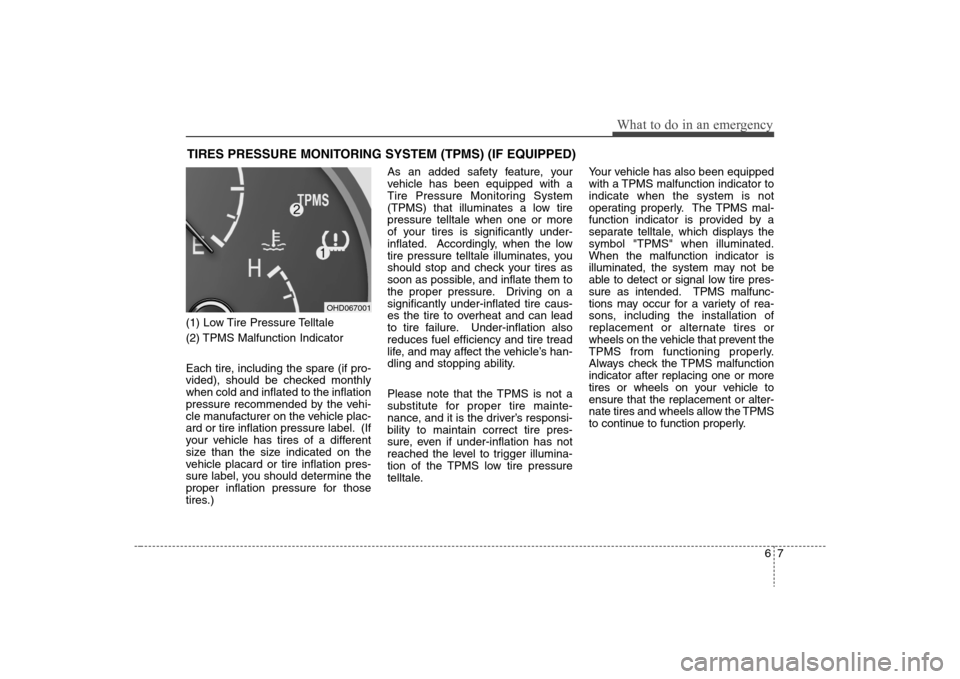
TIRES PRESSURE MONITORING SYSTEM (TPMS) (IF EQUIPPED) (1) Low Tire Pressure Telltale
(2) TPMS Malfunction Indicator
Each tire, including the spare (if pro-
vided), should be checked monthly
when cold and inflated to the inflation
pressure recommended by the vehi-
cle manufacturer on the vehicle plac-
ard or tire inflation pressure label. (If
your vehicle has tires of a different
size than the size indicated on the
vehicle placard or tire inflation pres-
sure label, you should determine the
proper inflation pressure for those
tires.)As an added safety feature, your
vehicle has been equipped with a
Tire Pressure Monitoring System
(TPMS) that illuminates a low tire
pressure telltale when one or more
of your tires is significantly under-
inflated. Accordingly, when the low
tire pressure telltale illuminates, you
should stop and check your tires as
soon as possible, and inflate them to
the proper pressure. Driving on a
significantly under-inflated tire caus-
es the tire to overheat and can lead
to tire failure. Under-inflation also
reduces fuel efficiency and tire tread
life, and may affect the vehicle’s han-
dling and stopping ability.
Please note that the TPMS is not a
substitute for proper tire mainte-
nance, and it is the driver’s responsi-
bility to maintain correct tire pres-
sure, even if under-inflation has not
reached the level to trigger illumina-
tion of the TPMS low tire pressure
telltale.Your vehicle has also been equipped
with a TPMS malfunction indicator to
indicate when the system is not
operating properly. The TPMS mal-
function indicator is provided by a
separate telltale, which displays the
symbol "TPMS" when illuminated.
When the malfunction indicator is
illuminated, the system may not be
able to detect or signal low tire pres-
sure as intended. TPMS malfunc-
tions may occur for a variety of rea-
sons, including the installation of
replacement or alternate tires or
wheels on the vehicle that prevent the
TPMS from functioning properly.
Always check the TPMS malfunction
indicator after replacing one or more
tires or wheels on your vehicle to
ensure that the replacement or alter-
nate tires and wheels allow the TPMS
to continue to function properly.
OHD067001
Page 261 of 360
What to do in an emergency8 6
Low tire pressure tell-
tale
When the tire pressure monitoring
system warning telltale is illuminat-
ed, one or more of your tires is sig-
nificantly under-inflated.
Immediately reduce your speed,
avoid hard cornering and anticipate
increased stopping distances. You
should stop and check your tires as
soon as possible. Inflate the tires to
the proper pressure as indicated on
the vehicle’s placard or tire inflation
pressure label located on the driver’s
side center pillar outer panel. If you
cannot reach a service station or if
the tire cannot hold the newly added
air, replace the low pressure tire with
the compact spare tire. Because the
compact spare tire is not equipped
with a tire pressure sensor, the
TPMS malfunction indicator may go
on and the Low Tire Pressure telltale
still turn on after restarting and about
20 minutes of continuous driving
before you have the low-pressure tire
repaired and replaced on the vehicle.
WARNING
- Low pressure
damage
Significantly low tire pressure
makes the vehicle unstable and
can contribute to loss of vehicle
control and increased braking
distances.
Continued driving on low pres-
sure tires will cause the tires to
overheat and fail.
CAUTION
In winter or cold weather, the
low tire pressure telltale may be
illuminated if the tire pressure
was adjusted to the recom-
mended tire inflation pressure
in warm weather. It does not
mean your TPMS is malfunction-
ing because the decreased tem-
perature leads to a proportional
lowering of tire pressure.
When you drive your vehicle
from a warm area to a cold area
or from a cold area to a warm
area, or the outside temperature
is greatly higher or lower, you
should check the tire inflation
pressure and adjust the tires to
the recommended tire inflation
pressure.
Page 262 of 360
69
What to do in an emergency
TPMS (Tire Pressure
Monitoring System)
malfunction indicator
The TPMS malfunction indicator
comes on and stays on when there is
a problem with the Tire Pressure
Monitoring System. If the system is
able to correctly detect an under-
inflation warning at the same time as
system failure then it will illuminate
both the TPMS malfunction and the
low tire pressure telltale e.g. If Front
Left sensor fails, the TPMS malfunc-
tion indicator comes on, but if Front
Right, Rear Left, or Rear Right tire is
under-inflated, the low tire pressure
telltale may come on with the TPMS
malfunction indicator.
Have the system checked by an
authorized HYUNDAI dealer as soon
as possible to determine the cause
of the problem.Changing a tire with TPMS
If you have a flat tire, the Low Tire
Pressure Telltale will turn on. Have
the flat tire repaired by an authorized
HYUNDAI dealer as soon as possi-
ble or replace the flat tire with the
compact spare tire.
Each wheel is equipped with a tire
pressure sensor mounted inside the
tire behind the valve stem. You must
use TPMS specific wheels. It is rec-
ommended that you always have
your tires serviced by an authorized
HYUNDAI dealer as soon as possi-
ble.
TPMS
CAUTION
NEVER use a puncture-repair-
ing agent to repair and/or inflate
a low pressure tire. If used, you
will have to replace the tire pres-
sure sensor.
CAUTION
The TPMS malfunction indica-
tor may be illuminated if the
vehicle is moving around elec-
tric power supply cable or
radio transmitter such as
police stations, government
and public offices, broadcast-
ing stations, military installa-
tions, airports, or transmitting
tower, etc. which can interfere
with normal operation of the
Tire Pressure Monitoring
System (TPMS).
The TPMS malfunction indica-
tor may be illuminated if snow
chains or some electronic
devices, such as notebook
computers, are used in the
vehicle. This can interfere with
normal operation of the Tire
Pressure Monitoring System
(TPMS).
Page 263 of 360
What to do in an emergency10 6After you replace the low pressure
tire with the compact spare tire, the
TPMS malfunction indicator may illu-
minate and the low tire pressure tell-
tale still illuminate after restarting
and about 20 minutes of continuous
driving.
Once the low pressure tire is re-inflat-
ed to the recommended pressure
and installed on the vehicle, the
TPMS malfunction indicator and the
low tire pressure telltale will be extin-
guished. If the low pressure and
TPMS malfunction indicators are not
extinguished after about 20 minutes
of continuous driving, please visit an
authorized HYUNDAI dealer.
You may not be able to identify a low
tire by simply looking at it. Always use
a good quality tire pressure gauge to
measure the tire's inflation pressure.
Please note that a tire that is hot
(from being driven) will have a higher
pressure measurement than a tire
that is cold (from sitting stationary for
at least 3 hours and driven less than
1 mile (1,6 km) during that 3 hour
period). Allow the tire to cool before
measuring the inflation pressure.Always be sure the tire is cold before
inflating to the recommended pres-
sure.
A cold tire means the vehicle has
been sitting for 3 hours and driven for
less than 1 mile (1.6 km) in that 3
hour period.
WARNING
- TPMS
The TPMS cannot alert you to
severe and sudden tire dam-
age caused by external fac-
tors such as nails or road
debris.
If you feel any vehicle instabil-
ity, immediately take your foot
off the accelerator, apply the
brakes gradually and with
light force, and slowly move to
a safe position off the road.
CAUTION
Do not use any tire sealant if
your vehicle is equipped with
a Tire Pressure Monitoring
System. The liquid sealant can
damage the tire pressure sen-
sors.
In order for the system to cor-
rectlymonitor tires for under-
inflation, there should be a
total of exactly 4 sensors fit-
ted to each of the four driven
wheel positions. There should
be no other sensors in the
vehicle including spare tire
since this could cause the
system to monitor the wrong
sensors.
Page 264 of 360
611
What to do in an emergency
This device complies with Part 15
of the FCC rules.
Operation is subject to the following
two conditions:
1. This device may not cause harm-
ful interference, and
2. This device must accept any inter-
ference received, including inter-
ference that may cause undesired
operation.
WARNING
Changes or modifications not
expressly approved by the party
responsible for compliance
could void the user’s authority
to operate the equipment.
WARNING
- Protecting
TPMS
Tampering with, modifying, or
disabling the Tire Pressure
Monitoring System (TPMS)
components may interfere with
the system's ability to warn the
driver of low tire pressure con-
ditions and/or TPMS malfunc-
tions. Tampering with, modify-
ing, or disabling the Tire
Pressure Monitoring System
(TPMS) components may void
the warranty for that portion of
the vehicle.
Page 265 of 360
What to do in an emergency12 6IF YOU HAVE A FLAT TIRE Jack and tools
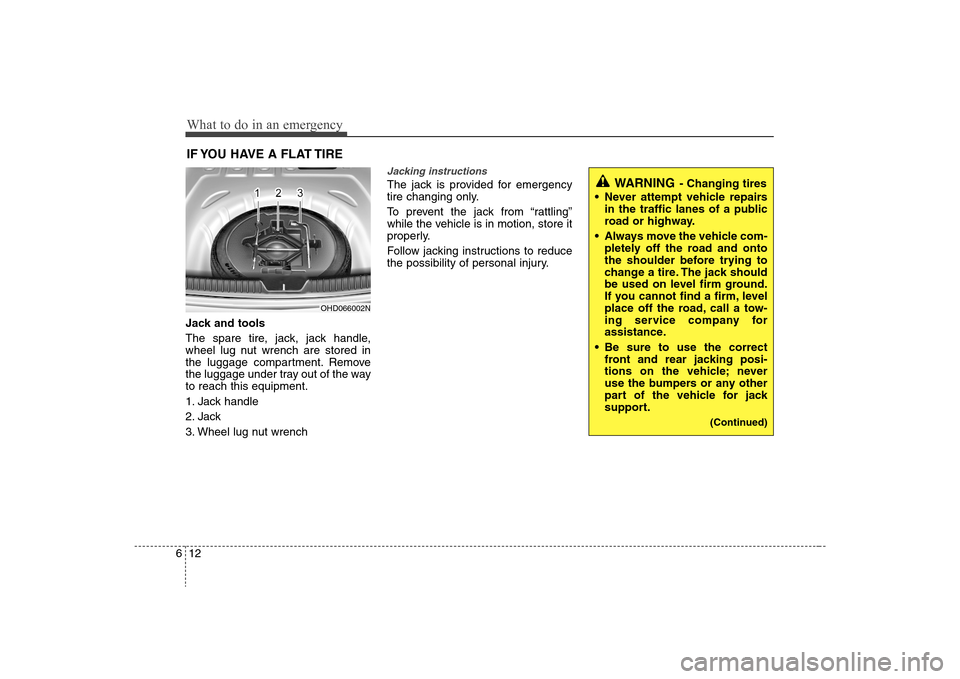
The spare tire, jack, jack handle,
wheel lug nut wrench are stored in
the luggage compartment. Remove
the luggage under tray out of the way
to reach this equipment.
1. Jack handle
2. Jack
3. Wheel lug nut wrench
Jacking instructions The jack is provided for emergency
tire changing only.
To prevent the jack from “rattling”
while the vehicle is in motion, store it
properly.
Follow jacking instructions to reduce
the possibility of personal injury.
OHD066002N
WARNING
- Changing tires
Never attempt vehicle repairs
in the traffic lanes of a public
road or highway.
Always move the vehicle com-
pletely off the road and onto
the shoulder before trying to
change a tire. The jack should
be used on level firm ground.
If you cannot find a firm, level
place off the road, call a tow-
ing service company for
assistance.
Be sure to use the correct
front and rear jacking posi-
tions on the vehicle; never
use the bumpers or any other
part of the vehicle for jack
support.
(Continued)
Page 266 of 360
613
What to do in an emergency
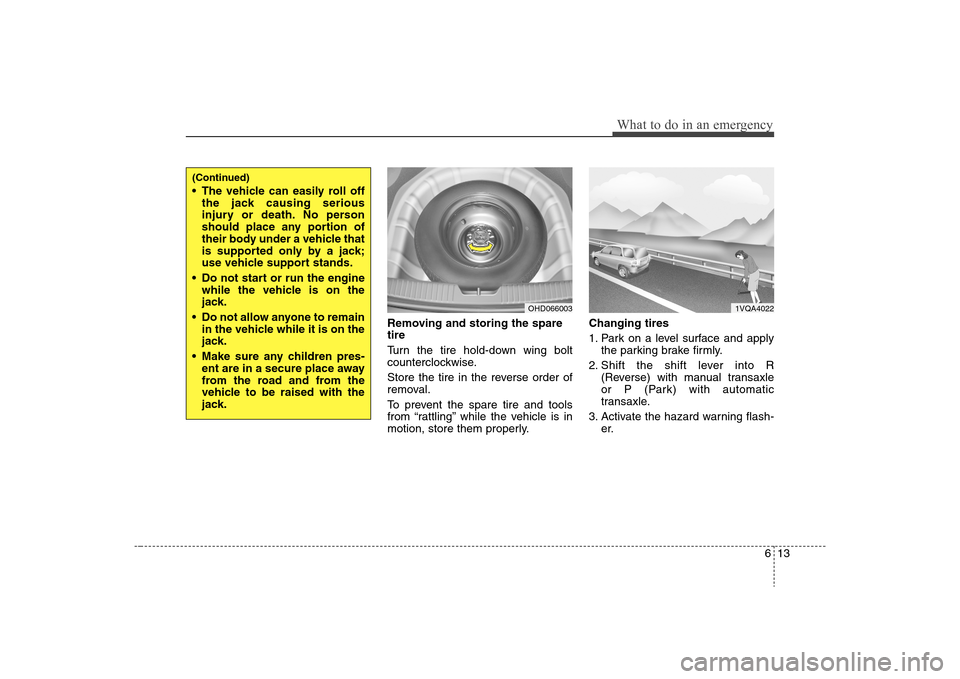
Removing and storing the spare
tire
Turn the tire hold-down wing bolt
counterclockwise.
Store the tire in the reverse order of
removal.
To prevent the spare tire and tools
from “rattling” while the vehicle is in
motion, store them properly.Changing tires
1. Park on a level surface and apply
the parking brake firmly.
2. Shift the shift lever into R
(Reverse) with manual transaxle
or P (Park) with automatic
transaxle.
3. Activate the hazard warning flash-
er.
OHD066003
(Continued) The vehicle can easily roll off
the jack causing serious
injury or death. No person
should place any portion of
their body under a vehicle that
is supported only by a jack;
use vehicle support stands.
Do not start or run the engine
while the vehicle is on the
jack.
Do not allow anyone to remain
in the vehicle while it is on the
jack.
Make sure any children pres-
ent are in a secure place away
from the road and from the
vehicle to be raised with the
jack.
1VQA4022
Page 267 of 360
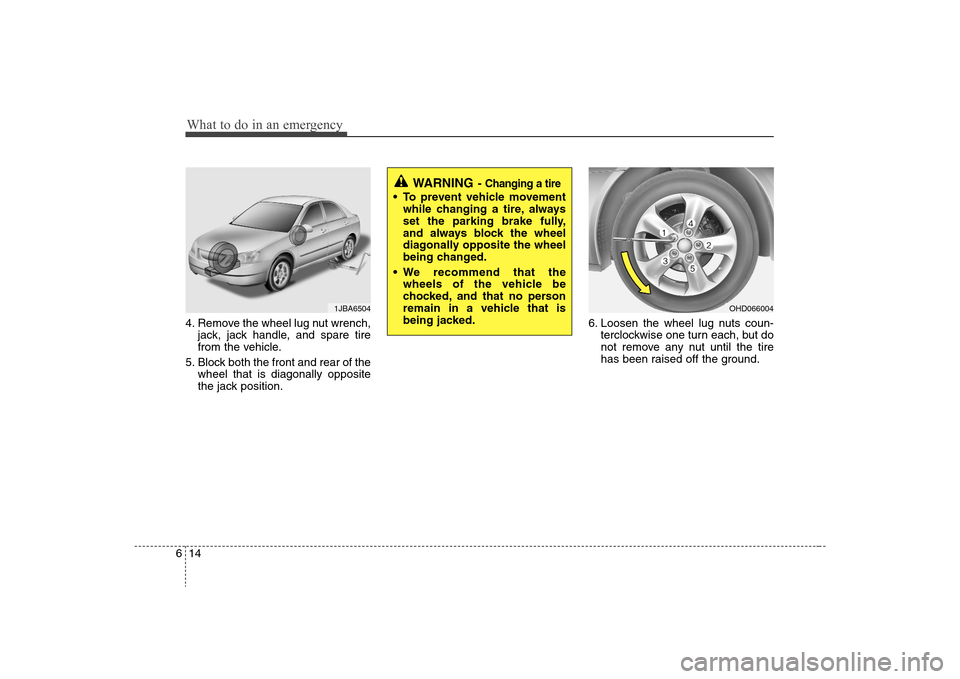
What to do in an emergency14 64. Remove the wheel lug nut wrench,
jack, jack handle, and spare tire
from the vehicle.
5. Block both the front and rear of the
wheel that is diagonally opposite
the jack position.6. Loosen the wheel lug nuts coun-
terclockwise one turn each, but do
not remove any nut until the tire
has been raised off the ground.
1JBA6504
OHD066004
WARNING
- Changing a tire
To prevent vehicle movement
while changing a tire, always
set the parking brake fully,
and always block the wheel
diagonally opposite the wheel
being changed.
We recommend that the
wheels of the vehicle be
chocked, and that no person
remain in a vehicle that is
being jacked.