ignition Hyundai Elantra 2010 User Guide
[x] Cancel search | Manufacturer: HYUNDAI, Model Year: 2010, Model line: Elantra, Model: Hyundai Elantra 2010Pages: 348, PDF Size: 5.78 MB
Page 61 of 348
Safety features of your vehicle
44
3
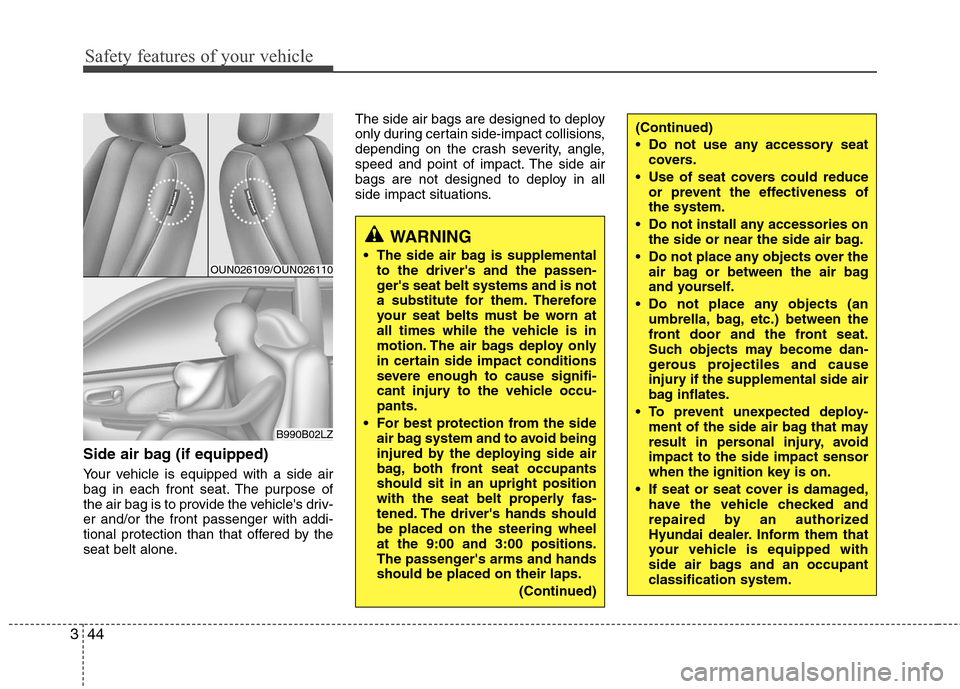
Side air bag (if equipped)
Your vehicle is equipped with a side air
bag in each front seat. The purpose of
the air bag is to provide the vehicle's driv-
er and/or the front passenger with addi-
tional protection than that offered by the
seat belt alone. The side air bags are designed to deploy
only during certain side-impact collisions,
depending on the crash severity, angle,
speed and point of impact. The side air
bags are not designed to deploy in all
side impact situations.
OUN026109/OUN026110
B990B02LZ
WARNING
The side air bag is supplemental
to the driver's and the passen-
ger's seat belt systems and is not
a substitute for them. Therefore
your seat belts must be worn at
all times while the vehicle is in
motion. The air bags deploy only
in certain side impact conditions
severe enough to cause signifi-
cant injury to the vehicle occu-
pants.
For best protection from the side air bag system and to avoid being
injured by the deploying side air
bag, both front seat occupants
should sit in an upright position
with the seat belt properly fas-
tened. The driver's hands should
be placed on the steering wheel
at the 9:00 and 3:00 positions.
The passenger's arms and hands
should be placed on their laps.
(Continued)
(Continued)
Do not use any accessory seatcovers.
Use of seat covers could reduce or prevent the effectiveness of
the system.
Do not install any accessories on the side or near the side air bag.
Do not place any objects over the air bag or between the air bag
and yourself.
Do not place any objects (an umbrella, bag, etc.) between the
front door and the front seat.
Such objects may become dan-
gerous projectiles and cause
injury if the supplemental side air
bag inflates.
To prevent unexpected deploy- ment of the side air bag that may
result in personal injury, avoid
impact to the side impact sensor
when the ignition key is on.
If seat or seat cover is damaged, have the vehicle checked and
repaired by an authorized
Hyundai dealer. Inform them that
your vehicle is equipped with
side air bags and an occupant
classification system.
Page 68 of 348

351
Safety features of your vehicle
How does the air bag system
operate
Air bags are activated (able to inflate ifnecessary) only when the ignition
switch is turned to ON or START posi-
tion.
Air bags inflate instantly in the event of a serious frontal or side collision (if
equipped with side air bag or curtain
air bag) in order to help protect the
occupants from serious physical injury.
There is no single speed at which the air bags will inflate.
Generally, air bags are designed to
inflate by the severity of a collision and
its direction. These two factors deter-
mine whether the sensors send out an
electronic deployment/inflation signal.
Air bag deployment depends on a number of factors including vehicle
speed, angles of impact and the densi-
ty and stiffness of the vehicles or
objects which your vehicle hits in the
collision. Though, factors are not limit-
ed to those mentioned above.
The front air bags will completely inflate and deflate in an instant.
It is virtually impossible for you to see
the air bags inflate during an accident.
It is much more likely that you will sim-
ply see the deflated air bags hanging
out of their storage compartments after
the collision. In order to help provide protection in a
severe collision, the air bags must
inflate rapidly. The speed of air bag
inflation is a consequence of the
extremely short time in which a collision
occurs and the need to get the air bag
between the occupant and the vehicle
structures before the occupant impacts
those structures. This speed of inflation
reduces the risk of serious or life-
threatening injuries in a severe collision
and is thus a necessary part of air bag
design.
However, air bag inflation can also
cause injuries which normally can
include facial abrasions, bruises and
broken bones, and sometimes more
severe injuries because the inflation
speed also causes the air bags to
expand with a great deal of force.
There are even circumstances under which contact with the steer-
ing wheel air bag can cause fatal
injuries, especially if the occupant
is positioned excessively close to
the steering wheel.
WARNING
To avoid severe personal injuryor death caused by deploying air
bags in a collision, the driver
should sit as far back from the
steering wheel air bag as possi-
ble (at least 10 inches (250 mm)
away). The front passenger
should always move their seat as
far back as possible and sit back
in their seat.
Air bag inflates instantly in the event of collision, and passen-
gers may be injured by the air bag
expansion force if they are not in
proper position.
Air bag inflation may cause injuries which normally include
facial or bodily abrasions,
injuries from broken glasses or
burns by the air bag inflation
gasses.
Page 70 of 348
353
Safety features of your vehicle
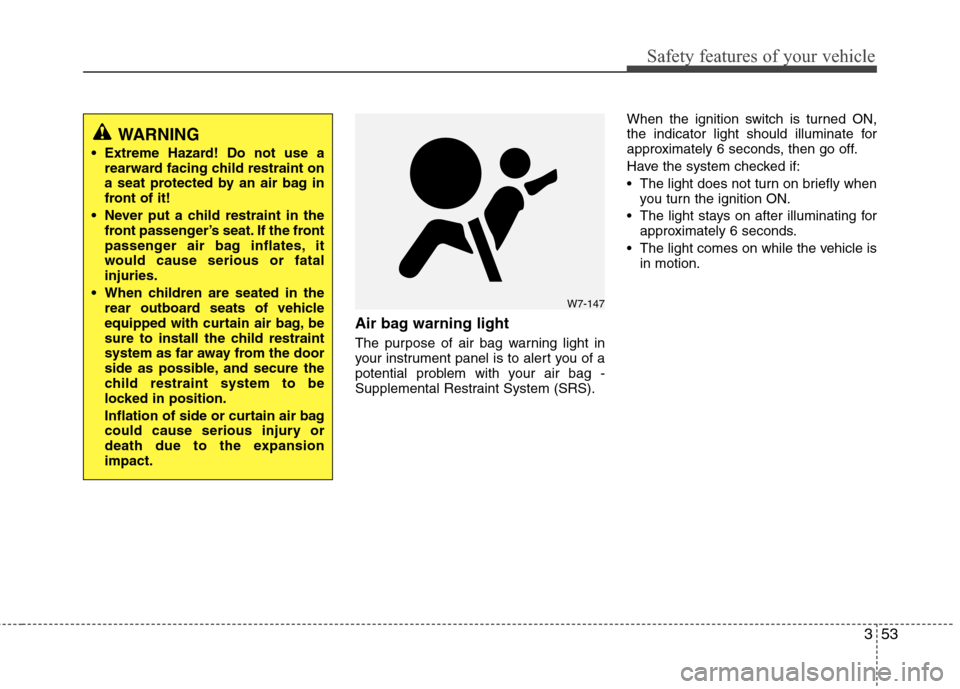
Air bag warning light
The purpose of air bag warning light in
your instrument panel is to alert you of a
potential problem with your air bag -
Supplemental Restraint System (SRS).When the ignition switch is turned ON,
the indicator light should illuminate for
approximately 6 seconds, then go off.
Have the system checked if:
The light does not turn on briefly when
you turn the ignition ON.
The light stays on after illuminating for approximately 6 seconds.
The light comes on while the vehicle is in motion.
WARNING
Extreme Hazard! Do not use arearward facing child restraint on
a seat protected by an air bag in
front of it!
Never put a child restraint in the front passenger’s seat. If the front
passenger air bag inflates, it
would cause serious or fatal
injuries.
When children are seated in the rear outboard seats of vehicle
equipped with curtain air bag, be
sure to install the child restraint
system as far away from the door
side as possible, and secure the
child restraint system to be
locked in position.
Inflation of side or curtain air bag
could cause serious injury or
death due to the expansion
impact.
W7-147
Page 75 of 348
Features of your vehicle
2
4
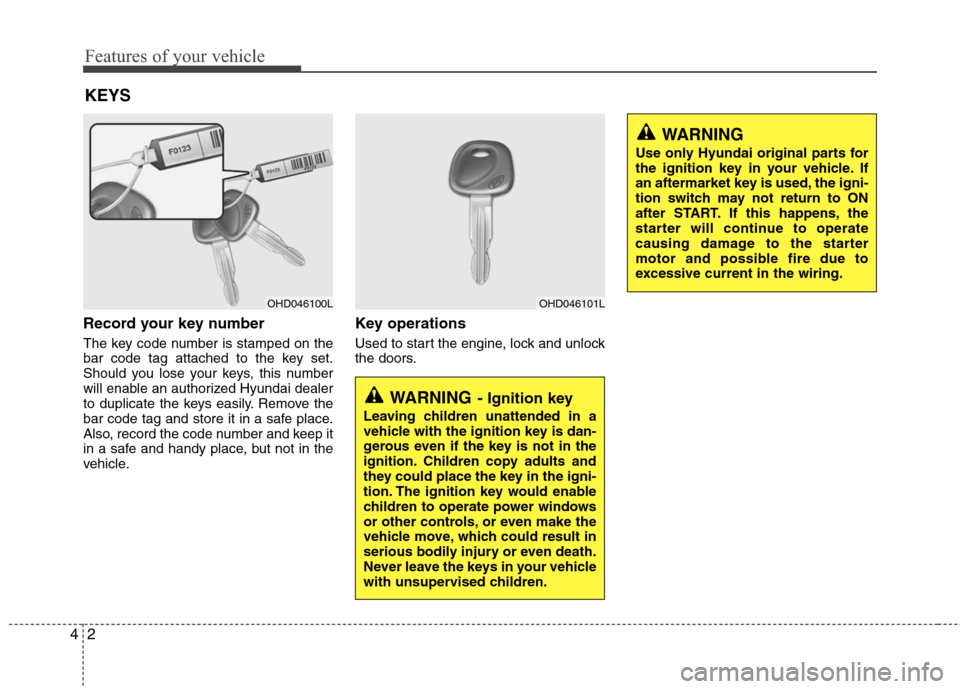
Record your key number
The key code number is stamped on the
bar code tag attached to the key set.
Should you lose your keys, this number
will enable an authorized Hyundai dealer
to duplicate the keys easily. Remove the
bar code tag and store it in a safe place.
Also, record the code number and keep it
in a safe and handy place, but not in the
vehicle.
Key operations
Used to start the engine, lock and unlock
the doors.
KEYS
WARNING- Ignition key
Leaving children unattended in a
vehicle with the ignition key is dan-
gerous even if the key is not in the
ignition. Children copy adults and
they could place the key in the igni-
tion. The ignition key would enable
children to operate power windows
or other controls, or even make the
vehicle move, which could result in
serious bodily injury or even death.
Never leave the keys in your vehicle
with unsupervised children.
OHD046100L
OHD046101L
WARNING
Use only Hyundai original parts for
the ignition key in your vehicle. If
an aftermarket key is used, the igni-
tion switch may not return to ON
after START. If this happens, the
starter will continue to operate
causing damage to the starter
motor and possible fire due to
excessive current in the wiring.
Page 76 of 348
43
Features of your vehicle
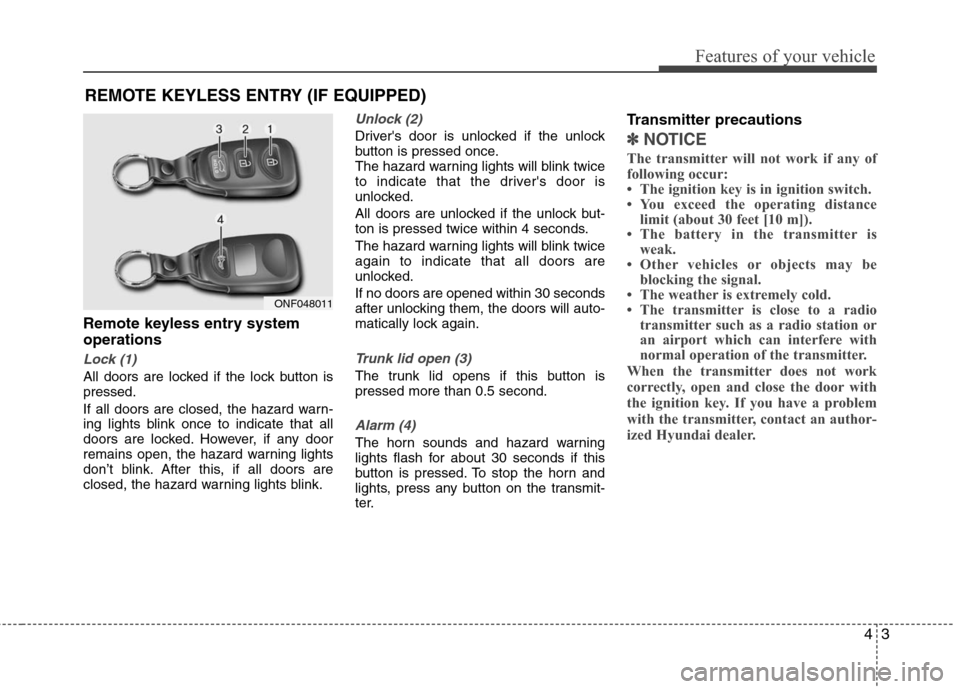
Remote keyless entry system
operations
Lock (1)
All doors are locked if the lock button is
pressed.
If all doors are closed, the hazard warn-
ing lights blink once to indicate that all
doors are locked. However, if any door
remains open, the hazard warning lights
don’t blink. After this, if all doors are
closed, the hazard warning lights blink.
Unlock (2)
Driver's door is unlocked if the unlock
button is pressed once.
The hazard warning lights will blink twice
to indicate that the driver's door is
unlocked.
All doors are unlocked if the unlock but-
ton is pressed twice within 4 seconds.
The hazard warning lights will blink twice
again to indicate that all doors are
unlocked.
If no doors are opened within 30 seconds
after unlocking them, the doors will auto-
matically lock again.
Trunk lid open (3)
The trunk lid opens if this button is
pressed more than 0.5 second.
Alarm (4)
The horn sounds and hazard warning
lights flash for about 30 seconds if this
button is pressed. To stop the horn and
lights, press any button on the transmit-
ter.
Transmitter precautions
✽ ✽NOTICE
The transmitter will not work if any of
following occur:
• The ignition key is in ignition switch.
• You exceed the operating distance
limit (about 30 feet [10 m]).
• The battery in the transmitter is weak.
• Other vehicles or objects may be blocking the signal.
• The weather is extremely cold.
• The transmitter is close to a radio transmitter such as a radio station or
an airport which can interfere with
normal operation of the transmitter.
When the transmitter does not work
correctly, open and close the door with
the ignition key. If you have a problem
with the transmitter, contact an author-
ized Hyundai dealer.
REMOTE KEYLESS ENTRY (IF EQUIPPED)
ONF048011
Page 79 of 348
Features of your vehicle
6
4
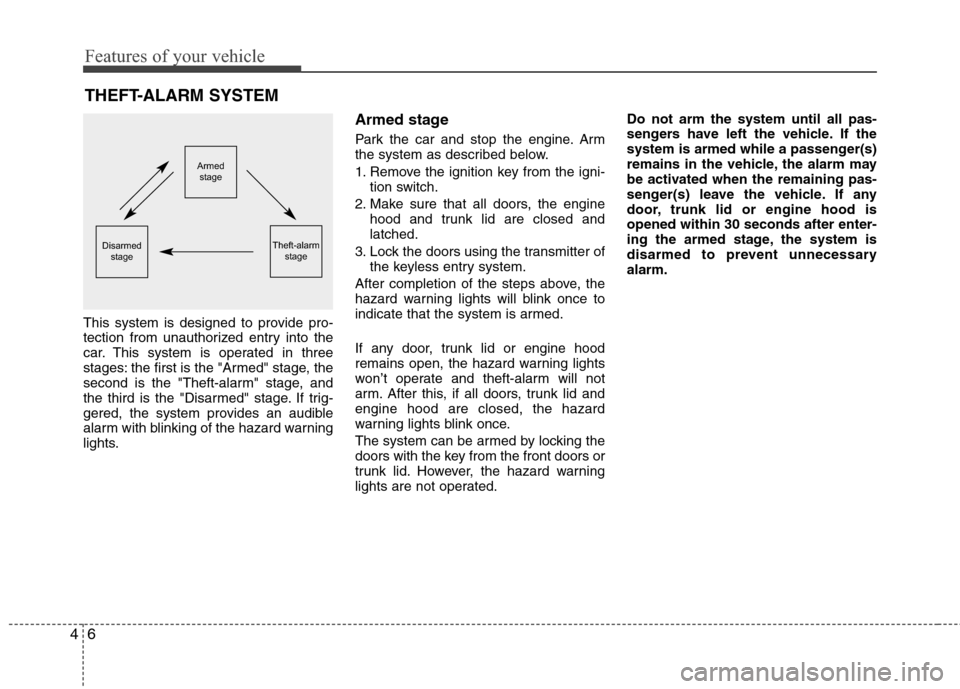
This system is designed to provide pro-
tection from unauthorized entry into the
car. This system is operated in three
stages: the first is the "Armed" stage, the
second is the "Theft-alarm" stage, and
the third is the "Disarmed" stage. If trig-
gered, the system provides an audible
alarm with blinking of the hazard warning
lights.
Armed stage
Park the car and stop the engine. Arm
the system as described below.
1. Remove the ignition key from the igni-
tion switch.
2. Make sure that all doors, the engine hood and trunk lid are closed and
latched.
3. Lock the doors using the transmitter of the keyless entry system.
After completion of the steps above, the
hazard warning lights will blink once to
indicate that the system is armed.
If any door, trunk lid or engine hood
remains open, the hazard warning lights
won’t operate and theft-alarm will not
arm. After this, if all doors, trunk lid and
engine hood are closed, the hazard
warning lights blink once.
The system can be armed by locking the
doors with the key from the front doors or
trunk lid. However, the hazard warning
lights are not operated. Do not arm the system until all pas-
sengers have left the vehicle. If the
system is armed while a passenger(s)
remains in the vehicle, the alarm may
be activated when the remaining pas-
senger(s) leave the vehicle. If any
door, trunk lid or engine hood is
opened within 30 seconds after enter-
ing the armed stage, the system is
disarmed to prevent unnecessary
alarm.
THEFT-ALARM SYSTEM
Armed
stage
Theft-alarm stageDisarmedstage
Page 80 of 348
47
Features of your vehicle
Theft-alarm stage
The alarm will be activated if any of the
following occurs while the system is
armed.
A front or rear door is opened withoutusing the ignition key or transmitter.
The trunk lid is opened without using the ignition key or transmitter.
The engine hood is opened.
The siren will sound and the hazard
warning lights will blink continuously for
27 seconds, and repeat the alarm 3
times unless the system is disarmed. To
turn off the system, unlock the doors with
the ignition key or transmitter.
Withheld alarm
If the trunk lid is opened with the trans-
mitter during the armed stage, the alarm
will not be activated but the armed state
will be maintained for the doors and
hood.
Disarmed stage
The system will be disarmed when the
doors are unlocked by depressing the
unlock button on the transmitter or
unlocked with the ignition key.
After depressing unlock button, the haz-
ard warning lights will blink twice to indi-
cate that the system is disarmed.
After depressing unlock button, if any
door is not opened within 30 seconds,
the system will be rearmed.
✽ ✽ NOTICE
• Avoid trying to start the engine while
the alarm is activated. The vehicle
starting motor is disabled during the
theft-alarm stage. If the system is not
disarmed with the ignition key or
transmitter, insert the key into the
ignition switch, turn the ignition
switch to the ON position and wait for
30 seconds. Then the system will be
disarmed.
• If you lose your keys, consult your authorized Hyundai dealer.
CAUTION
Do not change, alter or adjust the
theft-alarm system because it couldcause the theft-alarm system tomalfunction and should only beserviced by an authorized Hyundaidealer.
Malfunctions caused by improperalterations, adjustments or modifi-cations to the theft-alarm systemare not covered by your vehiclemanufacturer warranty.
Page 81 of 348
Features of your vehicle
8
4
Operating door locks from out-
side the vehicle
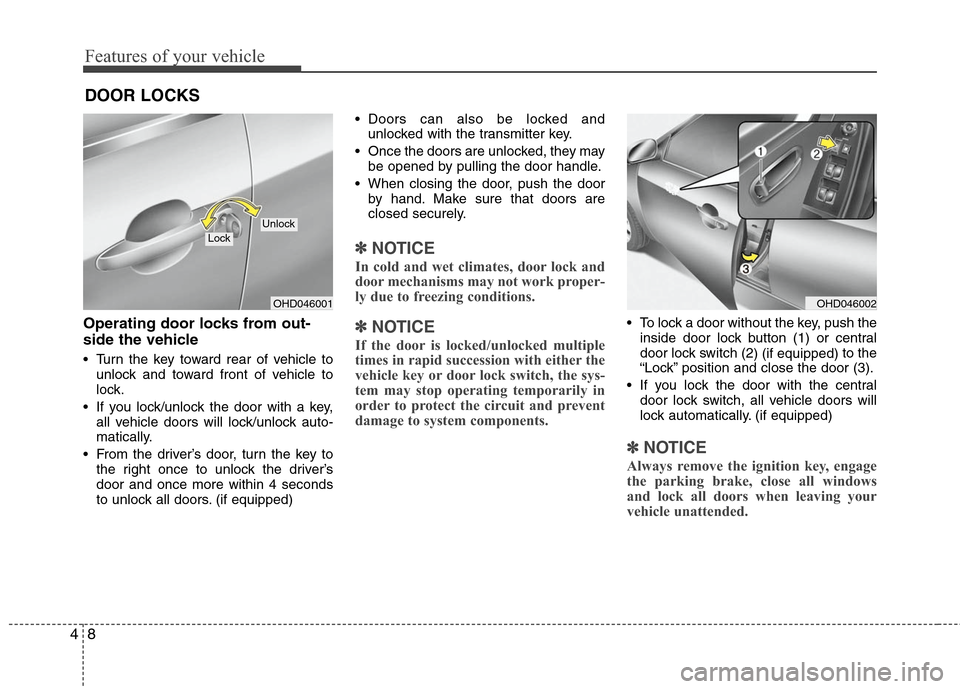
Turn the key toward rear of vehicle to
unlock and toward front of vehicle to
lock.
If you lock/unlock the door with a key, all vehicle doors will lock/unlock auto-
matically.
From the driver’s door, turn the key to the right once to unlock the driver’s
door and once more within 4 seconds
to unlock all doors. (if equipped) Doors can also be locked and
unlocked with the transmitter key.
Once the doors are unlocked, they may be opened by pulling the door handle.
When closing the door, push the door by hand. Make sure that doors are
closed securely.
✽ ✽ NOTICE
In cold and wet climates, door lock and
door mechanisms may not work proper-
ly due to freezing conditions.
✽ ✽NOTICE
If the door is locked/unlocked multiple
times in rapid succession with either the
vehicle key or door lock switch, the sys-
tem may stop operating temporarily in
order to protect the circuit and prevent
damage to system components.
To lock a door without the key, push the
inside door lock button (1) or central
door lock switch (2 ) (if equipped)to the
“Lock” position and close the door (3).
If you lock the door with the central door lock switch, all vehicle doors will
lock automatically. (if equipped)
✽ ✽ NOTICE
Always remove the ignition key, engage
the parking brake, close all windows
and lock all doors when leaving your
vehicle unattended.
DOOR LOCKS
OHD046001
LockUnlock
OHD046002
Page 82 of 348
49
Features of your vehicle
Operating door locks from inside
the vehicle
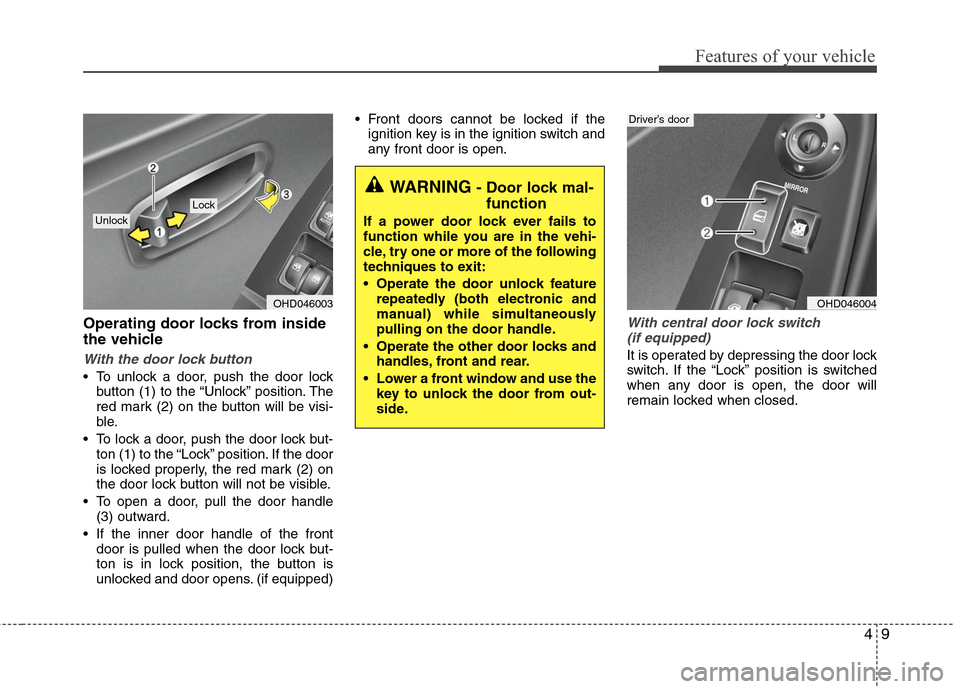
With the door lock button
To unlock a door, push the door lockbutton (1) to the “Unlock” position. The
red mark (2) on the button will be visi-
ble.
To lock a door, push the door lock but- ton (1) to the “Lock” position. If the door
is locked properly, the red mark (2) on
the door lock button will not be visible.
To open a door, pull the door handle (3) outward.
If the inner door handle of the front door is pulled when the door lock but-
ton is in lock position, the button is
unlocked and door opens. (if equipped) Front doors cannot be locked if the
ignition key is in the ignition switch and
any front door is open.
With central door lock switch(if equipped)
It is operated by depressing the door lock
switch. If the “Lock” position is switched
when any door is open, the door will
remain locked when closed.
OHD046003
Lock Unlock
WARNING - Door lock mal- function
If a power door lock ever fails to
function while you are in the vehi-
cle, try one or more of the following
techniques to exit:
Operate the door unlock feature
repeatedly (both electronic and
manual) while simultaneously
pulling on the door handle.
Operate the other door locks and handles, front and rear.
Lower a front window and use the key to unlock the door from out-
side.
OHD046004
Driver’s door
Page 83 of 348
Features of your vehicle
10
4
When pushing down on the front por-
tion (1) of the switch, all vehicle doors
will lock.
When pushing down on the rear por- tion (2) of the switch, all vehicle doors
will unlock.
However, if the key is in the ignition switch and any front door is open, the
doors will not lock when the front por-
tion of central door lock switch is
pressed.
WARNING- Unlocked
vehicles
Leaving your vehicle unlocked can
invite theft or possible harm to you
or others from someone hiding in
your vehicle while you are gone.
Always remove the ignition key,
engage the parking brake, close all
windows and lock all doors when
leaving your vehicle unattended.
WARNING- Unattendedchildren
An enclosed vehicle can become
extremely hot, causing death or
severe injury to unattended chil-
dren or animals who cannot escape
the vehicle. Furthermore, children
might operate features of the vehi-
cle that could injure them, or they
could encounter other harm, possi-
bly from someone gaining entry to
the vehicle. Never leave children or
animals unattended in your vehicle.
WARNING - Doors
The doors should always be fully
closed and locked while the vehi-
cle is in motion to prevent acci-
dental opening of the door.
Locked doors will also discour-
age potential intruders when the
vehicle stops or slows.
Be careful when opening doors and watch for vehicles, motorcy-
cles, bicycles or pedestrians
approaching the vehicle in the
path of the door. Opening a door
when something is approaching
can cause damage or injury.