brake Hyundai Elantra 2010 Owner's Manual
[x] Cancel search | Manufacturer: HYUNDAI, Model Year: 2010, Model line: Elantra, Model: Hyundai Elantra 2010Pages: 348, PDF Size: 5.78 MB
Page 12 of 348
15
Introduction
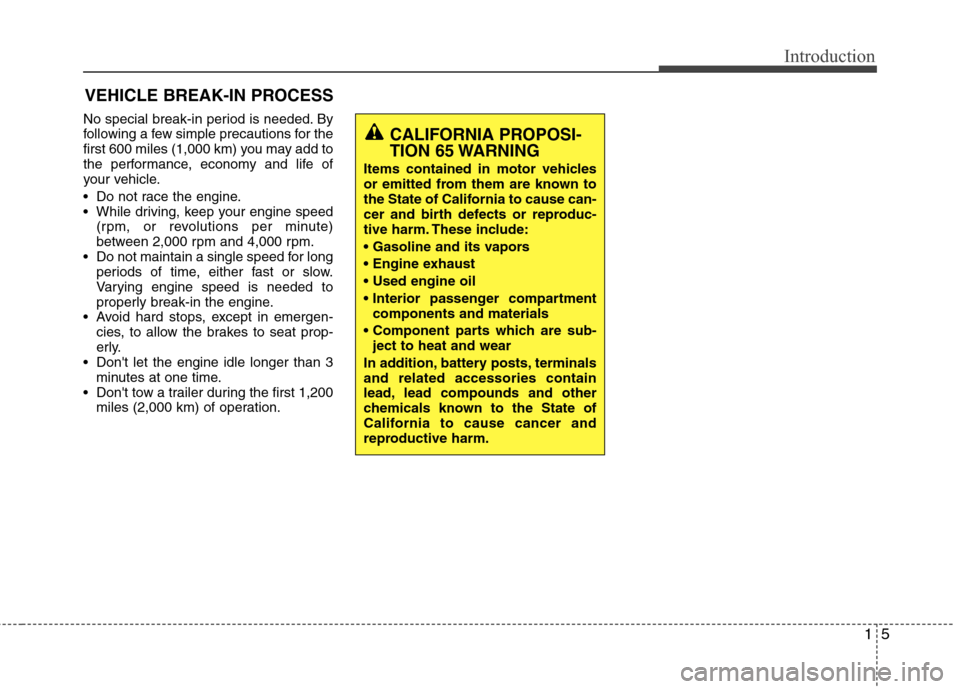
VEHICLE BREAK-IN PROCESS
No special break-in period is needed. By
following a few simple precautions for the
first 600 miles (1,000 km) you may add to
the performance, economy and life of
your vehicle.
Do not race the engine.
While driving, keep your engine speed(rpm, or revolutions per minute)
between 2,000 rpm and 4,000 rpm.
Do not maintain a single speed for long periods of time, either fast or slow.
Varying engine speed is needed to
properly break-in the engine.
Avoid hard stops, except in emergen- cies, to allow the brakes to seat prop-
erly.
Don't let the engine idle longer than 3 minutes at one time.
Don't tow a trailer during the first 1,200 miles (2,000 km) of operation.
CALIFORNIA PROPOSI-
TION 65 WARNING
Items contained in motor vehicles
or emitted from them are known to
the State of California to cause can-
cer and birth defects or reproduc-
tive harm. These include:
components and materials
ject to heat and wear
In addition, battery posts, terminals
and related accessories contain
lead, lead compounds and other
chemicals known to the State of
California to cause cancer and
reproductive harm.
Page 14 of 348
17
Introduction
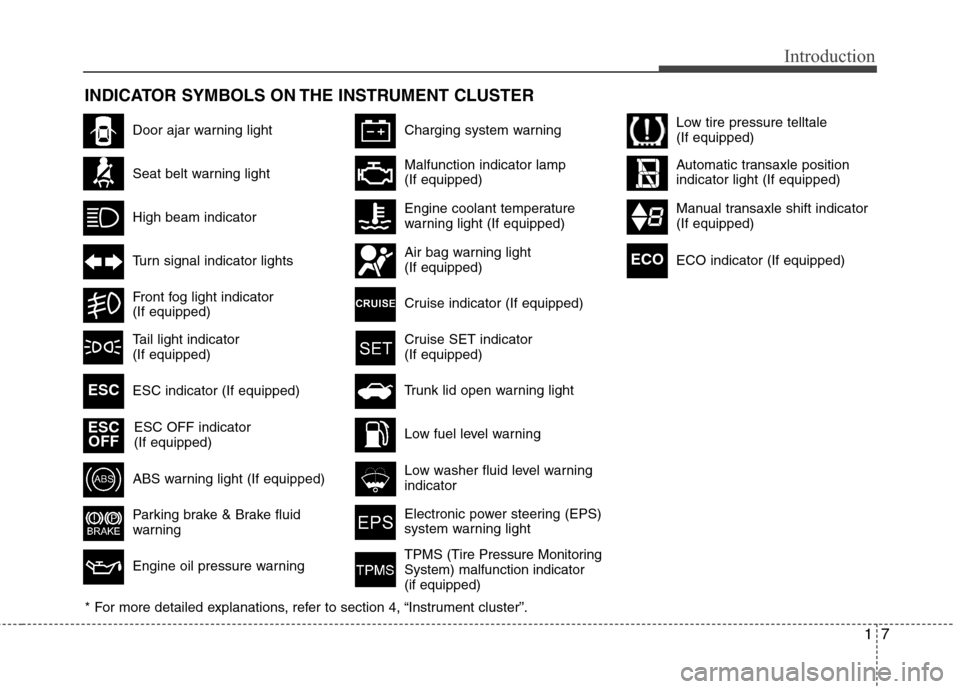
INDICATOR SYMBOLS ON THE INSTRUMENT CLUSTER
Door ajar warning light
Seat belt warning light
High beam indicator
Turn signal indicator lights
Front fog light indicator
(If equipped)
ABS warning light (If equipped)
Parking brake & Brake fluid
warning
Engine oil pressure warning
Charging system warning
ESC indicator (If equipped) ESC OFF indicator
(If equipped)
Malfunction indicator lamp
(If equipped)
Engine coolant temperature
warning light (If equipped)
Air bag warning light
(If equipped)
Cruise indicator (If equipped)
Cruise SET indicator
(If equipped)
Low fuel level warning
Low washer fluid level warning
indicator
Electronic power steering (EPS)
system warning light
Trunk lid open warning light
* For more detailed explanations, refer to section 4, “Instrument cluster”.ESC
ESC OFF
TPMS (Tire Pressure Monitoring
System) malfunction indicator
(if equipped)
Low tire pressure telltale
(If equipped)
Automatic transaxle position
indicator light (If equipped)
Manual transaxle shift indicator
(If equipped)
Tail light indicator
(If equipped) ECO indicator (If equipped)
ECO
Page 16 of 348
Your vehicle at a glance
2
2
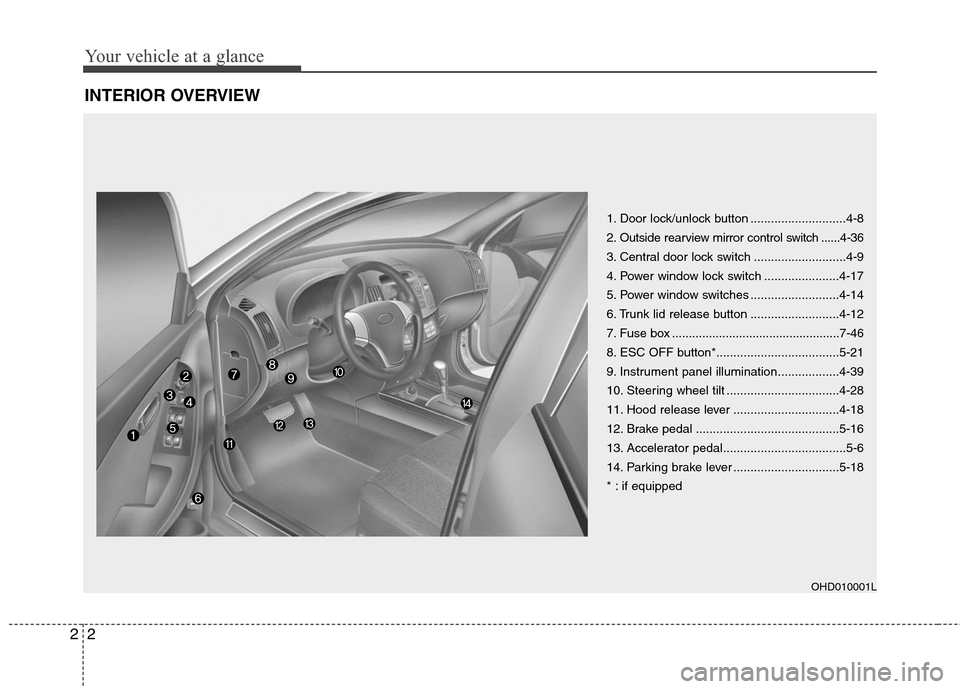
INTERIOR OVERVIEW
1. Door lock/unlock button ............................4-8
2. Outside rearview mirror control switch ......4-36
3. Central door lock switch ...........................4-9
4. Power window lock switch ......................4-17
5. Power window switches ..........................4-14
6. Trunk lid release button ..........................4-12
7. Fuse box ..................................................7-46
8. ESC OFF button*....................................5-21
9. Instrument panel illumination..................4-39
10. Steering wheel tilt .................................4-28
11. Hood release lever ...............................4-18
12. Brake pedal ..........................................5-16
13. Accelerator pedal....................................5-6
14. Parking brake lever ...............................5-18
* : if equipped
OHD010001L
Page 27 of 348
Safety features of your vehicle
10
3
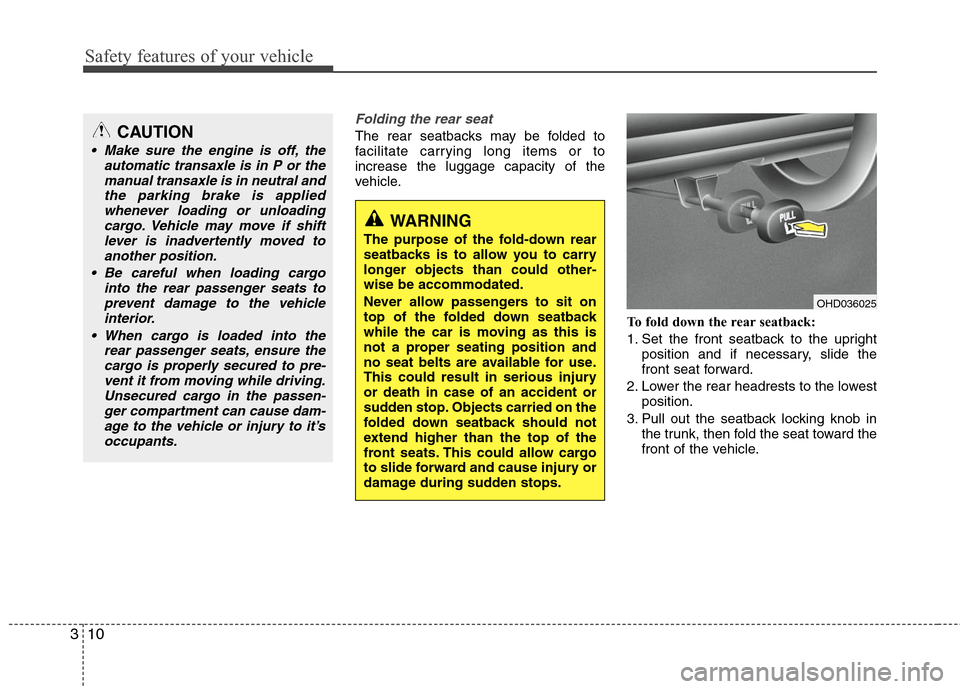
Folding the rear seat
The rear seatbacks may be folded to
facilitate carrying long items or to
increase the luggage capacity of the
vehicle.
To fold down the rear seatback:
1. Set the front seatback to the uprightposition and if necessary, slide the
front seat forward.
2. Lower the rear headrests to the lowest position.
3. Pull out the seatback locking knob in the trunk, then fold the seat toward the
front of the vehicle.CAUTION
Make sure the engine is off, the automatic transaxle is in P or themanual transaxle is in neutral andthe parking brake is appliedwhenever loading or unloading cargo. Vehicle may move if shiftlever is inadvertently moved toanother position.
Be careful when loading cargo into the rear passenger seats toprevent damage to the vehicleinterior.
When cargo is loaded into the rear passenger seats, ensure thecargo is properly secured to pre-vent it from moving while driving.Unsecured cargo in the passen-ger compartment can cause dam-age to the vehicle or injury to it’soccupants.
WARNING
The purpose of the fold-down rear
seatbacks is to allow you to carry
longer objects than could other-
wise be accommodated.
Never allow passengers to sit on
top of the folded down seatback
while the car is moving as this is
not a proper seating position and
no seat belts are available for use.
This could result in serious injury
or death in case of an accident or
sudden stop. Objects carried on the
folded down seatback should not
extend higher than the top of the
front seats. This could allow cargo
to slide forward and cause injury or
damage during sudden stops.
OHD036025
Page 29 of 348
Safety features of your vehicle
12
3
Seat belt restraint system
WARNING- Cargo
Cargo should always be secured to
prevent it from being thrown about
the vehicle in a collision and caus-
ing injury to the vehicle occupants.
Special care should be taken of
objects placed in the rear seats,
since those may hit the front seat
occupants in a frontal collision.
WARNING - Cargo loading
Make sure the engine is off, the
automatic transaxle is in P or the
manual transaxle is in neutral and
the parking brake is applied when-
ever loading or unloading cargo.
Failure to take these steps may
allow the vehicle to move if shift
lever is inadvertently moved to
another position.
SEAT BELTS
WARNING
For maximum restraint system
protection, the seat belts must
always be used whenever the car
is moving.
Seat belts are most effective when seatbacks are in the
upright position.
Children age 12 and under must always be properly restrained in
the rear seat. Never allow chil-
dren to ride in the front passen-
ger seat. If a child over 12 must
be seated in the front seat, he/she
must be properly belted and the
seat should be moved as far back
as possible.
Never wear the shoulder belt under your arm or behind your
back. An improperly positioned
shoulder belt can cause serious
injuries in a crash. The shoulder
belt should be positioned midway
over your shoulder across your
collarbone.
(Continued)
Page 81 of 348
Features of your vehicle
8
4
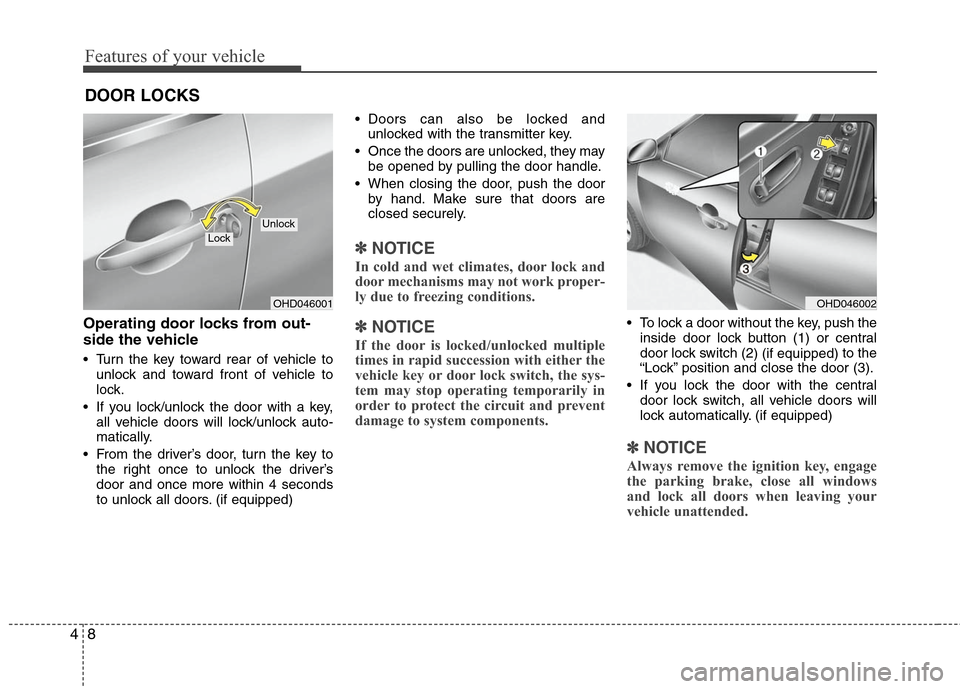
Operating door locks from out-
side the vehicle
Turn the key toward rear of vehicle to
unlock and toward front of vehicle to
lock.
If you lock/unlock the door with a key, all vehicle doors will lock/unlock auto-
matically.
From the driver’s door, turn the key to the right once to unlock the driver’s
door and once more within 4 seconds
to unlock all doors. (if equipped) Doors can also be locked and
unlocked with the transmitter key.
Once the doors are unlocked, they may be opened by pulling the door handle.
When closing the door, push the door by hand. Make sure that doors are
closed securely.
✽ ✽ NOTICE
In cold and wet climates, door lock and
door mechanisms may not work proper-
ly due to freezing conditions.
✽ ✽NOTICE
If the door is locked/unlocked multiple
times in rapid succession with either the
vehicle key or door lock switch, the sys-
tem may stop operating temporarily in
order to protect the circuit and prevent
damage to system components.
To lock a door without the key, push the
inside door lock button (1) or central
door lock switch (2 ) (if equipped)to the
“Lock” position and close the door (3).
If you lock the door with the central door lock switch, all vehicle doors will
lock automatically. (if equipped)
✽ ✽ NOTICE
Always remove the ignition key, engage
the parking brake, close all windows
and lock all doors when leaving your
vehicle unattended.
DOOR LOCKS
OHD046001
LockUnlock
OHD046002
Page 83 of 348
Features of your vehicle
10
4
When pushing down on the front por-
tion (1) of the switch, all vehicle doors
will lock.
When pushing down on the rear por- tion (2) of the switch, all vehicle doors
will unlock.
However, if the key is in the ignition switch and any front door is open, the
doors will not lock when the front por-
tion of central door lock switch is
pressed.
WARNING- Unlocked
vehicles
Leaving your vehicle unlocked can
invite theft or possible harm to you
or others from someone hiding in
your vehicle while you are gone.
Always remove the ignition key,
engage the parking brake, close all
windows and lock all doors when
leaving your vehicle unattended.
WARNING- Unattendedchildren
An enclosed vehicle can become
extremely hot, causing death or
severe injury to unattended chil-
dren or animals who cannot escape
the vehicle. Furthermore, children
might operate features of the vehi-
cle that could injure them, or they
could encounter other harm, possi-
bly from someone gaining entry to
the vehicle. Never leave children or
animals unattended in your vehicle.
WARNING - Doors
The doors should always be fully
closed and locked while the vehi-
cle is in motion to prevent acci-
dental opening of the door.
Locked doors will also discour-
age potential intruders when the
vehicle stops or slows.
Be careful when opening doors and watch for vehicles, motorcy-
cles, bicycles or pedestrians
approaching the vehicle in the
path of the door. Opening a door
when something is approaching
can cause damage or injury.
Page 119 of 348
Features of your vehicle
46
4
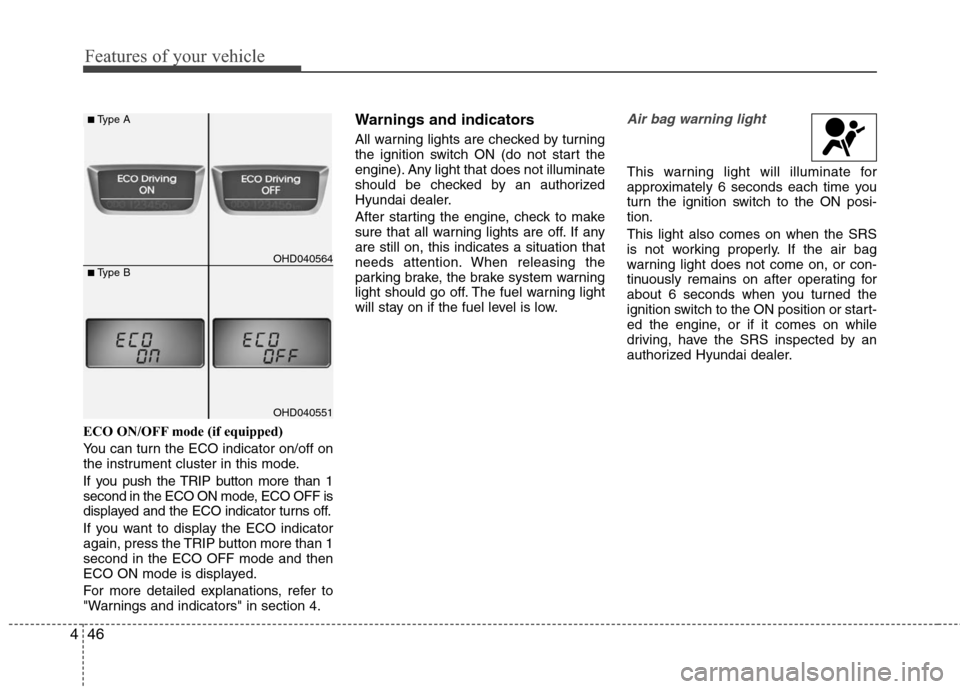
ECO ON/OFF mode (if equipped)
You can turn the ECO indicator on/off on
the instrument cluster in this mode.
If you push the TRIP button more than 1
second in the ECO ON mode, ECO OFF is
displayed and the ECO indicator turns off.
If you want to display the ECO indicator
again, press the TRIP button more than 1
second in the ECO OFF mode and then
ECO ON mode is displayed.
For more detailed explanations, refer to
"Warnings and indicators" in section 4.
Warnings and indicators
All warning lights are checked by turning
the ignition switch ON (do not start the
engine). Any light that does not illuminate
should be checked by an authorized
Hyundai dealer.
After starting the engine, check to make
sure that all warning lights are off. If any
are still on, this indicates a situation that
needs attention. When releasing the
parking brake, the brake system warning
light should go off. The fuel warning light
will stay on if the fuel level is low.
Air bag warning light
This warning light will illuminate for
approximately 6 seconds each time you
turn the ignition switch to the ON posi-
tion.
This light also comes on when the SRS
is not working properly. If the air bag
warning light does not come on, or con-
tinuously remains on after operating for
about 6 seconds when you turned the
ignition switch to the ON position or start-
ed the engine, or if it comes on while
driving, have the SRS inspected by an
authorized Hyundai dealer.
OHD040564
■Type A
■Type B
OHD040551
Page 120 of 348
447
Features of your vehicle
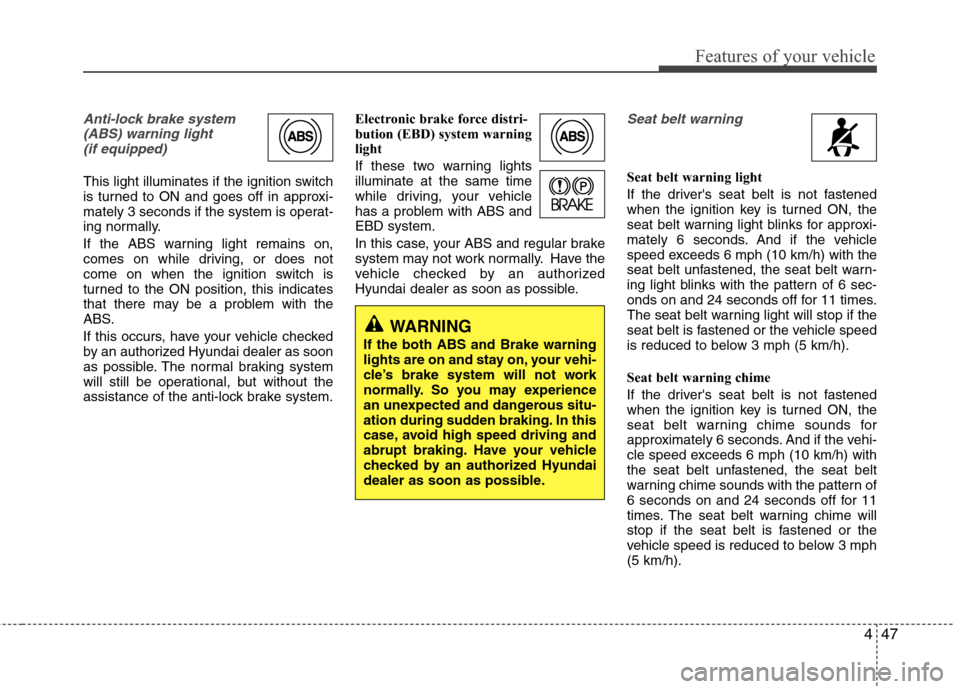
Anti-lock brake system(ABS) warning light (if equipped)
This light illuminates if the ignition switch
is turned to ON and goes off in approxi-
mately 3 seconds if the system is operat-
ing normally.
If the ABS warning light remains on,
comes on while driving, or does not
come on when the ignition switch is
turned to the ON position, this indicates
that there may be a problem with the
ABS.
If this occurs, have your vehicle checked
by an authorized Hyundai dealer as soon
as possible. The normal braking system
will still be operational, but without the
assistance of the anti-lock brake system. Electronic brake force distri-
bution (EBD) system warning
light
If these two warning lights
illuminate at the same time
while driving, your vehicle
has a problem with ABS and
EBD system.
In this case, your ABS and regular brake
system may not work normally. Have the
vehicle checked by an authorized
Hyundai dealer as soon as possible.
Seat belt warning
Seat belt warning light
If the driver's seat belt is not fastened
when the ignition key is turned ON, the
seat belt warning light blinks for approxi-
mately 6 seconds. And if the vehicle
speed exceeds 6 mph (10 km/h) with the
seat belt unfastened, the seat belt warn-
ing light blinks with the pattern of 6 sec-
onds on and 24 seconds off for 11 times.
The seat belt warning light will stop if the
seat belt is fastened or the vehicle speed
is reduced to below 3 mph (5 km/h).
Seat belt warning chime
If the driver's seat belt is not fastened
when the ignition key is turned ON, the
seat belt warning chime sounds for
approximately 6 seconds. And if the vehi-
cle speed exceeds 6 mph (10 km/h) with
the seat belt unfastened, the seat belt
warning chime sounds with the pattern of
6 seconds on and 24 seconds off for 11
times. The seat belt warning chime will
stop if the seat belt is fastened or the
vehicle speed is reduced to below 3 mph
(5 km/h).
WARNING
If the both ABS and Brake warning
lights are on and stay on, your vehi-
cle’s brake system will not work
normally. So you may experience
an unexpected and dangerous situ-
ation during sudden braking. In this
case, avoid high speed driving and
abrupt braking. Have your vehicle
checked by an authorized Hyundai
dealer as soon as possible.
Page 122 of 348
449
Features of your vehicle
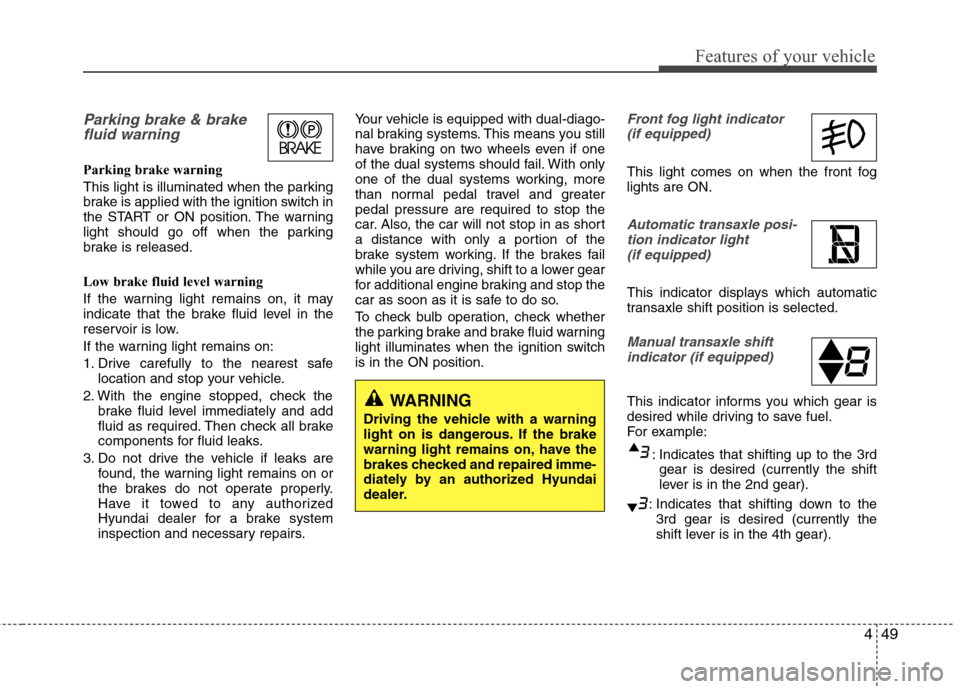
Parking brake & brakefluid warning
Parking brake warning
This light is illuminated when the parking
brake is applied with the ignition switch in
the START or ON position. The warning
light should go off when the parking
brake is released.
Low brake fluid level warning
If the warning light remains on, it may
indicate that the brake fluid level in the
reservoir is low.
If the warning light remains on:
1. Drive carefully to the nearest safe
location and stop your vehicle.
2. With the engine stopped, check the brake fluid level immediately and add
fluid as required. Then check all brake
components for fluid leaks.
3. Do not drive the vehicle if leaks are found, the warning light remains on or
the brakes do not operate properly.
Have it towed to any authorized
Hyundai dealer for a brake system
inspection and necessary repairs. Your vehicle is equipped with dual-diago-
nal braking systems. This means you still
have braking on two wheels even if one
of the dual systems should fail. With only
one of the dual systems working, more
than normal pedal travel and greater
pedal pressure are required to stop the
car. Also, the car will not stop in as short
a distance with only a portion of the
brake system working. If the brakes fail
while you are driving, shift to a lower gear
for additional engine braking and stop the
car as soon as it is safe to do so.
To check bulb operation, check whether
the parking brake and brake fluid warning
light illuminates when the ignition switch
is in the ON position.
Front fog light indicator
(if equipped)
This light comes on when the front fog
lights are ON.
Automatic transaxle posi- tion indicator light (if equipped)
This indicator displays which automatic
transaxle shift position is selected.
Manual transaxle shiftindicator (if equipped)
This indicator informs you which gear is
desired while driving to save fuel.
For example:
: Indicates that shifting up to the 3rdgear is desired (currently the shift
lever is in the 2nd gear).
: Indicates that shifting down to the 3rd gear is desired (currently the
shift lever is in the 4th gear).
WARNING
Driving the vehicle with a warning
light on is dangerous. If the brake
warning light remains on, have the
brakes checked and repaired imme-
diately by an authorized Hyundai
dealer.