drive Hyundai Elantra 2011 Owner's Guide
[x] Cancel search | Manufacturer: HYUNDAI, Model Year: 2011, Model line: Elantra, Model: Hyundai Elantra 2011Pages: 382, PDF Size: 9.25 MB
Page 53 of 382
335
Safety features of your vehicle
How does the air bag system
operate
Air bags are activated (able to inflate if
necessary) only when the ignition
switch is turned to the ON or START
position.
Air bags inflate instantly in the event of
serious frontal or side collision in order
to help protect the occupants from seri-
ous physical injury.
There is no single speed at which the
air bags will inflate.
Generally, air bags are designed to
inflate by the severity of a collision and
its direction. These two factors deter-
mine whether the sensors send out an
electronic deployment/ inflation signal.
Air bag deployment depends on a
number of factors including vehicle
speed, angles of impact and the densi-
ty and stiffness of the vehicles or
objects which your vehicle hits in the
collision. Though, factors are not limit-
ed to those mentioned above.
The front air bags will completely
inflate and deflate in an instant.
It is virtually impossible for you to see
the air bags inflate during an accident.It is much more likely that you will sim-
ply see the deflated air bags hanging
out of their storage compartments after
the collision.
In order to help provide protection in a
severe collision, the air bags must
inflate rapidly. The speed of air bag
inflation is a consequence of the
extremely short time in which a collision
occurs and the need to get the air bag
between the occupant and the vehicle
structures before the occupant impacts
those structures. This speed of inflation
reduces the risk of serious or life-
threatening injuries in a severe collision
and is thus a necessary part of air bag
design.
However, air bag inflation can also
cause injuries which normally can
include facial abrasions, bruises and
broken bones because the inflation
speed also causes the air bags to
expand with a great deal of force.
There are even circumstances
under which contact with the air bag
can cause fatal injuries, especially if
the occupant is positioned exces-
sively close to the air bag.
WARNING
To avoid severe personal injury
or death caused by deploying air
bags in a collision, the driver
should sit as far back from the
steering wheel air bag as possi-
ble (at least 10 inches (250 mm)
away). The front passengers
should always move their seats
as far back as possible and sit
back in their seat.
Air bags inflate instantly in the
event of collision, and passen-
gers may be injured by the air bag
expansion force if they are not in
proper position.
Air bag inflation may cause
injuries which normally include
facial or bodily abrasions,
injuries from broken glasses or
burns by the air bag inflation
gasses.
Page 55 of 382
337
Safety features of your vehicle
C041000AUN
Air bag warning light
The purpose of air bag warning light in
your instrument panel is to alert you of a
potential problem with your air bag -
Supplemental Restraint System (SRS).When the ignition switch is turned ON,
the indicator light should illuminate for
approximately 6 seconds, then go off.
Have the system checked if:
The light does not turn on briefly when
you turn the ignition ON.
The light stays on after illuminating for
approximately 6 seconds.
The light comes on while the vehicle is
in motion.
The light blinks when the ignition
switch is in ON position.
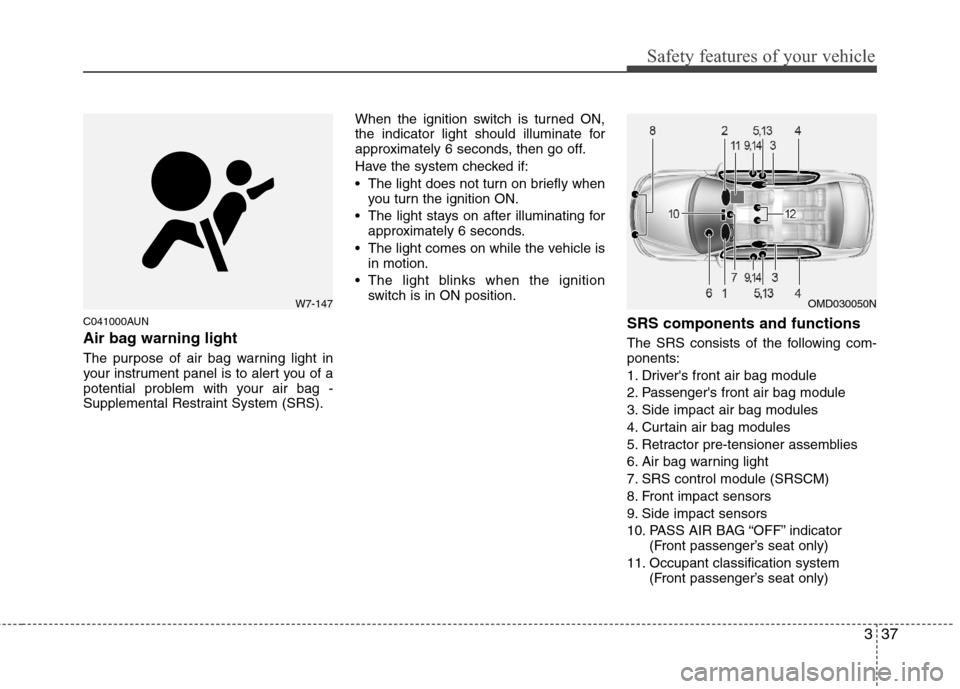
SRS components and functions
The SRS consists of the following com-
ponents:
1. Driver's front air bag module
2. Passenger's front air bag module
3. Side impact air bag modules
4. Curtain air bag modules
5. Retractor pre-tensioner assemblies
6. Air bag warning light
7. SRS control module (SRSCM)
8. Front impact sensors
9. Side impact sensors
10. PASS AIR BAG “OFF” indicator
(Front passenger’s seat only)
11. Occupant classification system
(Front passenger’s seat only)
W7-147OMD030050N
Page 56 of 382
Safety features of your vehicle
38 3
12. Driver’s and front passenger’s seat
belt buckle sensors
13. Anchor pre-tensioner
14. Side pressure sensor
The SRSCM continually monitors all
SRS components while the ignition
switch is ON to determine if a crash
impact is severe enough to require air
bag deployment or pre-tensioner seat
belt deployment.
The SRS air bag warning light " " on the
instrument panel will illuminate for about 6
seconds after the ignition switch is turned
to the ON position, after which the SRS air
bag warning light " " should go out.
W7-147
WARNING
If any of the following conditions
occurs, this indicates a malfunction
of the SRS. Have an authorized
HYUNDAI dealer inspect the air bag
system as soon as possible.
The light does not turn on briefly
when you turn the ignition ON.
The light stays on after illuminat-
ing for approximately 6 seconds.
The light comes on while the
vehicle is in motion.
The light blinks when the ignition
switch is in ON position.
Page 57 of 382
339
Safety features of your vehicle
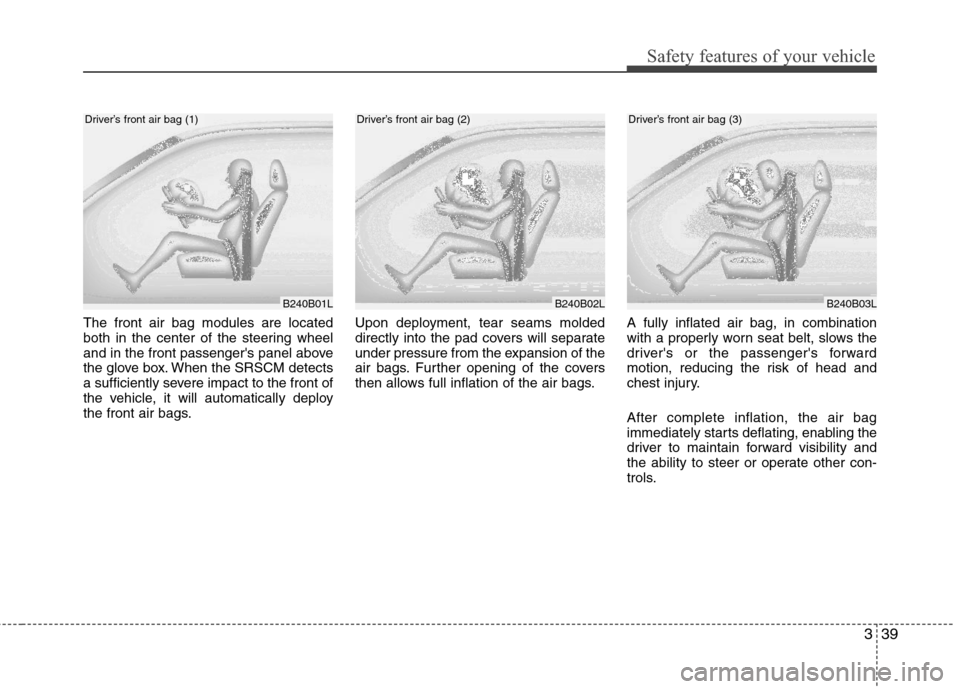
The front air bag modules are located
both in the center of the steering wheel
and in the front passenger's panel above
the glove box. When the SRSCM detects
a sufficiently severe impact to the front of
the vehicle, it will automatically deploy
the front air bags.Upon deployment, tear seams molded
directly into the pad covers will separate
under pressure from the expansion of the
air bags. Further opening of the covers
then allows full inflation of the air bags.A fully inflated air bag, in combination
with a properly worn seat belt, slows the
driver's or the passenger's forward
motion, reducing the risk of head and
chest injury.
After complete inflation, the air bag
immediately starts deflating, enabling the
driver to maintain forward visibility and
the ability to steer or operate other con-
trols.
B240B01L
Driver’s front air bag (1)
B240B02LB240B03L
Driver’s front air bag (2)Driver’s front air bag (3)
Page 59 of 382
341
Safety features of your vehicle
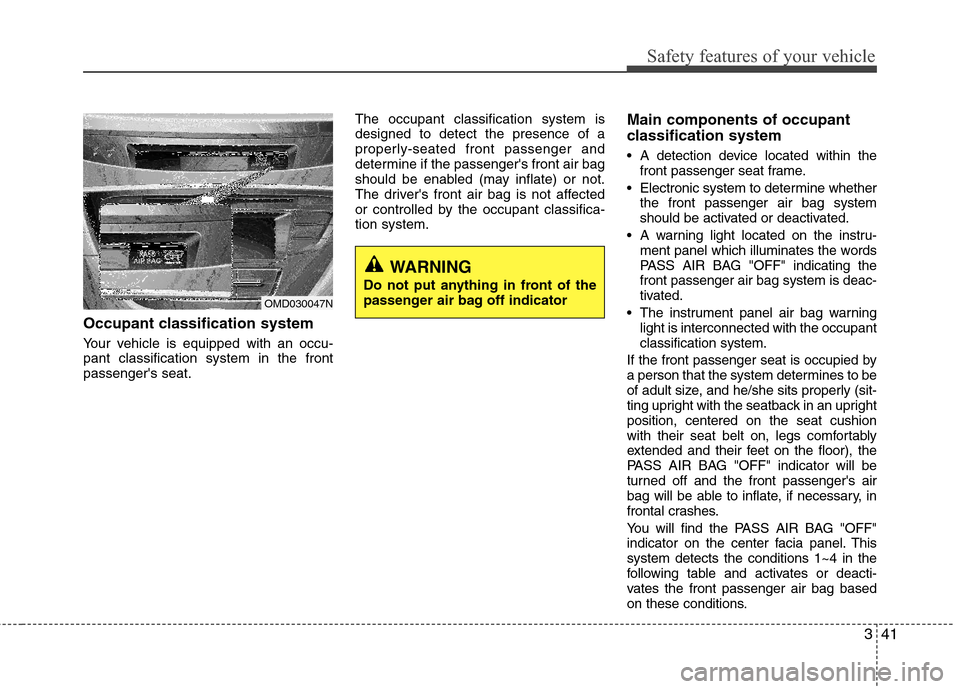
Occupant classification system
Your vehicle is equipped with an occu-
pant classification system in the front
passenger's seat.The occupant classification system is
designed to detect the presence of a
properly-seated front passenger and
determine if the passenger's front air bag
should be enabled (may inflate) or not.
The driver's front air bag is not affected
or controlled by the occupant classifica-
tion system.
Main components of occupant
classification system
A detection device located within the
front passenger seat frame.
Electronic system to determine whether
the front passenger air bag system
should be activated or deactivated.
A warning light located on the instru-
ment panel which illuminates the words
PASS AIR BAG "OFF" indicating the
front passenger air bag system is deac-
tivated.
The instrument panel air bag warning
light is interconnected with the occupant
classification system.
If the front passenger seat is occupied by
a person that the system determines to be
of adult size, and he/she sits properly (sit-
ting upright with the seatback in an upright
position, centered on the seat cushion
with their seat belt on, legs comfortably
extended and their feet on the floor), the
PASS AIR BAG "OFF" indicator will be
turned off and the front passenger's air
bag will be able to inflate, if necessary, in
frontal crashes.
You will find the PASS AIR BAG "OFF"
indicator on the center facia panel. This
system detects the conditions 1~4 in the
following table and activates or deacti-
vates the front passenger air bag based
on these conditions.
OMD030047N
WARNING
Do not put anything in front of the
passenger air bag off indicator
Page 64 of 382
Safety features of your vehicle
46 3
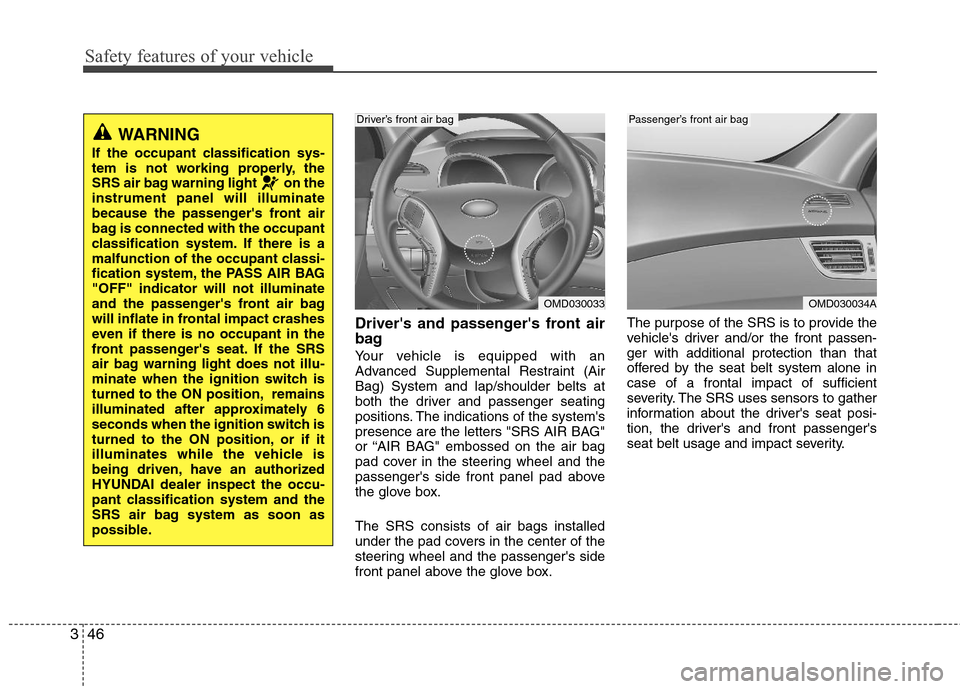
Driver's and passenger's front air
bag
Your vehicle is equipped with an
Advanced Supplemental Restraint (Air
Bag) System and lap/shoulder belts at
both the driver and passenger seating
positions. The indications of the system's
presence are the letters "SRS AIR BAG"
or “AIR BAG" embossed on the air bag
pad cover in the steering wheel and the
passenger's side front panel pad above
the glove box.
The SRS consists of air bags installed
under the pad covers in the center of the
steering wheel and the passenger's side
front panel above the glove box.The purpose of the SRS is to provide the
vehicle's driver and/or the front passen-
ger with additional protection than that
offered by the seat belt system alone in
case of a frontal impact of sufficient
severity. The SRS uses sensors to gather
information about the driver's seat posi-
tion, the driver's and front passenger's
seat belt usage and impact severity.
OMD030033
Driver’s front air bag
WARNING
If the occupant classification sys-
tem is not working properly, the
SRS air bag warning light on the
instrument panel will illuminate
because the passenger's front air
bag is connected with the occupant
classification system. If there is a
malfunction of the occupant classi-
fication system, the PASS AIR BAG
"OFF" indicator will not illuminate
and the passenger's front air bag
will inflate in frontal impact crashes
even if there is no occupant in the
front passenger's seat. If the SRS
air bag warning light does not illu-
minate when the ignition switch is
turned to the ON position, remains
illuminated after approximately 6
seconds when the ignition switch is
turned to the ON position, or if it
illuminates while the vehicle is
being driven, have an authorized
HYUNDAI dealer inspect the occu-
pant classification system and the
SRS air bag system as soon as
possible.
OMD030034A
Passenger’s front air bag
Page 65 of 382
347
Safety features of your vehicle
The seat belt buckle sensors determine if
the driver and front passenger's seat
belts are fastened. These sensors pro-
vide the ability to control the SRS deploy-
ment based on whether or not the seat
belts are fastened, and how severe the
impact is.
The advanced SRS offers the ability to
control the air bag inflation within two lev-
els. A first stage level is provided for mod-
erate-severity impacts. A second stage
level is provided for more severe impacts.
According to the impact severity and seat
belt usage, the SRSCM (SRS Control
Module) controls the air bag inflation.
Failure to properly wear seat belts can
increase the risk or severity of injury in
an accident.Additionally, your vehicle is equipped
with an occupant classification system in
the front passenger's seat. The occupant
classification system detects the pres-
ence of a passenger in the front passen-
ger's seat and will turn off the front pas-
senger's air bag under certain condi-
tions. For more detail, see "Occupant
classification system" in this section.
WARNING
If the occupant classification sys-
tem is not working properly, the
SRS air bag warning light on the
instrument panel will illuminate
because the SRS air bag warning
light is connected with the occu-
pant classification system. If the
SRS air bag warning light does not
illuminate when the ignition switch
is turned to the ON position,
remains illuminated after approxi-
mately 6 seconds when the ignition
switch is turned to the ON position,
or if it illuminates while the vehicle
is being driven, have an authorized
HYUNDAI dealer inspect the
advanced SRS air bag system as
soon as possible.
WARNING
Do not place any objects under-
neath the front seats as they could
interfere with the occupant classifi-
cation system.
Page 66 of 382
Safety features of your vehicle
48 3
✽
✽
NOTICE
• Be sure to read information about the
SRS on the labels provided on the sun
visor.
• Advanced air bags are combined with
pre-tensioner seat belts to help pro-
vide enhanced occupant protection in
frontal crashes. Front air bags are not
intended to deploy in collisions in
which protection can be provided by
the pre-tensioner seat belt.
(Continued)
Move your seat as far back as
practical from the front air bags,
while still maintaining control of
the vehicle.
You and your passengers should
never sit or lean unnecessarily
close to the air bags. Improperly
positioned driver and passengers
can be severely injured by inflat-
ing air bags.
Never lean against the door or
center console – always sit in an
upright position.
Do not allow a passenger to ride
in the front seat when the PASS
AIR BAG "OFF" indicator is illu-
minated, because the air bag will
not deploy in the event of a mod-
erate or severe frontal crash.
(Continued)WARNING
Always use seat belts and child
restraints – every trip, every time,
everyone! Air bags inflate with con-
siderable force and in the blink of
an eye. Seat belts help keep occu-
pants in proper position to obtain
maximum benefit from the air bag.
Even with advanced air bags,
improperly and unbelted occupants
can be severely injured when the
air bag inflates. Always follow the
precautions about seat belts, air
bags and occupant safety con-
tained in this manual.
To reduce the chance of serious or
fatal injuries and receive the maxi-
mum safety benefit from your
restraint system:
Never place a child in any child or
booster seat in the front seat.
ABC – Always Buckle Children in
the back seat. It is the safest
place for children of any age to
ride.
Front and side air bags can injure
occupants improperly positioned
in the front seats.
(Continued)
WARNING
If you are considering modification
of your vehicle due to a disability,
please contact the Hyundai
Customer Assistance Center at 1-
800-633-5151.
Page 67 of 382
349
Safety features of your vehicle
(Continued)
Even though your vehicle is
equipped with the occupant clas-
sification system, do not install a
child restraint system in the front
passenger seat position. A child
restraint system must never be
placed in the front seat. The infant
or child could be severely injured
or killed by an air bag deployment
in case of an accident.
Children age 12 and under must
always be properly restrained in
the rear seat. Never allow chil-
dren to ride in the front passen-
ger seat. If a child over 12 must
be seated in the front seat, he or
she must be properly belted and
the seat should be moved as far
back as possible.
For maximum safety protection in
all types of crashes, all occu-
pants including the driver should
always wear their seat belts
whether or not an air bag is also
provided at their seating position
to minimize the risk of severe
injury or death in the event of a
crash. Do not sit or lean unneces-
sarily close to the air bag while
the vehicle is in motion.
(Continued)(Continued)
No objects should be placed over
or near the air bag modules on
the steering wheel, instrument
panel, and the front passenger's
panel above the glove box,
because any such object could
cause harm if the vehicle is in a
crash severe enough to cause
the air bags to deploy.
Never place covers, blankets or
seat warmers on the passenger
seat as these may interfere with
the occupant classification sys-
tem.
Do not tamper with or disconnect
SRS wiring or other components
of the SRS system. Doing so
could result in injury, due to acci-
dental deployment of the air bags
or by rendering the SRS inopera-
tive.
If the SRS air bag warning light
remains illuminated while the
vehicle is being driven, have an
authorized HYUNDAI dealer
inspect the air bag system as
soon as possible.
(Continued)(Continued)
Air bags can only be used once –
have an authorized HYUNDAI
dealer replace the air bag imme-
diately after deployment.
The SRS is designed to deploy
the front air bags only when an
impact is sufficiently severe and
when the impact angle is less
than 30° from the forward longitu-
dinal axis of the vehicle.
Additionally, the air bags will only
deploy once. Seat belts must be
worn at all times.
Front air bags are not intended to
deploy in side-impact, rear-
impact or rollover crashes. In
addition, front air bags will not
deploy in frontal crashes below
the deployment threshold.
(Continued)
Page 68 of 382
Safety features of your vehicle
50 3
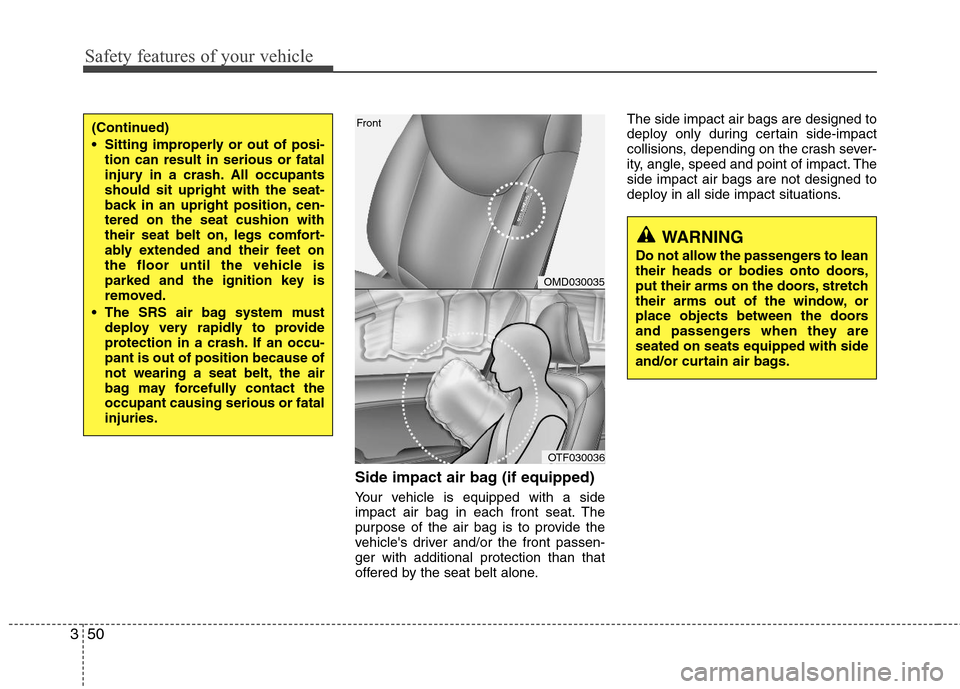
Side impact air bag (if equipped)
Your vehicle is equipped with a side
impact air bag in each front seat. The
purpose of the air bag is to provide the
vehicle's driver and/or the front passen-
ger with additional protection than that
offered by the seat belt alone.The side impact air bags are designed to
deploy only during certain side-impact
collisions, depending on the crash sever-
ity, angle, speed and point of impact. The
side impact air bags are not designed to
deploy in all side impact situations.
(Continued)
Sitting improperly or out of posi-
tion can result in serious or fatal
injury in a crash. All occupants
should sit upright with the seat-
back in an upright position, cen-
tered on the seat cushion with
their seat belt on, legs comfort-
ably extended and their feet on
the floor until the vehicle is
parked and the ignition key is
removed.
The SRS air bag system must
deploy very rapidly to provide
protection in a crash. If an occu-
pant is out of position because of
not wearing a seat belt, the air
bag may forcefully contact the
occupant causing serious or fatal
injuries.
OMD030035
OTF030036
Front
WARNING
Do not allow the passengers to lean
their heads or bodies onto doors,
put their arms on the doors, stretch
their arms out of the window, or
place objects between the doors
and passengers when they are
seated on seats equipped with side
and/or curtain air bags.