ECO mode Hyundai Elantra 2012 - RHD (UK. Australia) Owner's Guide
[x] Cancel search | Manufacturer: HYUNDAI, Model Year: 2012, Model line: Elantra, Model: Hyundai Elantra 2012Pages: 384, PDF Size: 26.92 MB
Page 227 of 384
Driving your vehicle
18
5
R (Reverse)
Use this position to drive the vehicle
backward.
N (Neutral)
The wheels and transaxle are not locked.
The vehicle will roll freely even on the
slightest incline unless the parking brake
or service brakes are applied. D (Drive)
This is the normal forward driving posi-
tion. The transaxle will automatically shift
through a 6-gear sequence, providing the
best fuel economy and power.
For extra power when passing another
vehicle or climbing grades, depress the
accelerator fully, at which time the
transaxle will automatically downshift to
the next lower gear.
✽✽
NOTICE
Always ensure vehicle is stationary, at a
complete stop, before selecting D
(Drive).
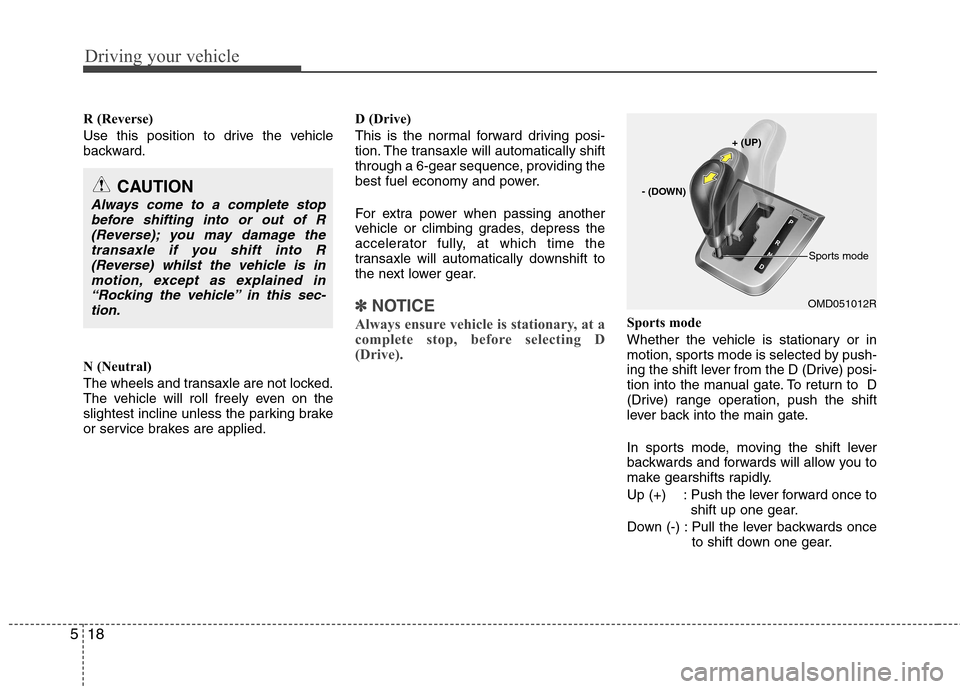
Sports mode
Whether the vehicle is stationary or in
motion, sports mode is selected by push-
ing the shift lever from the D (Drive) posi-
tion into the manual gate. To return to D
(Drive) range operation, push the shift
lever back into the main gate.
In sports mode, moving the shift lever
backwards and forwards will allow you to
make gearshifts rapidly.
Up (+) : Push the lever forward once to shift up one gear.
Down (-) : Pull the lever backwards once to shift down one gear.
CAUTION
Always come to a complete stop
before shifting into or out of R(Reverse); you may damage the
transaxle if you shift into R(Reverse) whilst the vehicle is inmotion, except as explained in “Rocking the vehicle” in this sec-
tion.
OMD051012R
+ (UP)
- (DOWN)
Sports mode
Page 249 of 384
Driving your vehicle
40
5
Your vehicle's fuel economy depends
mainly on your style of driving, where you
drive and when you drive.
Each of these factors affects how many
kilometers (miles) you can get from a
litre (gallon) of fuel. To operate your vehi-
cle as economically as possible, use the
following driving suggestions to help
save money in both fuel and repairs:
Drive smoothly. Accelerate at a moder-
ate rate. Don't make "kangaroo" starts or full-throttle shifts and maintain a
steady cruising speed. Don't race
between stoplights. Try to adjust your
speed to the traffic so you don't have to
change speeds unnecessarily. Avoid
heavy traffic whenever possible.
Always maintain a safe distance from
other vehicles so you can avoid unnec-
essary braking. This also reduces
brake wear.
Drive at a moderate speed. The faster you drive, the more fuel your vehicle
uses. Driving at a moderate speed,
especially on the highway, is one of the
most effective ways to reduce fuel con-sumption. Don't "ride" the brake or clutch pedal.
This can increase fuel consumption
and also increase wear on these com-
ponents. In addition, driving with your
foot resting on the brake pedal may
cause the brakes to overheat, which
reduces their effectiveness and may
lead to more serious consequences.
Take care of your tyres. Keep them inflated to the recommended pressure.
Incorrect inflation, either too much or
too little, results in unnecessary tyre
wear. Check the tyre pressures at leastonce a month.
Be sure that the wheels are aligned correctly. Improper alignment can
result from hitting kerbs or driving too
fast over irregular surfaces. Poor align-
ment causes faster tyre wear and may
also result in other problems as well as
greater fuel consumption. Keep your vehicle in good condition.
For better fuel economy and reduced
maintenance costs, maintain your vehi-cle in accordance with the mainte-
nance schedule in section 7. If you
drive your vehicle in severe conditions,more frequent maintenance is required
(see section 7 for details).
Keep your vehicle clean. For maximum service, your vehicle should be kept
clean and free of corrosive materials. It
is especially important that mud, dirt,
ice, etc. not be allowed to accumulate
on the underside of the vehicle. This
extra weight can result in increased
fuel consumption and also contributeto corrosion.
Travel lightly. Don't carry unnecessary weight in your vehicle. Weight reduces
fuel economy.
Don't let the engine idle longer than necessary. If you are waiting (and not
in traffic), turn off your engine and
restart only when you're ready to go.
ECONOMICAL OPERATION
Page 265 of 384

Driving your vehicle
56
5
If you do decide to pull a trailer
Here are some important points if you
decide to pull a trailer:
Do not do any towing with your car dur-
ing its first 2,000 km (1,200 miles) in
order to allow the engine to properly
run in. Failure to heed this caution may
result in serious engine or transaxle
damage.
When towing a trailer, be sure to con- sult an authorised HYUNDAI dealer for
further information on additional
requirements such as a towing kit, etc.
Always drive your vehicle at a moder- ate speed (less than 100 km/h / 60mph).
On a long uphill grade, do not exceed 70 km/h (45 mph) or the posted towing
speed limit, whichever is lower.
The chart contains important consider- ations that have to do with weight: M/T : Manual transaxle
A/T : Automatic transaxleEngine
Item 1.8 Engine
M/T A/T
Maximum trailer weight kg (Ibs.)
Without brake System 500
(1102)500
(1102)
With brake System 1300
(2866)
1300
(2866)
Maximum permissible static
vertical load on the coupling device kg (Ibs.)75 (165)
Recommended distance from rear wheel centre to coupling point mm (inch)1070 (42.1)
WARNING
HYUNDAI DO NOT recommend the use of load levelling devices of anytype.
The use of a load levelling devices may place undue stress on the chassis
causing chassis or mounting point failure.
Page 383 of 384

Index
8
I
Seatback pocket ..........................................................3-10
Headrest ..............................................................3-8, 3-10
Rear seat ....................................................................3-10
Seat warmer ........................................................3-9, 3-12
Armrest ......................................................................3-13
Shift lock system ..............................................................5-19
Side impact air bag ..........................................................3-47
Smart key ..........................................................................4-5
Smooth cornering ............................................................5-43
Snow tyres ........................................................................5-46
Special driving conditions................................................5-42 Driving at night ..........................................................5-43
Driving in flooded areas ............................................5-44
Driving in the rain ......................................................5-44
Hazardous driving conditions ....................................5-42
Highway driving ........................................................5-45
Rocking the vehicle ....................................................5-42
Smooth cornering ......................................................5-43
Speedometer ....................................................................4-43
Sports mode ....................................................................5-18
Starting difficulties, see engine will not start ....................6-4
Starting the engine ....................................................5-6, 5-11
Steering wheel ..................................................................4-36 Horn ............................................................................4-38
Power steering ............................................................4-36
Tilt steering ................................................................4-37
Storage compartment ....................................................4-102 Centre console storage ............................................4-102 Glove box ................................................................4-103
Sunglass holder ........................................................4-103
Sunglass holder ..............................................................4-103
Sunroof ............................................................................4-32
Sunvisor..........................................................................4-107
Tachometer ......................................................................4-43
Theft-alarm system ..........................................................4-13
Tilt steering ......................................................................4-37
Towing..............................................................................6-16 Emergency towing ......................................................6-18
Trailer towing ............................................................5-50
Transaxle Automatic transaxle....................................................5-16
Manual transaxle ........................................................5-13
Trip computer ..................................................................4-46
Tyre pressure ....................................................................7-38
Tyre specification and pressure label ................................8-7
Tyres and wheels ..............................................................7-37 Recommended cold tyre inflation pressures ..............7-37
Checking tyre inflation pressure ................................7-38
Wheel alignment and tyre balance ............................7-40
Compact spare tyre replacement ................................7-42
Wheel replacement ....................................................7-42
Tyres and wheels ................................................................8-3
T