check oil Hyundai Elantra 2012 - RHD (UK. Australia) Owner's Guide
[x] Cancel search | Manufacturer: HYUNDAI, Model Year: 2012, Model line: Elantra, Model: Hyundai Elantra 2012Pages: 384, PDF Size: 26.92 MB
Page 310 of 384
723
Maintenance
Changing the engine oil and filter
Have the engine oil and filter changed by
an authorised HYUNDAI dealer accord-ing to the Maintenance Schedule at thebeginning of this section.The high-pressure cooling system has a
reservoir filled with year-round antifreeze
coolant. The reservoir is filled at the fac-
tory.
Check the antifreeze protection and
coolant level at least once a year, at thebeginning of the winter season, and
before travelling to a colder climate.
WARNING
Used engine oil may cause skin irri- tation or cancer if left in contact
with the skin for prolonged periods
of time. Used engine oil contains
chemicals that have caused cancer
in laboratory animals. Always pro-
tect your skin by washing your
hands thoroughly with soap and
warm water as soon as possibleafter handling used oil.
ENGINE COOLANT
Page 313 of 384
Maintenance
26
7
BRAKE/CLUTCH FLUID (IF EQUIPPED)
Checking the brake/clutch fluid
level
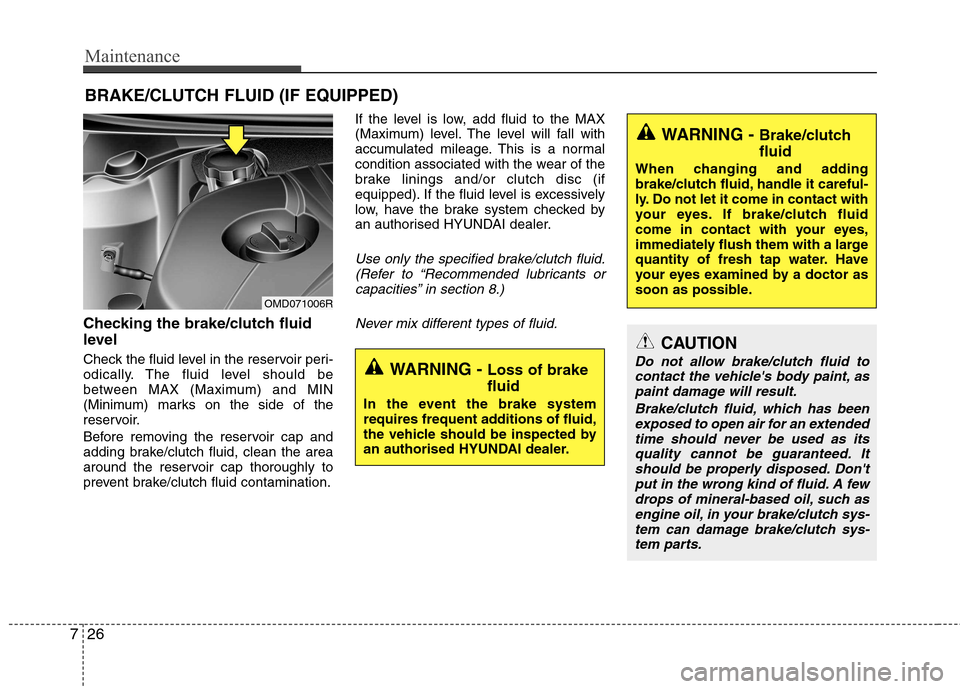
Check the fluid level in the reservoir peri-
odically. The fluid level should be
between MAX (Maximum) and MIN
(Minimum) marks on the side of the
reservoir.
Before removing the reservoir cap and
adding brake/clutch fluid, clean the area
around the reservoir cap thoroughly to
prevent brake/clutch fluid contamination. If the level is low, add fluid to the MAX
(Maximum) level. The level will fall with
accumulated mileage. This is a normal
condition associated with the wear of the
brake linings and/or clutch disc (if
equipped). If the fluid level is excessively
low, have the brake system checked by
an authorised HYUNDAI dealer.
Use only the specified brake/clutch fluid.
(Refer to “Recommended lubricants or
capacities” in section 8.)
Never mix different types of fluid.
WARNING - Loss of brake fluid
In the event the brake system
requires frequent additions of fluid,
the vehicle should be inspected by
an authorised HYUNDAI dealer.
WARNING - Brake/clutch fluid
When changing and adding
brake/clutch fluid, handle it careful-
ly. Do not let it come in contact with
your eyes. If brake/clutch fluid
come in contact with your eyes,
immediately flush them with a large
quantity of fresh tap water. Have
your eyes examined by a doctor as
soon as possible.
CAUTION
Do not allow brake/clutch fluid to contact the vehicle's body paint, as
paint damage will result.
Brake/clutch fluid, which has beenexposed to open air for an extendedtime should never be used as its quality cannot be guaranteed. It
should be properly disposed. Don'tput in the wrong kind of fluid. A few drops of mineral-based oil, such asengine oil, in your brake/clutch sys-
tem can damage brake/clutch sys-tem parts.
OMD071006R
Page 322 of 384
735
Maintenance
Battery recharging
Your vehicle has a maintenance-free,
calcium-based battery.
If the battery becomes discharged in ashort time (because, for example, the
headlights or interior lights were left on
whilst the vehicle was not in use),
recharge it by slow charging (trickle)
for 10 hours.
If the battery gradually discharges because of high electric load whilst the
vehicle is being used, recharge it at 20-
30A for two hours.(Continued)
When lifting a plastic-cased bat-tery, excessive pressure on the
case may cause battery acid to
leak, resulting in personal injury.
Lift with a battery carrier or with
your hands on opposite corners.
Never attempt to recharge the battery when the battery cablesare connected.
The electrical ignition system works with high voltage. Never
touch these components with theengine running or the ignition
switched on.
Failure to follow the above warn-
ings can result in serious bodily
injury or death.WARNING - Recharging
battery
When recharging the battery,
observe the following precautions:
The battery must be removed from the vehicle and placed in an area with good ventilation.
Do not allow cigarettes, sparks, or flame near the battery.
Watch the battery during charg- ing, and stop or reduce the charg-
ing rate if the battery cells begin
gassing (boiling) violently or if
the temperature of the electrolyte
of any cell exceeds 49°C (120°F).
Wear eye protection when check- ing the battery during charging.
Disconnect the battery charger in the following order.
1. Turn off the battery charger main switch.
2. Unhook the negative clamp from the negative battery terminal.
3. Unhook the positive clamp from the positive battery terminal.
CAUTION
If you connect unauthorised elec-
tronic devices to the battery, thebattery may be discharged. Never use unauthorised devices.
Page 334 of 384
747
Maintenance
FUSESA vehicle’s electrical system is protected
from electrical overload damage by
fuses.
This vehicle has 2 fuse panels, one locat-
ed in the driver’s side panel bolster, the
other in the engine compartment near
the battery.
If any of your vehicle’s lights, acces-
sories, or controls do not work, check the
appropriate circuit fuse. If a fuse has
blown, the element inside the fuse will bemelted.
If the electrical system does not work,
first check the driver’s side fuse panel.
Always replace a blown fuse with one of
the same rating.
If the replacement fuse blows, this indi-
cates an electrical problem. Avoid using
the system involved and immediately
consult an authorised HYUNDAI dealer.
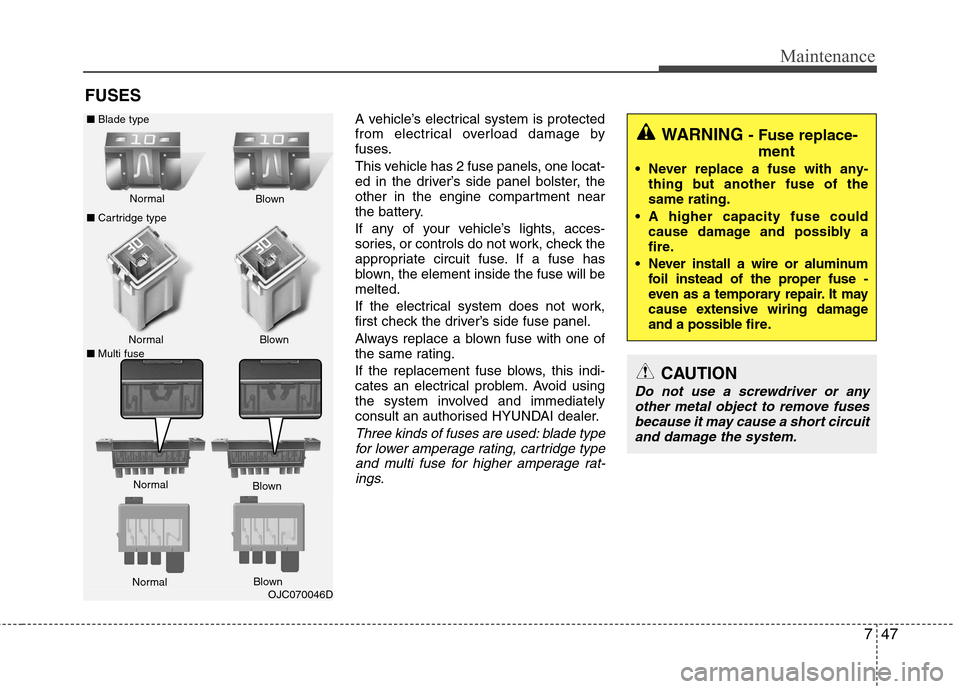
Three kinds of fuses are used: blade typefor lower amperage rating, cartridge type
and multi fuse for higher amperage rat-ings.
WARNING - Fuse replace-
ment
Never replace a fuse with any- thing but another fuse of the same rating.
A higher capacity fuse could cause damage and possibly a
fire.
Never install a wire or aluminum foil instead of the proper fuse -
even as a temporary repair. It may
cause extensive wiring damage
and a possible fire.
CAUTION
Do not use a screwdriver or any
other metal object to remove fusesbecause it may cause a short circuit
and damage the system.
OJC070046D
Normal
Normal
■ Cartridge type
■ Multi fuse Blown
Blown
Normal Blown
■
Blade type
Normal Blown
Page 342 of 384
755
Maintenance
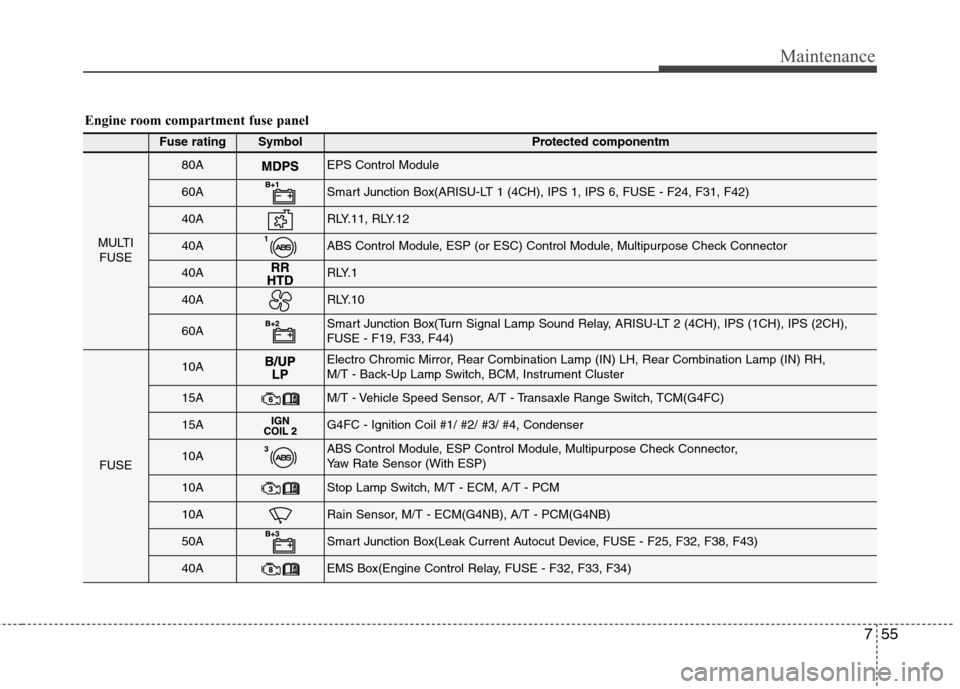
Engine room compartment fuse panel
Fuse ratingSymbol Protected componentm
MULTIFUSE
80AEPS Control Module
60ASmart Junction Box(ARISU-LT 1 (4CH), IPS 1, IPS 6, FUSE - F24, F31, F42)
40ARLY.11, RLY.12
40AABS Control Module, ESP (or ESC) Control Module, Multipurpose Check Connector
40AR LY. 1
40ARLY.10
60ASmart Junction Box(Turn Signal Lamp Sound Relay, ARISU-LT 2 (4CH), IPS (1CH), IPS (2CH), FUSE - F19, F33, F44)
FUSE
10AElectro Chromic Mirror, Rear Combination Lamp (IN) LH, Rear Combination Lamp (IN) RH,
M/T - Back-Up Lamp Switch, BCM, Instrument Cluster
15AM/T - Vehicle Speed Sensor, A/T - Transaxle Range Switch, TCM(G4FC)
15AG4FC - Ignition Coil #1/ #2/ #3/ #4, Condenser
10AABS Control Module, ESP Control Module, Multipurpose Check Connector,
Yaw Rate Sensor (With ESP)
10AStop Lamp Switch, M/T - ECM, A/T - PCM
10ARain Sensor, M/T - ECM(G4NB), A/T - PCM(G4NB)
50ASmart Junction Box(Leak Current Autocut Device, FUSE - F25, F32, F38, F43)
40AEMS Box(Engine Control Relay, FUSE - F32, F33, F34)
Page 343 of 384
Maintenance
56
7
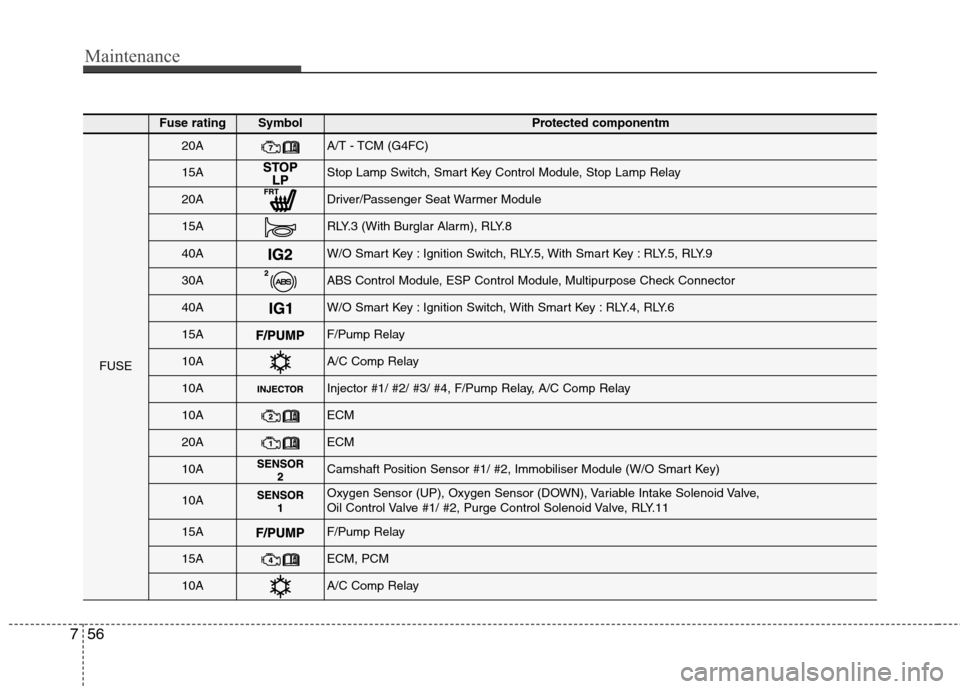
Fuse ratingSymbol Protected componentm
FUSE
20AA/T - TCM (G4FC)
15AStop Lamp Switch, Smart Key Control Module, Stop Lamp Relay
20ADriver/Passenger Seat Warmer Module
15ARLY.3 (With Burglar Alarm), RLY.8
40AW/O Smart Key : Ignition Switch, RLY.5, With Smart Key : RLY.5, RLY.9
30AABS Control Module, ESP Control Module, Multipurpose Check Connector
40AW/O Smart Key : Ignition Switch, With Smart Key : RLY.4, RLY.6
15AF/Pump Relay
10AA/C Comp Relay
10AInjector #1/ #2/ #3/ #4, F/Pump Relay, A/C Comp Relay
10AECM
20AECM
10ACamshaft Position Sensor #1/ #2, Immobiliser Module (W/O Smart Key)
10AOxygen Sensor (UP), Oxygen Sensor (DOWN), Variable Intake Solenoid Valve,
Oil Control Valve #1/ #2, Purge Control Solenoid Valve, RLY.11
15AF/Pump Relay
15AECM, PCM
10AA/C Comp Relay
Page 373 of 384
85
Specifications & Consumer information
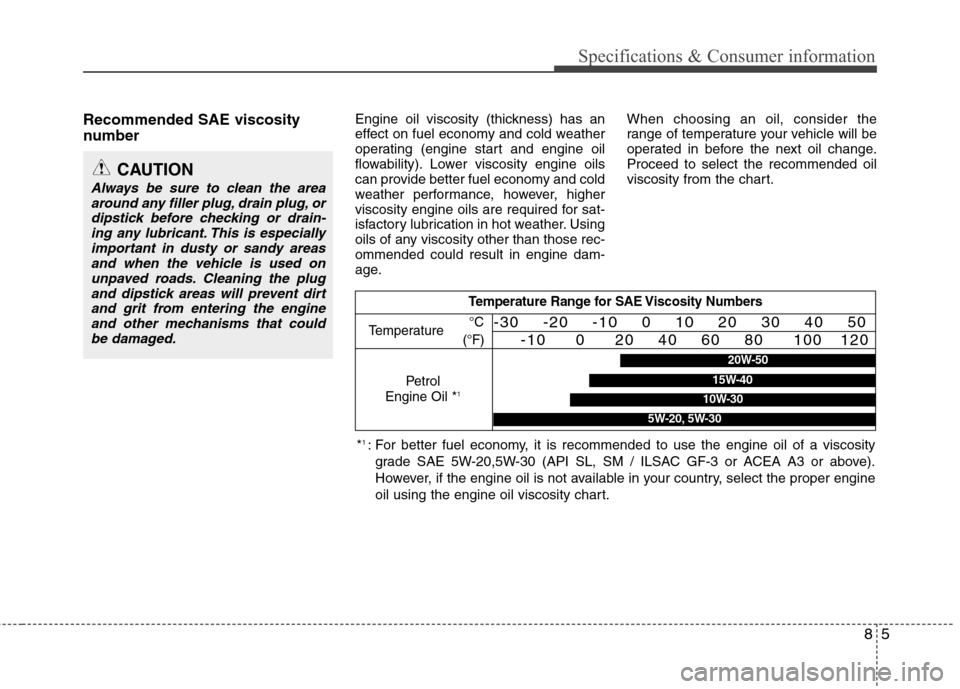
Recommended SAE viscosity
number Engine oil viscosity (thickness) has an
effect on fuel economy and cold weather
operating (engine start and engine oil
flowability). Lower viscosity engine oils
can provide better fuel economy and cold
weather performance, however, higher
viscosity engine oils are required for sat-
isfactory lubrication in hot weather. Using
oils of any viscosity other than those rec-ommended could result in engine dam-
age.When choosing an oil, consider the
range of temperature your vehicle will be
operated in before the next oil change.Proceed to select the recommended oil
viscosity from the chart.
CAUTION
Always be sure to clean the area
around any filler plug, drain plug, ordipstick before checking or drain-ing any lubricant. This is especially
important in dusty or sandy areasand when the vehicle is used on unpaved roads. Cleaning the plugand dipstick areas will prevent dirt
and grit from entering the engine and other mechanisms that couldbe damaged.
Temperature Range for SAE Viscosity Numbers
Temperature °C
(°F)-30 -20 -10 0 10 20 30 40 50 -10 0 20 40 60 80 100 120
Petrol
Engine Oil * 1
20W-50
10W-30
15W-40
5W-20, 5W-30
*1
: For better fuel economy, it is recommended to use the engine oil of a viscosity
grade SAE 5W-20,5W-30 (API SL, SM / ILSAC GF-3 or ACEA A3 or above).
However, if the engine oil is not available in your country, select the proper engine
oil using the engine oil viscosity chart.