kPa Hyundai Elantra 2012 Owner's Manual - RHD (UK. Australia)
[x] Cancel search | Manufacturer: HYUNDAI, Model Year: 2012, Model line: Elantra, Model: Hyundai Elantra 2012Pages: 384, PDF Size: 26.92 MB
Page 281 of 384
What to do in an emergency
14
6
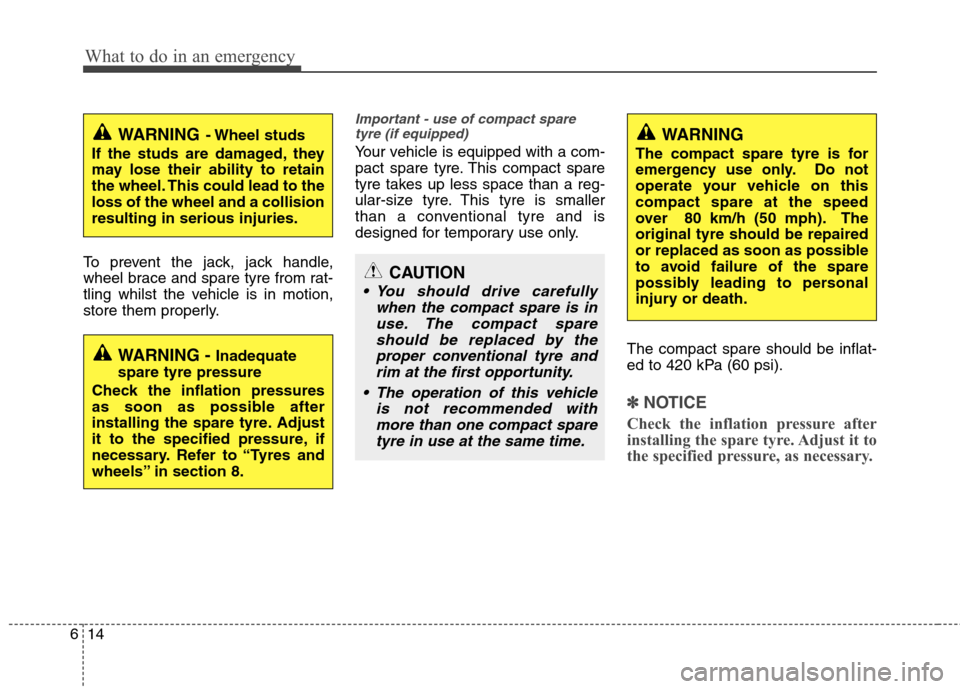
To prevent the jack, jack handle,
wheel brace and spare tyre from rat-
tling whilst the vehicle is in motion,
store them properly.
Important - use of compact spare
tyre (if equipped)
Your vehicle is equipped with a com-
pact spare tyre. This compact spare
tyre takes up less space than a reg-
ular-size tyre. This tyre is smaller
than a conventional tyre and is
designed for temporary use only.
The compact spare should be inflat-
ed to 420 kPa (60 psi).
✽✽NOTICE
Check the inflation pressure after
installing the spare tyre. Adjust it to
the specified pressure, as necessary.
CAUTION
You should drive carefully when the compact spare is inuse. The compact spareshould be replaced by theproper conventional tyre and rim at the first opportunity.
The operation of this vehicle is not recommended withmore than one compact sparetyre in use at the same time.
WARNING
The compact spare tyre is for
emergency use only. Do not
operate your vehicle on thiscompact spare at the speed
over 80 km/h (50 mph). Theoriginal tyre should be repaired
or replaced as soon as possible
to avoid failure of the spare
possibly leading to personal
injury or death.WARNING - Wheel studs
If the studs are damaged, they
may lose their ability to retain
the wheel. This could lead to theloss of the wheel and a collisionresulting in serious injuries.
WARNING - Inadequate
spare tyre pressure
Check the inflation pressures
as soon as possible after
installing the spare tyre. Adjust
it to the specified pressure, if
necessary. Refer to “Tyres and
wheels” in section 8.
Page 324 of 384
737
Maintenance
CAUTION
Underinflation also results inexcessive wear, poor handlingand reduced fuel economy. Wheel deformation also ispossible. Keep your tyre pres-sures at the proper levels. If a tyre frequently needs refilling,have it checked by an autho-rised HYUNDAI dealer.
Overinflation produces a harsh ride, excessive wear atthe centre of the tyre tread,and a greater possibility ofdamage from road hazards.
TYRES AND WHEELS
Tyre care
For proper maintenance, safety, and
maximum fuel economy, you must
always maintain recommended tyre
inflation pressures and stay within
the load limits and weight distribution
recommended for your vehicle. Recommended cold tyre inflation pressures All tyre pressures (including the
spare) should be checked when the
tyres are cold. “Cold Tyres” means
the vehicle has not been driven for at
least three hours or driven less than1.6 km (one mile).
Recommended pressures must be
maintained for the best ride, top vehi-
cle handling, and minimum tyre
wear.
For recommended inflation pressure,
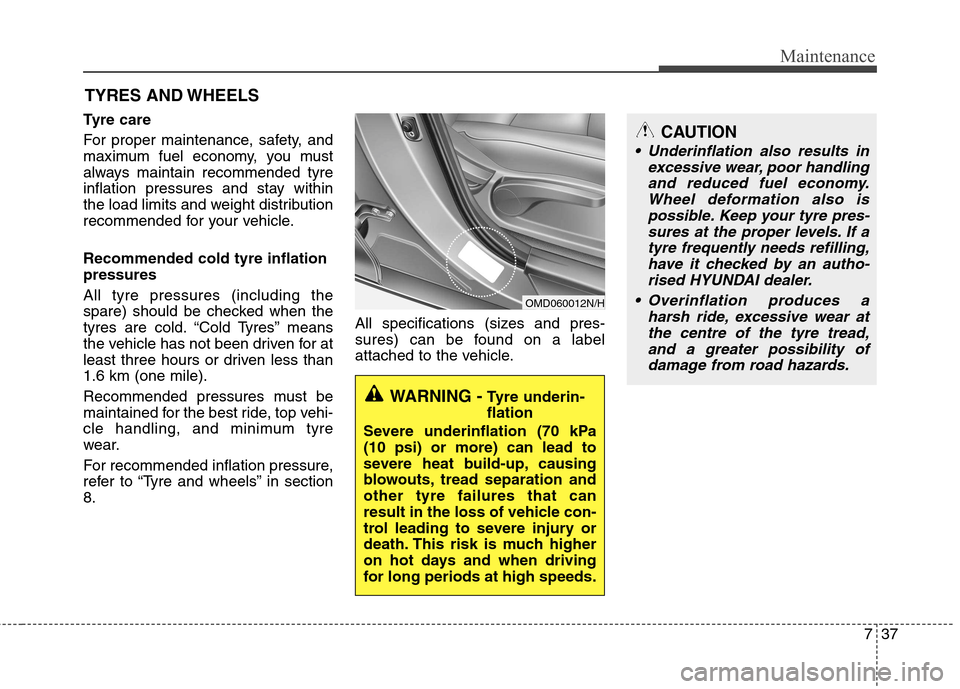
refer to “Tyre and wheels” in section8. All specifications (sizes and pres-
sures) can be found on a label
attached to the vehicle.
WARNING -
Tyre underin- flation
Severe underinflation (70 kPa(10 psi) or more) can lead to
severe heat build-up, causing
blowouts, tread separation andother tyre failures that can
result in the loss of vehicle con-
trol leading to severe injury or
death. This risk is much higher
on hot days and when driving
for long periods at high speeds.
OMD060012N/H
Page 325 of 384
Maintenance
38
7
Checking tyre inflation pressure
Check your tyres once a month or
more.
Also, check the tyre pressure of the
spare tyre.
How to check
Use a good quality gage to check
tyre pressure. You can not tell if your
tyres are properly inflated simply by
looking at them. Radial tyres may
look properly inflated even when
they're underinflated.
Check the tyre's inflation pressure
when the tyres are cold. - "Cold"
means your vehicle has been sitting
for at least three hours or driven nomore than 1.6 km (1 mile).
WARNING - Tyre Inflation
Overinflation or underinflation
can reduce tyre life, adversely
affect vehicle handling, and
lead to sudden tyre failure. This
could result in loss of vehicle
control and potential injury.
CAUTION - Tyre pressure
Always observe the following:
Check tyre pressure when the tyres are cold. (After vehiclehas been parked for at leastthree hours or hasn't beendriven more than 1.6 km (one mile) since startup.)
Check the pressure of your spare tyre each time youcheck the pressure of othertyres.
Never overload your vehicle. Be careful not to overload avehicle luggage rack if yourvehicle is equipped with one.
Worn, old tyres can cause accidents. If your tread isbadly worn, or if your tyres have been damaged, replacethem.
CAUTION
Warm tyres normally exceed recommended cold tyre pres-sures by 28 to 41 kPa (4 to 6psi). Do not release air fromwarm tyres to adjust the pres- sure or the tyres will be under-inflated.
Be sure to reinstall the tyre inflation valve caps. Withoutthe valve cap, dirt or moisture could get into the valve coreand cause air leakage. If avalve cap is missing, install a new one as soon as possible.
Page 371 of 384
83
Specifications & Consumer information
TYRES AND WHEELS
* Normal load : Up to 2 persons
CAUTION
When replacing tyres, use the same size originally supplied with the vehicle.Using tyres of a different size can damage the related parts or make it work irregularly.
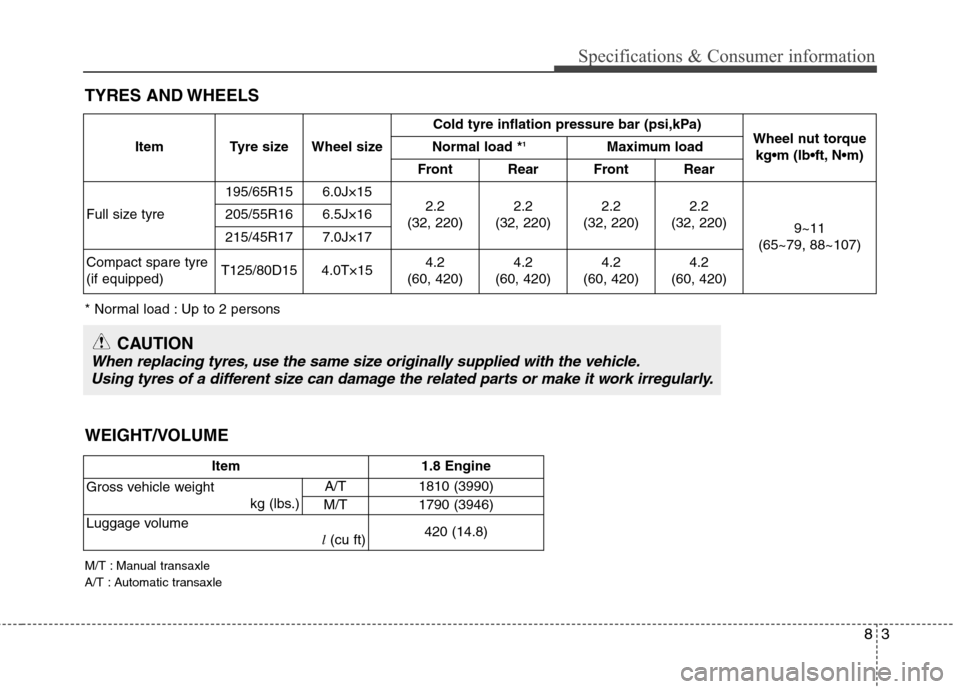
Item Tyre size Wheel size Cold tyre inflation pressure bar (psi,kPa)
Wheel nut torque
kg•m (lb N
Normal load *
1
Maximum load
Front Rear Front Rear
Full size tyre 195/65R15 6.0J×15
2.2
(32, 220) 2.2
(32, 220) 2.2
(32, 220) 2.2
(32, 220) 9~11
(65~79, 88~107)
205/55R16 6.5J×16 215/45R17 7.0J×17
Compact spare tyre (if equipped) T125/80D15 4.0T×15 4.2
(60, 420) 4.2
(60, 420) 4.2
(60, 420) 4.2
(60, 420)
WEIGHT/VOLUME
Item1.8 Engine
Gross vehicle weight kg (lbs.)A/T
1810 (3990)
M/T
1790 (3946)
Luggage volume l(cu ft)420 (14.8)
M/T : Manual transaxle
A/T : Automatic transaxle