Warning Hyundai Elantra 2014 User Guide
[x] Cancel search | Manufacturer: HYUNDAI, Model Year: 2014, Model line: Elantra, Model: Hyundai Elantra 2014Pages: 668, PDF Size: 35.58 MB
Page 27 of 668
Safety features of your vehicle
83
Seat belts must be snug against your
hips and chest to work properly.
When the seatback is reclined, the
shoulder belt cannot do its job
because it will not be snug against
your chest. Instead, it will be in front
of you. During an accident, you could
be thrown into the seat belt, causing
neck or other injuries.
The more the seatback is reclined,
the greater chance the passenger’s
hips will slide under the lap belt or
the passenger’s neck will strike the
shoulder belt.
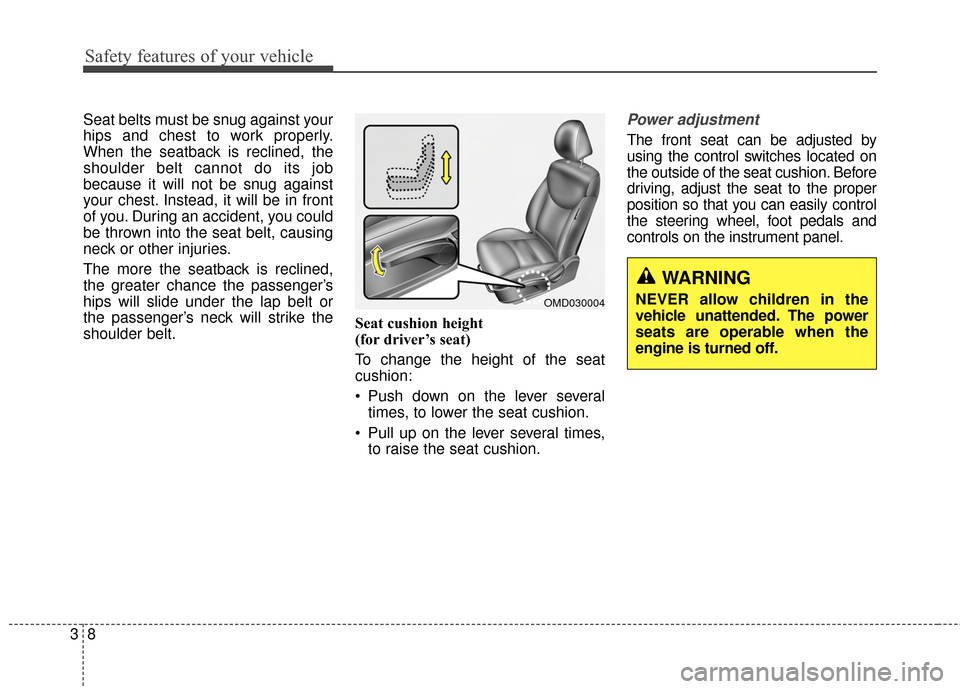
Seat cushion height
(for driver’s seat)
To change the height of the seat
cushion:
Push down on the lever several
times, to lower the seat cushion.
Pull up on the lever several times, to raise the seat cushion.
Power adjustment
The front seat can be adjusted by
using the control switches located on
the outside of the seat cushion. Before
driving, adjust the seat to the proper
position so that you can easily control
the steering wheel, foot pedals and
controls on the instrument panel.
OMD030004
WARNING
NEVER allow children in the
vehicle unattended. The power
seats are operable when the
engine is turned off.
Page 28 of 668
Safety features of your vehicle
39
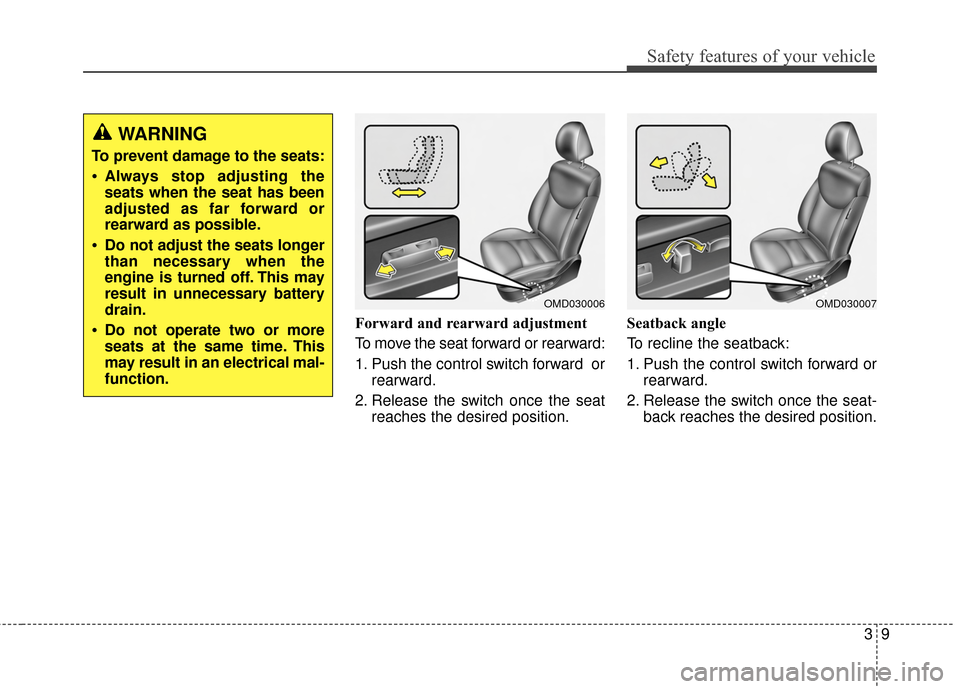
Forward and rearward adjustment
To move the seat forward or rearward:
1. Push the control switch forward orrearward.
2. Release the switch once the seat reaches the desired position. Seatback angle
To recline the seatback:
1. Push the control switch forward or
rearward.
2. Release the switch once the seat- back reaches the desired position.
WARNING
To prevent damage to the seats:
Always stop adjusting the
seats when the seat has been
adjusted as far forward or
rearward as possible.
Do not adjust the seats longer
than necessary when the
engine is turned off. This may
result in unnecessary battery
drain.
Do not operate two or more
seats at the same time. This
may result in an electrical mal-
function.
OMD030006OMD030007
Page 29 of 668
Safety features of your vehicle
10
3 Reclining seatback
Sitting in a reclined position when
the vehicle is in motion can be dan-
gerous. Even when buckled up, the
protections of your restraint system
(seat belts and air bags) is greatly
reduced by reclining your seatback.
Seat belts must be snug against your
hips and chest to work properly.
When the seatback is reclined, the
shoulder belt cannot do its job
because it will not be snug against
your chest. Instead, it will be in front
of you. During an accident, you could
be thrown into the seat belt, causing
neck or other injuries.
The more the seatback is reclined,
the greater chance the passenger’s
hips will slide under the lap belt or
the passenger’s neck will strike the
shoulder belt.
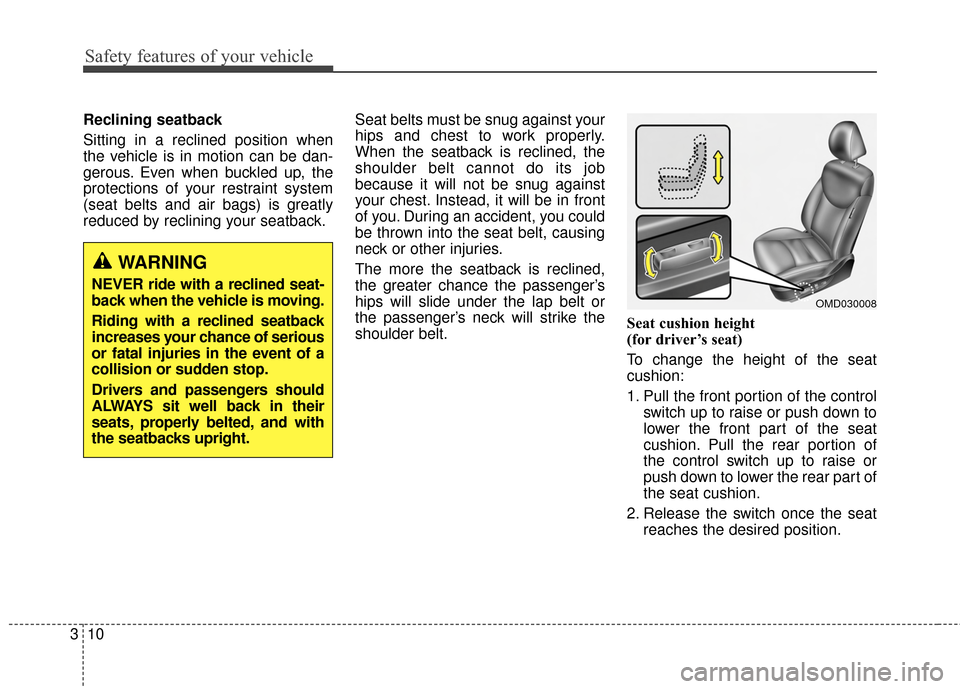
Seat cushion height
(for driver’s seat)
To change the height of the seat
cushion:
1. Pull the front portion of the control
switch up to raise or push down to
lower the front part of the seat
cushion. Pull the rear portion of
the control switch up to raise or
push down to lower the rear part of
the seat cushion.
2. Release the switch once the seat reaches the desired position.
WARNING
NEVER ride with a reclined seat-
back when the vehicle is moving.
Riding with a reclined seatback
increases your chance of serious
or fatal injuries in the event of a
collision or sudden stop.
Drivers and passengers should
ALWAYS sit well back in their
seats, properly belted, and with
the seatbacks upright.
OMD030008
Page 30 of 668
Safety features of your vehicle
311
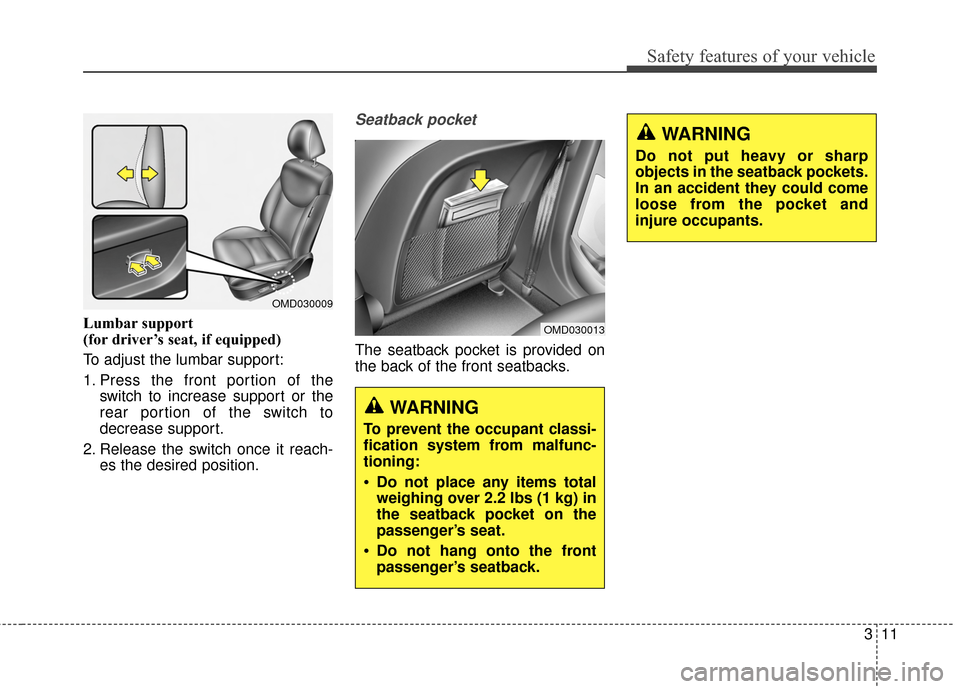
Lumbar support
(for driver’s seat, if equipped)
To adjust the lumbar support:
1. Press the front portion of theswitch to increase support or the
rear portion of the switch to
decrease support.
2. Release the switch once it reach- es the desired position.
Seatback pocket
The seatback pocket is provided on
the back of the front seatbacks.
OMD030009
OMD030013
WARNING
To prevent the occupant classi-
fication system from malfunc-
tioning:
Do not place any items total
weighing over 2.2 lbs (1 kg) in
the seatback pocket on the
passenger’s seat.
Do not hang onto the front
passenger’s seatback.
WARNING
Do not put heavy or sharp
objects in the seatback pockets.
In an accident they could come
loose from the pocket and
injure occupants.
Page 31 of 668
Safety features of your vehicle
12
3
Rear seats
Folding the rear seat
The rear seatbacks can be folded to
facilitate carrying long items or to
increase the luggage capacity of the
vehicle. To fold down the rear seatback:
1. Set the front seatback to the
upright position and if necessary,
slide the front seat forward.
2.Lower the rear headrests to the lowest position.
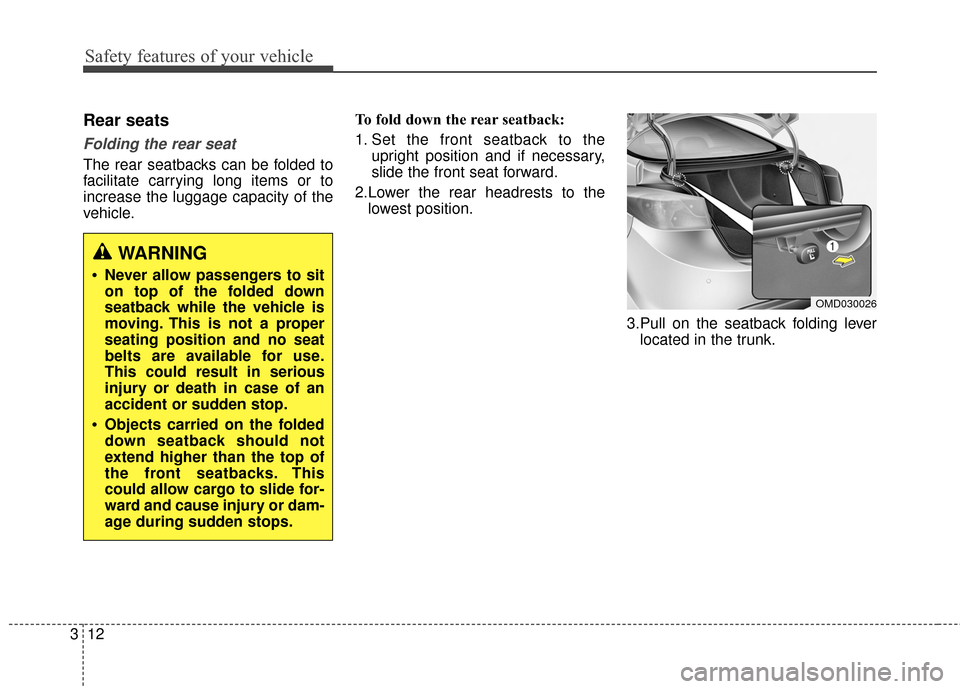
3.Pull on the seatback folding leverlocated in the trunk.
WARNING
Never allow passengers to sit
on top of the folded down
seatback while the vehicle is
moving. This is not a proper
seating position and no seat
belts are available for use.
This could result in serious
injury or death in case of an
accident or sudden stop.
Objects carried on the folded
down seatback should not
extend higher than the top of
the front seatbacks. This
could allow cargo to slide for-
ward and cause injury or dam-
age during sudden stops.
OMD030026
Page 32 of 668
Safety features of your vehicle
313
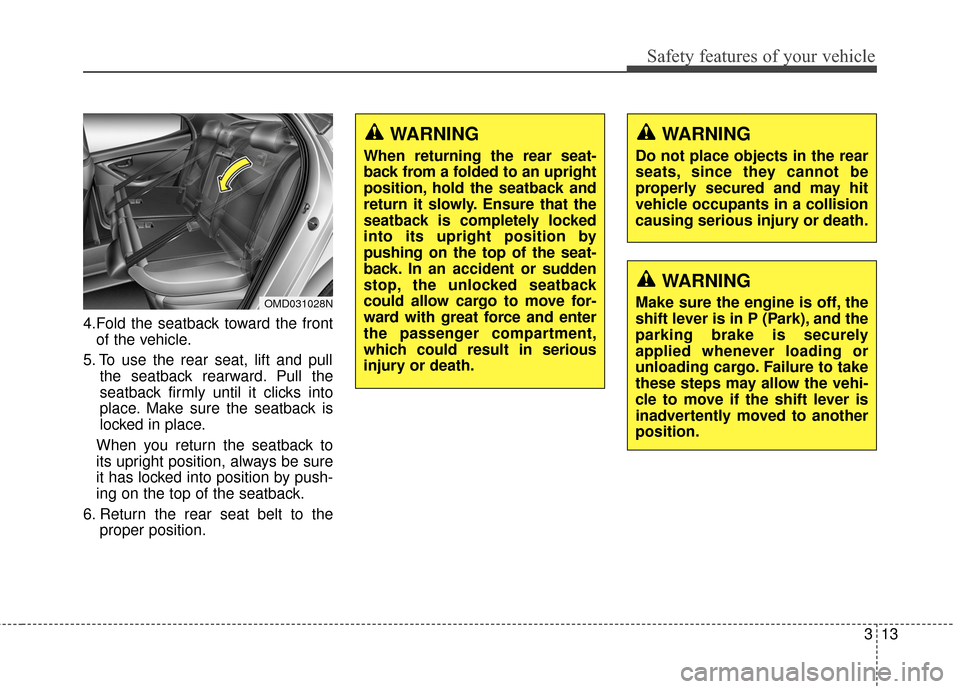
4.Fold the seatback toward the frontof the vehicle.
5. To use the rear seat, lift and pull the seatback rearward. Pull the
seatback firmly until it clicks into
place. Make sure the seatback is
locked in place.
When you return the seatback to
its upright position, always be sure
it has locked into position by push-
ing on the top of the seatback.
6. Return the rear seat belt to the proper position.
OMD031028N
WARNING
When returning the rear seat-
back from a folded to an upright
position, hold the seatback and
return it slowly. Ensure that the
seatback is completely locked
into its upright position by
pushing on the top of the seat-
back. In an accident or sudden
stop, the unlocked seatback
could allow cargo to move for-
ward with great force and enter
the passenger compartment,
which could result in serious
injury or death.
WARNING
Do not place objects in the rear
seats, since they cannot be
properly secured and may hit
vehicle occupants in a collision
causing serious injury or death.
WARNING
Make sure the engine is off, the
shift lever is in P (Park), and the
parking brake is securely
applied whenever loading or
unloading cargo. Failure to take
these steps may allow the vehi-
cle to move if the shift lever is
inadvertently moved to another
position.
Page 34 of 668
Safety features of your vehicle
315
Headrest
The vehicle’s front and rear seats
have adjustable headrests. The head-
rests provide comfort for passengers,
but more importantly they are
designed to help protect passengers
from whiplash and other neck and
spinal injuries during an accident,
especially in a rear impact collision.
Front seat headrest
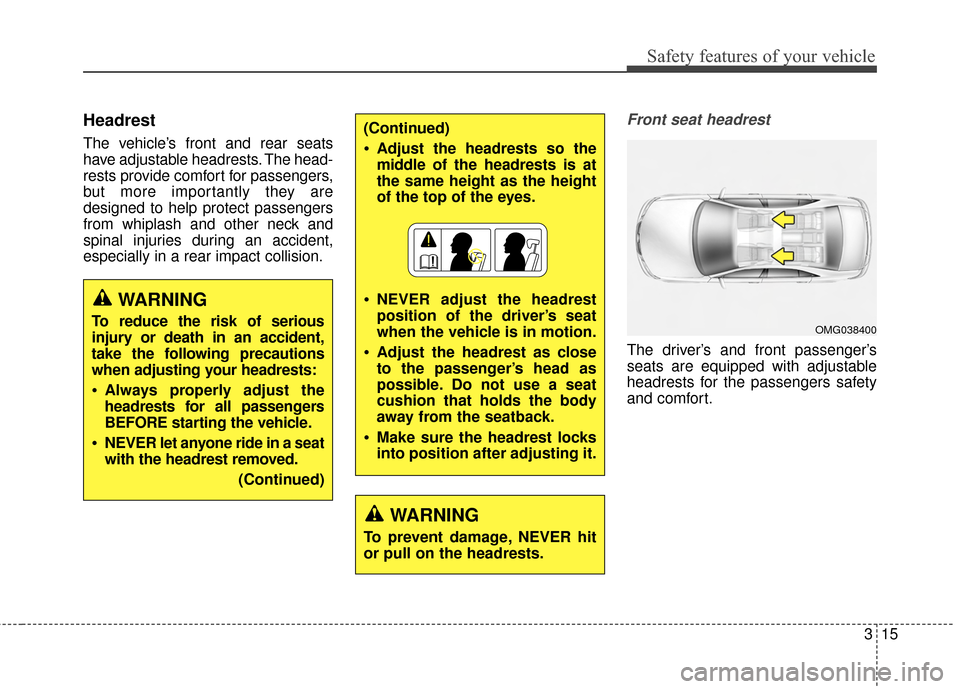
The driver’s and front passenger’s
seats are equipped with adjustable
headrests for the passengers safety
and comfort.
WARNING
To reduce the risk of serious
injury or death in an accident,
take the following precautions
when adjusting your headrests:
Always properly adjust the
headrests for all passengers
BEFORE starting the vehicle.
NEVER let anyone ride in a seat
with the headrest removed.(Continued)
(Continued)
Adjust the headrests so the
middle of the headrests is at
the same height as the height
of the top of the eyes.
NEVER adjust the headrest
position of the driver’s seat
when the vehicle is in motion.
Adjust the headrest as close
to the passenger’s head as
possible. Do not use a seat
cushion that holds the body
away from the seatback.
Make sure the headrest locks
into position after adjusting it.
WARNING
To prevent damage, NEVER hit
or pull on the headrests.
OMG038400
Page 36 of 668
Safety features of your vehicle
317
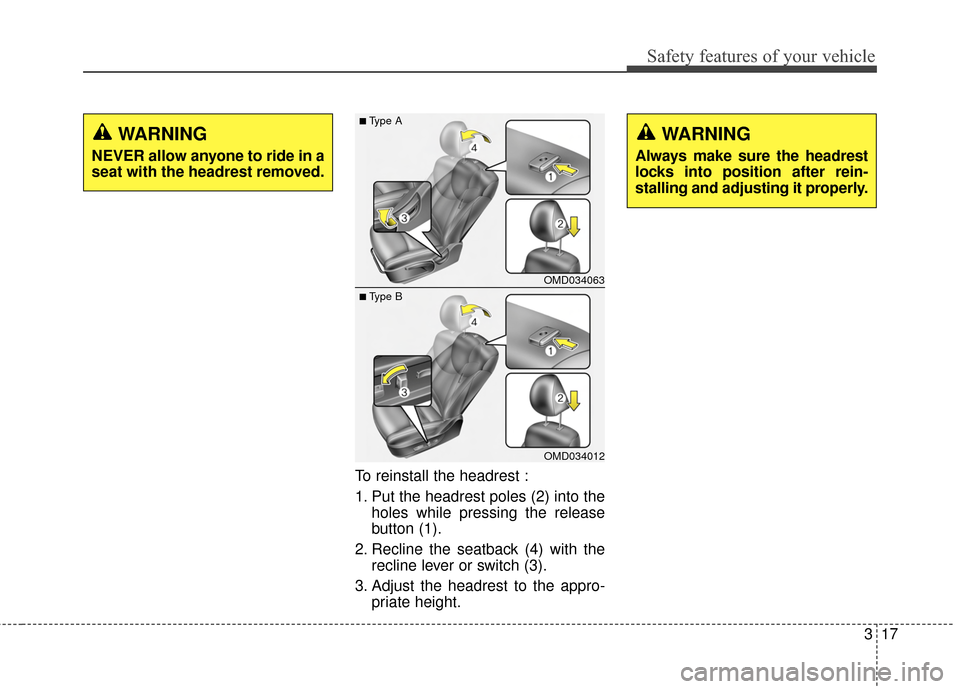
To reinstall the headrest :
1. Put the headrest poles (2) into theholes while pressing the release
button (1).
2. Recline the seatback (4) with the recline lever or switch (3).
3. Adjust the headrest to the appro- priate height.
WARNING
NEVER allow anyone to ride in a
seat with the headrest removed.
WARNING
Always make sure the headrest
locks into position after rein-
stalling and adjusting it properly.
OMD034063
OMD034012
■Type A
■ Type B
Page 37 of 668
Safety features of your vehicle
18
3
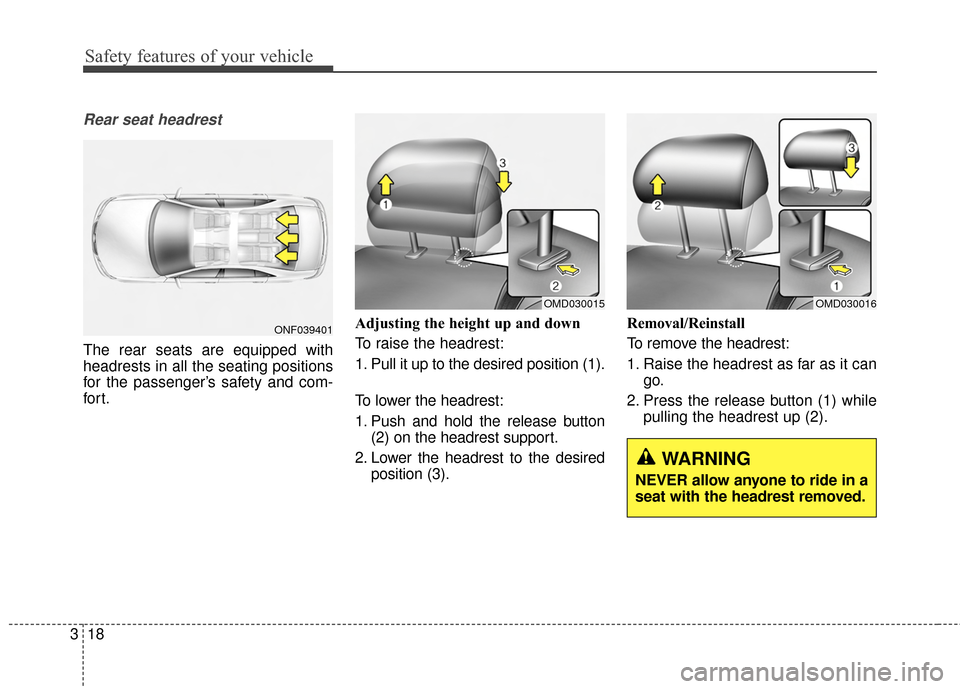
Rear seat headrest
The rear seats are equipped with
headrests in all the seating positions
for the passenger’s safety and com-
for t. Adjusting the height up and down
To raise the headrest:
1. Pull it up to the desired position (1).
To lower the headrest:
1. Push and hold the release button
(2) on the headrest support.
2. Lower the headrest to the desired position (3). Removal/Reinstall
To remove the headrest:
1. Raise the headrest as far as it can
go.
2. Press the release button (1) while pulling the headrest up (2).
ONF039401
OMD030016OMD030015
WARNING
NEVER allow anyone to ride in a
seat with the headrest removed.
Page 38 of 668
Safety features of your vehicle
319
To reinstall the headrest:
1. Recline the seatback.
2. Put the headrest poles (3) into theholes while pressing the release
button (1).
3. Adjust the headrest to the appropri- ate height.Seat warmers
Seat warmers are provided to warm
the seats during cold weather.
WARNING
Always make sure the headrest
locks into position after rein-
stalling and adjusting it to prop-
erly protect the occupants.
WARNING
The seat warmers can cause a
SERIOUS BURN, even at low
temperatures and especially if
used for long periods of time.
Passengers must be able to feel
if the seat is becoming too warm
so they can turn it off, if needed.
People who cannot detect tem-
perature change or pain to the
skin should use extreme cau-
tion, especially the following
types of passengers:
Infants, children, elderly or
disabled persons, or hospital
outpatients.
People with sensitive skin or
who burn easily.
Fatigued individuals.
Intoxicated individuals.
People taking medication that
can cause drowsiness or
sleepiness.
WARNING
NEVER place anything on the
seat that insulates against heat
when the seat warmer is in oper-
ation, such as a blanket or seat
cushion. This may cause the
seat warmer to overheat, caus-
ing a burn or damage to the seat.
CAUTION
To prevent damage to the seatwarmers and seats:
Never use a solvent such aspaint thinner, benzene, alco-hol or gasoline to clean theseats.
Do not place heavy or sharpobjects on seats equippedwith seat warmers.