engine overheat Hyundai Elantra 2014 User Guide
[x] Cancel search | Manufacturer: HYUNDAI, Model Year: 2014, Model line: Elantra, Model: Hyundai Elantra 2014Pages: 668, PDF Size: 35.58 MB
Page 487 of 668
531
Driving your vehicle
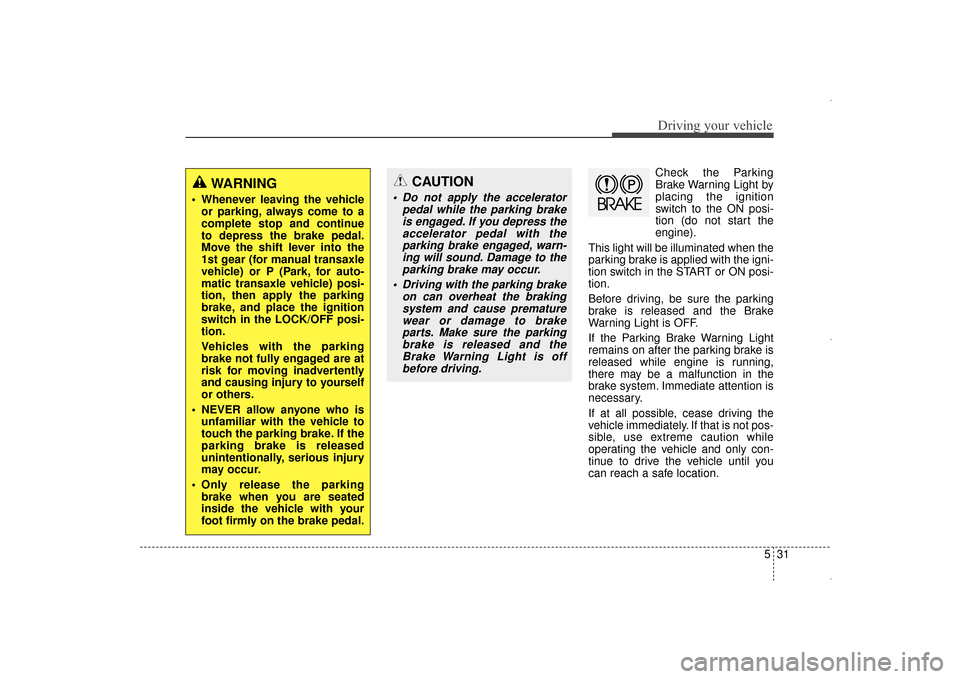
Check the ParkingBrake Warning Light by
placing the ignition
switch to the ON posi-
tion (do not start the
engine).
This light will be illuminated when the
parking brake is applied with the igni-
tion switch in the START or ON posi-
tion.
Before driving, be sure the parking
brake is released and the Brake
Warning Light is OFF.
If the Parking Brake Warning Light
remains on after the parking brake is
released while engine is running,
there may be a malfunction in the
brake system. Immediate attention is
necessary.
If at all possible, cease driving the
vehicle immediately. If that is not pos-
sible, use extreme caution while
operating the vehicle and only con-
tinue to drive the vehicle until you
can reach a safe location.
WARNING
Whenever leaving the vehicle or parking, always come to a
complete stop and continue
to depress the brake pedal.
Move the shift lever into the
1st gear (for manual transaxle
vehicle) or P (Park, for auto-
matic transaxle vehicle) posi-
tion, then apply the parking
brake, and place the ignition
switch in the LOCK/OFF posi-
tion.
Vehicles with the parking
brake not fully engaged are at
risk for moving inadvertently
and causing injury to yourself
or others.
NEVER allow anyone who is unfamiliar with the vehicle to
touch the parking brake. If the
parking brake is released
unintentionally, serious injury
may occur.
Only release the parking brake when you are seated
inside the vehicle with your
foot firmly on the brake pedal.
CAUTION
Do not apply the accelerator pedal while the parking brakeis engaged. If you depress theaccelerator pedal with theparking brake engaged, warn-ing will sound. Damage to theparking brake may occur.
Driving with the parking brake on can overheat the brakingsystem and cause prematurewear or damage to brakeparts. Make sure the parkingbrake is released and theBrake Warning Light is offbefore driving.
UD(FL) HMA 5.qxp 6/26/2014 3:22 PM Page 31
Page 504 of 668
Driving your vehicle
48
5
SPECIAL DRIVING CONDITIONS
Hazardous driving conditions
When hazardous driving conditions
are encountered such as water,
snow, ice, mud or sand:
Drive cautiously and allow extra dis-
tance for braking.
Avoid sudden movements in braking
or steering.
If stuck in snow, mud, or sand, use
second gear. Accelerate slowly to
avoid spinning the drive wheels.
Use sand, rock salt, or other non-slip
material under the drive wheels to
provide traction when stalled in ice,
snow, or mud.
Rocking the vehicle
If it is necessary to rock the vehicle
to free it from snow, sand, or mud,
first turn the steering wheel right and
left to clear the area around your
front wheels. Then, shift back and
forth between 1st and R (Reverse,
for manual transaxle vehicle) or R
(Reverse) and a forward gear (for
automatic transaxle vehicle). Try to
avoid spinning the wheels, and do
not race the engine.
To prevent transaxle wear, wait until
the wheels stop spinning before
shifting gears. Release the accelera-
tor pedal while shifting, and press
lightly on the accelerator pedal while
the transaxle is in gear. Slowly spin-
ning the wheels in forward and
reverse directions causes a rocking
motion that may free the vehicle.
WARNING
Downshifting with an automatic
transaxle, while driving on slip-
pery surfaces can cause an
accident. The sudden change in
tire speed could cause the tires
to skid. Be careful when down-
shifting on slippery surfaces.
WARNING
If the tires spin at high speed
the tires can explode, and you
or others may be injured. Do not
attempt this procedure if people
or objects are anywhere near
the vehicle.
The vehicle can overheat caus-
ing an engine compartment fire
or other damage. Spin the
wheels as little as possible and
avoid spinning the wheels at
speeds over 35 mph (56 km/h)
as indicated on the speedome-
ter.
CAUTION
If you are still stuck after rock-
ing the vehicle a few times, havethe vehicle pulled out by a towvehicle to avoid engine over-heating, possible damage to thetransaxle, and tire damage. See“Towing” in chapter 6.
To prevent damage to thetransaxle, turn OFF the ESCprior to rocking the vehicle.
UD(FL) HMA 5.qxp 6/26/2014 3:23 PM Page 48
Page 518 of 668
What to do in an emergency
Hazard warning flasher . . . . . . . . . . . . . . . . . . . . . . 6-2
In case of an emergency while driving . . . . . . . . . . 6-3
• If the engine stalls while driving . . . . . . . . . . . . . . . . . 6-3
• If the engine stalls at a crossroad or crossing. . . . . . . 6-3
• If you have a flat tire while driving . . . . . . . . . . . . . . . 6-3
If the engine will not start . . . . . . . . . . . . . . . . . . . . 6-4
• If the engine doesn't turn over or turns over slowly. . 6-4
• If the engine turns over normally but doesn't start. . 6-4
Jump starting . . . . . . . . . . . . . . . . . . . . . . . . . . . . . . 6-5
If the engine overheats . . . . . . . . . . . . . . . . . . . . . . . 6-8
Tire Pressure Monitoring System (TPMS) . . . . . 6-10
• Low tire pressure telltale . . . . . . . . . . . . . . . . . . . . . . 6-11
• TPMS malfunction indicator . . . . . . . . . . . . . . . . . . . 6-13
• Changing a tire with TPMS . . . . . . . . . . . . . . . . . . . . 6-14
If you have a flat tire . . . . . . . . . . . . . . . . . . . . . . . 6-15
• With spare tire . . . . . . . . . . . . . . . . . . . . . . . . . . . . . . . 6-15
• Jack label . . . . . . . . . . . . . . . . . . . . . . . . . . . . . . . . . . . 6-\
21
• With Tire Mobility Kit (TMK) . . . . . . . . . . . . . . . . . 6-22
Towing . . . . . . . . . . . . . . . . . . . . . . . . . . . . . . . . . . . 6-\
28
• Towing service . . . . . . . . . . . . . . . . . . . . . . . . . . . . . . . 6-28
• Removable towing hook . . . . . . . . . . . . . . . . . . . . . . . 6-29
• Emergency towing . . . . . . . . . . . . . . . . . . . . . . . . . . . . 6-29
6
Page 525 of 668
If your temperature gauge indicates
overheating, you experience a loss
of power, or hear loud pinging or
knocking, the engine may be over-
heating. If this happens, you should:
1.Pull off the road and stop as soonas it is safe to do so.
2.Place the shift lever in P (Park, for automatic transaxle vehicle) or
neutral (for manual transaxle vehi-
cle) and set the parking brake. If
the air conditioning is ON, turn it
OFF.
3.If engine coolant is running out under the vehicle or steam is com-
ing out from the hood, stop the
engine. Do not open the hood until
the coolant has stopped running or
the steaming has stopped. If there
is no visible loss of engine coolant
and no steam, leave the engine
running and check to be sure the
engine cooling fan is operating. If
the fan is not running, turn the
engine off. 4.Check for coolant leaking from the
radiator, hoses or under the vehi-
cle. (If the air conditioning had
been in use, it is normal for cold
water to be draining from it when
you stop.)
5.If engine coolant is leaking out, stop the engine immediately and
call an authorized HYUNDAI deal-
er for assistance.
IF THE ENGINE OVERHEATS
What to do in an emergency
86
WARNING
While the engine is
running, keep hands,
clothing and tools
away from the moving
parts such as the
cooling fan and drive
belt to prevent seri-
ous injury.
WARNING
NEVER remove the
radiator cap or the
drain plug while the
engine and radiator
are hot. Hot coolant
and steam may blow out under
pressure, causing serious
injury.
Turn the engine off and wait
until the engine cools down.
Use extreme care when remov-
ing the radiator cap. Wrap a
thick towel around it, and turn it
counterclockwise slowly to the
first stop. Step back while the
pressure is released from the
cooling system. When you are
sure all the pressure has been
released, press down on the
cap, using a thick towel, and
continue turning counterclock-
wise to remove it.
Page 526 of 668

6.If you cannot find the cause of theoverheating, wait until the engine
temperature has returned to nor-
mal. Then, if coolant has been lost,
carefully add coolant to the reser-
voir to bring the fluid level in the
reservoir up to the halfway mark.
7.Proceed with caution, keeping alert for further signs of overheat-
ing. If overheating happens again,
call an authorized HYUNDAI deal-
er for assistance.
69
What to do in an emergency
CAUTION
Serious loss of coolant indi- cates a leak in the coolingsystem and have the systemchecked by an authorizedHYUNDAI dealer.
When the engine overheats from low engine coolant, sud-denly adding engine coolantmay cause cracks in theengine. To prevent damage,add engine coolant slowly insmall quantities.
Page 540 of 668

623
What to do in an emergency
It is possible that some tires, espe-
cially with larger punctures or dam-
age to the sidewall, cannot be sealed
completely.
Air pressure loss in the tire may
adversely affect tire performance.
For this reason, you should avoid
abrupt steering or other driving
maneuvers, especially if the vehicle is
heavily loaded or if a trailer is in use.
The Tire Mobility Kit is not designed
or intended as a permanent tire
repair method and is to be used for
one tire only.
This instruction shows you step by
step how to temporarily seal the
puncture simply and reliably.
Read the section "Notes on the safe
use of the Tire Mobility Kit".Notes on the safe use of the TireMobility Kit
Park your car at the side of the road so that you can work with the
Tire Mobility Kit away from moving
traffic.
To be sure your vehicle will not move, even when you're on fairly
level ground, always set your park-
ing brake.
Only use the Tire Mobility Kit for sealing/inflation passenger car
tires. Only punctured areas located
within the tread region of the tire
can be sealed using the tire mobil-
ity kit.
Do not use on motorcycles, bicy- cles or any other type of tires.
When the tire and wheel are dam- aged, do not use Tire Mobility Kit
for your safety.
Use of the Tire Mobility Kit may not be effective for tire damage larger
than approximately 0.24 inch (6
mm).
Please contact the nearest
HYUNDAI dealership if the tire
cannot be made roadworthy with
the Tire Mobility Kit. Do not use the Tire Mobility Kit if a
tire is severely damaged by driving
run flat or with insufficient air pres-
sure.
Do not remove any foreign objects such as nails or screws that have
penetrated the tire.
Provided the car is outdoors, leave the engine running. Otherwise
operating the compressor may
eventually drain the car battery.
Never leave the Tire Mobility Kit unattended while it is being used.
Do not leave the compressor run- ning for more than 10 minutes at a
time or it may overheat.
Do not use the Tire Mobility Kit if the ambient temperature is below
-22°F (-30°C).
Page 662 of 668
I7
Index
If the engine doesn't turn over or turns over slowly ........6-4
If the engine overheats ......................................................6-8
If the engine stalls at a crossroad or crossing ..................6-3
If the engine stalls while driving ......................................6-3
If the engine turns over normally but doesn’t start ..........6-4
If the engine will not start ................................................6-4
If you have a flat tire ......................................................6-15
If you have a flat tire while driving ..................................6-3
Ignition key interlock system ........................................5-27
Ignition switch ..................................................................5-5Engine Start/Stop button................................................5-9
Key ignition switch ......................................................5-5
Immobilizer system ........................................................4-12
Impact sensing door unlock system ................................4-18
Improtant safety precautions ............................................3-2 Air bag hazards..............................................................3-2
Always wear your seat belt ..........................................3-2
Control your speed ........................................................3-3
Driver distraction ..........................................................3-2
Keep your vehicle in safe condition..............................3-3
Restrain all children ......................................................3-2
In case of emergency while driving..................................6-3
Inside rearview mirror ....................................................4-42 Instrument cluster ..........................................................4-51
ECO ON/OFF mode ....................................................4-59
Gauges ........................................................................\
4-53
Instrument panel illumination ....................................4-45
Manual transaxle shift indicator ..................................4-59
Transaxle shift indicator ..............................................4-56
Trip computer ..............................................................4-93
Warnings and indicators ..............................................4-60
Instrument panel fuse......................................................7-64
Instrument panel overview ..............................................2-5
Interior care ....................................................................7-92\
Interior features ............................................................4-113 Aux, USB and iPod ..................................................4-102
Clock ........................................................................\
..4-113
Clothes hanger ..........................................................4-117
Cup holder ................................................................4-115
Floor mat anchor(s) ..................................................4-118
Luggage net (holder) ................................................4-119
Outside temperature ..................................................4-114
Power outlet ..............................................................4-116
Sunvisor ....................................................................4-116
Interior lights ..................................................................4-78
Interior overview ..............................................................2-4
I