Fluid Hyundai Elantra 2014 Owner's Guide
[x] Cancel search | Manufacturer: HYUNDAI, Model Year: 2014, Model line: Elantra, Model: Hyundai Elantra 2014Pages: 668, PDF Size: 35.58 MB
Page 568 of 668
Maintenance
20
7
Maintenance
20
7
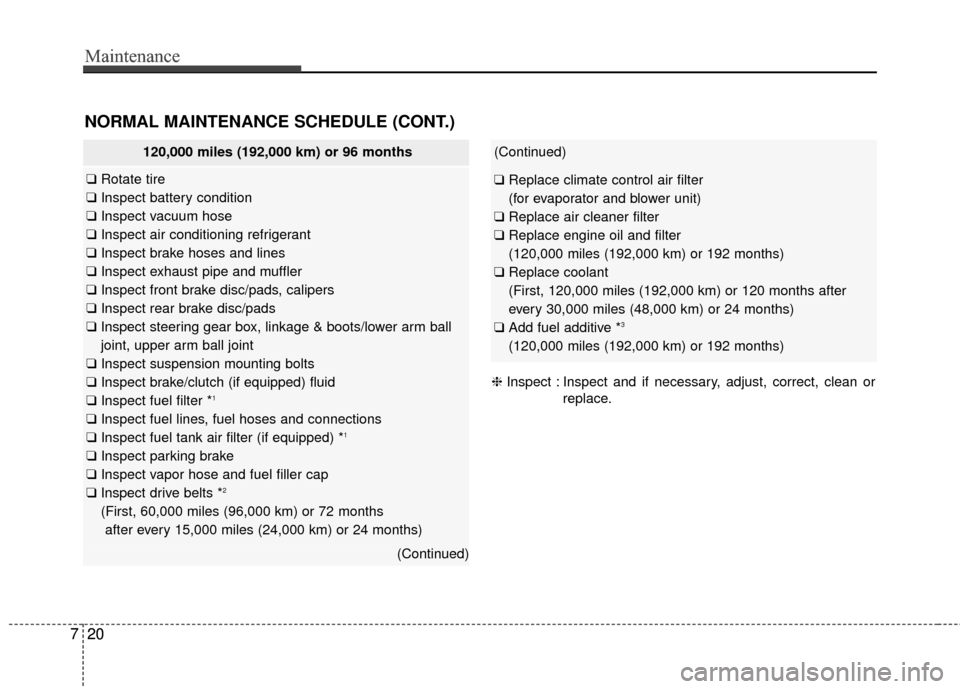
NORMAL MAINTENANCE SCHEDULE (CONT.)
120,000 miles (192,000 km) or 96 months
❑ Rotate tire
❑ Inspect battery condition
❑ Inspect vacuum hose
❑ Inspect air conditioning refrigerant
❑ Inspect brake hoses and lines
❑ Inspect exhaust pipe and muffler
❑ Inspect front brake disc/pads, calipers
❑ Inspect rear brake disc/pads
❑ Inspect steering gear box, linkage & boots/lower arm ball
joint, upper arm ball joint
❑ Inspect suspension mounting bolts
❑ Inspect brake/clutch (if equipped) fluid
❑ Inspect fuel filter *
1
❑Inspect fuel lines, fuel hoses and connections
❑ Inspect fuel tank air filter (if equipped) *1
❑Inspect parking brake
❑ Inspect vapor hose and fuel filler cap
❑ Inspect drive belts *
2
(First, 60,000 miles (96,000 km) or 72 months
after every 15,000 miles (24,000 km) or 24 months)
(Continued)
(Continued)
❑ Replace climate control air filter
(for evaporator and blower unit)
❑ Replace air cleaner filter
❑ Replace engine oil and filter
(120,000 miles (192,000 km) or 192 months)
❑ Replace coolant
(First, 120,000 miles (192,000 km) or 120 months after
every 30,000 miles (48,000 km) or 24 months)
❑ Add fuel additive *
3
(120,000 miles (192,000 km) or 192 months)
❈ Inspect : Inspect and if necessary, adjust, correct, clean or
replace.
Page 571 of 668
723
Maintenance
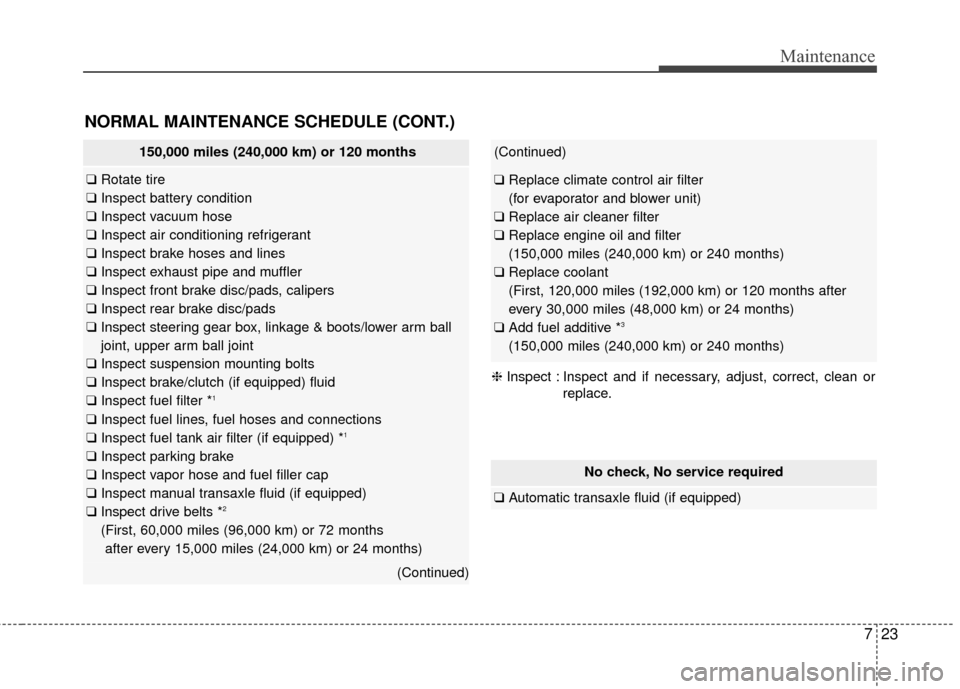
NORMAL MAINTENANCE SCHEDULE (CONT.)
No check, No service required
❑Automatic transaxle fluid (if equipped)
150,000 miles (240,000 km) or 120 months
❑Rotate tire
❑ Inspect battery condition
❑ Inspect vacuum hose
❑ Inspect air conditioning refrigerant
❑ Inspect brake hoses and lines
❑ Inspect exhaust pipe and muffler
❑ Inspect front brake disc/pads, calipers
❑ Inspect rear brake disc/pads
❑ Inspect steering gear box, linkage & boots/lower arm ball
joint, upper arm ball joint
❑ Inspect suspension mounting bolts
❑ Inspect brake/clutch (if equipped) fluid
❑ Inspect fuel filter *
1
❑Inspect fuel lines, fuel hoses and connections
❑ Inspect fuel tank air filter (if equipped) *1
❑Inspect parking brake
❑ Inspect vapor hose and fuel filler cap
❑ Inspect manual transaxle fluid (if equipped)
❑ Inspect drive belts *
2
(First, 60,000 miles (96,000 km) or 72 months
after every 15,000 miles (24,000 km) or 24 months)
(Continued)
(Continued)
❑ Replace climate control air filter
(for evaporator and blower unit)
❑ Replace air cleaner filter
❑ Replace engine oil and filter
(150,000 miles (240,000 km) or 240 months)
❑ Replace coolant
(First, 120,000 miles (192,000 km) or 120 months after
every 30,000 miles (48,000 km) or 24 months)
❑ Add fuel additive *
3
(150,000 miles (240,000 km) or 240 months)
❈ Inspect : Inspect and if necessary, adjust, correct, clean or
replace.
Page 572 of 668
Maintenance
24
7
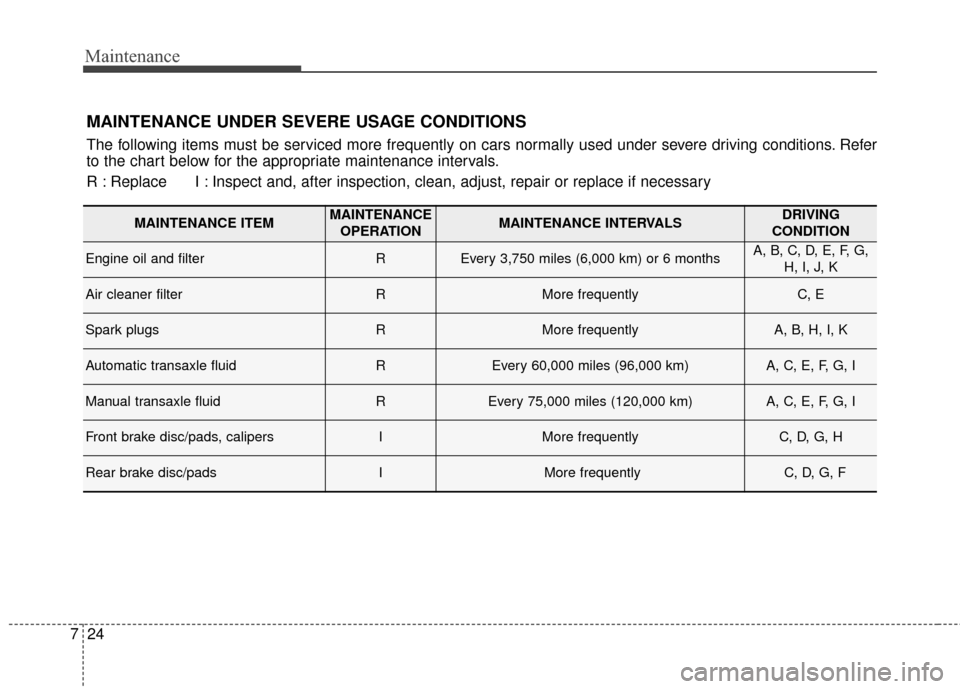
MAINTENANCE UNDER SEVERE USAGE CONDITIONS
The following items must be serviced more frequently on cars normally used under severe driving conditions. Refer
to the chart below for the appropriate maintenance intervals.
R : Replace I : Inspect and, after inspection, clean, adjust, repair or replace if neces\
sary
MAINTENANCE ITEMMAINTENANCE
OPERATIONMAINTENANCE INTERVALSDRIVING
CONDITION
Engine oil and filterREvery 3,750 miles (6,000 km) or 6 monthsA, B, C, D, E, F, G, H, I, J, K
Air cleaner filterRMore frequentlyC, E
Spark plugsRMore frequentlyA, B, H, I, K
Automatic transaxle fluidREvery 60,000 miles (96,000 km) A, C, E, F, G, I
Manual transaxle fluidREvery 75,000 miles (120,000 km) A, C, E, F, G, I
Front brake disc/pads, calipersIMore frequentlyC, D, G, H
Rear brake disc/padsIMore frequentlyC, D, G, F
Page 576 of 668
Maintenance
28
7
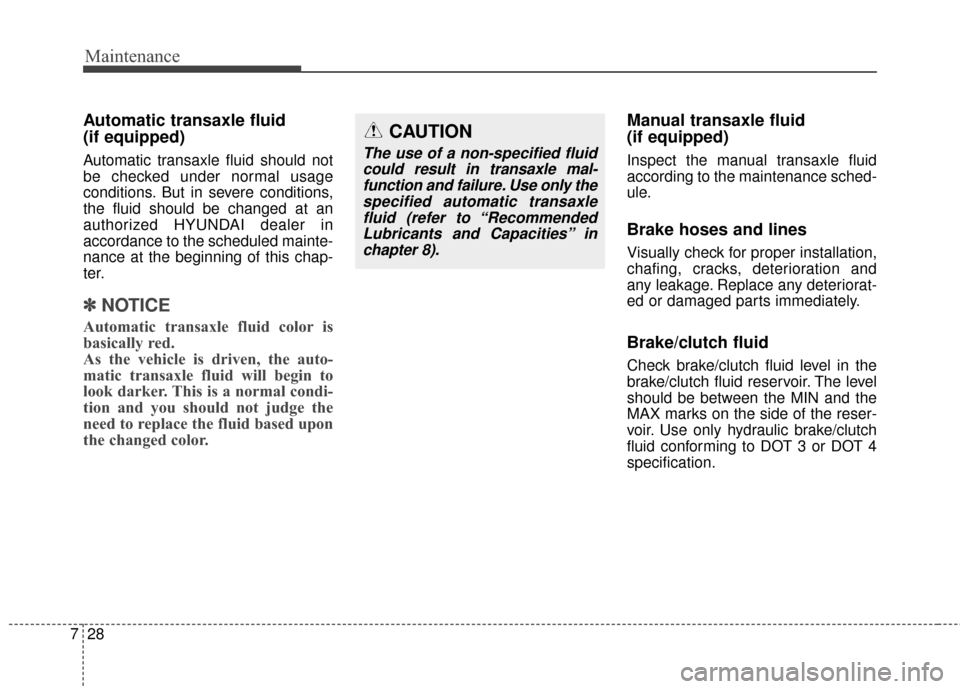
Automatic transaxle fluid
(if equipped)
Automatic transaxle fluid should not
be checked under normal usage
conditions. But in severe conditions,
the fluid should be changed at an
authorized HYUNDAI dealer in
accordance to the scheduled mainte-
nance at the beginning of this chap-
ter.
✽ ✽
NOTICE
Automatic transaxle fluid color is
basically red.
As the vehicle is driven, the auto-
matic transaxle fluid will begin to
look darker. This is a normal condi-
tion and you should not judge the
need to replace the fluid based upon
the changed color.
Manual transaxle fluid
(if equipped)
Inspect the manual transaxle fluid
according to the maintenance sched-
ule.
Brake hoses and lines
Visually check for proper installation,
chafing, cracks, deterioration and
any leakage. Replace any deteriorat-
ed or damaged parts immediately.
Brake/clutch fluid
Check brake/clutch fluid level in the
brake/clutch fluid reservoir. The level
should be between the MIN and the
MAX marks on the side of the reser-
voir. Use only hydraulic brake/clutch
fluid conforming to DOT 3 or DOT 4
specification.
CAUTION
The use of a non-specified fluid
could result in transaxle mal-function and failure. Use only thespecified automatic transaxlefluid (refer to “RecommendedLubricants and Capacities” inchapter 8).
Page 577 of 668
729
Maintenance
Parking brake
Inspect the parking brake system
including the parking brake pedal
and cables.
Brake discs, pads, calipers
and rotors
Check the pads for excessive wear,
discs for run out and wear, and
calipers for fluid leakage.
Exhaust pipe and muffler
Visually inspect the exhaust pipes,
muffler and hangers for cracks, dete-
rioration, or damage. Start the
engine and listen carefully for any
exhaust gas leakage. Tighten con-
nections or replace parts as neces-
sary.
Suspension mounting bolts
Check the suspension connections
for looseness or damage. Retighten
to the specified torque.
Steering gear box, linkage &
boots/lower arm ball joint
With the vehicle stopped and the
engine off, check for excessive free-
play in the steering wheel. Check the
linkage for bends or damage. Check
the dust boots and ball joints for
deterioration, cracks, or damage.
Replace any damaged parts.
Drive shafts and boots
Check the drive shafts, boots and
clamps for cracks, deterioration, or
damage. Replace any damaged
parts and, if necessary, repack the
grease.
Air conditioning refrigerant
Check the air conditioning lines and
connections for leakage and dam-
age.
Page 582 of 668
Maintenance
34
7
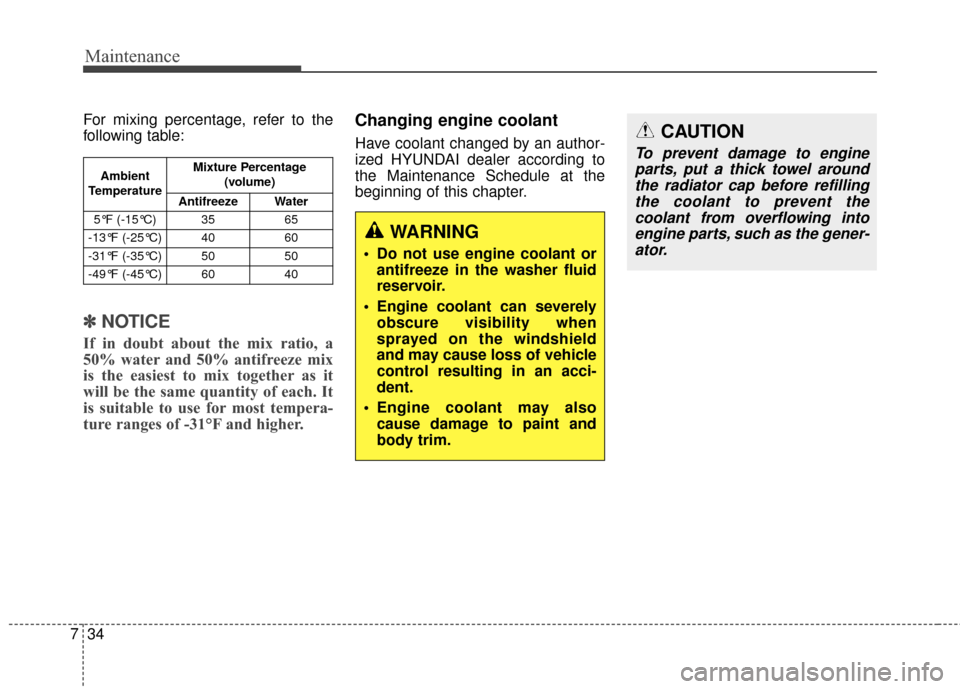
For mixing percentage, refer to the
following table:
✽ ✽
NOTICE
If in doubt about the mix ratio, a
50% water and 50% antifreeze mix
is the easiest to mix together as it
will be the same quantity of each. It
is suitable to use for most tempera-
ture ranges of -31°F and higher.
Changing engine coolant
Have coolant changed by an author-
ized HYUNDAI dealer according to
the Maintenance Schedule at the
beginning of this chapter.CAUTION
To prevent damage to engine
parts, put a thick towel aroundthe radiator cap before refillingthe coolant to prevent thecoolant from overflowing intoengine parts, such as the gener-ator.
WARNING
Do not use engine coolant or antifreeze in the washer fluid
reservoir.
Engine coolant can severely obscure visibility when
sprayed on the windshield
and may cause loss of vehicle
control resulting in an acci-
dent.
Engine coolant may also cause damage to paint and
body trim.
Ambient
Temperature Mixture Percentage
(volume)
Antifreeze Water
5°F (-15°C) 35 65
-13°F (-25°C) 40 60
-31°F (-35°C) 50 50
-49°F (-45°C) 60 40
Page 583 of 668
735
Maintenance
BRAKE/CLUTCH FLUID
Checking the brake/clutchfluid
level
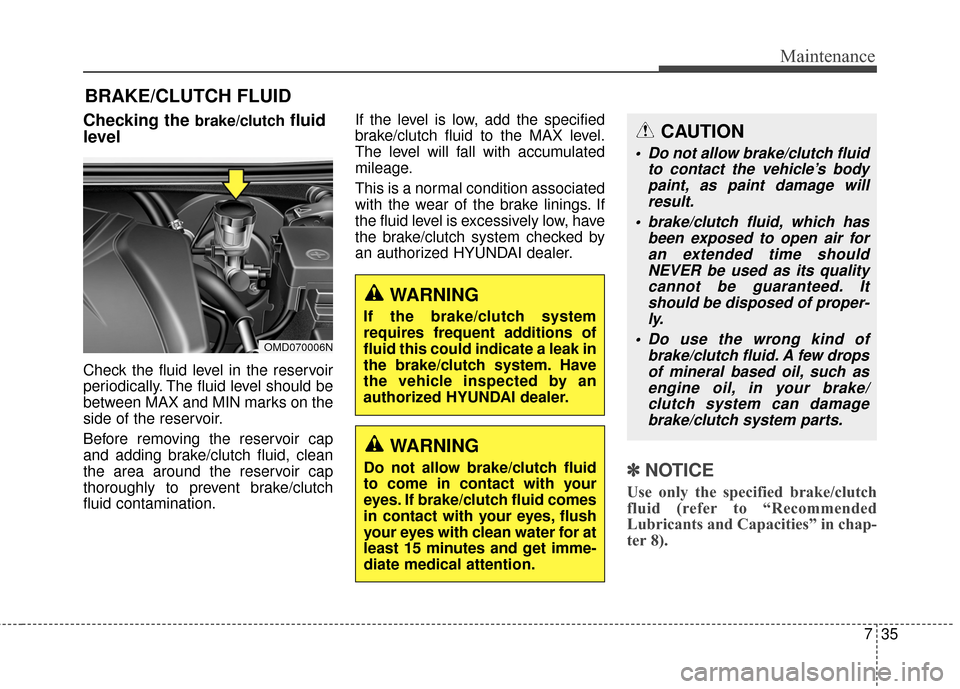
Check the fluid level in the reservoir
periodically. The fluid level should be
between MAX and MIN marks on the
side of the reservoir.
Before removing the reservoir cap
and adding brake/clutch fluid, clean
the area around the reservoir cap
thoroughly to prevent brake/clutch
fluid contamination. If the level is low, add the specified
brake/clutch fluid to the MAX level.
The level will fall with accumulated
mileage.
This is a normal condition associated
with the wear of the brake linings. If
the fluid level is excessively low, have
the brake/clutch system checked by
an authorized HYUNDAI dealer.
✽ ✽
NOTICE
Use only the specified brake/clutch
fluid (refer to “Recommended
Lubricants and Capacities” in chap-
ter 8).
WARNING
If the brake/clutch system
requires frequent additions of
fluid this could indicate a leak in
the brake/clutch system. Have
the vehicle inspected by an
authorized HYUNDAI dealer.
WARNING
Do not allow brake/clutch fluid
to come in contact with your
eyes. If brake/clutch fluid comes
in contact with your eyes, flush
your eyes with clean water for at
least 15 minutes and get imme-
diate medical attention.
CAUTION
Do not allow brake/clutch fluid
to contact the vehicle’s bodypaint, as paint damage willresult.
brake/clutch fluid, which has been exposed to open air foran extended time shouldNEVER be used as its qualitycannot be guaranteed. Itshould be disposed of proper-ly.
Do use the wrong kind of brake/clutch fluid. A few dropsof mineral based oil, such asengine oil, in your brake/clutch system can damagebrake/clutch system parts.
OMD070006N
Page 584 of 668
Maintenance
36
7
WASHER FLUID
Checking the washer fluid
level
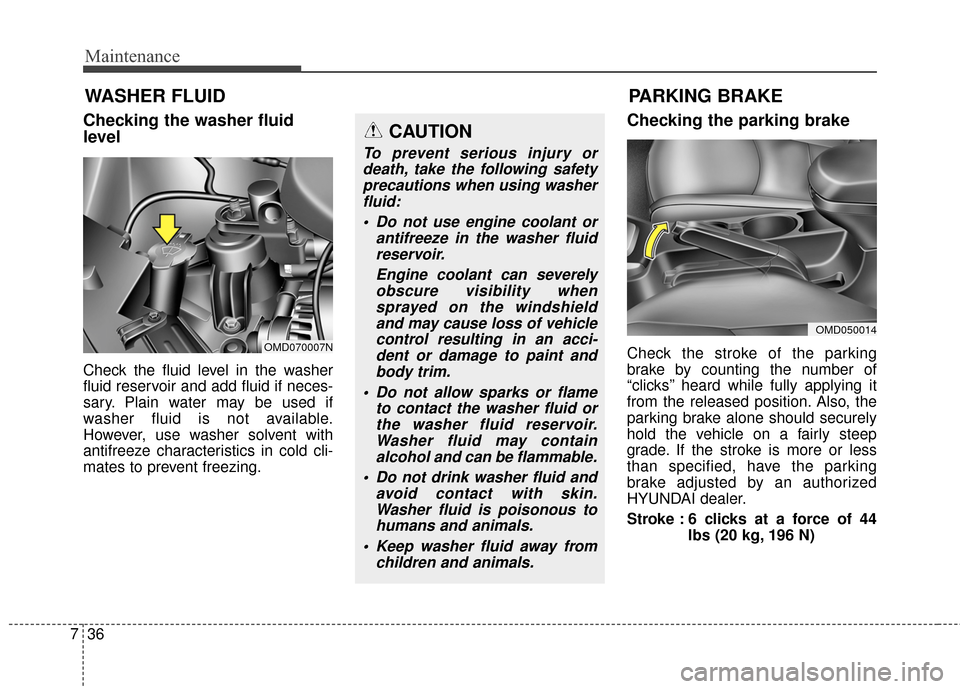
Check the fluid level in the washer
fluid reservoir and add fluid if neces-
sary. Plain water may be used if
washer fluid is not available.
However, use washer solvent with
antifreeze characteristics in cold cli-
mates to prevent freezing.
Checking the parking brake
Check the stroke of the parking
brake by counting the number of
“clicks’’ heard while fully applying it
from the released position. Also, the
parking brake alone should securely
hold the vehicle on a fairly steep
grade. If the stroke is more or less
than specified, have the parking
brake adjusted by an authorized
HYUNDAI dealer.
Stroke : 6 clicks at a force of 44
lbs (20 kg, 196 N)
PARKING BRAKE
OMD070007N
OMD050014
CAUTION
To prevent serious injury ordeath, take the following safetyprecautions when using washerfluid:
Do not use engine coolant or antifreeze in the washer fluidreservoir.
Engine coolant can severelyobscure visibility whensprayed on the windshieldand may cause loss of vehiclecontrol resulting in an acci-dent or damage to paint andbody trim.
Do not allow sparks or flame to contact the washer fluid orthe washer fluid reservoir.Washer fluid may containalcohol and can be flammable.
Do not drink washer fluid and avoid contact with skin.Washer fluid is poisonous tohumans and animals.
Keep washer fluid away from children and animals.
Page 589 of 668
741
Maintenance
WIPER BLADES
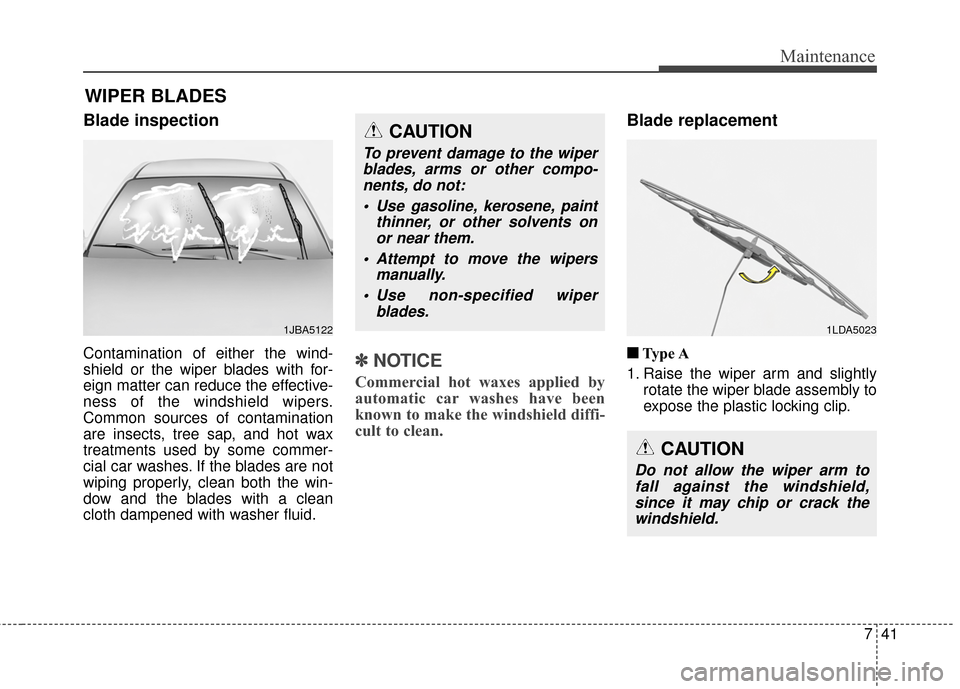
Blade inspection
Contamination of either the wind-
shield or the wiper blades with for-
eign matter can reduce the effective-
ness of the windshield wipers.
Common sources of contamination
are insects, tree sap, and hot wax
treatments used by some commer-
cial car washes. If the blades are not
wiping properly, clean both the win-
dow and the blades with a clean
cloth dampened with washer fluid.✽ ✽NOTICE
Commercial hot waxes applied by
automatic car washes have been
known to make the windshield diffi-
cult to clean.
Blade replacement
■ ■ Type A
1. Raise the wiper arm and slightly rotate the wiper blade assembly to
expose the plastic locking clip.
1JBA5122
CAUTION
Do not allow the wiper arm tofall against the windshield,since it may chip or crack thewindshield.
CAUTION
To prevent damage to the wiperblades, arms or other compo-nents, do not:
Use gasoline, kerosene, paint thinner, or other solvents onor near them.
Attempt to move the wipers manually.
Use non-specified wiper blades.
1LDA5023
Page 644 of 668
Maintenance
96
7
Do not operate the engine in con-
fined or closed areas (such as
garages) any more than what is
necessary to move the vehicle in or
out of the area.
When the vehicle is stopped in an open area for more than a short
time with the engine running,
adjust the ventilation system (as
needed) to draw outside air into the
vehicle.
Never sit in a parked or stopped vehicle for any extended time with
the engine running.
When the engine stalls or fails to start, excessive attempts to restart
the engine may cause damage to
the emission control system.Operating precautions for catalyt-
ic converters (if equipped)
WARNING
The exhaust system and cat- alytic converter are very hot
during and immediately after
the engine has been running.
To avoid SERIOUS INJURY or
DEATH.
Do not park, idle, or drive the vehicle over or near flamma-
ble objects, such as grass,
vegetation, paper, leaves, etc.
A hot exhaust system can
ignite flammable items under
your vehicle.
Keep away from the exhaust system and catalytic convert-
er or you may get burned.
Also, Do not remove the heat
sink around the exhaust sys-
tem, do not seal the bottom of
the vehicle, and do not coat
the vehicle for corrosion con-
trol. It may present a fire risk
under certain conditions.
WARNING- CALIFORNIA
PROPOSITION 65 WARNING
Engine exhaust and a wide vari-
ety of automobile components
and parts, including compo-
nents found in the interior fur-
nishings in a vehicle, contain or
emit chemicals known to the
State of California to cause can-
cer and birth defects and repro-
ductive harm. In addition, cer-
tain fluids contained in vehicles
and certain products of compo-
nent wear contain or emit chem-
icals known to the State of
California to cause cancer and
birth defects or other reproduc-
tive harm.