steering wheel Hyundai Elantra 2017 Owner's Manual - RHD (UK. Australia)
[x] Cancel search | Manufacturer: HYUNDAI, Model Year: 2017, Model line: Elantra, Model: Hyundai Elantra 2017Pages: 571, PDF Size: 65.66 MB
Page 13 of 571
F13F13
Child restraint system (CRS) .............................2-36
Children always in the rear seat .................................2-36
Selecting a Child Restraint System (CRS) ................2-37
Installing a Child Restraint System (CRS)..................2-39
Air bag
- supplemental restraint system.....................2-47
Where are the air bags? ..............................................2-49
How does the air bag system operate? ...................2-52
What to expect after an air bag inflates ................2-56
Why didn't my air bag go off in a collision? ...........2-58
SRS care ...........................................................................2-63
Additional safety precautions .....................................2-64
Air bag warning labels ...................................................2-65
Accessing your vehicle .........................................3-4
Remote key .......................................................................3-4
Remote key precautions..................................................3-6
Smart key ...........................................................................3-8
Smart key precautions...................................................3-11
Immobiliser system ........................................................3-13
Door locks .............................................................3-14
Operating door locks from outside the vehicle .....3-14
Operating door locks from inside the vehicle ........3-16
Auto door lock/unlock features ................................3-18
Child-protector rear door locks ..................................3-19
Theft-alarm system .............................................3-20
Driver position memory system ........................3-21
Storing memory positions .............................................3-21
Easy access function ....................................................3-22
Steering wheel......................................................3-23
Electric power steering (EPS) ......................................3-23
Tilt steering/Telescope steering .................................3-24
Heated steering wheel .................................................3-24
Horn ....................................................................................3-25
Mirrors ...................................................................3-26
Inside rearview mirror....................................................3-26
Outside rearview mirror ................................................3-28
3Convenient features of your vehicle
Page 16 of 571
F16F16
Multimedia system .................................................4-2
Aux, USB and iPod®port ................................................4-2
Antenna ...............................................................................4-3
Steering wheel audio controls .......................................4-4
Audio / Video / Navigation system (AVN) ..................4-5
Bluetooth®Wireless Technology hands-free ............4-5
How vehicle audio works ................................................4-6
AUDIO (Without Touch Screen) ...........................4-9
Features of Your Audio .................................................4-10
Radio Mode
(Type A-1, Type A-2, Type A-3, Type A-4
with RDS)...........................................................................4-30
Radio Mode (Type A-5, Type A-6) .............................4-32
Media Mode......................................................................4-33
Phone Mode .....................................................................4-40
Setup Mode
(Type A-1, Type A-2, Type A-3, Type A-4).............4-42
Setup Mode (Type A-5, Type A-6).............................4-50
AUDIO (With Touch Screen) ...............................4-58
Features of Your Audio .................................................4-59
Radio Mode
(Type B-1, Type B-2, Type B-3, Type B-4) .............4-77
Radio Mode (Type B-5, Type B-6) .............................4-80
Media Mode......................................................................4-82
Phone Mode .....................................................................4-97
Bluetooth®Wireless Technology
(Type B-1, Type B-2, Type B-3, Type B-4) .............4-98
Bluetooth®Wireless Technology
(Type B-5, Type B-6)...................................................4-105
Setup Mode
(Type B-1, Type B-2, Type B-3, Type B-4)...........4-112
Setup Mode (Type B-5, Type B-6)) .........................4-120
4Multimedia system
Page 25 of 571
1-4
Yo u r v e h i c l e a t a g l a n c e
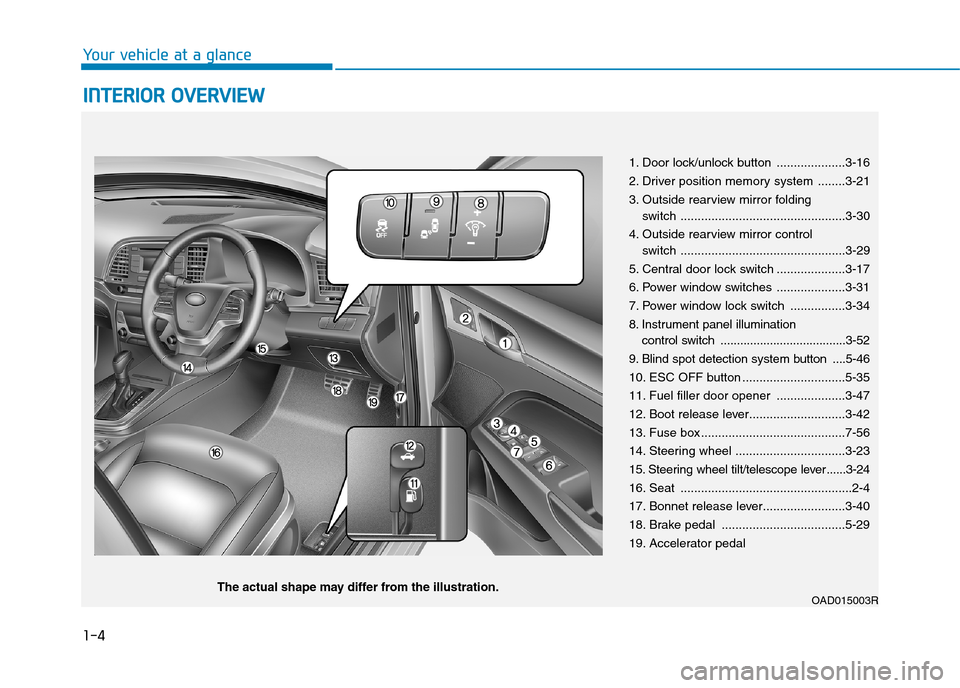
IINNTTEERRIIOORR OOVVEERRVVIIEEWW
1. Door lock/unlock button ....................3-16
2. Driver position memory system ........3-21
3. Outside rearview mirror folding
switch ................................................3-30
4. Outside rearview mirror control
switch ................................................3-29
5. Central door lock switch ....................3-17
6. Power window switches ....................3-31
7. Power window lock switch ................3-34
8. Instrument panel illumination
control switch ......................................3-52
9. Blind spot detection system button ....5-46
10. ESC OFF button ..............................5-35
11. Fuel filler door opener ....................3-47
12. Boot release lever............................3-42
13. Fuse box ..........................................7-56
14. Steering wheel ................................3-23
15. Steering wheel tilt/telescope lever ......3-24
16. Seat ..................................................2-4
17. Bonnet release lever........................3-40
18. Brake pedal ....................................5-29
19. Accelerator pedal
OAD015003RThe actual shape may differ from the illustration.
Page 26 of 571
1-5
Yo u r v e h i c l e a t a g l a n c e
1
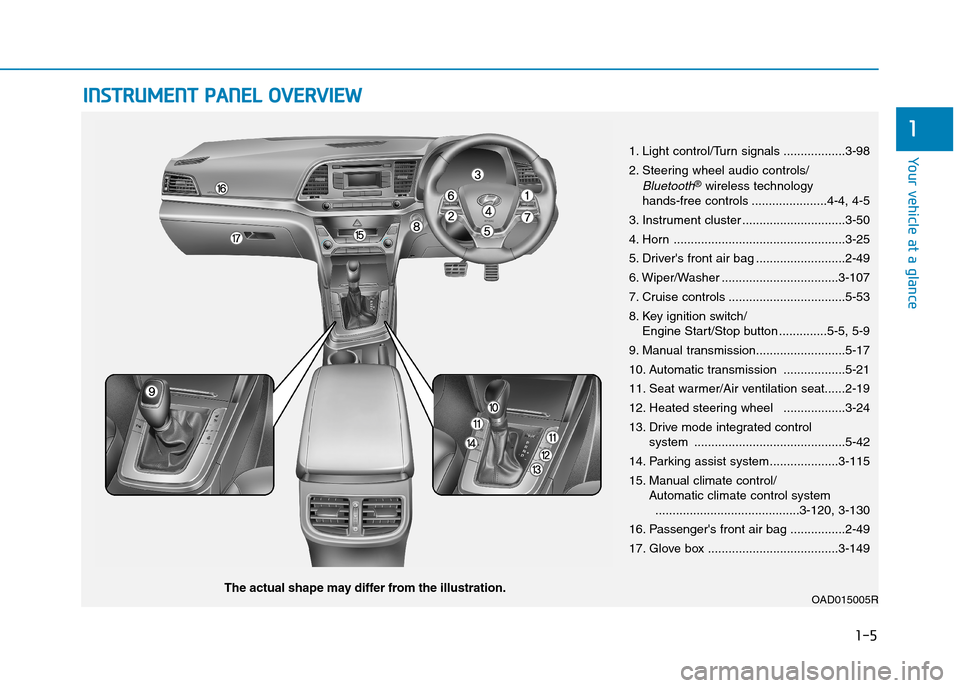
IINNSSTTRRUUMMEENNTT PPAANNEELL OOVVEERRVVIIEEWW
1. Light control/Turn signals ..................3-98
2. Steering wheel audio controls/
Bluetooth®wireless technology hands-free controls ......................4-4, 4-5
3. Instrument cluster ..............................3-50
4. Horn ..................................................3-25
5. Driver's front air bag ..........................2-49
6. Wiper/Washer ..................................3-107
7. Cruise controls ..................................5-53
8. Key ignition switch/Engine Start/Stop button ..............5-5, 5-9
9. Manual transmission..........................5-17
10. Automatic transmission ..................5-21
11. Seat warmer/Air ventilation seat......2-19
12. Heated steering wheel ..................3-24
13. Drive mode integrated control system ............................................5-42
14. Parking assist system....................3-115
15. Manual climate control/Automatic climate control system..........................................3-120, 3-130
16. Passenger's front air bag ................2-49
17. Glove box ......................................3-149
OAD015005RThe actual shape may differ from the illustration.
Page 32 of 571
2-5
Safety system of your vehicle
2
Safety precautions
Adjusting the seats so that you are sit-
ting in a safe, comfortable position
plays an important role in driver and
passenger safety, together with seat
belts and air bags, in an accident.
Air bags
Yo u c a n t a k e s t e p s t o r e d u c e t h e r i s k
of being injured by an inflating air
bag. Sitting too close to an air bag
greatly increases the risk of injury in
the event the air bag inflates. Move
your seat as far back as possible
from front air bags, whilst still main-
taining control of the vehicle.
Do not sit on a cushion. A pas-
senger may slide under the lap
portion of the seat belt during an
accident or a sudden stop.
Serious or fatal internal injuries
could result because the seat
belt cannot operate properly.
WA R N I N G
To r e d u c e t h e r i s k o f s e r i o u s
injury or death from an inflating
air bag, take the following pre-
cautions:
•Adjust the driver’s seat as far
to the rear as possible whilst
maintaining the ability to
maintain full control of the
vehicle.
•Adjust the front passenger
seat as far to the rear as pos-
sible.
•Hold the steering wheel by the
rim with hands at the 9 o’clock
and 3 o’clock positions to
minimise the risk of injuries to
your hands and arms.
•NEVER place anything or any-
one between the air bag.
•Do not allow the front passen-
ger to place their feet or legs
on the instrument panel, to
minimise the risk of leg
injuries.
WA R N I N G
Page 33 of 571
2-6
Safety system of your vehicle
Seat belts
Always fasten your seat belt before
starting any trip.
At all times, passengers should sit
upright and be properly restrained.
Infants and small children must be
restrained in appropriate child restraint
systems. Children who have outgrown
a booster seat as well as adults, must
be restrained using the seat belts.
Front seats
The front seat can be adjusted by
using the control switches located on
the outside of the seat cushion. Before
driving, adjust the seat to the proper
position so that you can easily control
the steering wheel, foot pedals and
controls on the instrument panel.
Ta k e t h e f o l l o w i n g p r e c a u t i o n s
when adjusting your seat belt:
•NEVER use one seat belt for
more than one occupant.
•Always position the seatback
upright with the lap portion of
the seat belt snug and low
across the hips.
•NEVER allow children or
small infants to ride in a pas-
senger’s lap.
•Do not route the seat belt
across your neck, across
sharp edges, or reroute the
shoulder strap away from
your body.
•Do not allow the seat belt to
become caught or jammed.
WA R N I N G
Ta k e t h e f o l l o w i n g p r e c a u t i o n s
when adjusting your seat:
•NEVER attempt to adjust the
seat whilst the vehicle is mov-
ing. The seat could respond
with unexpected movement
and may cause loss of vehicle
control resulting in an acci-
dent.
•Do not place anything under
the front seats. Loose objects
in the driver’s foot area could
interfere with the operation of
the foot pedals, causing an
accident.
(Continued)
WA R N I N G
Page 36 of 571
2-9
Safety system of your vehicle
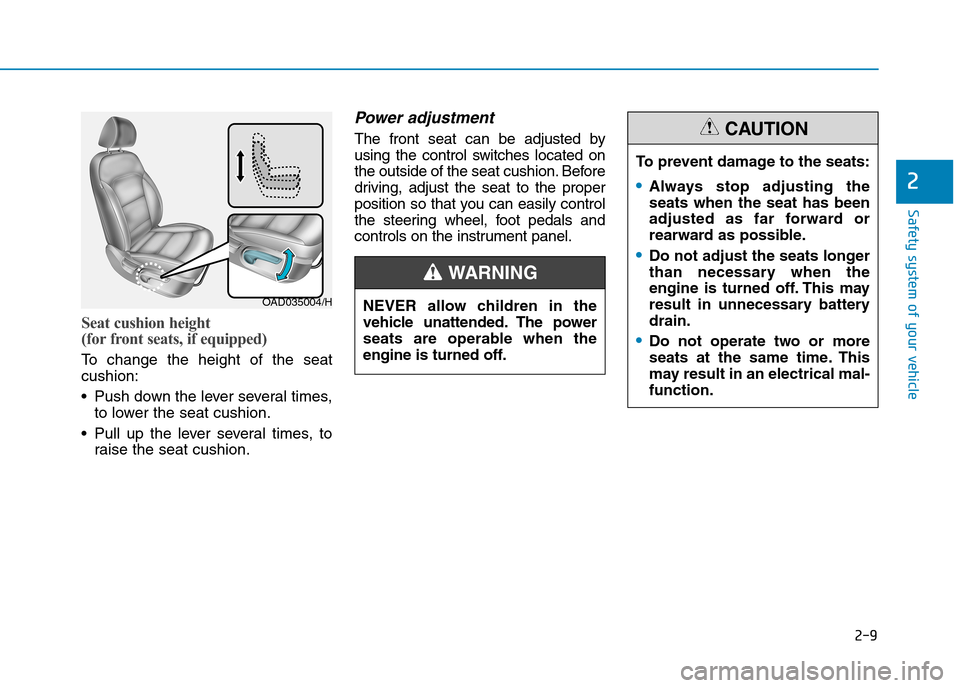
Seat cushion height
(for front seats, if equipped)
To c h a n g e t h e h e i g h t o f t h e s e a t
cushion:
•Push down the lever several times,
to lower the seat cushion.
•Pull up the lever several times, to
raise the seat cushion.
Power adjustment
The front seat can be adjusted by
using the control switches located on
the outside of the seat cushion. Before
driving, adjust the seat to the proper
position so that you can easily control
the steering wheel, foot pedals and
controls on the instrument panel.
2
OAD035004/H
To p r e v e n t d a m a g e t o t h e s e a t s :
•Always stop adjusting the
seats when the seat has been
adjusted as far forward or
rearward as possible.
•Do not adjust the seats longer
than necessary when the
engine is turned off. This may
result in unnecessary battery
drain.
•Do not operate two or more
seats at the same time. This
may result in an electrical mal-
function.
CAUTION
NEVER allow children in the
vehicle unattended. The power
seats are operable when the
engine is turned off.
WA R N I N G
Page 76 of 571
2-49
Safety system of your vehicle
2
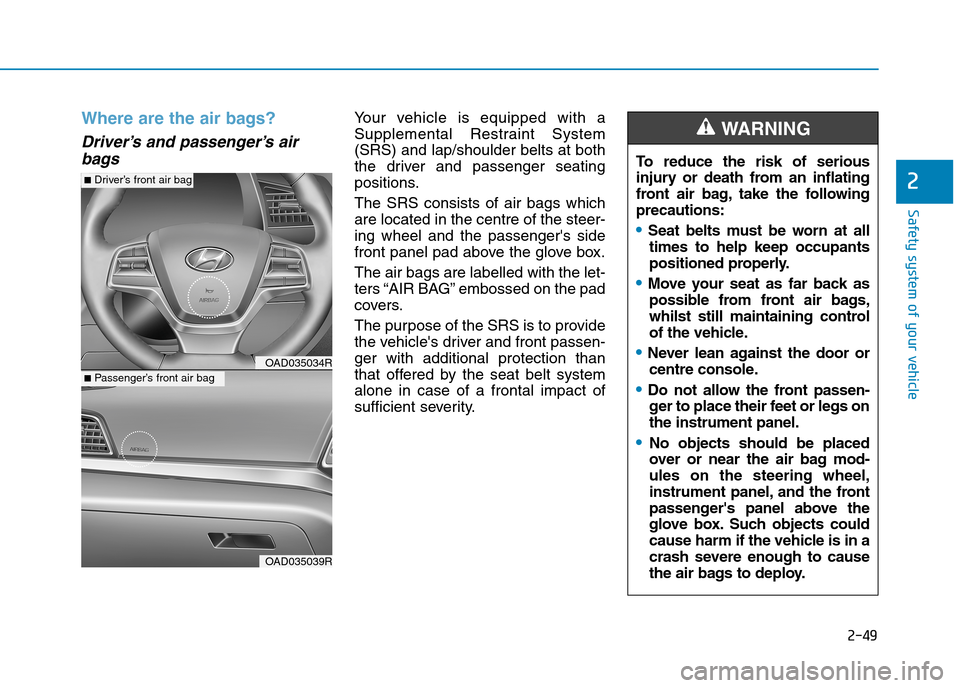
Where are the air bags?
Driver’s and passenger’s air
bags
Yo u r v e h i c l e i s e q u i p p e d w i t h a
Supplemental Restraint System
(SRS) and lap/shoulder belts at both
the driver and passenger seating
positions.
The SRS consists of air bags which
are located in the centre of the steer-
ing wheel and the passenger's side
front panel pad above the glove box.
The air bags are labelled with the let-
ters “AIR BAG” embossed on the pad
covers.
The purpose of the SRS is to provide
the vehicle's driver and front passen-
ger with additional protection than
that offered by the seat belt system
alone in case of a frontal impact of
sufficient severity.
OAD035034R
OAD035039R
■Driver’s front air bag
■Passenger’s front air bag
To r e d u c e t h e r i s k o f s e r i o u s
injury or death from an inflating
front air bag, take the following
precautions:
•Seat belts must be worn at all
times to help keep occupants
positioned properly.
•Move your seat as far back as
possible from front air bags,
whilst still maintaining control
of the vehicle.
•Never lean against the door or
centre console.
•Do not allow the front passen-
ger to place their feet or legs on
the instrument panel.
•No objects should be placed
over or near the air bag mod-
ules on the steering wheel,
instrument panel, and the front
passenger's panel above the
glove box. Such objects could
cause harm if the vehicle is in a
crash severe enough to cause
the air bags to deploy.
WA R N I N G
Page 77 of 571
2-50
Safety system of your vehicle
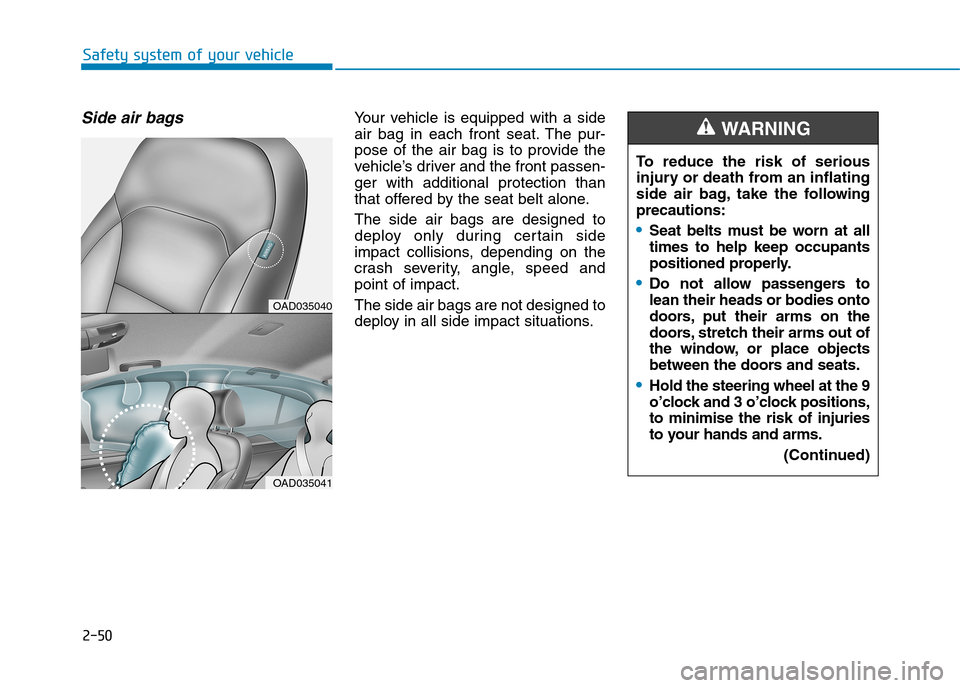
Side air bagsYo u r v e h i c l e i s e q u i p p e d w i t h a s i d e
air bag in each front seat. The pur-
pose of the air bag is to provide the
vehicle’s driver and the front passen-
ger with additional protection than
that offered by the seat belt alone.
The side air bags are designed to
deploy only during certain side
impact collisions, depending on the
crash severity, angle, speed and
point of impact.
The side air bags are not designed to
deploy in all side impact situations.
OAD035040
OAD035041
To r e d u c e t h e r i s k o f s e r i o u s
injury or death from an inflating
side air bag, take the following
precautions:
•Seat belts must be worn at all
times to help keep occupants
positioned properly.
•Do not allow passengers to
lean their heads or bodies onto
doors, put their arms on the
doors, stretch their arms out of
the window, or place objects
between the doors and seats.
•Hold the steering wheel at the 9
o’clock and 3 o’clock positions,
to minimise the risk of injuries
to your hands and arms.
(Continued)
WA R N I N G
Page 81 of 571
2-54
Safety system of your vehicle
•Air bag deployment depends on a
number of factors including vehicle
speed, angles of impact and the
density and stiffness of the vehi-
cles or objects which your vehicle
impacts during a collision. The
determining factors are not limited
to those mentioned above.
•The front air bags will completely
inflate and deflate in an instant. It is
virtually impossible for you to see
the air bags inflate during an acci-
dent. It is much more likely that you
will simply see the deflated air
bags hanging out of their storage
compartments after the collision.
•To help provide protection, the air
bags must inflate rapidly. The
speed of air bag inflation is a con-
sequence of an extremely short
time in which to inflate the air bag
between the occupant and the
vehicle structures before the occu-
pant impacts those structures. This
speed of inflation reduces the risk
of serious or life-threatening
injuries and is thus a necessary
part of air bag design.
However, the rapid air bag inflation
can also cause injuries which can
include facial abrasions, bruises
and broken bones because the
inflation speed also causes the air
bags to expand with a great deal of
force.
•There are even circumstances
under which contact with the air
bag can cause fatal injuries, espe-
cially if the occupant is positioned
excessively close to the air bag.
Yo u c a n t a k e s t e p s t o r e d u c e t h e r i s k
of being injured by an inflating air
bag. The greatest risk is sitting too
close to the air bag. An air bag needs
space to inflate. It is recommended
that drivers sit as far back as possi-
ble leaving space between the centre
of the steering wheel and the chest
while still maintaining control of the
vehicle.