mic Hyundai Elantra 2017 User Guide
[x] Cancel search | Manufacturer: HYUNDAI, Model Year: 2017, Model line: Elantra, Model: Hyundai Elantra 2017Pages: 637, PDF Size: 15.02 MB
Page 358 of 637
4-101
Multimedia System
4
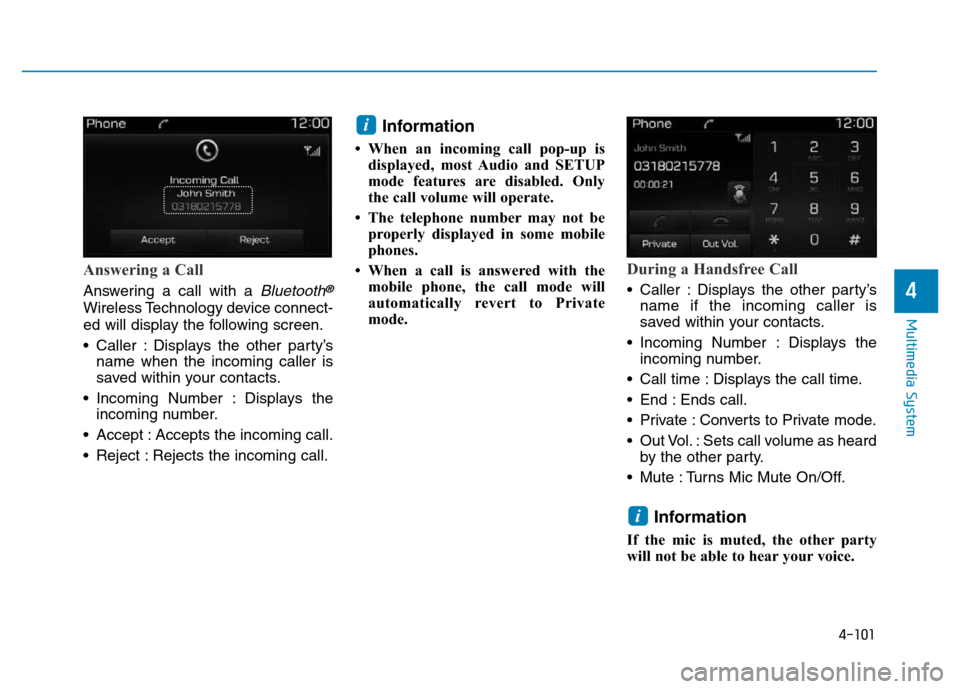
Answering a Call
Answering a call with a Bluetooth®
Wireless Technology device connect-
ed will display the following screen.
• Caller : Displays the other party’s
name when the incoming caller is
saved within your contacts.
• Incoming Number : Displays the
incoming number.
• Accept : Accepts the incoming call.
• Reject : Rejects the incoming call.
Information
• When an incoming call pop-up is
displayed, most Audio and SETUP
mode features are disabled. Only
the call volume will operate.
• The telephone number may not be
properly displayed in some mobile
phones.
• When a call is answered with the
mobile phone, the call mode will
automatically revert to Private
mode.
During a Handsfree Call
• Caller : Displays the other party’s
name if the incoming caller is
saved within your contacts.
• Incoming Number : Displays the
incoming number.
• Call time : Displays the call time.
• End : Ends call.
• Private : Converts to Private mode.
• Out Vol. : Sets call volume as heard
by the other party.
• Mute : Turns Mic Mute On/Off.
Information
If the mic is muted, the other party
will not be able to hear your voice.
i
i
Page 447 of 637
5-61
Driving your vehicle
5
When the ECO mode is activated:
• The acceleration response may be
slightly reduced as the accelerator
pedal is depressed moderately.
• The air conditioner performance
may be limited.
• The shift pattern of the automatic
transmission may change.
• The engine noise may get louder.
The above situations are normal
conditions when the ECO mode is
activated to improve fuel efficiency.Limitation of the ECO mode oper-
ation:
If the following conditions occur while
the ECO mode is operating, the sys-
tem operation is limited even though
there is no change in the ECO indi-
cator.
• When the coolant temperature is
low:
The system will be limited until
engine performance becomes nor-
mal.
• When driving up a hill:
The system will be limited to gain
power when driving uphill because
engine torque is restricted.
• When driving the vehicle with the
automatic transmission or the dual
clutch transmission gear shift lever
in manual shift mode:
The system will be limited accord-
ing to the shift location.
• When the accelerator pedal is
deeply depressed for a few sec-
onds:
The system will be limited, judging
that the driver wants to speed up.SPORT mode
SPORT mode manages
the driving dynamics by
automatically adjusting the
steering effort, the engine
and transmission control logic for
enhanced driver performance.
• When SPORT mode is selected by
pressing the DRIVE MODE button,
the SPORT indicator (orange
color) will illuminate.
• Whenever the engine is restarted,
the Drive Mode will revert back to
NORMAL mode. If SPORT mode is
desired, re-select SPORT mode
from the DRIVE MODE button.
• When SPORT mode is activated:
- The engine rpm will tend to
remain raised over a certain
length of time even after releas-
ing the accelerator
- Upshifts are delayed when accel-
erating
Information
In SPORT mode, the fuel efficiency
may decrease.
i
Page 545 of 637
7-34
Maintenance
Checking the engine oil and
filter
We recommend that the engine oil
and filter be replaced by an author-
ized HYUNDAI dealer.Used engine oil may cause irri-
tation or cancer of the skin if
left in contact with the skin for
prolonged periods of time. Used
engine oil contains chemicals
that have caused cancer in lab-
oratory animals. Always protect
your skin by washing your
hands thoroughly with soap
and warm water as soon as pos-
sible after handling used oil.
WARNING
Page 582 of 637
7-71
7
Maintenance
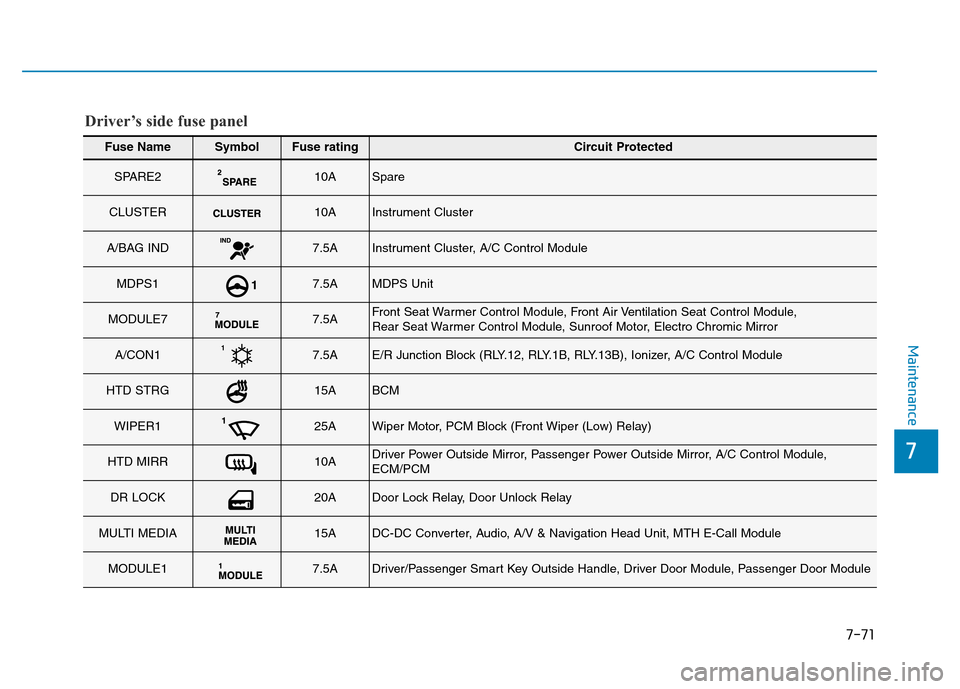
Fuse NameSymbolFuse ratingCircuit Protected
SPARE210ASpare
CLUSTER10AInstrument Cluster
A/BAG IND7.5AInstrument Cluster, A/C Control Module
MDPS17.5AMDPS Unit
MODULE77.5AFront Seat Warmer Control Module, Front Air Ventilation Seat Control Module,
Rear Seat Warmer Control Module, Sunroof Motor, Electro Chromic Mirror
A/CON17.5AE/R Junction Block (RLY.12, RLY.1B, RLY.13B), Ionizer, A/C Control Module
HTD STRG15ABCM
WIPER125AWiper Motor, PCM Block (Front Wiper (Low) Relay)
HTD MIRR10ADriver Power Outside Mirror, Passenger Power Outside Mirror, A/C Control Module,
ECM/PCM
DR LOCK20ADoor Lock Relay, Door Unlock Relay
MULTI MEDIA15ADC-DC Converter, Audio, A/V & Navigation Head Unit, MTH E-Call Module
MODULE17.5ADriver/Passenger Smart Key Outside Handle, Driver Door Module, Passenger Door Module
Driver’s side fuse panel
Page 587 of 637
Maintenance
7-76
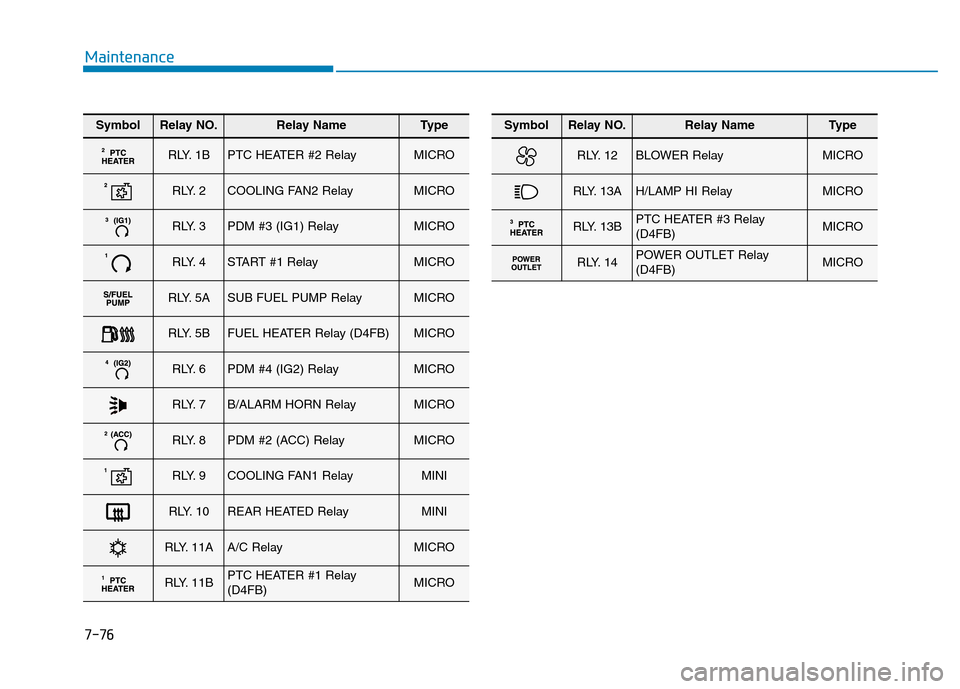
SymbolRelay NO.Relay NameType
R LY. 1 BPTC HEATER #2 RelayMICRO
R LY. 2COOLING FAN2 RelayMICRO
R LY. 3PDM #3 (IG1) RelayMICRO
R LY. 4START #1 RelayMICRO
R LY. 5 ASUB FUEL PUMP RelayMICRO
R LY. 5 BFUEL HEATER Relay (D4FB)MICRO
R LY. 6PDM #4 (IG2) RelayMICRO
R LY. 7B/ALARM HORN RelayMICRO
R LY. 8PDM #2 (ACC) RelayMICRO
R LY. 9COOLING FAN1 RelayMINI
R LY. 1 0REAR HEATED RelayMINI
R LY. 1 1 AA/C RelayMICRO
R LY. 1 1 BPTC HEATER #1 Relay
(D4FB)MICRO
SymbolRelay NO.Relay NameType
R LY. 1 2BLOWER RelayMICRO
R LY. 1 3 AH/LAMP HI RelayMICRO
R LY. 1 3 BPTC HEATER #3 Relay
(D4FB)MICRO
R LY. 1 4POWER OUTLET Relay
(D4FB)MICRO
Page 589 of 637
Maintenance
7-78
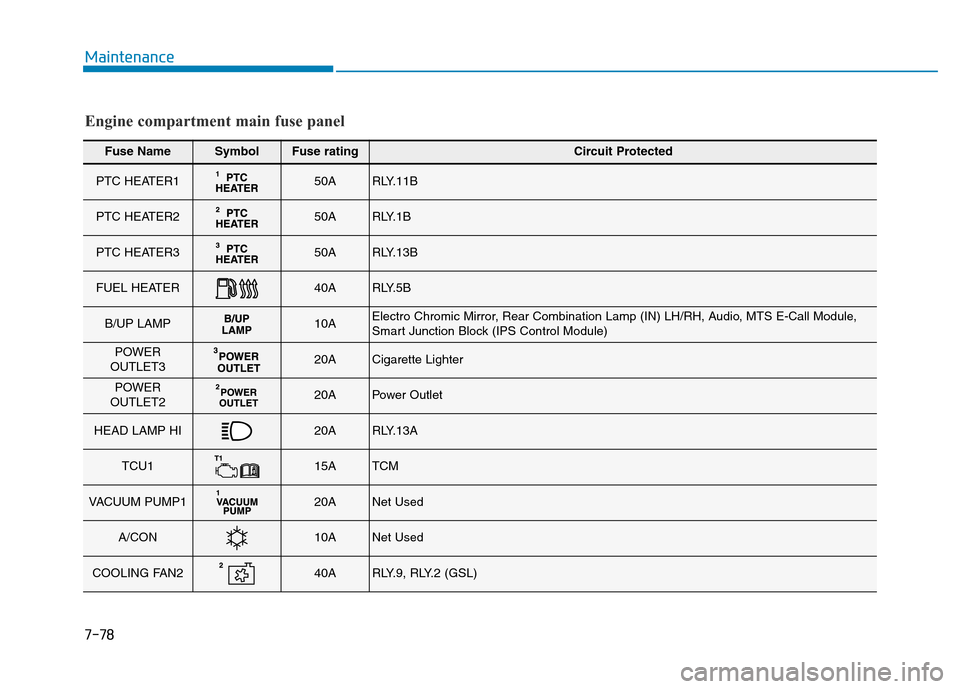
Fuse NameSymbolFuse ratingCircuit Protected
PTC HEATER150ARLY.11B
PTC HEATER250ARLY.1B
PTC HEATER350ARLY.13B
FUEL HEATER40ARLY.5B
B/UP LAMP10AElectro Chromic Mirror, Rear Combination Lamp (IN) LH/RH, Audio, MTS E-Call Module,
Smart Junction Block (IPS Control Module)
POWER
OUTLET320ACigarette Lighter
POWER
OUTLET220APower Outlet
HEAD LAMP HI20ARLY.13A
TCU115ATCM
VACUUM PUMP120ANet Used
A/CON10ANet Used
COOLING FAN240ARLY.9, RLY.2 (GSL)
Engine compartment main fuse panel
Page 614 of 637
7-103
7
Maintenance
APPEARANCE CARE
Exterior care
Exterior general caution
It is very important to follow the label
directions when using any chemical
cleaner or polish. Read all warning
and caution statements that appear
on the label.
High-pressure washing
• When using high-pressure wash-
ers, make sure to maintain suffi-
cient distance from the vehicle.
Insufficient clearance or excessive
pressure can lead to component
damage or water penetration.
• Do not spray the camera, sensors
or its surrounding area directly with
a high pressure washer. Shock
applied from high pressure water
may cause the device to not oper-
ate normally.
• Do not bring the nozzle tip close to
boots (rubber or plastic covers) or
connectors as they may be dam-
aged if they come into contact with
high pressure water.
Finish maintenance
Washing
To help protect your vehicle’s finish
from rust and deterioration, wash it
thoroughly and frequently at least
once a month with lukewarm or cold
water.
If you use your vehicle for off-road
driving, you should wash it after each
off-road trip. Pay special attention to
the removal of any accumulation of
salt, dirt, mud, and other foreign
materials. Make sure the drain holes
in the lower edges of the doors and
rocker panels are kept clear and
clean.
Insects, tar, tree sap, bird droppings,
industrial pollution and similar
deposits can damage your vehicle’s
finish if not removed immediately.
Even prompt washing with plain
water may not completely remove all
these deposits.
A mild soap, safe for use on painted
surfaces, may be used.
After washing, rinse the vehicle thor-
oughly with lukewarm or cold water.
Do not allow soap to dry on the finish.• Do not use strong soap, chemi-
cal detergents or hot water, and
do not wash the vehicle in direct
sunlight or when the body of the
vehicle is warm.
• Be careful when washing the
side windows of your vehicle.
Especially, with high-pressure
water, water may leak through
the windows and wet the interi-
or.
• To prevent damage to the plastic
parts and lamps, do not clean
with chemical solvents or strong
detergents.
NOTICE
Page 618 of 637
7-107
7
Maintenance
High-corrosion areas
If you live in an area where your car
is regularly exposed to corrosive
materials, corrosion protection is
particularly important. Some of the
common causes of accelerated cor-
rosion are road salts, dust control
chemicals, ocean air and industrial
pollution.
Moisture breeds corrosion
Moisture creates the conditions in
which corrosion is most likely to
occur. For example, corrosion is
accelerated by high humidity, partic-
ularly when temperatures are just
above freezing. In such conditions,
the corrosive material is kept in con-
tact with the car surfaces by moisture
that is slow to evaporate.
Mud is particularly corrosive
because it is slow to dry and holds
moisture in contact with the vehicle.
Although the mud appears to be dry,
it can still retain the moisture and
promote corrosion.High temperatures can also acceler-
ate corrosion of parts that are not
properly ventilated so the moisture
can be dispersed. For all these rea-
sons, it is particularly important to
keep your car clean and free of mud
or accumulations of other materials.
This applies not only to the visible
surfaces but particularly to the
underside of the car.To help prevent corrosion
You can help prevent corrosion from
getting started by observing the fol-
lowing:Keep your car clean
The best way to prevent corrosion is
to keep your car clean and free of
corrosive materials. Attention to the
underside of the car is particularly
important.
• If you live in a high-corrosion area
— where road salts are used, near
the ocean, areas with industrial
pollution, acid rain, etc.—, you
should take extra care to prevent
corrosion. In winter, hose off the
underside of your car at least once
a month and be sure to clean the
underside thoroughly when winter
is over.
• When cleaning underneath the car,
give particular attention to the
components under the fenders and
other areas that are hidden from
view. Do a thorough job; just damp-
ening the accumulated mud rather
than washing it away will acceler-
ate corrosion rather than prevent
it. Water under high pressure and
steam are particularly effective in
removing accumulated mud and
corrosive materials.
Page 620 of 637
7-109
7
Maintenance
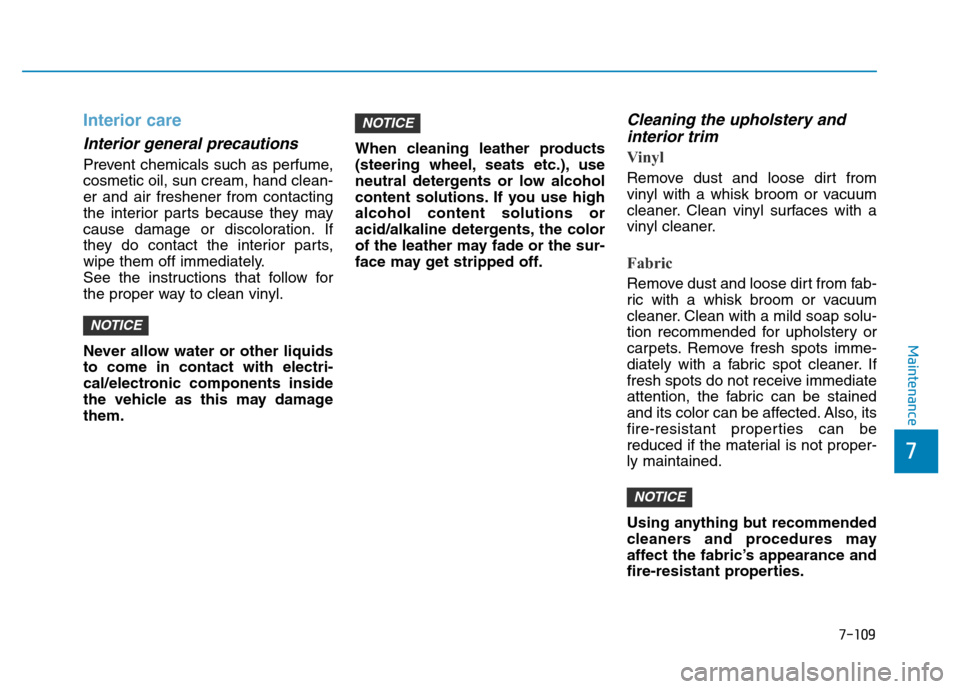
Interior care
Interior general precautions
Prevent chemicals such as perfume,
cosmetic oil, sun cream, hand clean-
er and air freshener from contacting
the interior parts because they may
cause damage or discoloration. If
they do contact the interior parts,
wipe them off immediately.
See the instructions that follow for
the proper way to clean vinyl.
Never allow water or other liquids
to come in contact with electri-
cal/electronic components inside
the vehicle as this may damage
them.When cleaning leather products
(steering wheel, seats etc.), use
neutral detergents or low alcohol
content solutions. If you use high
alcohol content solutions or
acid/alkaline detergents, the color
of the leather may fade or the sur-
face may get stripped off.
Cleaning the upholstery and
interior trim
Vinyl
Remove dust and loose dirt from
vinyl with a whisk broom or vacuum
cleaner. Clean vinyl surfaces with a
vinyl cleaner.
Fabric
Remove dust and loose dirt from fab-
ric with a whisk broom or vacuum
cleaner. Clean with a mild soap solu-
tion recommended for upholstery or
carpets. Remove fresh spots imme-
diately with a fabric spot cleaner. If
fresh spots do not receive immediate
attention, the fabric can be stained
and its color can be affected. Also, its
fire-resistant properties can be
reduced if the material is not proper-
ly maintained.
Using anything but recommended
cleaners and procedures may
affect the fabric’s appearance and
fire-resistant properties.
NOTICE
NOTICE
NOTICE
Page 632 of 637
8-6
Specifications & Consumer information
R RE
EC
CO
OM
MM
ME
EN
ND
DE
ED
D
L
LU
UB
BR
RI
IC
CA
AN
NT
TS
S
A
AN
ND
D
C
CA
AP
PA
AC
CI
IT
TI
IE
ES
S
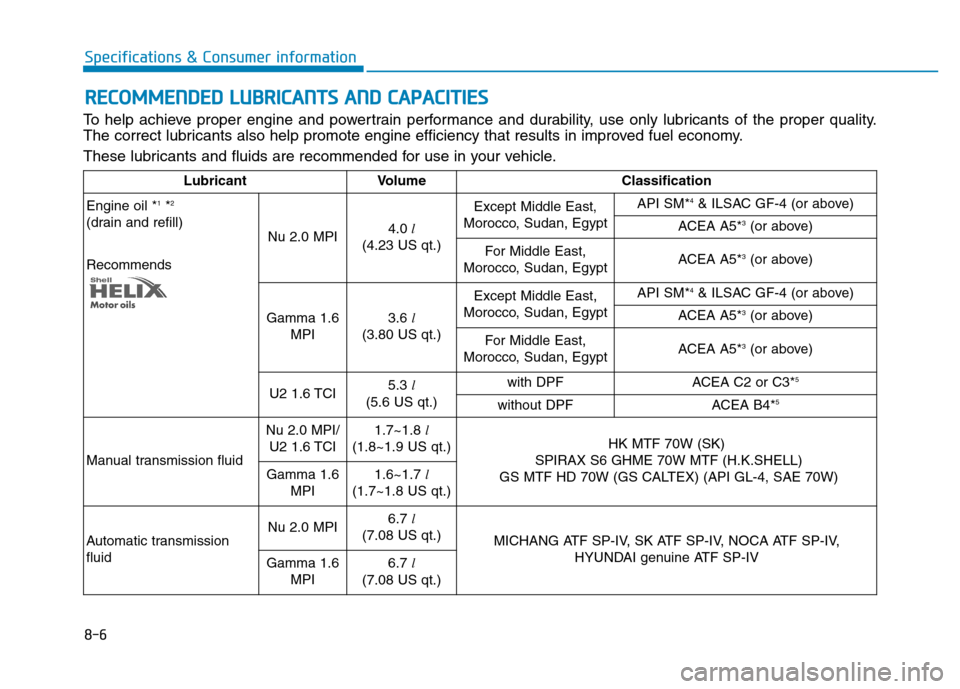
To help achieve proper engine and powertrain performance and durability, use only lubricants of the proper quality.
The correct lubricants also help promote engine efficiency that results in improved fuel economy.
These lubricants and fluids are recommended for use in your vehicle.
Lubricant Volume Classification
Engine oil *
1*2
(drain and refill)
RecommendsNu 2.0 MPI4.0l
(4.23 US qt.)Except Middle East,
Morocco, Sudan, EgyptAPI SM*
4& ILSAC GF-4 (or above)
ACEA A5*
3(or above)
For Middle East,
Morocco, Sudan, EgyptACEA A5*
3(or above)
Gamma 1.6
MPI3.6 l
(3.80 US qt.)Except Middle East,
Morocco, Sudan, EgyptAPI SM*
4& ILSAC GF-4 (or above)
ACEA A5*
3(or above)
For Middle East,
Morocco, Sudan, EgyptACEA A5*
3(or above)
U2 1.6 TCI5.3 l
(5.6 US qt.)with DPF ACEA C2 or C3*
5
without DPF ACEA B4*5
Manual transmission fluidNu 2.0 MPI/
U2 1.6 TCI1.7~1.8 l
(1.8~1.9 US qt.)HK MTF 70W (SK)
SPIRAX S6 GHME 70W MTF (H.K.SHELL)
GS MTF HD 70W (GS CALTEX) (API GL-4, SAE 70W) Gamma 1.6
MPI1.6~1.7 l
(1.7~1.8 US qt.)
Automatic transmission
fluidNu 2.0 MPI6.7 l
(7.08 US qt.)
MICHANG ATF SP-IV, SK ATF SP-IV, NOCA ATF SP-IV,
HYUNDAI genuine ATF SP-IV
Gamma 1.6
MPI6.7 l
(7.08 US qt.)