warning Hyundai Elantra 2017 Owner's Manual
[x] Cancel search | Manufacturer: HYUNDAI, Model Year: 2017, Model line: Elantra, Model: Hyundai Elantra 2017Pages: 637, PDF Size: 15.02 MB
Page 576 of 637
7-65
7
Maintenance
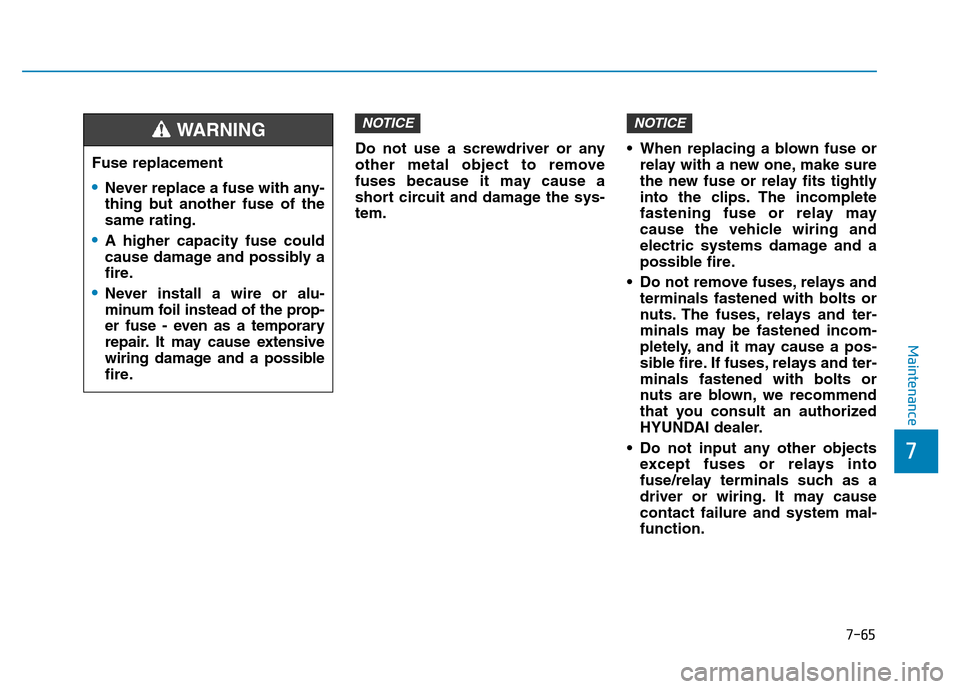
Do not use a screwdriver or any
other metal object to remove
fuses because it may cause a
short circuit and damage the sys-
tem.• When replacing a blown fuse or
relay with a new one, make sure
the new fuse or relay fits tightly
into the clips. The incomplete
fastening fuse or relay may
cause the vehicle wiring and
electric systems damage and a
possible fire.
• Do not remove fuses, relays and
terminals fastened with bolts or
nuts. The fuses, relays and ter-
minals may be fastened incom-
pletely, and it may cause a pos-
sible fire. If fuses, relays and ter-
minals fastened with bolts or
nuts are blown, we recommend
that you consult an authorized
HYUNDAI dealer.
• Do not input any other objects
except fuses or relays into
fuse/relay terminals such as a
driver or wiring. It may cause
contact failure and system mal-
function.
NOTICENOTICE
Fuse replacement
•Never replace a fuse with any-
thing but another fuse of the
same rating.
•A higher capacity fuse could
cause damage and possibly a
fire.
•Never install a wire or alu-
minum foil instead of the prop-
er fuse - even as a temporary
repair. It may cause extensive
wiring damage and a possible
fire.
WARNING
Page 585 of 637
Maintenance
7-74
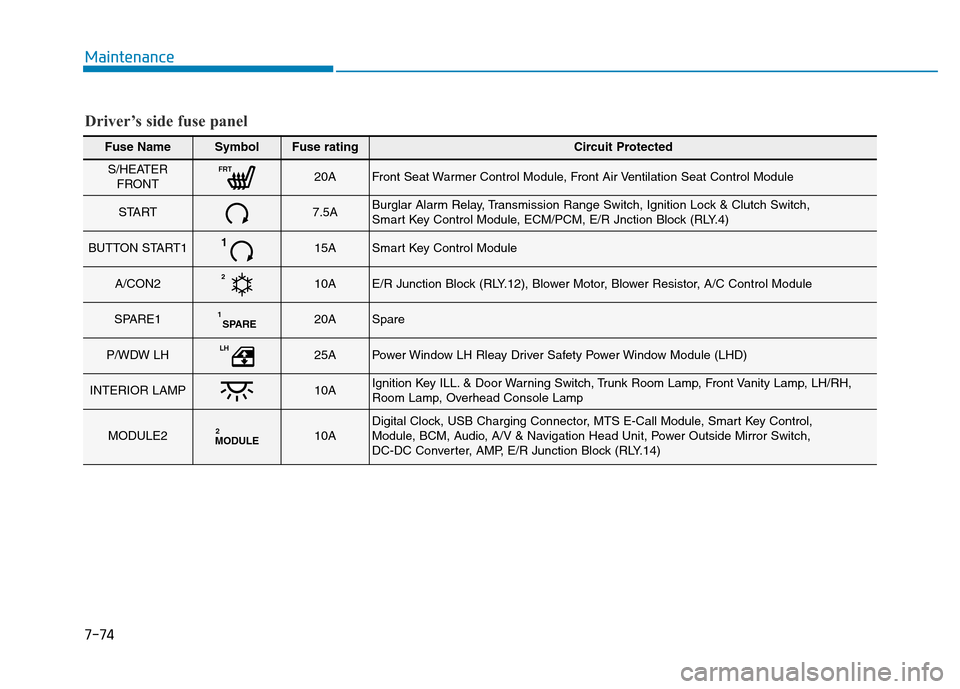
Fuse NameSymbolFuse ratingCircuit Protected
S/HEATER
FRONTFRT20AFront Seat Warmer Control Module, Front Air Ventilation Seat Control Module
START7.5ABurglar Alarm Relay, Transmission Range Switch, Ignition Lock & Clutch Switch,
Smart Key Control Module, ECM/PCM, E/R Jnction Block (RLY.4)
BUTTON START1115ASmart Key Control Module
A/CON2210AE/R Junction Block (RLY.12), Blower Motor, Blower Resistor, A/C Control Module
SPARE1SPARE120ASpare
P/WDW LHLH25APower Window LH Rleay Driver Safety Power Window Module (LHD)
INTERIOR LAMP10AIgnition Key ILL. & Door Warning Switch, Trunk Room Lamp, Front Vanity Lamp, LH/RH,
Room Lamp, Overhead Console Lamp
MODULE2MODULE210ADigital Clock, USB Charging Connector, MTS E-Call Module, Smart Key Control,
Module, BCM, Audio, A/V & Navigation Head Unit, Power Outside Mirror Switch,
DC-DC Converter, AMP, E/R Junction Block (RLY.14)
Driver’s side fuse panel
Page 593 of 637
Maintenance
7-82
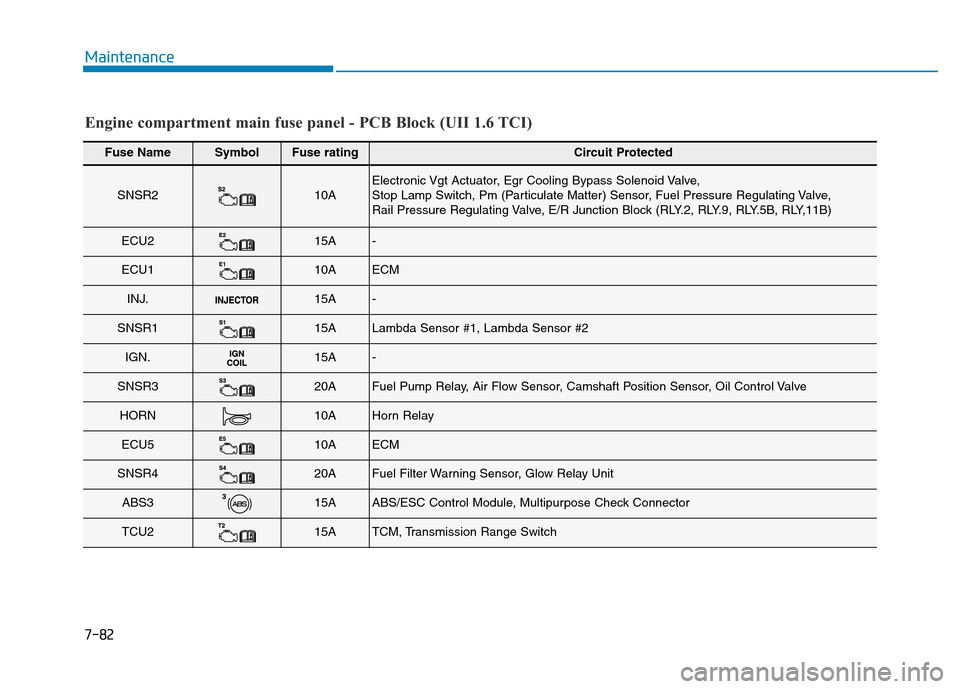
Engine compartment main fuse panel - PCB Block (UII 1.6 TCI)
Fuse NameSymbolFuse ratingCircuit Protected
SNSR210AElectronic Vgt Actuator, Egr Cooling Bypass Solenoid Valve,
Stop Lamp Switch, Pm (Particulate Matter) Sensor, Fuel Pressure Regulating Valve,
Rail Pressure Regulating Valve, E/R Junction Block (RLY.2, RLY.9, RLY.5B, RLY,11B)
ECU215A-
ECU110AECM
INJ.15A-
SNSR115ALambda Sensor #1, Lambda Sensor #2
IGN.15A-
SNSR320AFuel Pump Relay, Air Flow Sensor, Camshaft Position Sensor, Oil Control Valve
HORN10AHorn Relay
ECU510AECM
SNSR420AFuel Filter Warning Sensor, Glow Relay Unit
ABS315AABS/ESC Control Module, Multipurpose Check Connector
TCU215ATCM, Transmission Range Switch
Page 595 of 637
7-84
Maintenance
LIGHT BULBS
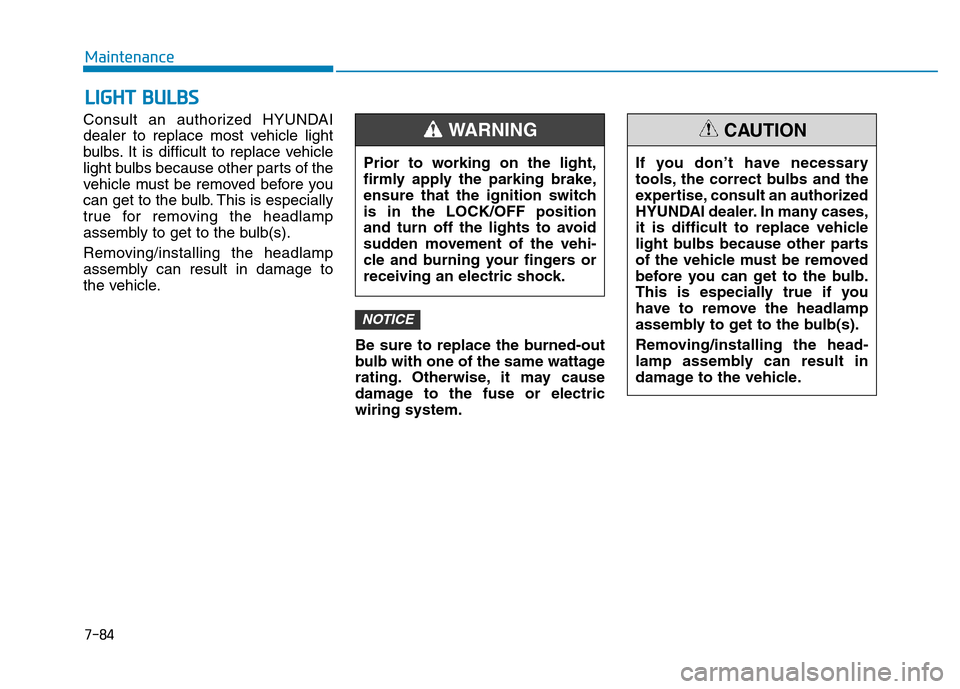
Consult an authorized HYUNDAI
dealer to replace most vehicle light
bulbs. It is difficult to replace vehicle
light bulbs because other parts of the
vehicle must be removed before you
can get to the bulb. This is especially
true for removing the headlamp
assembly to get to the bulb(s).
Removing/installing the headlamp
assembly can result in damage to
the vehicle.
Be sure to replace the burned-out
bulb with one of the same wattage
rating. Otherwise, it may cause
damage to the fuse or electric
wiring system.
NOTICE
If you don’t have necessary
tools, the correct bulbs and the
expertise, consult an authorized
HYUNDAI dealer. In many cases,
it is difficult to replace vehicle
light bulbs because other parts
of the vehicle must be removed
before you can get to the bulb.
This is especially true if you
have to remove the headlamp
assembly to get to the bulb(s).
Removing/installing the head-
lamp assembly can result in
damage to the vehicle.
CAUTION
Prior to working on the light,
firmly apply the parking brake,
ensure that the ignition switch
is in the LOCK/OFF position
and turn off the lights to avoid
sudden movement of the vehi-
cle and burning your fingers or
receiving an electric shock.
WARNING
Page 597 of 637
7-86
Maintenance
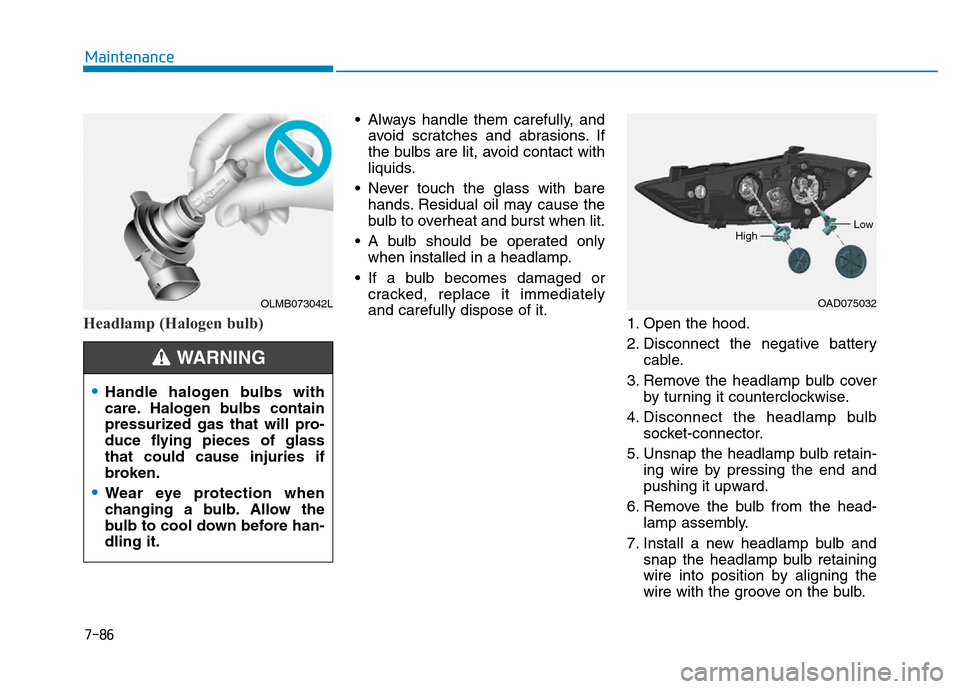
Headlamp (Halogen bulb)
• Always handle them carefully, and
avoid scratches and abrasions. If
the bulbs are lit, avoid contact with
liquids.
• Never touch the glass with bare
hands. Residual oil may cause the
bulb to overheat and burst when lit.
• A bulb should be operated only
when installed in a headlamp.
• If a bulb becomes damaged or
cracked, replace it immediately
and carefully dispose of it.
1. Open the hood.
2. Disconnect the negative battery
cable.
3. Remove the headlamp bulb cover
by turning it counterclockwise.
4. Disconnect the headlamp bulb
socket-connector.
5. Unsnap the headlamp bulb retain-
ing wire by pressing the end and
pushing it upward.
6. Remove the bulb from the head-
lamp assembly.
7. Install a new headlamp bulb and
snap the headlamp bulb retaining
wire into position by aligning the
wire with the groove on the bulb.
OLMB073042L
•Handle halogen bulbs with
care. Halogen bulbs contain
pressurized gas that will pro-
duce flying pieces of glass
that could cause injuries if
broken.
•Wear eye protection when
changing a bulb. Allow the
bulb to cool down before han-
dling it.
WARNING
OAD075032
HighLow
Page 599 of 637
7-88
Maintenance
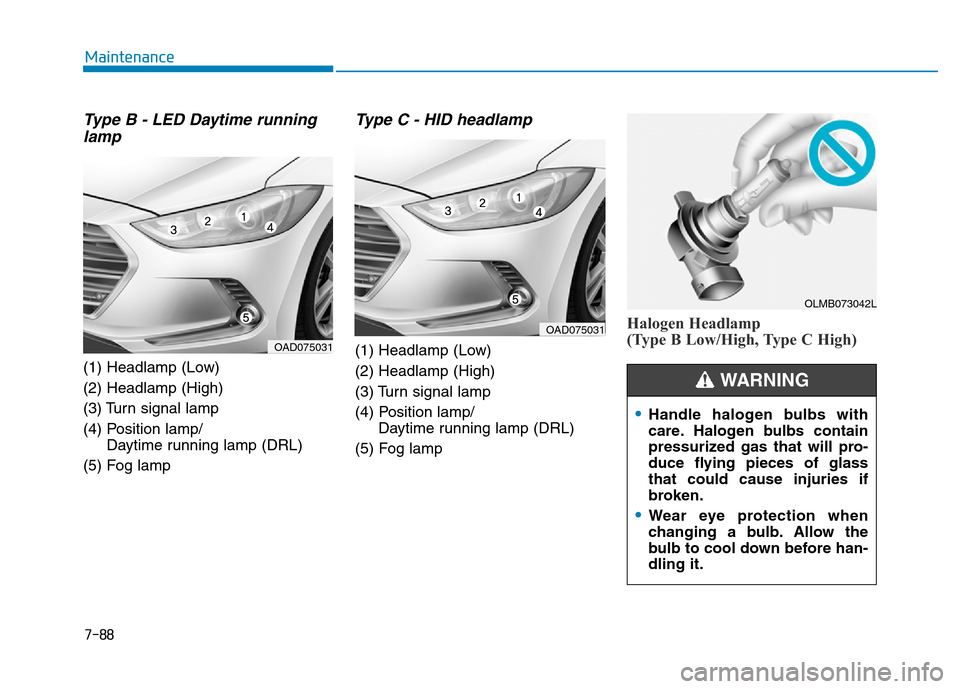
Type B - LED Daytime running
lamp
(1) Headlamp (Low)
(2) Headlamp (High)
(3) Turn signal lamp
(4) Position lamp/
Daytime running lamp (DRL)
(5) Fog lamp
Type C - HID headlamp
(1) Headlamp (Low)
(2) Headlamp (High)
(3) Turn signal lamp
(4) Position lamp/
Daytime running lamp (DRL)
(5) Fog lamp
Halogen Headlamp
(Type B Low/High, Type C High)
OAD075031
OAD075031
OLMB073042L
•Handle halogen bulbs with
care. Halogen bulbs contain
pressurized gas that will pro-
duce flying pieces of glass
that could cause injuries if
broken.
•Wear eye protection when
changing a bulb. Allow the
bulb to cool down before han-
dling it.
WARNING
Page 601 of 637

7-90
Maintenance
HID Headlamp (Type C Low)
If the HID lamp does not operate, we
recommend that the system be
checked by an authorized HYUNDAI
dealer.Information
HID lamps have superior perform-
ance vs. halogen bulbs.
HID lamps are estimated by the man-
ufacturer to last twice as long or
longer than halogen bulbs depending
on their frequency of use. They will
probably require replacement at some
point in the life of the vehicle. Cycling
the headlamps on and off more than
typical use will shorten HID lamps
life. HID lamps do not fail in the same
manner as halogen incandescent
lamps. If a headlamp goes out after a
period of operation but will immedi-
ately relight when the headlamp
switch is cycled it is likely the HID
lamp needs to be replaced. HID light-
ing components are more complex
than conventional halogen bulbs thus
have higher replacement cost.
Turn signal lamp
1. Open the hood.
2. Disconnect the negative battery
cable.
3.Remove the socket from the
assembly by turning the socket
counterclockwise until the tabs on
the socket align with the slots on
the assembly.
4.Remove the bulb from the socket
by pressing it in and rotating it
counterclockwise until the tabs on
the bulb align with the slots in the
socket. Pull the bulb out of the
socket.
i
HID Headlight low beam
(if equipped)
Do not attempt to replace or
inspect the low beam (XENON
bulb) due to electric shock dan-
ger. If the low beam (XENON
bulb) is not working, we recom-
mend that the system be
checked by an authorized
HYUNDAI dealer.
WARNING
OAD075033
Page 613 of 637
7-102
Maintenance
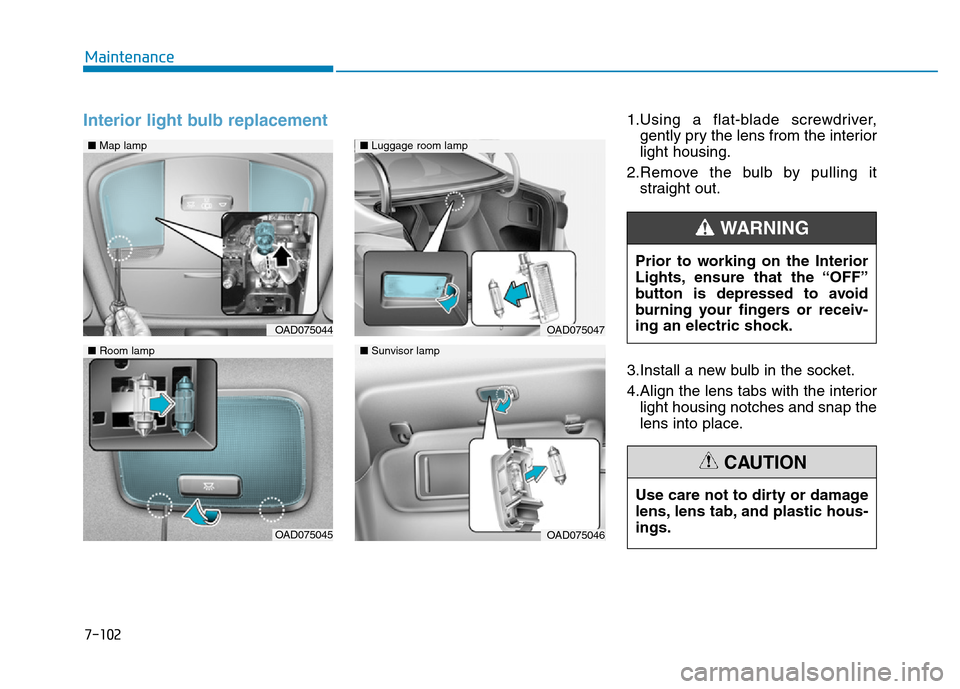
Interior light bulb replacement1.Using a flat-blade screwdriver,
gently pry the lens from the interior
light housing.
2.Remove the bulb by pulling it
straight out.
3.Install a new bulb in the socket.
4.Align the lens tabs with the interior
light housing notches and snap the
lens into place.
■Map lamp
OAD075044
OAD075045
■Luggage room lamp
■Sunvisor lamp
OAD075047
OAD075046
■Room lamp
Prior to working on the Interior
Lights, ensure that the “OFF”
button is depressed to avoid
burning your fingers or receiv-
ing an electric shock.
WARNING
Use care not to dirty or damage
lens, lens tab, and plastic hous-
ings.
CAUTION
Page 614 of 637
7-103
7
Maintenance
APPEARANCE CARE
Exterior care
Exterior general caution
It is very important to follow the label
directions when using any chemical
cleaner or polish. Read all warning
and caution statements that appear
on the label.
High-pressure washing
• When using high-pressure wash-
ers, make sure to maintain suffi-
cient distance from the vehicle.
Insufficient clearance or excessive
pressure can lead to component
damage or water penetration.
• Do not spray the camera, sensors
or its surrounding area directly with
a high pressure washer. Shock
applied from high pressure water
may cause the device to not oper-
ate normally.
• Do not bring the nozzle tip close to
boots (rubber or plastic covers) or
connectors as they may be dam-
aged if they come into contact with
high pressure water.
Finish maintenance
Washing
To help protect your vehicle’s finish
from rust and deterioration, wash it
thoroughly and frequently at least
once a month with lukewarm or cold
water.
If you use your vehicle for off-road
driving, you should wash it after each
off-road trip. Pay special attention to
the removal of any accumulation of
salt, dirt, mud, and other foreign
materials. Make sure the drain holes
in the lower edges of the doors and
rocker panels are kept clear and
clean.
Insects, tar, tree sap, bird droppings,
industrial pollution and similar
deposits can damage your vehicle’s
finish if not removed immediately.
Even prompt washing with plain
water may not completely remove all
these deposits.
A mild soap, safe for use on painted
surfaces, may be used.
After washing, rinse the vehicle thor-
oughly with lukewarm or cold water.
Do not allow soap to dry on the finish.• Do not use strong soap, chemi-
cal detergents or hot water, and
do not wash the vehicle in direct
sunlight or when the body of the
vehicle is warm.
• Be careful when washing the
side windows of your vehicle.
Especially, with high-pressure
water, water may leak through
the windows and wet the interi-
or.
• To prevent damage to the plastic
parts and lamps, do not clean
with chemical solvents or strong
detergents.
NOTICE
Page 615 of 637
7-104
Maintenance
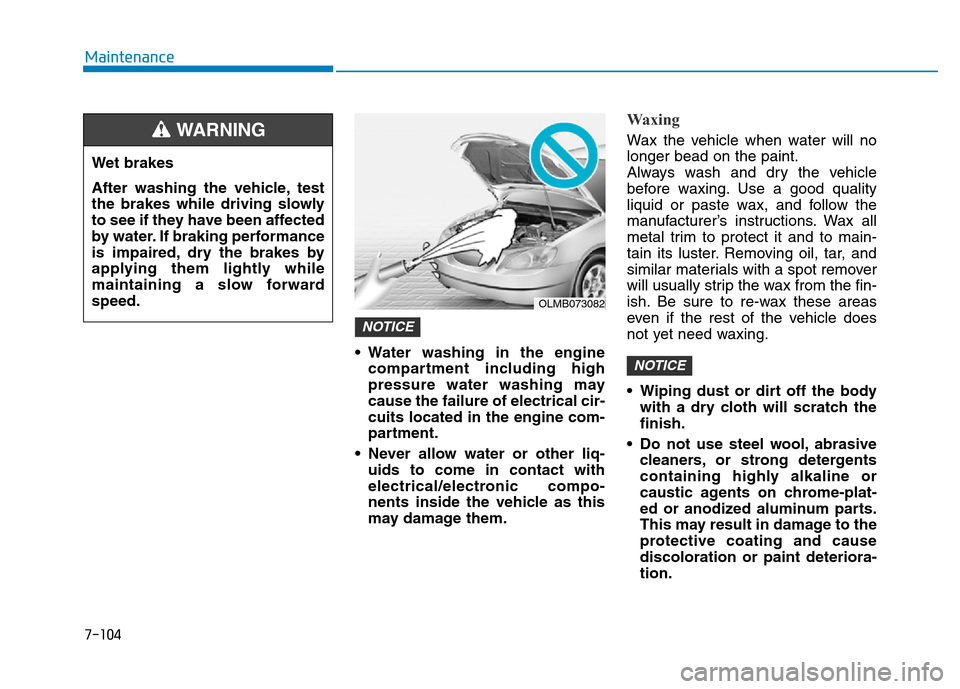
• Water washing in the engine
compartment including high
pressure water washing may
cause the failure of electrical cir-
cuits located in the engine com-
partment.
• Never allow water or other liq-
uids to come in contact with
electrical/electronic compo-
nents inside the vehicle as this
may damage them.
Waxing
Wax the vehicle when water will no
longer bead on the paint.
Always wash and dry the vehicle
before waxing. Use a good quality
liquid or paste wax, and follow the
manufacturer’s instructions. Wax all
metal trim to protect it and to main-
tain its luster. Removing oil, tar, and
similar materials with a spot remover
will usually strip the wax from the fin-
ish. Be sure to re-wax these areas
even if the rest of the vehicle does
not yet need waxing.
• Wiping dust or dirt off the body
with a dry cloth will scratch the
finish.
• Do not use steel wool, abrasive
cleaners, or strong detergents
containing highly alkaline or
caustic agents on chrome-plat-
ed or anodized aluminum parts.
This may result in damage to the
protective coating and cause
discoloration or paint deteriora-
tion.
NOTICE
NOTICE
Wet brakes
After washing the vehicle, test
the brakes while driving slowly
to see if they have been affected
by water. If braking performance
is impaired, dry the brakes by
applying them lightly while
maintaining a slow forward
speed.
WARNING
OLMB073082