front seat Hyundai Elantra 2017 Owner's Guide
[x] Cancel search | Manufacturer: HYUNDAI, Model Year: 2017, Model line: Elantra, Model: Hyundai Elantra 2017Pages: 637, PDF Size: 15.02 MB
Page 52 of 637

2-22
Safety system of your vehicle
Seat warmers and air ventilation
seats (if equipped)
The seat warmers and air ventilation
seats are provided to warm or cool
the front seats by blowing air through
small vent holes on the surface of the
seat cushions and seatbacks.When the operation of the seat
warmers or air ventilation seat are
not needed, keep the switches in the
OFF position.
While the engine is running, push the
switch to warm or cool the driver's
seat or the front passenger's seat (if
equipped).
• Each time you push the switch, the
airflow changes as follows:
• When pressing the switch for more
than 1.5 seconds with the seat
warmer or air ventilation seat oper-
ating, the seat warmer will turn
OFF.
• The seat warmers or air ventilation
seats defaults to the OFF position
whenever the ignition switch is
placed to the ON position.
Information
With the seat warmer switch in the
ON position, the heating system in the
seat turns off or on automatically
depending on the seat temperature.
i
OAD035016
OFF HIGH ( )
LOW ( ) MIDDLE ( )
→→
→
→
■Seat warmer
■Air ventilation seatOAD035072L
To prevent damage to the seat
warmer, air ventilation seat and
seats:
•Use the seat warmer and air
ventilation seat ONLY when
the climate control system is
on. Using the seat warmer and
air ventilation seat for pro-
longed periods of time with
the climate control system off
could cause the seat warmer
and air ventilation seat to mal-
function.
•Never use a solvent such as
paint thinner, benzene, alco-
hol or gasoline to clean the
seats.
(Continued)
CAUTION
Page 53 of 637

2-23
Safety system of your vehicle
2
Rear seat warmers (if equipped)
While the engine is running, push
either of the switches to warm the rear
seat.
During mild weather or under condi-
tions where the operation of the seat
warmer is not needed, keep the
switches in the OFF position.Each time you push the switch, the
temperature setting of the seat is
changed as follows :
The seat warmer defaults to the OFF
position whenever the ignition switch
is placed in the ON position.
Information
With the seat warmer switch in the
ON position, the heating system in the
seat turns off or on automatically
depending on the seat temperature.
i
(Continued)
•Avoid spilling liquids on the
surface of the front seats and
seatbacks; this may cause the
air vent holes to become
blocked and not work properly.
•Do not place materials such
as plastic bags or newspa-
pers under the seats. They
may block the air intake caus-
ing the air vents to not work
properly.
•Do not change the seat cov-
ers. It may damage the seat
warmer or air ventilation seat.
•If the air vents do not operate,
restart the vehicle. If there is
no change, we recommend
that you have your vehicle
inspected by an authorized
HYUNDAI dealer.
OAD035024
OFF →HIGH ( ) →LOW ( )
→
Page 54 of 637

2-24
Safety system of your vehicle
This section describes how to use the
seat belts properly. It also describes
some of the things not to do when
using seat belts.
Seat belt safety precautions
Always fasten your seat belt and
make sure all passengers have fas-
tened their seat belts before starting
any trip. Air bags (if equipped) are
designed to supplement the seat belt
as an additional safety device, but
they are not a substitute. Most coun-
tries require all occupants of a vehicle
to wear seat belts.
SEAT BELTS
Seat belts must be used by ALL
passengers whenever the vehi-
cle is moving. Take the following
precautions when adjusting and
wearing seat belts:
•ALWAYS properly restrain
children under age 13 in the
rear seats.
•NEVER allow children to ride
in the front passenger seat. If
a child age 13 or older must be
seated in the front seat, move
the seat as far back as possi-
ble and properly restrain them
in the seat.
•NEVER allow an infant or child
to be carried on an occupant’s
lap.
•NEVER ride with the seatback
reclined when the vehicle is
moving.
•Do not allow children to share
a seat or seat belt.
(Continued)
WARNING (Continued)
•Do not wear the shoulder belt
under your arm or behind your
back.
•Never wear a seat belt over
fragile objects. If there is a
sudden stop or impact, the
seat belt can damage it.
•Do not use the seat belt if it is
twisted. A twisted seat belt
will not protect you properly
in an accident.
•Do not use a seat belt if the
webbing or hardware is dam-
aged.
•Do not latch the seat belt into
the buckles of other seats.
•NEVER unfasten the seat belt
while driving. This may cause
loss of vehicle control result-
ing in an accident.
•Make sure there is nothing in
the buckle interfering with the
seat belt latch mechanism.
This may prevent the seat belt
from fastening securely.
(Continued)
Page 56 of 637
2-26
Safety system of your vehicle
Seat belt restraint system
Lap/shoulder belt
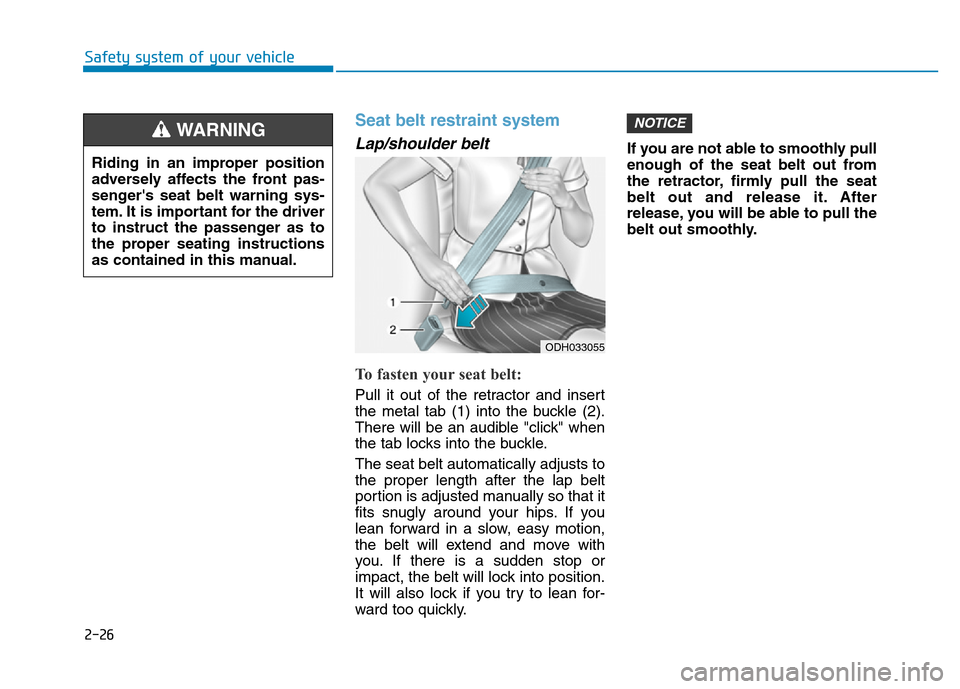
To fasten your seat belt:
Pull it out of the retractor and insert
the metal tab (1) into the buckle (2).
There will be an audible "click" when
the tab locks into the buckle.
The seat belt automatically adjusts to
the proper length after the lap belt
portion is adjusted manually so that it
fits snugly around your hips. If you
lean forward in a slow, easy motion,
the belt will extend and move with
you. If there is a sudden stop or
impact, the belt will lock into position.
It will also lock if you try to lean for-
ward too quickly.If you are not able to smoothly pull
enough of the seat belt out from
the retractor, firmly pull the seat
belt out and release it. After
release, you will be able to pull the
belt out smoothly.
NOTICE
Riding in an improper position
adversely affects the front pas-
senger's seat belt warning sys-
tem. It is important for the driver
to instruct the passenger as to
the proper seating instructions
as contained in this manual.
WARNING
ODH033055
Page 57 of 637
2-27
Safety system of your vehicle
2
Height adjustment
You can adjust the height of the
shoulder belt anchor to one of the
four different positions for maximum
comfort and safety.
The shoulder portion should be
adjusted so it lies across your chest
and midway over your shoulder near-
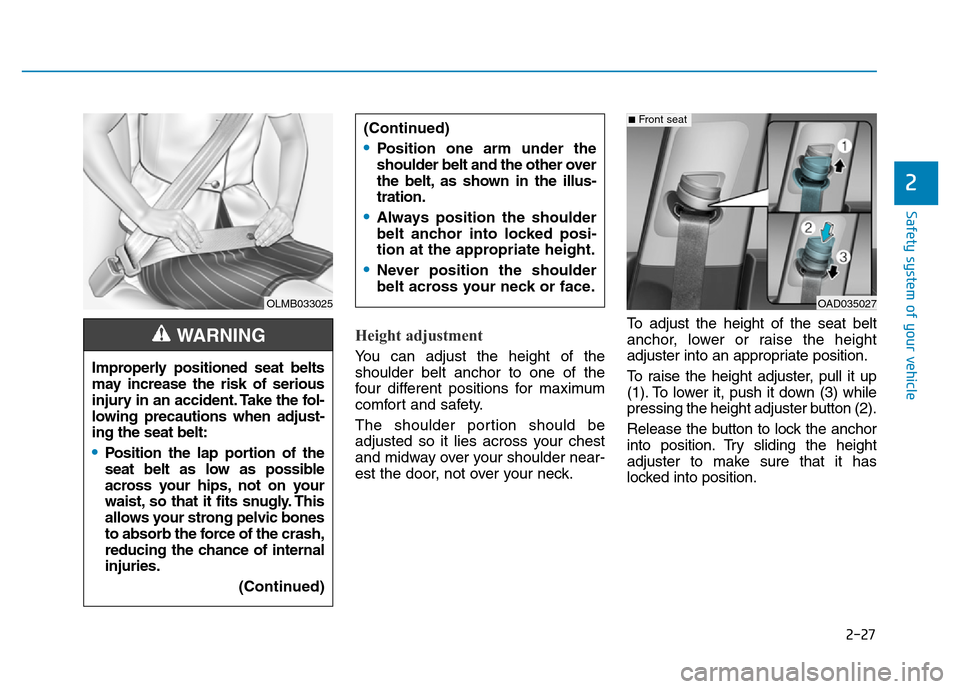
est the door, not over your neck.To adjust the height of the seat belt
anchor, lower or raise the height
adjuster into an appropriate position.
To raise the height adjuster, pull it up
(1). To lower it, push it down (3) while
pressing the height adjuster button (2).
Release the button to lock the anchor
into position. Try sliding the height
adjuster to make sure that it has
locked into position.
OLMB033025
Improperly positioned seat belts
may increase the risk of serious
injury in an accident. Take the fol-
lowing precautions when adjust-
ing the seat belt:
•Position the lap portion of the
seat belt as low as possible
across your hips, not on your
waist, so that it fits snugly. This
allows your strong pelvic bones
to absorb the force of the crash,
reducing the chance of internal
injuries.
(Continued)
WARNING
(Continued)
•Position one arm under the
shoulder belt and the other over
the belt, as shown in the illus-
tration.
•Always position the shoulder
belt anchor into locked posi-
tion at the appropriate height.
•Never position the shoulder
belt across your neck or face.
OAD035027
■Front seat
Page 59 of 637

2-29
Safety system of your vehicle
2
Pre-tensioner seat belt
(Driver and front passenger,
if equipped)
Your vehicle is equipped with driver's
and front passenger's Pre-tensioner
Seat Belts. The purpose of the pre-
tensioner is to make sure the seat
belts fit tightly against the occupant's
body in certain frontal collisions. The
pre-tensioner seat belts may be acti-
vated in crashes where the frontal col-
lision is severe enough, together with
the air bags.When the vehicle stops suddenly, or
if the occupant tries to lean forward
too quickly, the seat belt retractor will
lock into position. In certain frontal
collisions, the pre-tensioner will acti-
vate and pull the seat belt into tighter
contact against the occupant's body.
ODH033058
•Always wear your seat belt and
sit properly in your seat.
•Do not use the seat belt if it is
loose or twisted. A loose or
twisted seat belt will not pro-
tect you properly in an acci-
dent.
•Do not place anything near the
buckle. This may adversely
affect the buckle and cause it
to function improperly.
•Always replace your pre-ten-
sioners after activation or an
accident.
•NEVER inspect, service, repair
or replace the pre-tensioners
yourself. This must be done by
an authorized HYUNDAI dealer.
(Continued)
WARNING
(Continued)
•Do not hit the seat belt assem-
blies.
Do not touch the pre-tensioner
seat belt assemblies for several
minutes after they have been
activated. When the pre-ten-
sioner seat belt mechanism
deploys during a collision, the
pre-tensioner can become hot
and can burn you.
WARNING
Body work on the front area of
the vehicle may damage the
pre-tensioner seat belt system.
Therefore, we recommend that
the system be serviced by an
authorized HYUNDAI dealer.
CAUTION
Page 60 of 637
2-30
Safety system of your vehicle
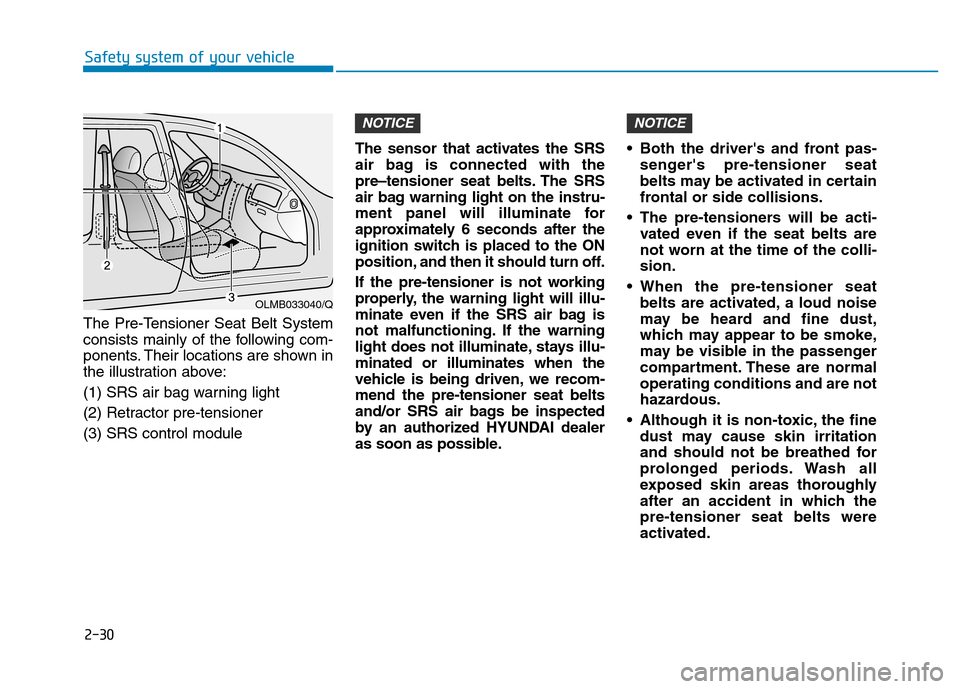
The Pre-Tensioner Seat Belt System
consists mainly of the following com-
ponents. Their locations are shown in
the illustration above:
(1) SRS air bag warning light
(2) Retractor pre-tensioner
(3) SRS control moduleThe sensor that activates the SRS
air bag is connected with the
pre–tensioner seat belts. The SRS
air bag warning light on the instru-
ment panel will illuminate for
approximately 6 seconds after the
ignition switch is placed to the ON
position, and then it should turn off.
If the pre-tensioner is not working
properly, the warning light will illu-
minate even if the SRS air bag is
not malfunctioning. If the warning
light does not illuminate, stays illu-
minated or illuminates when the
vehicle is being driven, we recom-
mend the pre-tensioner seat belts
and/or SRS air bags be inspected
by an authorized HYUNDAI dealer
as soon as possible.• Both the driver's and front pas-
senger's pre-tensioner seat
belts may be activated in certain
frontal or side collisions.
• The pre-tensioners will be acti-
vated even if the seat belts are
not worn at the time of the colli-
sion.
• When the pre-tensioner seat
belts are activated, a loud noise
may be heard and fine dust,
which may appear to be smoke,
may be visible in the passenger
compartment. These are normal
operating conditions and are not
hazardous.
• Although it is non-toxic, the fine
dust may cause skin irritation
and should not be breathed for
prolonged periods. Wash all
exposed skin areas thoroughly
after an accident in which the
pre-tensioner seat belts were
activated.
NOTICENOTICE
OLMB033040/Q
Page 62 of 637
2-32
Safety system of your vehicle
•Always make sure larger chil-
dren’s seat belts are worn and
properly adjusted.
•NEVER allow the shoulder
belt to contact the child’s
neck or face.
•Do not allow more than one
child to use a single seat belt.
WARNING Larger children
Children under age 13 and who are
too large for a booster seat must
always occupy the rear seat and use
the available lap/shoulder belts. A
seat belt should lie across the upper
thighs and be snug across the shoul-
der and chest to restrain the child
safely. Check belt fit periodically. A
child's squirming could put the belt
out of position. Children are afforded
the most safety in the event of an
accident when they are restrained by
a proper restraint system and/or seat
belts in the rear seat.
If a larger child over age 13 must be
seated in the front seat, the child
must be securely restrained by the
available lap/shoulder belt and the
seat should be placed in the rear-
most position.
If the shoulder belt portion slightly
touches the child’s neck or face, try
placing the child closer to the center
of the vehicle. If the shoulder belt still
touches their face or neck, they need
to be returned to an appropriate
booster seat in the rear seat.
Seat belt use and injured people
A seat belt should be used when an
injured person is being transported.
Consult a physician for specific rec-
ommendations.
One person per belt
Two people (including children) should
never attempt to use a single seat belt.
This could increase the severity of
injuries in case of an accident.
Do not lie down
Sitting in a reclined position when
the vehicle is in motion can be dan-
gerous. Even when buckled up, the
protections of your restraint system
(seat belts and/or air bags) is greatly
reduced by reclining your seatback.
Seat belts must be snug against your
hips and chest to work properly.
During an accident, you could be
thrown into the seat belt, causing
neck or other injuries.
Page 64 of 637
2-34
Safety system of your vehicle
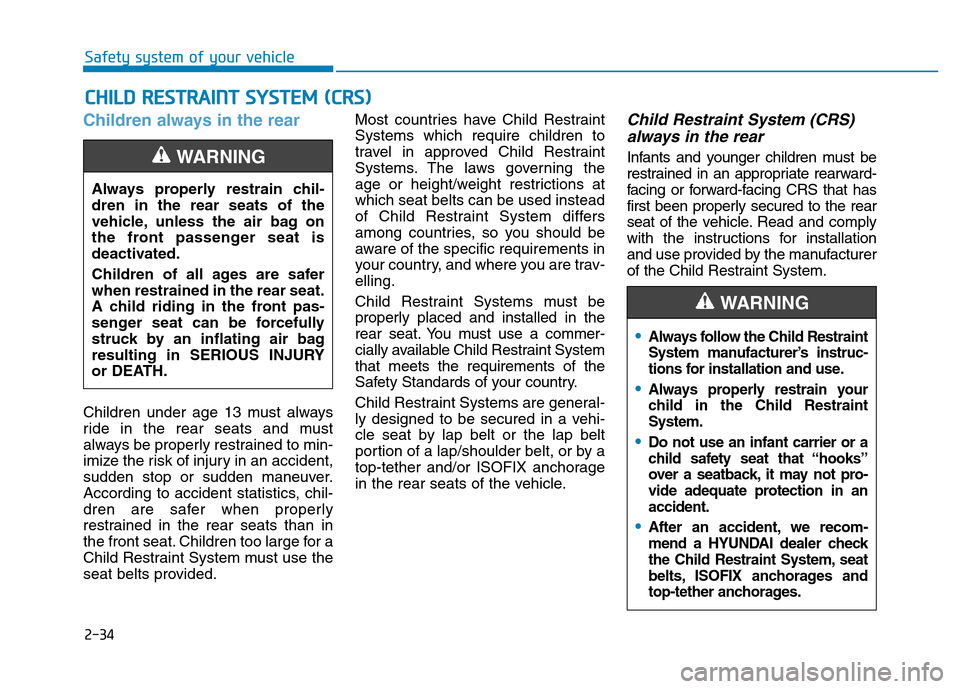
Children always in the rear
Children under age 13 must always
ride in the rear seats and must
always be properly restrained to min-
imize the risk of injury in an accident,
sudden stop or sudden maneuver.
According to accident statistics, chil-
dren are safer when properly
restrained in the rear seats than in
the front seat. Children too large for a
Child Restraint System must use the
seat belts provided.Most countries have Child Restraint
Systems which require children to
travel in approved Child Restraint
Systems. The laws governing the
age or height/weight restrictions at
which seat belts can be used instead
of Child Restraint System differs
among countries, so you should be
aware of the specific requirements in
your country, and where you are trav-
elling.
Child Restraint Systems must be
properly placed and installed in the
rear seat. You must use a commer-
cially available Child Restraint System
that meets the requirements of the
Safety Standards of your country.
Child Restraint Systems are general-
ly designed to be secured in a vehi-
cle seat by lap belt or the lap belt
portion of a lap/shoulder belt, or by a
top-tether and/or ISOFIX anchorage
in the rear seats of the vehicle.
Child Restraint System (CRS)
always in the rear
Infants and younger children must be
restrained in an appropriate rearward-
facing or forward-facing CRS that has
first been properly secured to the rear
seat of the vehicle. Read and comply
with the instructions for installation
and use provided by the manufacturer
of the Child Restraint System.
CHILD RESTRAINT SYSTEM (CRS)
•Always follow the Child Restraint
System manufacturer’s instruc-
tions for installation and use.
•Always properly restrain your
child in the Child Restraint
System.
•Do not use an infant carrier or a
child safety seat that “hooks”
over a seatback, it may not pro-
vide adequate protection in an
accident.
•After an accident, we recom-
mend a HYUNDAI dealer check
the Child Restraint System, seat
belts, ISOFIX anchorages and
top-tether anchorages.
WARNING
Always properly restrain chil-
dren in the rear seats of the
vehicle, unless the air bag on
the front passenger seat is
deactivated.
Children of all ages are safer
when restrained in the rear seat.
A child riding in the front pas-
senger seat can be forcefully
struck by an inflating air bag
resulting in SERIOUS INJURY
or DEATH.
WARNING
Page 72 of 637

2-42
Safety system of your vehicle
Child Seat Restraint for Vehicle ISOFIX Positions
Suitability of each seating position for ISOFIX Child Restraint Systems according to ECE regulations.
Mass Group Size Class FixtureVehicle ISOFIX Positions
Front PassengerRear Outboard
(Driver side)Rear Outboard
(Passenger side)Rear Center
CarrycotF ISO/L1 - X X -
G ISO/L2 - X X -
0 : UP to 10kg E ISO/R1 - IL IL -
0+ : UP to 13kgE ISO/R1 - IL IL -
D ISO/R2 - IL IL -
C ISO/R3 - IL IL -
I : 9 to 18kgD ISO/R2 - IL IL -
C ISO/R3 - IL IL -
B ISO/F2 - IUF, IL IUF, IL -
B1 ISO/F2X - IUF, IL IUF, IL -
A ISO/F3 - IUF, IL IUF, IL -
IUF = Suitable for ISOFIX forward child restraints systems of universal category approved for use in the mass group.
IL = Suitable for particular ISOFIX child restraints systems (CRS) given in the attached list. These ISOFIX CRS are those of the
"specific vehicle", "restricted" or "semi-universal" categories.
X = ISOFIX position not suitable for ISOFIX child restraint system in this mass group and/or this size class.