hose Hyundai Elantra 2017 Owner's Guide
[x] Cancel search | Manufacturer: HYUNDAI, Model Year: 2017, Model line: Elantra, Model: Hyundai Elantra 2017Pages: 637, PDF Size: 15.02 MB
Page 574 of 637
7-63
7
Maintenance
Low aspect ratio tire
(if equipped)
The low aspect ratio tires, of which
aspect ratio is below 50, are
equipped with for the sporty look.
Riding with high aspect ratio tires
may be uncomfortable with unpleas-
ant noises, because the low aspect
ratio tires are optimized for handling
and braking.The sidewall of the low aspect
ratio tire is thinner than the high
aspect ratio tire. Thus, the wheel
and the tire may be easily dam-
aged. Thus, follow the below
instructions.
- Cautiously drive the vehicle on a
rough road or off the road.
Otherwise, the tires and wheels
may be damaged. After driving
those areas, inspect the tires
and wheels.
- Slowly drive the vehicle to pass
over a pothole, speed bump,
manhole, or curb stone.
Otherwise, the tires and wheels
may be damaged.
- Upon having an impact on the
tire, we recommend you to have
the tires inspected by an author-
ized HYUNDAI dealer.
- Inspect the tires every 3,000 km
to prevent damage.• It is difficult to recognize tire
damage only with eyes. However,
we recommend you to have the
tire checked or replaced upon
detecting even the slightest tire
damage. The tire damage may
leak air from the tire.
• Tire damage, caused by driving
on a rough road, pothole, man-
hole or curb stone, or off the
road, is not covered by the man-
ufacturer’s warranty.
• For further information about
the tire, refer to the label on the
tire sidewall.
NOTICENOTICE
Page 618 of 637
7-107
7
Maintenance
High-corrosion areas
If you live in an area where your car
is regularly exposed to corrosive
materials, corrosion protection is
particularly important. Some of the
common causes of accelerated cor-
rosion are road salts, dust control
chemicals, ocean air and industrial
pollution.
Moisture breeds corrosion
Moisture creates the conditions in
which corrosion is most likely to
occur. For example, corrosion is
accelerated by high humidity, partic-
ularly when temperatures are just
above freezing. In such conditions,
the corrosive material is kept in con-
tact with the car surfaces by moisture
that is slow to evaporate.
Mud is particularly corrosive
because it is slow to dry and holds
moisture in contact with the vehicle.
Although the mud appears to be dry,
it can still retain the moisture and
promote corrosion.High temperatures can also acceler-
ate corrosion of parts that are not
properly ventilated so the moisture
can be dispersed. For all these rea-
sons, it is particularly important to
keep your car clean and free of mud
or accumulations of other materials.
This applies not only to the visible
surfaces but particularly to the
underside of the car.To help prevent corrosion
You can help prevent corrosion from
getting started by observing the fol-
lowing:Keep your car clean
The best way to prevent corrosion is
to keep your car clean and free of
corrosive materials. Attention to the
underside of the car is particularly
important.
• If you live in a high-corrosion area
— where road salts are used, near
the ocean, areas with industrial
pollution, acid rain, etc.—, you
should take extra care to prevent
corrosion. In winter, hose off the
underside of your car at least once
a month and be sure to clean the
underside thoroughly when winter
is over.
• When cleaning underneath the car,
give particular attention to the
components under the fenders and
other areas that are hidden from
view. Do a thorough job; just damp-
ening the accumulated mud rather
than washing it away will acceler-
ate corrosion rather than prevent
it. Water under high pressure and
steam are particularly effective in
removing accumulated mud and
corrosive materials.
Page 622 of 637

7-111
7
Maintenance
EMISSION CONTROL SYSTEM
The emission control system of your
vehicle is covered by a written limited
warranty. Please see the warranty
information contained in the Service
Passport in your vehicle.
Your vehicle is equipped with an
emission control system to meet all
emission regulations.
There are three emission control
systems which are as follows.
(1) Crankcase emission control sys-
tem
(2) Evaporative emission control sys-
tem
(3) Exhaust emission control system
In order to assure the proper function
of the emission control systems, it is
recommended that you have your
car inspected and maintained by an
authorized HYUNDAI dealer in
accordance with the maintenance
schedule in this manual.1. Crankcase emission control
system
The positive crankcase ventilation
system is employed to prevent air
pollution caused by blow-by gases
being emitted from the crankcase.
This system supplies fresh filtered air
to the crankcase through the air
intake hose. Inside the crankcase,
the fresh air mixes with blow-by
gases, which then pass through the
PCV valve into the induction system.
2. Evaporative emission con-
trol system
The Evaporative Emission Control
System is designed to prevent fuel
vapors from escaping into the atmos-
phere. For the Inspection and
Maintenance Test (With Electronic
Stability Control (ESC) system)
•To prevent the vehicle from
misfiring during dynamome-
ter testing, turn the Electronic
Stability Control (ESC) sys-
tem off by pressing the ESC
switch.
•After dynamometer testing is
completed, turn the ESC sys-
tem back on by pressing the
ESC switch again.
CAUTION
Page 634 of 637
8-8
Specifications & Consumer information
Recommended SAE viscosity
number
Engine oil viscosity (thickness) has
an effect on fuel economy and cold
weather operating (engine start and
engine oil flowability). Lower viscosi-
ty engine oils can provide better fuel
economy and cold weather perform-
ance, however, higher viscosity
engine oils are required for satisfac-
tory lubrication in hot weather. Using
oils of any viscosity other than those
recommended could result in engine
damage.Always be sure to clean the area
around any filler plug, drain
plug, or dipstick before check-
ing or draining any lubricant.
This is especially important in
dusty or sandy areas and when
the vehicle is used on unpaved
roads. Cleaning the plug and
dipstick areas will prevent dirt
and grit from entering the
engine and other mechanisms
that could be damaged.
CAUTION
*1: For better fuel economy, it is recommended to use the engine oil of a viscosity grade SAE
5W-20
*
2: For better fuel economy, it is recommended to use the engine oil of a viscosity grade SAE
5W-30. However, if the engine oil is not available in your country, select the proper engine oil
using the engine oil viscosity chart.
*
3: Middle East includes Morocco, Sudan and Egypt.
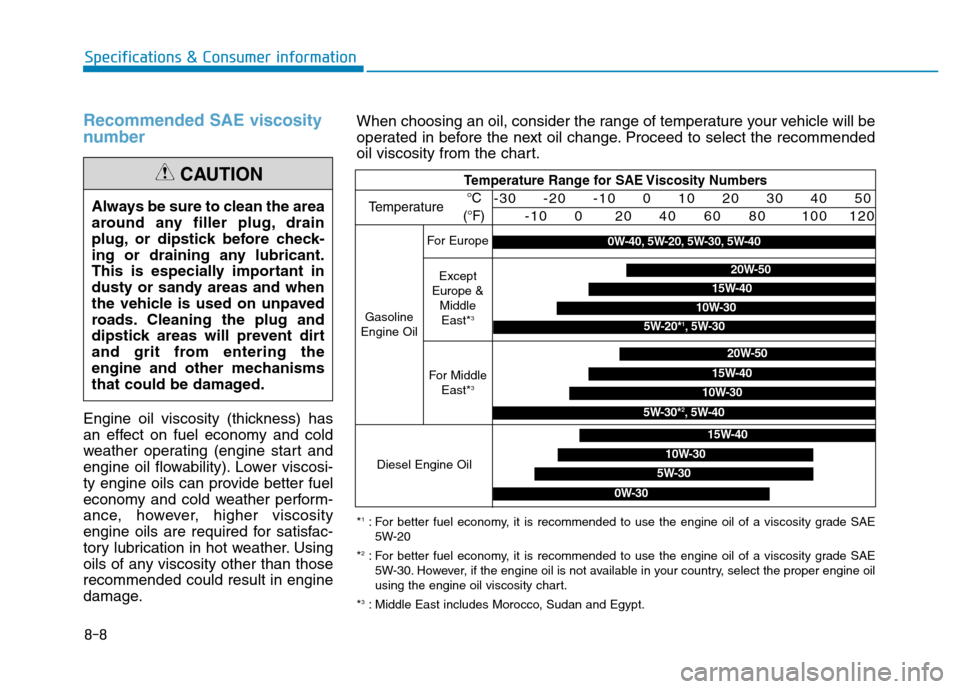
When choosing an oil, consider the range of temperature your vehicle will be
operated in before the next oil change. Proceed to select the recommended
oil viscosity from the chart.
Temperature Range for SAE Viscosity Numbers
Temperature
Gasoline
Engine Oil
°C
(°F)-30 -20 -10 0 10 20 30 40 50
-10 0 20 40 60 80 100 120
For Europe
20W-50
10W-30
15W-40
5W-30*2, 5W-40
5W-30
15W-40
10W-30
0W-30
0W-40, 5W-20, 5W-30, 5W-40
Diesel Engine Oil
20W-50
15W-40
10W-30
5W-20*1, 5W-30
Except
Europe &
Middle
East*
3
For Middle
East*3
Page 636 of 637

8-10
Specifications & Consumer information
The tires supplied on your new vehi-
cle are chosen to provide the best
performance for normal driving.
The tire label located on the driver's
side center pillar gives the tire pres-
sures recommended for your vehicle.The engine number is stamped on
the engine block as shown in the
drawing.
T TI
IR
RE
E
S
SP
PE
EC
CI
IF
FI
IC
CA
AT
TI
IO
ON
N
A
AN
ND
D
P PR
RE
ES
SS
SU
UR
RE
E
L
LA
AB
BE
EL
LE EN
NG
GI
IN
NE
E
N
NU
UM
MB
BE
ER
R
OAD085010L
■Gamma 1.6 MPI
OAD085009L
■Nu 2.0 MPI
OAD085007L
OAD085007R
■Right-hand drive
■Left-hand drive
OAD085006
■U2 1.6 TCI