pressure Hyundai Elantra 2017 Repair Manual
[x] Cancel search | Manufacturer: HYUNDAI, Model Year: 2017, Model line: Elantra, Model: Hyundai Elantra 2017Pages: 637, PDF Size: 15.02 MB
Page 615 of 637
7-104
Maintenance
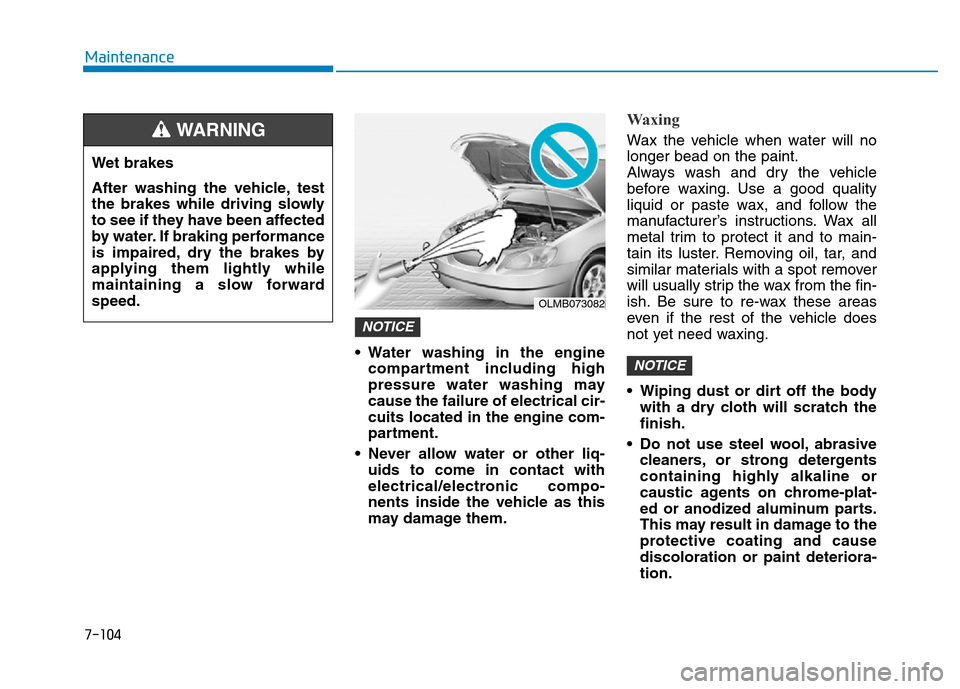
• Water washing in the engine
compartment including high
pressure water washing may
cause the failure of electrical cir-
cuits located in the engine com-
partment.
• Never allow water or other liq-
uids to come in contact with
electrical/electronic compo-
nents inside the vehicle as this
may damage them.
Waxing
Wax the vehicle when water will no
longer bead on the paint.
Always wash and dry the vehicle
before waxing. Use a good quality
liquid or paste wax, and follow the
manufacturer’s instructions. Wax all
metal trim to protect it and to main-
tain its luster. Removing oil, tar, and
similar materials with a spot remover
will usually strip the wax from the fin-
ish. Be sure to re-wax these areas
even if the rest of the vehicle does
not yet need waxing.
• Wiping dust or dirt off the body
with a dry cloth will scratch the
finish.
• Do not use steel wool, abrasive
cleaners, or strong detergents
containing highly alkaline or
caustic agents on chrome-plat-
ed or anodized aluminum parts.
This may result in damage to the
protective coating and cause
discoloration or paint deteriora-
tion.
NOTICE
NOTICE
Wet brakes
After washing the vehicle, test
the brakes while driving slowly
to see if they have been affected
by water. If braking performance
is impaired, dry the brakes by
applying them lightly while
maintaining a slow forward
speed.
WARNING
OLMB073082
Page 618 of 637
7-107
7
Maintenance
High-corrosion areas
If you live in an area where your car
is regularly exposed to corrosive
materials, corrosion protection is
particularly important. Some of the
common causes of accelerated cor-
rosion are road salts, dust control
chemicals, ocean air and industrial
pollution.
Moisture breeds corrosion
Moisture creates the conditions in
which corrosion is most likely to
occur. For example, corrosion is
accelerated by high humidity, partic-
ularly when temperatures are just
above freezing. In such conditions,
the corrosive material is kept in con-
tact with the car surfaces by moisture
that is slow to evaporate.
Mud is particularly corrosive
because it is slow to dry and holds
moisture in contact with the vehicle.
Although the mud appears to be dry,
it can still retain the moisture and
promote corrosion.High temperatures can also acceler-
ate corrosion of parts that are not
properly ventilated so the moisture
can be dispersed. For all these rea-
sons, it is particularly important to
keep your car clean and free of mud
or accumulations of other materials.
This applies not only to the visible
surfaces but particularly to the
underside of the car.To help prevent corrosion
You can help prevent corrosion from
getting started by observing the fol-
lowing:Keep your car clean
The best way to prevent corrosion is
to keep your car clean and free of
corrosive materials. Attention to the
underside of the car is particularly
important.
• If you live in a high-corrosion area
— where road salts are used, near
the ocean, areas with industrial
pollution, acid rain, etc.—, you
should take extra care to prevent
corrosion. In winter, hose off the
underside of your car at least once
a month and be sure to clean the
underside thoroughly when winter
is over.
• When cleaning underneath the car,
give particular attention to the
components under the fenders and
other areas that are hidden from
view. Do a thorough job; just damp-
ening the accumulated mud rather
than washing it away will acceler-
ate corrosion rather than prevent
it. Water under high pressure and
steam are particularly effective in
removing accumulated mud and
corrosive materials.
Page 627 of 637
8
Specifications & Consumer information
8
Specifications & Consumer information
8
Dimensions ..............................................................8-2
Engine ......................................................................8-2
Bulb wattage ...........................................................8-3
Tires and wheels ....................................................8-4
Air conditioning system ........................................8-4
Tire load and speed capacity ..............................8-5
Volume and weight ................................................8-5
Recommended lubricants and capacities ...........8-6
Recommended SAE viscosity number ..........................8-8
Vehicle identification number (VIN) ....................8-9
Vehicle certification label .....................................8-9
Tire specification and pressure label ...............8-10
Engine number .....................................................8-10
Air conditioner compressor label ......................8-11
Declaration of conformity ..................................8-11
Page 630 of 637
8-4
Specifications & Consumer information
T TI
IR
RE
ES
S
A
AN
ND
D
W
WH
HE
EE
EL
LS
S
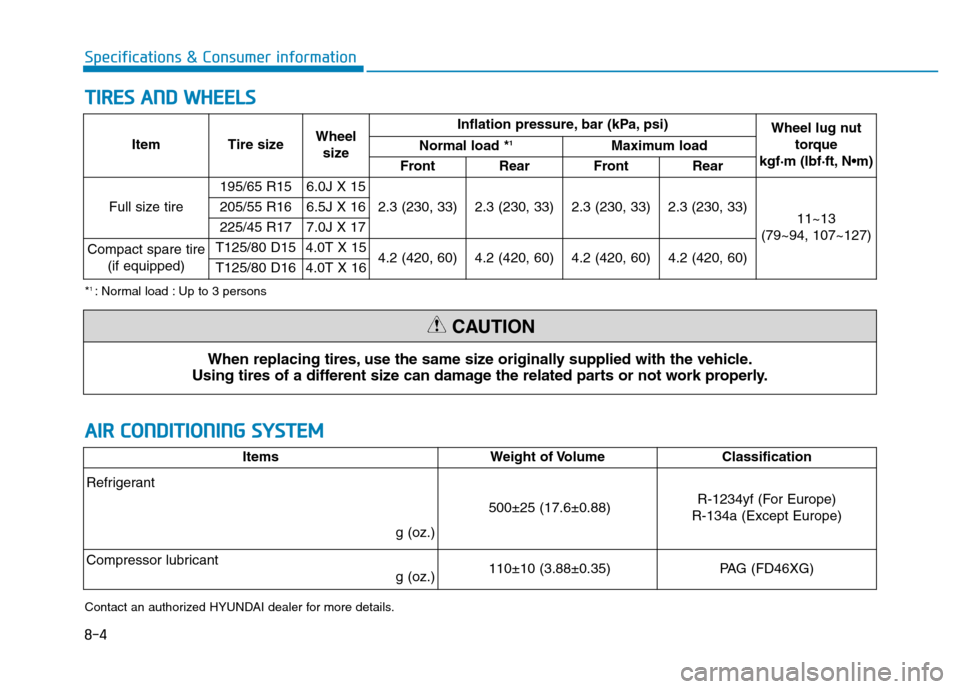
Item Tire sizeWheel
sizeInflation pressure, bar (kPa, psi)
Wheel lug nut
torque
kgf·m (lbf·ft, N Normal load *1Maximum load
Front Rear Front Rear
Full size tire195/65 R15 6.0J X 15
2.3 (230, 33) 2.3 (230, 33) 2.3 (230, 33) 2.3 (230, 33)
11~13
(79~94, 107~127) 205/55 R16 6.5J X 16
225/45 R17 7.0J X 17
Compact spare tire
(if equipped)T125/80 D154.0T X 154.2 (420, 60)4.2 (420, 60)4.2 (420, 60)4.2 (420, 60)T125/80 D164.0T X 16
When replacing tires, use the same size originally supplied with the vehicle.
Using tires of a different size can damage the related parts or not work properly.
CAUTION
*1 : Normal load : Up to 3 persons
A AI
IR
R
C
CO
ON
ND
DI
IT
TI
IO
ON
NI
IN
NG
G
S
SY
YS
ST
TE
EM
M
ItemsWeight of Volume Classification
Refrigerant
g (oz.)
500±25 (17.6±0.88)R-1234yf (For Europe)
R-134a (Except Europe)
Compressor lubricant
g (oz.) 110±10 (3.88±0.35)PAG (FD46XG)
Contact an authorized HYUNDAI dealer for more details.