filter Hyundai Elantra 2018 User Guide
[x] Cancel search | Manufacturer: HYUNDAI, Model Year: 2018, Model line: Elantra, Model: Hyundai Elantra 2018Pages: 526, PDF Size: 17.2 MB
Page 433 of 526
7-15
7
Maintenance
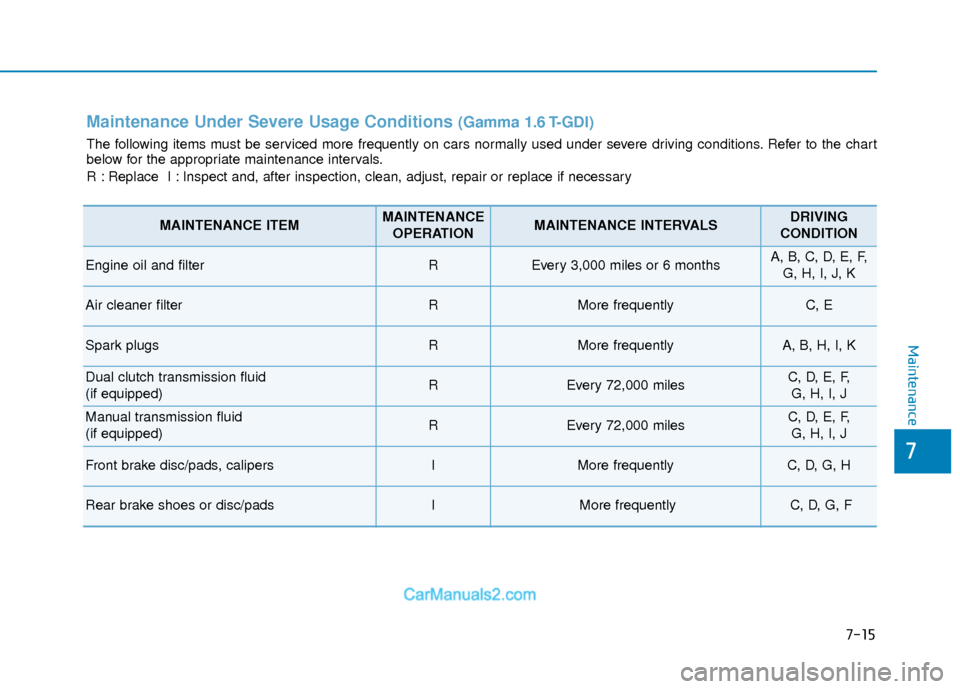
Maintenance Under Severe Usage Conditions (Gamma 1.6 T-GDI)
The following items must be serviced more frequently on cars normally used under severe driving conditions. Refer to the chart
below for the appropriate maintenance intervals.
R : Replace I : Inspect and, after inspection, clean, adjust, repair or replace if neces\
sary
MAINTENANCE ITEMMAINTENANCEOPERATIONMAINTENANCE INTERVALSDRIVING
CONDITION
Engine oil and filterREvery 3,000 miles or 6 monthsA, B, C, D, E, F, G, H, I, J, K
Air cleaner filterRMore frequentlyC, E
Spark plugsRMore frequentlyA, B, H, I, K
Dual clutch transmission fluid
(if equipped)REvery 72,000 milesC, D, E, F, G, H, I, J
Manual transmission fluid
(if equipped)REvery 72,000 milesC, D, E, F, G, H, I, J
Front brake disc/pads, calipersIMore frequentlyC, D, G, H
Rear brake shoes or disc/padsIMore frequentlyC, D, G, F
Page 434 of 526
7-16
Maintenance
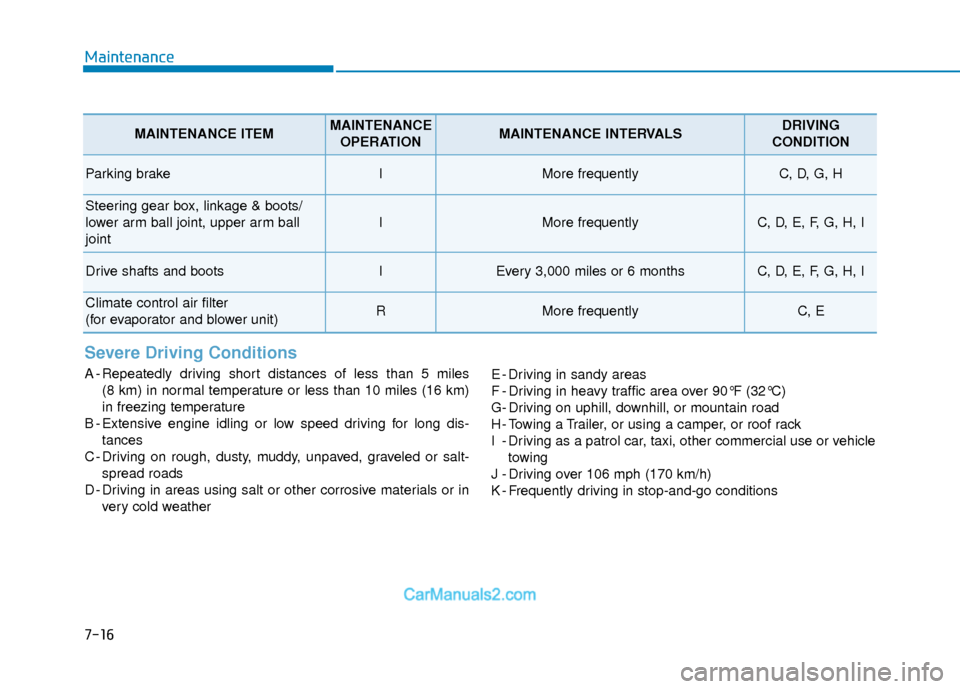
Severe Driving Conditions
A - Repeatedly driving short distances of less than 5 miles (8 km) in normal temperature or less than 10 miles (16 km)
in freezing temperature
B - Extensive engine idling or low speed driving for long dis- tances
C - Driving on rough, dusty, muddy, unpaved, graveled or salt- spread roads
D - Driving in areas using salt or other corrosive materials or in very cold weather E - Driving in sandy areas
F - Driving in heavy traffic area over 90°F (32°C)
G- Driving on uphill, downhill, or mountain road
H - Towing a Trailer, or using a camper, or roof rack
I - Driving as a patrol car, taxi, other commercial use or vehicle
towing
J - Driving over 106 mph (170 km/h)
K - Frequently driving in stop-and-go conditions
MAINTENANCE ITEMMAINTENANCE OPERATIONMAINTENANCE INTERVALSDRIVING
CONDITION
Parking brakeIMore frequentlyC, D, G, H
Steering gear box, linkage & boots/
lower arm ball joint, upper arm ball
joint
IMore frequentlyC, D, E, F, G, H, I
Drive shafts and bootsIEvery 3,000 miles or 6 monthsC, D, E, F, G, H, I
Climate control air filter
(for evaporator and blower unit)RMore frequentlyC, E
Page 435 of 526
7-17
7
Maintenance
E
EX
X P
PL
LA
A N
N A
AT
TI
IO
O N
N
O
O F
F
S
S C
C H
H E
ED
D U
U L
LE
E D
D
M
M A
AI
IN
N T
TE
EN
N A
AN
N C
CE
E
I
IT
T E
EM
M S
S
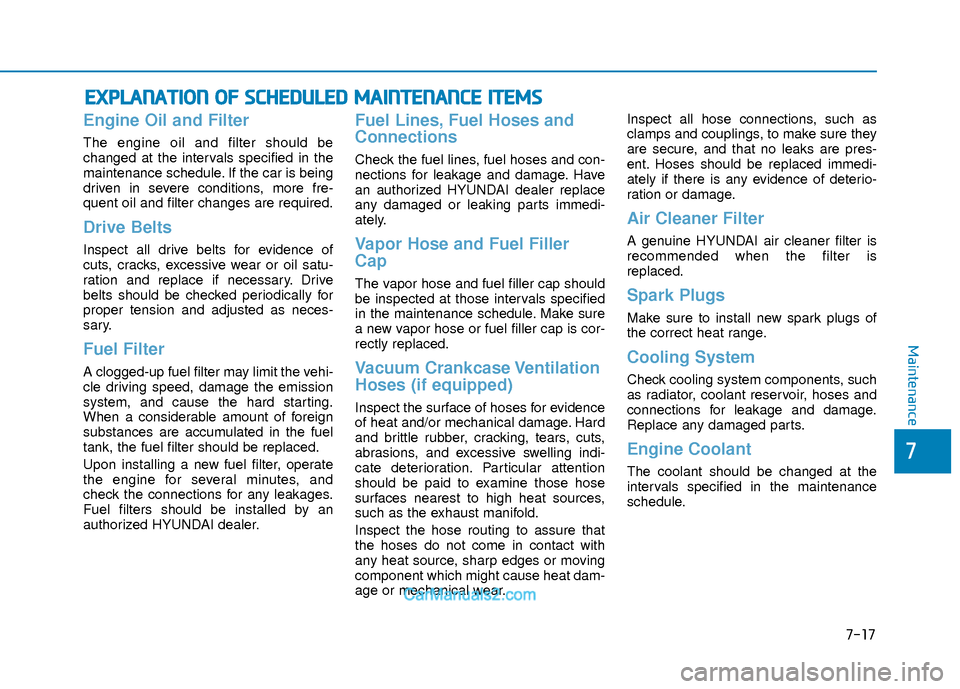
Engine Oil and Filter
The engine oil and filter should be
changed at the intervals specified in the
maintenance schedule. If the car is being
driven in severe conditions, more fre-
quent oil and filter changes are required.
Drive Belts
Inspect all drive belts for evidence of
cuts, cracks, excessive wear or oil satu-
ration and replace if necessary. Drive
belts should be checked periodically for
proper tension and adjusted as neces-
sary.
Fuel Filter
A clogged-up fuel filter may limit the vehi-
cle driving speed, damage the emission
system, and cause the hard starting.
When a considerable amount of foreign
substances are accumulated in the fuel
tank, the fuel filter should be replaced.
Upon installing a new fuel filter, operate
the engine for several minutes, and
check the connections for any leakages.
Fuel filters should be installed by an
authorized HYUNDAI dealer.
Fuel Lines, Fuel Hoses and
Connections
Check the fuel lines, fuel hoses and con-
nections for leakage and damage. Have
an authorized HYUNDAI dealer replace
any damaged or leaking parts immedi-
ately.
Vapor Hose and Fuel Filler
Cap
The vapor hose and fuel filler cap should
be inspected at those intervals specified
in the maintenance schedule. Make sure
a new vapor hose or fuel filler cap is cor-
rectly replaced.
Vacuum Crankcase Ventilation
Hoses (if equipped)
Inspect the surface of hoses for evidence
of heat and/or mechanical damage. Hard
and brittle rubber, cracking, tears, cuts,
abrasions, and excessive swelling indi-
cate deterioration. Particular attention
should be paid to examine those hose
surfaces nearest to high heat sources,
such as the exhaust manifold.
Inspect the hose routing to assure that
the hoses do not come in contact with
any heat source, sharp edges or moving
component which might cause heat dam-
age or mechanical wear. Inspect all hose connections, such as
clamps and couplings, to make sure they
are secure, and that no leaks are pres-
ent. Hoses should be replaced immedi-
ately if there is any evidence of deterio-
ration or damage.
Air Cleaner Filter
A genuine HYUNDAI air cleaner filter is
recommended when the filter is
replaced.
Spark Plugs
Make sure to install new spark plugs of
the correct heat range.
Cooling System
Check cooling system components, such
as radiator, coolant reservoir, hoses and
connections for leakage and damage.
Replace any damaged parts.
Engine Coolant
The coolant should be changed at the
intervals specified in the maintenance
schedule.
Page 438 of 526
7-20
Maintenance
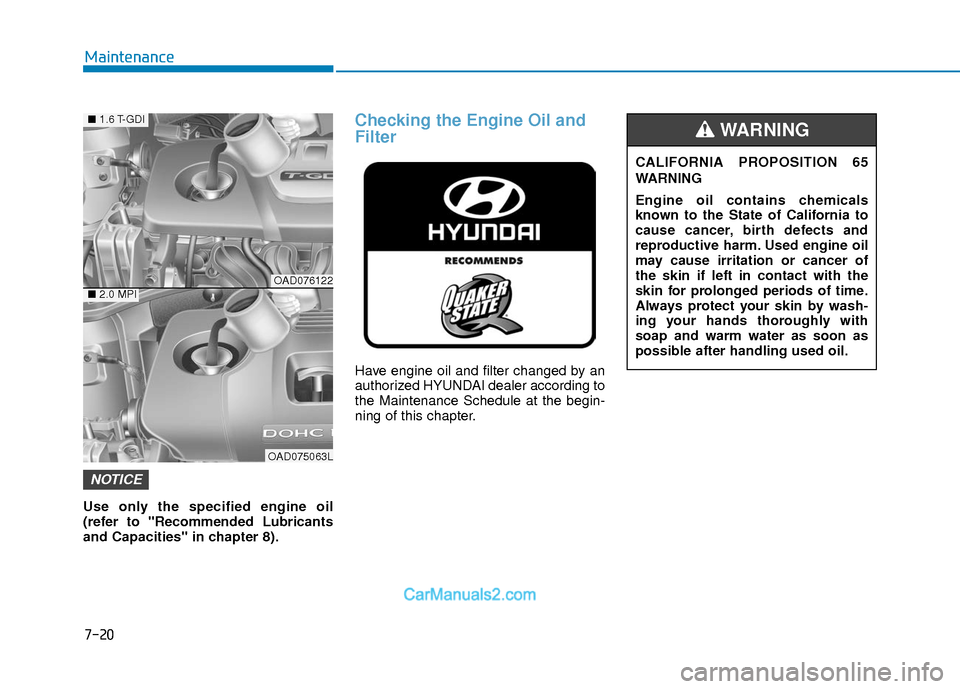
Use only the specified engine oil
(refer to "Recommended Lubricants
and Capacities" in chapter 8).
Checking the Engine Oil and
Filter
Have engine oil and filter changed by an
authorized HYUNDAI dealer according to
the Maintenance Schedule at the begin-
ning of this chapter.
NOTICE
CALIFORNIA PROPOSITION 65
WARNING
Engine oil contains chemicals
known to the State of California to
cause cancer, birth defects and
reproductive harm. Used engine oil
may cause irritation or cancer of
the skin if left in contact with the
skin for prolonged periods of time.
Always protect your skin by wash-
ing your hands thoroughly with
soap and warm water as soon as
possible after handling used oil.
WARNING
OAD076122
OAD075063L
■1.6 T-GDI
■2.0 MPI
Page 443 of 526
7-25
7
Maintenance
A
AI
IR
R
C
C L
LE
E A
A N
N E
ER
R
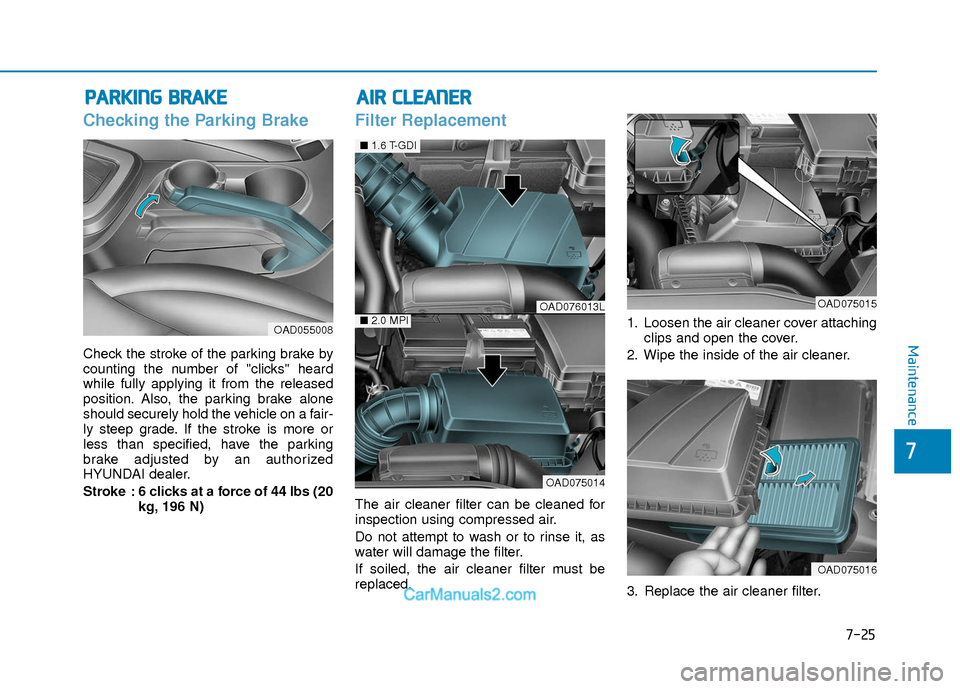
Checking the Parking Brake
Check the stroke of the parking brake by
counting the number of "clicks" heard
while fully applying it from the released
position. Also, the parking brake alone
should securely hold the vehicle on a fair-
ly steep grade. If the stroke is more or
less than specified, have the parking
brake adjusted by an authorized
HYUNDAI dealer.
Stroke : 6 clicks at a force of 44 lbs (20
kg, 196 N)
Filter Replacement
The air cleaner filter can be cleaned for
inspection using compressed air.
Do not attempt to wash or to rinse it, as
water will damage the filter.
If soiled, the air cleaner filter must be
replaced. 1. Loosen the air cleaner cover attaching
clips and open the cover.
2. Wipe the inside of the air cleaner.
3. Replace the air cleaner filter.
OAD055008
P
P A
A R
RK
K I
IN
N G
G
B
B R
RA
A K
KE
E
OAD075015OAD076013L
OAD075014
■ 1.6 T-GDI
■2.0 MPI
OAD075016
Page 444 of 526
7-26
Maintenance
4. Lock the cover with the cover attach-ing clips.
Information
If the vehicle is operated in extremely
dusty or sandy areas, replace the element
more often than the usual recommended
intervals (refer to "Maintenance Under
Severe Usage Conditions" in this chapter).
Do not drive with the air cleaner fil-ter removed. This will result in
excessive engine wear.
When removing the air cleaner filter, be careful that dust or dirt does not
enter the air intake, or damage may
result.
Use HYUNDAI genuine parts, use of non-genuine parts could damage
the air flow sensor.
Filter Inspection
The climate control air filter should be
replaced according to the Maintenance
Schedule. If the vehicle is operated in
severely air-polluted cities or on dusty
rough roads for a long period, it should
be inspected more frequently and
replaced earlier. When you replace the
climate control air filter, replace it per-
forming the following procedure, and be
careful to avoid damaging other compo-
nents.
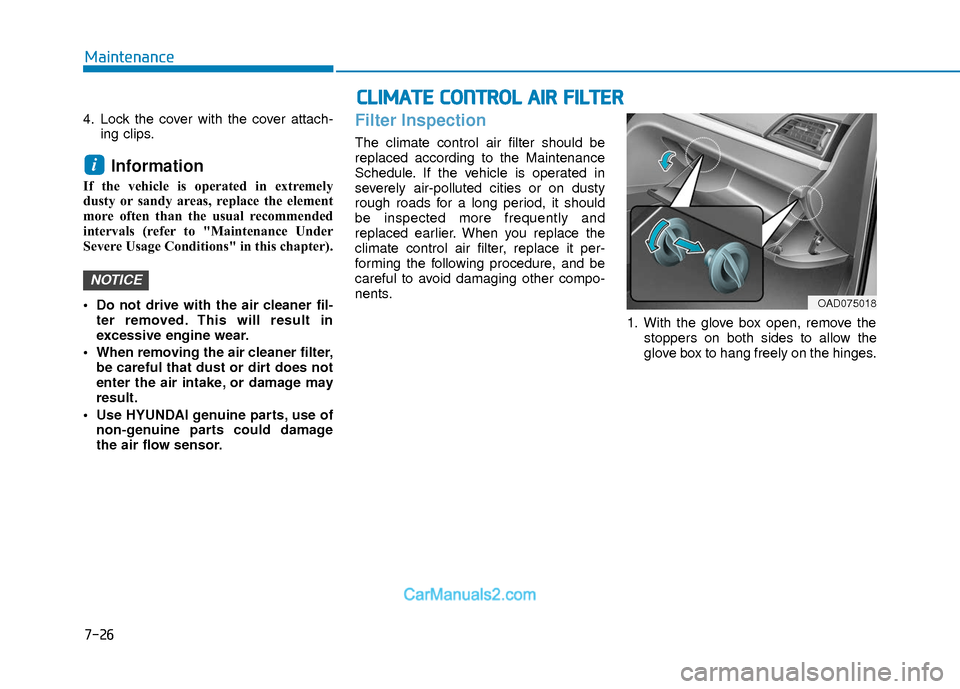
1. With the glove box open, remove thestoppers on both sides to allow the
glove box to hang freely on the hinges.
NOTICE
i
C CL
LI
IM
M A
AT
TE
E
C
C O
O N
NT
TR
R O
O L
L
A
A I
IR
R
F
F I
IL
L T
T E
ER
R
OAD075018
Page 445 of 526
7-27
7
Maintenance
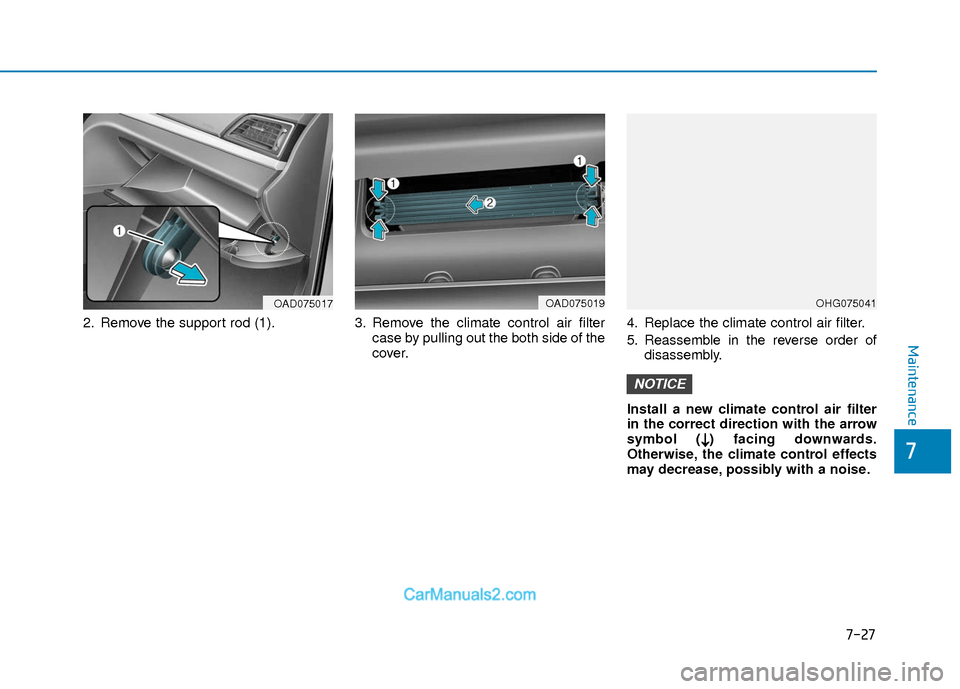
2. Remove the support rod (1).3. Remove the climate control air filter
case by pulling out the both side of the
cover. 4. Replace the climate control air filter.
5. Reassemble in the reverse order of
disassembly.
Install a new climate control air filter
in the correct direction with the arrow
symbol ( ↓ ↓) facing downwards.
Otherwise, the climate control effects
may decrease, possibly with a noise.
NOTICE
OAD075019OHG075041OAD075017
Page 501 of 526
7-83
7
Maintenance
The emission control system of your
vehicle is covered by a written limited
warranty. Please see the warranty infor-
mation contained in the Owner’s
Handbook & Warranty Information book-
let in your vehicle.
Your vehicle is equipped with an emis-
sion control system to meet all applicable
emission regulations. There are three
emission control systems, as follows.
(1) Crankcase emission control system
(2) Evaporative emission control system
(3) Exhaust emission control system
In order to assure the proper function of
the emission control systems, it is recom-
mended that you have your vehicle
inspected and maintained by an author-
ized HYUNDAI dealer in accordance with
the maintenance schedule in this manual.For the Inspection and Maintenance
Test (With Electronic Stability Control
(ESC) system)
To prevent the vehicle from misfir-
ing during dynamometer testing,
turn the Electronic Stability Control
(ESC) system off by pressing the
ESC switch (ESC OFF light illumi-
nated).
After dynamometer testing is com- pleted, turn the ESC system back on
by pressing the ESC switch again.1. Crankcase Emission Control System
The positive crankcase ventilation sys-
tem is employed to prevent air pollution
caused by blow-by gases being emitted
from the crankcase. This system supplies
fresh filtered air to the crankcase through
the air intake hose. Inside the crankcase,
the fresh air mixes with blow-by gases,
which then pass through the PCV valve
into the induction system.
2. Evaporative Emission ControlSystem Including Onboard
Refueling Vapor Recovery
(ORVR)
The Evaporative Emission Control
System is designed to prevent fuel
vapors from escaping into the atmos-
phere. The ORVR system is designed to
allow the vapors from the fuel tank to be
loaded into a canister while refueling at
the gas station, preventing the escape of
fuel vapors into the atmosphere.
NOTICE
E EM
M I
IS
S S
SI
IO
O N
N
C
C O
O N
NT
TR
R O
O L
L
S
S Y
Y S
ST
T E
EM
M
Page 519 of 526
I-2
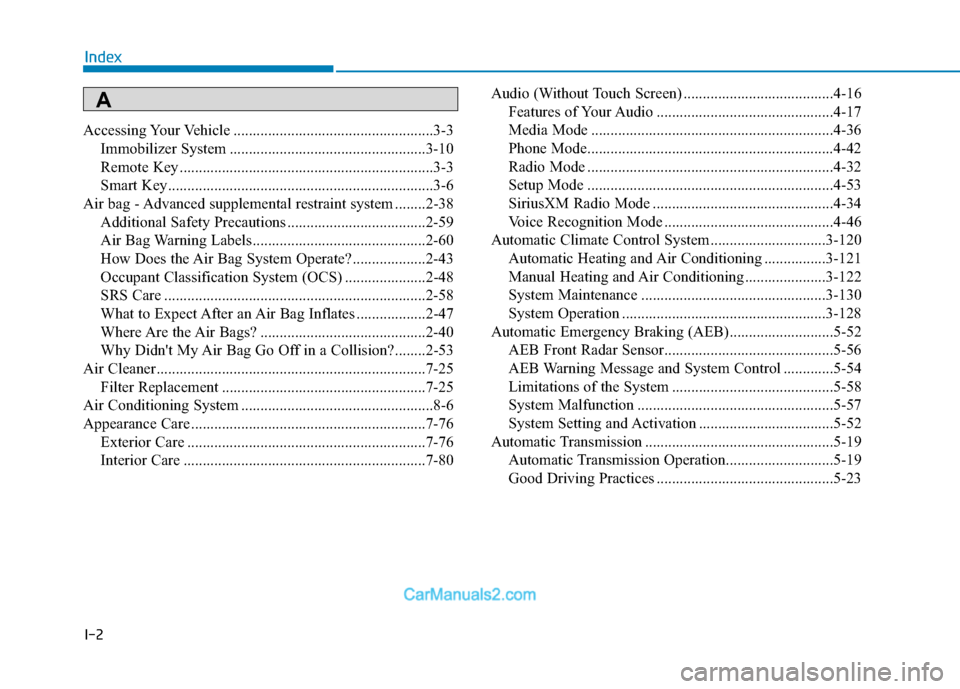
Accessing Your Vehicle ....................................................3-3Immobilizer System ...................................................3-10
Remote Key ..................................................................3-3
Smart Key.....................................................................3-6\
Air bag - Advanced supplemental restraint system ........2-38 Additional Safety Precautions ....................................2-59
Air Bag Warning Labels.............................................2-60
How Does the Air Bag System Operate? ...................2-43
Occupant Classification System (OCS) .....................2-48
SRS Care ....................................................................2-58\
What to Expect After an Air Bag Inflates ..................2-47
Where Are the Air Bags? ...........................................2-40
Why Didn't My Air Bag Go Off in a Collision?........2-53
Air Cleaner......................................................................7-\
25 Filter Replacement .....................................................7-25
Air Conditioning System ..................................................8-6
Appearance Care .............................................................7-76 Exterior Care ..............................................................7-76
Interior Care ...............................................................7-80 Audio (Without Touch Screen) .......................................4-16
Features of Your Audio ..............................................4-17
Media Mode ...............................................................4-36
Phone Mode................................................................4-42
Radio Mode ................................................................4-32
Setup Mode ................................................................4-53
SiriusXM Radio Mode ...............................................4-34
Voice Recognition Mode ............................................4-46
Automatic Climate Control System..............................3-120 Automatic Heating and Air Conditioning ................3-121
Manual Heating and Air Conditioning .....................3-122
System Maintenance ................................................3-130
System Operation .....................................................3-128
Automatic Emergency Braking (AEB)...........................5-52 AEB Front Radar Sensor............................................5-56
AEB Warning Message and System Control .............5-54
Limitations of the System ..........................................5-58
System Malfunction ...................................................5-57
System Setting and Activation ...................................5-52
Automatic Transmission .................................................5-19 Automatic Transmission Operation............................5-19
Good Driving Practices ..............................................5-23
Index
A
Page 520 of 526

I-3
Battery ........................................................................\
.....7-30Battery Recharging .....................................................7-31
For Best Battery Service ............................................7-31
Reset Features ............................................................7-32
Before Driving ..................................................................5-4 Before Entering the Vehicle .........................................5-4
Before Starting .............................................................5-4
Blind Spot Detection System (BSD) ..............................5-45 BSD (Blind Spot Detection) / LCA (Lane Change Assist) .....................................5-46
Limitations of the System ..........................................5-51
RCTA (Rear Cross Traffic Alert) ...............................5-49
Brake/Clutch Fluid..........................................................7-23 Checking the Brake/Clutch Fluid Level.....................7-23
Braking System ...............................................................5-33 Anti-lock Brake System (ABS)..................................5-36
Disc Brakes Wear Indicator........................................5-34
Electronic Stability Control (ESC).............................5-38
Good Braking Practices..............................................5-42
Hill-Start Assist Control (HAC) .................................5-42
Parking Brake .............................................................5-34
Power Brakes..............................................................5-33
Rear Drum Brakes ......................................................5-34
Vehicle Stability Management (VSM) .......................5-41
Bulb Wattage .....................................................................8-3\
California Perchlorate Notice .........................................7-86
Child restraint system (CRS) ..........................................2-28
Children Always in the Rear ......................................2-28
Installing a Child Restraint System (CRS) ................2-31
Selecting a Child Restraint System (CRS).................2-29
Climate Control Additional Features ............................3-135 Automatic Ventilation...............................................3-135
Sunroof Inside Air Recirculation .............................3-135
Climate Control Air Filter...............................................7-26 Filter Inspection..........................................................7-26
Consumer Information ....................................................8-12
Cruise Control .................................................................5-69 Cruise Control operation ............................................5-69
Declaration of conformity...............................................4-63 FCC ........................................................................\
....4-63
Defroster........................................................................\
3-110 Rear Window Defroster ............................................3-110
Dimensions .......................................................................8\
-2
Door Locks......................................................................3-\
11 Auto Door Lock/Unlock Features ..............................3-14
Child-Protector Rear Door locks................................3-15
Operating Door Locks from Inside the Vehicle .........3-12
Operating Door Locks from Outside the Vehicle.......3-11
I
Index
BC
D