engine coolant Hyundai Elantra 2018 Owner's Guide
[x] Cancel search | Manufacturer: HYUNDAI, Model Year: 2018, Model line: Elantra, Model: Hyundai Elantra 2018Pages: 526, PDF Size: 17.2 MB
Page 442 of 526
7-24
Maintenance
W
WA
AS
SH
H E
ER
R
F
F L
LU
U I
ID
D
Do not allow brake/clutch fluid to
contact the vehicle's body paint, as
paint damage will result.
Brake/clutch fluid, which has been exposed to open air for an extended
time should NEVER be used as its
quality cannot be guaranteed. It
should be disposed of properly.
Do not use the wrong kind of brake/clutch fluid. A few drops of
mineral based oil, such as engine
oil, in your brake/clutch system can
damage brake/clutch system parts.
Information
Use only the specified brake/clutch fluid
(refer to "Recommended Lubricants and
Capacities" in chapter 8).
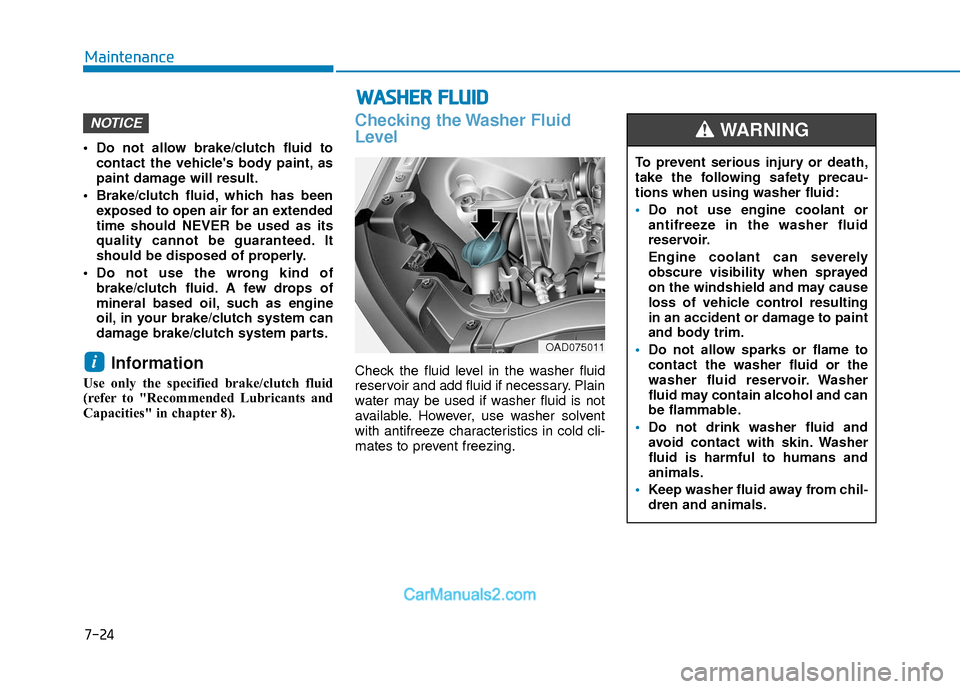
Checking the Washer Fluid
Level
Check the fluid level in the washer fluid
reservoir and add fluid if necessary. Plain
water may be used if washer fluid is not
available. However, use washer solvent
with antifreeze characteristics in cold cli-
mates to prevent freezing.i
NOTICE
OAD075011
To prevent serious injury or death,
take the following safety precau-
tions when using washer fluid:
Do not use engine coolant or
antifreeze in the washer fluid
reservoir.
Engine coolant can severely
obscure visibility when sprayed
on the windshield and may cause
loss of vehicle control resulting
in an accident or damage to paint
and body trim.
Do not allow sparks or flame to
contact the washer fluid or the
washer fluid reservoir. Washer
fluid may contain alcohol and can
be flammable.
Do not drink washer fluid and
avoid contact with skin. Washer
fluid is harmful to humans and
animals.
Keep washer fluid away from chil-
dren and animals.
WARNING
Page 502 of 526
7-84
Maintenance
Canister
Fuel vapors generated inside the fuel
tank are absorbed and stored in the
onboard canister. When the engine is
running, the fuel vapors absorbed in the
canister are drawn into the surge tank
through the purge control solenoid valve.
Purge Control Solenoid Valve(PCSV)
The purge control solenoid valve is con-
trolled by the Engine Control Module
(ECM); when the engine coolant temper-
ature is low during idling, the PCSV clos-
es so that evaporated fuel is not taken
into the engine. After the engine warms-
up during ordinary driving, the PCSV
opens to introduce evaporated fuel to the
engine.
3. Exhaust Emission Control System
The Exhaust Emission Control System is
a highly effective system which controls
exhaust emissions while maintaining
good vehicle performance.
When the engine starts or fails to start,
excessive attempts to restart the engine
may cause damage to the emission sys-
tem.
Engine exhaust (carbon monox-
ide) precautions
Carbon monoxide can be present with
other exhaust fumes. If you smell
exhaust fumes of any kind in your vehi-
cle, drive with all the windows fully
open. Have your vehicle checked and
repaired immediately.
Engine exhaust gases contain car-
bon monoxide (CO). Though color-
less and odorless, it is dangerous
and could be lethal if inhaled.
Follow the instructions on this
page to avoid CO poisoning.
WARNING
CALIFORNIA PROPOSITION 65
WARNING
Engine exhaust and a wide variety
of automobile components and
parts, including components found
in the interior furnishings in a vehi-
cle, contain or emit chemicals
known to the State of California to
cause cancer and birth defects and
reproductive harm. In addition, cer-
tain fluids contained in vehicles
and certain products of component
wear contain or emit chemicals
known to the State of California to
cause cancer and birth defects or
other reproductive harm.
WARNING
Page 512 of 526
8-8
Specifications, Consumer information and Reporting safety defects
*1: Refer to the recommended SAE viscosity numbers on the next page.
*2: Engine oils labeled Energy Conserving Oil are now available. Along with other additional benefits, they contribute to fuel economy by reducing the amount of fuel necessary to overcome engine friction. Often, these improvements are difficult to measure in everyday driving, but in a year's
time, they can offer significant cost and energy savings.
*
3: If the ACEA A5 engine oil is not available in your country, you are able to use ILSAC GF-3 (or above) or ACEA A3 (or above).
*4: If the API service SM engine oil is not available in your country, you are able to use API service SL.
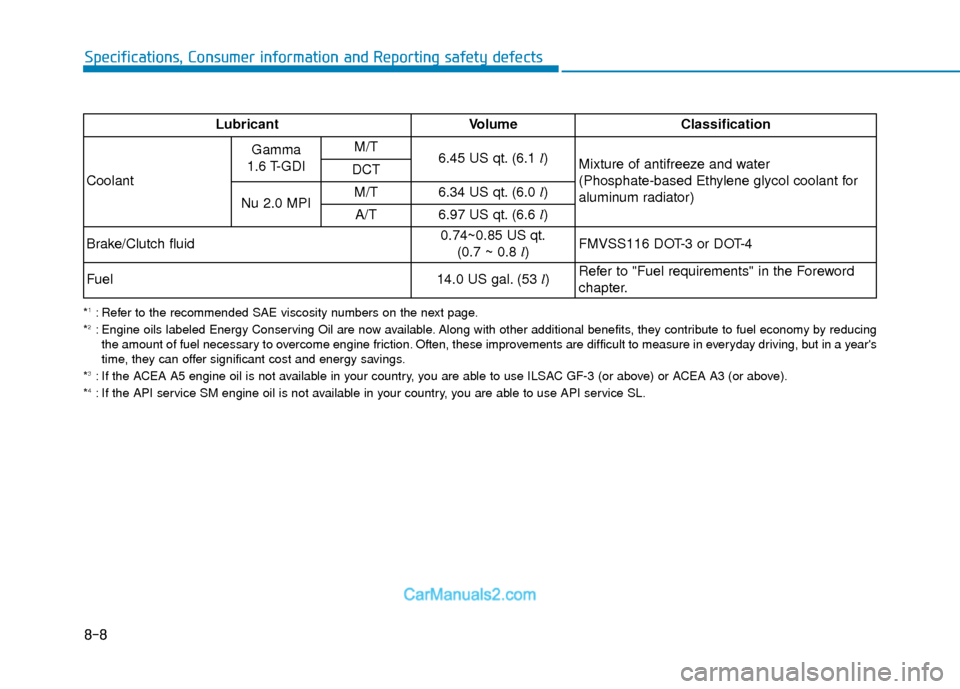
LubricantVolume Classification
Coolant Gamma
1.6 T-GDI M/T
6.45 US qt. (6.1
l)
Mixture of antifreeze and water
(Phosphate-based Ethylene glycol coolant for
aluminum radiator)
DCT
Nu 2.0 MPI M/T
6.34 US qt. (6.0
l)
A/T
6.97 US qt. (6.6 l)
Brake/Clutch fluid
0.74~0.85 US qt. (0.7 ~ 0.8 l) FMVSS116 DOT-3 or DOT-4
Fuel14.0 US gal. (53 l)Refer to "Fuel requirements" in the Foreword
chapter.
Page 521 of 526
I-4
Drive Mode Integrated Control System .........................5-43
Driver Assist System.....................................................3-109Rear View Camera ...................................................3-109
Driver Position Memory System ....................................3-16 Easy Access Function .................................................3-18
Storing Positions into Memory ..................................3-17
Dual Clutch Transmission...............................................5-24 Dual Clutch Transmission Operation .........................5-24
Good Driving Practices ..............................................5-32
Emission Control System ...............................................7-83 Crankcase Emission Control System .........................7-83
Evaporative Emission Control System Including Onboard Refueling Vapor Recovery (ORVR) ........7-83
Exhaust Emission Control System .............................7-84
Engine ........................................................................\
.......8-2
Engine Compartment.................................................1-6, 7-3
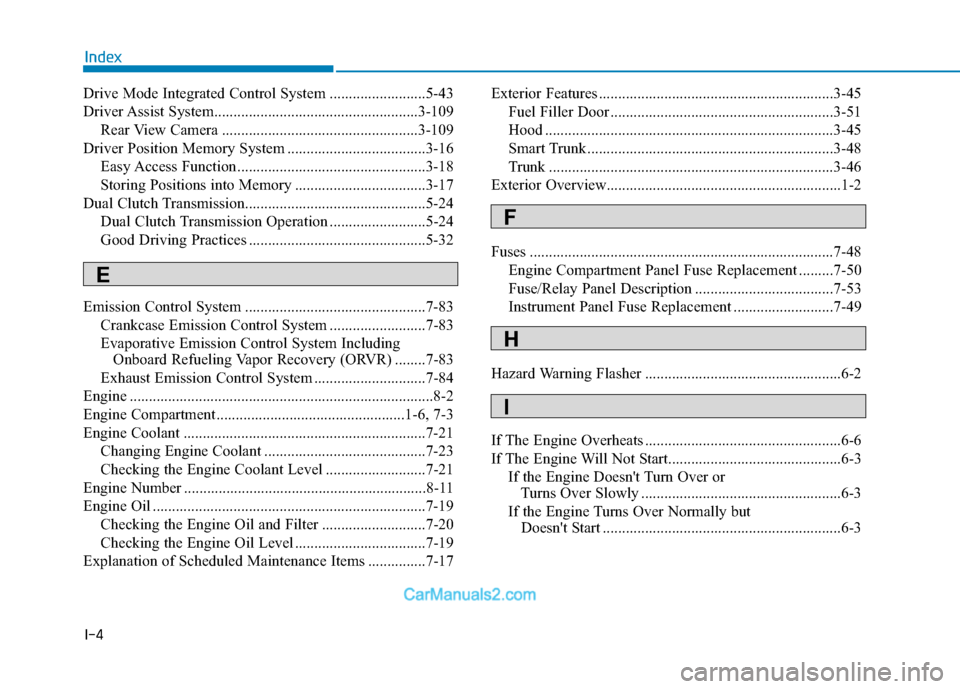
Engine Coolant ...............................................................7-21 Changing Engine Coolant ..........................................7-23
Checking the Engine Coolant Level ..........................7-21
Engine Number ...............................................................8-11
Engine Oil .......................................................................7\
-19 Checking the Engine Oil and Filter ...........................7-20
Checking the Engine Oil Level ..................................7-19
Explanation of Scheduled Maintenance Items ...............7-17 Exterior Features .............................................................3-45
Fuel Filler Door ..........................................................3-51
Hood ........................................................................\
...3-45
Smart Trunk ................................................................3-48
Trunk ........................................................................\
..3-46
Exterior Overview.............................................................1-2
Fuses ........................................................................\
.......7-48 Engine Compartment Panel Fuse Replacement .........7-50
Fuse/Relay Panel Description ....................................7-53
Instrument Panel Fuse Replacement ..........................7-49
Hazard Warning Flasher ...................................................6-2
If The Engine Overheats ...................................................6-6
If The Engine Will Not Start.............................................6-3 If the Engine Doesn't Turn Over or Turns Over Slowly ....................................................6-3
If the Engine Turns Over Normally but Doesn't Start ..............................................................6-3
Index
E
F
H
I