stop start Hyundai Elantra 2018 Service Manual
[x] Cancel search | Manufacturer: HYUNDAI, Model Year: 2018, Model line: Elantra, Model: Hyundai Elantra 2018Pages: 526, PDF Size: 17.2 MB
Page 320 of 526
5-37
Driving your vehicle
5
Using ABS
To obtain the maximum benefit from your
ABS in an emergency situation, do not
attempt to modulate your brake pressure
and do not try to pump your brakes.
Depress your brake pedal as hard as
possible.
When you apply your brakes under con-
ditions which may lock the wheels, you
may hear sounds from the brakes, or feel
a corresponding sensation in the brake
pedal. This is normal and it means your
ABS is active.
ABS does not reduce the time or dis-
tance it takes to stop the vehicle.
Always maintain a safe distance from the
vehicle in front of you.
ABS will not prevent a skid that results
from sudden changes in direction, such
as trying to take a corner too fast or mak-
ing a sudden lane change. Always drive
at a safe speed for the road and weather
conditions.
ABS cannot prevent a loss of stability.
Always steer moderately when braking
hard. Severe or sharp steering wheel
movement can still cause your vehicle to
veer into oncoming traffic or off the road.On loose or uneven road surfaces, oper-
ation of the anti-lock brake system may
result in a longer stopping distance than
for vehicles equipped with a conventional
brake system.
The ABS warning light ( ) will stay on
for several seconds after the ignition
switch is in the ON position. During that
time, the ABS will go through self-diag-
nosis and the light will go off if everything
is normal. If the light stays on, you may
have a problem with your ABS. Contact
an authorized HYUNDAI dealer as soon
as possible
Information
When you jump start your vehicle because
of a drained battery, the ABS warning
light ( ) may turn on at the same time.
This happens because of the low battery
voltage. It does not mean your ABS is mal-
functioning. Have the battery recharged
before driving the vehicle.
i
If the ABS warning light ( ) is on
and stays on, you may have a prob-
lem with the ABS. Your power
brakes will work normally. To
reduce the risk of serious injury or
death, contact your HYUNDAI deal-
er as soon as possible.
WARNING
When you drive on a road having
poor traction, such as an icy road,
and apply your brakes continuous-
ly, the ABS will be active continu-
ously and the ABS warning light
( ) may illuminate. Pull your car
over to a safe place and turn the
engine off.
Restart the engine. If the ABS warn-
ing light is off, then your ABS sys-
tem is normal.
Otherwise, you may have a problem
with your ABS system.
Contact an
authorized HYUNDAI dealer as soon
as possible.
CAUTION
Page 325 of 526
5-42
Driving your vehicle
Hill-Start Assist Control (HAC)
The Hill-Start Assist Control (HAC) helps
prevent the vehicle from rolling back-
wards when starting a vehicle from a
stop on a hill. The system operates the
brakes automatically for approximately 2
seconds and releases the brake after 2
seconds or when the accelerator pedal is
depressed.
The HAC does not operate when theshift lever is in P (Park) or N
(Neutral)
The HAC activates even though the ESC (Electronic Stability Control) is
off but does not activate when the
ESC has malfunctioned.
Good Braking Practices
Wet brakes can be dangerous! The
brakes may get wet if the vehicle is driv-
en through standing water or if it is
washed. Your vehicle will not stop as
quickly if the brakes are wet. Wet brakes
may cause the vehicle to pull to one side. To dry the brakes, apply the brakes light-
ly until the braking action returns to nor-
mal, taking care to keep the vehicle
under control at all times. If the braking
action does not return to normal, stop as
soon as it is safe to do so and call an
authorized HYUNDAI dealer for assis-
tance.
DO NOT drive with your foot resting on
the brake pedal. Even light, but constant
pedal pressure can result in the brakes
overheating, brake wear, and possibly
even brake failure.
If a tire goes flat while you are driving,
apply the brakes gently and keep the
vehicle pointed straight ahead while you
slow down. When you are moving slowly
enough for it to be safe to do so, pull off
the road and stop in a safe location.
Keep your foot firmly on the brake pedal
when the vehicle is stopped to prevent
the vehicle from rolling forward.
NOTICE
Always be ready to depress the
accelerator pedal when starting off
on a incline. The HAC activates only
for approximately 2 seconds.
WARNING
Whenever leaving the vehicle or
parking, always come to a complete
stop and continue to depress the
brake pedal. Move the shift lever
into the 1
stgear (for manual trans-
mission vehicle) or P (Park, for
automatic transmission vehicle)
position, then apply the parking
brake, and place the ignition switch
in the LOCK/OFF position.
Vehicles parked with the parking
brake not applied or not fully
engaged may roll inadvertently and
may cause injury to the driver and
others. ALWAYS apply the parking
brake before exiting the vehicle.
WARNING
Page 383 of 526
6-2
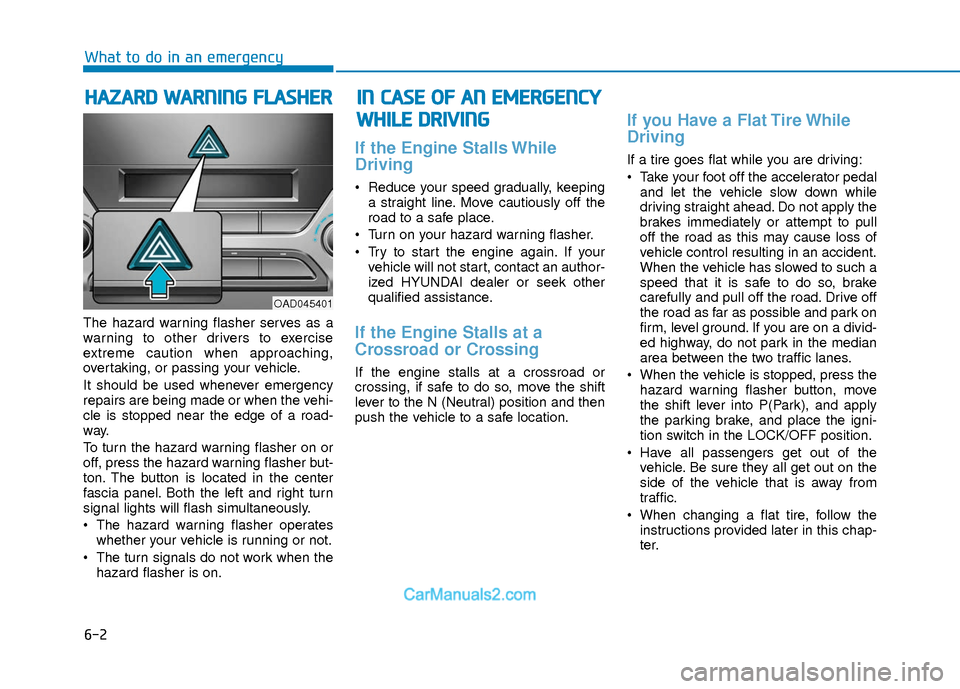
The hazard warning flasher serves as a
warning to other drivers to exercise
extreme caution when approaching,
overtaking, or passing your vehicle.
It should be used whenever emergency
repairs are being made or when the vehi-
cle is stopped near the edge of a road-
way.
To turn the hazard warning flasher on or
off, press the hazard warning flasher but-
ton. The button is located in the center
fascia panel. Both the left and right turn
signal lights will flash simultaneously.
• The hazard warning flasher operates
whether your vehicle is running or not.
The turn signals do not work when the hazard flasher is on.
If the Engine Stalls While
Driving
Reduce your speed gradually, keepinga straight line. Move cautiously off the
road to a safe place.
Turn on your hazard warning flasher.
Try to start the engine again. If your vehicle will not start, contact an author-
ized HYUNDAI dealer or seek other
qualified assistance.
If the Engine Stalls at a
Crossroad or Crossing
If the engine stalls at a crossroad or
crossing, if safe to do so, move the shift
lever to the N (Neutral) position and then
push the vehicle to a safe location.
If you Have a Flat Tire While
Driving
If a tire goes flat while you are driving:
Take your foot off the accelerator pedaland let the vehicle slow down while
driving straight ahead. Do not apply the
brakes immediately or attempt to pull
off the road as this may cause loss of
vehicle control resulting in an accident.
When the vehicle has slowed to such a
speed that it is safe to do so, brake
carefully and pull off the road. Drive off
the road as far as possible and park on
firm, level ground. If you are on a divid-
ed highway, do not park in the median
area between the two traffic lanes.
When the vehicle is stopped, press the hazard warning flasher button, move
the shift lever into P(Park), and apply
the parking brake, and place the igni-
tion switch in the LOCK/OFF position.
Have all passengers get out of the vehicle. Be sure they all get out on the
side of the vehicle that is away from
traffic.
When changing a flat tire, follow the instructions provided later in this chap-
ter.
H HA
AZ
ZA
A R
RD
D
W
W A
AR
RN
N I
IN
N G
G
F
F L
LA
A S
SH
H E
ER
R
What to do in an emergency
I
IN
N
C
C A
A S
SE
E
O
O F
F
A
A N
N
E
E M
M E
ER
R G
G E
EN
N C
CY
Y
W
W H
HI
IL
L E
E
D
D R
RI
IV
V I
IN
N G
G
OAD045401
Page 389 of 526
6-8
What to do in an emergency
Tire Pressure Monitoring
System
Each tire, including the spare (if pro-
vided), should be checked monthly
when cold and inflated to the inflation
pressure recommended by the vehi-
cle manufacturer on the vehicle plac-
ard or tire inflation pressure label.
If your vehicle has tires of a different
size than the size indicated on the
vehicle placard or tire inflation pres-
sure label, you should determine the
proper tire inflation pressure for
those tires.As an added safety feature, your
vehicle has been equipped with a tire
pressure monitoring system (TPMS)
that illuminates a low tire pressure
telltale when one or more of your
tires is significantly under-inflated.
Accordingly, when the low tire pres-
sure telltale illuminates, you should
stop and check your tires as soon as
possible, and inflate them to the
proper pressure. Driving on a signifi-
cantly under-inflated tire causes the
tire to overheat and can lead to tire
failure.
Under-inflation also reduces fuel effi-
ciency and tire tread life, and may
affect the vehicle's handling and
stopping ability.
Please note that the TPMS is not a
substitute for proper tire mainte-
nance, and it is the driver's responsi-
bility to maintain correct tire pres-
sure, even if under-inflation has not
reached the level to trigger illumina-
tion of the TPMS low tire pressure
telltale.Your vehicle has also been equipped
with a TPMS malfunction indicator to
indicate when the system is not
operating properly. The TPMS mal-
function indicator is combined with
the low tire pressure telltale. When
the system detects a malfunction,
the telltale will flash for approximate-
ly one minute and then remain con-
tinuously illuminated. This sequence
will continue upon subsequent vehi-
cle start-ups as long as the malfunc-
tion exists.
When the malfunction indicator is
illuminated, the system may not be
able to detect or signal low tire pres-
sure as intended. TPMS malfunc-
tions may occur for a variety of rea-
sons, including the installation of
replacement or alternate tires or
wheels on the vehicle that prevent
the TPMS from functioning properly.
Always check the TPMS malfunction
telltale after replacing one or more
tires or wheels on your vehicle to
ensure that the replacement or alter-
nate tires and wheels allow the TPMS
to continue to function properly.
Over-inflation or under-inflation
can reduce tire life, adversely
affect vehicle handling, and
lead to sudden tire failure that
may cause loss of vehicle con-
trol resulting in an accident.
WARNING
Page 436 of 526
7-18
Maintenance
Automatic Transmission Fluid
(if equipped)
Automatic transmission fluid should not
be checked under normal usage condi-
tions. But in severe conditions, the fluid
should be changed at an authorized
HYUNDAI dealer in accordance to the
scheduled maintenance at the beginning
of this chapter.
Automatic transmission fluid color is
basically red.
As the vehicle is driven, the automatic
transmission fluid will begin to look
darker. This is a normal condition and
you should not judge the need to
replace the fluid based upon the
changed color.
Dual Clutch Transmission
Fluid (if equipped)
Inspect the dual clutch transmission fluid
according to the maintenance schedule.
Manual Transmission Fluid
(if equipped)
Inspect the manual transmission fluid
according to the maintenance schedule.
Brake Hoses and Lines
Visually check for proper installation,
chafing, cracks, deterioration and any
leakage. Replace any deteriorated or
damaged parts immediately.
Brake/Clutch Fluid
Check brake/clutch fluid level in the
brake/clutch fluid reservoir. The level
should be between the MIN and the MAX
marks on the side of the reservoir. Use
only hydraulic brake/clutch fluid conform-
ing to DOT 3 or DOT 4 specification.
Parking Brake
Inspect the parking brake system includ-
ing the parking brake pedal and cables.
Brake Discs, Pads, Calipers
and Rotors
Check the pads for excessive wear, discs
for run out and wear, and calipers for fluid
leakage.
Exhaust Pipe and Muffler
Visually inspect the exhaust pipes, muf-
fler and hangers for cracks, deterioration,
or damage. Start the engine and listen
carefully for any exhaust gas leakage.
Tighten connections or replace parts as
necessary.
Suspension Mounting Bolts
Check the suspension connections for
looseness or damage. Retighten to the
specified torque.
Steering Gear Box, Linkage &
Boots/Lower Arm Ball Joint
With the vehicle stopped and the engine
off, check for excessive free-play in the
steering wheel. Check the linkage for
bends or damage. Check the dust boots
and ball joints for deterioration, cracks, or
damage.
Replace any damaged parts.
Drive Shafts and Boots
Check the drive shafts, boots and clamps
for cracks, deterioration, or damage.
Replace any damaged parts and, if nec-
essary, repack the grease.
Air Conditioning Refrigerant
Check the air conditioning lines and con-
nections for leakage and damage.
NOTICE
The use of a non-specified fluid
could result in transmission mal-
function and failure. Use only the
specified automatic transmission
fluid (refer to "Recommended
Lubricants and Capacities" in
chapter 8).
CAUTION
Page 440 of 526
7-22
Maintenance
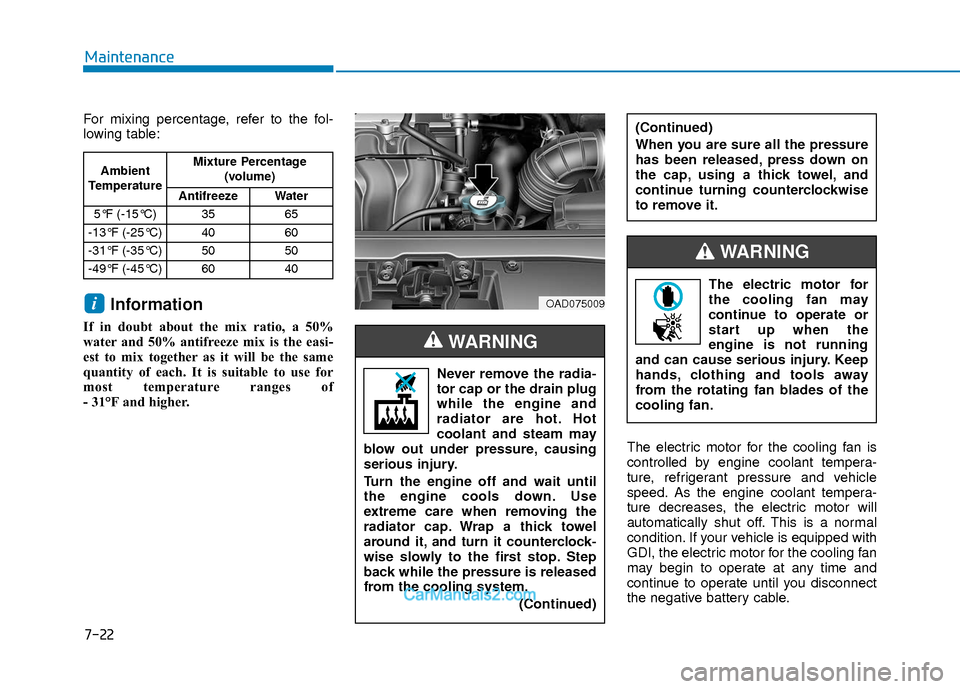
For mixing percentage, refer to the fol-
lowing table:
Information
If in doubt about the mix ratio, a 50%
water and 50% antifreeze mix is the easi-
est to mix together as it will be the same
quantity of each. It is suitable to use for
most temperature ranges of
- 31°F and higher.The electric motor for the cooling fan is
controlled by engine coolant tempera-
ture, refrigerant pressure and vehicle
speed. As the engine coolant tempera-
ture decreases, the electric motor will
automatically shut off. This is a normal
condition. If your vehicle is equipped with
GDI, the electric motor for the cooling fan
may begin to operate at any time and
continue to operate until you disconnect
the negative battery cable.
i
Ambient
Temperature Mixture Percentage
(volume)
Antifreeze Water
5°F (-15°C) 35 65
-13°F (-25°C) 40 60
-31°F (-35°C) 50 50
-49°F (-45°C) 60 40
Never remove the radia-
tor cap or the drain plug
while the engine and
radiator are hot. Hot
coolant and steam may
blow out under pressure, causing
serious injury.
Turn the engine off and wait until
the engine cools down. Use
extreme care when removing the
radiator cap. Wrap a thick towel
around it, and turn it counterclock-
wise slowly to the first stop. Step
back while the pressure is released
from the cooling system.
(Continued)
WARNING
(Continued)
When you are sure all the pressure
has been released, press down on
the cap, using a thick towel, and
continue turning counterclockwise
to remove it.
OAD075009
The electric motor for
the cooling fan may
continue to operate or
start up when the
engine is not running
and can cause serious injury. Keep
hands, clothing and tools away
from the rotating fan blades of the
cooling fan.
WARNING
Page 448 of 526
7-30
Maintenance
B
BA
A T
TT
TE
ER
R Y
Y
To prevent SERIOUS INJURY or
DEATH to you or bystanders,
always follow these precautions
when working near or handling the
battery:
Always read and follow
instructions carefully when
handling a battery.
Wear eye protection
designed to protect the
eyes from acid splashes.
Keep all flames, sparks, or
smoking materials away
from the battery.
Hydrogen is always present in battery cells, is highly
combustible, and may
explode if ignited.
Keep batteries out of reach
of children. (Continued)
WARNING (Continued)Batteries contain sulfuric
acid which is highly corro-
sive. Do not allow acid to
contact your eyes, skin or
clothing.
If acid gets into your eyes, flush
your eyes with clean water for at
least 15 minutes and get immediate
medical attention. If acid gets on
your skin, thoroughly wash the
area. If you feel pain or a burning
sensation, get medical attention
immediately.
When lifting a plastic-cased bat-
tery, excessive pressure on the
case may cause battery acid to
leak. Lift with a battery carrier or
with your hands on opposite cor-
ners.
Do not attempt to jump start your
vehicle if your battery is frozen.
NEVER attempt to recharge the
battery when the vehicle’s battery
cables are connected to the bat-
tery. (Continued)
(Continued)
The electrical ignition system
works with high voltage. NEVER
touch these components with the
engine running or when the
Engine Start/Stop button is in the
ON position.
Leaked battery electrolyte due to
repeated driving on sharp curves
(e.g. on circuits) may cause safe-
ty problem. Avoid repeated driv-
ing on sharp curves.
CALIFORNIA PROPOSITION 65
WARNING
Battery posts, terminals, and relat-
ed accessories contain lead and
lead compounds, chemicals known
to the State of California to cause
cancer, birth defects and reproduc-
tive harm. Batteries also contain
other chemicals known to the State
of California to cause cancer. Wash
hands after handling.
WARNING
Page 473 of 526
7-55
7
Maintenance
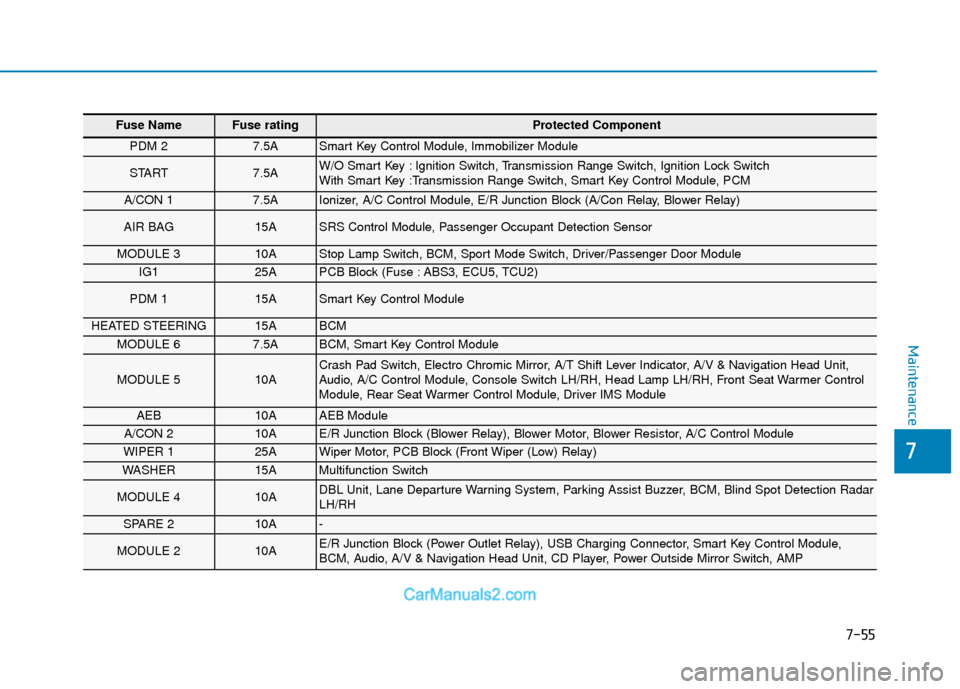
Fuse Name Fuse rating Protected Component
PDM 2 7.5A Smart Key Control Module, Immobilizer Module
START 7.5A W/O Smart Key : Ignition Switch, Transmission Range Switch, Ignition Lock Switch
With Smart Key :Transmission Range Switch, Smart Key Control Module, PCM
A/CON 1 7.5A Ionizer, A/C Control Module, E/R Junction Block (A/Con Relay, Blower Relay)
AIR BAG 15A SRS Control Module, Passenger Occupant Detection Sensor
MODULE 3 10A Stop Lamp Switch, BCM, Sport Mode Switch, Driver/Passenger Door Module
IG1 25A PCB Block (Fuse : ABS3, ECU5, TCU2)
PDM 1 15A Smart Key Control Module
HEATED STEERING 15A BCM
MODULE 6 7.5A BCM, Smart Key Control Module
MODULE 5 10A Crash Pad Switch, Electro Chromic Mirror, A/T Shift Lever Indicator, A/V & Navigation Head Unit,
Audio, A/C Control Module, Console Switch LH/RH, Head Lamp LH/RH, Front Seat Warmer Control
Module, Rear Seat Warmer Control Module, Driver IMS Module
AEB 10A AEB Module
A/CON 2 10A E/R Junction Block (Blower Relay), Blower Motor, Blower Resistor, A/C Control Module
WIPER 1 25A Wiper Motor, PCB Block (Front Wiper (Low) Relay)
WASHER 15A Multifunction Switch
MODULE 4 10A DBL Unit, Lane Departure Warning System, Parking Assist Buzzer, BCM, Blind Spot Detection Radar
LH/RH
SPARE 2 10A -
MODULE 2 10A E/R Junction Block (Power Outlet Relay), USB Charging Connector, Smart Key Control Module,
BCM, Audio, A/V & Navigation Head Unit, CD Player, Power Outside Mirror Switch, AMP
Page 503 of 526
7-85
7
Maintenance
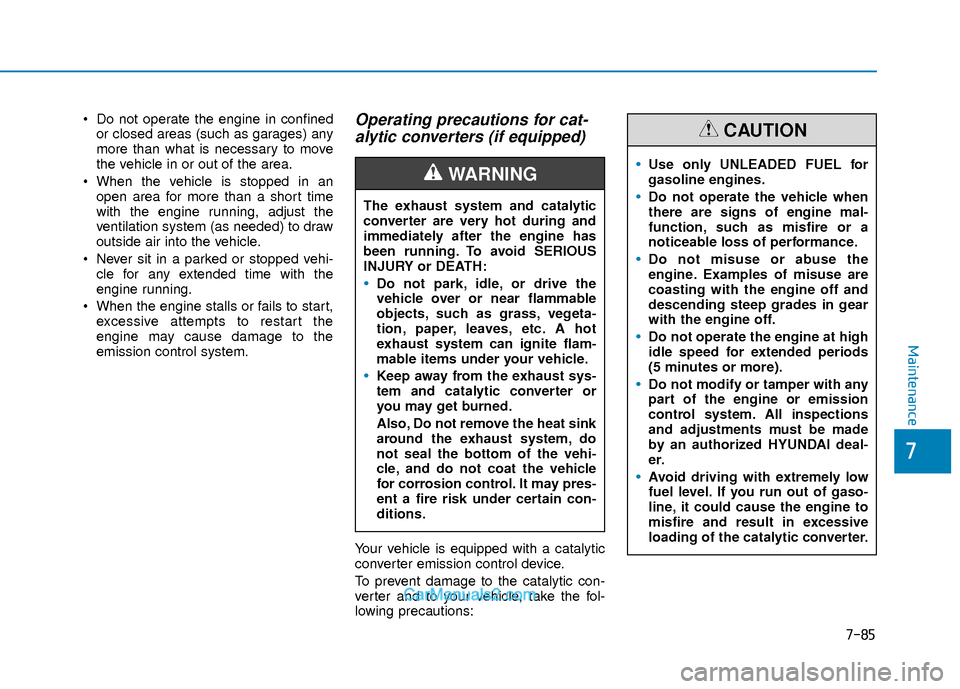
Do not operate the engine in confinedor closed areas (such as garages) any
more than what is necessary to move
the vehicle in or out of the area.
When the vehicle is stopped in an open area for more than a short time
with the engine running, adjust the
ventilation system (as needed) to draw
outside air into the vehicle.
Never sit in a parked or stopped vehi- cle for any extended time with the
engine running.
When the engine stalls or fails to start, excessive attempts to restart the
engine may cause damage to the
emission control system.Operating precautions for cat-alytic converters (if equipped)
Your vehicle is equipped with a catalytic
converter emission control device.
To prevent damage to the catalytic con-
verter and to your vehicle, take the fol-
lowing precautions: The exhaust system and catalytic
converter are very hot during and
immediately after the engine has
been running. To avoid SERIOUS
INJURY or DEATH:
Do not park, idle, or drive the
vehicle over or near flammable
objects, such as grass, vegeta-
tion, paper, leaves, etc. A hot
exhaust system can ignite flam-
mable items under your vehicle.
Keep away from the exhaust sys-
tem and catalytic converter or
you may get burned.
Also, Do not remove the heat sink
around the exhaust system, do
not seal the bottom of the vehi-
cle, and do not coat the vehicle
for corrosion control. It may pres-
ent a fire risk under certain con-
ditions.
WARNING Use only UNLEADED FUEL for
gasoline engines.
Do not operate the vehicle when
there are signs of engine mal-
function, such as misfire or a
noticeable loss of performance.
Do not misuse or abuse the
engine. Examples of misuse are
coasting with the engine off and
descending steep grades in gear
with the engine off.
Do not operate the engine at high
idle speed for extended periods
(5 minutes or more).
Do not modify or tamper with any
part of the engine or emission
control system. All inspections
and adjustments must be made
by an authorized HYUNDAI deal-
er.
Avoid driving with extremely low
fuel level. If you run out of gaso-
line, it could cause the engine to
misfire and result in excessive
loading of the catalytic converter.
CAUTION
Page 522 of 526
I-5
If You Have a Flat Tire ...................................................6-13Checking the tire inflation pressure ...........................6-32
Components of the Tire Mobility Kit.........................6-29
Distributing the sealant ..............................................6-32
Introduction ................................................................6-27
Notes on the safe use of the Tire Mobility Kit ..........6-28
Using the Tire Mobility Kit........................................6-30
With Spare Tire ..........................................................6-13
With Tire Mobility Kit (TMK) - Type A,B ................6-19
With Tire Mobility Kit (TMK) - Type C ...................6-27
Ignition Switch..................................................................5-6 Engine Start/Stop Button ..............................................5-9
Key Ignition Switch .....................................................5-6
Important safety precautions.............................................2-2 Air Bag Hazards ...........................................................2-2
Always Wear Your Seat Belt ........................................2-2
Control Your Speed ......................................................2-2
Driver Distraction.........................................................2-2
Keep Your Vehicle in Safe Condition ..........................2-2
Restrain All Children....................................................2-2
In Case of an Emergency While Driving .........................6-2 If the Engine Stalls at a Crossroad or Crossing ...........6-2
If the Engine Stalls While Driving...............................6-2
If you Have a Flat Tire While Driving.........................6-2 Instrument Cluster...........................................................3-54
Gauges ........................................................................\
3-56
Instrument Cluster Control .........................................3-56
LCD Display Messages ..............................................3-71
Warning and Indicator lights ......................................3-61
Instrument Panel Overview ..............................................1-5
Interior Features ............................................................3-138 Clock ........................................................................\
3-141
Clothes Hanger .........................................................3-141
Cup Holder ...............................................................3-138
Floor Mat Anchor(s) .................................................3-142
Luggage Net Holder .................................................3-142
Power Outlet.............................................................3-139
Sunvisor ....................................................................3-13\
9
USB Charger ............................................................3-140
Interior Overview..............................................................1-4
Jump Starting ....................................................................6-3
I
Index
J