Car seat Hyundai Elantra 2018 Owner's Manual
[x] Cancel search | Manufacturer: HYUNDAI, Model Year: 2018, Model line: Elantra, Model: Hyundai Elantra 2018Pages: 526, PDF Size: 17.2 MB
Page 18 of 526
Safety system of your vehicle
Important safety precautions...............................2-2
Always Wear Your Seat Belt ..........................................2-2
Restrain All Children .........................................................2-2
Air Bag Hazards .................................................................2-2
Driver Distraction ..............................................................2-2
Control Your Speed ...........................................................2-2
Keep Your Vehicle in Safe Condition ............................2-2
Seats ........................................................................\
2-3
Safety Precautions ...........................................................2-4
Front Seats ........................................................................\
.2-5
Rear Seats........................................................................\
.2-10
Head Restraints ...............................................................2-12
Seat warmers ...................................................................2-16
Seat belts ..............................................................2-18
Seat Belt Safety Precautions .......................................2-18
Seat Belt Warning Light ................................................2-19
Seat Belt Restraint System...........................................2-20
Additional Seat Belt Safety Precautions ...................2-25
Care of Seat Belts...........................................................2-27
Child restraint system (CRS) ..............................2-28
Children Always in the Rear .........................................2-28
Selecting a Child Restraint System (CRS) .................2-29
Installing a Child Restraint System (CRS)..................2-31
Air bag -
Advanced supplemental restraint system ........2-38
Where Are the Air Bags? ..............................................2-40
How Does the Air Bag System Operate?..................2-43
What to Expect After an Air Bag Inflates ................2-47
Occupant Classification System (OCS).......................2-48
Why Didn't My Air Bag Go Off in a Collision? ........2-53
SRS Care ........................................................................\
....2-58
Additional Safety Precautions .....................................2-59
Air Bag Warning Labels .................................................2-60
This chapter provides you with important information about how to protect yourself and your passengers. It explains
how to properly use your seats and seat belts, and how your air bags work.
Additionally, this chapter explains how to properly restrain infants and children in your vehicle.
2
Page 23 of 526
2-6
Safety system of your vehicle
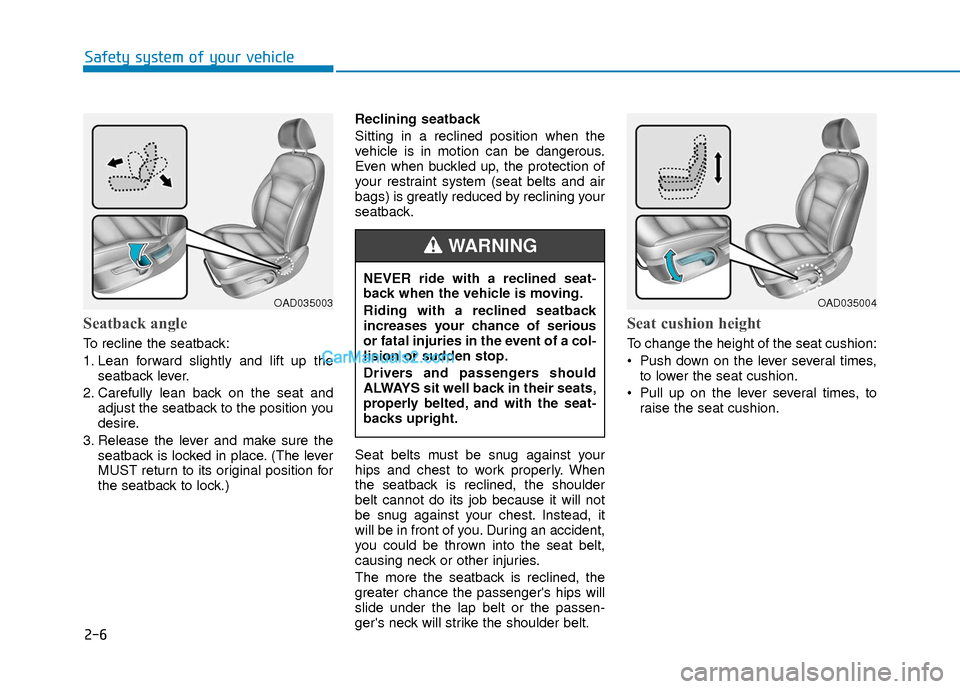
Seatback angle
To recline the seatback:
1. Lean forward slightly and lift up theseatback lever.
2. Carefully lean back on the seat and adjust the seatback to the position you
desire.
3. Release the lever and make sure the seatback is locked in place. (The lever
MUST return to its original position for
the seatback to lock.) Reclining seatback
Sitting in a reclined position when the
vehicle is in motion can be dangerous.
Even when buckled up, the protection of
your restraint system (seat belts and air
bags) is greatly reduced by reclining your
seatback.
Seat belts must be snug against your
hips and chest to work properly. When
the seatback is reclined, the shoulder
belt cannot do its job because it will not
be snug against your chest. Instead, it
will be in front of you. During an accident,
you could be thrown into the seat belt,
causing neck or other injuries.
The more the seatback is reclined, the
greater chance the passenger's hips will
slide under the lap belt or the passen-
ger's neck will strike the shoulder belt.
Seat cushion height
To change the height of the seat cushion:
Push down on the lever several times,
to lower the seat cushion.
Pull up on the lever several times, to raise the seat cushion.
OAD035003OAD035004
NEVER ride with a reclined seat-
back when the vehicle is moving.
Riding with a reclined seatback
increases your chance of serious
or fatal injuries in the event of a col-
lision or sudden stop.
Drivers and passengers should
ALWAYS sit well back in their seats,
properly belted, and with the seat-
backs upright.
WARNING
Page 27 of 526
2-10
Safety system of your vehicle
Rear Seats
Folding the rear seat
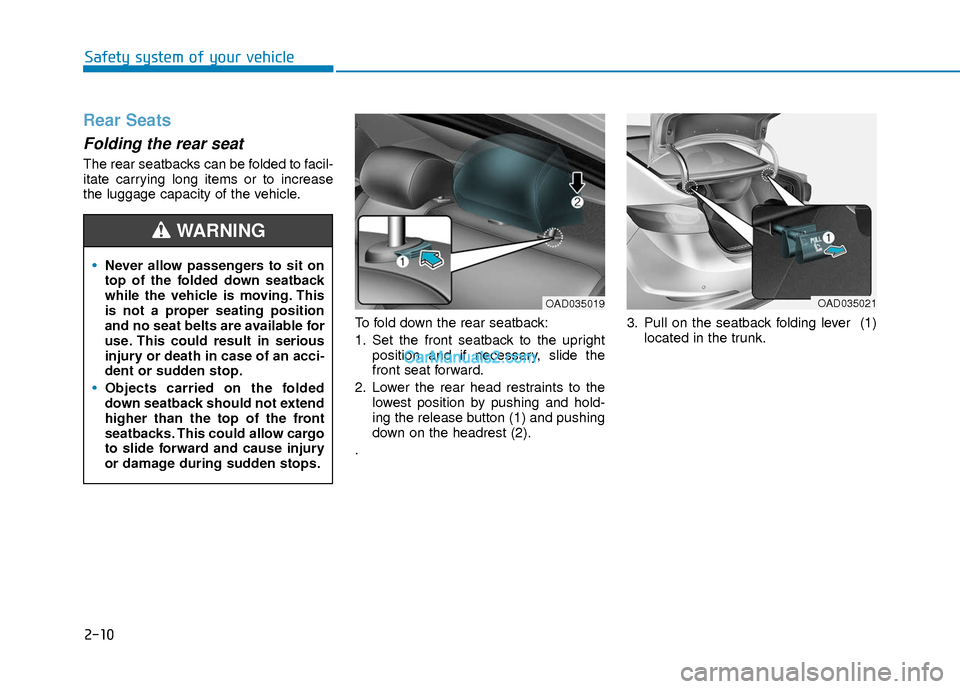
The rear seatbacks can be folded to facil-
itate carrying long items or to increase
the luggage capacity of the vehicle.To fold down the rear seatback:
1. Set the front seatback to the uprightposition and if necessary, slide the
front seat forward.
2. Lower the rear head restraints to the lowest position by pushing and hold-
ing the release button (1) and pushing
down on the headrest (2).
. 3. Pull on the seatback folding lever (1)
located in the trunk.
Never allow passengers to sit on
top of the folded down seatback
while the vehicle is moving. This
is not a proper seating position
and no seat belts are available for
use. This could result in serious
injury or death in case of an acci-
dent or sudden stop.
Objects carried on the folded
down seatback should not extend
higher than the top of the front
seatbacks. This could allow cargo
to slide forward and cause injury
or damage during sudden stops.
WARNING
OAD035019OAD035021
Page 28 of 526
2-11
Safety system of your vehicle
2
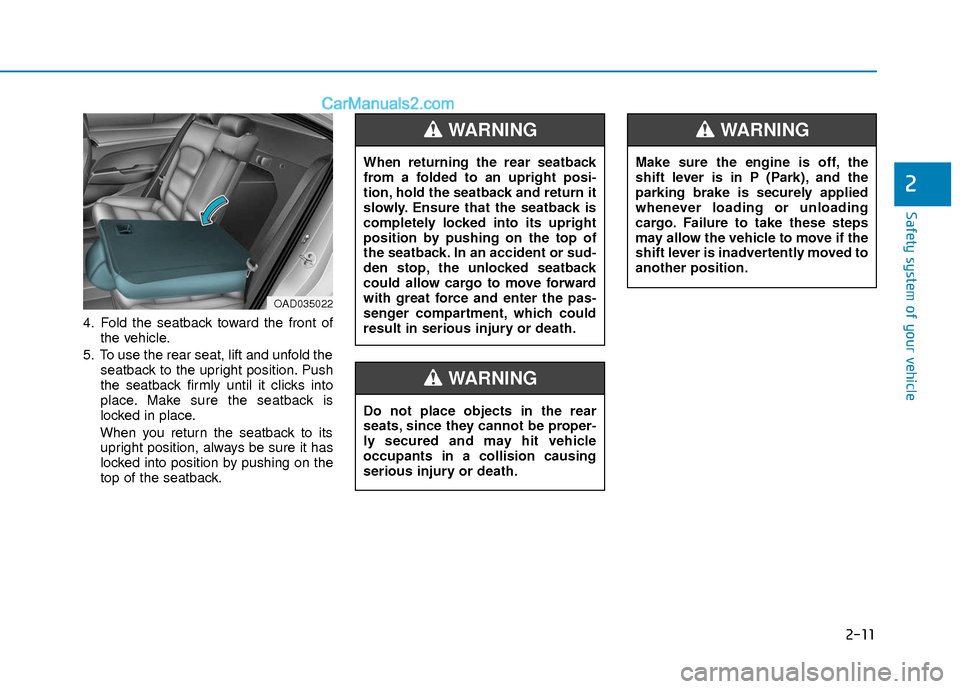
4. Fold the seatback toward the front ofthe vehicle.
5. To use the rear seat, lift and unfold the seatback to the upright position. Push
the seatback firmly until it clicks into
place. Make sure the seatback is
locked in place.
When you return the seatback to its upright position, always be sure it has
locked into position by pushing on the
top of the seatback.
OAD035022
Do not place objects in the rear
seats, since they cannot be proper-
ly secured and may hit vehicle
occupants in a collision causing
serious injury or death.
WARNING
When returning the rear seatback
from a folded to an upright posi-
tion, hold the seatback and return it
slowly. Ensure that the seatback is
completely locked into its upright
position by pushing on the top of
the seatback. In an accident or sud-
den stop, the unlocked seatback
could allow cargo to move forward
with great force and enter the pas-
senger compartment, which could
result in serious injury or death.
WARNING
Make sure the engine is off, the
shift lever is in P (Park), and the
parking brake is securely applied
whenever loading or unloading
cargo. Failure to take these steps
may allow the vehicle to move if the
shift lever is inadvertently moved to
another position.
WARNING
Page 29 of 526
2-12
Safety system of your vehicle
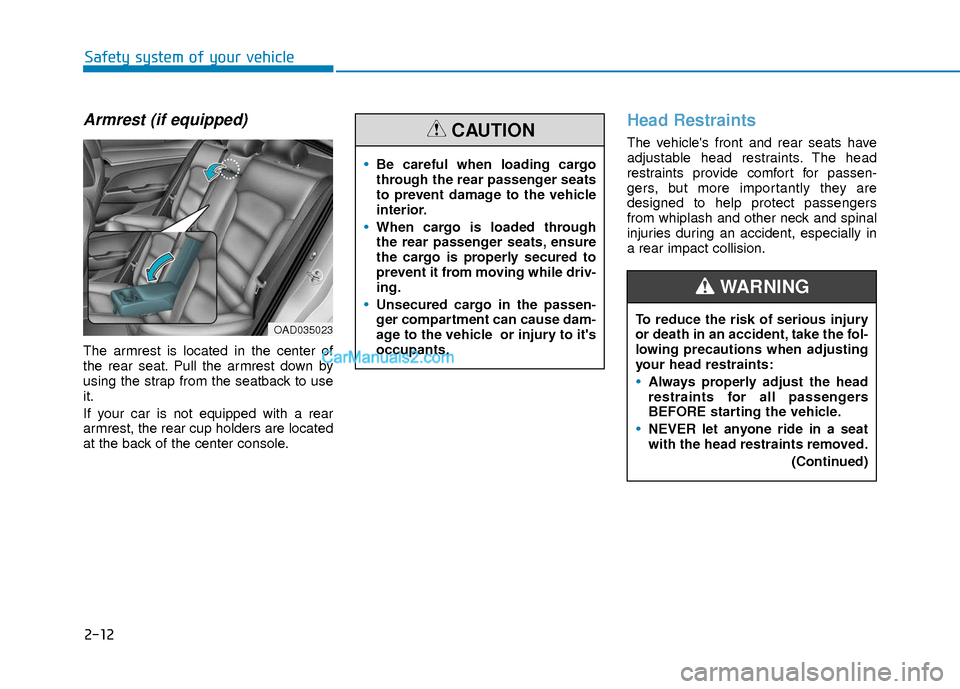
Armrest (if equipped)
The armrest is located in the center of
the rear seat. Pull the armrest down by
using the strap from the seatback to use
it.
If your car is not equipped with a rear
armrest, the rear cup holders are located
at the back of the center console.
Head Restraints
The vehicle's front and rear seats have
adjustable head restraints. The head
restraints provide comfort for passen-
gers, but more importantly they are
designed to help protect passengers
from whiplash and other neck and spinal
injuries during an accident, especially in
a rear impact collision.
OAD035023
Be careful when loading cargo
through the rear passenger seats
to prevent damage to the vehicle
interior.
When cargo is loaded through
the rear passenger seats, ensure
the cargo is properly secured to
prevent it from moving while driv-
ing.
Unsecured cargo in the passen-
ger compartment can cause dam-
age to the vehicle or injury to it's
occupants.
CAUTION
To reduce the risk of serious injury
or death in an accident, take the fol-
lowing precautions when adjusting
your head restraints:
Always properly adjust the head
restraints for all passengers
BEFORE starting the vehicle.
NEVER let anyone ride in a seat
with the head restraints removed.(Continued)
WARNING
Page 35 of 526
2-18
Safety system of your vehicle
This section describes how to use the
seat belts properly. It also describes
some of the things not to do when using
seat belts.
Seat Belt Safety Precautions
Always fasten your seat belt and make
sure all passengers have fastened their
seat belts before starting any trip. Air
bags are designed to supplement the
seat belt as an additional safety device,
but they are not a substitute. Most states
require all occupants of a vehicle to wear
seat belts.
S SE
E A
A T
T
B
B E
EL
LT
T S
S
Seat belts must be used by ALL
passengers whenever the vehicle is
moving. Take the following precau-
tions when adjusting and wearing
seat belts:
ALWAYS properly restrain chil-
dren under age 13 in the rear
seats.
NEVER allow children to ride in
the front passenger seat. If a child
age 13 or older must be seated in
the front seat, move the seat as
far back as possible and properly
restrain them in the seat.
(Continued)
WARNING
(Continued)
NEVER allow an infant or child to
be carried on an occupant’s lap.
NEVER ride with the seatback
reclined when the vehicle is mov-
ing.
Do not allow children to share a
seat or seat belt.
Do not wear the shoulder belt
under your arm or behind your
back.
Always wear both the shoulder
portion and lap portion of the
lap/shoulder belt.
Do not use the seat belt if it is
twisted. A twisted seat belt will
not protect you properly in an
accident.
Do not use a seat belt if the web-
bing or hardware is damaged.
Do not latch the seat belt into the
buckles of other seats.
NEVER unfasten the seat belt
while driving. This may cause
loss of vehicle control resulting
in an accident.
Make sure there is nothing in the
buckle interfering with the seat
belt latch mechanism. This may
prevent the seat belt from fasten-
ing securely.(Continued)
(Continued)
No modifications or additions
should be made by the user
which will either prevent the seat
belt adjusting devices from oper-
ating to remove slack, or prevent
the seat belt assembly from being
adjusted to remove slack.
Damaged seat belts and seat belt
assemblies will not operate proper-
ly. Always replace:
Frayed, contaminated, or dam-
aged webbing
Damaged hardware
The entire seat belt assembly
after it has been worn in an acci-
dent, even if damage to webbing
or assembly is not apparent
WARNING
Page 44 of 526
2-27
Safety system of your vehicle
2
Transporting an injured person
A seat belt should be used when an
injured person is being transported.
Consult a physician for specific recom-
mendations.
One person per belt
Two people (including children) should
never attempt to use a single seat belt.
This could increase the severity of
injuries in case of an accident.
Do not lie down
Sitting in a reclined position when the
vehicle is in motion can be dangerous.
Even when buckled up, the protections of
your restraint system (seat belts and air
bags) is greatly reduced by reclining your
seatback.
To reduce the chance of injuries in the
event of an accident and to achieve the
maximum effectiveness of the restraint
system, all passengers should be sitting
up and the front and rear seats should be
in an upright position when the car is
moving.
A seat belt cannot provide proper protec-
tion if the person is lying down in the rear
seat or if the front or rear seats are in a
reclined position.
Care of Seat Belts
Seat belt systems should never be disas-
sembled or modified. In addition, care
should be taken to assure that seat belts
and belt hardware are not damaged by
seat hinges, doors or other abuse.
Periodic inspection
All seat belts should be inspected peri-
odically for wear or damage of any kind.
Any damaged parts should be replaced
as soon as possible by an authorized
HYUNDAI dealer.
Keep belts clean and dry
Seat belts should be kept clean and dry.
If belts become dirty, they can be
cleaned by using a mild soap solution
and warm water. Bleach, dye, strong
detergents or abrasives should not be
used because they may damage and
weaken the fabric.
When to replace seat belts
The entire seat belt assembly or assem-
blies should be replaced if the vehicle
has been involved in an accident. This
should be done even if no damage is vis-
ible. Additional questions concerning
seat belt operation should be directed to
an authorized HYUNDAI dealer.
Always make sure children are
wearing their seat belts and that
they are properly adjusted before
driving.
NEVER allow the shoulder belt to
contact the child’s neck or face.
Do not allow more than one child
to use a single seat belt.
WARNING
NEVER ride with a reclined seat-
back when the vehicle is moving.
Riding with a reclined seatback
increases your chance of serious
or fatal injuries in the event of a
collision or sudden stop.
Drivers and passengers should
always sit well back in their seats,
properly belted, and with the
seatbacks upright.
WARNING
Page 46 of 526
2-29
Safety system of your vehicle
2
Selecting a Child Restraint
System (CRS)
When selecting a CRS for your child,
always:
Make sure the CRS has a label certify-ing that it meets applicable Federal
Motor Vehicle Safety Standards
(FMVSS 213).
Select a child restraint based on your child’s height and weight. The required
label or the instructions for use typical-
ly provide this information.
Select a child restraint that fits the vehicle seating position where it will be
used.
Read and comply with the warnings and instructions for installation and use
provided with the child restraint sys-
tem.
Child restraint system types
There are three main types of child
restraint systems: rear-facing seats, for-
ward-facing seats, and booster seats.
They are classified according to the
child’s age, height and weight.
Rear-facing child seats
(Continued)
If the vehicle head restraint pre-
vents proper installation of a
child seat (as described in the
child restraint system manual),
the head restraint of the respec-
tive seating position shall be
readjusted or entirely removed.
Do not use an infant carrier or a
child safety seat that "hooks"
over a seatback, it may not pro-
vide adequate protection in an
accident.
After an accident, have a
HYUNDAI dealer check the child
restraint system, seat belts, teth-
er anchors and lower anchors.
NEVER install a child or infant
restraint in the front passenger’s
seat.
Placing a rear-facing child restraint
in the front seat can result in SERI-
OUS INJURY or DEATH if the child
restraint is struck by an inflating air
bag.
WARNING
Page 54 of 526
2-37
Safety system of your vehicle
2
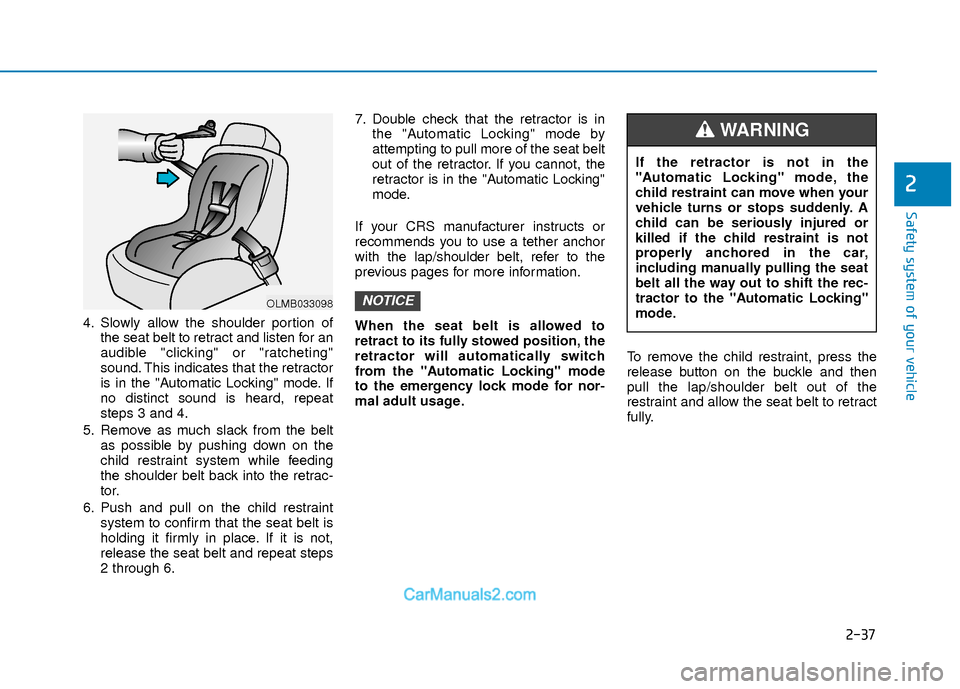
4. Slowly allow the shoulder portion ofthe seat belt to retract and listen for an
audible "clicking" or "ratcheting"
sound. This indicates that the retractor
is in the "Automatic Locking" mode. If
no distinct sound is heard, repeat
steps 3 and 4.
5. Remove as much slack from the belt as possible by pushing down on the
child restraint system while feeding
the shoulder belt back into the retrac-
tor.
6. Push and pull on the child restraint system to confirm that the seat belt is
holding it firmly in place. If it is not,
release the seat belt and repeat steps
2 through 6. 7. Double check that the retractor is in
the "Automatic Locking" mode by
attempting to pull more of the seat belt
out of the retractor. If you cannot, the
retractor is in the "Automatic Locking"
mode.
If your CRS manufacturer instructs or
recommends you to use a tether anchor
with the lap/shoulder belt, refer to the
previous pages for more information.
When the seat belt is allowed to
retract to its fully stowed position, the
retractor will automatically switch
from the "Automatic Locking" mode
to the emergency lock mode for nor-
mal adult usage. To remove the child restraint, press the
release button on the buckle and then
pull the lap/shoulder belt out of the
restraint and allow the seat belt to retract
fully.
NOTICEOLMB033098
If the retractor is not in the
"Automatic Locking" mode, the
child restraint can move when your
vehicle turns or stops suddenly. A
child can be seriously injured or
killed if the child restraint is not
properly anchored in the car,
including manually pulling the seat
belt all the way out to shift the rec-
tractor to the "Automatic Locking"
mode.
WARNING
Page 68 of 526
2-51
Safety system of your vehicle
2
ODH035900K
ODH035901K
ODH035902K
ODH035903K
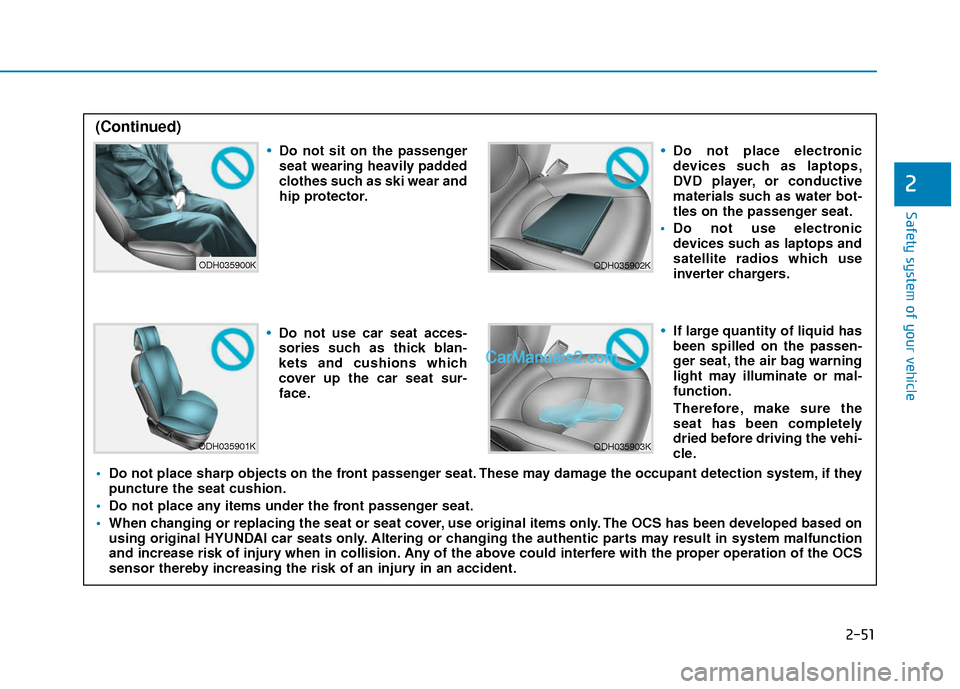
Do not sit on the passenger
seat wearing heavily padded
clothes such as ski wear and
hip protector.
Do not use car seat acces-
sories such as thick blan-
kets and cushions which
cover up the car seat sur-
face.
Do not place electronic
devices such as laptops,
DVD player, or conductive
materials such as water bot-
tles on the passenger seat.
Do not use electronic
devices such as laptops and
satellite radios which use
inverter chargers.
If large quantity of liquid has
been spilled on the passen-
ger seat, the air bag warning
light may illuminate or mal-
function.
Therefore, make sure the
seat has been completely
dried before driving the vehi-
cle.
Do not place sharp objects on the front passenger seat. These may damage the occupant detection system, if they
puncture the seat cushion.
Do not place any items under the front passenger seat.
When changing or replacing the seat or seat cover, use original items only. The OCS has been developed based on
using original HYUNDAI car seats only. Altering or changing the authentic parts may result in system malfunction
and increase risk of injury when in collision. Any of the above could interfere with the proper operation of the OCS
sensor thereby increasing the risk of an injury in an accident.
(Continued)