dash board Hyundai Elantra 2018 Owner's Manual
[x] Cancel search | Manufacturer: HYUNDAI, Model Year: 2018, Model line: Elantra, Model: Hyundai Elantra 2018Pages: 526, PDF Size: 17.2 MB
Page 21 of 526
2-4
Safety system of your vehicle
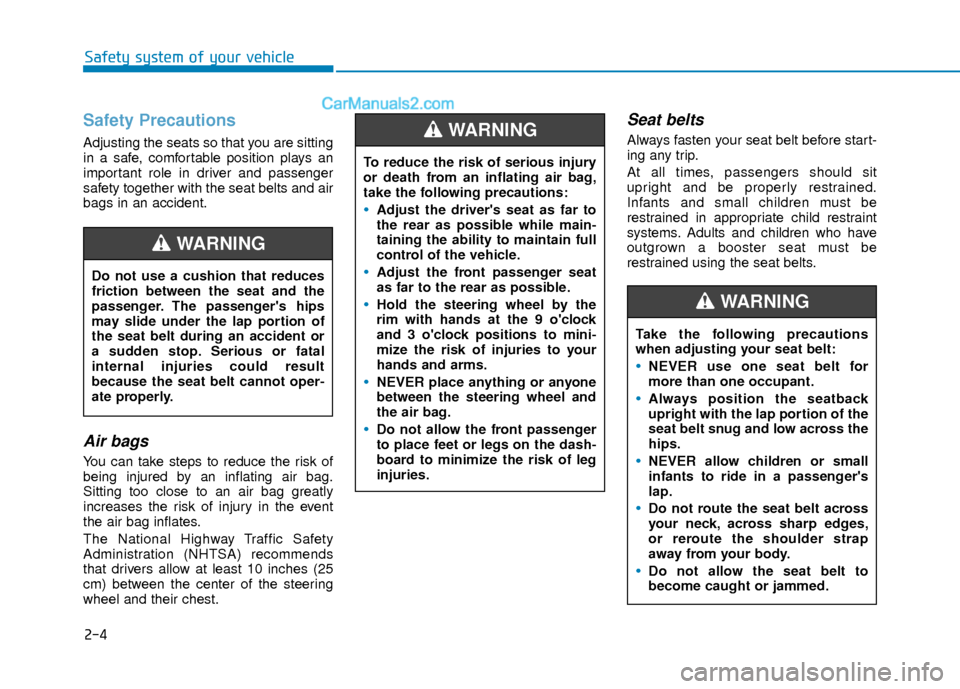
Safety Precautions
Adjusting the seats so that you are sitting
in a safe, comfortable position plays an
important role in driver and passenger
safety together with the seat belts and air
bags in an accident.
Air bags
You can take steps to reduce the risk of
being injured by an inflating air bag.
Sitting too close to an air bag greatly
increases the risk of injury in the event
the air bag inflates.
The National Highway Traffic Safety
Administration (NHTSA) recommends
that drivers allow at least 10 inches (25
cm) between the center of the steering
wheel and their chest.
Seat belts
Always fasten your seat belt before start-
ing any trip.
At all times, passengers should sit
upright and be properly restrained.
Infants and small children must be
restrained in appropriate child restraint
systems. Adults and children who have
outgrown a booster seat must be
restrained using the seat belts.
Do not use a cushion that reduces
friction between the seat and the
passenger. The passenger's hips
may slide under the lap portion of
the seat belt during an accident or
a sudden stop. Serious or fatal
internal injuries could result
because the seat belt cannot oper-
ate properly.
WARNING
To reduce the risk of serious injury
or death from an inflating air bag,
take the following precautions:
•Adjust the driver's seat as far to
the rear as possible while main-
taining the ability to maintain full
control of the vehicle.
Adjust the front passenger seat
as far to the rear as possible.
Hold the steering wheel by the
rim with hands at the 9 o'clock
and 3 o'clock positions to mini-
mize the risk of injuries to your
hands and arms.
NEVER place anything or anyone
between the steering wheel and
the air bag.
Do not allow the front passenger
to place feet or legs on the dash-
board to minimize the risk of leg
injuries.
WARNING
Take the following precautions
when adjusting your seat belt:
NEVER use one seat belt for
more than one occupant.
Always position the seatback
upright with the lap portion of the
seat belt snug and low across the
hips.
NEVER allow children or small
infants to ride in a passenger's
lap.
Do not route the seat belt across
your neck, across sharp edges,
or reroute the shoulder strap
away from your body.
Do not allow the seat belt to
become caught or jammed.
WARNING
Page 58 of 526
2-41
Safety system of your vehicle
2
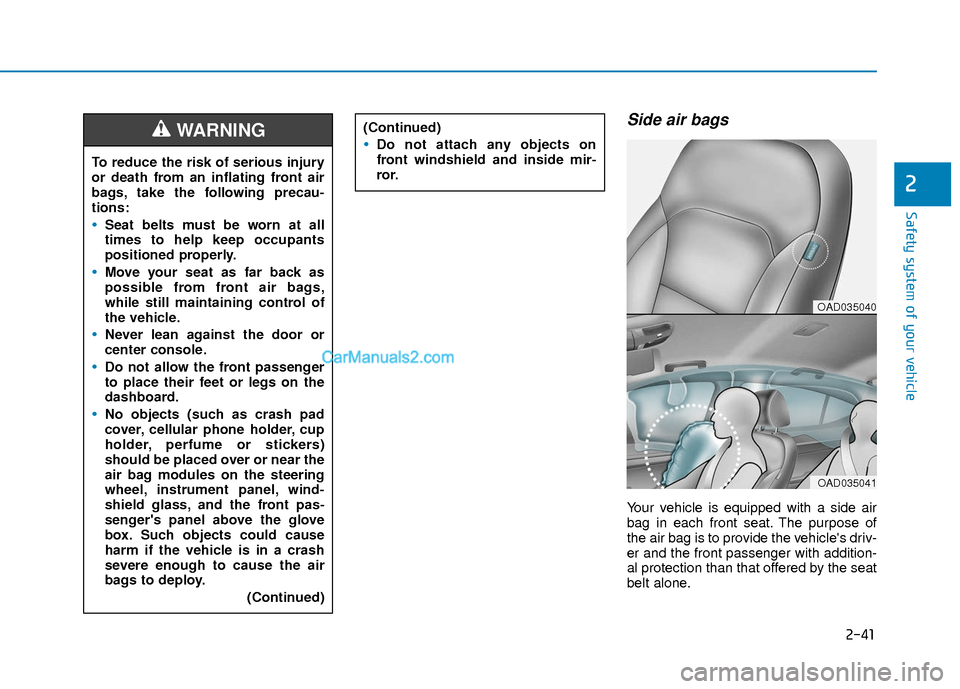
Side air bags
Your vehicle is equipped with a side air
bag in each front seat. The purpose of
the air bag is to provide the vehicle's driv-
er and the front passenger with addition-
al protection than that offered by the seat
belt alone.
To reduce the risk of serious injury
or death from an inflating front air
bags, take the following precau-
tions:
Seat belts must be worn at all
times to help keep occupants
positioned properly.
Move your seat as far back as
possible from front air bags,
while still maintaining control of
the vehicle.
Never lean against the door or
center console.
Do not allow the front passenger
to place their feet or legs on the
dashboard.
No objects (such as crash pad
cover, cellular phone holder, cup
holder, perfume or stickers)
should be placed over or near the
air bag modules on the steering
wheel, instrument panel, wind-
shield glass, and the front pas-
senger's panel above the glove
box. Such objects could cause
harm if the vehicle is in a crash
severe enough to cause the air
bags to deploy.
(Continued)
(Continued)
Do not attach any objects on
front windshield and inside mir-
ror.WARNING
OAD035040
OAD035041
Page 62 of 526
2-45
Safety system of your vehicle
2
Air bag deployment depends on anumber of factors including vehicle
speed, angles of impact and the densi-
ty and stiffness of the vehicles or
objects which your vehicle impacts
during a collision. The determining fac-
tors are not limited to those mentioned
above.
The front air bags will completely inflate and deflate in an instant. It is vir-
tually impossible for you to see the air
bags inflate during an accident. It is
much more likely that you will simply
see the deflated air bags hanging out
of their storage compartments after the
collision.
In addition to inflating in certain side collisions, vehicles equipped with a
rollover sensor, side and curtain air
bags will inflate if the sensing system
detects a rollover.
When a rollover is detected, side and
curtain air bags will remain inflated
longer to help provide protection from
ejection, especially when used in con-
junction with the seat belts. To help provide protection, the air bags
must inflate rapidly. The speed of air
bag inflation is a consequence of
extremely short time in which to inflate
the air bag between the occupant and
the vehicle structures before the occu-
pant impacts those structures. This
speed of inflation reduces the risk of
serious or life-threatening injuries and
is thus a necessary part of air bag
design.
However, the rapid air bag inflation can
also cause injuries which can include
facial abrasions, bruises and broken
bones because the inflation speed also
causes the air bags to expand with a
great deal of force.
There are even circumstances under which contact with the air bag can
cause fatal injuries, especially if the
occupant is positioned excessively
close to the air bag.
You can take steps to help reduce the
risk of being injured by an inflating air
bag. The greatest risk is sitting too close
to the air bag. An air bag needs about 10
inches (25 cm) of space to inflate.
NHTSA recommends that drivers allow
at least 10 inches (25 cm) between the
center of the steering wheel and the
chest. To reduce the risk of serious injury
or death from an inflating air bag,
take the following precautions:
NEVER place a child restraint in
the front passenger seat.
Always properly restrain children
under age 13 in the rear seats of
the vehicle.
Adjust the front passenger’s and
driver's seats as far to the rear as
possible while allowing you to
maintain full control of the vehi-
cle.
Hold the steering wheel with
hands at the 9 o'clock and 3
o'clock positions.
Never place anything or anyone
between the air bag and the seat
occupant.
Do not allow the front passenger
to place their feet or legs on the
dashboard.
WARNING
Page 66 of 526
2-49
Safety system of your vehicle
2
Always be sure that you and all vehicle
occupants are seated properly and wear-
ing the seat belt properly for the most
effective protection by the air bag and the
seat belt.
The OCS may not function properly if the
passenger takes actions which can affect
the classification system. These include:
Failing to sit in an upright position.
Leaning against the door or centerconsole.
Sitting towards the sides of the front of the seat.
Putting their legs on the dashboard or resting them on other locations which
reduce the passenger weight on the
front seat.
Wearing the seat belt improperly.
Reclining the seatback.
Wearing a thick cloth like ski wear or hip protection wear.
Putting an additional thick cushion on the seat.
Putting electrical devices (e.g. note- book, satellite radio) on the seat with
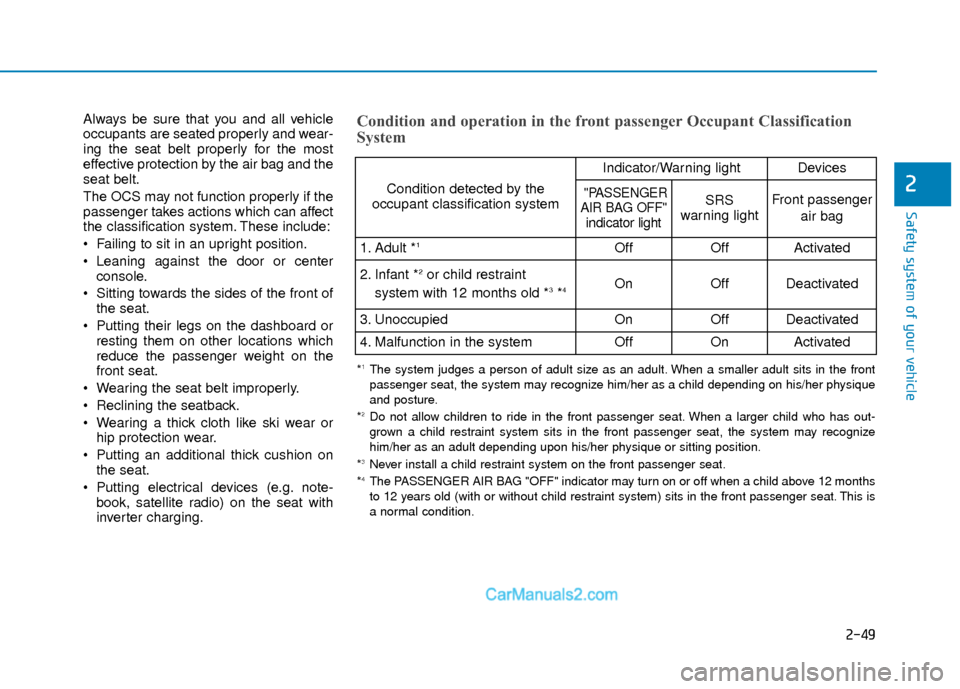
inverter charging.Condition and operation in the front passenger Occupant Classification
System
Condition detected by the
occupant classification system
Indicator/Warning lightDevices
"PASSENGER
AIR BAG OFF" indicator lightSRS
warning lightFront passenger
air bag
1. Adult *1OffOffActivated
2. Infant *2or child restraint
system with 12 months old *3*4 OnOffDeactivated
3. Unoccupied OnOffDeactivated
4. Malfunction in the systemOffOnActivated
*1The system judges a person of adult size as an adult. When a smaller adult sits in the front
passenger seat, the system may recognize him/her as a child depending on his/her physique
and posture.
*
2Do not allow children to ride in the front passenger seat. When a larger child who has out- grown a child restraint system sits in the front passenger seat, the system may recognize
him/her as an adult depending upon his/her physique or sitting position.
*
3Never install a child restraint system on the front passenger seat.
*4The PASSENGER AIR BAG "OFF" indicator may turn on or off when a child above 12 months
to 12 years old (with or without child restraint system) sits in the front passenger seat. This is
a normal condition.
Page 67 of 526
2-50
Safety system of your vehicle
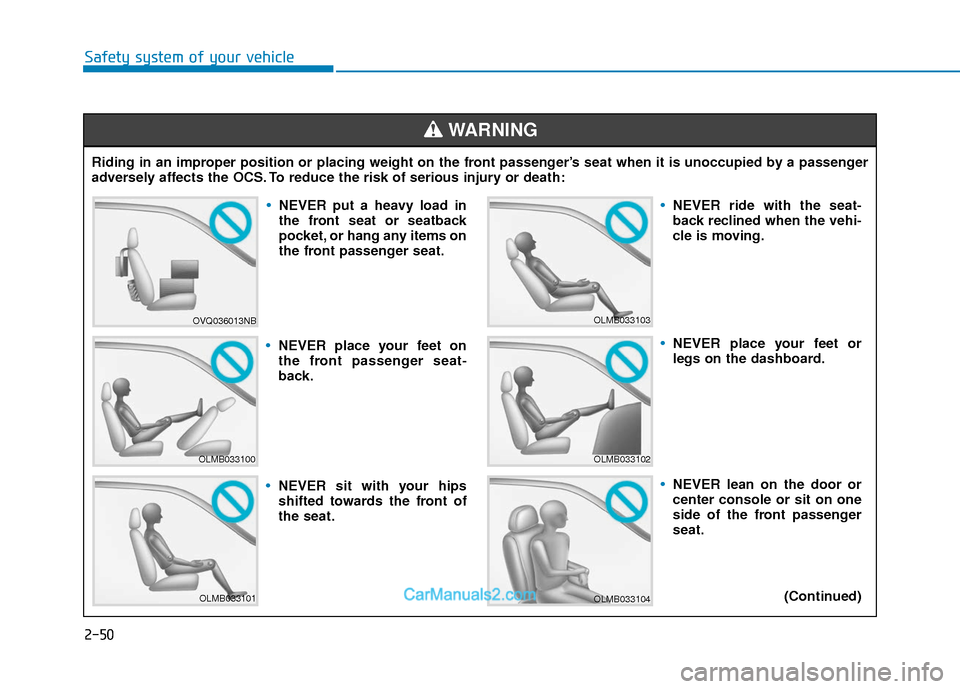
Riding in an improper position or placing weight on the front passenger’s seat when it is unoccupied by a passenger
adversely affects the OCS. To reduce the risk of serious injury or death:
WARNING
OVQ036013NB
OLMB033100
OLMB033101
OLMB033103
OLMB033102
OLMB033104
NEVER put a heavy load in
the front seat or seatback
pocket, or hang any items on
the front passenger seat.
NEVER place your feet on
the front passenger seat-
back.
NEVER sit with your hips
shifted towards the front of
the seat.
NEVER ride with the seat-
back reclined when the vehi-
cle is moving.
NEVER place your feet or
legs on the dashboard.
NEVER lean on the door or
center console or sit on one
side of the front passenger
seat.(Continued)
Page 179 of 526
3-102
Convenient features of your vehicle
Turn signals and lane changesignals
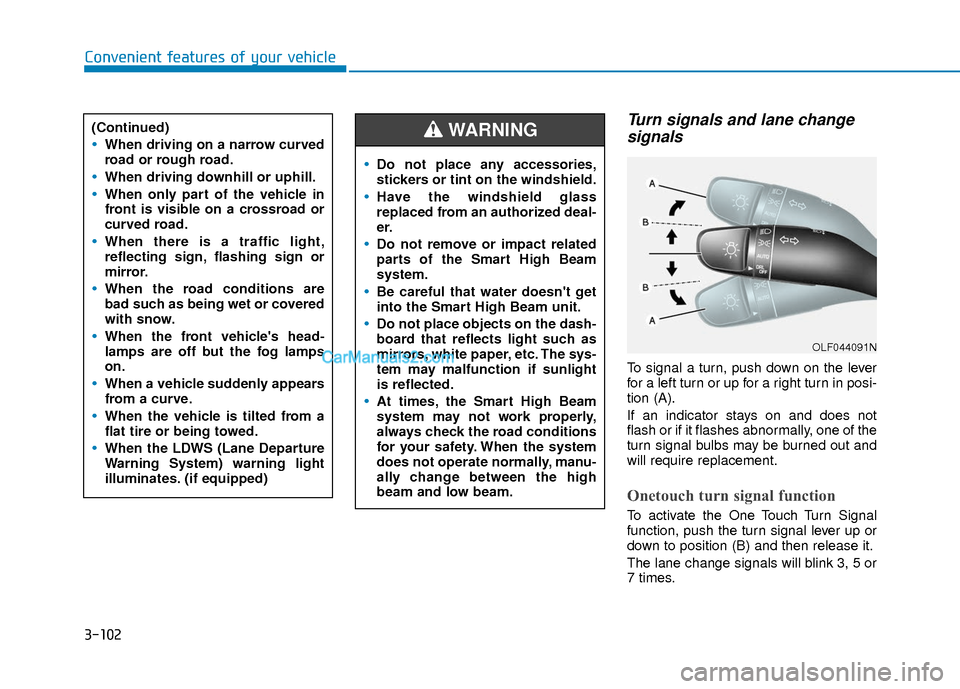
To signal a turn, push down on the lever
for a left turn or up for a right turn in posi-
tion (A).
If an indicator stays on and does not
flash or if it flashes abnormally, one of the
turn signal bulbs may be burned out and
will require replacement.
Onetouch turn signal function
To activate the One Touch Turn Signal
function, push the turn signal lever up or
down to position (B) and then release it.
The lane change signals will blink 3, 5 or
7 times.
(Continued)
When driving on a narrow curved
road or rough road.
When driving downhill or uphill.
When only part of the vehicle in
front is visible on a crossroad or
curved road.
When there is a traffic light,
reflecting sign, flashing sign or
mirror.
When the road conditions are
bad such as being wet or covered
with snow.
When the front vehicle's head-
lamps are off but the fog lamps
on.
When a vehicle suddenly appears
from a curve.
When the vehicle is tilted from a
flat tire or being towed.
When the LDWS (Lane Departure
Warning System) warning light
illuminates. (if equipped)
OLF044091N
Do not place any accessories,
stickers or tint on the windshield.
Have the windshield glass
replaced from an authorized deal-
er.
Do not remove or impact related
parts of the Smart High Beam
system.
Be careful that water doesn't get
into the Smart High Beam unit.
Do not place objects on the dash-
board that reflects light such as
mirrors, white paper, etc. The sys-
tem may malfunction if sunlight
is reflected.
At times, the Smart High Beam
system may not work properly,
always check the road conditions
for your safety. When the system
does not operate normally, manu-
ally change between the high
beam and low beam.
WARNING
Page 190 of 526
3-113
Convenient features of your vehicle
3
Mode selection
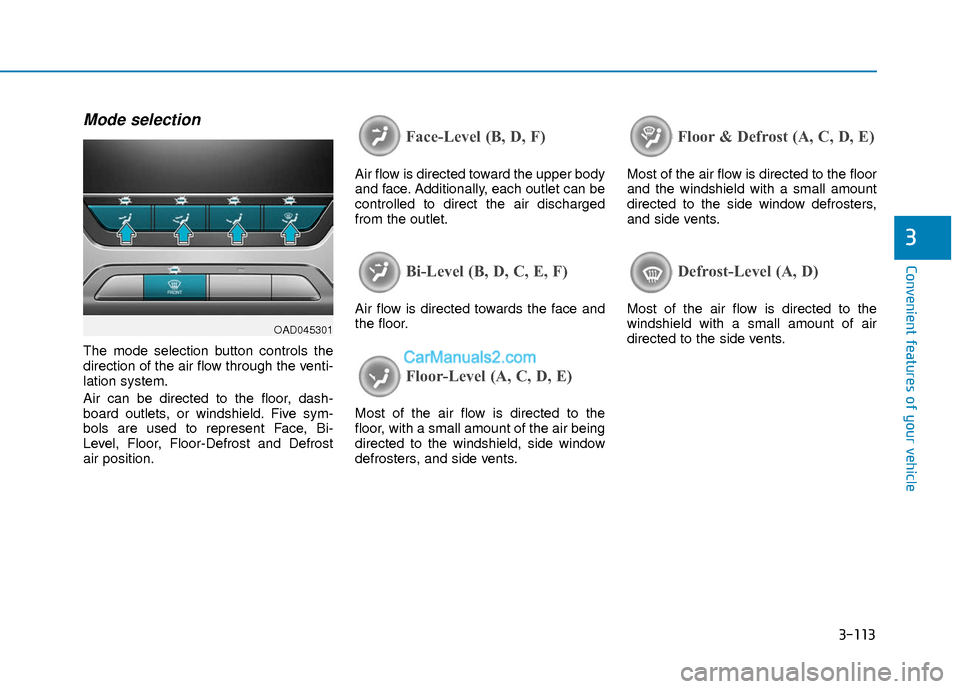
The mode selection button controls the
direction of the air flow through the venti-
lation system.
Air can be directed to the floor, dash-
board outlets, or windshield. Five sym-
bols are used to represent Face, Bi-
Level, Floor, Floor-Defrost and Defrost
air position.
Face-Level (B, D, F)
Air flow is directed toward the upper body
and face. Additionally, each outlet can be
controlled to direct the air discharged
from the outlet.
Bi-Level (B, D, C, E, F)
Air flow is directed towards the face and
the floor.
Floor-Level (A, C, D, E)
Most of the air flow is directed to the
floor, with a small amount of the air being
directed to the windshield, side window
defrosters, and side vents.
Floor & Defrost (A, C, D, E)
Most of the air flow is directed to the floor
and the windshield with a small amount
directed to the side window defrosters,
and side vents.
Defrost-Level (A, D)
Most of the air flow is directed to the
windshield with a small amount of air
directed to the side vents.
OAD045301
Page 346 of 526
5-63
Driving your vehicle
5
LKAS Operation
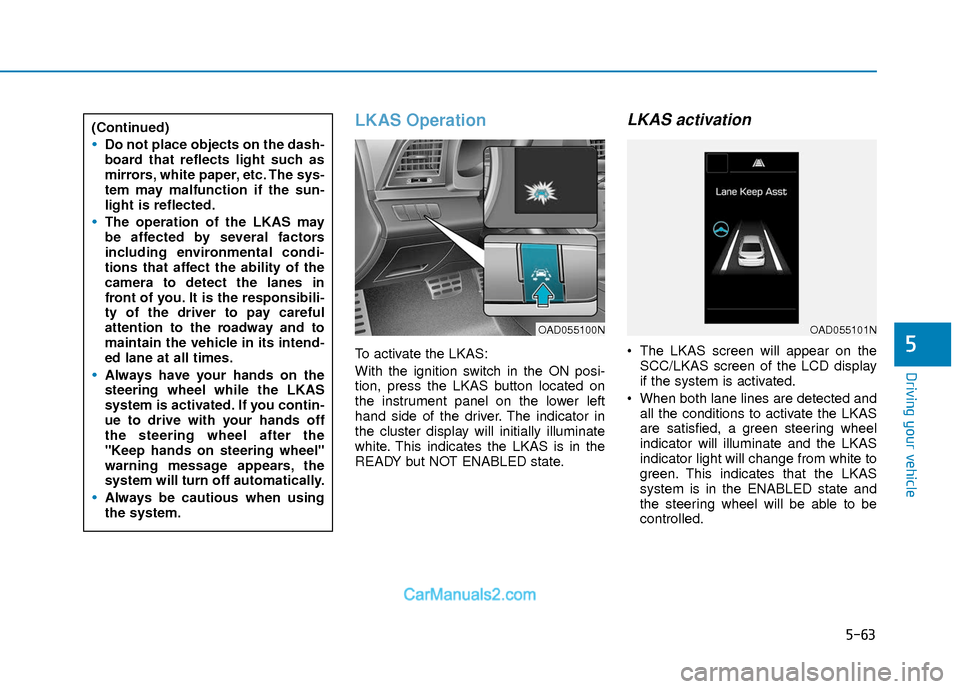
To activate the LKAS:
With the ignition switch in the ON posi-
tion, press the LKAS button located on
the instrument panel on the lower left
hand side of the driver. The indicator in
the cluster display will initially illuminate
white. This indicates the LKAS is in the
READY but NOT ENABLED state.
LKAS activation
The LKAS screen will appear on theSCC/LKAS screen of the LCD display
if the system is activated.
When both lane lines are detected and all the conditions to activate the LKAS
are satisfied, a green steering wheel
indicator will illuminate and the LKAS
indicator light will change from white to
green. This indicates that the LKAS
system is in the ENABLED state and
the steering wheel will be able to be
controlled.
(Continued)
Do not place objects on the dash-
board that reflects light such as
mirrors, white paper, etc. The sys-
tem may malfunction if the sun-
light is reflected.
The operation of the LKAS may
be affected by several factors
including environmental condi-
tions that affect the ability of the
camera to detect the lanes in
front of you. It is the responsibili-
ty of the driver to pay careful
attention to the roadway and to
maintain the vehicle in its intend-
ed lane at all times.
Always have your hands on the
steering wheel while the LKAS
system is activated. If you contin-
ue to drive with your hands off
the steering wheel after the
"Keep hands on steering wheel"
warning message appears, the
system will turn off automatically.
Always be cautious when using
the system.
OAD055100NOAD055101N
Page 514 of 526
8-10
Specifications, Consumer information and Reporting safety defects
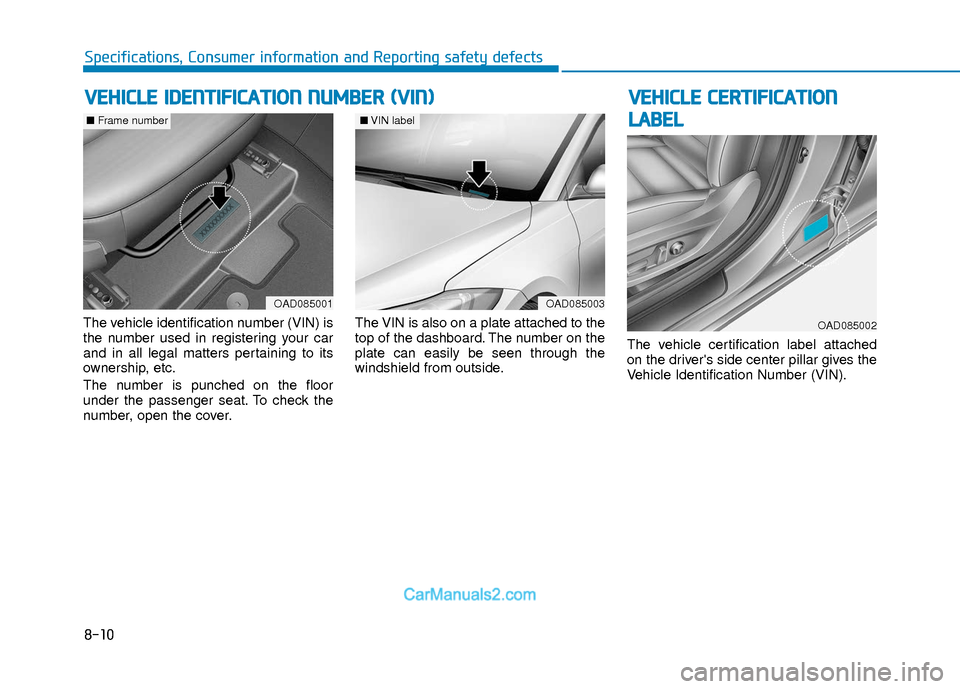
The vehicle identification number (VIN) is
the number used in registering your car
and in all legal matters pertaining to its
ownership, etc.
The number is punched on the floor
under the passenger seat. To check the
number, open the cover.The VIN is also on a plate attached to the
top of the dashboard. The number on the
plate can easily be seen through the
windshield from outside.
The vehicle certification label attached
on the driver's side center pillar gives the
Vehicle Identification Number (VIN).
V V
E
EH
H I
IC
C L
LE
E
I
ID
D E
EN
N T
TI
IF
F I
IC
C A
A T
TI
IO
O N
N
N
N U
U M
M B
BE
ER
R
(
( V
V I
IN
N )
)
OAD085003
■ VIN label
OAD085001
■ Frame number
OAD085002
V
VE
EH
H I
IC
C L
LE
E
C
C E
E R
R T
TI
IF
F I
IC
C A
A T
TI
IO
O N
N
L
L A
A B
BE
EL
L