lock Hyundai Elantra 2018 Owner's Manual
[x] Cancel search | Manufacturer: HYUNDAI, Model Year: 2018, Model line: Elantra, Model: Hyundai Elantra 2018Pages: 526, PDF Size: 17.2 MB
Page 14 of 526
1-3
Your vehicle at a glance
1
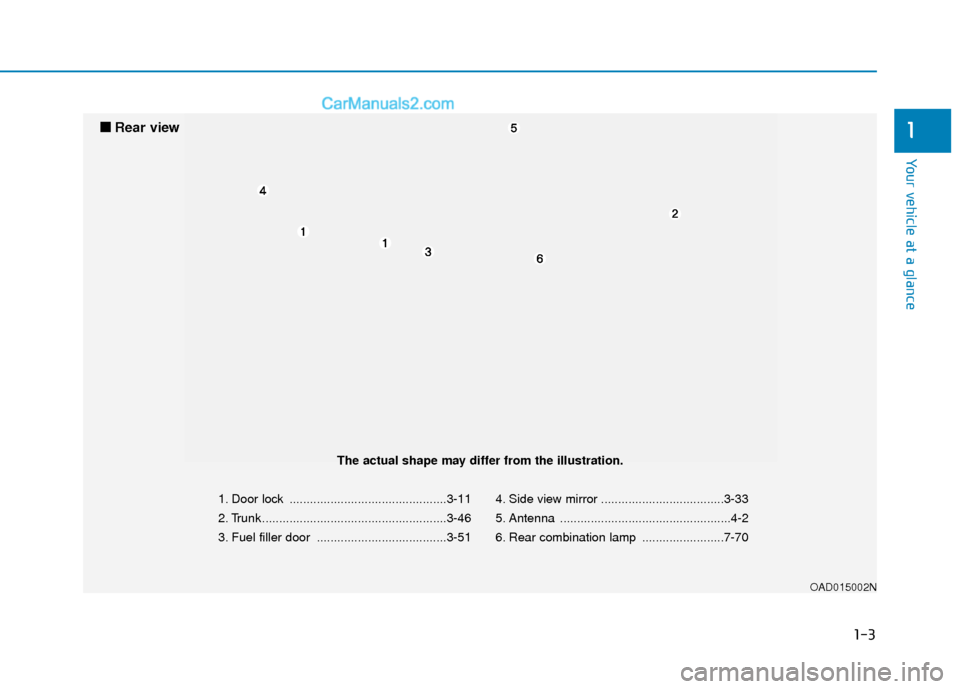
1. Door lock ..............................................3-11
2. Trunk ......................................................3-46
3. Fuel filler door ......................................3-514. Side view mirror ....................................3-33
5. Antenna ..................................................4-2
6. Rear combination lamp ........................7-70
OAD015002N
■
■
Rear view
The actual shape may differ from the illustration.
Page 15 of 526
1-4
Your vehicle at a glance
I
IN
N T
TE
ER
R I
IO
O R
R
O
O V
VE
ER
R V
V I
IE
E W
W
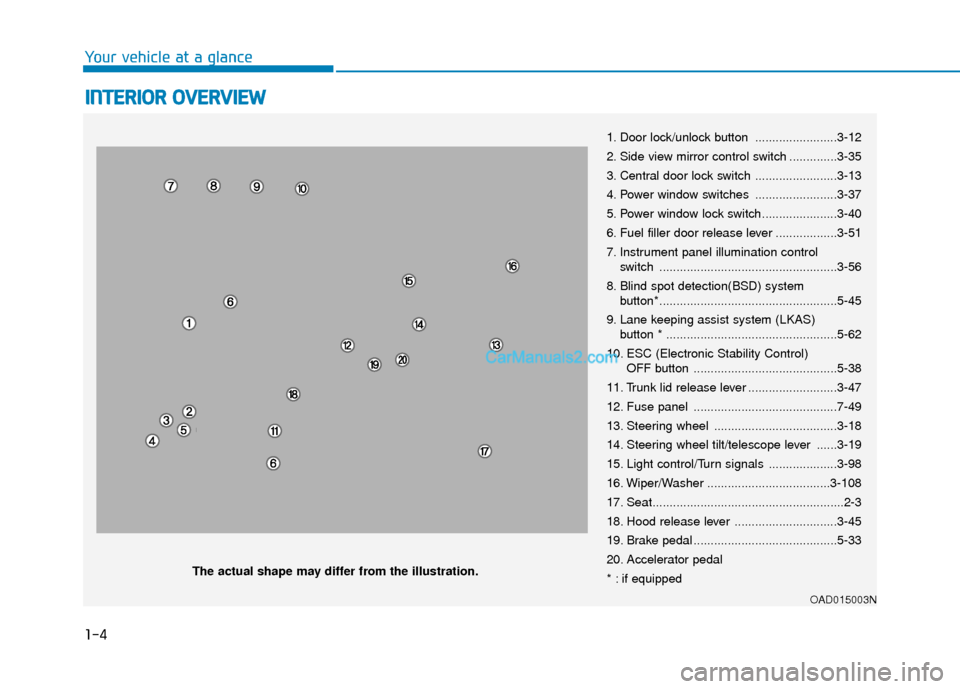
1. Door lock/unlock button ........................3-12
2. Side view mirror control switch ..............3-35
3. Central door lock switch ........................3-13
4. Power window switches ........................3-37
5. Power window lock switch......................3-40
6. Fuel filler door release lever ..................3-51
7. Instrument panel illumination control
switch ....................................................3-56
8. Blind spot detection(BSD) system button* ....................................................5-45
9. Lane keeping assist system (LKAS) button * ..................................................5-62
10. ESC (Electronic Stability Control) OFF button ..........................................5-38
11. Trunk lid release lever ..........................3-47
12. Fuse panel ..........................................7-49
13. Steering wheel ....................................3-18
14. Steering wheel tilt/telescope lever ......3-19
15. Light control/Turn signals ....................3-98
16. Wiper/Washer ....................................3-108
17. Seat........................................................2-3
18. Hood release lever ..............................3-45
19. Brake pedal ..........................................5-33
20. Accelerator pedal
* : if equipped
OAD015003N
The actual shape may differ from the illustration.
Page 21 of 526
2-4
Safety system of your vehicle
Safety Precautions
Adjusting the seats so that you are sitting
in a safe, comfortable position plays an
important role in driver and passenger
safety together with the seat belts and air
bags in an accident.
Air bags
You can take steps to reduce the risk of
being injured by an inflating air bag.
Sitting too close to an air bag greatly
increases the risk of injury in the event
the air bag inflates.
The National Highway Traffic Safety
Administration (NHTSA) recommends
that drivers allow at least 10 inches (25
cm) between the center of the steering
wheel and their chest.
Seat belts
Always fasten your seat belt before start-
ing any trip.
At all times, passengers should sit
upright and be properly restrained.
Infants and small children must be
restrained in appropriate child restraint
systems. Adults and children who have
outgrown a booster seat must be
restrained using the seat belts.
Do not use a cushion that reduces
friction between the seat and the
passenger. The passenger's hips
may slide under the lap portion of
the seat belt during an accident or
a sudden stop. Serious or fatal
internal injuries could result
because the seat belt cannot oper-
ate properly.
WARNING
To reduce the risk of serious injury
or death from an inflating air bag,
take the following precautions:
•Adjust the driver's seat as far to
the rear as possible while main-
taining the ability to maintain full
control of the vehicle.
Adjust the front passenger seat
as far to the rear as possible.
Hold the steering wheel by the
rim with hands at the 9 o'clock
and 3 o'clock positions to mini-
mize the risk of injuries to your
hands and arms.
NEVER place anything or anyone
between the steering wheel and
the air bag.
Do not allow the front passenger
to place feet or legs on the dash-
board to minimize the risk of leg
injuries.
WARNING
Take the following precautions
when adjusting your seat belt:
NEVER use one seat belt for
more than one occupant.
Always position the seatback
upright with the lap portion of the
seat belt snug and low across the
hips.
NEVER allow children or small
infants to ride in a passenger's
lap.
Do not route the seat belt across
your neck, across sharp edges,
or reroute the shoulder strap
away from your body.
Do not allow the seat belt to
become caught or jammed.
WARNING
Page 22 of 526
2-5
Safety system of your vehicle
2
Front Seats
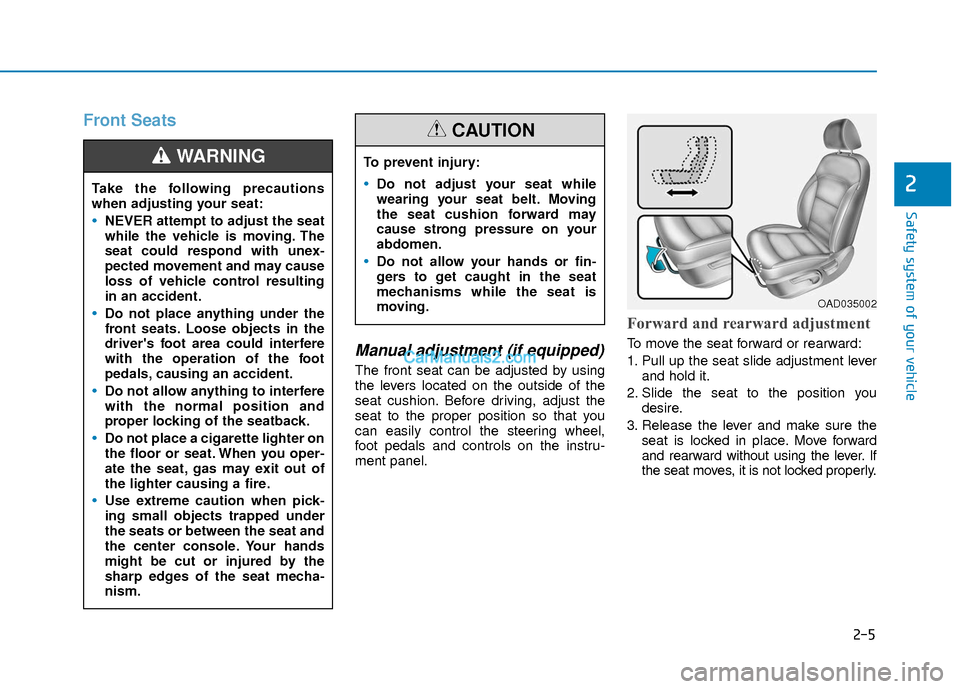
Manual adjustment (if equipped)
The front seat can be adjusted by using
the levers located on the outside of the
seat cushion. Before driving, adjust the
seat to the proper position so that you
can easily control the steering wheel,
foot pedals and controls on the instru-
ment panel.
Forward and rearward adjustment
To move the seat forward or rearward:
1. Pull up the seat slide adjustment leverand hold it.
2. Slide the seat to the position you desire.
3. Release the lever and make sure the seat is locked in place. Move forward
and rearward without using the lever. If
the seat moves, it is not locked properly.
Take the following precautions
when adjusting your seat:
NEVER attempt to adjust the seat
while the vehicle is moving. The
seat could respond with unex-
pected movement and may cause
loss of vehicle control resulting
in an accident.
Do not place anything under the
front seats. Loose objects in the
driver's foot area could interfere
with the operation of the foot
pedals, causing an accident.
Do not allow anything to interfere
with the normal position and
proper locking of the seatback.
Do not place a cigarette lighter on
the floor or seat. When you oper-
ate the seat, gas may exit out of
the lighter causing a fire.
Use extreme caution when pick-
ing small objects trapped under
the seats or between the seat and
the center console. Your hands
might be cut or injured by the
sharp edges of the seat mecha-
nism.
WARNING To prevent injury:
Do not adjust your seat while
wearing your seat belt. Moving
the seat cushion forward may
cause strong pressure on your
abdomen.
Do not allow your hands or fin-
gers to get caught in the seat
mechanisms while the seat is
moving.
CAUTION
OAD035002
Page 23 of 526
2-6
Safety system of your vehicle
Seatback angle
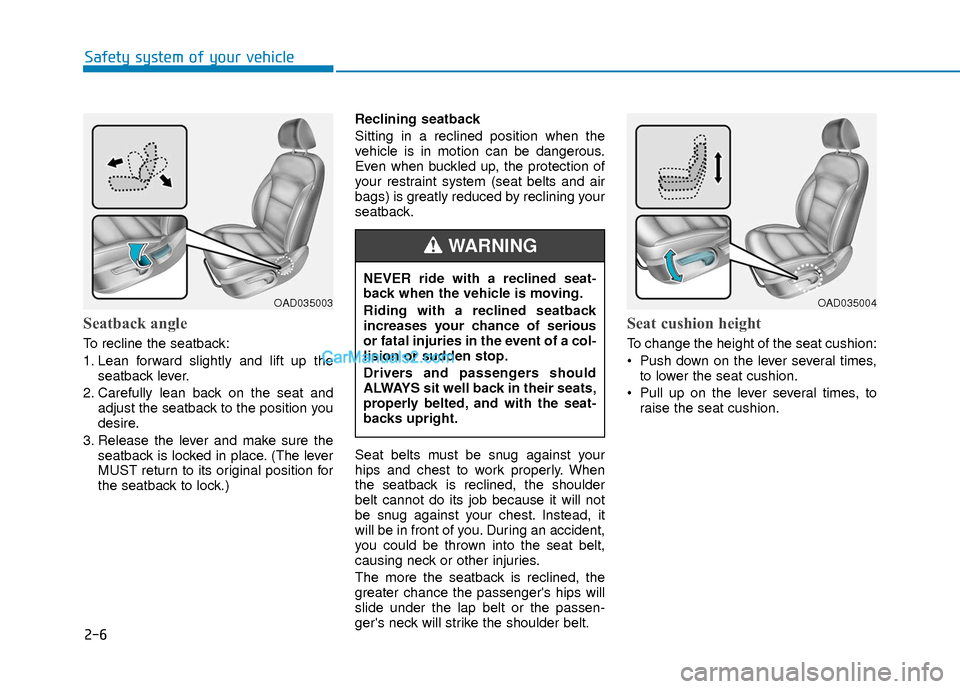
To recline the seatback:
1. Lean forward slightly and lift up theseatback lever.
2. Carefully lean back on the seat and adjust the seatback to the position you
desire.
3. Release the lever and make sure the seatback is locked in place. (The lever
MUST return to its original position for
the seatback to lock.) Reclining seatback
Sitting in a reclined position when the
vehicle is in motion can be dangerous.
Even when buckled up, the protection of
your restraint system (seat belts and air
bags) is greatly reduced by reclining your
seatback.
Seat belts must be snug against your
hips and chest to work properly. When
the seatback is reclined, the shoulder
belt cannot do its job because it will not
be snug against your chest. Instead, it
will be in front of you. During an accident,
you could be thrown into the seat belt,
causing neck or other injuries.
The more the seatback is reclined, the
greater chance the passenger's hips will
slide under the lap belt or the passen-
ger's neck will strike the shoulder belt.
Seat cushion height
To change the height of the seat cushion:
Push down on the lever several times,
to lower the seat cushion.
Pull up on the lever several times, to raise the seat cushion.
OAD035003OAD035004
NEVER ride with a reclined seat-
back when the vehicle is moving.
Riding with a reclined seatback
increases your chance of serious
or fatal injuries in the event of a col-
lision or sudden stop.
Drivers and passengers should
ALWAYS sit well back in their seats,
properly belted, and with the seat-
backs upright.
WARNING
Page 28 of 526
2-11
Safety system of your vehicle
2
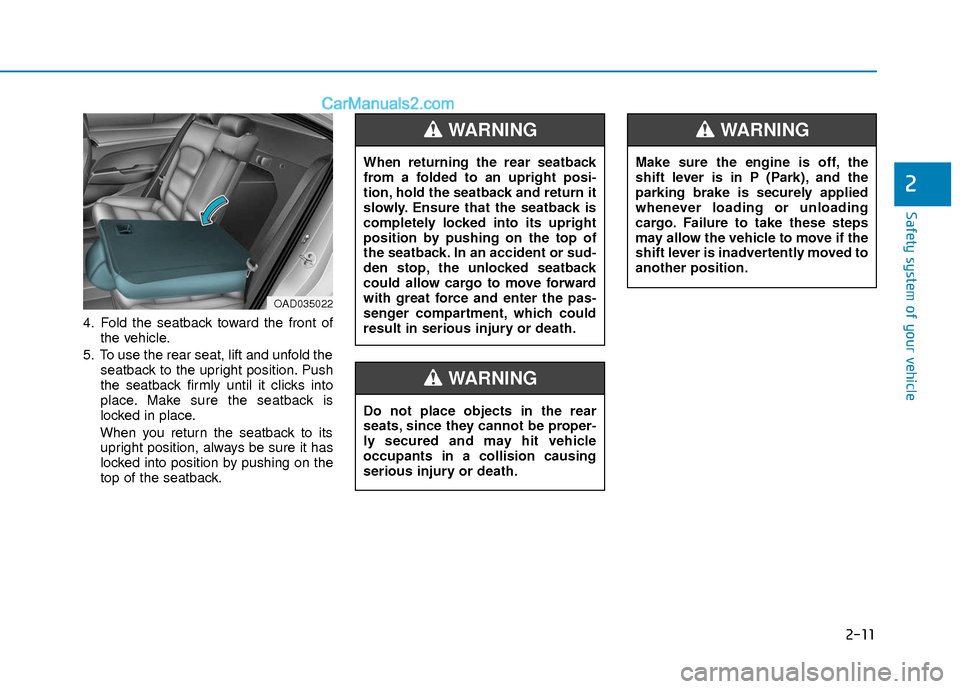
4. Fold the seatback toward the front ofthe vehicle.
5. To use the rear seat, lift and unfold the seatback to the upright position. Push
the seatback firmly until it clicks into
place. Make sure the seatback is
locked in place.
When you return the seatback to its upright position, always be sure it has
locked into position by pushing on the
top of the seatback.
OAD035022
Do not place objects in the rear
seats, since they cannot be proper-
ly secured and may hit vehicle
occupants in a collision causing
serious injury or death.
WARNING
When returning the rear seatback
from a folded to an upright posi-
tion, hold the seatback and return it
slowly. Ensure that the seatback is
completely locked into its upright
position by pushing on the top of
the seatback. In an accident or sud-
den stop, the unlocked seatback
could allow cargo to move forward
with great force and enter the pas-
senger compartment, which could
result in serious injury or death.
WARNING
Make sure the engine is off, the
shift lever is in P (Park), and the
parking brake is securely applied
whenever loading or unloading
cargo. Failure to take these steps
may allow the vehicle to move if the
shift lever is inadvertently moved to
another position.
WARNING
Page 30 of 526
2-13
Safety system of your vehicle
2
To prevent damage, NEVER hit or pull
on the head restraints.
Front seat head restraints
The vehicle's front and passenger's
seats are equipped with adjustable head
restraints for the passengers safety and
comfort.
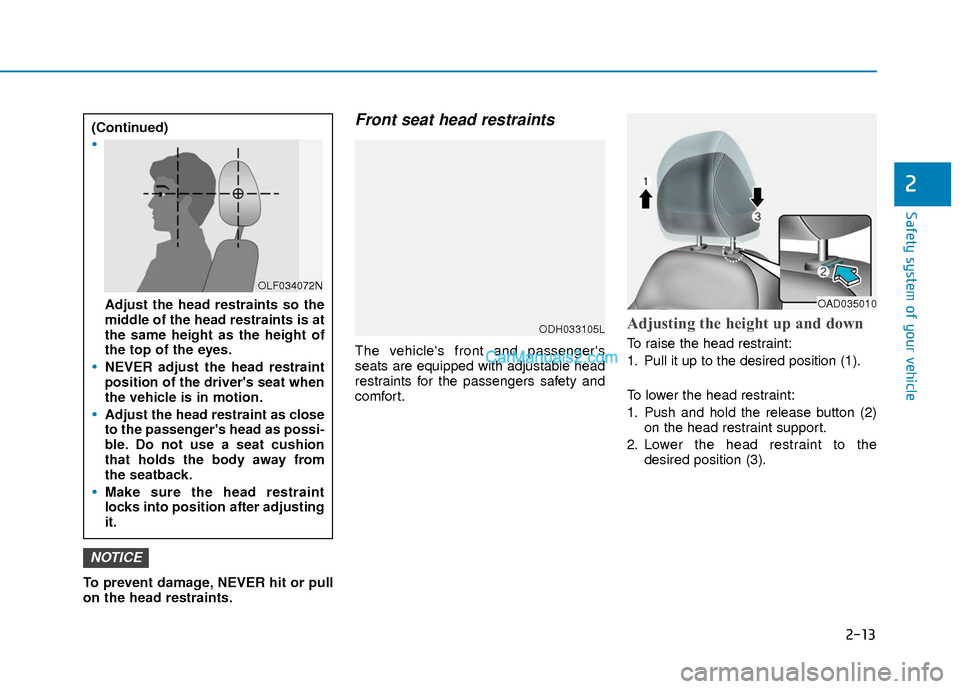
Adjusting the height up and down
To raise the head restraint:
1. Pull it up to the desired position (1).
To lower the head restraint:
1. Push and hold the release button (2)on the head restraint support.
2. Lower the head restraint to the desired position (3).
NOTICE
(Continued)
Adjust the head restraints so the
middle of the head restraints is at
the same height as the height of
the top of the eyes.
NEVER adjust the head restraint
position of the driver's seat when
the vehicle is in motion.
Adjust the head restraint as close
to the passenger's head as possi-
ble. Do not use a seat cushion
that holds the body away from
the seatback.
Make sure the head restraint
locks into position after adjusting
it.
OLF034072N
ODH033105L
OAD035010
Page 37 of 526
2-20
Safety system of your vehicle
If you continue not to fasten the seat belt
and you drive over 6 mph (9 km/h), the
warning light will stay illuminated.
If you continue not to fasten the seat belt
and you drive over 12 mph (20 km/h) the
seat belt warning chime
will sound for approximately 100 seconds
and the corresponding warning light will
blink.
If you unfasten the seat belt while driving
under 12 mph (20 km/h) the seat belt
warning light will illuminate until the seat
belt is fastened.
If you unfasten the seat belt while driving
over 12 mph (20 km/h), the seat belt
warning chime will sound for approxi-
mately 100 seconds and the correspon-
ding warning light will blink.Seat Belt Restraint System
Seat Belt-Driver's 3-point sys-tem with emergency lockingretractor
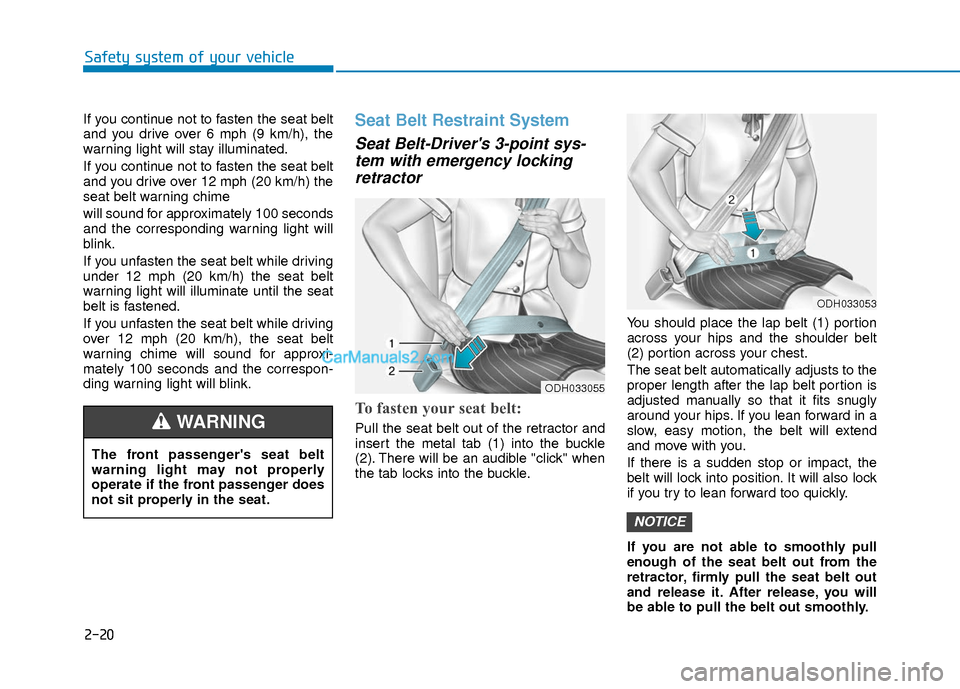
To fasten your seat belt:
Pull the seat belt out of the retractor and
insert the metal tab (1) into the buckle
(2). There will be an audible "click" when
the tab locks into the buckle. You should place the lap belt (1) portion
across your hips and the shoulder belt
(2) portion across your chest.
The seat belt automatically adjusts to the
proper length after the lap belt portion is
adjusted manually so that it fits snugly
around your hips. If you lean forward in a
slow, easy motion, the belt will extend
and move with you.
If there is a sudden stop or impact, the
belt will lock into position. It will also lock
if you try to lean forward too quickly.
If you are not able to smoothly pull
enough of the seat belt out from the
retractor, firmly pull the seat belt out
and release it. After release, you will
be able to pull the belt out smoothly.
NOTICE
The front passenger's seat belt
warning light may not properly
operate if the front passenger does
not sit properly in the seat.
WARNING
ODH033055
ODH033053
Page 38 of 526
2-21
Safety system of your vehicle
2
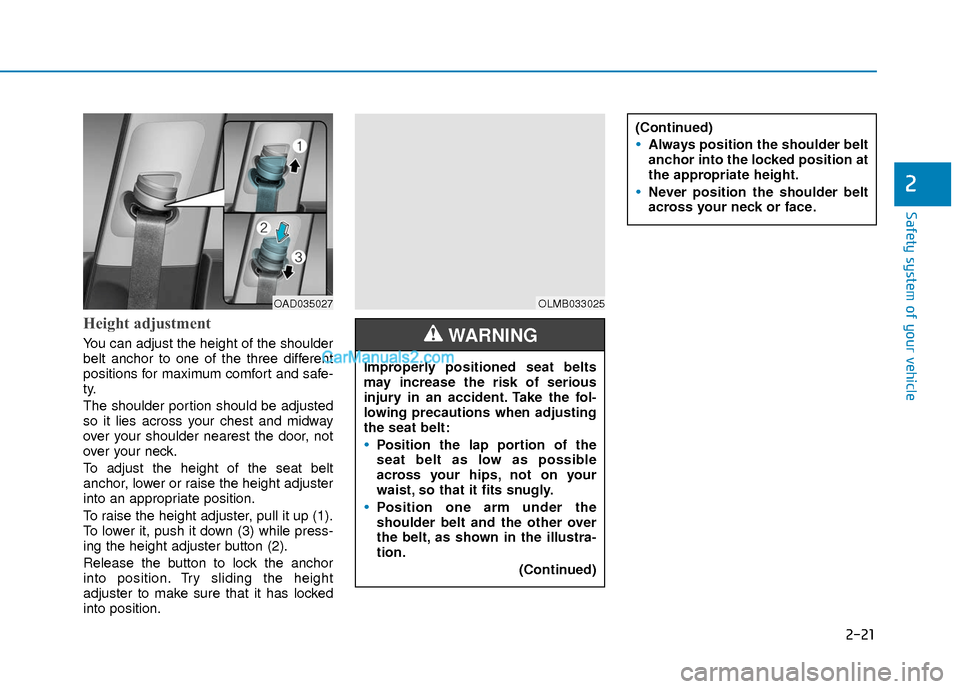
Height adjustment
You can adjust the height of the shoulder
belt anchor to one of the three different
positions for maximum comfort and safe-
ty.
The shoulder portion should be adjusted
so it lies across your chest and midway
over your shoulder nearest the door, not
over your neck.
To adjust the height of the seat belt
anchor, lower or raise the height adjuster
into an appropriate position.
To raise the height adjuster, pull it up (1).
To lower it, push it down (3) while press-
ing the height adjuster button (2).
Release the button to lock the anchor
into position. Try sliding the height
adjuster to make sure that it has locked
into position.
OAD035027
(Continued)
Always position the shoulder belt
anchor into the locked position at
the appropriate height.
Never position the shoulder belt
across your neck or face.
OLMB033025
Improperly positioned seat belts
may increase the risk of serious
injury in an accident. Take the fol-
lowing precautions when adjusting
the seat belt:
Position the lap portion of the
seat belt as low as possible
across your hips, not on your
waist, so that it fits snugly.
Position one arm under the
shoulder belt and the other over
the belt, as shown in the illustra-
tion.(Continued)
WARNING
Page 39 of 526
2-22
Safety system of your vehicle
Rear Seat Belt – Passenger's 3-point system with convertiblelocking retractor
This type of seat belt combines the fea-
tures of both an emergency locking
retractor seat belt and an automatic lock-
ing retractor seat belt. Convertible retrac-
tor type seat belts are installed in the rear
seat positions to help accommodate the
installation of child restraint systems.
Although a convertible retractor is also
installed in the front passenger seat posi-
tion, NEVER place any infant/child
restraint system in the front seat of the
vehicle.
To fasten your seat belt:
Pull the seat belt out of the retractor and
insert the metal tab into the buckle. There
will be an audible "click" when the tab
locks into the buckle. When not securing
a child restraint, the seat belt operates in
the same way as the driver's seat belt
(Emergency Locking Retractor Type). It
automatically adjusts to the proper length
only after the lap belt portion of the seat
belt is adjusted manually so that it fits
snugly across your hips. When the seat belt is fully extended from
the retractor to allow the installation of a
child restraint system, the seat belt oper-
ation changes to allow the belt to retract,
but not to extend (Automatic Locking
Retractor Type). Refer to the "Using a
Child Restraint System" section in this
chapter.
Although the seat belt retractor pro-
vides the same level of protection for
seated passengers in either emer-
gency or automatic locking modes,
the emergency locking mode allows
seated passengers to move freely in
their seat while keeping some tension
on the belt. During a collision or sud-
den stop, the retractor automatically
locks the belt to help restrain your
body.
To deactivate the automatic locking
mode, unbuckle the seat belt and
allow the belt to fully retract.
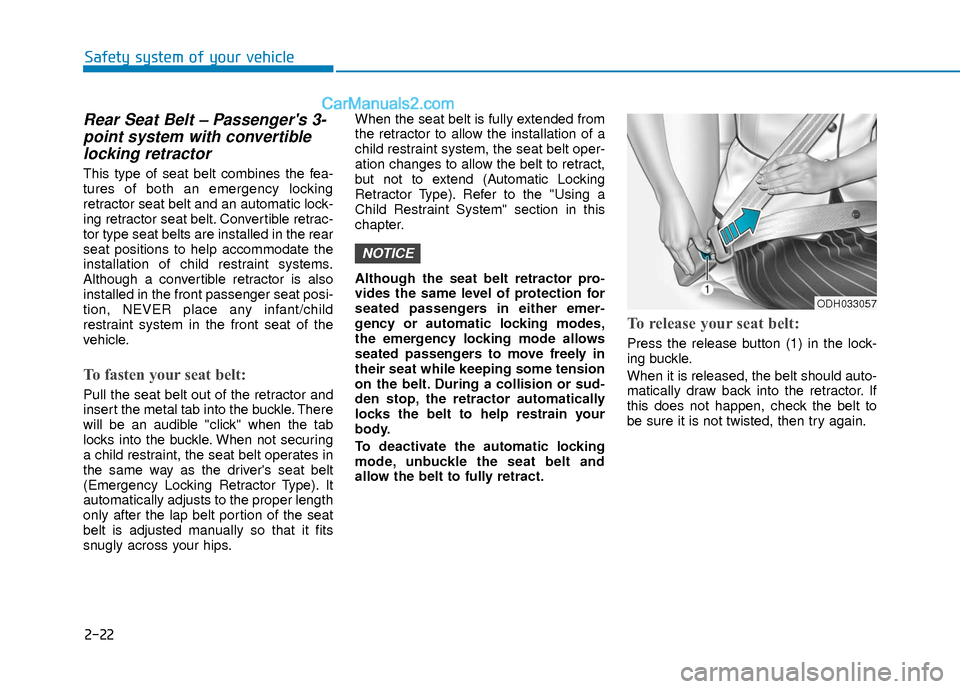
To release your seat belt:
Press the release button (1) in the lock-
ing buckle.
When it is released, the belt should auto-
matically draw back into the retractor. If
this does not happen, check the belt to
be sure it is not twisted, then try again.
NOTICE
ODH033057