latch Hyundai Elantra 2019 User Guide
[x] Cancel search | Manufacturer: HYUNDAI, Model Year: 2019, Model line: Elantra, Model: Hyundai Elantra 2019Pages: 535, PDF Size: 16.83 MB
Page 128 of 535
3-44
Convenient features of your vehicle
Closing the hood
1. Before closing the hood, check thefollowing:
ment must be correctly installed.
bustible material must be
removed from the engine com-
partment.
2. Return the support rod to its clip to prevent it from rattling.
3. Lower the hood halfway (front edge approximately 12 inches (30
cm) from the bumper) before drop-
ping the hood to its locked posi-
tion. Then double check to make
sure the hood is secure. If the
hood can be raised again, it is not
securely locked. Open it again and
close it with more force.
Trunk
Opening the trunk
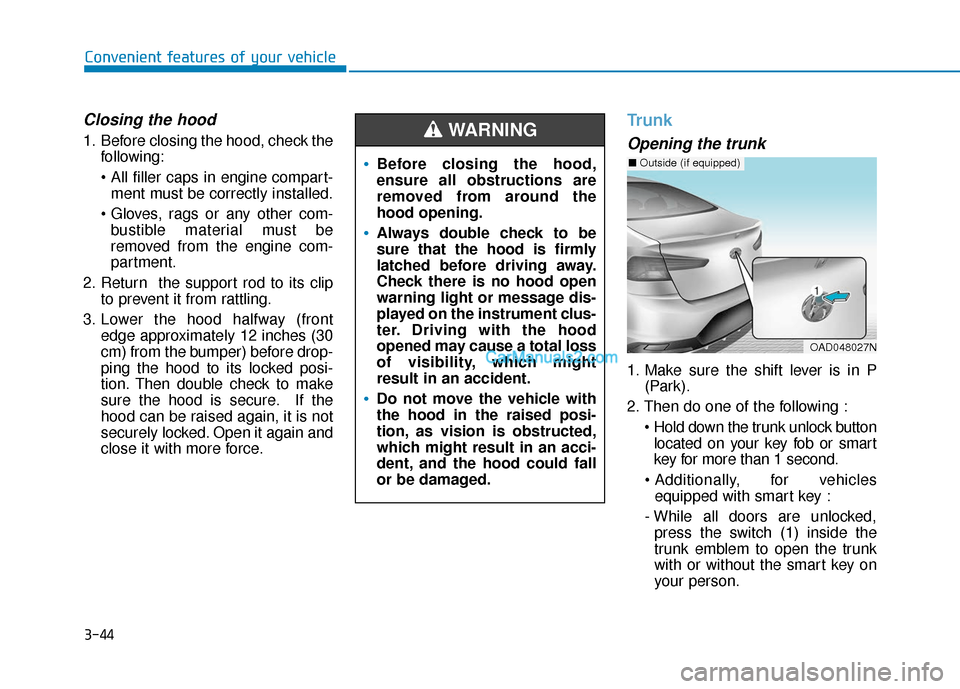
1. Make sure the shift lever is in P(Park).
2. Then do one of the following : located on your key fob or smart
key for more than 1 second.
for vehicles equipped with smart key :
- While all doors are unlocked, press the switch (1) inside the
trunk emblem to open the trunk
with or without the smart key on
your person.
Before closing the hood,
ensure all obstructions are
removed from around the
hood opening.
Always double check to be
sure that the hood is firmly
latched before driving away.
Check there is no hood open
warning light or message dis-
played on the instrument clus-
ter. Driving with the hood
opened may cause a total loss
of visibility, which might
result in an accident.
Do not move the vehicle with
the hood in the raised posi-
tion, as vision is obstructed,
which might result in an acci-
dent, and the hood could fall
or be damaged.
WARNING
OAD048027N
■ Outside (if equipped)
Page 130 of 535
3-46
Convenient features of your vehicle
Smart Trunk (if equipped)
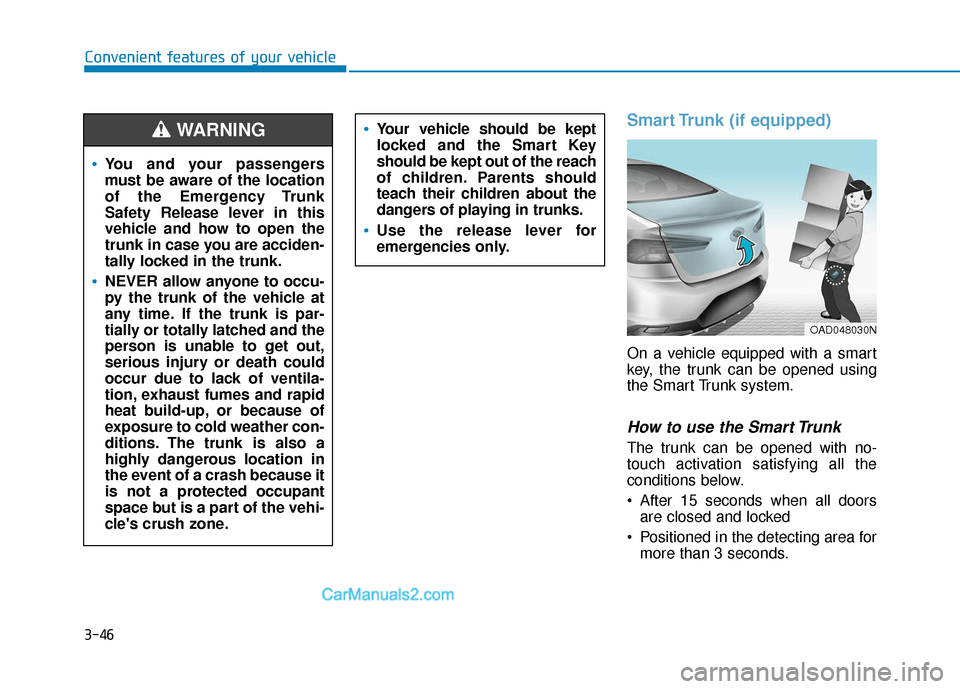
On a vehicle equipped with a smart
key, the trunk can be opened using
the Smart Trunk system.
How to use the Smart Trunk
The trunk can be opened with no-
touch activation satisfying all the
conditions below.
After 15 seconds when all doorsare closed and locked
Positioned in the detecting area for more than 3 seconds.
You and your passengers
must be aware of the location
of the Emergency Trunk
Safety Release lever in this
vehicle and how to open the
trunk in case you are acciden-
tally locked in the trunk.
NEVER allow anyone to occu-
py the trunk of the vehicle at
any time. If the trunk is par-
tially or totally latched and the
person is unable to get out,
serious injury or death could
occur due to lack of ventila-
tion, exhaust fumes and rapid
heat build-up, or because of
exposure to cold weather con-
ditions. The trunk is also a
highly dangerous location in
the event of a crash because it
is not a protected occupant
space but is a part of the vehi-
cle's crush zone.
Your vehicle should be kept
locked and the Smart Key
should be kept out of the reach
of children. Parents should
teach their children about the
dangers of playing in trunks.
Use the release lever for
emergencies only.
WARNING
OAD048030N
Page 134 of 535
3-50
Convenient features of your vehicle
Information
If the fuel filler door does not open
because ice has formed around it, tap
lightly or push on the door to break
the ice and release the door. Do not
pry on the door. If necessary, spray
around the door with an approved de-
icer fluid (do not use radiator anti-
freeze) or move the vehicle to a warm
place and allow the ice to melt.
Closing the fuel filler door
1. To install the fuel tank cap, turn itclockwise until it "clicks" one time.
2. Close the fuel filler door until it is latched securely.
Information
• Tighten the cap until it clicks once,otherwise the fuel cap open warn-
ing indicator light will illuminate.
• There may be an intermittent noise near the refueling hole while the
engine is idling if the fuel cap is not
closed securely. This occurs nor-
mally with the OBD system.
• When refueling on unleveled ground, the fuel gauge may not
point to the F position. It is not a
malfunction. If you move your
vehicle to a level ground, the fuel
gauge will move to the full position.
i
i
Gasoline is highly flammable
and explosive. Failure to follow
these guidelines may result in
SERIOUS INJURY or DEATH:
Read and follow all warnings
posted at the gas station.
Before refueling, note the
location of the Emergency
Gasoline Shut-Off, if available,
at the gas station.
Before touching the fuel noz-
zle, you should eliminate the
potential build-up of static
electricity by touching a metal
part of the vehicle, a safe dis-
tance away from the fuel filler
neck, nozzle, or other gas
source, with your bare hand.
Do not use cellular phones
while refueling. Electric cur-
rent and/or electronic interfer-
ence from cellular phones can
potentially ignite fuel vapors
and cause a fire.
WARNING
Page 224 of 535
3-140
Convenient features of your vehicle
Center Console Storage
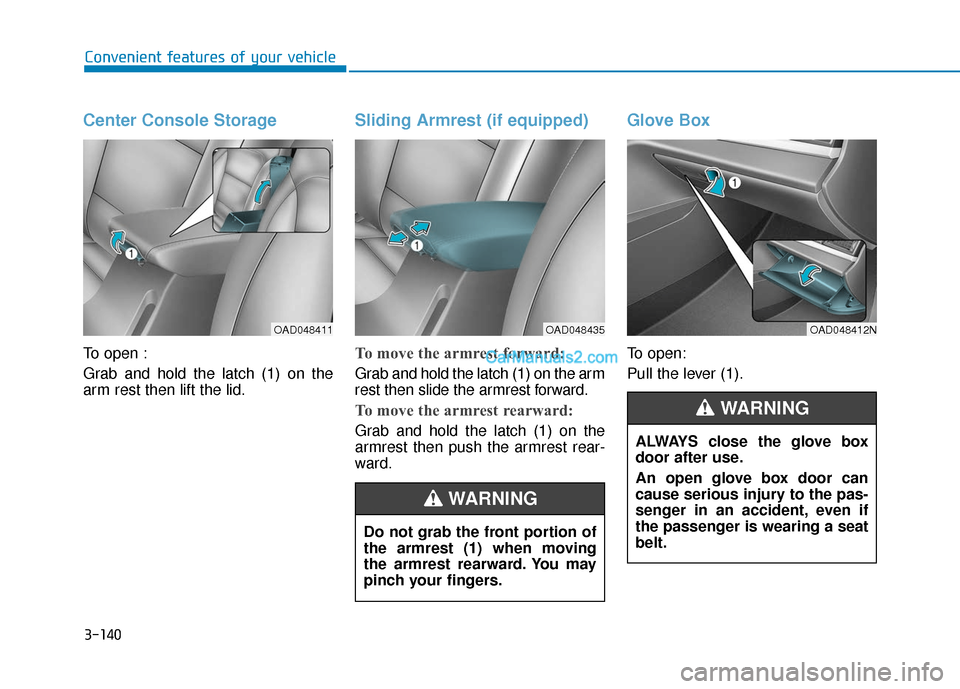
To open :
Grab and hold the latch (1) on the
arm rest then lift the lid.
Sliding Armrest (if equipped)
To move the armrest forward:
Grab and hold the latch (1) on the arm
rest then slide the armrest forward.
To move the armrest rearward:
Grab and hold the latch (1) on the
armrest then push the armrest rear-
ward.
Glove Box
To open:
Pull the lever (1).
OAD048411OAD048435
Do not grab the front portion of
the armrest (1) when moving
the armrest rearward. You may
pinch your fingers.
WARNING
OAD048412N
ALWAYS close the glove box
door after use.
An open glove box door can
cause serious injury to the pas-
senger in an accident, even if
the passenger is wearing a seat
belt.
WARNING
Page 429 of 535
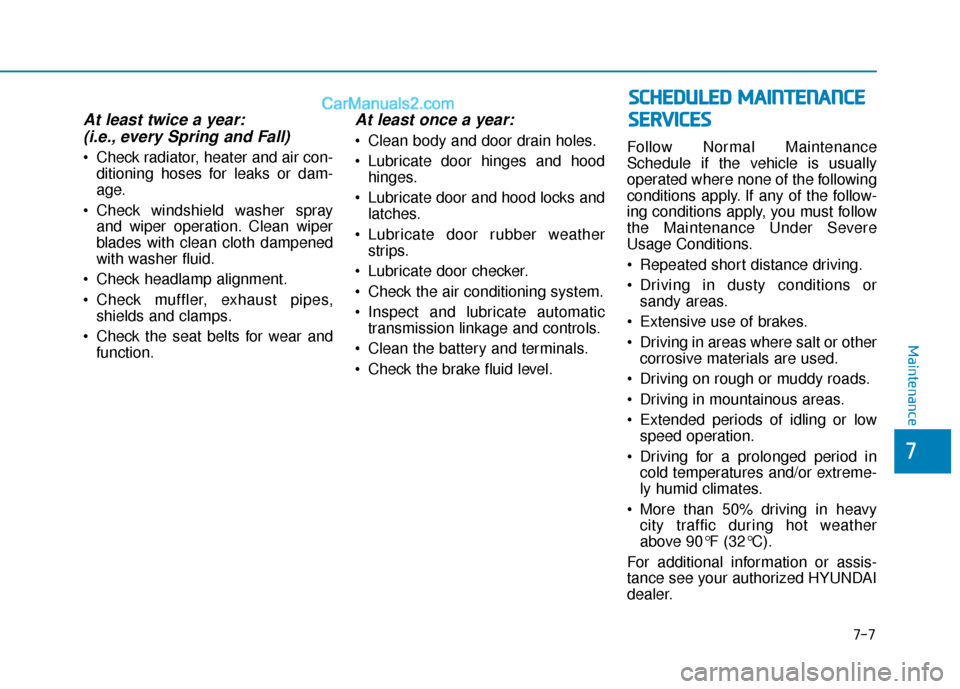
At least twice a year:(i.e., every Spring and Fall)
Check radiator, heater and air con-
ditioning hoses for leaks or dam-
age.
Check windshield washer spray and wiper operation. Clean wiper
blades with clean cloth dampened
with washer fluid.
Check headlamp alignment.
Check muffler, exhaust pipes, shields and clamps.
Check the seat belts for wear and function.
At least once a year:
Clean body and door drain holes.
Lubricate door hinges and hoodhinges.
Lubricate door and hood locks and latches.
Lubricate door rubber weather strips.
Lubricate door checker.
Check the air conditioning system.
Inspect and lubricate automatic transmission linkage and controls.
Clean the battery and terminals.
Check the brake fluid level. Follow Normal Maintenance
Schedule if the vehicle is usually
operated where none of the following
conditions apply. If any of the follow-
ing conditions apply, you must follow
the Maintenance Under Severe
Usage Conditions.
Repeated short distance driving.
Driving in dusty conditions or
sandy areas.
Extensive use of brakes.
Driving in areas where salt or other corrosive materials are used.
Driving on rough or muddy roads.
Driving in mountainous areas.
Extended periods of idling or low speed operation.
Driving for a prolonged period in cold temperatures and/or extreme-
ly humid climates.
More than 50% driving in heavy city traffic during hot weather
above 90°F (32°C).
For additional information or assis-
tance see your authorized HYUNDAI
dealer.
7-7
7
Maintenance
S S C
C H
H E
ED
D U
U L
LE
E D
D
M
M A
AI
IN
N T
TE
EN
N A
AN
N C
CE
E
S
S E
E R
R V
V I
IC
C E
E S
S
Page 526 of 535
I-4
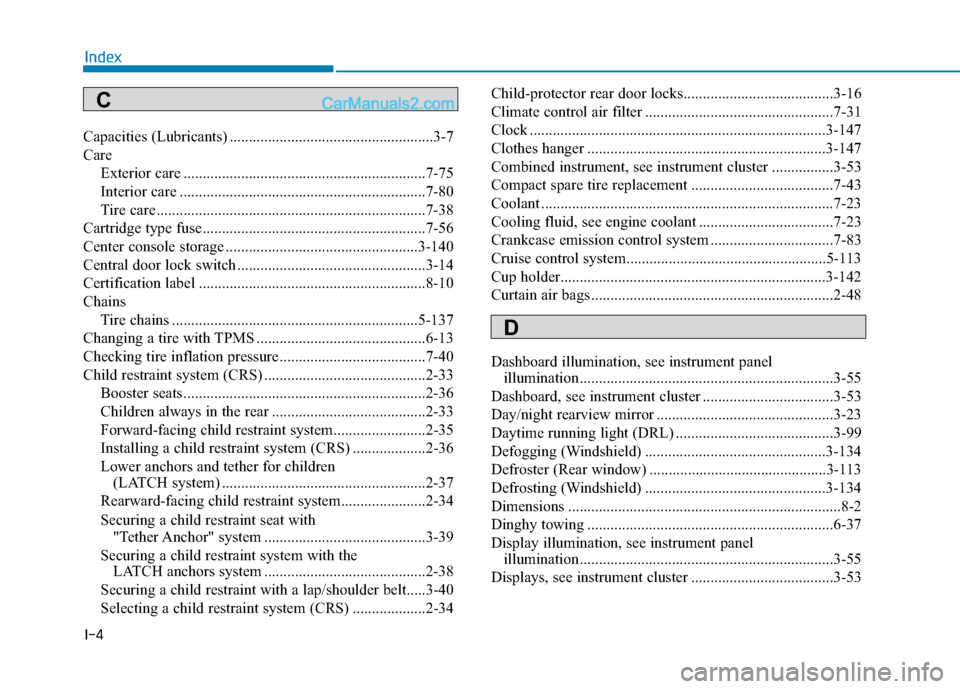
Capacities (Lubricants) .....................................................3-7
CareExterior care ...............................................................7-75
Interior care ................................................................7-80
Tire care ......................................................................7-\
38
Cartridge type fuse..........................................................7-56
Center console storage ..................................................3-140
Central door lock switch .................................................3-14
Certification label ...........................................................8-10
Chains Tire chains ................................................................5-137
Changing a tire with TPMS ............................................6-13
Checking tire inflation pressure ......................................7-40
Child restraint system (CRS) ..........................................2-33 Booster seats...............................................................2-36
Children always in the rear ........................................2-33
Forward-facing child restraint system........................2-35
Installing a child restraint system (CRS) ...................2-36
Lower anchors and tether for children (LATCH system) .....................................................2-37
Rearward-facing child restraint system......................2-34
Securing a child restraint seat with "Tether Anchor" system ..........................................3-39
Securing a child restraint system with the LATCH anchors system ..........................................2-38
Securing a child restraint with a lap/shoulder belt.....3-40
Selecting a child restraint system (CRS) ...................2-34 Child-protector rear door locks.......................................3-16
Climate control air filter .................................................7-31
Clock ........................................................................\
.....3-147
Clothes hanger ..............................................................3-147
Combined instrument, see instrument cluster ................3-53
Compact spare tire replacement .....................................7-43
Coolant ........................................................................\
....7-23
Cooling fluid, see engine coolant ...................................7-23
Crankcase emission control system ................................7-83
Cruise control system....................................................5-113
Cup holder.....................................................................3-1\
42
Curtain air bags ...............................................................2-48
Dashboard illumination, see instrument panel
illumination..................................................................3-55
Dashboard, see instrument cluster ..................................3-53
Day/night rearview mirror ..............................................3-23
Daytime running light (DRL) .........................................3-99
Defogging (Windshield) ...............................................3-134
Defroster (Rear window) ..............................................3-113
Defrosting (Windshield) ...............................................3-134
Dimensions .......................................................................8\
-2
Dinghy towing ................................................................6-37
Display illumination, see instrument panel illumination..................................................................3-55
Displays, see instrument cluster .....................................3-53
Index
D
C