climate control Hyundai Elantra 2019 Owner's Guide
[x] Cancel search | Manufacturer: HYUNDAI, Model Year: 2019, Model line: Elantra, Model: Hyundai Elantra 2019Pages: 535, PDF Size: 16.83 MB
Page 430 of 535
7-8
Maintenance
I : Inspect and if necessary, adjust, correct, clean or replace.
R : Replace or change.
*
1: If TOP TIER Detergent Gasoline is not available, one bottle of additive is recommended. Additives are available from yourauthorized HYUNDAI dealer along with information on how to use them. Do not mix other additives.
*
2: The drive belt should be replaced when cracks occur or tension is reduced excessively.
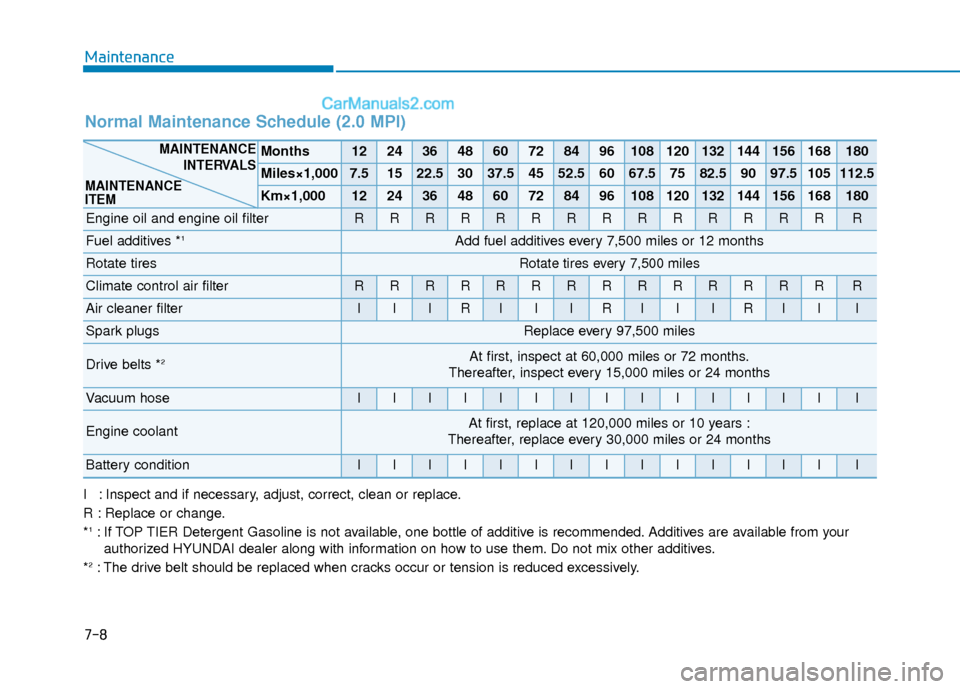
Normal Maintenance Schedule (2.0 MPI)
Months1224364860728496108120132144156168180
Miles×1,0007.51522.53037.54552.56067.57582.59097.5105112.5
Km×1,0001224364860728496108120132144156168180
Engine oil and engine oil filterRRRRRRRRRRRRRRR
Fuel additives *1Add fuel additives every 7,500 miles or 12 months
Rotate tiresRotate tires every 7,500 miles
Climate control air filterRRRRRRRRRRRRRRR
Air cleaner filterIIIRIIIRIIIRIII
Spark plugsReplace every 97,500 miles
Drive belts *2At first, inspect at 60,000 miles or 72 months.
Thereafter, inspect every 15,000 miles or 24 months
Vacuum hoseIIIIIIIIIIIIIII
Engine coolantAt first, replace at 120,000 miles or 10 years :
Thereafter, replace every 30,000 miles or 24 months
Battery conditionIIIIIIIIIIIIIII
MAINTENANCE
INTERVALS
MAINTENANCE
ITEM
Page 434 of 535
7-12
Maintenance
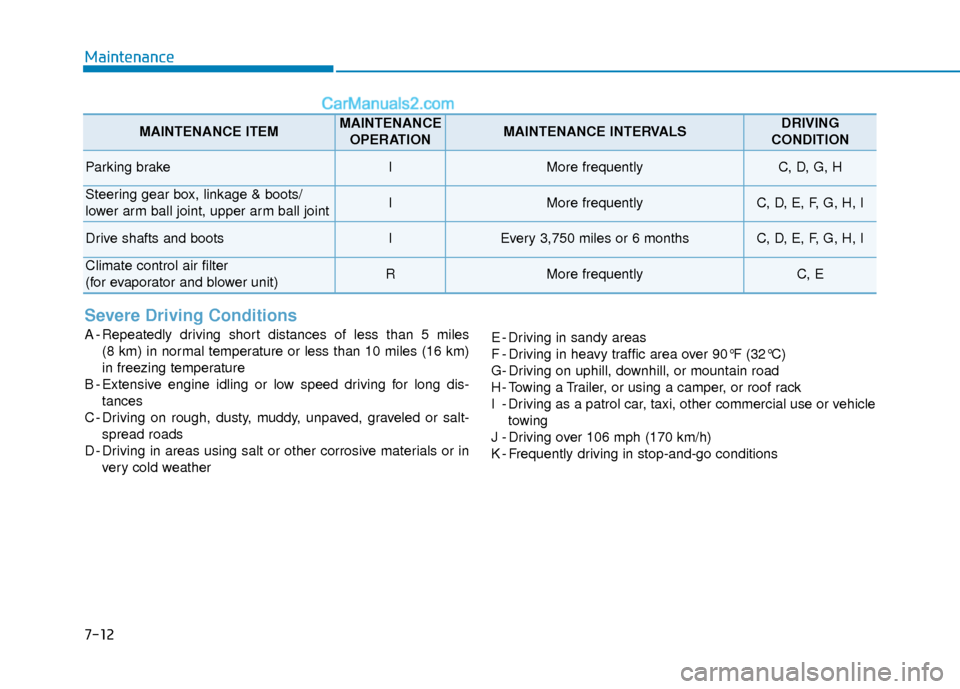
Severe Driving Conditions
A - Repeatedly driving short distances of less than 5 miles (8 km) in normal temperature or less than 10 miles (16 km)
in freezing temperature
B - Extensive engine idling or low speed driving for long dis- tances
C - Driving on rough, dusty, muddy, unpaved, graveled or salt- spread roads
D - Driving in areas using salt or other corrosive materials or in very cold weather E - Driving in sandy areas
F - Driving in heavy traffic area over 90°F (32°C)
G- Driving on uphill, downhill, or mountain road
H - Towing a Trailer, or using a camper, or roof rack
I - Driving as a patrol car, taxi, other commercial use or vehicle
towing
J - Driving over 106 mph (170 km/h)
K - Frequently driving in stop-and-go conditions
MAINTENANCE ITEMMAINTENANCE OPERATIONMAINTENANCE INTERVALSDRIVING
CONDITION
Parking brakeIMore frequentlyC, D, G, H
Steering gear box, linkage & boots/
lower arm ball joint, upper arm ball jointIMore frequentlyC, D, E, F, G, H, I
Drive shafts and bootsIEvery 3,750 miles or 6 monthsC, D, E, F, G, H, I
Climate control air filter
(for evaporator and blower unit)RMore frequentlyC, E
Page 435 of 535
7-13
7
Maintenance
I : Inspect and if necessary, adjust, correct, clean or replace.
R : Replace or change.
*
1: If TOP TIER Detergent Gasoline is not available, one bottle of additive is recommended. Additives are available from yourauthorized HYUNDAI dealer along with information on how to use them. Do not mix other additives.
*
2: The drive belt should be replaced when cracks occur or tension is reduced excessively.
*3: Inspect for excessive valve noise and/or engine vibration and adjust if necessary. Have an authorized HYUNDAI dealer per- form the operation.
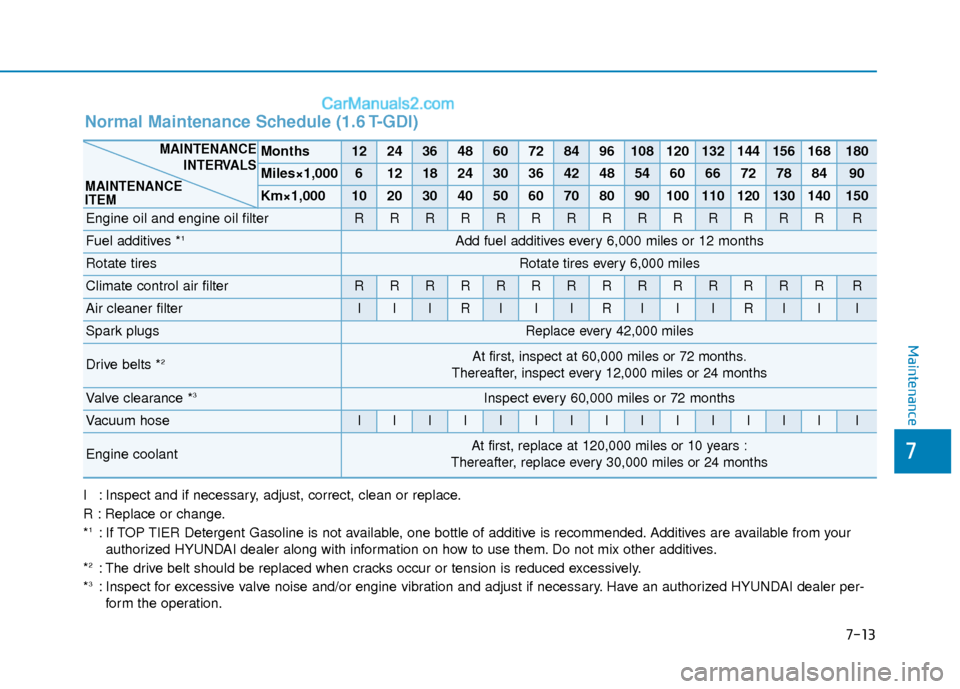
Normal Maintenance Schedule (1.6 T-GDI)
Months1224364860728496108120132144156168180
Miles×1,00061218243036424854606672788490
Km×1,000102030405060708090100110120130140150
Engine oil and engine oil filterRRRRRRRRRRRRRRR
Fuel additives *1Add fuel additives every 6,000 miles or 12 months
Rotate tiresRotate tires every 6,000 miles
Climate control air filterRRRRRRRRRRRRRRR
Air cleaner filterIIIRIIIRIIIRIII
Spark plugsReplace every 42,000 miles
Drive belts *2At first, inspect at 60,000 miles or 72 months.
Thereafter, inspect every 12,000 miles or 24 months
Valve clearance *3Inspect every 60,000 miles or 72 months
Vacuum hoseIIIIIIIIIIIIIII
Engine coolantAt first, replace at 120,000 miles or 10 years :
Thereafter, replace every 30,000 miles or 24 months
MAINTENANCE INTERVALS
MAINTENANCE
ITEM
Page 439 of 535
7-17
7
Maintenance
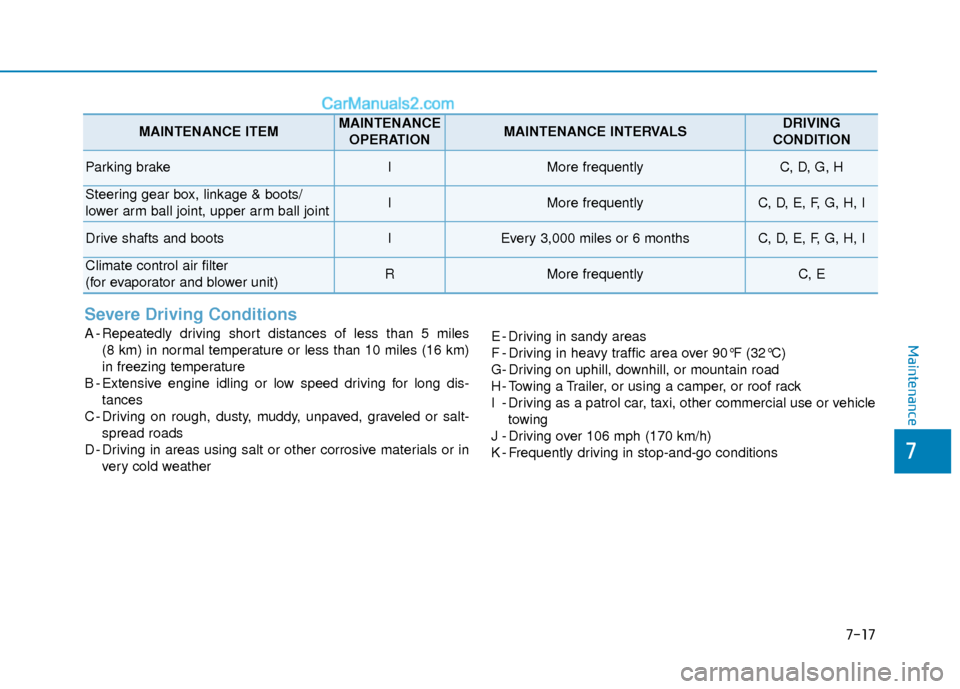
Severe Driving Conditions
A - Repeatedly driving short distances of less than 5 miles (8 km) in normal temperature or less than 10 miles (16 km)
in freezing temperature
B - Extensive engine idling or low speed driving for long dis- tances
C - Driving on rough, dusty, muddy, unpaved, graveled or salt- spread roads
D - Driving in areas using salt or other corrosive materials or in very cold weather E - Driving in sandy areas
F - Driving in heavy traffic area over 90°F (32°C)
G- Driving on uphill, downhill, or mountain road
H - Towing a Trailer, or using a camper, or roof rack
I - Driving as a patrol car, taxi, other commercial use or vehicle
towing
J - Driving over 106 mph (170 km/h)
K - Frequently driving in stop-and-go conditions
MAINTENANCE ITEMMAINTENANCE OPERATIONMAINTENANCE INTERVALSDRIVING
CONDITION
Parking brakeIMore frequentlyC, D, G, H
Steering gear box, linkage & boots/
lower arm ball joint, upper arm ball jointIMore frequentlyC, D, E, F, G, H, I
Drive shafts and bootsIEvery 3,000 miles or 6 monthsC, D, E, F, G, H, I
Climate control air filter
(for evaporator and blower unit)RMore frequentlyC, E
Page 453 of 535
7-31
7
Maintenance
C
CL
LI
IM
M A
AT
TE
E
C
C O
O N
NT
TR
R O
O L
L
A
A I
IR
R
F
F I
IL
L T
T E
ER
R
Filter Inspection
The climate control air filter should
be replaced according to the
Maintenance Schedule. If the vehicle
is operated in severely air-polluted
cities or on dusty rough roads for a
long period, it should be inspected
more frequently and replaced earlier.
When you replace the climate control
air filter, replace it performing the fol-
lowing procedure, and be careful to
avoid damaging other components.
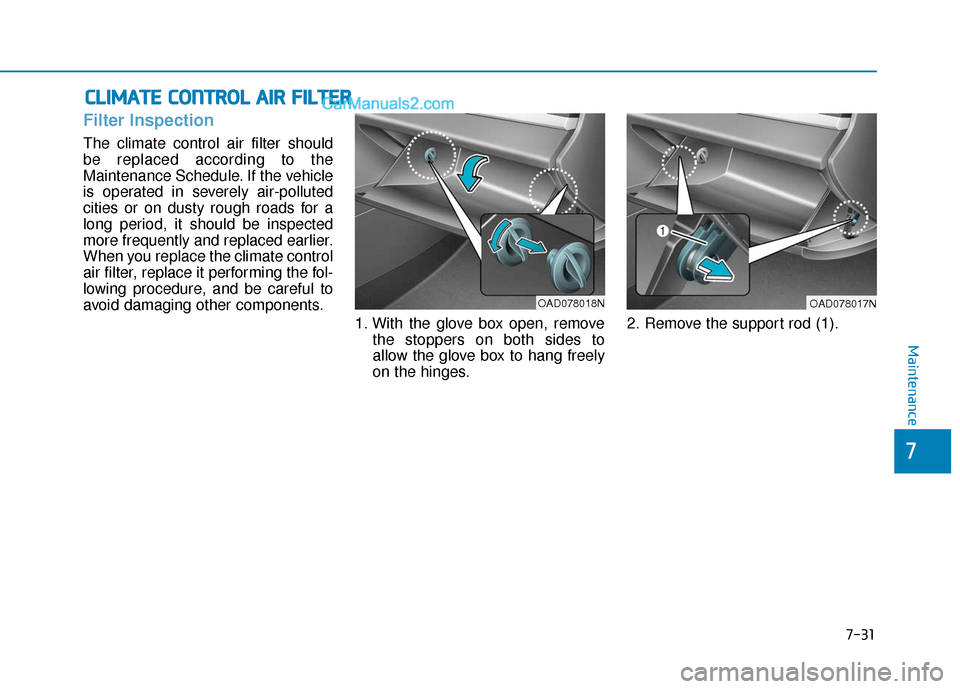
1. With the glove box open, removethe stoppers on both sides to
allow the glove box to hang freely
on the hinges. 2. Remove the support rod (1).
OAD078017NOAD078018N
Page 454 of 535
7-32
Maintenance
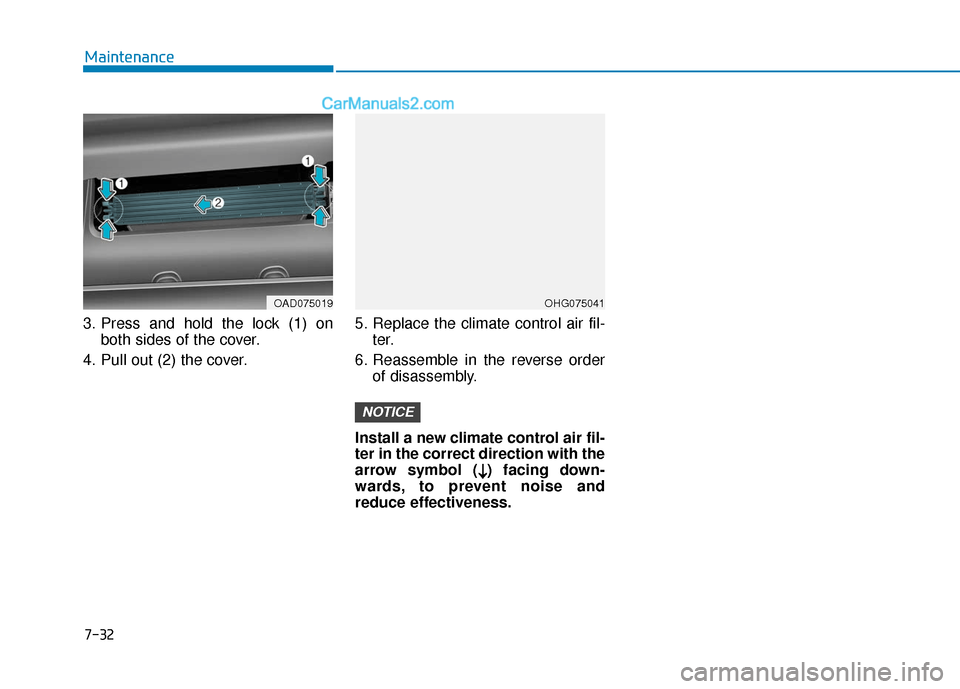
3. Press and hold the lock (1) on both sides of the cover.
4. Pull out (2) the cover. 5. Replace the climate control air fil-
ter.
6. Reassemble in the reverse order of disassembly.
Install a new climate control air fil-
ter in the correct direction with the
arrow symbol ( ↓ ↓) facing down-
wards, to prevent noise and
reduce effectiveness.
NOTICE
OHG075041OAD075019
Page 459 of 535
7-37
7
Maintenance
By jump starting
After a jump start from a good bat-
tery, drive the vehicle for 20-30 min-
utes before it is shutoff. The vehicle
may not restart if you shut it off
before the battery had a chance to
adequately recharge. See "Jump
Starting" in chapter 6 for more infor-
mation on jump starting procedures.
Information
An inappropriately disposedbattery can be harmful to
the environment and human
health.
Dispose the battery according to your
local law(s) or regulation.
Reset Features
The following items may need to be
reset after the battery has been dis-
charged or the battery has been dis-
connected.
Power Windows
Trip Computer
Climate Control System
Clock
Audio System
Sunroof
i
Watch the battery during
charging, and stop or reduce
the charging rate if the battery
cells begin boiling violently.
The negative battery cable
must be removed first and
installed last when the battery
is disconnected. Disconnect
the battery charger in the fol-
lowing order:
(1) Turn off the battery charg- er main switch.
(2) Unhook the negative
clamp from the negative
battery terminal.
(3) Unhook the positive clamp from the positive battery
terminal.
Always use a genuine
HYUNDAI approved battery
when you replace the battery.
Page 465 of 535
7-43
7
Maintenance
Compact spare tire replacement
A compact spare tire has a shorter
tread life than a regular size tire.
Replace it when you can see the
tread wear indicator bars on the tire.
The replacement compact spare tire
should be the same size and design
tire as the one provided with your
new vehicle and should be mounted
on the same compact spare tire
wheel. The compact spare tire is not
designed to be mounted on a regular
size wheel, and the compact spare
tire wheel is not designed for mount-
ing a regular size tire.
Wheel Replacement
When replacing the metal wheels for
any reason, make sure the new
wheels are equivalent to the original
factory units in diameter, rim width
and offset.
Tire Traction
Tire traction can be reduced if you
drive on worn tires, tires that are
improperly inflated or on slippery
road surfaces. Tires should be
replaced when the tread depth is at
least 2/32 inch (1.6 mm). To reduce
the possibility of losing control, slow
down whenever there is rain, snow or
ice on the road.
When replacing tires (or
wheels), it is recommended to
replace the two front or two
rear tires (or wheels) as a pair.
Replacing just one tire can
seriously affect your vehicle's
handling.
Heat caused by hot climates
or frequent high loading con-
ditions can accelerate the
aging process. Failure to fol-
low this warning may cause
sudden tire failure, which
could lead to a loss of vehicle
control resulting in an acci-
dent.
The original tire should be
repaired or replaced as soon as
possible to avoid failure of the
spare and loss of vehicle con-
trol resulting in an accident. The
compact spare tire is for emer-
gency use only. Do not operate
your vehicle over 50 mph (80
km/h) when using the compact
spare tire.
WARNING
Page 468 of 535
7-46
Maintenance
4. Tire ply composition andmaterial
The number of layers or plies of rub-
ber-coated fabric in the tire. Tire
manufacturers also must indicate the
materials in the tire, which include
steel, nylon, polyester, and others.
The letter "R" means radial ply con-
struction; the letter "D" means diago-
nal or bias ply construction; and the
letter "B" means belted-bias ply con-
struction.
5. Maximum permissible infla-tion pressure
This number is the greatest amount
of air pressure that should be put in
the tire. Do not exceed the maximum
permissible inflation pressure. Refer
to the Tire and Loading Information
label for recommended inflation
pressure.
6. Maximum load rating
This number indicates the maximum
load in kilograms and pounds that
can be carried by the tire. When
replacing the tires on the vehicle,
always use a tire that has the same
load rating as the factory installed
tire.
7. Uniform tire quality grading
Quality grades can be found where
applicable on the tire sidewall
between tread shoulder and maxi-
mum section width.
For example:
TREAD WEAR 200
TRACTION AA
TEMPERATURE A
Tread wear
The tread wear grade is a compara-
tive rating based on the wear rate of
the tire when tested under controlled
conditions on a specified govern-
ment test course. For example, a tire
graded 150 would wear one-and-a-
half times (1½) as well on the gov-
ernment course as a tire graded 100.
The relative performance of tires
depends upon the actual conditions
of their use, however, and may
depart significantly from the norm
due to variations in driving habits,
service practices and differences in
road characteristics and climate.
These grades are molded on the
sidewalls of passenger vehicle tires.
The tires available as standard or
optional equipment on your vehicle
may vary with respect to grade.
Page 524 of 535

I-2
Accessing your vehicle .....................................................3-3Immobilizer System....................................................3-\
11
Remote key...................................................................3-3
Remote key precautions ...............................................3-5
Smart key......................................................................3-\
6
Smart key precautions ..................................................3-9
Air bag warning labels ....................................................2-67
Air bags ........................................................................\
...2-43 Additional safety precautions .....................................2-66
Air bag collision sensors ............................................2-60
Air bag inflation conditions .......................................2-62
Air bag non-inflation conditions ................................2-63
Air bag warning labels ...............................................2-67
Curtain air bags ..........................................................2-48
Do not install a child restraint on the front passenger seat..........................................................2-59
Driver's air bag ...........................................................2-45
Driver's knee airbag....................................................2-45
How does the air bags system operate? .....................2-49
Occupant classification system (OCS) .......................2-55
Passenger's front air bag.............................................2-45
Side air bags ...............................................................2-47
SRS Care ....................................................................2-65\
SRS components and functions..................................2-49
What to expect after an air bag inflates .....................2-54 Where are the air bags? ..............................................2-45
Why didn't my air bag go off in a collision ...............2-60
Air cleaner.......................................................................7\
-29
Air conditioning system specification ..............................8-6
Airconditioning system Automatic climate control system............................3-123
Manual climate control system ................................3-114
Antenna ........................................................................\
.....4-2
Anti-lock brake system (ABS) .......................................5-42
Appearance care..............................................................7-75 Exterior care ...............................................................7-75
Interior care ................................................................7-80
Armrest (Rear seats) .......................................................2-14
Audio (Display Audio)/Video/Navigation System (AVN) ........................................................................\
....4-4
Audio remote control ........................................................4-3
Audio system Audio remote control ...................................................4-3
Auto defogging system .................................................3-137
Auto door lock/unlock features ......................................3-15 Impact sensing door unlock .......................................3-15
Shift lever auto door lock ...........................................3-15
Speed sensing door lock .............................................3-15
Auto light position ..........................................................3-99
Index
A