check engine HYUNDAI ELANTRA 2021 Repair Manual
[x] Cancel search | Manufacturer: HYUNDAI, Model Year: 2021, Model line: ELANTRA, Model: HYUNDAI ELANTRA 2021Pages: 570, PDF Size: 52.21 MB
Page 497 of 570
09
9-11
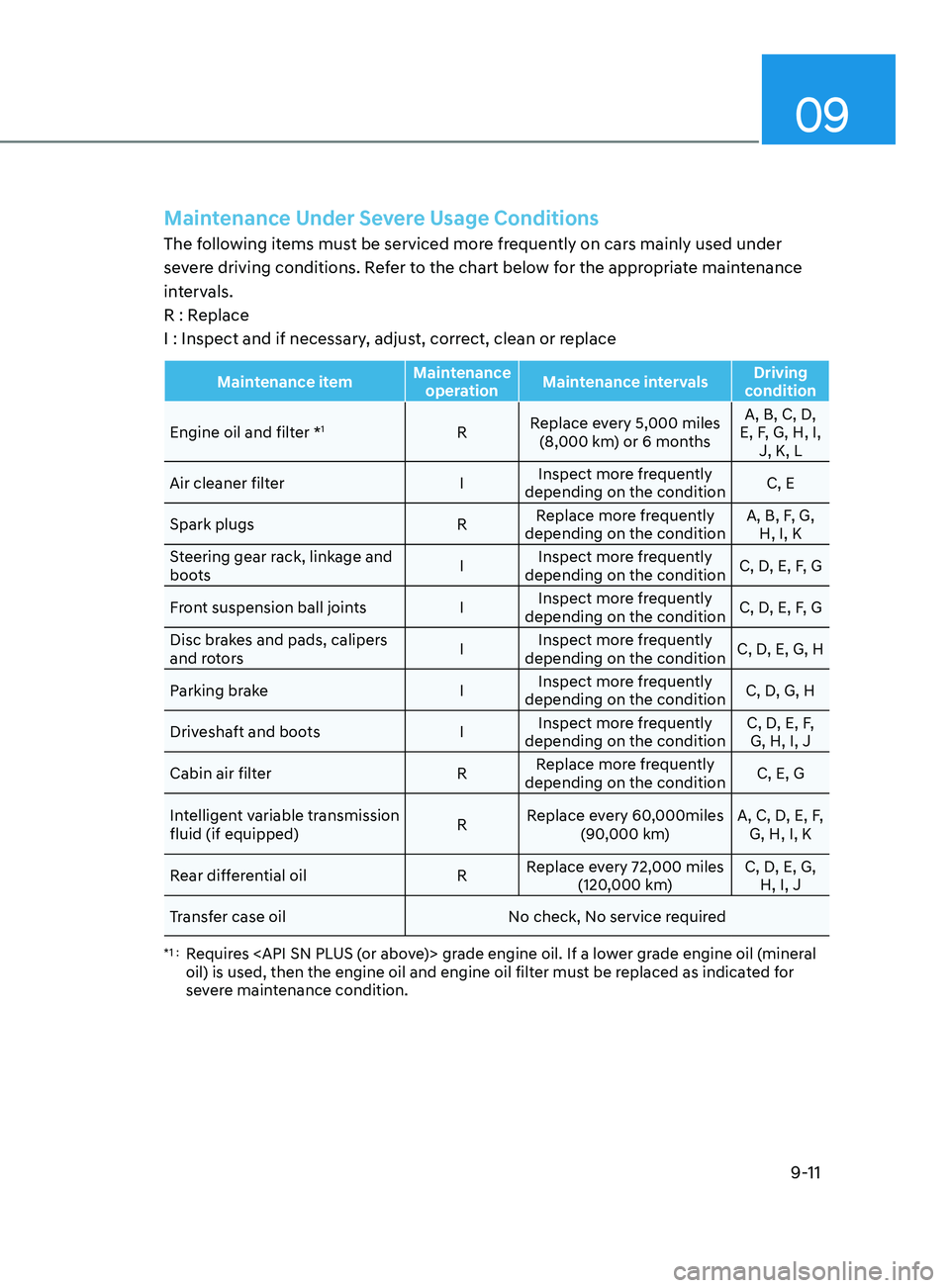
Maintenance Under Severe Usage Conditions
The following items must be serviced more frequently on cars mainly used under
severe driving conditions. Refer to the chart below for the appropriate maintenance
intervals.
R : Replace
I : Inspect and if necessary, adjust, correct, clean or replace
Maintenance itemMaintenance
operation Maintenance intervals Driving
condition
Engine oil and filter *
1R Replace every 5,000 miles
(8,000 km) or 6 months A, B, C, D,
E, F, G, H, I, J, K, L
Air cleaner filter IInspect more frequently
depending on the condition C, E
Spark plugs RReplace more frequently
depending on the condition A, B, F, G,
H, I, K
Steering gear rack, linkage and
boots IInspect more frequently
depending on the condition C, D, E, F, G
Front suspension ball joints IInspect more frequently
depending on the condition C, D, E, F, G
Disc brakes and pads, calipers
and rotors IInspect more frequently
depending on the condition C, D, E, G, H
Parking brake IInspect more frequently
depending on the condition C, D, G, H
Driveshaft and boots IInspect more frequently
depending on the condition C, D, E, F,
G, H, I, J
Cabin air filter RReplace more frequently
depending on the condition C, E, G
Intelligent variable transmission
fluid (if equipped) RReplace every 60,000miles
(90,000 km) A, C, D, E, F,
G, H, I, K
Rear differential oil RReplace every 72,000 miles
(120,000 km) C, D, E, G,
H, I, J
Transfer case oil No check, No service required
*1 : Requires
oil) is used, then the engine oil and engine oil filter must be replaced as indicated for
severe maintenance condition.
Page 499 of 570
09
9-13
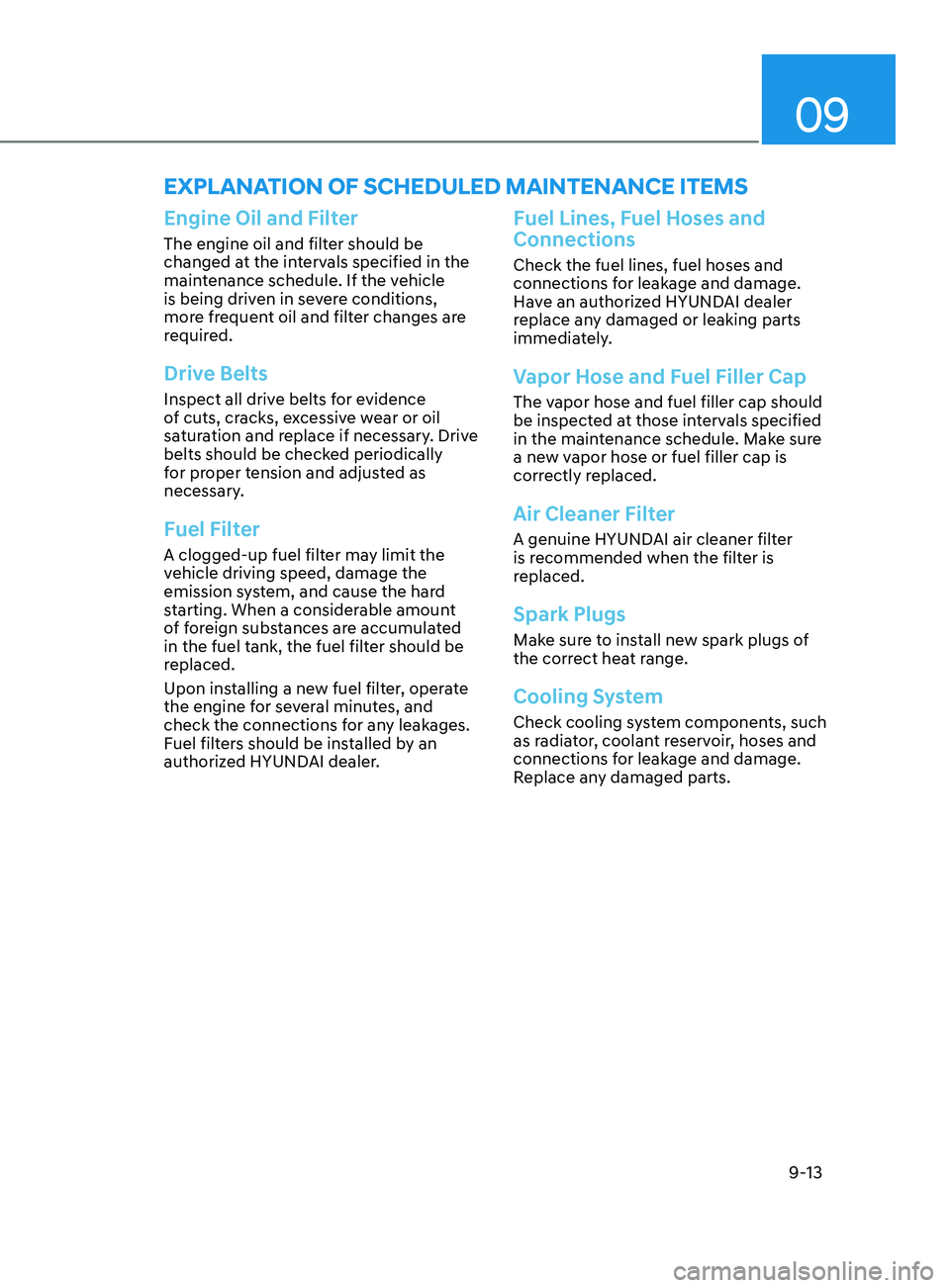
Engine Oil and Filter
The engine oil and filter should be
changed at the intervals specified in the
maintenance schedule. If the vehicle
is being driven in severe conditions,
more frequent oil and filter changes are
required.
Drive Belts
Inspect all drive belts for evidence
of cuts, cracks, excessive wear or oil
saturation and replace if necessary. Drive
belts should be checked periodically
for proper tension and adjusted as
necessary.
Fuel Filter
A clogged-up fuel filter may limit the
vehicle driving speed, damage the
emission system, and cause the hard
starting. When a considerable amount
of foreign substances are accumulated
in the fuel tank, the fuel filter should be
replaced.
Upon installing a new fuel filter, operate
the engine for several minutes, and
check the connections for any leakages.
Fuel filters should be installed by an
authorized HYUNDAI dealer.
Fuel Lines, Fuel Hoses and
Connections
Check the fuel lines, fuel hoses and
connections for leakage and damage.
Have an authorized HYUNDAI dealer
replace any damaged or leaking parts
immediately.
Vapor Hose and Fuel Filler Cap
The vapor hose and fuel filler cap should
be inspected at those intervals specified
in the maintenance schedule. Make sure
a new vapor hose or fuel filler cap is
correctly replaced.
Air Cleaner Filter
A genuine HYUNDAI air cleaner filter
is recommended when the filter is
replaced.
Spark Plugs
Make sure to install new spark plugs of
the correct heat range.
Cooling System
Check cooling system components, such
as radiator, coolant reservoir, hoses and
connections for leakage and damage.
Replace any damaged parts.
Explanation of SChEdulEd maintEnanCE itEmS
Page 500 of 570
Maintenance
9-14
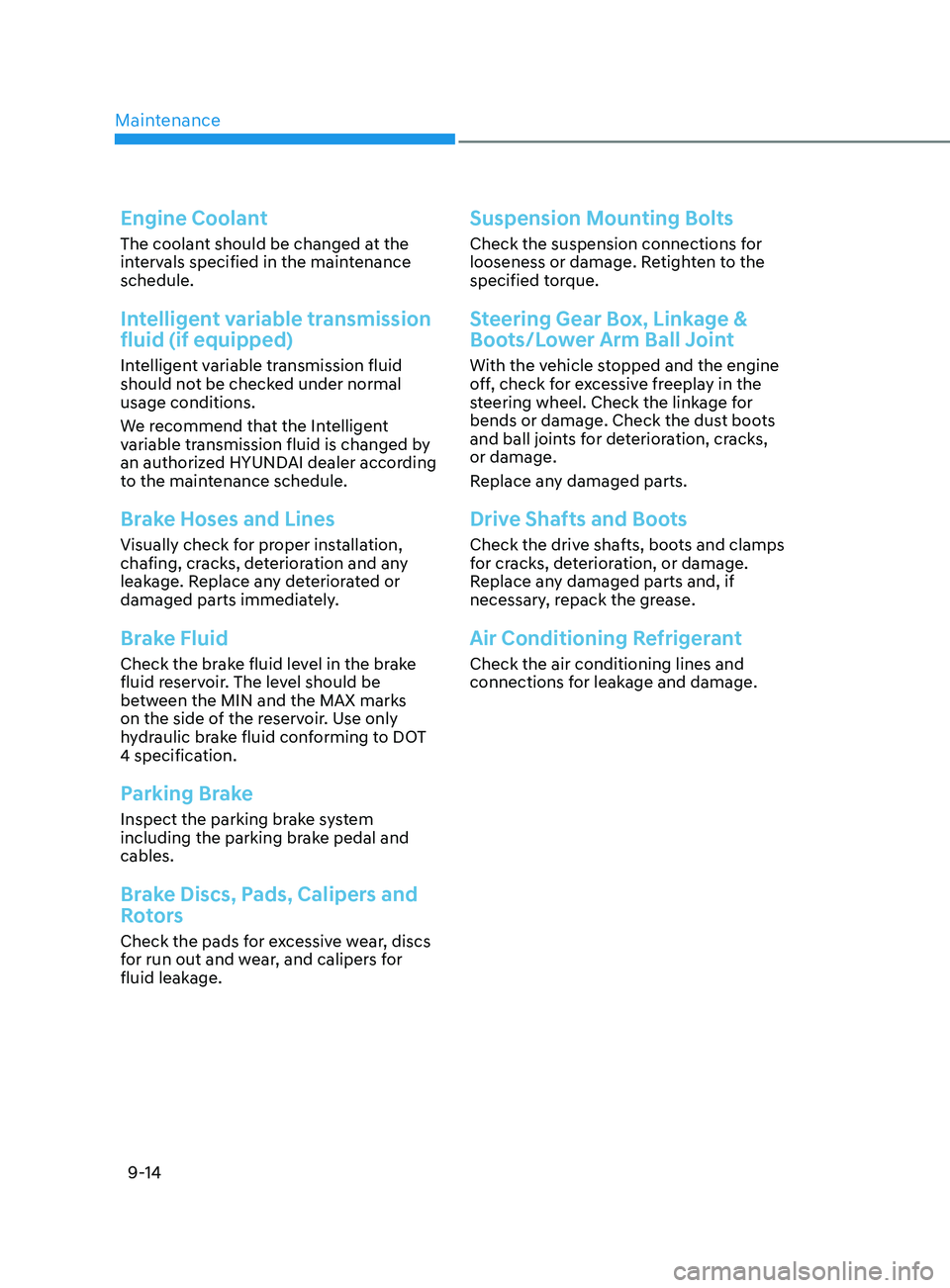
Engine Coolant
The coolant should be changed at the
intervals specified in the maintenance
schedule.
Intelligent variable transmission
fluid (if equipped)
Intelligent variable transmission fluid
should not be checked under normal
usage conditions.
We recommend that the Intelligent
variable transmission fluid is changed by
an authorized HYUNDAI dealer according
to the maintenance schedule.
Brake Hoses and Lines
Visually check for proper installation,
chafing, cracks, deterioration and any
leakage. Replace any deteriorated or
damaged parts immediately.
Brake Fluid
Check the brake fluid level in the brake
fluid reservoir. The level should be
between the MIN and the MAX marks
on the side of the reservoir. Use only
hydraulic brake fluid conforming to DOT
4 specification.
Parking Brake
Inspect the parking brake system
including the parking brake pedal and
cables.
Brake Discs, Pads, Calipers and
Rotors
Check the pads for excessive wear, discs
for run out and wear, and calipers for
fluid leakage.
Suspension Mounting Bolts
Check the suspension connections for
looseness or damage. Retighten to the
specified torque.
Steering Gear Box, Linkage &
Boots/Lower Arm Ball Joint
With the vehicle stopped and the engine
off, check for excessive freeplay in the
steering wheel. Check the linkage for
bends or damage. Check the dust boots
and ball joints for deterioration, cracks,
or damage.
Replace any damaged parts.
Drive Shafts and Boots
Check the drive shafts, boots and clamps
for cracks, deterioration, or damage.
Replace any damaged parts and, if
necessary, repack the grease.
Air Conditioning Refrigerant
Check the air conditioning lines and
connections for leakage and damage.
Page 501 of 570
09
9-15
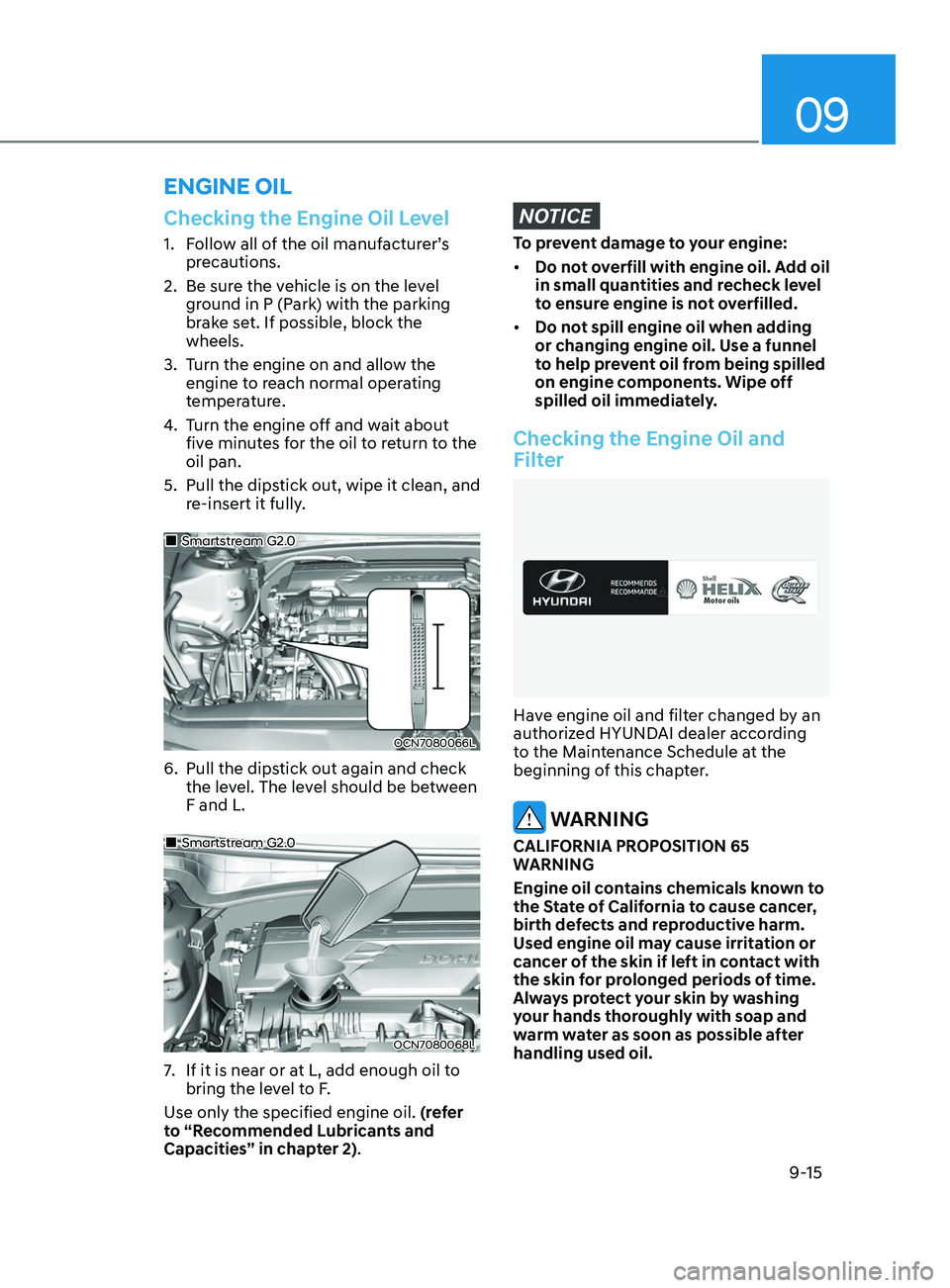
Checking the Engine Oil Level
1. Follow all of the oil manufacturer’s
precautions.
2.
Be sure the v
ehicle is on the level
ground in P (Park) with the parking
brake set. If possible, block the
wheels.
3.
Turn the engine on and allo
w the
engine to reach normal operating
temperature.
4.
Turn the engine o
ff and wait about
five minutes for the oil to return to the
oil pan.
5.
Pull the dipstick out, wipe it clean, and
r
e-insert it fully.
OCN7080066L
„„Smartstream G2.0
6. Pull the dipstick out again and check
the le vel. The level should be between
F and L.
OCN7080068L
„„Smartstream G2.0
7. If it is near or at L, add enough oil t o
bring the level to F.
Use only the specified engine oil. (refer
to “Recommended Lubricants and
Capacities” in chapter 2).
NOTICE
To prevent damage to your engine:
• Do not overfill with engine oil. Add oil
in small quantities and recheck level
to ensure engine is not overfilled.
• Do not spill engine oil when adding
or changing engine oil. Use a funnel
to help prevent oil from being spilled
on engine components. Wipe off
spilled oil immediately.
Checking the Engine Oil and
Filter
Have engine oil and filter changed by an
authorized HYUNDAI dealer according
to the Maintenance Schedule at the
beginning of this chapter.
WARNING
CALIFORNIA PROPOSITION 65
WARNING
Engine oil contains chemicals known to
the State of California to cause cancer,
birth defects and reproductive harm.
Used engine oil may cause irritation or
cancer of the skin if left in contact with
the skin for prolonged periods of time.
Always protect your skin by washing
your hands thoroughly with soap and
warm water as soon as possible after
handling used oil.
EnginE oil
Page 502 of 570
Maintenance
9-16
The high-pressure cooling system has a
reservoir filled with year-round antifreeze
coolant. The reservoir is filled at the
factory.
Check the antifreeze protection and
coolant level at least once a year, at
the beginning of the winter season and
before traveling to a colder climate.
NOTICE
• When the engine overheats from
low engine coolant, suddenly adding
engine coolant may cause cracks
in the engine. To prevent damage,
add engine coolant slowly in small
quantities.
• Do not drive with no engine coolant.
It may cause water pump failure and
engine seizure, etc.
Checking the Engine Coolant
Level
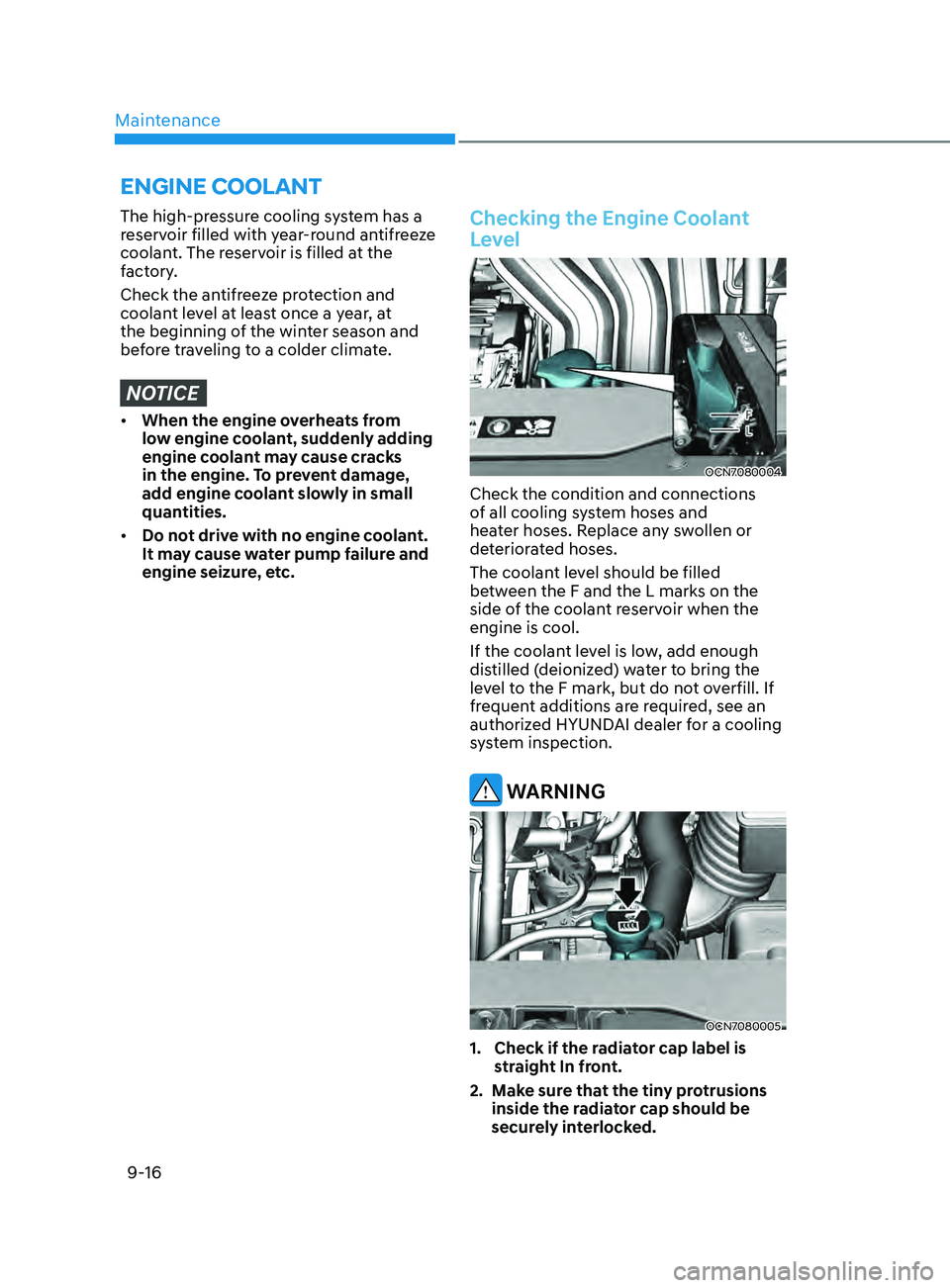
OCN7080004
Check the condition and connections
of all cooling system hoses and
heater hoses. Replace any swollen or
deteriorated hoses.
The coolant level should be filled
between the F and the L marks on the
side of the coolant reservoir when the
engine is cool.
If the coolant level is low, add enough
distilled (deionized) water to bring the
level to the F mark, but do not overfill. If
frequent additions are required, see an
authorized HYUNDAI dealer for a cooling
system inspection.
WARNING
OCN7080005
1. Check if the radia tor cap label is
straight In front.
2.
Mak
e sure that the tiny protrusions
inside the radiator cap should be
securely interlocked.
EnginE Coolant
Page 504 of 570
Maintenance
9-18
Checking the brake fluid level
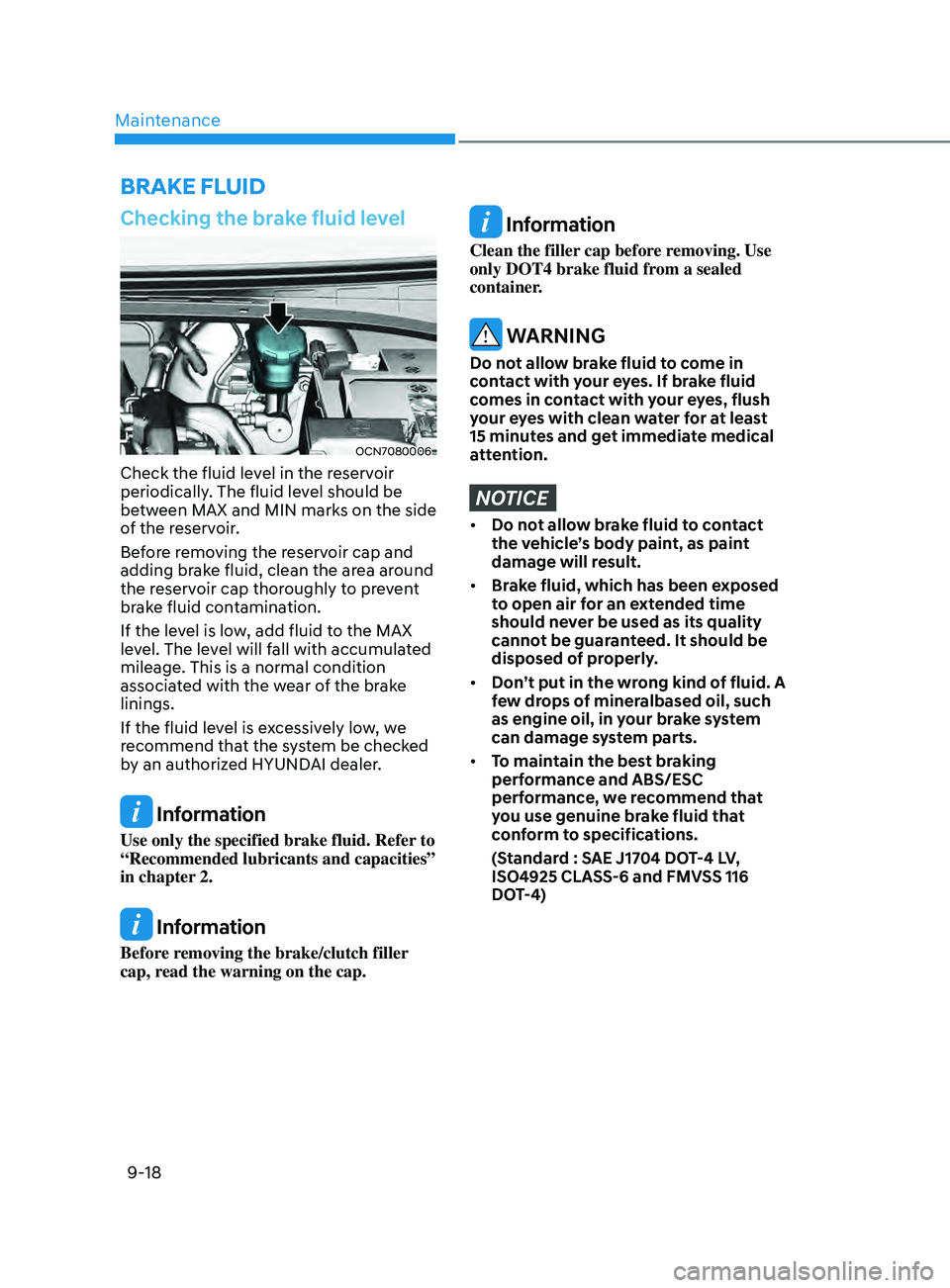
OCN7080006
Check the fluid level in the reservoir
periodically. The fluid level should be
between MAX and MIN marks on the side
of the reservoir.
Before removing the reservoir cap and
adding brake fluid, clean the area around
the reservoir cap thoroughly to prevent
brake fluid contamination.
If the level is low, add fluid to the MAX
level. The level will fall with accumulated
mileage. This is a normal condition
associated with the wear of the brake
linings.
If the fluid level is excessively low, we
recommend that the system be checked
by an authorized HYUNDAI dealer.
Information
Use only the specified brake fluid. Refer to
“Recommended lubricants and capacities”
in chapter 2.
Information
Before removing the brake/clutch filler
cap, read the warning on the cap.
Information
Clean the filler cap before removing. Use
only DOT4 brake fluid from a sealed
container.
WARNING
Do not allow brake fluid to come in
contact with your eyes. If brake fluid
comes in contact with your eyes, flush
your eyes with clean water for at least
15 minutes and get immediate medical
attention.
NOTICE
• Do not allow brake fluid to contact
the vehicle’s body paint, as paint
damage will result.
• Brake fluid, which has been exposed
to open air for an extended time
should never be used as its quality
cannot be guaranteed. It should be
disposed of properly.
• Don’t put in the wrong kind of fluid. A
few drops of mineralbased oil, such
as engine oil, in your brake system
can damage system parts.
• To maintain the best braking
performance and ABS/ESC
performance, we recommend that
you use genuine brake fluid that
conform to specifications.
(Standard : SAE J1704 DOT-4 LV,
ISO4925 CLASS-6 and FMVSS 116
DOT-4)
BrakE fluid
Page 505 of 570
09
9-19
parking BrakE
Checking the Washer Fluid Level
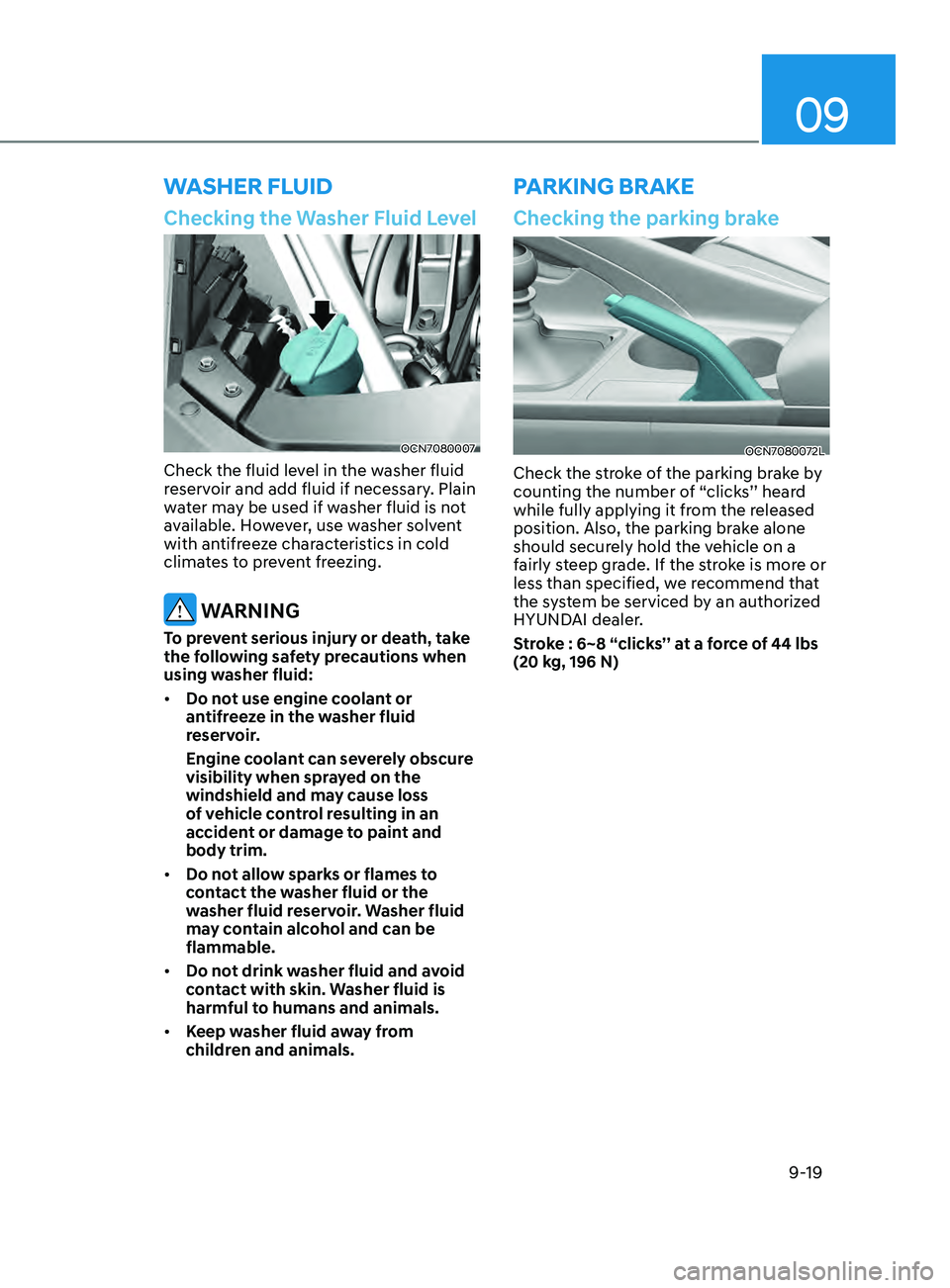
OCN7080007
Check the fluid level in the washer fluid
reservoir and add fluid if necessary. Plain
water may be used if washer fluid is not
available. However, use washer solvent
with antifreeze characteristics in cold
climates to prevent freezing.
WARNING
To prevent serious injury or death, take
the following safety precautions when
using washer fluid:
• Do not use engine coolant or
antifreeze in the washer fluid
reservoir.
Engine coolant can severely obscure
visibility when sprayed on the
windshield and may cause loss
of vehicle control resulting in an
accident or damage to paint and
body trim.
• Do not allow sparks or flames to
contact the washer fluid or the
washer fluid reservoir. Washer fluid
may contain alcohol and can be
flammable.
• Do not drink washer fluid and avoid
contact with skin. Washer fluid is
harmful to humans and animals.
• Keep washer fluid away from
children and animals.
waShEr fl uid
Checking the parking brake
OCN7080072L
Check the stroke of the parking brake by
counting the number of “clicks’’ heard
while fully applying it from the released
position. Also, the parking brake alone
should securely hold the vehicle on a
fairly steep grade. If the stroke is more or
less than specified, we recommend that
the system be serviced by an authorized
HYUNDAI dealer.
Stroke : 6~8 “clicks’’ at a force of 44 lbs
(20 kg, 196 N)
Page 506 of 570
Maintenance
9-20
Filter replacement
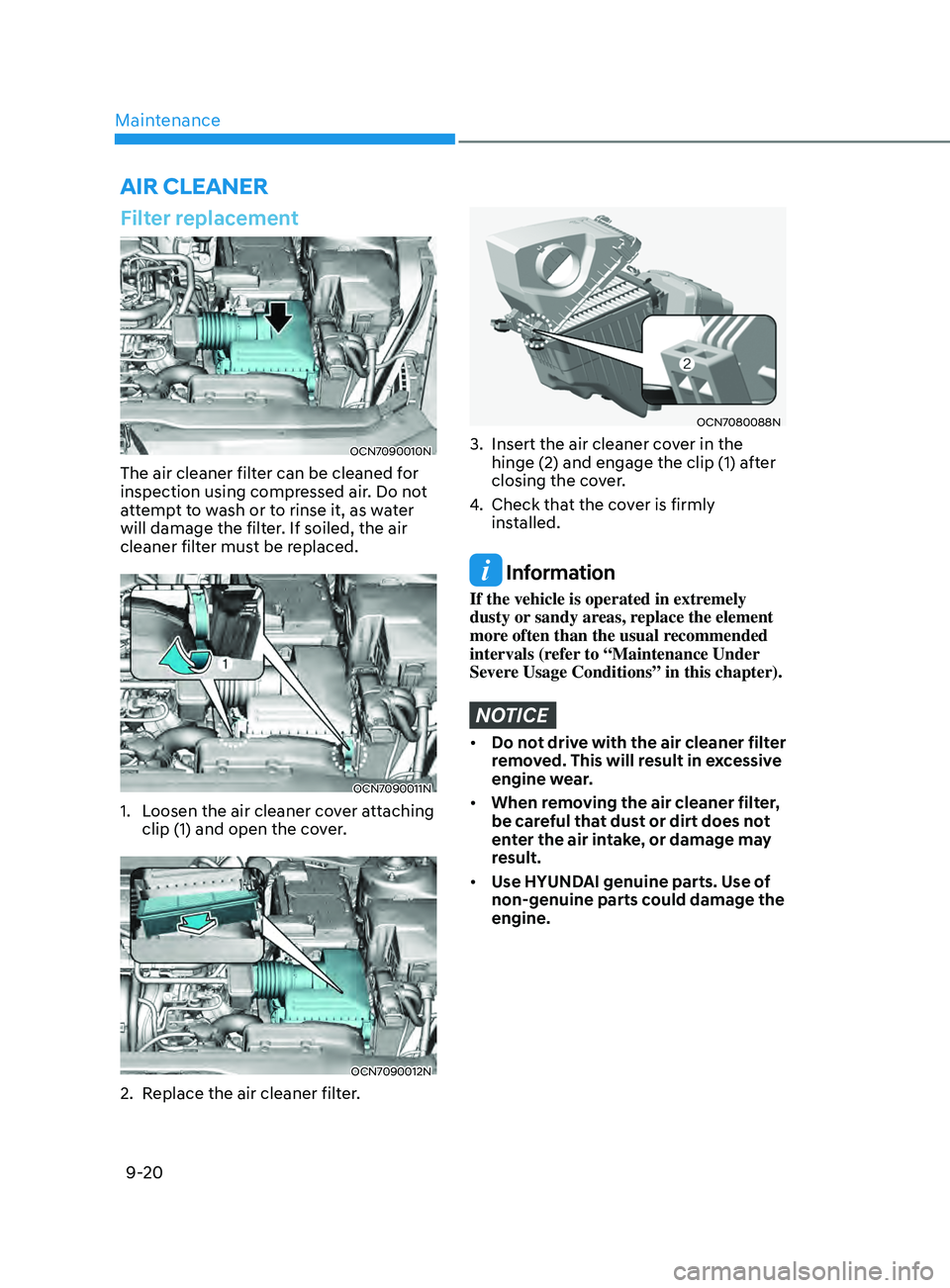
OCN7090010N
The air cleaner filter can be cleaned for
inspection using compressed air. Do not
attempt to wash or to rinse it, as water
will damage the filter. If soiled, the air
cleaner filter must be replaced.
OCN7090011N
1. Loosen the air cleaner cover attaching
clip (1) and open the cover.
OCN7090012N
2. Replace the air cleaner filter.
OCN7080088N
3. Insert the air cleaner cov er in the
hinge (2) and engage the clip (1) after
closing the cover.
4.
Check that the co
ver is firmly
installed.
Information
If the vehicle is operated in extremely
dusty or sandy areas, replace the element
more often than the usual recommended
intervals (refer to “Maintenance Under
Severe Usage Conditions” in this chapter).
NOTICE
• Do not drive with the air cleaner filter
removed. This will result in excessive
engine wear.
• When removing the air cleaner filter,
be careful that dust or dirt does not
enter the air intake, or damage may
result.
• Use HYUNDAI genuine parts. Use of
non-genuine parts could damage the
engine.
air ClEanEr
Page 526 of 570
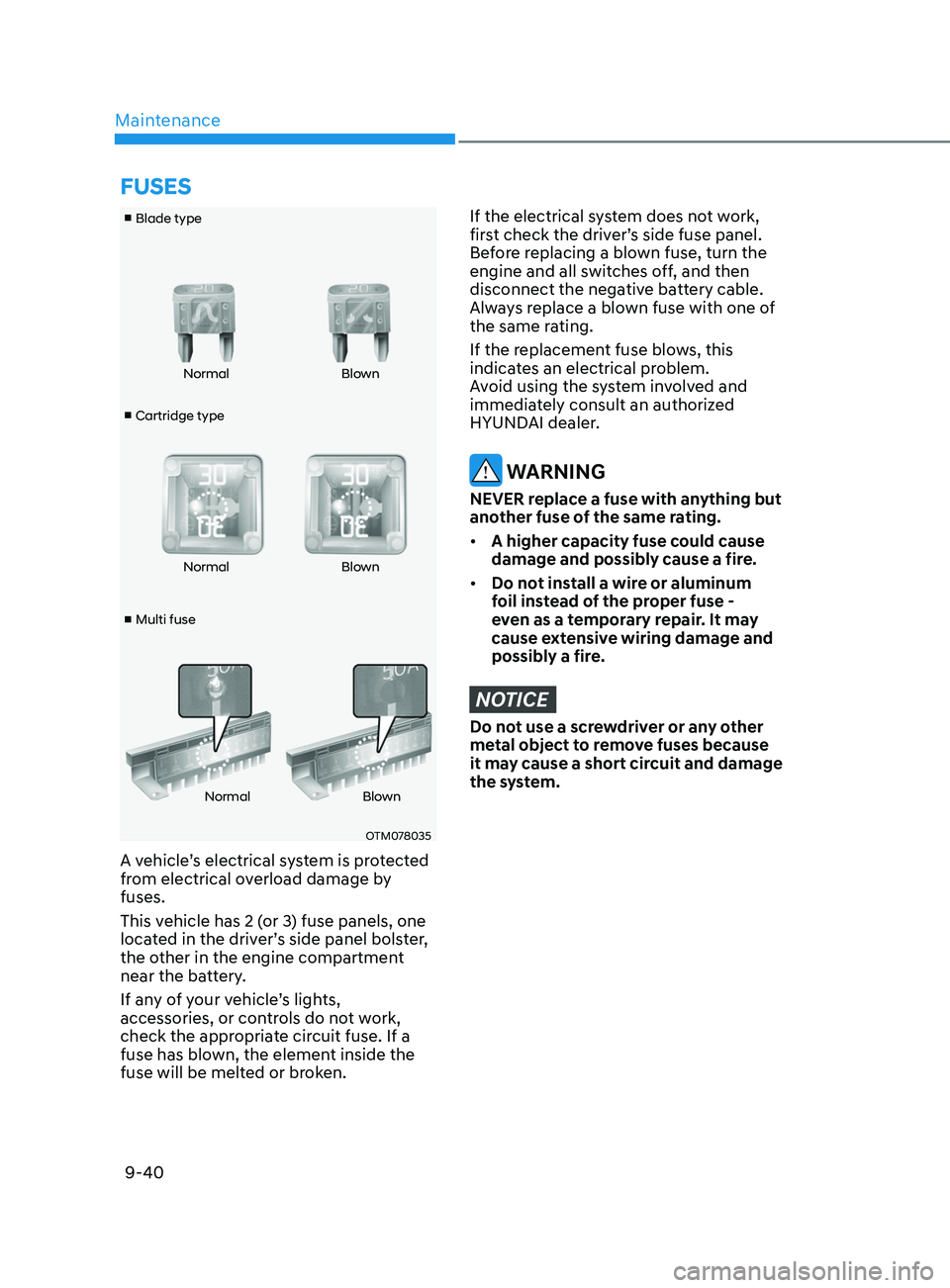
Maintenance9-40
■ Cartridge type
■ Blade type
■ Multi fuse Normal
Blown
Normal Blown
Normal Blown
OTM078035
A vehicle’s electrical system is protected
from electrical overload damage by
fuses.
This vehicle has 2 (or 3) fuse panels, one
located in the driver’s side panel bolster,
the other in the engine compartment
near the battery.
If any of your vehicle’s lights,
accessories, or controls do not work,
check the appropriate circuit fuse. If a
fuse has blown, the element inside the
fuse will be melted or broken.
If the electrical system does not work,
first check the driver’s side fuse panel.
Before replacing a blown fuse, turn the
engine and all switches off, and then
disconnect the negative battery cable.
Always replace a blown fuse with one of
the same rating.
If the replacement fuse blows, this
indicates an electrical problem.
Avoid using the system involved and
immediately consult an authorized
HYUNDAI dealer.
WARNING
NEVER replace a fuse with anything but
another fuse of the same rating.
• A higher capacity fuse could cause
damage and possibly cause a fire.
• Do not install a wire or aluminum
foil instead of the proper fuse -
even as a temporary repair. It may
cause extensive wiring damage and
possibly a fire.
NOTICE
Do not use a screwdriver or any other
metal object to remove fuses because
it may cause a short circuit and damage
the system.
fuSES
Page 527 of 570
09
9-41
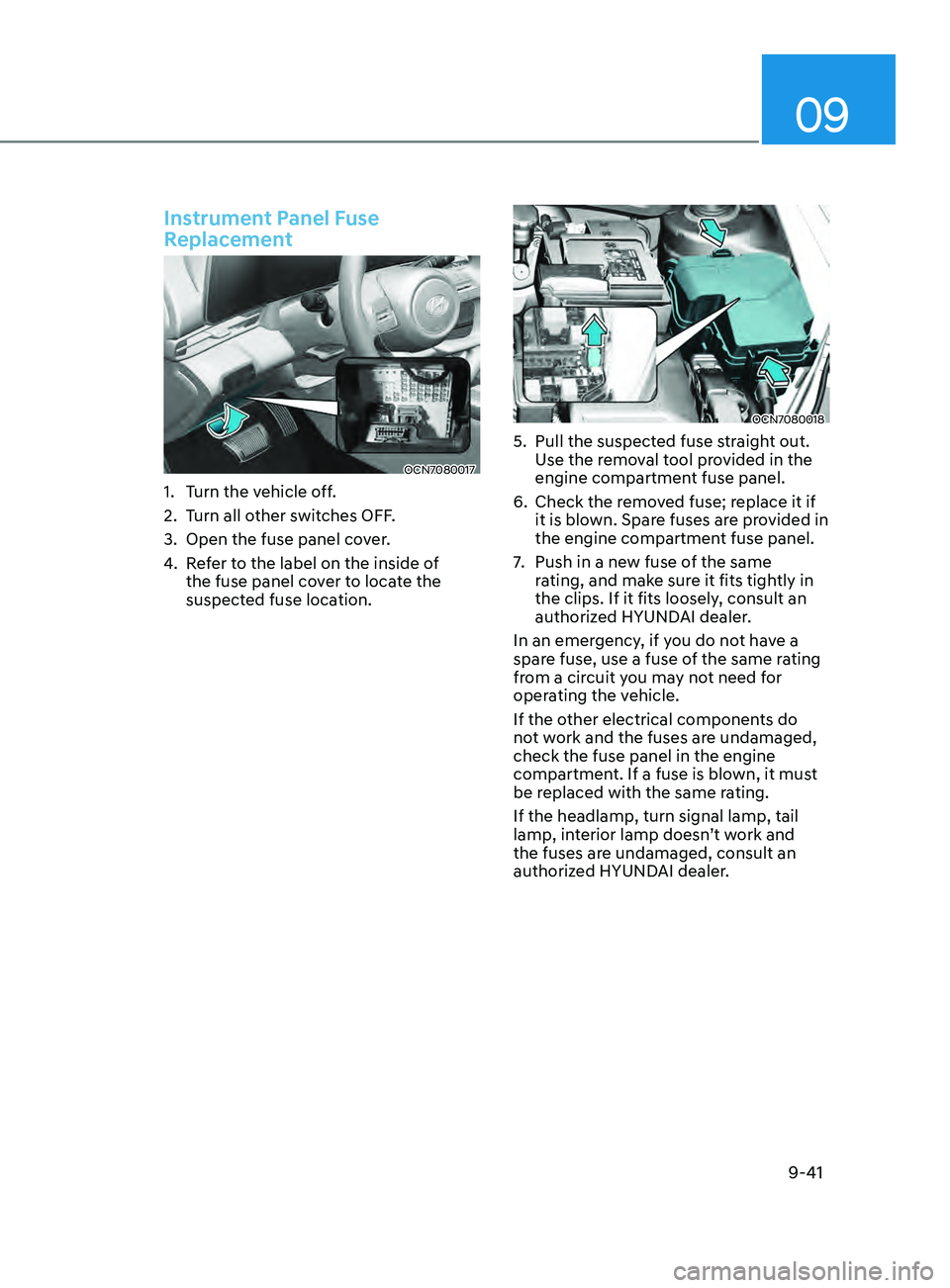
Instrument Panel Fuse
Replacement
OCN7080017
1. Turn the vehicle off.
2.
Turn all o
ther switches OFF.
3.
Open the fuse panel cov
er.
4.
Re
fer to the label on the inside of
the fuse panel cover to locate the
suspected fuse location.
OCN7080018
5. Pull the suspected fuse s traight out.
Use the removal tool provided in the
engine compartment fuse panel.
6.
Check the remo
ved fuse; replace it if
it is blown. Spare fuses are provided in
the engine compartment fuse panel.
7.
Push in a new fuse o
f the same
rating, and make sure it fits tightly in
the clips. If it fits loosely, consult an
authorized HYUNDAI dealer.
In an emergency, if you do not have a
spare fuse, use a fuse of the same rating
from a circuit you may not need for
operating the vehicle.
If the other electrical components do
not work and the fuses are undamaged,
check the fuse panel in the engine
compartment. If a fuse is blown, it must
be replaced with the same rating.
If the headlamp, turn signal lamp, tail
lamp, interior lamp doesn’t work and
the fuses are undamaged, consult an
authorized HYUNDAI dealer.