replace HYUNDAI ELANTRA 2021 Repair Manual
[x] Cancel search | Manufacturer: HYUNDAI, Model Year: 2021, Model line: ELANTRA, Model: HYUNDAI ELANTRA 2021Pages: 570, PDF Size: 52.21 MB
Page 519 of 570
09
9-33
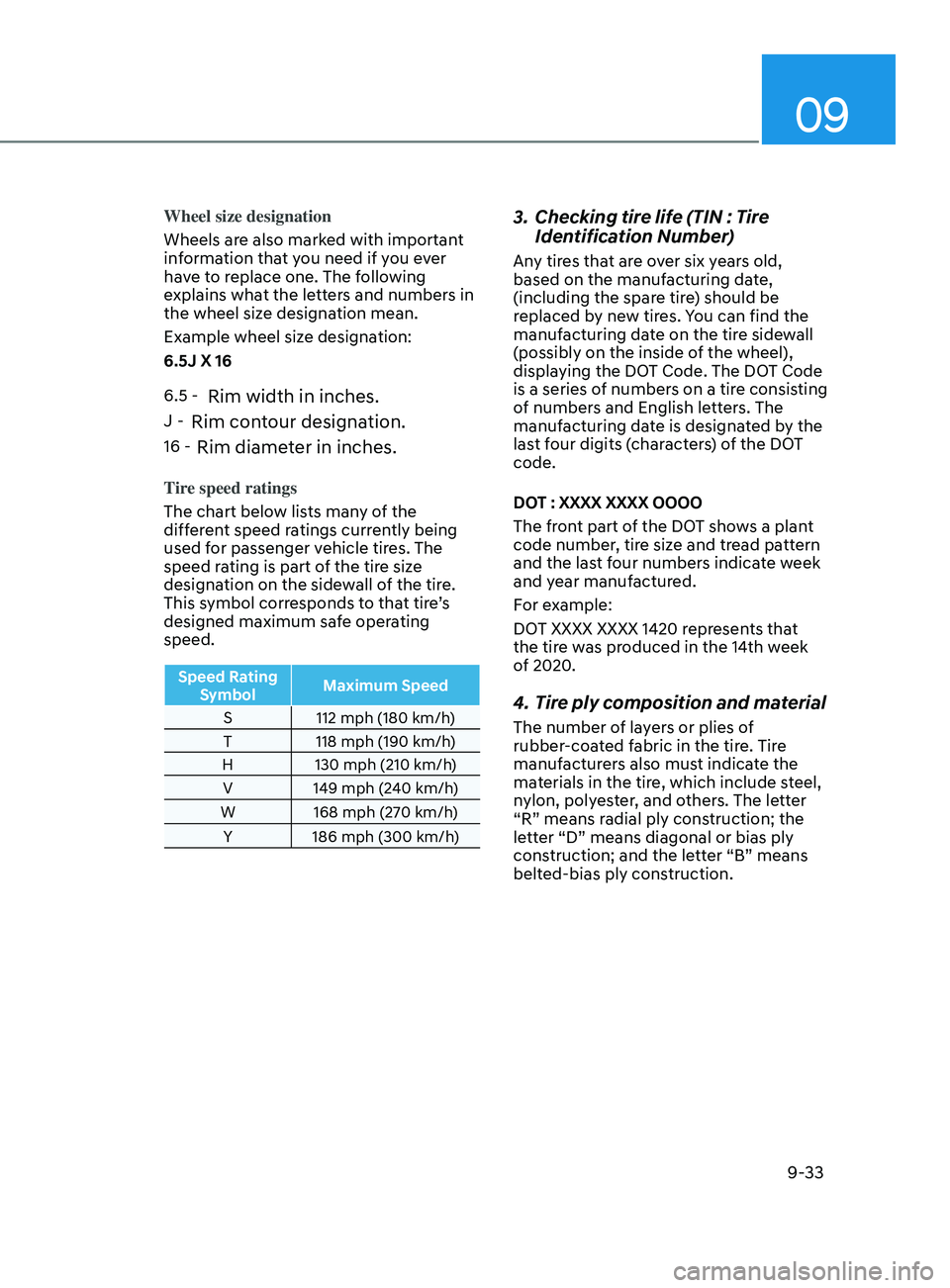
Wheel size designation
Wheels are also marked with important
information that you need if you ever
have to replace one. The following
explains what the letters and numbers in
the wheel size designation mean.
Example wheel size designation:
6.5J X 16
6.5 -
Rim width in inches.
J -Rim contour designation.
16 -Rim diameter in inches.
Tire speed ratings
The chart below lists many of the
different speed ratings currently being
used for passenger vehicle tires. The
speed rating is part of the tire size
designation on the sidewall of the tire.
This symbol corresponds to that tire’s
designed maximum safe operating
speed.
Speed Rating Symbol Maximum Speed
S 112 mph (180 km/h)
T 118 mph (190 km/h)
H 130 mph (210 km/h)
V 149 mph (240 km/h)
W 168 mph (270 km/h) Y 186 mph (300 km/h)
3. Checking tire lif e (TIN : Tire
Identification Number)
Any tires that are over six years old,
based on the manufacturing date,
(including the spare tire) should be
replaced by new tires. You can find the
manufacturing date on the tire sidewall
(possibly on the inside of the wheel),
displaying the DOT Code. The DOT Code
is a series of numbers on a tire consisting
of numbers and English letters. The
manufacturing date is designated by the
last four digits (characters) of the DOT
code.
DOT : XXXX XXXX OOOO
The front part of the DOT shows a plant
code number, tire size and tread pattern
and the last four numbers indicate week
and year manufactured.
For example:
DOT XXXX XXXX 1420 represents that
the tire was produced in the 14th week
of 2020.
4. Tire ply composition and material
The number of layers or plies of
rubber-coated fabric in the tire. Tire
manufacturers also must indicate the
materials in the tire, which include steel,
nylon, polyester, and others. The letter
“R” means radial ply construction; the
letter “D” means diagonal or bias ply
construction; and the letter “B” means
belted-bias ply construction.
Page 523 of 570
09
9-37
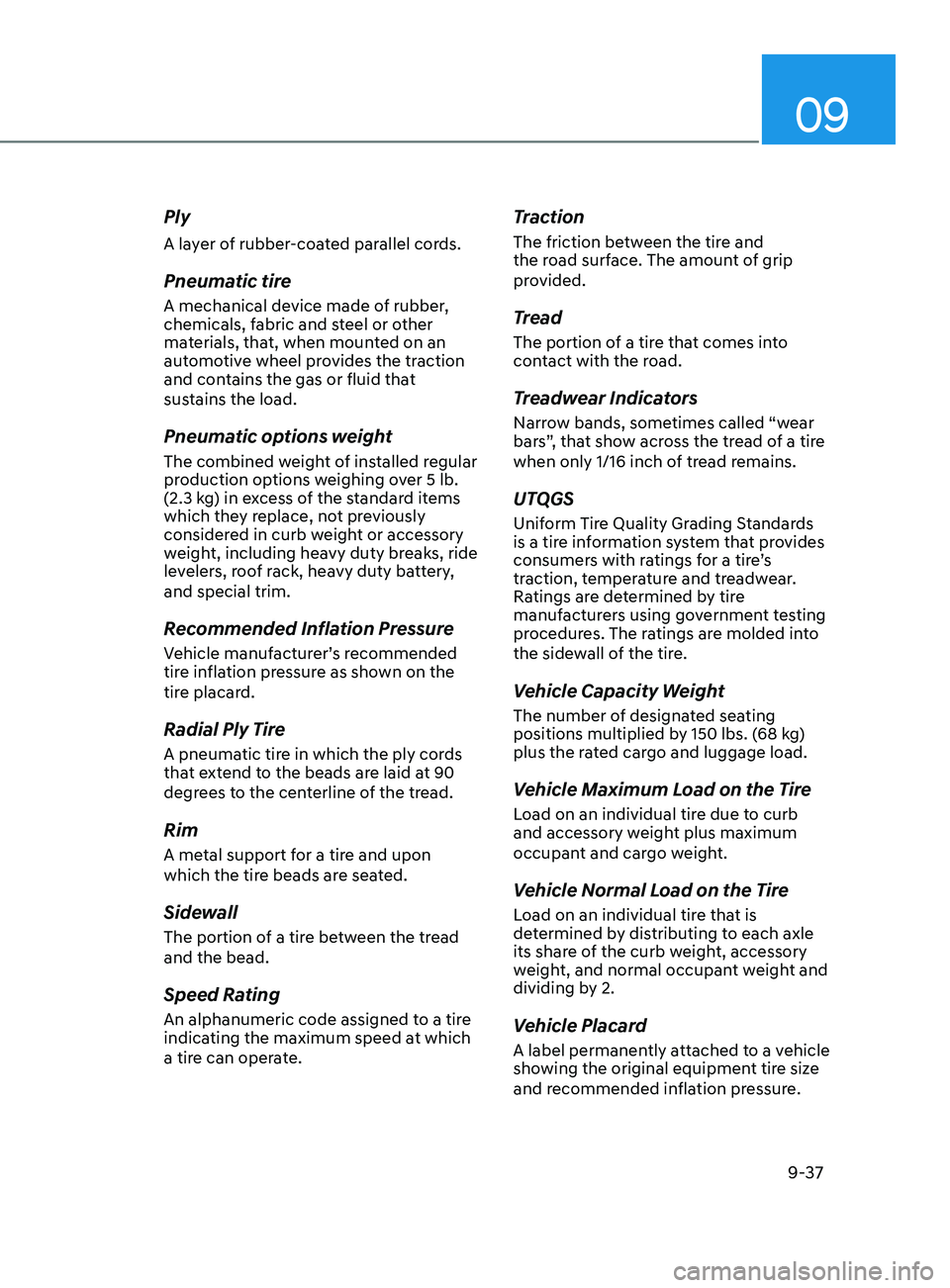
Ply
A layer of rubber-coated parallel cords.
Pneumatic tire
A mechanical device made of rubber,
chemicals, fabric and steel or other
materials, that, when mounted on an
automotive wheel provides the traction
and contains the gas or fluid that
sustains the load.
Pneumatic options weight
The combined weight of installed regular
production options weighing over 5 lb.
(2.3 kg) in excess of the standard items
which they replace, not previously
considered in curb weight or accessory
weight, including heavy duty breaks, ride
levelers, roof rack, heavy duty battery,
and special trim.
Recommended Inflation Pressure
Vehicle manufacturer’s recommended
tire inflation pressure as shown on the
tire placard.
Radial Ply Tire
A pneumatic tire in which the ply cords
that extend to the beads are laid at 90
degrees to the centerline of the tread.
Rim
A metal support for a tire and upon
which the tire beads are seated.
Sidewall
The portion of a tire between the tread
and the bead.
Speed Rating
An alphanumeric code assigned to a tire
indicating the maximum speed at which
a tire can operate.
Traction
The friction between the tire and
the road surface. The amount of grip
provided.
Tread
The portion of a tire that comes into
contact with the road.
Treadwear Indicators
Narrow bands, sometimes called “wear
bars”, that show across the tread of a tire
when only 1/16 inch of tread remains.
UTQGS
Uniform Tire Quality Grading Standards
is a tire information system that provides
consumers with ratings for a tire’s
traction, temperature and treadwear.
Ratings are determined by tire
manufacturers using government testing
procedures. The ratings are molded into
the sidewall of the tire.
Vehicle Capacity Weight
The number of designated seating
positions multiplied by 150 lbs. (68 kg)
plus the rated cargo and luggage load.
Vehicle Maximum Load on the Tire
Load on an individual tire due to curb
and accessory weight plus maximum
occupant and cargo weight.
Vehicle Normal Load on the Tire
Load on an individual tire that is
determined by distributing to each axle
its share of the curb weight, accessory
weight, and normal occupant weight and
dividing by 2.
Vehicle Placard
A label permanently attached to a vehicle
showing the original equipment tire size
and recommended inflation pressure.
Page 525 of 570
09
9-39
CAUTION
• It is not easy to recognize tire
damage with your own eyes. But
if there is the slightest hint of tire
damage, have the tire checked or
replaced because the tire damage
may cause air leakage from the tire.
• If the tire is damaged by driving
on a rough road, off road, pothole,
manhole, or curb stone, it will not be
covered by the warranty.
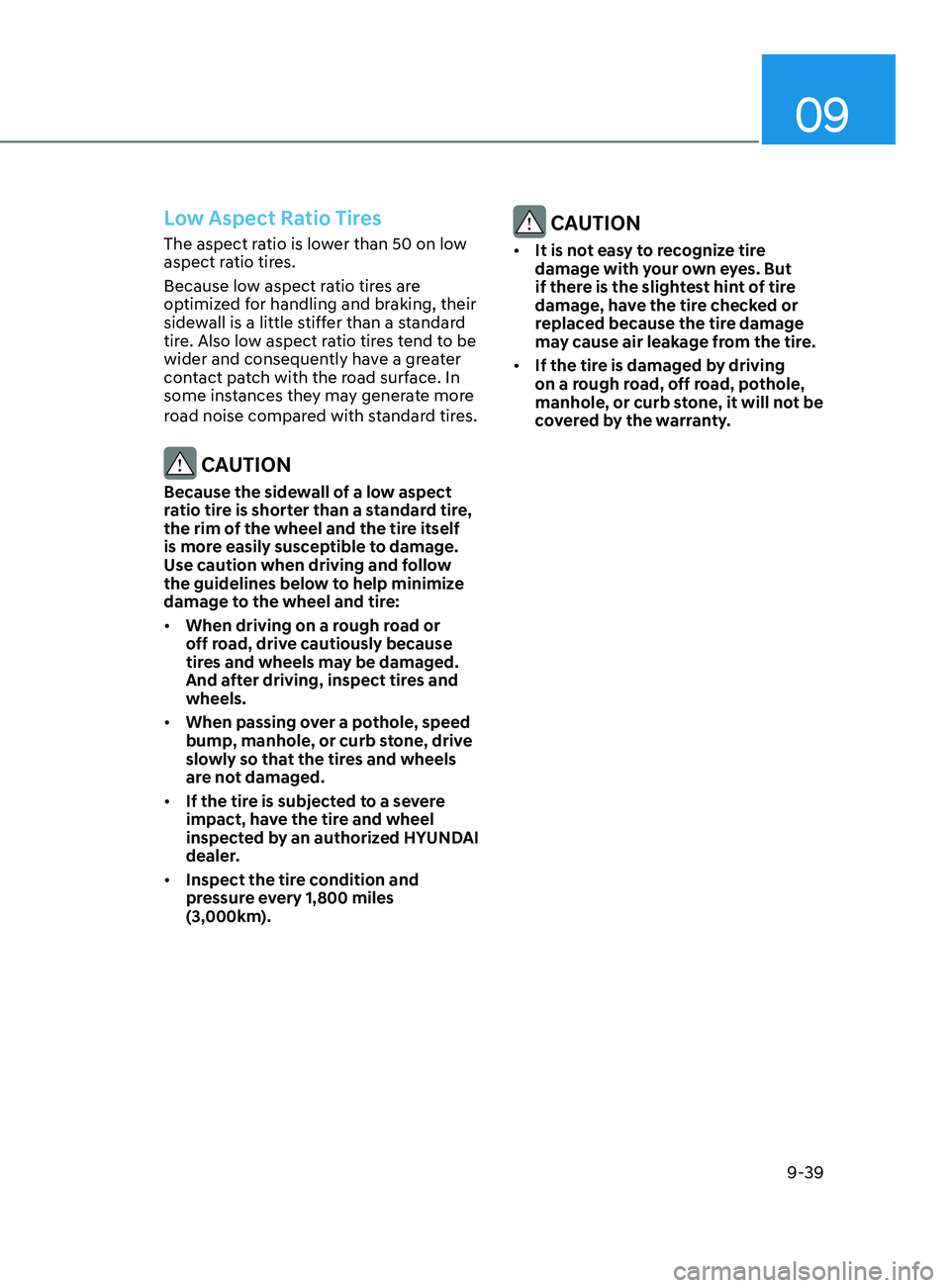
Low Aspect Ratio Tires
The aspect ratio is lower than 50 on low
aspect ratio tires.
Because low aspect ratio tires are
optimized for handling and braking, their
sidewall is a little stiffer than a standard
tire. Also low aspect ratio tires tend to be
wider and consequently have a greater
contact patch with the road surface. In
some instances they may generate more
road noise compared with standard tires.
CAUTION
Because the sidewall of a low aspect
ratio tire is shorter than a standard tire,
the rim of the wheel and the tire itself
is more easily susceptible to damage.
Use caution when driving and follow
the guidelines below to help minimize
damage to the wheel and tire:
• When driving on a rough road or
off road, drive cautiously because
tires and wheels may be damaged.
And after driving, inspect tires and
wheels.
• When passing over a pothole, speed
bump, manhole, or curb stone, drive
slowly so that the tires and wheels
are not damaged.
• If the tire is subjected to a severe
impact, have the tire and wheel
inspected by an authorized HYUNDAI
dealer.
• Inspect the tire condition and
pressure every 1,800 miles
(3,000km).
Page 526 of 570
Maintenance9-40
■ Cartridge type
■ Blade type
■ Multi fuse Normal
Blown
Normal Blown
Normal Blown
OTM078035
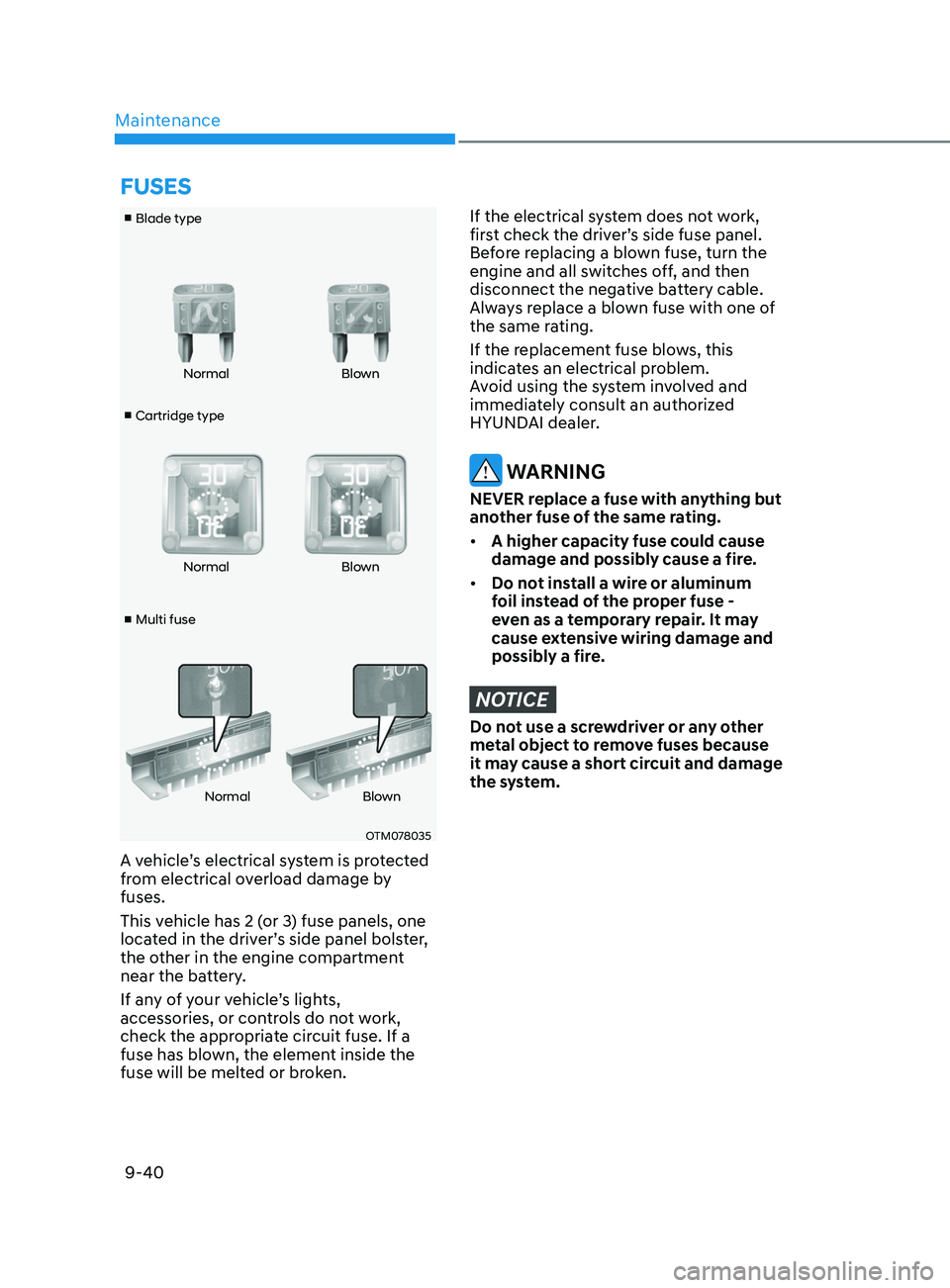
A vehicle’s electrical system is protected
from electrical overload damage by
fuses.
This vehicle has 2 (or 3) fuse panels, one
located in the driver’s side panel bolster,
the other in the engine compartment
near the battery.
If any of your vehicle’s lights,
accessories, or controls do not work,
check the appropriate circuit fuse. If a
fuse has blown, the element inside the
fuse will be melted or broken.
If the electrical system does not work,
first check the driver’s side fuse panel.
Before replacing a blown fuse, turn the
engine and all switches off, and then
disconnect the negative battery cable.
Always replace a blown fuse with one of
the same rating.
If the replacement fuse blows, this
indicates an electrical problem.
Avoid using the system involved and
immediately consult an authorized
HYUNDAI dealer.
WARNING
NEVER replace a fuse with anything but
another fuse of the same rating.
• A higher capacity fuse could cause
damage and possibly cause a fire.
• Do not install a wire or aluminum
foil instead of the proper fuse -
even as a temporary repair. It may
cause extensive wiring damage and
possibly a fire.
NOTICE
Do not use a screwdriver or any other
metal object to remove fuses because
it may cause a short circuit and damage
the system.
fuSES
Page 527 of 570
09
9-41
Instrument Panel Fuse
Replacement
OCN7080017
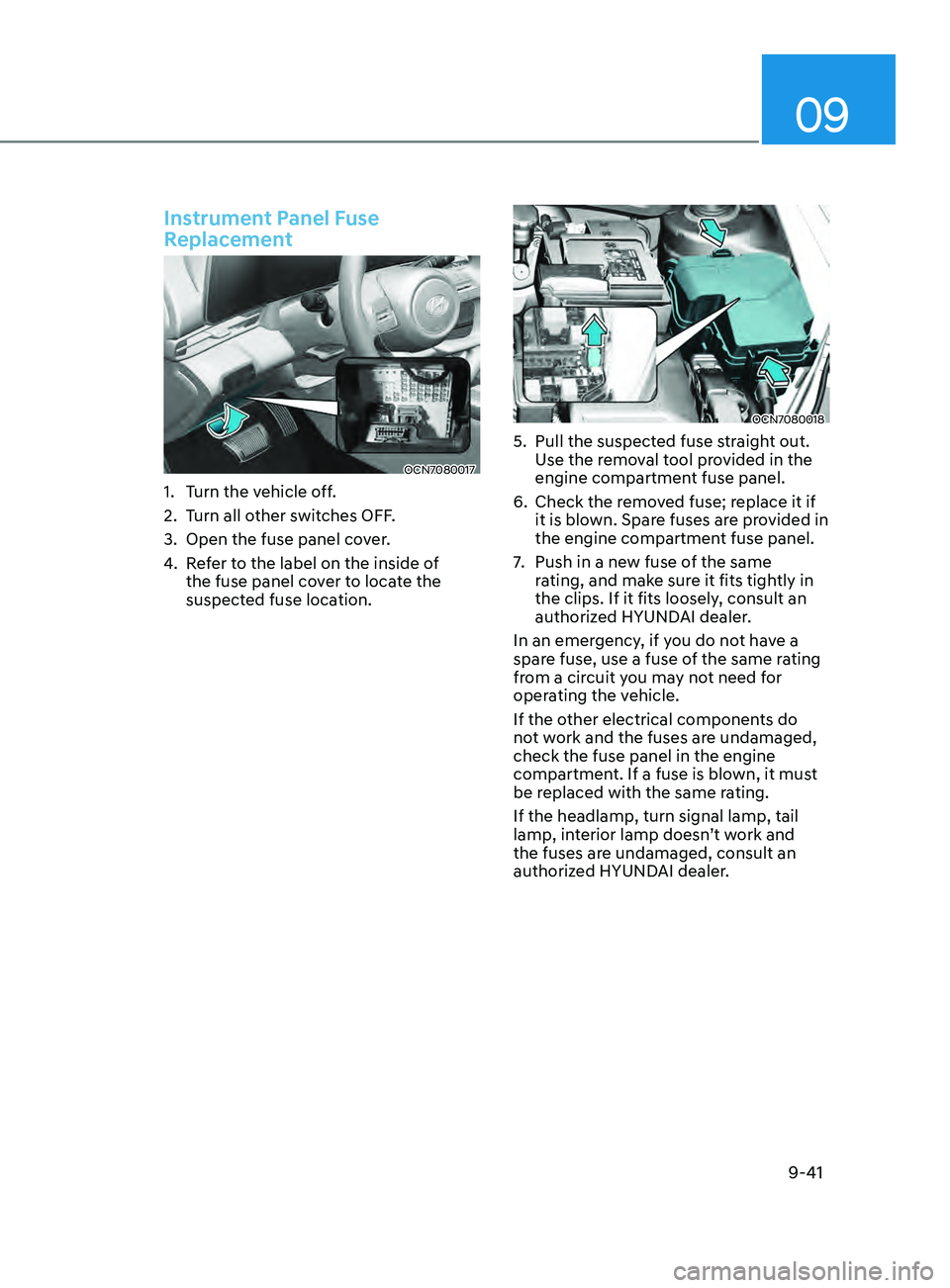
1. Turn the vehicle off.
2.
Turn all o
ther switches OFF.
3.
Open the fuse panel cov
er.
4.
Re
fer to the label on the inside of
the fuse panel cover to locate the
suspected fuse location.
OCN7080018
5. Pull the suspected fuse s traight out.
Use the removal tool provided in the
engine compartment fuse panel.
6.
Check the remo
ved fuse; replace it if
it is blown. Spare fuses are provided in
the engine compartment fuse panel.
7.
Push in a new fuse o
f the same
rating, and make sure it fits tightly in
the clips. If it fits loosely, consult an
authorized HYUNDAI dealer.
In an emergency, if you do not have a
spare fuse, use a fuse of the same rating
from a circuit you may not need for
operating the vehicle.
If the other electrical components do
not work and the fuses are undamaged,
check the fuse panel in the engine
compartment. If a fuse is blown, it must
be replaced with the same rating.
If the headlamp, turn signal lamp, tail
lamp, interior lamp doesn’t work and
the fuses are undamaged, consult an
authorized HYUNDAI dealer.
Page 528 of 570
Maintenance
9-42
Engine Compartment Panel Fuse
Replacement
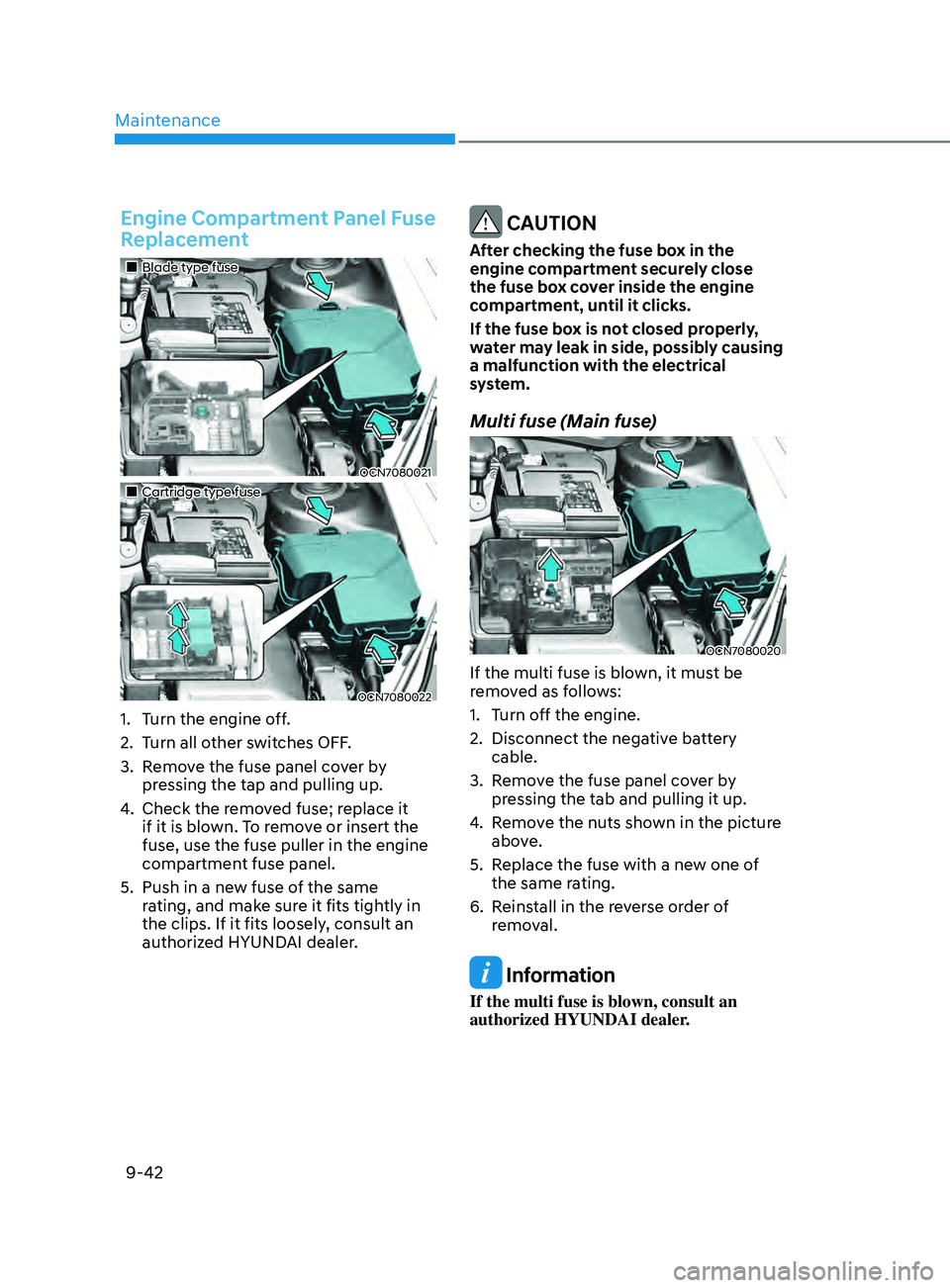
„„Blade type fuse
OCN7080021
„„Cartridge type fuse
OCN7080022
1. Turn the engine off.
2.
Turn all o
ther switches OFF.
3.
Remo
ve the fuse panel cover by
pressing the tap and pulling up.
4.
Check the remo
ved fuse; replace it
if it is blown. To remove or insert the
fuse, use the fuse puller in the engine
compartment fuse panel.
5.
Push in a new fuse o
f the same
rating, and make sure it fits tightly in
the clips. If it fits loosely, consult an
authorized HYUNDAI dealer.
CAUTION
After checking the fuse box in the
engine compartment securely close
the fuse box cover inside the engine
compartment, until it clicks.
If the fuse box is not closed properly,
water may leak in side, possibly causing
a malfunction with the electrical
system.
Multi fuse (Main fuse)
OCN7080020
If the multi fuse is blown, it must be
removed as follows:
1.
Turn o
ff the engine.
2.
Disconnect the negativ
e battery
cable.
3.
Remo
ve the fuse panel cover by
pressing the tab and pulling it up.
4.
Remo
ve the nuts shown in the picture
above.
5.
Replace the fuse with a ne
w one of
the same rating.
6.
Reins
tall in the reverse order of
removal.
Information
If the multi fuse is blown, consult an
authorized HYUNDAI dealer.
Page 536 of 570
Maintenance
9-50
Consult an authorized HYUNDAI dealer
to replace most vehicle light bulbs. It is
difficult to replace vehicle light bulbs
because other parts of the vehicle must
be removed before you can get to the
bulb. This is especially true for removing
the headlamp assembly to get to the
bulb(s).
Removing/installing the headlamp
assembly can result in damage to the
vehicle.
Information
The headlamp and tail lamp lenses could
appear frosty if the vehicle is washed after
driving or the vehicle is driven at night in
wet weather. This condition is caused by
temperature difference between the lamp
inside and outside and does not indicate
a problem with your vehicle. When
moisture condenses in the lamp, it will be
removed after driving with the headlamp
on. The removable level may differ
depending on lamp size, lamp position
and environmental condition. However, if
moisture is not removed, have the vehicle
inspected by an authorized HYUNDAI
dealer.
WARNING
• Prior to replacing a lamp, depress
the foot brake, move the shift button
into P (Park) apply the parking brake,
place the ignition switch to the
LOCK/OFF position, and take the key
with you when leaving the vehicle
to avoid sudden movement of the
vehicle and to prevent possible
electric shock.
• Be aware the bulbs may be hot and
may burn your fingers.
• When the bulb is disconnected or the
lamp connector is removed while the
lamp is operating normally, the fuse
box electronics may recognize the
lamp as a malfunction. Therefore, a
fault record for the lamp may remain
in the Diagnostic Trouble Code (DTC)
recorded in the fuse box.
NOTICE
Be sure to replace the burned-out bulb
with one of the same wattage rating.
Otherwise, it may cause damage to the
fuse or electrical wiring system.
Information
The headlamp aiming should be adjusted
after an accident or after the headlamp
assembly is reinstalled at an authorized
HYUNDAI dealer.
light BulBS
Page 537 of 570
09
9-51
Headlamp, Parking Lamp,
Daytime Running Light, Turn
Signal Lamp and Side Marker
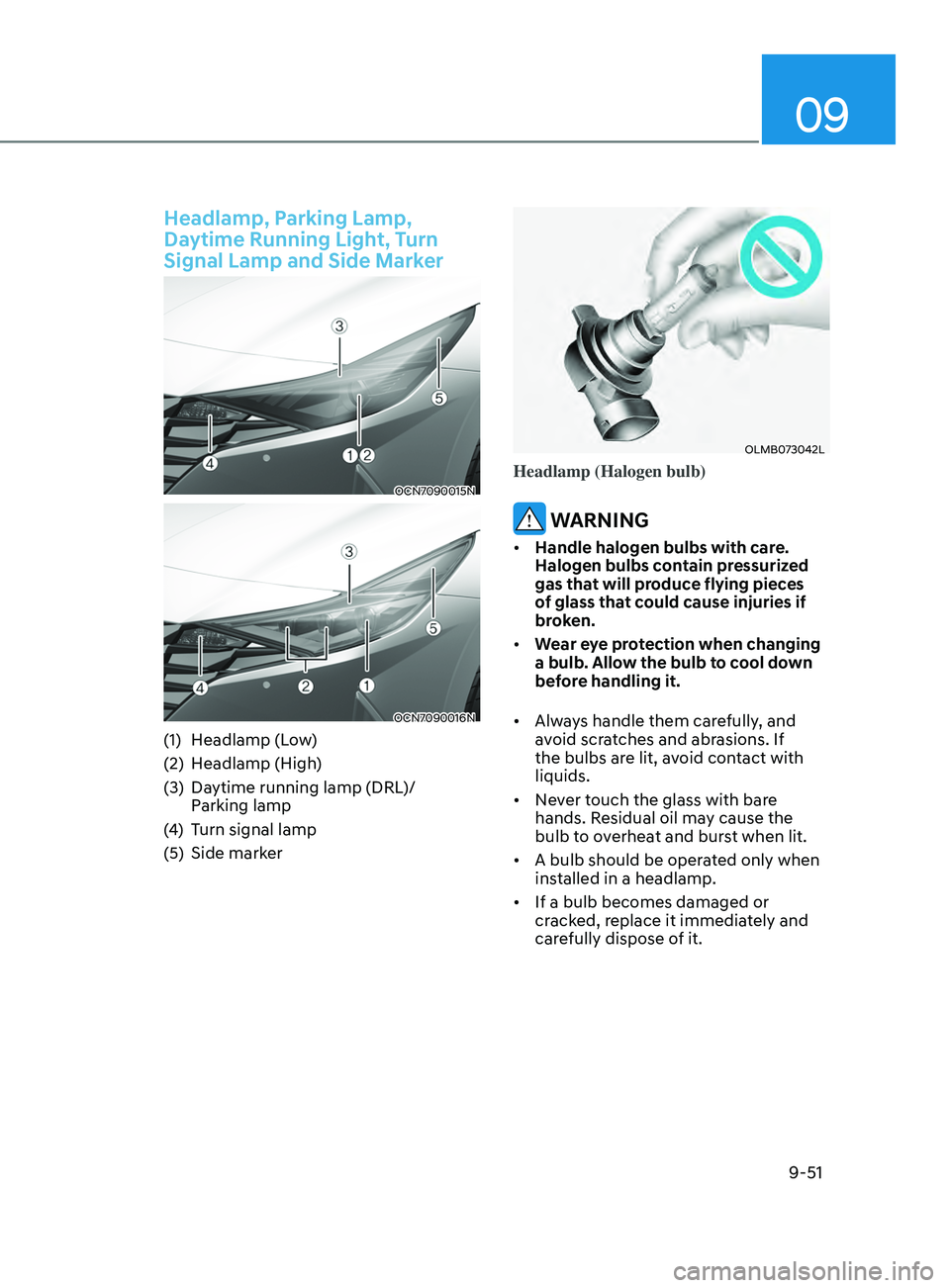
OCN7090015N
OCN7090016N
(1) Headlamp (Low)
(2)
Headlamp (High
)
(3)
Daytime running lamp (DRL
)/
Parking lamp
(4)
Turn signal lamp
(5)
Side marker
OLMB073042L
Headlamp (Halogen bulb)
WARNING
• Handle halogen bulbs with care.
Halogen bulbs contain pressurized
gas that will produce flying pieces
of glass that could cause injuries if
broken.
• Wear eye protection when changing
a bulb. Allow the bulb to cool down
before handling it.
• Always handle them carefully, and
avoid scratches and abrasions. If
the bulbs are lit, avoid contact with
liquids.
• Never touch the glass with bare
hands. Residual oil may cause the
bulb to overheat and burst when lit.
• A bulb should be operated only when
installed in a headlamp.
• If a bulb becomes damaged or
cracked, replace it immediately and
carefully dispose of it.
Page 538 of 570
Maintenance
9-52
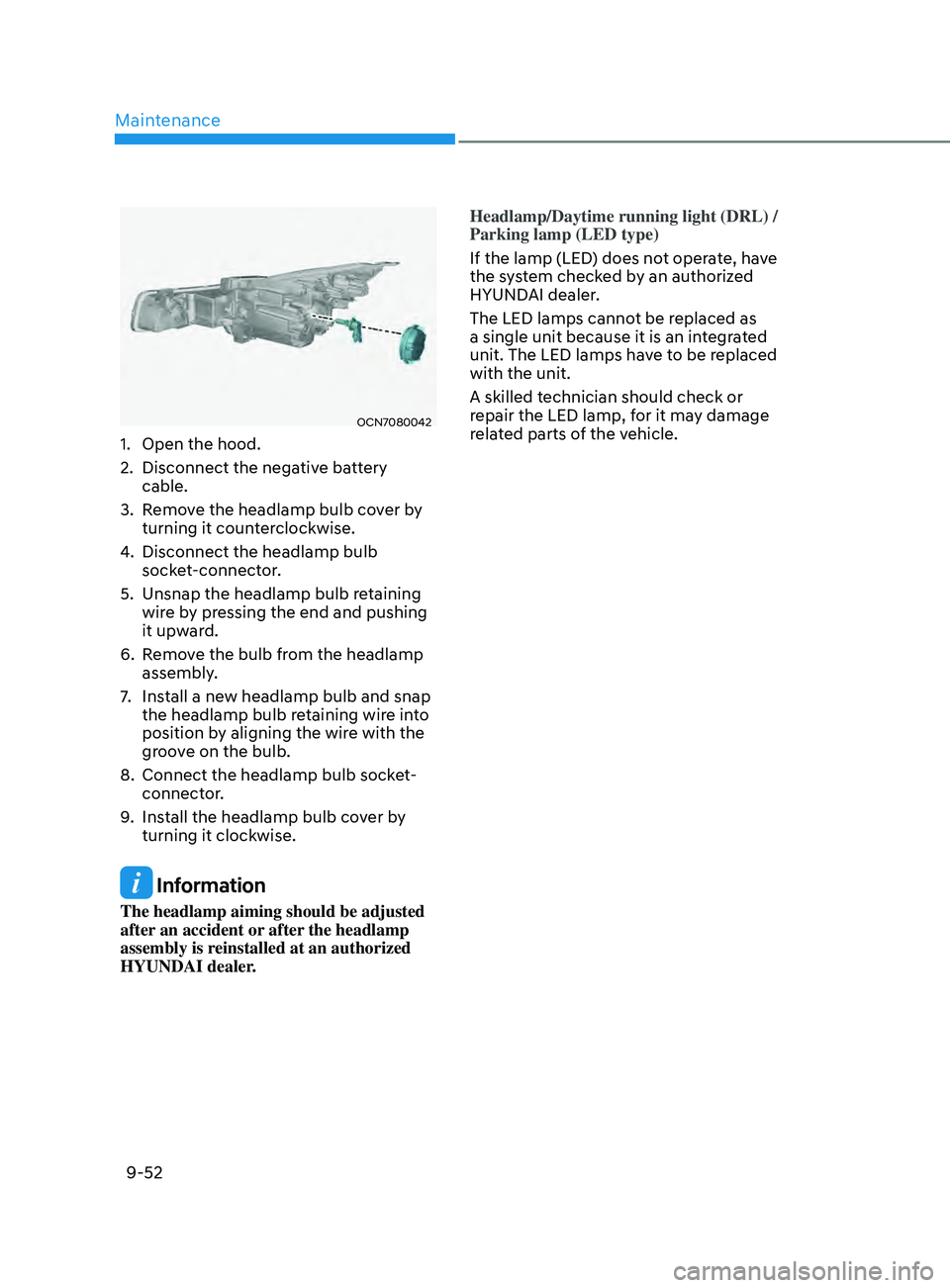
OCN7080042
1. Open the hood.
2.
Disconnect the negativ
e battery
cable.
3.
Remo
ve the headlamp bulb cover by
turning it counterclockwise.
4.
Disconnect the headlamp bulb
socke
t-connector.
5.
Unsnap the headlamp bulb re
taining
wire by pressing the end and pushing
it upward.
6.
Remo
ve the bulb from the headlamp
assembly.
7.
Install a ne
w headlamp bulb and snap
the headlamp bulb retaining wire into
position by aligning the wire with the
groove on the bulb.
8.
Connect the headlamp bulb socke
t-
connector.
9.
Install the headlamp bulb co
ver by
turning it clockwise.
Information
The headlamp aiming should be adjusted
after an accident or after the headlamp
assembly is reinstalled at an authorized
HYUNDAI dealer. Headlamp/Daytime running light (DRL) /
Parking lamp (LED type)
If the lamp (LED) does not operate, have
the system checked by an authorized
HYUNDAI dealer.
The LED lamps cannot be replaced as
a single unit because it is an integrated
unit. The LED lamps have to be replaced
with the unit.
A skilled technician should check or
repair the LED lamp, for it may damage
related parts of the vehicle.
Page 540 of 570
Maintenance
9-54
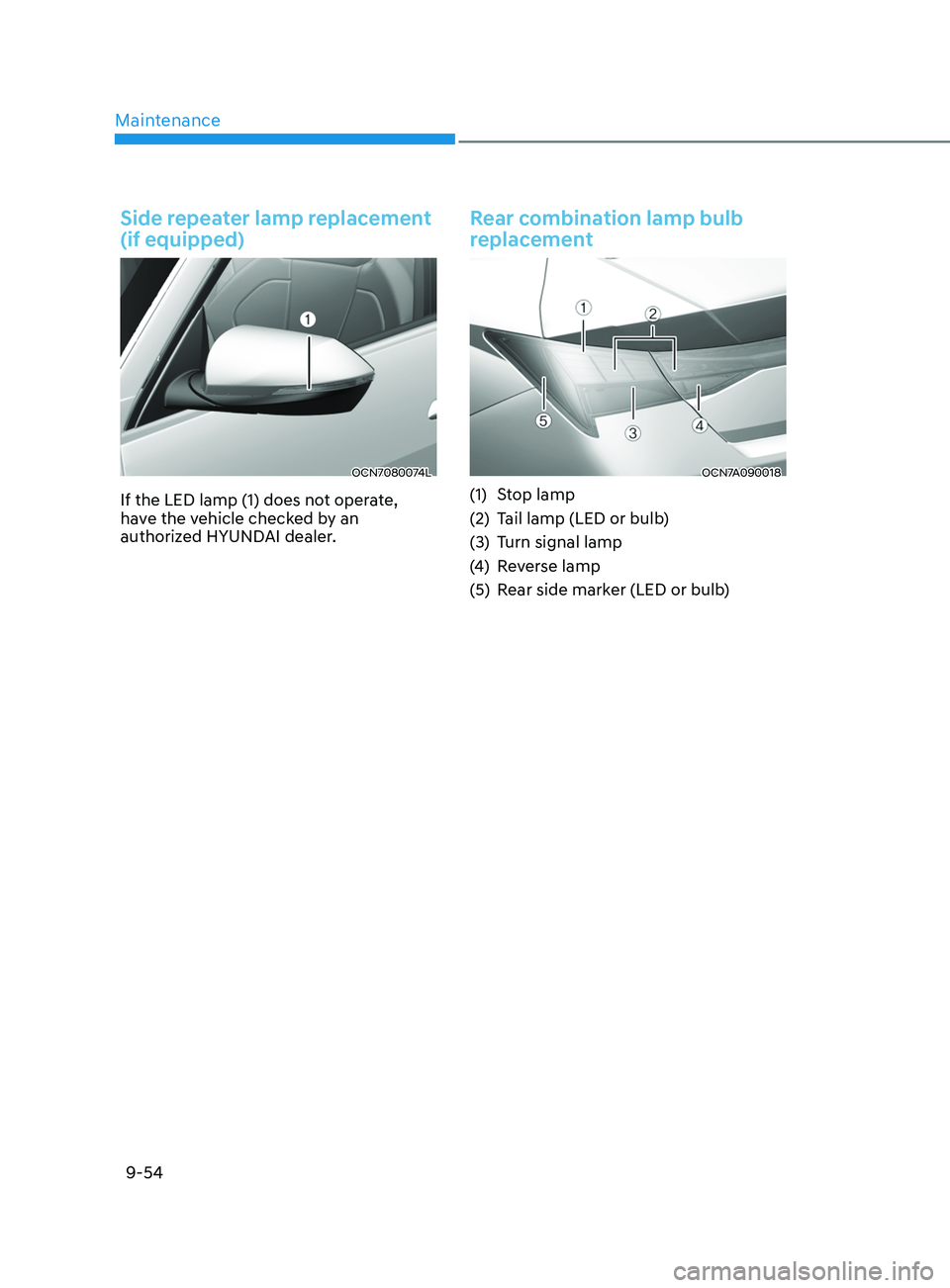
Side repeater lamp replacement
(if equipped)
OCN7080074L
If the LED lamp (1) does not operate,
have the vehicle checked by an
authorized HYUNDAI dealer.
Rear combination lamp bulb
replacement
OCN7A090018
(1) Stop lamp
(2)
Tail lamp (LED or bulb
)
(3)
Turn signal lamp
(4
)
Re
verse lamp
(5)
Rear side mark
er (LED or bulb)