brakes HYUNDAI ELANTRA 2022 Owner's Guide
[x] Cancel search | Manufacturer: HYUNDAI, Model Year: 2022, Model line: ELANTRA, Model: HYUNDAI ELANTRA 2022Pages: 584, PDF Size: 14.08 MB
Page 504 of 584
09
9-7
Follow Normal Maintenance Schedule if the vehicle is usually operated where none of
the following conditions apply. If any of the following conditions apply, you must follow
the Maintenance Under Severe Usage Conditions.
• Repeated short distance driving.
• Driving in dusty conditions or sandy areas.
• Extensive use of brakes.
• Driving in areas where salt or other corrosive materials are used.
• Driving on rough or muddy roads.
• Driving in mountainous areas.
• Extended periods of idling or low speed operation.
• Driving for a prolonged period in cold temperatures and/or extremely humid
climates.
• More than 50% driving in heavy city traffic during hot weather above 90°F (32°C).
• Engine oil usage which is not recommended (mineral type, lower grade spec, etc.)
For additional information or assistance see your authorized HYUNDAI dealer.
NOTICE
After 10 years or 100,000 miles, we recommend to use severe maintenance
schedule.
SCHEDULED MAINTENANCE SERVICES
CN7 HMA 9.indd 9-72020-12-03 9:42:18
Page 506 of 584
09
9-9
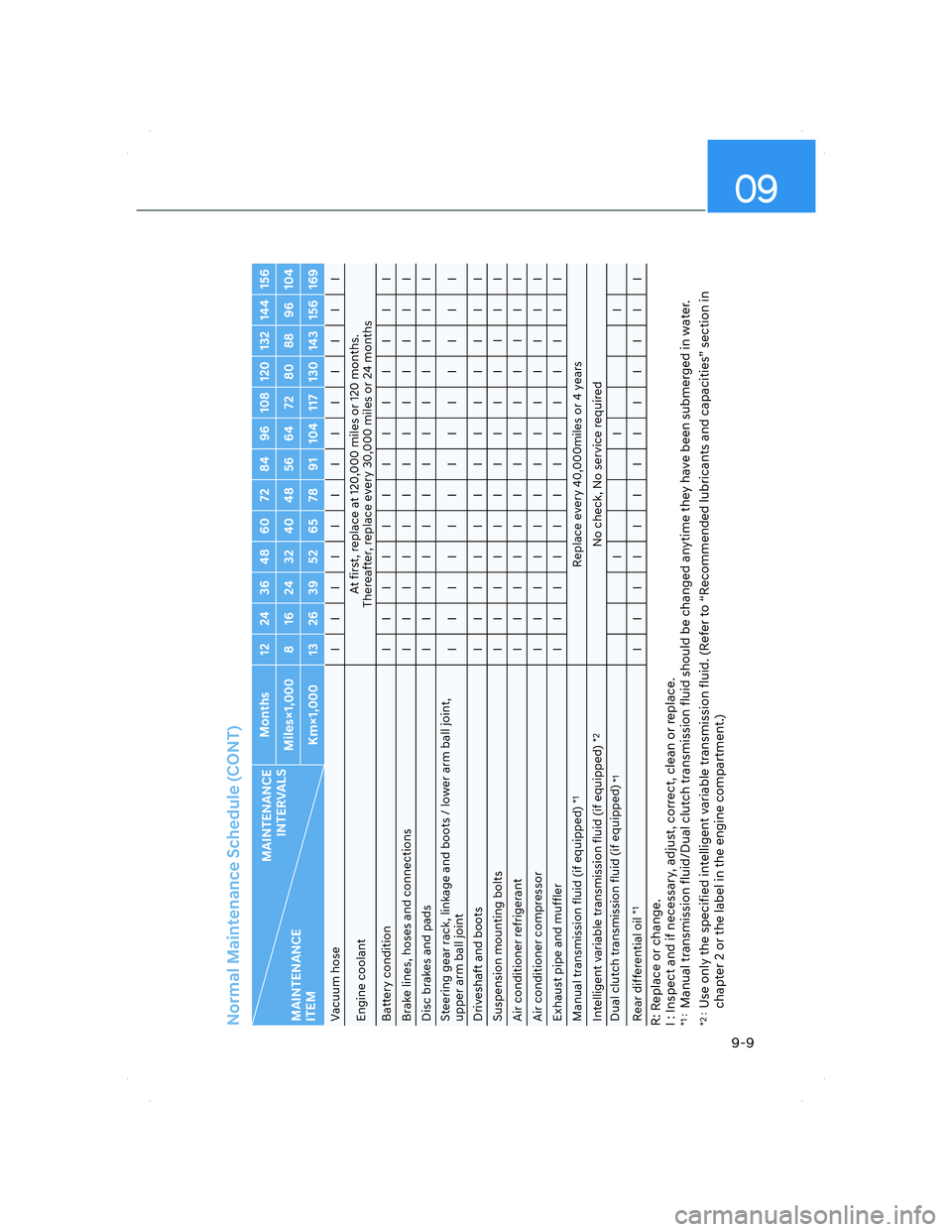
Normal Maintenance Schedule (CONT)
MAINTENANCE
INTERVALS
MAINTENANCE
ITEMMonths 12 24 36 48 60 72 84 96 108 120 132 144 156
Miles×1,000 8 16 24 32 40 48 56 64 72 80 88 96 104
Km×1,000 13 26 39 52 65 78 91 104 117 130 143 156 169
Vacuum hose I I I I I I I I I I I I I
Engine coolantAt first, replace at 120,000 miles or 120 months.
Thereafter, replace every 30,000 miles or 24 months
Battery condition I I I I I I I I I I I I I
Brake lines, hoses and connections I I I I I I I I I I I I I
Disc brakes and pads I I I I I I I I I I I I I
Steering gear rack, linkage and boots / lower arm ball joint,
upper arm ball jointIIIIIIIIIIIII
Driveshaft and boots I I I I I I I I I I I I I
Suspension mounting bolts I I I I I I I I I I I I I
Air conditioner refrigerant I I I I I I I I I I I I I
Air conditioner compressor I I I I I I I I I I I I I
Exhaust pipe and muffler I I I I I I I I I I I I I
Manual transmission fluid (if equipped)
*1
Replace every 40,000miles or 4 years
Intelligent variable transmission fluid (if equipped)
*2
No check, No service required
Dual clutch transmission fluid (if equipped)
*1
III
Rear differential oil
*1
IIIIIIIIIIIII
R: Replace or change.
I : Inspect and if necessary, adjust, correct, clean or replace.*1 :
Manual transmission fluid/Dual clutch transmission fluid should be changed anytime they have been submerged in water.
*2 :
Use only the specified intelligent variable transmission fluid. (Refer to “Recommended lubricants and capacities” section in
chapter 2 or the label in the engine compartment.)
CN7 HMA 9.indd 9-92020-12-03 9:42:18
Page 508 of 584
09
9-11
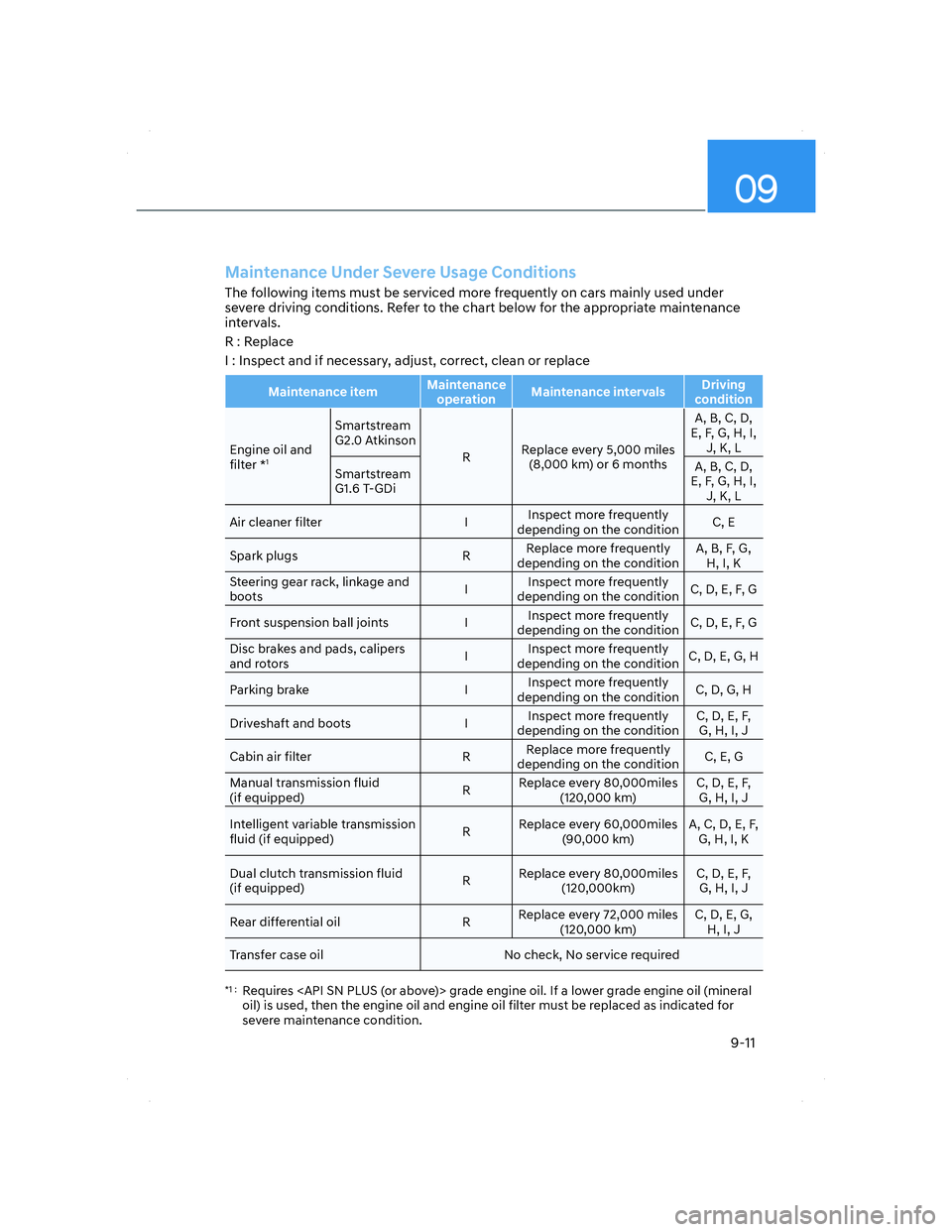
Maintenance Under Severe Usage Conditions
The following items must be serviced more frequently on cars mainly used under
severe driving conditions. Refer to the chart below for the appropriate maintenance
intervals.
R : Replace
I : Inspect and if necessary, adjust, correct, clean or replace
Maintenance itemMaintenance
operationMaintenance intervalsDriving
condition
Engine oil and
filter *1
Smartstream
G2.0 Atkinson
RReplace every 5,000 miles
(8,000 km) or 6 monthsA, B, C, D,
E, F, G, H, I,
J, K, L
Smartstream
G1.6 T-GDiA, B, C, D,
E, F, G, H, I,
J, K, L
Air cleaner filter IInspect more frequently
depending on the conditionC, E
Spark plugs RReplace more frequently
depending on the conditionA, B, F, G,
H, I, K
Steering gear rack, linkage and
bootsIInspect more frequently
depending on the conditionC, D, E, F, G
Front suspension ball joints IInspect more frequently
depending on the conditionC, D, E, F, G
Disc brakes and pads, calipers
and rotorsIInspect more frequently
depending on the conditionC, D, E, G, H
Parking brake IInspect more frequently
depending on the conditionC, D, G, H
Driveshaft and boots IInspect more frequently
depending on the conditionC, D, E, F,
G, H, I, J
Cabin air filter RReplace more frequently
depending on the conditionC, E, G
Manual transmission fluid
(if equipped)RReplace every 80,000miles
(120,000 km)C, D, E, F,
G, H, I, J
Intelligent variable transmission
fluid (if equipped)RReplace every 60,000miles
(90,000 km)A, C, D, E, F,
G, H, I, K
Dual clutch transmission fluid
(if equipped)RReplace every 80,000miles
(120,000km)C, D, E, F,
G, H, I, J
Rear differential oil RReplace every 72,000 miles
(120,000 km)C, D, E, G,
H, I, J
Transfer case oil No check, No service required
*1 : Requires
oil) is used, then the engine oil and engine oil filter must be replaced as indicated for
severe maintenance condition.
CN7 HMA 9.indd 9-112020-12-03 9:42:18
Page 560 of 584
09
9-63
WARNING
After washing the vehicle, test the
brakes while driving slowly to see
if they have been affected by water
before getting on the road. If braking
performance is impaired, dry the
brakes by applying them lightly while
maintaining a slow forward speed.
NOTICE
• Do not use strong soap, chemical
detergents or hot water, and do not
wash the vehicle in direct sunlight
or when the body of the vehicle is
warm.
• Be careful when washing the side
windows of your vehicle.
Especially, with high-pressure water,
water may leak through the windows
and wet the interior.
• To prevent damage to the plastic
parts, do not clean with chemical
solvents or strong detergents.ODN8A089039ODN8A089039
NOTICE
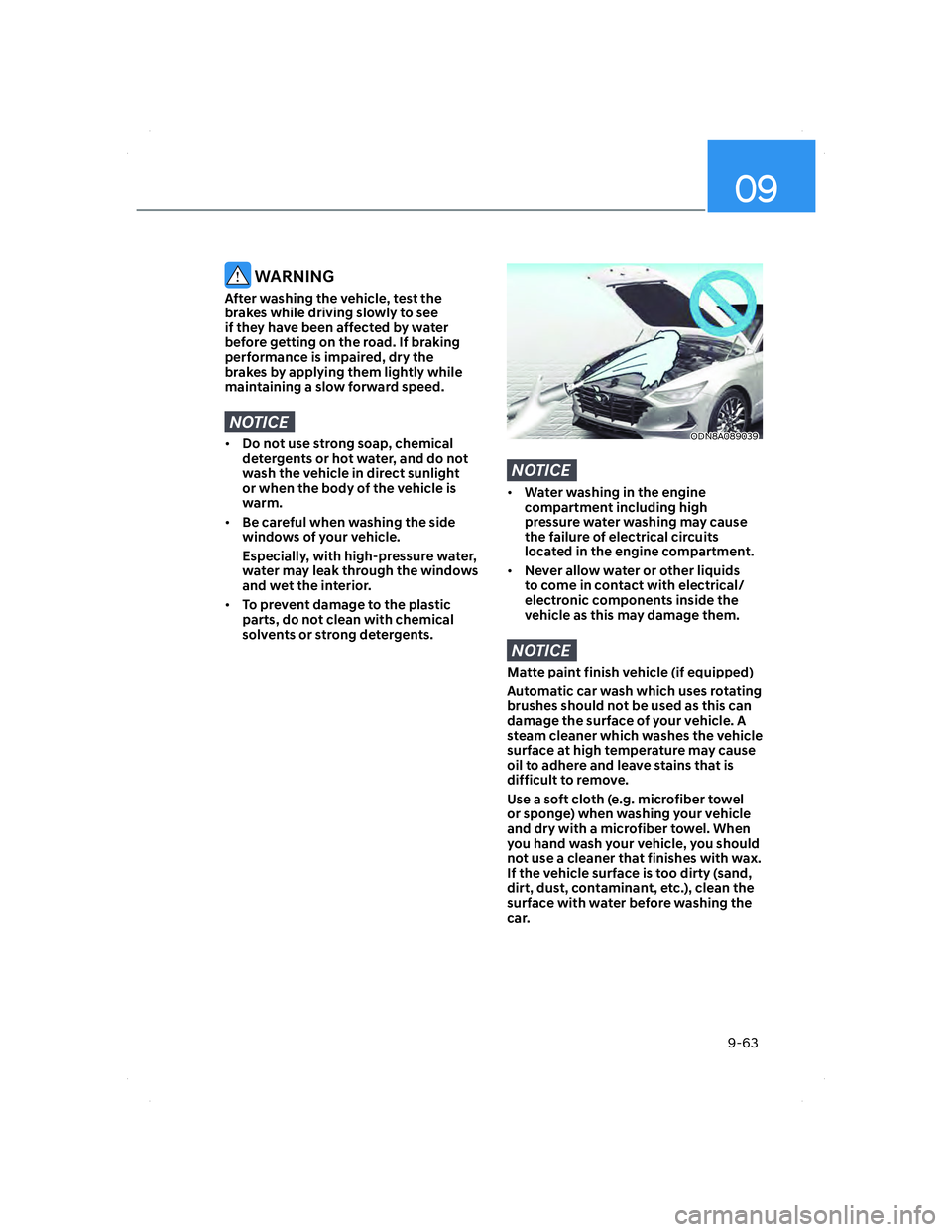
• Water washing in the engine
compartment including high
pressure water washing may cause
the failure of electrical circuits
located in the engine compartment.
• Never allow water or other liquids
to come in contact with electrical/
electronic components inside the
vehicle as this may damage them.
NOTICE
Matte paint finish vehicle (if equipped)
Automatic car wash which uses rotating
brushes should not be used as this can
damage the surface of your vehicle. A
steam cleaner which washes the vehicle
surface at high temperature may cause
oil to adhere and leave stains that is
difficult to remove.
Use a soft cloth (e.g. microfiber towel
or sponge) when washing your vehicle
and dry with a microfiber towel. When
you hand wash your vehicle, you should
not use a cleaner that finishes with wax.
If the vehicle surface is too dirty (sand,
dirt, dust, contaminant, etc.), clean the
surface with water before washing the
car.
CN7 HMA 9.indd 9-632020-12-03 9:42:37
Page 562 of 584
09
9-65
Underbody maintenance
Corrosive materials used for ice and
snow removal and dust control may
collect on the underbody. If these
materials are not removed, accelerated
rusting can occur on underbody parts
such as the fuel lines, frame, floor pan
and exhaust system, even though they
have been treated with rust protection.
Thoroughly flush the vehicle underbody
and wheel openings with lukewarm or
cold water once a month, after off-road
driving and at the end of each winter. Pay
special attention to these areas because
it is difficult to see all the mud and dirt.
It will do more harm than good to wet
down the road grime without removing
it. The lower edges of doors, rocker
panels, and frame members have drain
holes that should not be allowed to clog
with dirt; trapped water in these areas
can cause rusting.
WARNING
After washing the vehicle, test the
brakes while driving slowly to see if
they have been affected by water. If
braking performance is impaired, dry
the brakes by applying them lightly
while maintaining a slow forward
speed.
Aluminum wheel maintenance
The aluminum wheels are coated with a
clear protective finish.
NOTICE
• Do not use abrasive cleaner,
polishing compound, solvent, or wire
brushes on aluminum wheels.
• Clean the wheel when it has cooled.
• Use only a mild soap or neutral
detergent, and rinse thoroughly with
water. Also, clean the wheels after
driving on salted roads.
• Do not wash the wheels with high-
speed car wash brushes.
• Do not use any cleaners containing
acid or alkaline detergents.
CN7 HMA 9.indd 9-652020-12-03 9:42:38
Page 574 of 584
I
I-3
B
Battery ................................................................................................................. 9-27
Battery Capacity Label ..................................................................................... 9-28
Battery Recharging........................................................................................... 9-29
For Best Battery Service .................................................................................. 9-28
Reset Items ....................................................................................................... 9-29
Before Driving ....................................................................................................... 6-4
Before Entering the Vehicle ............................................................................... 6-4
Before Starting ................................................................................................... 6-4
Blind-Spot Collision Warning (BCW) ................................................................ 7-37
Function malfunction and limitations .............................................................. 7-42
Function operation............................................................................................ 7-40
Function settings .............................................................................................. 7-38
Blind-Spot Collision-Avoidance Assist (BCA) ................................................... 7-46
Function malfunction and limitations .............................................................. 7-55
Function operation............................................................................................ 7-50
Function settings .............................................................................................. 7-48
Brake System ....................................................................................................... 6-34
Auto Hold ......................................................................................................... 6-41
Disc Brakes Wear Indicator.............................................................................. 6-34
Electronic Parking Brake (EPB) ...................................................................... 6-37
Parking brake.................................................................................................... 6-35
Power Brakes.................................................................................................... 6-34
Brake/Clutch Fluid .............................................................................................. 9-20
Checking the Brake/Clutch Fluid Level ........................................................... 9-20
Bulb Wattage........................................................................................................ 2-10