fuel filter HYUNDAI ELANTRA 2022 Owners Manual
[x] Cancel search | Manufacturer: HYUNDAI, Model Year: 2022, Model line: ELANTRA, Model: HYUNDAI ELANTRA 2022Pages: 584, PDF Size: 14.08 MB
Page 27 of 584
Vehicle Information
2-14
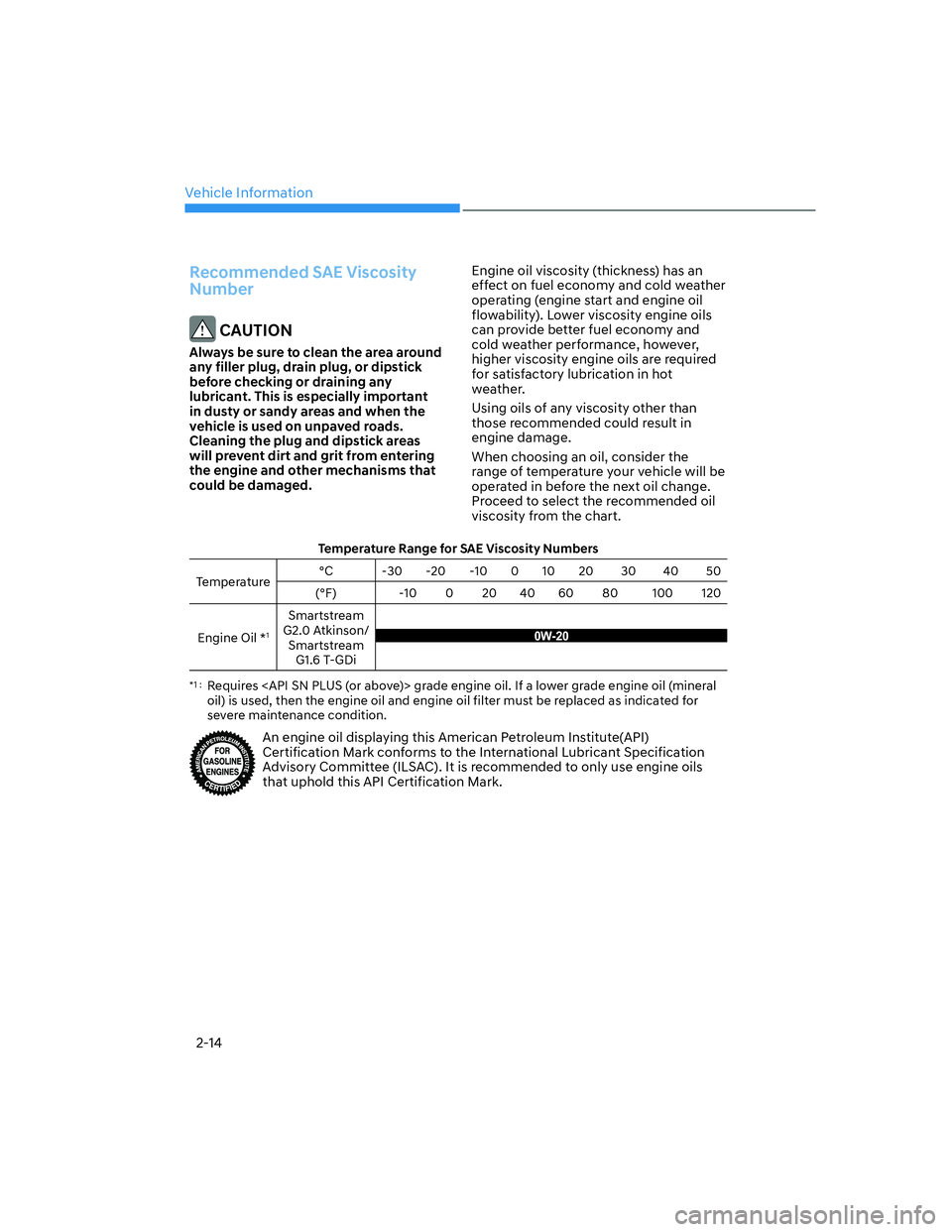
Recommended SAE Viscosity
Number
CAUTION
Always be sure to clean the area around
any filler plug, drain plug, or dipstick
before checking or draining any
lubricant. This is especially important
in dusty or sandy areas and when the
vehicle is used on unpaved roads.
Cleaning the plug and dipstick areas
will prevent dirt and grit from entering
the engine and other mechanisms that
could be damaged.Engine oil viscosity (thickness) has an
effect on fuel economy and cold weather
operating (engine start and engine oil
flowability). Lower viscosity engine oils
can provide better fuel economy and
cold weather performance, however,
higher viscosity engine oils are required
for satisfactory lubrication in hot
weather.
Using oils of any viscosity other than
those recommended could result in
engine damage.
When choosing an oil, consider the
range of temperature your vehicle will be
operated in before the next oil change.
Proceed to select the recommended oil
viscosity from the chart.
Temperature Range for SAE Viscosity Numbers
Temperature°C -30 -20 -10 0 10 20 30 40 50
(°F) -10 0 20 40 60 80 100 120
Engine Oil *
1
Smartstream
G2.0 Atkinson/
Smartstream
G1.6 T-GDi
0W-20
*1 : Requires
oil) is used, then the engine oil and engine oil filter must be replaced as indicated for
severe maintenance condition.
An engine oil displaying this American Petroleum Institute(API)
Certification Mark conforms to the International Lubricant Specification
Advisory Committee (ILSAC). It is recommended to only use engine oils
that uphold this API Certification Mark.
Page 505 of 584
Maintenance
9-8
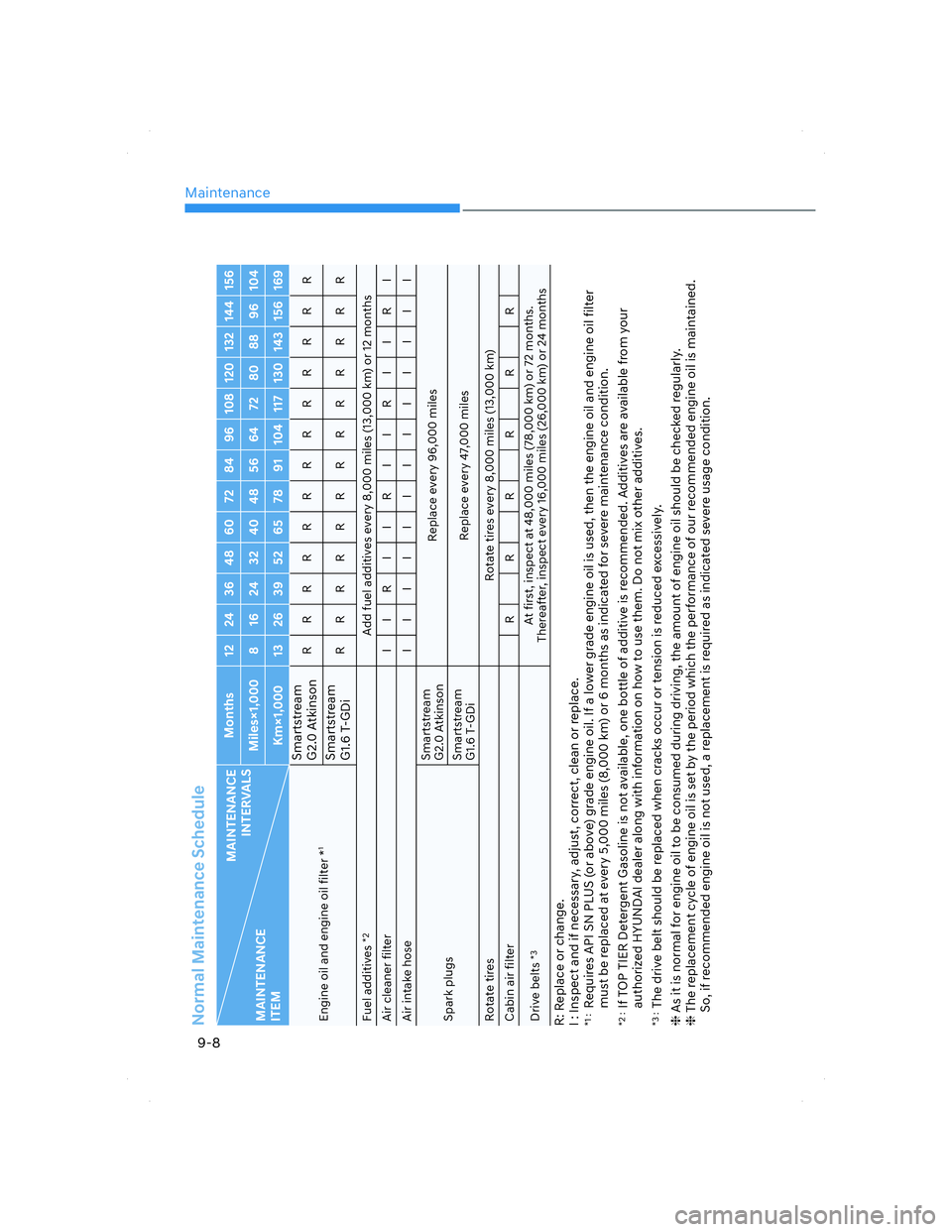
Normal Maintenance Schedule
MAINTENANCE
INTERVALS
MAINTENANCE
ITEMMonths 12 24 36 48 60 72 84 96 108 120 132 144 156
Miles×1,000 8 16 24 32 40 48 56 64 72 80 88 96 104
Km×1,000 13 26 39 52 65 78 91 104 117 130 143 156 169
Engine oil and engine oil filter *
1
Smartstream
G2.0 Atkinson
RRRRRRRRRRRRR
Smartstream
G1.6 T-GDi
RRRRRRRRRRRRR
Fuel additives
*2
Add fuel additives every 8,000 miles (13,000 km) or 12 months
Air cleaner filter I I R I I R I I R I I R I
Air intake hose I I I I I I I I I I I I I
Spark plugsSmartstream
G2.0 AtkinsonReplace every 96,000 miles
Smartstream
G1.6 T-GDiReplace every 47,000 miles
Rotate tires Rotate tires every 8,000 miles (13,000 km)
Cabin air filterRRRRRR
Drive belts
*3
At first, inspect at 48,000 miles (78,000 km) or 72 months.
Thereafter, inspect every 16,000 miles (26,000 km) or 24 months
R: Replace or change.
I : Inspect and if necessary, adjust, correct, clean or replace.*1 :
Requires API SN PLUS (or above) grade engine oil. If a lower grade engine oil is used, then the engine oil and engine oil filter
must be replaced at every 5,000 miles (8,000 km) or 6 months as indicated for severe maintenance condition.
*2 :
If TOP TIER Detergent Gasoline is not available, one bottle of additive is recommended. Additives are available from your
authorized HYUNDAI dealer along with information on how to use them. Do not mix other additives.
*3 :
The drive belt should be replaced when cracks occur or tension is reduced excessively.
❈ As it is normal for engine oil to be consumed during driving, the amount of engine oil should be checked regularly.
❈ The replacement cycle of engine oil is set by the period which the performance of our recommended engine oil is maintained.
So, if recommended engine oil is not used, a replacement is required as indicated severe usage condition.
CN7 HMA 9.indd 9-82020-12-03 9:42:18
Page 507 of 584
Maintenance
9-10
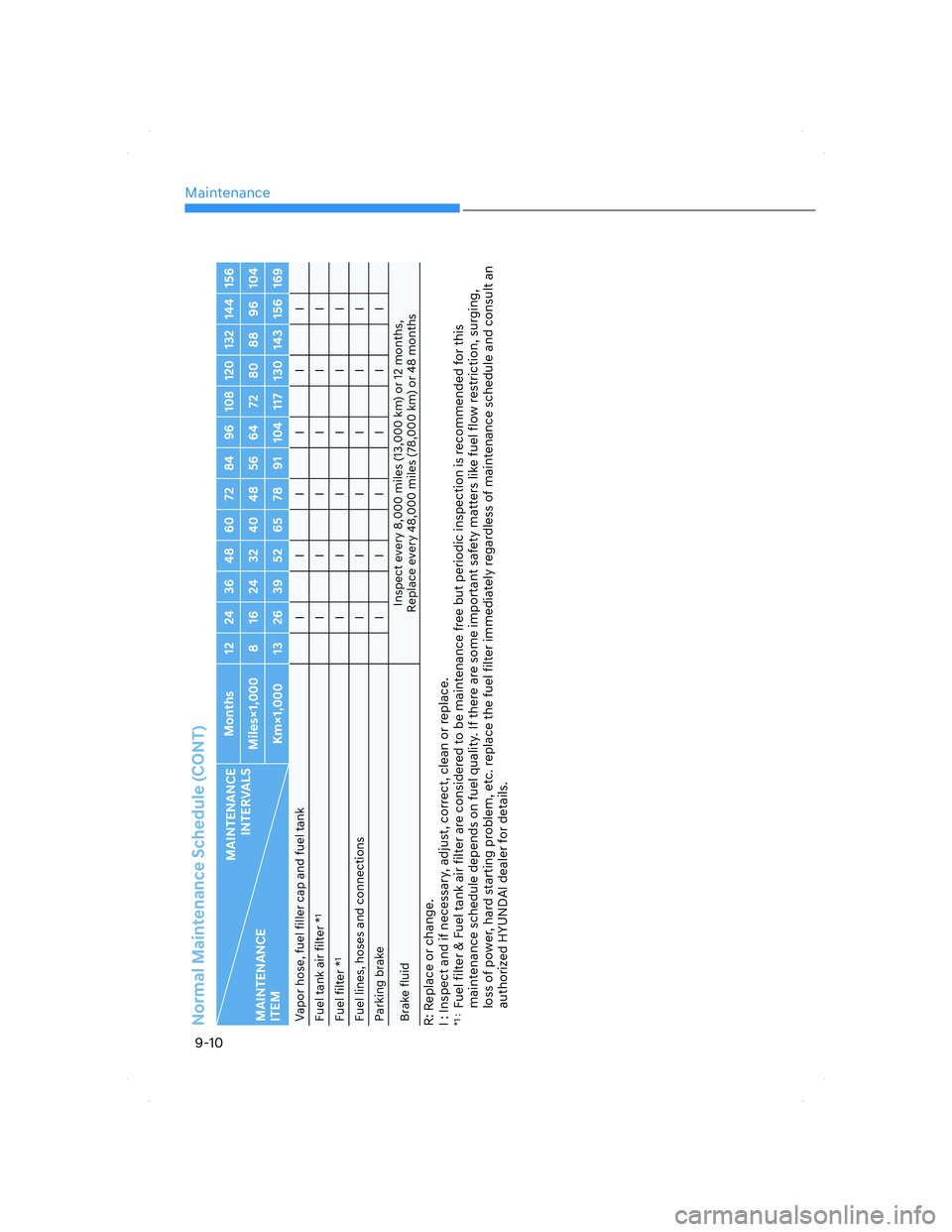
Normal Maintenance Schedule (CONT)
MAINTENANCE
INTERVALS
MAINTENANCE
ITEMMonths 12 24 36 48 60 72 84 96 108 120 132 144 156
Miles×1,000 8 16 24 32 40 48 56 64 72 80 88 96 104
Km×1,000 13 26 39 52 65 78 91 104 117 130 143 156 169
Vapor hose, fuel filler cap and fuel tankIIIIII
Fuel tank air filter *
1
IIIIII
Fuel filter *
1
IIIIII
Fuel lines, hoses and connectionsIIIIII
Parking brakeIIIIII
Brake fluidInspect every 8,000 miles (13,000 km) or 12 months,
Replace every 48,000 miles (78,000 km) or 48 months
R: Replace or change.
I : Inspect and if necessary, adjust, correct, clean or replace.*1 :
Fuel filter & Fuel tank air filter are considered to be maintenance free but periodic inspection is recommended for this
maintenance schedule depends on fuel quality. If there are some important safety matters like fuel flow restriction, surging,
loss of power, hard starting problem, etc. replace the fuel filter immediately regardless of maintenance schedule and consult an
authorized HYUNDAI dealer for details.
CN7 HMA 9.indd 9-102020-12-03 9:42:18
Page 510 of 584
09
9-13
Engine Oil and Filter
The engine oil and filter should be
changed at the intervals specified in the
maintenance schedule. If the vehicle
is being driven in severe conditions,
more frequent oil and filter changes are
required.
Drive Belts
Inspect all drive belts for evidence
of cuts, cracks, excessive wear or oil
saturation and replace if necessary. Drive
belts should be checked periodically
for proper tension and adjusted as
necessary.
Fuel Filter
A clogged-up fuel filter may limit the
vehicle driving speed, damage the
emission system, and cause the hard
starting. When a considerable amount
of foreign substances are accumulated
in the fuel tank, the fuel filter should be
replaced.
Upon installing a new fuel filter, operate
the engine for several minutes, and
check the connections for any leakages.
Fuel filters should be installed by an
authorized HYUNDAI dealer.
Fuel Lines, Fuel Hoses and
Connections
Check the fuel lines, fuel hoses and
connections for leakage and damage.
Have an authorized HYUNDAI dealer
replace any damaged or leaking parts
immediately.
Vapor Hose and Fuel Filler Cap
The vapor hose and fuel filler cap should
be inspected at those intervals specified
in the maintenance schedule. Make sure
a new vapor hose or fuel filler cap is
correctly replaced.
Air Cleaner Filter
A genuine HYUNDAI air cleaner filter
is recommended when the filter is
replaced.
Spark Plugs
Make sure to install new spark plugs of
the correct heat range.
Cooling System
Check cooling system components, such
as radiator, coolant reservoir, hoses and
connections for leakage and damage.
Replace any damaged parts.
EXPLANATION OF SCHEDULED MAINTENANCE ITEMS
CN7 HMA 9.indd 9-132020-12-03 9:42:18
Page 568 of 584
09
9-71
The emission control system of your
vehicle is covered by a written limited
warranty. Please see the warranty
information contained in the Owner’s
Handbook & Warranty Information
booklet in your vehicle.
Your vehicle is equipped with an
emission control system to meet all
applicable emission regulations. There
are three emission control systems, as
follows.
(1) Crankcase emission control system
(2) Evaporative emission control system
(3) Exhaust emission control system
In order to ensure the proper function
of the emission control systems, it
is recommended that you have your
vehicle inspected and maintained
by an authorized HYUNDAI dealer in
accordance with the maintenance
schedule in this manual.
NOTICE
For the Inspection and Maintenance
Test (with Electronic Stability Control
(ESC) system)
• To prevent the vehicle from misfiring
during dynamometer testing, turn
the Electronic Stability Control
(ESC) system off by pressing the ESC
switch (ESC OFF light illuminated).
• After dynamometer testing is
completed, turn the ESC system back
on by pressing the ESC switch again.
1. Crankcase Emission Control
System
The positive crankcase ventilation system
is employed to prevent air pollution
caused by blow-by gases being emitted
from the crankcase. This system supplies
fresh filtered air to the crankcase through
the air intake hose. Inside the crankcase,
the fresh air mixes with blow-by gases,
which then pass through the PCV valve
into the induction system.
2. Evaporative Emission Control
System Including Onboard
Refueling Vapor Recovery
(ORVR)
The Evaporative Emission Control System
is designed to prevent fuel vapors from
escaping into the atmosphere. The
ORVR system is designed to allow the
vapors from the fuel tank to be loaded
into a canister while refueling at the gas
station, preventing the escape of fuel
vapors into the atmosphere.
Canister
Fuel vapors generated inside the fuel
tank are absorbed and stored in the
onboard canister. When the engine is
running, the fuel vapors absorbed in the
canister are drawn into the surge tank
through the purge control solenoid valve.
Purge Control Solenoid Valve (PCSV)
The purge control solenoid valve
is controlled by the Engine Control
Module (ECM); when the engine coolant
temperature is low during idling, the
PCSV closes so that evaporated fuel
is not taken into the engine. After the
engine warms-up during ordinary
driving, the PCSV opens to introduce
evaporated fuel to the engine.
EMISSION CONTROL SYSTEM
CN7 HMA 9.indd 9-712020-12-03 9:42:38
Page 576 of 584
I
I-5
E
Emission Control System .................................................................................... 9-71
Engine Compartment ..................................................................................... 2-8/ 9-3
Engine Coolant .................................................................................................... 9-17
Changing Engine Coolant ................................................................................ 9-19
Checking the Engine Coolant Level................................................................. 9-17
Engine Number .................................................................................................... 2-16
Engine Oil ............................................................................................................ 9-15
Checking the Engine Oil and Filter .................................................................. 9-16
Checking the Engine Oil Level ........................................................................ 9-15
Engine specification............................................................................................... 2-9
Explanation of Scheduled Maintenance Items .................................................... 9-13
Dual clutch transmission fluid ......................................................................... 9-14
Exterior Lights ..................................................................................................... 5-68
Battery saver function ...................................................................................... 5-71
Headlamp delay function ................................................................................. 5-71
High beam operation ........................................................................................ 5-69
Lighting control ................................................................................................ 5-68
Turn signals and lane change signals ............................................................... 5-70
Exterior Overview ................................................................................................. 2-2
F
Forward Collision–Avoidance Assist (FCA) (front view camera only) ............... 7-2
Function malfunction and limitations ................................................................ 7-7
Function operation.............................................................................................. 7-5
Function settings ................................................................................................ 7-3
Forward Collision–Avoidance Assist (FCA) (sensor fusion) ............................. 7-14
Function malfunction and limitations .............................................................. 7-22
Function operation............................................................................................ 7-18
Function settings .............................................................................................. 7-16
Fuel filler door ..................................................................................................... 5-66
Fuel Requirements ................................................................................................. 1-5
Detergent Fuel Additives.................................................................................... 1-7
Gasoline containing alcohol or methanol ........................................................... 1-6
Gasoline containing MMT ................................................................................. 1-6
Operation in foreign countries............................................................................ 1-7
Using Fuel Additives (except Detergent Fuel Additives)................................... 1-6