light Hyundai Elantra Coupe 2016 Owner's Manual
[x] Cancel search | Manufacturer: HYUNDAI, Model Year: 2016, Model line: Elantra Coupe, Model: Hyundai Elantra Coupe 2016Pages: 526, PDF Size: 9.99 MB
Page 388 of 526
555
Driving your vehicle
Don't let your parking brake
freeze
Under some conditions your parking
brake can freeze in the engaged
position. This is most likely to hap-
pen when there is an accumulation
of snow or ice around or near the
rear brakes or if the brakes are wet.
If there is a risk the parking brake
may freeze, apply it only temporarily
while you put the shift lever in P
(automatic transaxle) or in first or
reverse gear (manual transaxle) and
block the rear wheels so the vehicle
cannot roll. Then release the parking
brake.
Don't let ice and snow accu-
mulate underneath
Under some conditions, snow and
ice can build up under the fenders
and interfere with the steering. When
driving in severe winter conditions
where this may happen, you should
periodically check underneath the
vehicle to be sure the movement of
the front wheels and the steering
components is not obstructed.
Carry emergency equipment
Depending on the severity of the
weather, you should carry appropri-
ate emergency equipment. Some of
the items you may want to carry
include tire chains, tow straps or
chains, flashlight, emergency flares,
sand, a shovel, jumper cables, a win-
dow scraper, gloves, ground cloth,
coveralls, a blanket, etc.
Don't place foreign objects or
materials in the engine com-
partment
Placement of foreign objects or
materials which prevent cooling of
the engine, in the engine compart-
ment, may cause a failure or com-
bustion. The manufacturer is not
responsible for the damage caused
by such placement.
Page 397 of 526
The hazard warning flasher serves
as a warning to other drivers to exer-
cise extreme caution when
approaching, overtaking, or passing
your vehicle.
It should be used whenever emer-
gency repairs are being made or
when the vehicle is stopped near the
edge of a roadway.
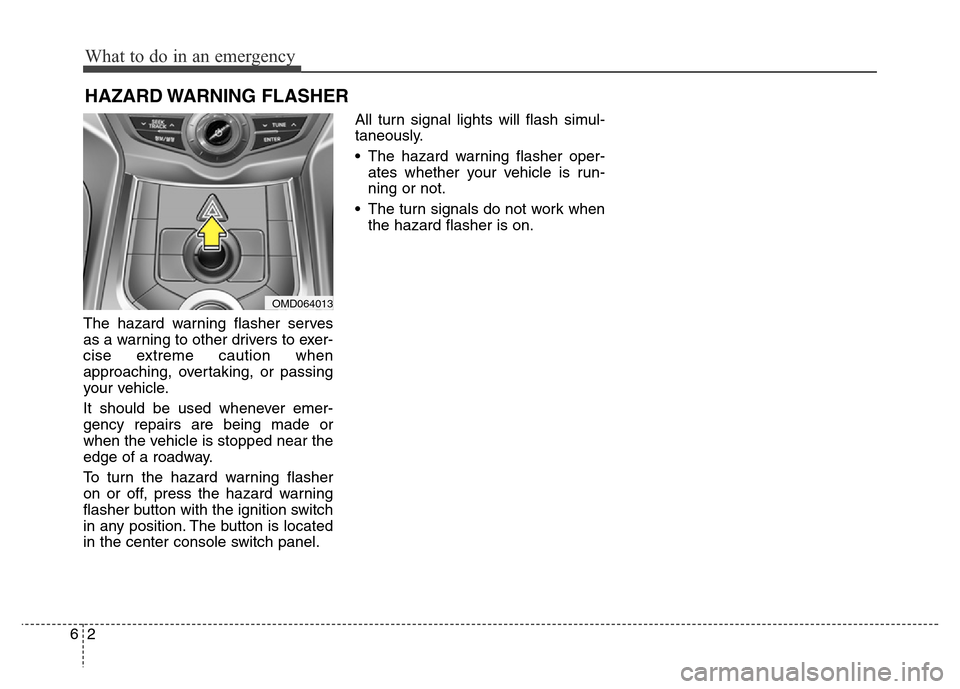
To turn the hazard warning flasher
on or off, press the hazard warning
flasher button with the ignition switch
in any position. The button is located
in the center console switch panel.All turn signal lights will flash simul-
taneously.
• The hazard warning flasher oper-
ates whether your vehicle is run-
ning or not.
• The turn signals do not work when
the hazard flasher is on.
HAZARD WARNING FLASHER
What to do in an emergency
2 6
OMD064013
Page 399 of 526
IF THE ENGINE WILL NOT START
If the engine doesn't turn over
or turns over slowly
• Be sure the shift lever is in N
(Neutral) or P (Park) if it is an auto-
matic transaxle vehicle. The engine
starts only when the shift lever is in
N (Neutral) or P (Park).
• Check the battery connections to
be sure they are clean and tight.
• Turn on the interior light. If the light
dims or goes out when you operate
the starter, the battery is drained.
Do not push or pull the vehicle to
start it. This could cause damage to
your vehicle. See instructions for
"Jump Starting" provided in this
chapter.
If the engine turns over nor-
mally but doesn’t start
• Check the fuel level and add fuel if
necessary.
If the engine still does not start, call
an authorized HYUNDAI dealer for
assistance.
What to do in an emergency
4 6
WARNING
Push or pull starting the vehicle
may cause the catalytic con-
verter to overload which can
lead to damage to the emission
control system.
Page 401 of 526
✽NOTICE
An inappropriately disposed
battery can be harmful to
the environment and human
health. Dispose the battery
according to your local
law(s) or regulation.
Jump starting procedure
1.Position the vehicles close enough
that the jumper cables will reach,
but do not allow the vehicles to
touch.
2.Avoid fans or any moving parts in
the engine compartment at all
times, even when the vehicles are
turned off.
3.Turn off all electrical devices such
as radios, lights, air conditioning,
etc. Put the vehicles in P (Park, for
automatic transaxle vehicle) or
neutral (for manual transaxle vehi-
cle), and set the parking brakes.
Turn both vehicles OFF.
What to do in an emergency
6 6
(Continued)
• NEVER attempt to recharge
the battery when the vehicle’s
battery cables are connected
to the battery.
• The electrical ignition system
works with high voltage.
NEVER touch these compo-
nents with the engine running
or when the ignition switch is
in the ON position.
Pb
CAUTION
To prevent damage to your vehi-
cle:
• Only use a 12-volt power sup-
ply (battery or jumper system)
to jump start your vehicle.
• Do not attempt to jump start
your vehicle by push-starting.
Page 427 of 526
What to do in an emergency
32 6
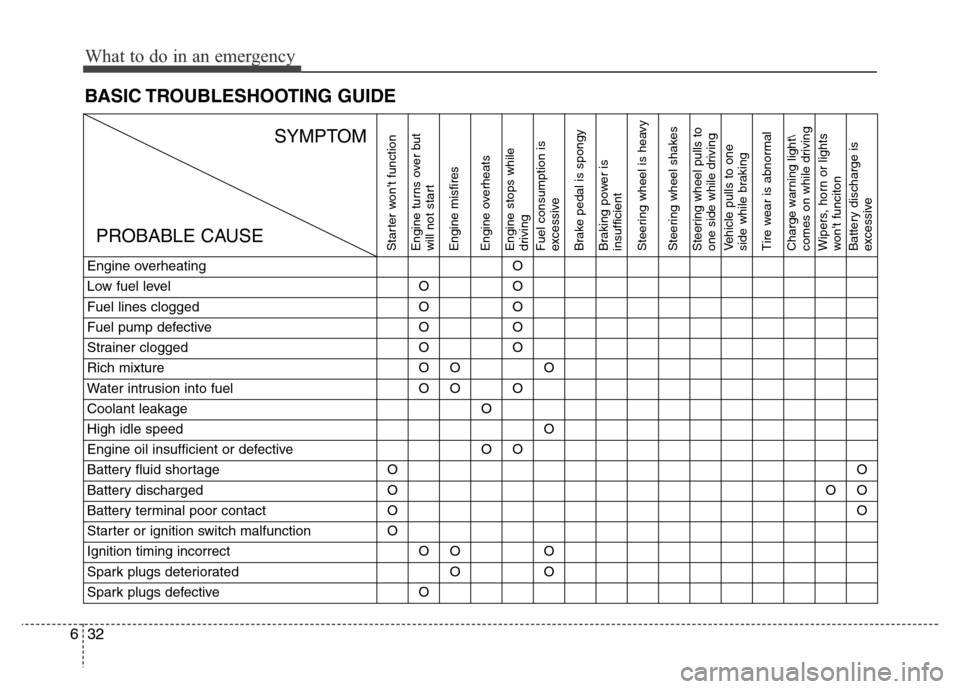
BASIC TROUBLESHOOTING GUIDE
Engine overheatingO
Low fuel levelOO
Fuel lines cloggedOO
Fuel pump defectiveOO
Strainer cloggedOO
Rich mixtureOOO
Water intrusion into fuelOOO
Coolant leakageO
High idle speedO
Engine oil insufficient or defectiveOO
Battery fluid shortageOO
Battery dischargedOOO
Battery terminal poor contactOO
Starter or ignition switch malfunctionO
Ignition timing incorrectOOO
Spark plugs deterioratedOO
Spark plugs defectiveO
Starter won't function
Engine turns over but
will not start
Engine misfires
Engine overheats
Engine stops while
driving
Fuel consumption is
excessive
Brake pedal is spongy
Braking power is
insufficient
Steering wheel is heavy
Steering wheel shakesSteering wheel pulls to
one side while drivingVehicle pulls to one
side while braking
Tire wear is abnormalCharge warning light\
comes on while drivingWipers, horn or lights
won't funciton
Battery discharge is
excessive
SYMPTOM
PROBABLE CAUSE
Page 428 of 526
633
What to do in an emergency
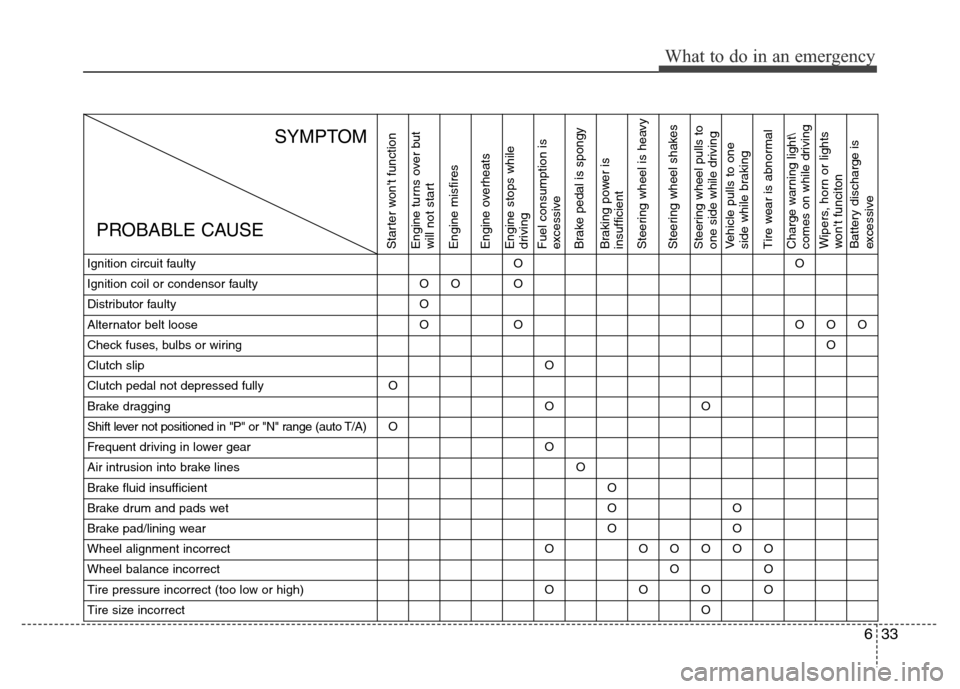
Ignition circuit faultyOO
Ignition coil or condensor faultyOOO
Distributor faultyO
Alternator belt looseOOOOO
Check fuses, bulbs or wiringO
Clutch slipO
Clutch pedal not depressed fullyO
Brake draggingOO
Shift lever not positioned in "P" or "N" range (auto T/A)O
Frequent driving in lower gearO
Air intrusion into brake linesO
Brake fluid insufficientO
Brake drum and pads wetOO
Brake pad/lining wearOO
Wheel alignment incorrectOOOOOO
Wheel balance incorrectOO
Tire pressure incorrect (too low or high)OOOO
Tire size incorrectO
Starter won't function
Engine turns over but
will not start
Engine misfires
Engine overheats
Engine stops while
driving
Fuel consumption is
excessive
Brake pedal is spongy
Braking power is
insufficient
Steering wheel is heavy
Steering wheel shakesSteering wheel pulls to
one side while drivingVehicle pulls to one
side while braking
Tire wear is abnormalCharge warning light\
comes on while drivingWipers, horn or lights
won't funciton
Battery discharge is
excessive
SYMPTOM
PROBABLE CAUSE
Page 430 of 526
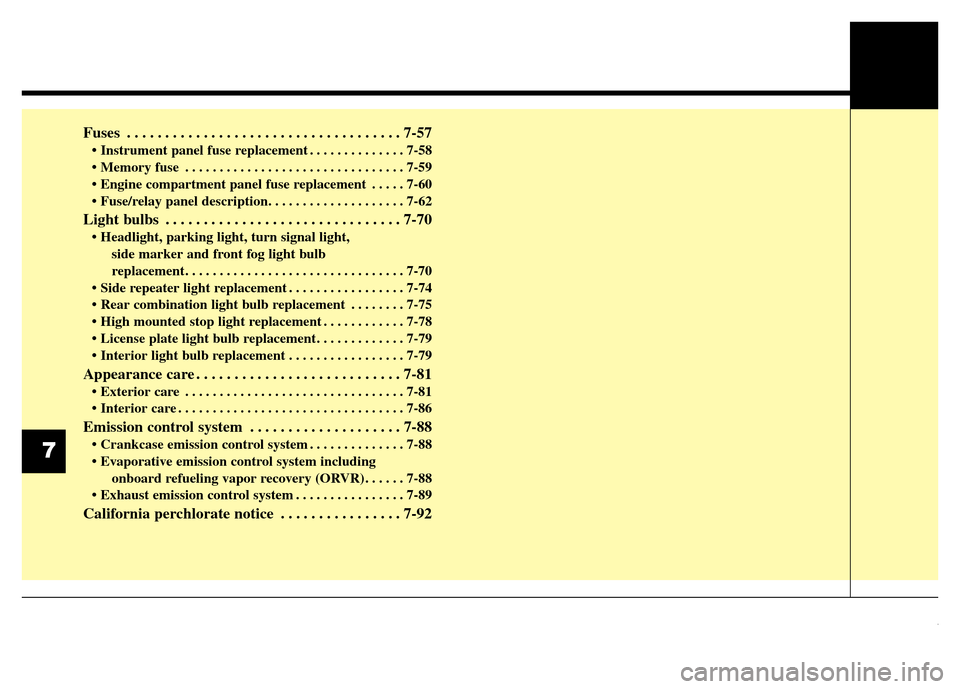
Fuses . . . . . . . . . . . . . . . . . . . . . . . . . . . . . . . . . . . . 7-57
• Instrument panel fuse replacement . . . . . . . . . . . . . . 7-58
• Memory fuse . . . . . . . . . . . . . . . . . . . . . . . . . . . . . . . . 7-59
• Engine compartment panel fuse replacement . . . . . 7-60
• Fuse/relay panel description. . . . . . . . . . . . . . . . . . . . 7-62
Light bulbs . . . . . . . . . . . . . . . . . . . . . . . . . . . . . . . 7-70
• Headlight, parking light, turn signal light,
side marker and front fog light bulb
replacement. . . . . . . . . . . . . . . . . . . . . . . . . . . . . . . . 7-70
• Side repeater light replacement . . . . . . . . . . . . . . . . . 7-74
• Rear combination light bulb replacement . . . . . . . . 7-75
• High mounted stop light replacement . . . . . . . . . . . . 7-78
• License plate light bulb replacement . . . . . . . . . . . . . 7-79
• Interior light bulb replacement . . . . . . . . . . . . . . . . . 7-79
Appearance care . . . . . . . . . . . . . . . . . . . . . . . . . . . 7-81
• Exterior care . . . . . . . . . . . . . . . . . . . . . . . . . . . . . . . . 7-81
• Interior care . . . . . . . . . . . . . . . . . . . . . . . . . . . . . . . . . 7-86
Emission control system . . . . . . . . . . . . . . . . . . . . 7-88
• Crankcase emission control system . . . . . . . . . . . . . . 7-88
• Evaporative emission control system including
onboard refueling vapor recovery (ORVR) . . . . . . 7-88
• Exhaust emission control system . . . . . . . . . . . . . . . . 7-89
California perchlorate notice . . . . . . . . . . . . . . . . 7-92
7
Page 435 of 526
77
Maintenance
Owner maintenance schedule
When you stop for fuel:
• Check the engine oil level.
• Check coolant level in the engine
coolant reservoir.
• Check the windshield washer fluid
level.
• Check for low or under-inflated
tires
While operating your vehicle:
• Note any changes in the sound of
the exhaust or any smell of
exhaust fumes in the vehicle.
• Check for vibrations in the steering
wheel. Notice if there is any
increased steering effort or loose-
ness in the steering wheel, or
change in its straight-ahead posi-
tion.
• Notice if your vehicle constantly
turns slightly or “pulls” to one side
when traveling on smooth, level
road.
• When stopping, listen and check
for unusual sounds, pulling to one
side, increased brake pedal travel
or “hard-to-push” brake pedal.
• If any slipping or changes in the
operation of your transaxle occurs,
check the transaxle fluid level.
• Check the automatic transaxle P
(Park) function.
• Check the parking brake.
• Check for fluid leaks under your
vehicle (water dripping from the air
conditioning system during or after
use is normal).
At least monthly:
• Check coolant level in the engine
coolant reservoir.
• Check the operation of all exterior
lights, including the stoplights, turn
signals and hazard warning flash-
ers.
• Check the inflation pressures of all
tires including the spare for tires
that are worn, show uneven wear,
or are damaged.
• Check for loose wheel lug nuts.
WARNING
Be careful when checking your
engine coolant level when the
engine is hot. This may result in
coolant being blown out of the
opening and cause serious
burns and other injuries.
Page 436 of 526
Maintenance
8 7
At least twice a year:
(i.e., every Spring and Fall):
• Check radiator, heater and air con-
ditioning hoses for leaks or dam-
age.
• Check windshield washer spray
and wiper operation. Clean wiper
blades with clean cloth dampened
with washer fluid.
• Check headlight alignment.
• Check muffler, exhaust pipes,
shields and clamps.
• Check the seat belts for wear and
function.
At least once a year:
• Clean body and door drain holes.
• Lubricate door hinges and hood
hinges.
• Lubricate door and hood locks and
latches.
• Lubricate door rubber weather
strips.
• Check the air conditioning system.
• Inspect and lubricate automatic
transaxle linkage and controls.
• Clean the battery and terminals.
• Check the brake/clutch fluid level.Follow Normal Maintenance
Schedule if the vehicle is usually
operated where none of the following
conditions apply. If any of the follow-
ing conditions apply, you must follow
the Maintenance Under Severe
Usage Conditions.
• Repeated short distance driving.
• Driving in dusty conditions or
sandy areas.
• Extensive use of brakes.
• Driving in areas where salt or other
corrosive materials are used.
• Driving on rough or muddy roads.
• Driving in mountainous areas.
• Extended periods of idling or low
speed operation.
• Driving for a prolonged period in
cold temperatures and/or extreme-
ly humid climates.
• More than 50% driving in heavy
city traffic during hot weather
above 32°C (90°F).
For additional information or assis-
tance see your authorized HYUNDAI
dealer.
SCHEDULED MAINTENANCE
SERVICES
Page 463 of 526
735
Maintenance
WIPER BLADES
Blade inspection
Contamination of either the wind-
shield or the wiper blades with for-
eign matter can reduce the effective-
ness of the windshield wipers.
Common sources of contamination
are insects, tree sap, and hot wax
treatments used by some commer-
cial car washes. If the blades are not
wiping properly, clean both the win-
dow and the blades with a clean
cloth dampened with washer fluid.✽NOTICE
Commercial hot waxes applied by
automatic car washes have been
known to make the windshield diffi-
cult to clean.
Blade replacement
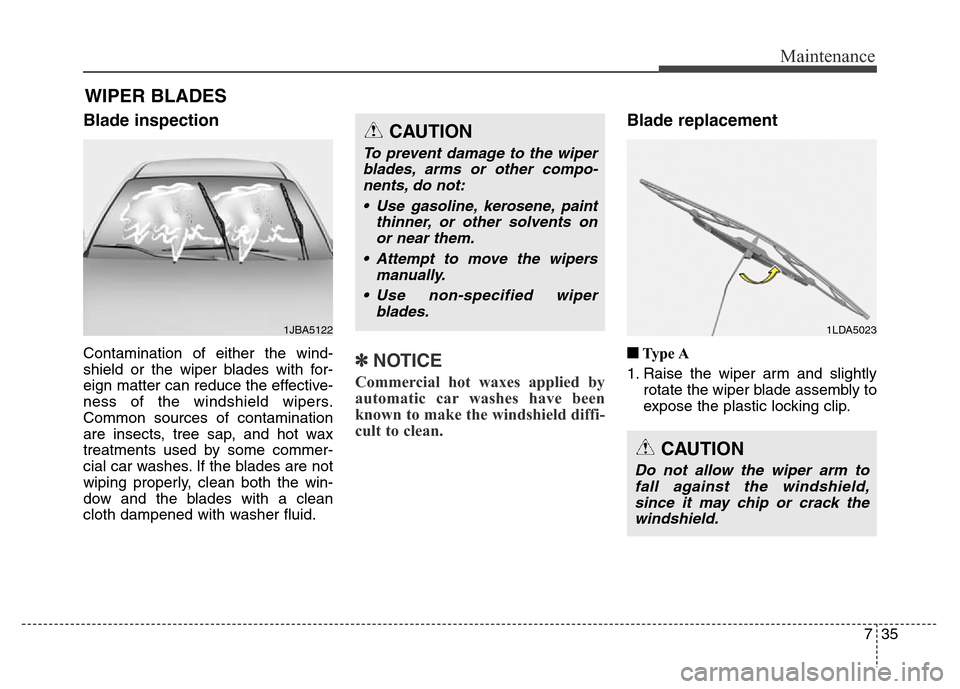
■Ty p e A
1. Raise the wiper arm and slightly
rotate the wiper blade assembly to
expose the plastic locking clip.
1JBA5122
CAUTION
Do not allow the wiper arm to
fall against the windshield,
since it may chip or crack the
windshield.
CAUTION
To prevent damage to the wiper
blades, arms or other compo-
nents, do not:
• Use gasoline, kerosene, paint
thinner, or other solvents on
or near them.
• Attempt to move the wipers
manually.
• Use non-specified wiper
blades.
1LDA5023