cooling Hyundai Elantra Coupe 2016 User Guide
[x] Cancel search | Manufacturer: HYUNDAI, Model Year: 2016, Model line: Elantra Coupe, Model: Hyundai Elantra Coupe 2016Pages: 526, PDF Size: 9.99 MB
Page 216 of 526
4131
Features of your vehicle
(Continued)
• Park the vehicle when connecting
the head unit with the mobile
phone.
•Bluetooth
®connection may become
intermittently disconnected in
some mobile phones. Follow these
steps to try again.
1. Within the mobile phone, turn
the Bluetooth
®function off/on
and try again.
2. Turn the mobile phone power
Off/On and try again.
3. Completely remove the mobile
phone battery, reboot, and then
again.
4. Reboot the Audio System and
try again.
5. Delete all paired devices, pair
and try again.
• Handsfree call quality and volume
may differ depending on the
model of your mobile phone.
✽NOTICE - USING THE
VOICE RECOGNITION
• When using the voice recognition
feature, only commands listed
within the user's manual are sup-
ported.
• Be aware that during the opera-
tion of the voice recognition sys-
tem, pressing any key other than
the key terminates voice
recognition mode.
• For superior voice recognition
performance, position the micro-
phone used for voice recognition
above the head of the driver’s seat
and maintain a proper position
when saying commands.
• Within the following situations,
voice recognition may not function
properly due to external sound.
- When the windows and sunroof
are open
- When the wind of the cooling /
heating device is strong
- When entering and passing
through tunnels
(Continued)(Continued)
- When driving on rugged and
uneven roads
- During severe rain (heavy rains,
windstorms)
• Phone related voice commands
can be used only when a
Bluetooth
®Wireless Technology
device is connected.
• When making calls by stating a
name, the corresponding contact
must be downloaded and stored
within the audio system.
• After downloading the Bluetooth
®
Wireless Technology phone book,
it takes some time to convert the
phone book data into voice infor-
mation. During this time, voice
recognition may not properly
operate.
• Pronounce the voice commands
naturally and clearly as if in a nor-
mal conversation.
Page 386 of 526
Snow or icy conditions
You need to keep sufficient distance
between your vehicle and the vehicle
in front of you.
Apply the brakes gently. Speeding,
rapid acceleration, sudden brake
applications, and sharp turns are
potentially very hazardous practices.
During deceleration, use engine
braking to the fullest extent. Sudden
brake applications on snowy or icy
roads may cause skids to occur.
To drive your vehicle in deep snow, it
may be necessary to use snow tires.
Always carry emergency equipment.
Some of the items you may want to
carry include, tow straps or chains, a
flashlight, emergency flares, sand, a
shovel, jumper cables, a window
scraper, gloves, ground cloth, cover-
alls, a blanket, etc.
Snow tires
If you mount snow tires on your vehi-
cle, make sure to use radial tires of
the same size and load range as the
original tires. Mount snow tires on all
four wheels to balance your vehicle’s
handling in all weather conditions.
The traction provided by snow tires
on dry roads may not be as high as
your vehicle's original equipment
tires. Check with the tire dealer for
maximum speed recommendations.
✽NOTICE
Do not install studded tires without
first checking local and municipal
regulations for possible restrictions
against their use.
Use high quality ethylene gly-
col coolant
Your vehicle is delivered with high
quality ethylene glycol coolant in the
cooling system. It is the only type of
coolant that should be used because
it helps prevent corrosion in the cool-
ing system, lubricates the water
pump and prevents freezing. Be sure
to replace or replenish your coolant
in accordance with the maintenance
schedule in section 7. Before winter,
have your coolant tested to assure
that its freezing point is sufficient for
the temperatures anticipated during
the winter.
WINTER DRIVING
553
Driving your vehicle
WARNING
Snow tires should be equivalent
in size and type to the vehicle's
standard tires. Otherwise, the
safety and handling of your
vehicle may be adversely affect-
ed.
Page 388 of 526
555
Driving your vehicle
Don't let your parking brake
freeze
Under some conditions your parking
brake can freeze in the engaged
position. This is most likely to hap-
pen when there is an accumulation
of snow or ice around or near the
rear brakes or if the brakes are wet.
If there is a risk the parking brake
may freeze, apply it only temporarily
while you put the shift lever in P
(automatic transaxle) or in first or
reverse gear (manual transaxle) and
block the rear wheels so the vehicle
cannot roll. Then release the parking
brake.
Don't let ice and snow accu-
mulate underneath
Under some conditions, snow and
ice can build up under the fenders
and interfere with the steering. When
driving in severe winter conditions
where this may happen, you should
periodically check underneath the
vehicle to be sure the movement of
the front wheels and the steering
components is not obstructed.
Carry emergency equipment
Depending on the severity of the
weather, you should carry appropri-
ate emergency equipment. Some of
the items you may want to carry
include tire chains, tow straps or
chains, flashlight, emergency flares,
sand, a shovel, jumper cables, a win-
dow scraper, gloves, ground cloth,
coveralls, a blanket, etc.
Don't place foreign objects or
materials in the engine com-
partment
Placement of foreign objects or
materials which prevent cooling of
the engine, in the engine compart-
ment, may cause a failure or com-
bustion. The manufacturer is not
responsible for the damage caused
by such placement.
Page 403 of 526
If your temperature gauge indicates
overheating, you experience a loss
of power, or hear loud pinging or
knocking, the engine may be over-
heating. If this happens, you should:
1.Pull off the road and stop as soon
as it is safe to do so.
2.Place the shift lever in P (Park, for
automatic transaxle vehicle) or
neutral (for manual transaxle vehi-
cle) and set the parking brake. If
the air conditioning is ON, turn it
OFF.
3.If engine coolant is running out
under the vehicle or steam is com-
ing out from the hood, stop the
engine. Do not open the hood until
the coolant has stopped running or
the steaming has stopped. If there
is no visible loss of engine coolant
and no steam, leave the engine
running and check to be sure the
engine cooling fan is operating. If
the fan is not running, turn the
engine off.4.Check for coolant leaking from the
radiator, hoses or under the vehi-
cle. (If the air conditioning had
been in use, it is normal for cold
water to be draining from it when
you stop.)
5.If engine coolant is leaking out,
stop the engine immediately and
call an authorized HYUNDAI deal-
er for assistance.
IF THE ENGINE OVERHEATS
What to do in an emergency
8 6
WARNING
While the engine is
running, keep hands,
clothing and tools
away from the moving
parts such as the
cooling fan and drive
belt to prevent seri-
ous injury.
WARNING
NEVER remove the
radiator cap or the
drain plug while the
engine and radiator
are hot. Hot coolant
and steam may blow out under
pressure, causing serious
injury.
Turn the engine off and wait
until the engine cools down.
Use extreme care when remov-
ing the radiator cap. Wrap a
thick towel around it, and turn it
counterclockwise slowly to the
first stop. Step back while the
pressure is released from the
cooling system. When you are
sure all the pressure has been
released, press down on the
cap, using a thick towel, and
continue turning counterclock-
wise to remove it.
Page 404 of 526
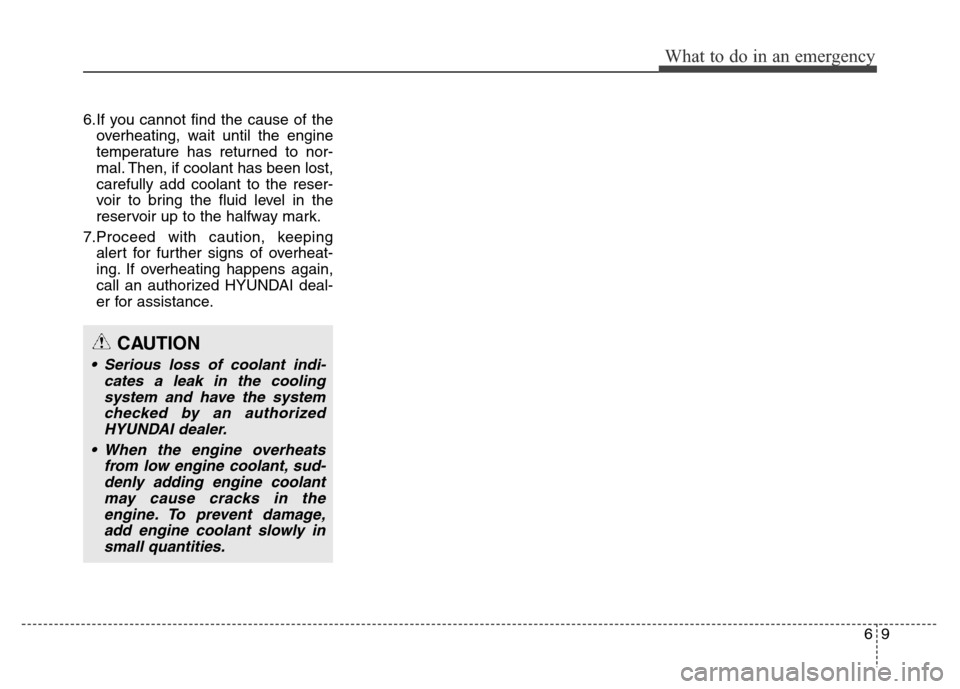
6.If you cannot find the cause of the
overheating, wait until the engine
temperature has returned to nor-
mal. Then, if coolant has been lost,
carefully add coolant to the reser-
voir to bring the fluid level in the
reservoir up to the halfway mark.
7.Proceed with caution, keeping
alert for further signs of overheat-
ing. If overheating happens again,
call an authorized HYUNDAI deal-
er for assistance.
69
What to do in an emergency
CAUTION
• Serious loss of coolant indi-
cates a leak in the cooling
system and have the system
checked by an authorized
HYUNDAI dealer.
• When the engine overheats
from low engine coolant, sud-
denly adding engine coolant
may cause cracks in the
engine. To prevent damage,
add engine coolant slowly in
small quantities.
Page 437 of 526
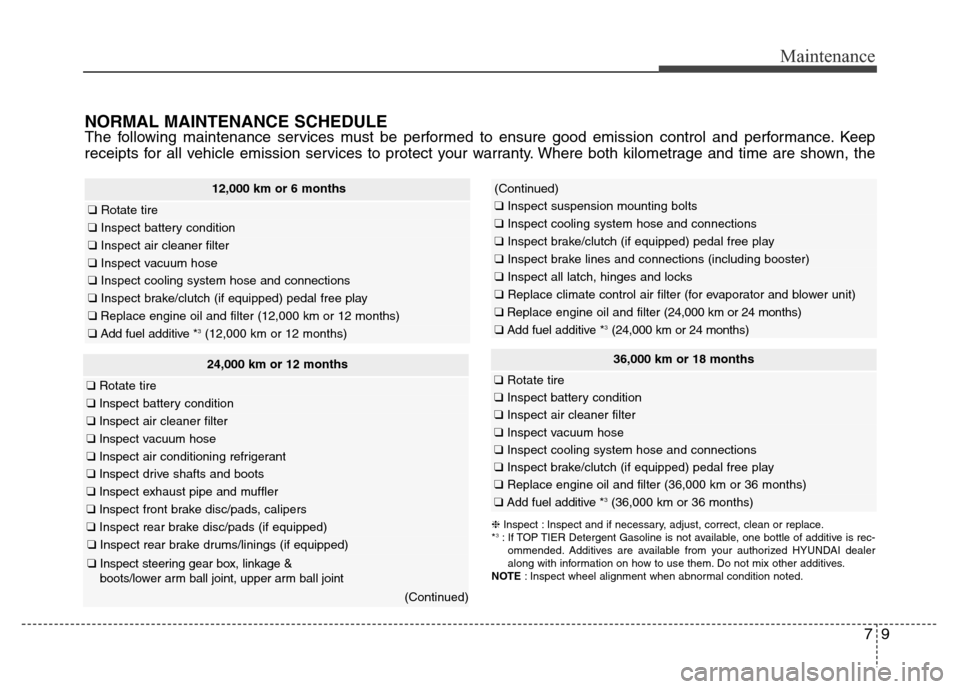
79
Maintenance
NORMAL MAINTENANCE SCHEDULEThe following maintenance services must be performed to ensure good emission control and performance. Keep
receipts for all vehicle emission services to protect your warranty. Where both kilometrage and time are shown, the
24,000 km or 12 months
❑ Rotate tire
❑ Inspect battery condition
❑Inspect air cleaner filter
❑Inspect vacuum hose
❑Inspect air conditioning refrigerant
❑Inspect drive shafts and boots
❑Inspect exhaust pipe and muffler
❑Inspect front brake disc/pads, calipers
❑Inspect rear brake disc/pads (if equipped)
❑Inspect rear brake drums/linings (if equipped)
❑Inspect steering gear box, linkage &
boots/lower arm ball joint, upper arm ball joint
(Continued)
36,000 km or 18 months
❑ Rotate tire
❑ Inspect battery condition
❑Inspect air cleaner filter
❑Inspect vacuum hose
❑Inspect cooling system hose and connections
❑Inspect brake/clutch (if equipped) pedal free play
❑Replace engine oil and filter (36,000 km or 36 months)
❑Add fuel additive *3(36,000 km or 36 months)
12,000 km or 6 months
❑ Rotate tire
❑ Inspect battery condition
❑Inspect air cleaner filter
❑Inspect vacuum hose
❑Inspect cooling system hose and connections
❑Inspect brake/clutch (if equipped) pedal free play
❑Replace engine oil and filter (12,000 km or 12 months)
❑Add fuel additive *3(12,000 km or 12 months)
(Continued)
❑Inspect suspension mounting bolts
❑Inspect cooling system hose and connections
❑Inspect brake/clutch (if equipped) pedal free play
❑Inspect brake lines and connections (including booster)
❑Inspect all latch, hinges and locks
❑Replace climate control air filter (for evaporator and blower unit)
❑Replace engine oil and filter (24,000 km or 24 months)
❑Add fuel additive *3(24,000 km or 24 months)
❈Inspect : Inspect and if necessary, adjust, correct, clean or replace.
*3: If TOP TIER Detergent Gasoline is not available, one bottle of additive is rec-
ommended. Additives are available from your authorized HYUNDAI dealer
along with information on how to use them. Do not mix other additives.
NOTE: Inspect wheel alignment when abnormal condition noted.
Page 438 of 526
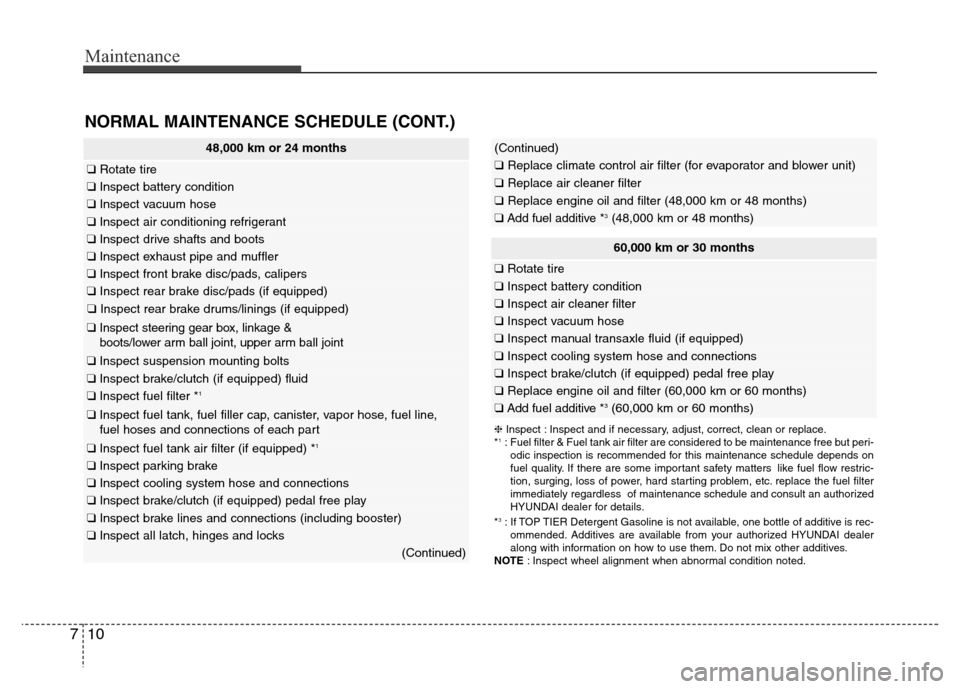
Maintenance
10 7
NORMAL MAINTENANCE SCHEDULE (CONT.)
60,000 km or 30 months
❑Rotate tire
❑Inspect battery condition
❑Inspect air cleaner filter
❑Inspect vacuum hose
❑Inspect manual transaxle fluid (if equipped)
❑Inspect cooling system hose and connections
❑Inspect brake/clutch (if equipped) pedal free play
❑Replace engine oil and filter (60,000 km or 60 months)
❑Add fuel additive *3(60,000 km or 60 months)
❈Inspect : Inspect and if necessary, adjust, correct, clean or replace.
*1: Fuel filter & Fuel tank air filter are considered to be maintenance free but peri-
odic inspection is recommended for this maintenance schedule depends on
fuel quality. If there are some important safety matters like fuel flow restric-
tion, surging, loss of power, hard starting problem, etc. replace the fuel filter
immediately regardless of maintenance schedule and consult an authorized
HYUNDAI dealer for details.
*
3: If TOP TIER Detergent Gasoline is not available, one bottle of additive is rec-
ommended. Additives are available from your authorized HYUNDAI dealer
along with information on how to use them. Do not mix other additives.
NOTE: Inspect wheel alignment when abnormal condition noted.
48,000 km or 24 months
❑Rotate tire
❑Inspect battery condition
❑Inspect vacuum hose
❑Inspect air conditioning refrigerant
❑Inspect drive shafts and boots
❑Inspect exhaust pipe and muffler
❑Inspect front brake disc/pads, calipers
❑Inspect rear brake disc/pads (if equipped)
❑Inspect rear brake drums/linings (if equipped)
❑Inspect steering gear box, linkage &
boots/lower arm ball joint, upper arm ball joint
❑Inspect suspension mounting bolts
❑Inspect brake/clutch (if equipped) fluid
❑Inspect fuel filter *1
❑Inspect fuel tank, fuel filler cap, canister, vapor hose, fuel line,
fuel hoses and connections of each part
❑Inspect fuel tank air filter (if equipped) *1
❑Inspect parking brake
❑Inspect cooling system hose and connections
❑Inspect brake/clutch (if equipped) pedal free play
❑Inspect brake lines and connections (including booster)
❑Inspect all latch, hinges and locks
(Continued)
(Continued)
❑Replace climate control air filter (for evaporator and blower unit)
❑Replace air cleaner filter
❑Replace engine oil and filter (48,000 km or 48 months)
❑Add fuel additive *3(48,000 km or 48 months)
Page 439 of 526
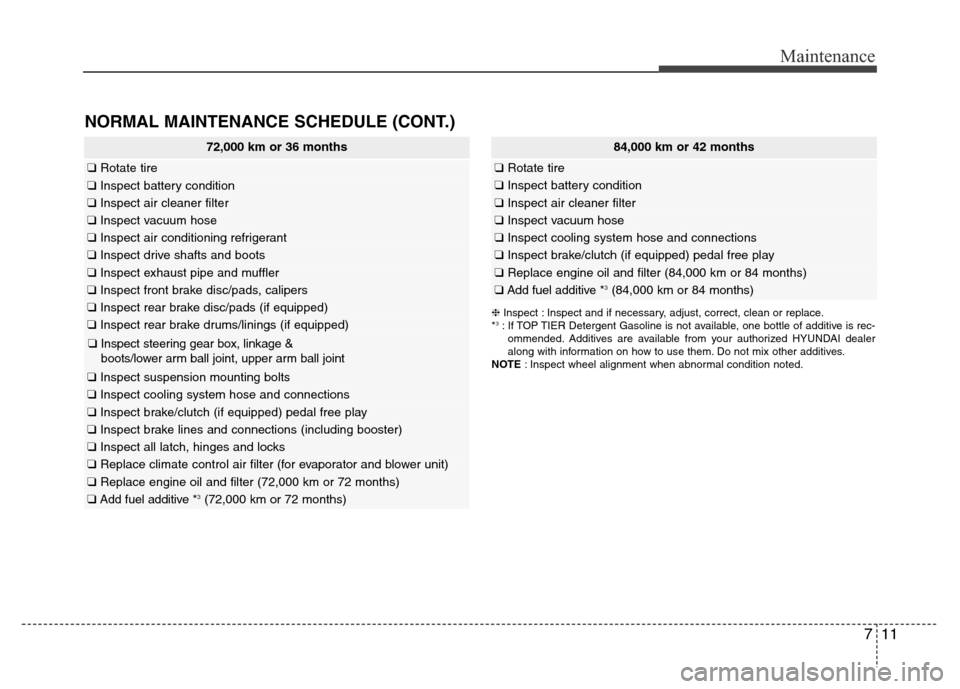
711
Maintenance
72,000 km or 36 months
❑Rotate tire
❑Inspect battery condition
❑Inspect air cleaner filter
❑Inspect vacuum hose
❑Inspect air conditioning refrigerant
❑Inspect drive shafts and boots
❑Inspect exhaust pipe and muffler
❑Inspect front brake disc/pads, calipers
❑Inspect rear brake disc/pads (if equipped)
❑Inspect rear brake drums/linings (if equipped)
❑Inspect steering gear box, linkage &
boots/lower arm ball joint, upper arm ball joint
❑Inspect suspension mounting bolts
❑Inspect cooling system hose and connections
❑Inspect brake/clutch (if equipped) pedal free play
❑Inspect brake lines and connections (including booster)
❑Inspect all latch, hinges and locks
❑Replace climate control air filter (for evaporator and blower unit)
❑Replace engine oil and filter (72,000 km or 72 months)
❑Add fuel additive *3(72,000 km or 72 months)
NORMAL MAINTENANCE SCHEDULE (CONT.)
84,000 km or 42 months
❑Rotate tire
❑Inspect battery condition
❑Inspect air cleaner filter
❑Inspect vacuum hose
❑Inspect cooling system hose and connections
❑Inspect brake/clutch (if equipped) pedal free play
❑Replace engine oil and filter (84,000 km or 84 months)
❑Add fuel additive *3(84,000 km or 84 months)
❈Inspect : Inspect and if necessary, adjust, correct, clean or replace.
*3: If TOP TIER Detergent Gasoline is not available, one bottle of additive is rec-
ommended. Additives are available from your authorized HYUNDAI dealer
along with information on how to use them. Do not mix other additives.
NOTE: Inspect wheel alignment when abnormal condition noted.
Page 440 of 526
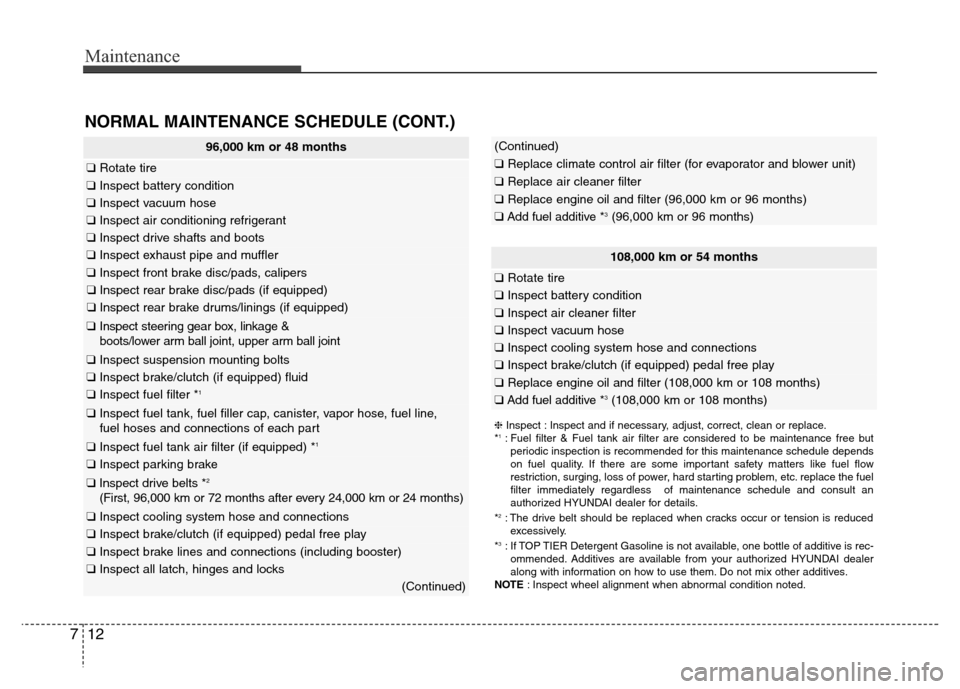
Maintenance
12 7
NORMAL MAINTENANCE SCHEDULE (CONT.)
❈Inspect : Inspect and if necessary, adjust, correct, clean or replace.
*1: Fuel filter & Fuel tank air filter are considered to be maintenance free but
periodic inspection is recommended for this maintenance schedule depends
on fuel quality. If there are some important safety matters like fuel flow
restriction, surging, loss of power, hard starting problem, etc. replace the fuel
filter immediately regardless of maintenance schedule and consult an
authorized HYUNDAI dealer for details.
*
2: The drive belt should be replaced when cracks occur or tension is reduced
excessively.
*
3: If TOP TIER Detergent Gasoline is not available, one bottle of additive is rec-
ommended. Additives are available from your authorized HYUNDAI dealer
along with information on how to use them. Do not mix other additives.
NOTE: Inspect wheel alignment when abnormal condition noted.
108,000 km or 54 months
❑Rotate tire
❑Inspect battery condition
❑Inspect air cleaner filter
❑Inspect vacuum hose
❑Inspect cooling system hose and connections
❑Inspect brake/clutch (if equipped) pedal free play
❑Replace engine oil and filter (108,000 km or 108 months)
❑Add fuel additive *3(108,000 km or 108 months)
96,000 km or 48 months
❑Rotate tire
❑Inspect battery condition
❑Inspect vacuum hose
❑Inspect air conditioning refrigerant
❑Inspect drive shafts and boots
❑Inspect exhaust pipe and muffler
❑Inspect front brake disc/pads, calipers
❑Inspect rear brake disc/pads (if equipped)
❑Inspect rear brake drums/linings (if equipped)
❑Inspect steering gear box, linkage &
boots/lower arm ball joint, upper arm ball joint
❑Inspect suspension mounting bolts
❑Inspect brake/clutch (if equipped) fluid
❑Inspect fuel filter *1
❑Inspect fuel tank, fuel filler cap, canister, vapor hose, fuel line,
fuel hoses and connections of each part
❑Inspect fuel tank air filter (if equipped) *1
❑Inspect parking brake
❑Inspect drive belts *2
(First, 96,000 km or 72 months after every 24,000 km or 24 months)
❑Inspect cooling system hose and connections
❑Inspect brake/clutch (if equipped) pedal free play
❑Inspect brake lines and connections (including booster)
❑Inspect all latch, hinges and locks
(Continued)
(Continued)
❑Replace climate control air filter (for evaporator and blower unit)
❑Replace air cleaner filter
❑Replace engine oil and filter (96,000 km or 96 months)
❑Add fuel additive *3(96,000 km or 96 months)
Page 441 of 526
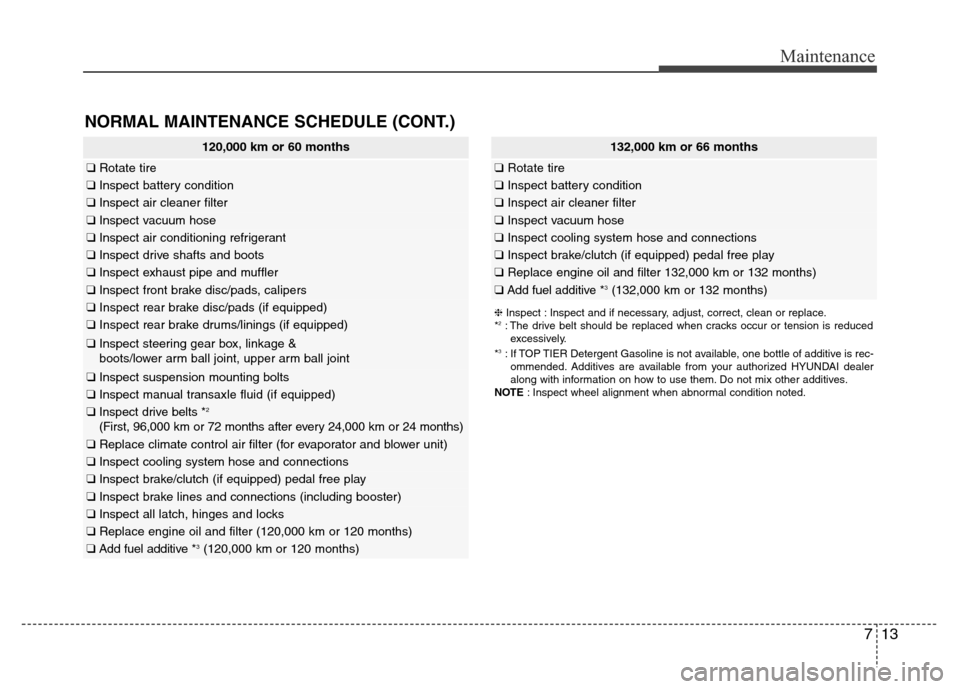
713
Maintenance
NORMAL MAINTENANCE SCHEDULE (CONT.)
120,000 km or 60 months
❑Rotate tire
❑Inspect battery condition
❑Inspect air cleaner filter
❑Inspect vacuum hose
❑Inspect air conditioning refrigerant
❑Inspect drive shafts and boots
❑Inspect exhaust pipe and muffler
❑Inspect front brake disc/pads, calipers
❑Inspect rear brake disc/pads (if equipped)
❑Inspect rear brake drums/linings (if equipped)
❑Inspect steering gear box, linkage &
boots/lower arm ball joint, upper arm ball joint
❑Inspect suspension mounting bolts
❑Inspect manual transaxle fluid (if equipped)
❑Inspect drive belts *2
(First, 96,000 km or 72 months after every 24,000 km or 24 months)
❑Replace climate control air filter (for evaporator and blower unit)
❑Inspect cooling system hose and connections
❑Inspect brake/clutch (if equipped) pedal free play
❑Inspect brake lines and connections (including booster)
❑Inspect all latch, hinges and locks
❑Replace engine oil and filter (120,000 km or 120 months)
❑Add fuel additive *3(120,000 km or 120 months)
❈Inspect : Inspect and if necessary, adjust, correct, clean or replace.
*2: The drive belt should be replaced when cracks occur or tension is reduced
excessively.
*
3: If TOP TIER Detergent Gasoline is not available, one bottle of additive is rec-
ommended. Additives are available from your authorized HYUNDAI dealer
along with information on how to use them. Do not mix other additives.
NOTE: Inspect wheel alignment when abnormal condition noted.
132,000 km or 66 months
❑Rotate tire
❑Inspect battery condition
❑Inspect air cleaner filter
❑Inspect vacuum hose
❑Inspect cooling system hose and connections
❑Inspect brake/clutch (if equipped) pedal free play
❑Replace engine oil and filter 132,000 km or 132 months)
❑Add fuel additive *3(132,000 km or 132 months)