vent HYUNDAI ELANTRA GT 2014 Owners Manual
[x] Cancel search | Manufacturer: HYUNDAI, Model Year: 2014, Model line: ELANTRA GT, Model: HYUNDAI ELANTRA GT 2014Pages: 476, PDF Size: 31.71 MB
Page 444 of 476

783
Maintenance
APPEARANCE CARE
Exterior care
Exterior general caution
It is very important to follow the label
directions when using any chemical
cleaner or polish. Read all warning
and caution statements that appear
on the label.
Finish maintenance
Washing
To help protect your vehicle’s finish
from rust and deterioration, wash it
thoroughly and frequently at least
once a month with lukewarm or cold
water.
If you use your vehicle for off-road
driving, you should wash it after each
off-road trip. Pay special attention to
the removal of any accumulation of
salt, dirt, mud, and other foreign mate-
rials. Make sure the drain holes in the
lower edges of the doors and rocker
panels are kept clear and clean.Insects, tar, tree sap, bird droppings,
industrial pollution and similar
deposits can damage your vehicle’s
finish if not removed immediately.
Even prompt washing with plain
water may not completely remove all
these deposits. A mild soap, safe for
use on painted surfaces, may be
used.
After washing, rinse the vehicle thor-
oughly with lukewarm or cold water.
Do not allow soap to dry on the fin-
ish.
CAUTION
Do not use strong soap, chem-
ical detergents or hot water,
and do not wash the vehicle in
direct sunlight or when the
body of the vehicle is warm.
Be careful when washing the
side windows of your vehicle.
Especially, with high-pressure
water, water may leak through
the windows and wet the inte-
rior.
To prevent damage to the
plastic parts and lamps, do
not clean with chemical sol-
vents or strong detergents.
WARNING - Wet brakes
After washing the vehicle, test
the brakes while driving slowly
to see if they have been affected
by water. If braking performance
is impaired, dry the brakes by
applying them lightly while main-
taining a slow forward speed.
Page 447 of 476

Maintenance
86 7
Aluminum or chrome wheel main-
tenance
The aluminum or chrome wheels are
coated with a clear protective finish.
Do not use any abrasive cleaner,
polishing compound, solvent, or
wire brushes on aluminum or
chrome wheels. They may scratch
or damage the finish.
Clean the wheel when it has
cooled.
Use only a mild soap or neutral
detergent, and rinse thoroughly
with water. Also, be sure to clean
the wheels after driving on salted
roads. This helps prevent corro-
sion.
Avoid washing the wheels with
high-speed car wash brushes.
Do not use any cleaners containing
alkaline or acid detergents. It may
damage and corrode the aluminum
or chrome wheels coated with a
clear protective finish.
Corrosion protection
Protecting your vehicle from corro-
sion
By using the most advanced design
and construction practices to combat
corrosion, we produce cars of the
highest quality. However, this is only
part of the job. To achieve the long-
term corrosion resistance your vehi-
cle can deliver, the owner's coopera-
tion and assistance is also required.
Common causes of corrosion
The most common causes of corro-
sion on your car are:
Road salt, dirt and moisture that is
allowed to accumulate underneath
the car.
coatings by stones, gravel, abra-
sion or minor scrapes and dents
which leave unprotected metal
exposed to corrosion.High-corrosion areas
If you live in an area where your car
is regularly exposed to corrosive
materials, corrosion protection is
particularly important. Some of the
common causes of accelerated cor-
rosion are road salts, dust control
chemicals, ocean air and industrial
pollution.
Page 448 of 476

787
Maintenance
Moisture breeds corrosion
Moisture creates the conditions in
which corrosion is most likely to
occur. For example, corrosion is
accelerated by high humidity, partic-
ularly when temperatures are just
above freezing. In such conditions,
the corrosive material is kept in con-
tact with the car surfaces by moisture
that is slow to evaporate.
Mud is particularly corrosive
because it is slow to dry and holds
moisture in contact with the vehicle.
Although the mud appears to be dry,
it can still retain the moisture and
promote corrosion.
High temperatures can also acceler-
ate corrosion of parts that are not
properly ventilated so the moisture
can be dispersed. For all these rea-
sons, it is particularly important to
keep your car clean and free of mud
or accumulations of other materials.
This applies not only to the visible
surfaces but particularly to the
underside of the car.To help prevent corrosion
You can help prevent corrosion from
getting started by observing the fol-
lowing:
Keep your car clean
The best way to prevent corrosion is
to keep your car clean and free of
corrosive materials. Attention to the
underside of the car is particularly
important.
If you live in a high-corrosion area
— where road salts are used, near
the ocean, areas with industrial pol-
lution, acid rain, etc.—, you should
take extra care to prevent corrosion.
In winter, hose off the underside of
your car at least once a month and
be sure to clean the underside thor-
oughly when winter is over. When cleaning underneath the car,
give particular attention to the
components under the fenders and
other areas that are hidden from
view. Do a thorough job; just damp-
ening the accumulated mud rather
than washing it away will acceler-
ate corrosion rather than prevent it.
Water under high pressure and
steam are particularly effective in
removing accumulated mud and
corrosive materials.
When cleaning lower door panels,
rocker panels and frame members,
be sure that drain holes are kept
open so that moisture can escape
and not be trapped inside to accel-
erate corrosion.
Page 449 of 476

Maintenance
88 7
Keep your garage dry
Don't park your car in a damp, poor-
ly ventilated garage. This creates a
favorable environment for corrosion.
This is particularly true if you wash
your car in the garage or drive it into
the garage when it is still wet or cov-
ered with snow, ice or mud. Even a
heated garage can contribute to cor-
rosion unless it is well ventilated so
moisture is dispersed.Keep paint and trim in good con-
dition
Scratches or chips in the finish
should be covered with "touch-up"
paint as soon as possible to reduce
the possibility of corrosion. If bare
metal is showing through, the atten-
tion of a qualified body and paint
shop is recommended.
Bird droppings : Bird droppings are
highly corrosive and may damage
painted surfaces in just a few hours.
Always remove bird droppings as
soon as possible.Don't neglect the interior
Moisture can collect under the floor
mats and carpeting to cause corro-
sion. Check under the mats periodi-
cally to be sure the carpeting is dry.
Use particular care if you carry fertil-
izers, cleaning materials or chemi-
cals in the car.
These should be carried only in prop-
er containers and any spills or leaks
should be cleaned up, flushed with
clean water and thoroughly dried.
Page 450 of 476

789
Maintenance
Interior care
Interior general precautions
Prevent caustic solutions such as
perfume and cosmetic oil from con-
tacting the dashboard because they
may cause damage or discoloration.
If they do contact the dashboard,
wipe them off immediately. See the
instructions that follow for the proper
way to clean vinyl.
Cleaning the upholstery and inte-
rior trim
Vinyl
Remove dust and loose dirt from
vinyl with a whisk broom or vacuum
cleaner. Clean vinyl surfaces with a
vinyl cleaner.
Fabric
Remove dust and loose dirt from fab-
ric with a whisk broom or vacuum
cleaner. Clean with a mild soap solu-
tion recommended for upholstery or
carpets. Remove fresh spots imme-
diately with a fabric spot cleaner. If
fresh spots do not receive immediate
attention, the fabric can be stained
and its color can be affected. Also, its
fire-resistant properties can be
reduced if the material is not proper-
ly maintained.
Cleaning the lap/shoulder belt
webbing
Clean the belt webbing with any mild
soap solution recommended for
cleaning upholstery or carpet. Follow
the instructions provided with the
soap. Do not bleach or re-dye the
webbing because this may weaken it.
Cleaning the interior window
glass
If the interior glass surfaces of the
vehicle become fogged (that is, cov-
ered with an oily, greasy or waxy
film), they should be cleaned with
glass cleaner. Follow the directions
on the glass cleaner container.
CAUTION
Using anything but recommend-
ed cleaners and procedures may
affect the fabric’s appearance
and fire-resistant properties.
CAUTION
Do not scrape or scratch the
inside of the rear window. This
may result in damage to the rear
window defroster grid.
CAUTION
Never allow water or other liq-
uids to come in contact with
electrical/electronic compo-
nents inside the vehicle as
this may damage them.
When cleaning leather prod-
ucts (steering wheel, seats
etc.), use neutral detergents
or low alcohol content solu-
tions. If you use high alcohol
content solutions or acid/alka-
line detergents, the color of
the leather may fade or the
surface may get stripped off.
Page 451 of 476
Maintenance
90 7
EMISSION CONTROL SYSTEM
The emission control system of your
vehicle is covered by a written limited
warranty. Please see the warranty
information contained in the Owner’s
Handbook & Warranty Information
booklet in your vehicle.
Your vehicle is equipped with an
emission control system to meet all
applicable emission regulations.
There are three emission control
systems, as follows.
(1) Crankcase emission control
system
(2) Evaporative emission control
system
(3) Exhaust emission control system
In order to assure the proper function
of the emission control systems, it is
recommended that you have your
car inspected and maintained by an
authorized HYUNDAI dealer in
accordance with the maintenance
schedule in this manual.Notice for Inspection and
Maintenance Test (With Electronic
Stability Control (ESC) system)
To prevent the vehicle from indi-
cating an erroneous misfire dur-
ing dynamometer testing, turn
the Electronic Stability Control
(ESC) system off by pressing
the ESC switch.
After dynamometer testing is
completed, turn the ESC system
back on by pressing the ESC
switch again.
1. Crankcase emission control
system
The positive crankcase ventilation
system is employed to prevent air
pollution caused by blow-by gases
being emitted from the crankcase.
This system supplies fresh filtered air
to the crankcase through the air
intake hose. Inside the crankcase,
the fresh air mixes with blow-by
gases, which then pass through the
PCV valve into the induction system.
2. Evaporative emission con-
trol (including ORVR:
Onboard Refueling Vapor
Recovery) system
The Evaporative Emission Control
System is designed to prevent fuel
vapors from escaping into the atmos-
phere.
(The ORVR system is designed to
allow the vapors from the fuel tank to
be loaded into a canister while refu-
eling at the gas station, preventing
the escape of fuel vapors into the
atmosphere.)
Canister
Fuel vapors generated inside the fuel
tank are absorbed and stored in the
onboard canister. When the engine is
running, the fuel vapors absorbed in
the canister are drawn into the surge
tank through the purge control sole-
noid valve.
Page 453 of 476
Maintenance
92 7
Do not operate the engine in con-
fined or closed areas (such as
garages) any more than what is
necessary to move the vehicle in or
out of the area.
When the vehicle is stopped in an
open area for more than a short
time with the engine running,
adjust the ventilation system (as
needed) to draw outside air into the
vehicle.
Never sit in a parked or stopped
vehicle for any extended time with
the engine running.
When the engine stalls or fails to
start, excessive attempts to restart
the engine may cause damage to
the emission control system.Operating precautions for catalyt-
ic converters (if equipped)
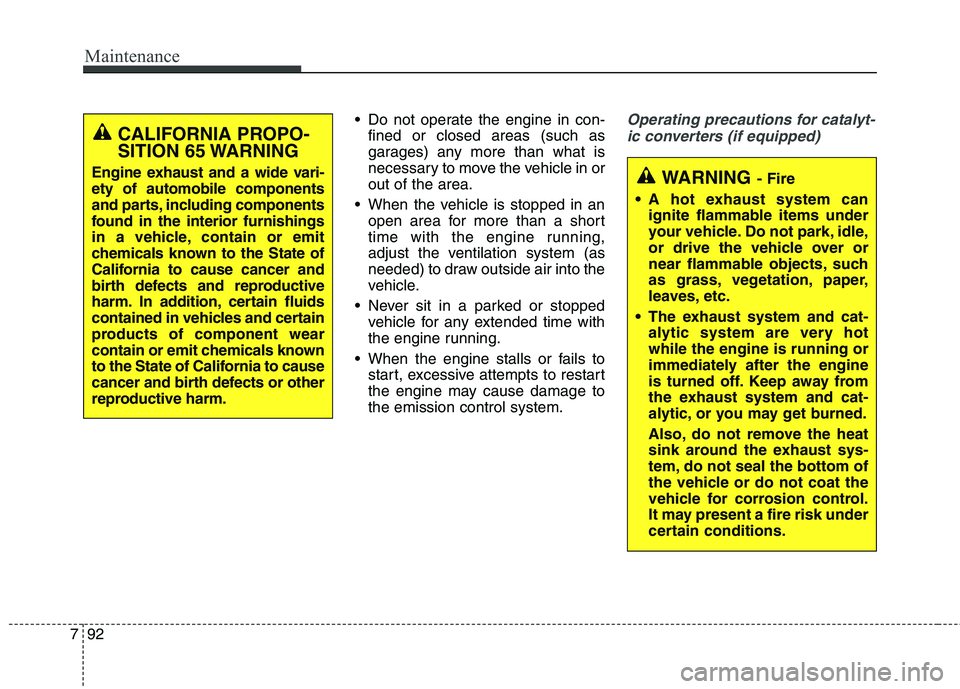
CALIFORNIA PROPO-
SITION 65 WARNING
Engine exhaust and a wide vari-
ety of automobile components
and parts, including components
found in the interior furnishings
in a vehicle, contain or emit
chemicals known to the State of
California to cause cancer and
birth defects and reproductive
harm. In addition, certain fluids
contained in vehicles and certain
products of component wear
contain or emit chemicals known
to the State of California to cause
cancer and birth defects or other
reproductive harm.WARNING- Fire
A hot exhaust system can
ignite flammable items under
your vehicle. Do not park, idle,
or drive the vehicle over or
near flammable objects, such
as grass, vegetation, paper,
leaves, etc.
The exhaust system and cat-
alytic system are very hot
while the engine is running or
immediately after the engine
is turned off. Keep away from
the exhaust system and cat-
alytic, or you may get burned.
Also, do not remove the heat
sink around the exhaust sys-
tem, do not seal the bottom of
the vehicle or do not coat the
vehicle for corrosion control.
It may present a fire risk under
certain conditions.
Page 461 of 476
87
Specifications, Consumer information, Reporting safety defects
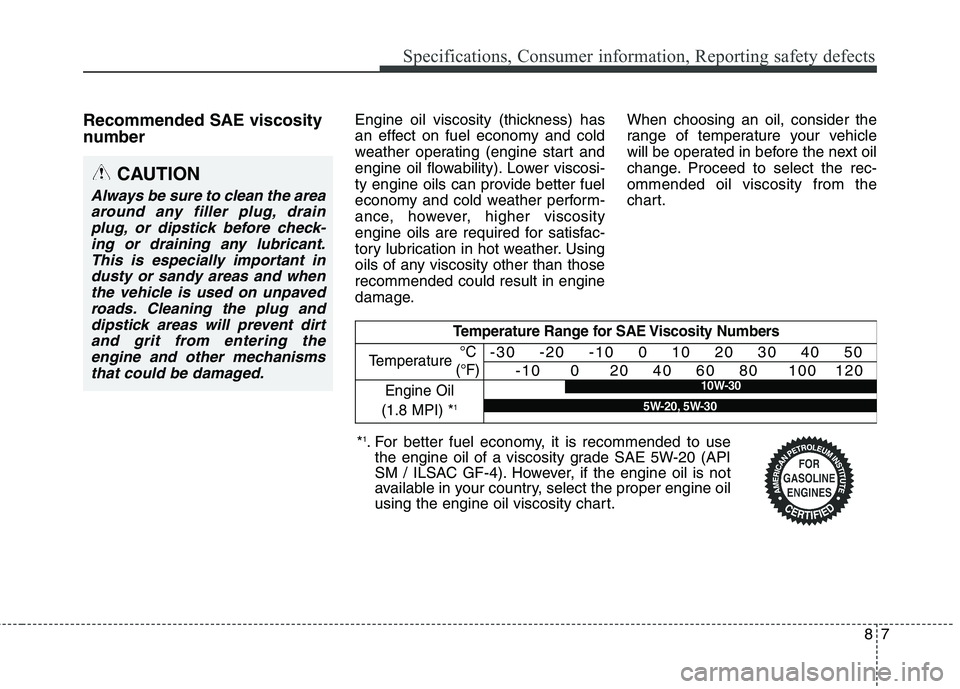
Recommended SAE viscosity
numberEngine oil viscosity (thickness) has
an effect on fuel economy and cold
weather operating (engine start and
engine oil flowability). Lower viscosi-
ty engine oils can provide better fuel
economy and cold weather perform-
ance, however, higher viscosity
engine oils are required for satisfac-
tory lubrication in hot weather. Using
oils of any viscosity other than those
recommended could result in engine
damage.When choosing an oil, consider the
range of temperature your vehicle
will be operated in before the next oil
change. Proceed to select the rec-
ommended oil viscosity from the
chart.
CAUTION
Always be sure to clean the area
around any filler plug, drain
plug, or dipstick before check-
ing or draining any lubricant.
This is especially important in
dusty or sandy areas and when
the vehicle is used on unpaved
roads. Cleaning the plug and
dipstick areas will prevent dirt
and grit from entering the
engine and other mechanisms
that could be damaged.
*1. For better fuel economy, it is recommended to use
the engine oil of a viscosity grade SAE 5W-20 (API
SM / ILSAC GF-4). However, if the engine oil is not
available in your country, select the proper engine oil
using the engine oil viscosity chart.
Temperature Range for SAE Viscosity Numbers
Temperature -30 -20 -10 0 10 20 30 40 50
-10 0 20 40 60 80 100 120
Engine Oil
(1.8 MPI) *1
10W-30
5W-20, 5W-30
°C
(°F)
Page 475 of 476
I9
Index
Tachometer ....................................................................4-57
Tailgate ..........................................................................4-25
Tether anchor system ....................................................3-34
Theft-alarm system........................................................4-17
Tilt steering ..................................................................4-44
Tire and loading information label ..............................5-58
Tire chains ....................................................................5-55
Tire pressure monitoring system (TPMS) ......................6-9
Tire specification and pressure label ..............................8-9
Tires and wheels............................................................7-44
Checking tire inflation pressure ................................7-45
Compact spare tire replacement ................................7-49
Recommended cold tire inflation pressures ..............7-44
Tire care ......................................................................7-44
Tire maintenance ........................................................7-49
Tire replacement ........................................................7-48
Tire rotation ................................................................7-46
Tire sidewall labeling ................................................7-50
Tire traction ................................................................7-49
Wheel alignment and tire balance ..............................7-47
Wheel replacement ....................................................7-49
Tires and wheels..............................................................8-4
Towing ..........................................................................6-22
Towing capacity ............................................................5-59
Trailer towing ................................................................5-64Transaxle
Automatic transaxle....................................................5-17
Manual transaxle ........................................................5-14
Trip computer ................................................................4-61
Automatic transaxle shift position indicator ..............4-60
Manual transaxle shift indicator ................................4-60
Outside temperature ..................................................4-60
Vehicle break-in process ................................................1-5
Vehicle capacity weight ................................................5-58
Vehicle certification label................................................8-8
Vehicle curb weight ......................................................5-63
Vehicle data collection and event data recorders ............1-6
Vehicle identification number (VIN) ..............................8-8
Vehicle load limit ..........................................................5-58
Cargo capacity ............................................................5-59
Certification label ......................................................5-61
Seating capacity..........................................................5-58
Steps For Determining Correct Load Limit ..............5-59
Tire and loading information label ............................5-58
Towing capacity..........................................................5-59
Vehicle capacity weight..............................................5-58
Vehicle stability management ......................................5-38
Vehicle weight ..............................................................5-63
Base curb weight ........................................................5-63
Cargo weight ..............................................................5-63
T
V