tires HYUNDAI ELANTRA GT 2014 Owner's Guide
[x] Cancel search | Manufacturer: HYUNDAI, Model Year: 2014, Model line: ELANTRA GT, Model: HYUNDAI ELANTRA GT 2014Pages: 476, PDF Size: 31.71 MB
Page 411 of 476
Maintenance
50 7
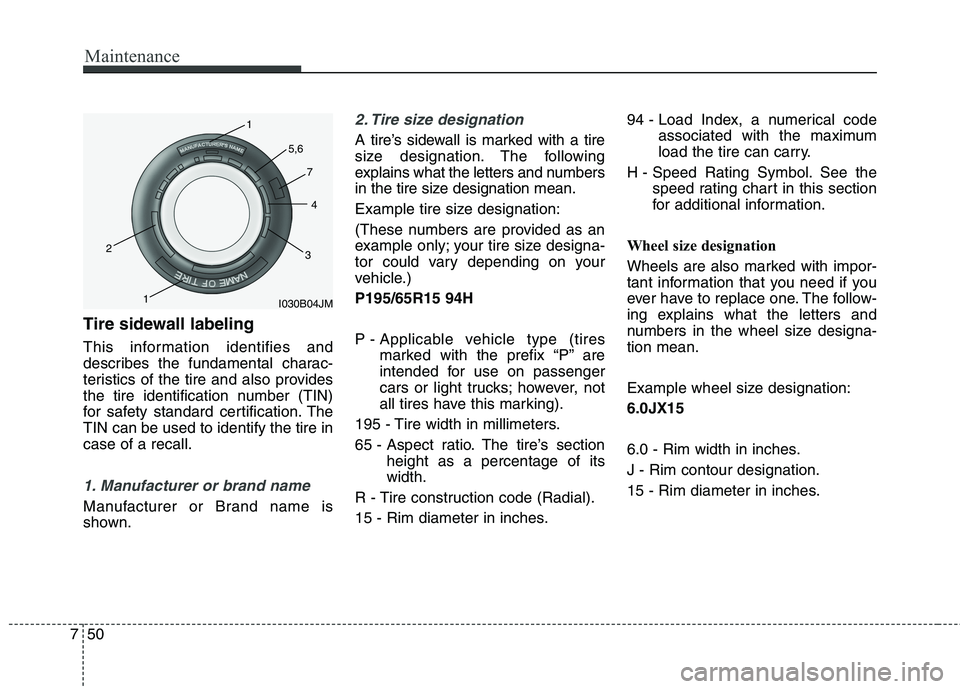
Tire sidewall labeling
This information identifies and
describes the fundamental charac-
teristics of the tire and also provides
the tire identification number (TIN)
for safety standard certification. The
TIN can be used to identify the tire in
case of a recall.
1. Manufacturer or brand name
Manufacturer or Brand name is
shown.
2. Tire size designation
A tire’s sidewall is marked with a tire
size designation. The following
explains what the letters and numbers
in the tire size designation mean.
Example tire size designation:
(These numbers are provided as an
example only; your tire size designa-
tor could vary depending on your
vehicle.)
P195/65R15 94H
P - Applicable vehicle type (tires
marked with the prefix “P’’ are
intended for use on passenger
cars or light trucks; however, not
all tires have this marking).
195 - Tire width in millimeters.
65 - Aspect ratio. The tire’s section
height as a percentage of its
width.
R - Tire construction code (Radial).
15 - Rim diameter in inches.94 - Load Index, a numerical code
associated with the maximum
load the tire can carry.
H - Speed Rating Symbol. See the
speed rating chart in this section
for additional information.
Wheel size designation
Wheels are also marked with impor-
tant information that you need if you
ever have to replace one. The follow-
ing explains what the letters and
numbers in the wheel size designa-
tion mean.
Example wheel size designation:
6.0JX15
6.0 - Rim width in inches.
J - Rim contour designation.
15 - Rim diameter in inches.
I030B04JM 1
1 2
34 5,6
7
Page 412 of 476
751
Maintenance
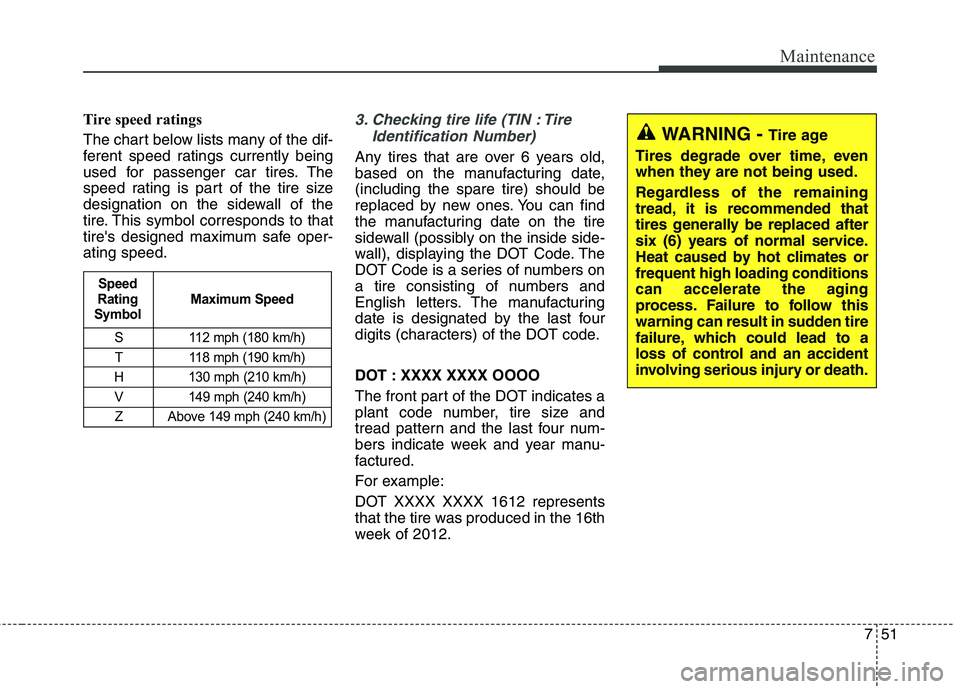
Tire speed ratings
The chart below lists many of the dif-
ferent speed ratings currently being
used for passenger car tires. The
speed rating is part of the tire size
designation on the sidewall of the
tire. This symbol corresponds to that
tire's designed maximum safe oper-
ating speed.3. Checking tire life (TIN : Tire
Identification Number)
Any tires that are over 6 years old,
based on the manufacturing date,
(including the spare tire) should be
replaced by new ones. You can find
the manufacturing date on the tire
sidewall (possibly on the inside side-
wall), displaying the DOT Code. The
DOT Code is a series of numbers on
a tire consisting of numbers and
English letters. The manufacturing
date is designated by the last four
digits (characters) of the DOT code.
DOT : XXXX XXXX OOOO
The front part of the DOT indicates a
plant code number, tire size and
tread pattern and the last four num-
bers indicate week and year manu-
factured.
For example:
DOT XXXX XXXX 1612 represents
that the tire was produced in the 16th
week of 2012.
S 112 mph (180 km/h)
T 118 mph (190 km/h)
H 130 mph (210 km/h)
V 149 mph (240 km/h)
Z Above 149 mph (240 km/h)
Maximum Speed Speed
Rating
Symbol
WARNING - Tire age
Tires degrade over time, even
when they are not being used.
Regardless of the remaining
tread, it is recommended that
tires generally be replaced after
six (6) years of normal service.
Heat caused by hot climates or
frequent high loading conditions
can accelerate the aging
process. Failure to follow this
warning can result in sudden tire
failure, which could lead to a
loss of control and an accident
involving serious injury or death.
Page 413 of 476
Maintenance
52 7
4. Tire ply composition and mate-
rial
The number of layers or plies of rub-
ber-coated fabric in the tire. Tire man-
ufacturers also must indicate the
materials in the tire, which include
steel, nylon, polyester, and others. The
letter "R" means radial ply construc-
tion; the letter "D" means diagonal or
bias ply construction; and the letter "B"
means belted-bias ply construction.
5. Maximum permissible inflation
pressure
This number is the greatest amount
of air pressure that should be put in
the tire. Do not exceed the maximum
permissible inflation pressure. Refer
to the Tire and Loading Information
label for recommended inflation
pressure.
6. Maximum load rating
This number indicates the maximum
load in kilograms and pounds that
can be carried by the tire. When
replacing the tires on the vehicle,
always use a tire that has the same
load rating as the factory installed
tire.
7. Uniform tire quality grading
Quality grades can be found where
applicable on the tire sidewall
between tread shoulder and maxi-
mum section width.
For example: TREAD WEAR 200
TRACTION AA
TEMPERATURE ATread wear
The tread wear grade is a compara-
tive rating based on the wear rate of
the tire when tested under controlled
conditions on a specified govern-
ment test course. For example, a tire
graded 150 would wear one-and-a-
half times (1½) as well on the gov-
ernment course as a tire graded 100.
The relative performance of tires
depends upon the actual conditions
of their use, however, and may
depart significantly from the norm
due to variations in driving habits,
service practices and differences in
road characteristics and climate.
These grades are molded on the
side-walls of passenger vehicle tires.
The tires available as standard or
optional equipment on your vehicle
may vary with respect to grade.
Page 414 of 476
753
Maintenance
Traction - AA, A, B & C
The traction grades, from highest to
lowest, are AA, A, B and C. Those
grades represent the tire’s ability to
stop on wet pavement as measured
under controlled conditions on spec-
ified government test surfaces of
asphalt and concrete. A tire marked
C may have poor wet traction per-
formance.Temperature -A, B & C
The temperature grades are A (the
highest), B and C representing the
tire’s resistance to the generation of
heat and its ability to dissipate heat
when tested under controlled condi-
tions on a specified indoor laboratory
test wheel.
Sustained high temperature can
cause the material of the tire to
degenerate and reduce tire life, and
excessive temperature can lead to
sudden tire failure. The grade C cor-
responds to a level of performance
which all passenger car tires must
meet under the Federal Motor
Vehicle Safety Standard No. 109.
Grades B and A represent higher
levels of performance on the labora-
tory test wheel than the minimum
required by law.
WARNING - Tire
temperature
The temperature grade for this
tire is established for a tire that
is properly inflated and not
overloaded. Excessive speed,
underinflation, or excessive
loading, either separately or in
combination, can cause heat
build-up and possible sudden
tire failure. This can cause loss
of vehicle control and serious
injury or death.
WARNING
The traction grade assigned to
this tire is based on straight-
ahead braking traction tests,
and does not include accelera-
tion, cornering, hydroplaning,
or peak traction characteristics.
Page 417 of 476
Maintenance
56 7
All season tires
HYUNDAI specifies all season tires
on some models to provide good
performance for use all year round,
including snowy and icy road condi-
tions. All season tires are identified
by ALL SEASON and/or M+S (Mud
and Snow) on the tire sidewall. Snow
tires have better snow traction than
all season tires and may be more
appropriate in some areas.
Summer tires
HYUNDAI specifies summer tires on
some models to provide superior
performance on dry roads. Summer
tire performance is substantially
reduced in snow and ice. Summer
tires do not have the tire traction rat-
ing M+S (Mud and Snow) on the tire
side wall. if you plan to operate your
vehicle in snowy or icy conditions.
HYUNDAI recommends the use of
snow tires or all season tires on all
four wheels.
Snow tires
If you equip your car with snow tires,
they should be the same size and
have the same load capacity as the
original tires. Snow tires should be
installed on all four wheels; other-
wise, poor handling may result.
Snow tires should carry 4 psi (28
kPa) more air pressure than the
pressure recommended for the stan-
dard tires on the tire label on the dri-
ver's side of the center pillar, or up to
the maximum pressure shown on the
tire sidewall, whichever is less.Do not drive faster than 75 mph (120
km/h) when your car is equipped with
snow tires.
Tire chains
Tire chains, if necessary, should be
installed on the front wheels.
Be sure that the chains are installed
in accordance with the manufactur-
er's instructions.
To minimize tire and chain wear, do
not continue to use tire chains when
they are no longer needed.
CAUTION
Since the sidewalls of radial
tires are thinner, they can be
damaged by mounting some
types of snow chains on them.
Therefore, the use of snow tires
is recommended instead of
snow chains.
Page 418 of 476
757
Maintenance
Radial-ply tires
Radial-ply tires provide improved
tread life, road hazard resistance and
smoother high speed ride. The radi-
al-ply tires used on this vehicle are of
belted construction, and are selected
to complement the ride and handling
characteristics of your vehicle.
Radial-ply tires have the same load
carrying capacity, as bias-ply or bias
belted tires of the same size, and use
the same recommended inflation
pressure. Mixing of radial-ply tires
with bias-ply or bias belted tires is
not recommended. Any combina-
tions of radial-ply and bias-ply or bias
belted tires when used on the same
vehicle will seriously deteriorate
vehicle handling. The best rule to fol-
low is: Identical radial-ply tires should
always be used as a set of four.Longer wearing tires can be more
susceptible to irregular tread wear. It
is very important to follow the tire
rotation interval shown in this section
to achieve the tread life potential of
these tires. Cuts and punctures in
radial-ply tires are repairable only in
the tread area, because of sidewall
flexing. Consult your tire dealer for
radial-ply tire repairs.WARNING - Snow or ice
When driving on roads cov-
ered with snow or ice, drive at
less than 20 mph (30 km/h).
Use the SAE “S” class or wire
chains.
If you hear noise caused by
chains contacting the body,
retighten the chain to avoid
contact with the vehicle body.
To prevent body damage,
retighten the chains after driv-
ing 0.3~0.6 miles (0.5~1.0 km).
Do not use tire chains on
vehicles equipped with alu-
minum wheels. In unavoidable
circumstance, use a wire type
chain.
Use wire chains less than 0.59
inches (15 mm) to prevent
damage to the chain’s con-
nection.
Page 455 of 476

Specifications, Consumer information and Reporting safety defects
Engine ........................................................................8-2
Dimensions ................................................................8-2
Bulb wattage ..............................................................8-3
Tires and wheels ........................................................8-4
Capacity/Weight ........................................................8-4
Recommended lubricants and capacities ................8-5
Vehicle identification number (VIN) ......................8-8
Vehicle certification label..........................................8-8
Tire specification and pressure label ......................8-9
Engine number ..........................................................8-9
Refrigerant label........................................................8-9
Consumer information............................................8-10
Reporting safety defects..........................................8-12
Binding arbitration (U.S.A only) ..........................8-12
8
Page 458 of 476

Specifications, Consumer information, Reporting safety defects
4 8
TIRES AND WHEELS
*1Normal load : Up to 3 persons
CAUTION
When replacing tires, use the same size originally supplied with the vehicle.
Using tires of a different size can damage the related parts or make it work irregularly.
CAPACITY/WEIGHT
Item Specification
Gross vehicle weight
lbs. (kg)4,056 (1,840)
Luggage volume
cu ft (l)Min. 13.3 (378)
Max. 46.5 (1,316)
ItemTire sizeWheel size
Inflation pressure psi (kPa)Wheel lug nut torque
Normal load *1Maximum load
FrontRearFrontRear
Full size tireP205/55 R166.5J×1632 (220)32 (220)32 (220)32 (220)
65~79
(9~11, 88~107)P215/45 R177.0J×1732 (220)32 (220)32 (220)32 (220)
Compact
spare tire
(if equipped)T125/80D154.0T×15
60 (420)60 (420)60 (420)60 (420)
T125/80D164.0T×16
Page 463 of 476

89
Specifications, Consumer information, Reporting safety defects
The tires supplied on your new vehi-
cle are chosen to provide the best
performance for normal driving.
The tire label located on the driver's
side center pillar gives the tire pres-
sures recommended for your car.The engine number is stamped on
the engine block as shown in the
drawing.The refrigerant label is located on
the underside of the hood.
The label contains the following infor-
mation:
Type of refrigerant
Amout of refrigerant
TIRE SPECIFICATION AND
PRESSURE LABEL
OMD060012NOMD070054N
REFRIGERANT LABEL
ENGINE NUMBER
OGD082009
Page 469 of 476
I3
Index
California perchlorate notice ........................................7-93
Capacities (Lubricants) ..................................................8-5
Care
Exterior care ..............................................................7-83
Interior care ................................................................7-89
Tire care ......................................................................7-44
Cargo area cover..........................................................4-126
Cargo capacity ..............................................................5-59
Cargo weight ................................................................5-63
Center console storage ................................................4-117
Central door lock switch ..............................................4-22
Certification label ..........................................................5-61
Certification label ............................................................8-8
Chains
Tire chains ..................................................................5-55
Changing tires ..............................................................6-15
Checking tire inflation pressure ....................................7-45
Child restraint system....................................................3-29
Lower anchor..............................................................3-36
Seat belt ......................................................................3-32
Tether anchor system..................................................3-34
Child-protector rear door lock ......................................4-24
Climate control air filter..............................................4-105
Climate control air filter................................................7-36
Clothes hanger ............................................................4-124
Combined instrument, see instrument cluster ..............4-56Compact spare tire ........................................................6-20
Compact spare tire replacement ....................................7-49
Consumer information ..................................................8-10
Cool box ......................................................................4-118
Coolant ..........................................................................7-29
Cooling fluid, see engine coolant ................................7-29
Crankcase emission control system ..............................7-90
Crankcase emission control system ..............................7-90
Cruise control system ....................................................5-41
Cup holder ..................................................................4-121
Curtain air bag ..............................................................3-57
Dashboard illumination,
see instrument panel illumination ..............................4-57
Dashboard, see instrument cluster ................................4-56
Daytime running light ..................................................4-84
Defogging (Windshield)..............................................4-113
Defroster (Rear window) ..............................................4-96
Defrosting (Windshield)..............................................4-113
Dimensions ......................................................................8-2
Display illumination,
see instrument panel illumination ..............................4-57
Displays, see instrument cluster....................................4-56
Door locks ....................................................................4-21
Central door lock switch ............................................4-22
Child-protector rear door lock....................................4-24
C
D